US Facial Cleanser Market Report: Trends, Growth and Forecast (2026-2032)
By Product Type (Gel Cleanser, Foam Cleanser, Cream Cleanser, Liquid Cleanser, Oil Cleanser, Balm Cleanser, Micellar Cleanser, Powder/Bar Cleanser), By Skin Type (Oily & Acne-Prone Skin, Dry Skin, Sensitive Skin, Combination Skin, Normal Skin), By Ingredient (Conventional, Natural/Organic, Sulfate-Free, Fragrance-Free, Medicated/Active-Based), By Consumer Group (Women, Men, Unisex, Teen), By Distribution Channel (Retail Offline (Supermarkets/Hypermarkets, Pharmacies/Drug Stores, Specialty Beauty Stores, Department Stores), Retail Online (E-commerce Platforms, Brand-Owned Websites (D2C), Online Beauty Retailers)), By Price Point (Mass, Premium, Luxury), By Region (West, Midwest, South, North, Northeast) ... Read more
|
Major Players
|
US Facial Cleanser Market Statistics and Insights, 2026
- Market Size Statistics
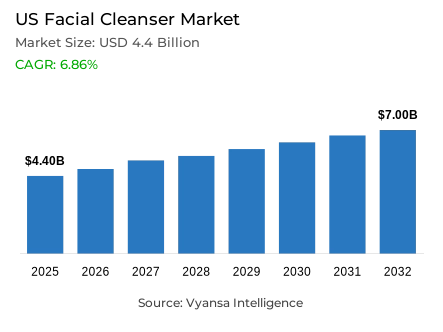
- Facial cleanser market size in US was valued at USD 4.4 billion in 2025 and is estimated at USD 4.7 billion in 2026.
- The market size is expected to grow to USD 7 billion by 2032.
- Market to register a CAGR of around 6.86% during 2026-32.
- Product Type Shares
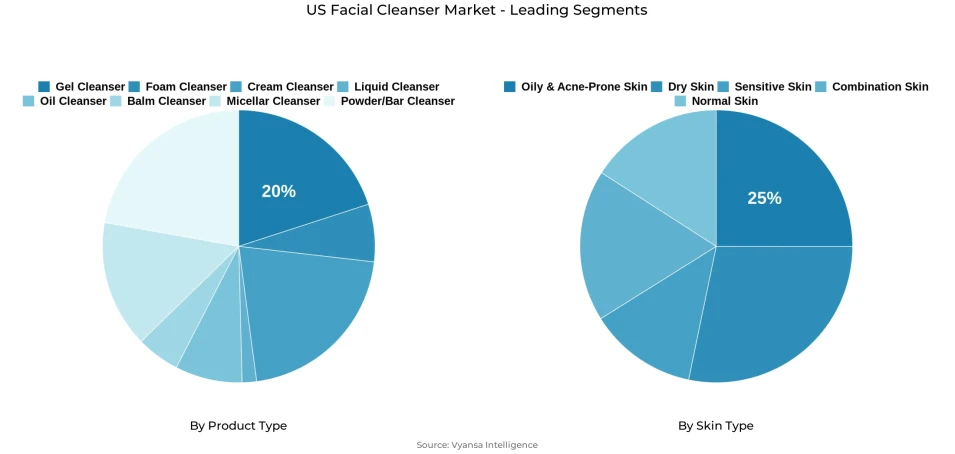
- Gel cleanser grabbed market share of 20%.
- Competition
- More than 10 companies are actively engaged in producing facial cleanser in US.
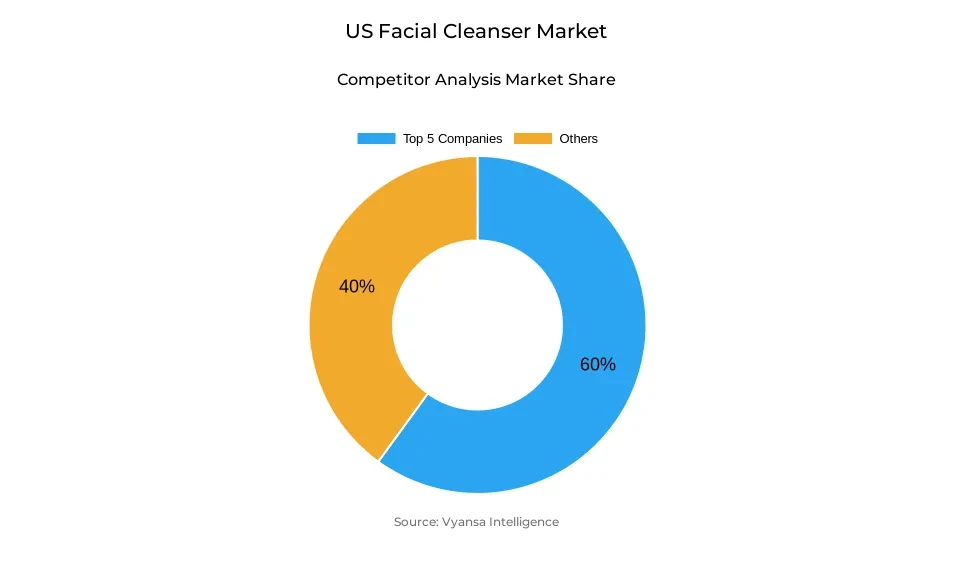
- Top 5 companies acquired around 60% of the market share.
- The Estee Lauder Companies, Beiersdorf, e.l.f. Beauty, L’Oreal, Kenvue etc., are few of the top companies.
- Skin Type
- Oily & acne-prone skin grabbed 25% of the market.
US Facial Cleanser Market Outlook
Valued at USD 4.4 billion in 2025, the US facial cleanser market reaches an estimated USD 4.7 billion in 2026 and is expected to climb to USD 7 billion by 2032. This reflects a CAGR of around 6.86% during 2026-32. The outlook remains supported by steady daily-use demand, as facial cleansing in the United States is closely linked to skin comfort, barrier care, and concern-based routines rather than only appearance-led usage.
Growth in the US facial cleanser market is supported by a large consumer base dealing with skin sensitivity, dryness, and allergy-linked skin discomfort. Centers for Disease Control and Prevention (CDC) data for 2024 shows that 31.7% of US adults have a diagnosed seasonal allergy, eczema, or food allergy, while 7.7% of adults and 12.7% of children have diagnosed eczema. Gel cleanser holds 20% share, while oily & acne-prone skin accounts for 25%, reflecting continued preference for fresh-feel cleansing formats and daily purification support.
At the same time, the US facial cleanser market remains influenced by pricing pressure and comparison-led purchasing behavior. The Bureau of Labor Statistics indicates that CPI trends continue to affect consumer sentiment, while product-level pricing remains visible across personal care categories. Despite this, digital discovery continues to strengthen the US facial cleanser market, with US retail e-commerce sales reaching USD 1,233.7 billion in 2025 and accounting for 16.4% of total retail sales.
The outlook also benefits from the growing role of personalized and digitally guided skin-care selection. The content states that HHS releases its AI Strategy in December 2025, publishes its FY25 AI Use Case Inventory, and frames the strategy around five pillars, showing that AI-led decision support is becoming more normal across the wider U.S. care ecosystem. This creates room for facial cleanser brands to build stronger personalization through skin quizzes, routine builders, and ingredient-matching tools. As online comparison, concern-based shopping, and targeted guidance continue to gain importance, the category remains well placed for everyday use, stronger conversion, and more tailored product positioning.
US Facial Cleanser Market Growth Driver
Rising Need for Gentle Daily Skin Care
The US facial cleanser market remains relevant because a large consumer base continues to live with skin sensitivity, dryness, and allergy-linked skin discomfort. This keeps the US facial cleanser market closely tied to skin comfort, barrier care, and routine-led use rather than only appearance-based demand. CDC data for 2024 shows that 31.7% of US adults have a diagnosed seasonal allergy, eczema, or food allergy. The same CDC release also shows that 7.7% of adults and 12.7% of children have diagnosed eczema. National Institute of Allergy and Infectious Diseases (NIAID) describes eczema as the most common chronic inflammatory skin disease and states that it occurs in 10% to 30% of children and 2% to 10% of adults in the United States. These indicators continue to support demand across the facial skincare products market and strengthen the role of daily facial cleansing solutions in everyday skin management.
This demand pattern supports the US facial cleanser market because consumers with reactive, dry, or irritation-prone skin generally seek products that remove oil, sweat, sunscreen, and pollution without leaving the skin tighter or rougher. In practical terms, this keeps usage frequent and routine-driven across age groups, supporting broader growth in the skin cleansing products industry. As a result, the US facial cleanser market benefits from steady interest in mild, skin-type-specific, and dermatologist-recommended cleansers that fit daily care rather than occasional use. This pattern also reinforces dermocosmetic cleanser demand and supports the sensitive skin facial cleanser segment, where gentleness, skin balance, and barrier-friendly performance remain central to purchasing decisions.
US Facial Cleanser Market Challenge
Value Pressure Keeps Upgrading Decisions Careful
Household budgets remain an important restraint for discretionary personal care purchases in the United States, and that continues to shape the US facial cleanser market. The Bureau of Labor Statistics reports that the overall CPI rises 2.4% year over year in February 2026, while the personal care index rises 4.5% over the same period. In March 2026, overall CPI moves up to 3.3% year over year, even though the personal care index declines 0.5% month on month. This mix shows that consumers continue to face broader cost pressure while category pricing remains visible enough to influence shopping behavior. As a result, the US facial cleanser market remains sensitive to affordability concerns, even though it falls within the frequently used beauty and skincare cleansing products category.
That pricing backdrop affects the US facial cleanser market because many buyers postpone premium upgrades, shift to familiar mass brands, or purchase larger value packs when they become more price aware. The category is used often, but it is also easy to compare across claims, pack sizes, and price points, making the US facial cleanser market highly responsive to value-based decision-making. This keeps premium vs mass facial cleanser market analysis highly relevant. It also increases pressure on brands to justify pricing through clearer ingredient stories, improved skin-feel, and visible benefits such as hydration, acne support, and gentleness. In this context, sulfate-free facial cleanser market offerings, paraben-free skincare products demand, and organic and natural facial cleanser trends play an increasingly important role in influencing purchasing decisions.
Unlock Market Intelligence
Explore the market potential with our data-driven report
US Facial Cleanser Market Trend
Online Discovery Is Reshaping Purchase Behavior
Digital commerce is becoming more central to how US consumers discover and purchase cleansing products, which is steadily reshaping the US facial cleanser market. The US Census Bureau estimates that total US retail e-commerce sales reach USD 1,233.7 billion in 2025, up 5.4% from 2024, while accounting for 16.4% of total retail sales. In the fourth quarter of 2025, adjusted retail e-commerce sales reach USD 316.1 billion and account for 16.6% of total retail sales. These figures highlight the growing influence of online channels across the US facial cleanser market, particularly within the e-commerce facial cleanser market and broader online skincare product sales growth landscape.
This shift reinforces a strong trend in the US facial cleanser market, as the category remains highly comparison-driven. Buyers actively review ingredient transparency, dermatologist messaging, user ratings, and product claims before making purchase decisions. As online retail expands, brands operating in the US facial cleanser market gain more opportunities to influence buying behavior through educational content, bundles, and direct-to-consumer (DTC) beauty brands strategies. This aligns with evolving retail skincare distribution trends and the continued relevance of pharmacy skincare product sales, while also strengthening facial cleanser market by distribution channel (online/offline) dynamics.
US Facial Cleanser Market Opportunity
AI-Led Personalization Creates New Room for Premiumization
Artificial intelligence is becoming more visible across the US health and wellness ecosystem, creating new growth pathways for the US facial cleanser market. HHS released its AI Strategy in December 2025 and stated that AI is being integrated across internal operations, research, and public health. HHS also published its FY25 AI use case inventory, reviewed in January 2026, structured around five pillars. These developments indicate that AI-led decision support is becoming more common across the broader care environment, which strengthens the future relevance of the US facial cleanser market, particularly in the context of AI-driven skincare personalization.
This creates a strong opportunity within the US facial cleanser market, as personalization tools, skin quizzes, routine builders, and ingredient-matching systems gain consumer trust. In a category where product selection depends heavily on skin type, sensitivity, and specific concerns, enhanced digital guidance can support higher conversion and stronger product alignment. The US facial cleanser market therefore benefits from growing interest by skin type (oily, dry, sensitive), anti-acne facial cleanser market insights, and best facial cleanser trends in skincare industry. These developments also contribute to product innovation in facial cleansers and strengthen long-term market penetration strategies skincare brands adopt to differentiate offerings.
Unlock Market Intelligence
Explore the market potential with our data-driven report
US Facial Cleanser Market Segmentation Analysis
By Product Type
- Gel Cleanser
- Foam Cleanser
- Cream Cleanser
- Liquid Cleanser
- Oil Cleanser
- Balm Cleanser
- Micellar Cleanser
- Powder/Bar Cleanser
The segment with the highest share under the product type category is gel cleanser, accounting for 20% of the market. This leading position shows that gel-based formats have built strong acceptance among US consumers because they are widely seen as practical, lightweight, and easy to use in daily skin care routines. Gel cleansers are often preferred for their fresh skin feel and their ability to remove excess oil, dirt, sweat, and product buildup without leaving a heavy residue. That makes them suitable for consumers who want an effective cleansing step that feels simple and fast in both morning and evening use.
This share also reflects the broad appeal of gel cleansers across different age groups and usage occasions. They fit well with modern skin care preferences where consumers look for products that feel clean, non-greasy, and easy to rinse. Their positioning also works strongly in categories linked to deep cleansing, everyday freshness, and routine-based facial care. Because of this, gel cleansers continue to maintain the largest share within the product type landscape and remain an important format shaping product development, shelf presence, and brand competition across the category.
By Skin Type
- Oily & Acne-Prone Skin
- Dry Skin
- Sensitive Skin
- Combination Skin
- Normal Skin
Under the skin type category, oily & acne-prone skin holds the highest share, with 25% of the market. This leading share indicates that a notable portion of facial cleanser demand in the US is closely linked to concerns such as excess sebum, clogged pores, breakouts, and shine control. Consumers in this segment usually look for cleansers that support a cleaner skin feel, help remove excess oil, and fit into regular acne-care or blemish-control routines. As a result, demand remains concentrated in products that are positioned around balancing, purifying, and daily cleansing support.
Its strong share also shows that skin concern-driven purchasing plays a major role in this market. Buyers with oily and acne-prone skin are often more routine-focused and more active in comparing cleanser texture, ingredient profile, and expected performance before purchase. This makes the segment highly important for product positioning and communication. Because of that, oily and acne-prone skin continues to represent the most influential skin-type segment, helping shape innovation, marketing focus, and everyday usage demand across the facial cleanser category.
List of Companies Covered in US Facial Cleanser Market
The companies listed below are highly influential in the US facial cleanser market, with a significant market share and a strong impact on industry developments.
- The Estee Lauder Companies
- Beiersdorf
- e.l.f. Beauty
- L’Oreal
- Kenvue
- Galderma
- Procter & Gamble
- Unilever
- Coty
- Amorepacific
Market News & Updates
- Procter & Gamble, 2026:
In January 2026, Procter & Gamble highlighted OLAY Cleansing Melts on its official US corporate blog as a market-ready skincare innovation built from a decade of patented water-free science through collaboration across R&D, IT, and Product Supply, positioning the product as a new cleansing format within Olay’s skincare portfolio. For the US facial cleanser market, this is a significant verified update because it introduces a differentiated format in a mature category, supports premium and sustainability-led innovation in cleansing, and can push competing brands to expand beyond traditional liquid and gel cleansers as consumers look for convenience, portability, and new product experiences.
- Galderma, 2025:
In June 2025, Galderma announced on its official site the US launch of Cetaphil Nourishing Oil to Foam Cleanser, describing it as a breakthrough hydrating cleanser for sensitive skin that transforms from oil to foam and was developed to deliver a gentler yet effective cleansing experience without leaving skin dry or tight. For the US facial cleanser market, this is one of the strongest fully verified developments from the company set because it expands one of the country’s most established sensitive-skin cleansing franchises with a new format tailored to hydration-focused consumer demand, which can strengthen competition in dermatologist-led facial cleansing and support further premiumization in everyday sensitive-skin skincare routines.
Frequently Asked Questions
Related Report
- Market Segmentation
- Research Scope
- Research Methodology
- Definitions and Assumptions
- Executive Summary
- US Facial Cleanser Market Policies, Regulations, and Standards
- US Facial Cleanser Market Dynamics
- Growth Factors
- Challenges
- Trends
- Opportunities
- US Facial Cleanser Market Statistics, 2022-2032F
- Market Size & Growth Outlook
- By Revenues in USD Million
- Market Segmentation & Growth Outlook
- By Product Type
- Gel Cleanser- Market Insights and Forecast 2022-2032, USD Million
- Foam Cleanser- Market Insights and Forecast 2022-2032, USD Million
- Cream Cleanser- Market Insights and Forecast 2022-2032, USD Million
- Liquid Cleanser- Market Insights and Forecast 2022-2032, USD Million
- Oil Cleanser- Market Insights and Forecast 2022-2032, USD Million
- Balm Cleanser- Market Insights and Forecast 2022-2032, USD Million
- Micellar Cleanser- Market Insights and Forecast 2022-2032, USD Million
- Powder/Bar Cleanser- Market Insights and Forecast 2022-2032, USD Million
- By Skin Type
- Oily & Acne-Prone Skin- Market Insights and Forecast 2022-2032, USD Million
- Dry Skin- Market Insights and Forecast 2022-2032, USD Million
- Sensitive Skin- Market Insights and Forecast 2022-2032, USD Million
- Combination Skin- Market Insights and Forecast 2022-2032, USD Million
- Normal Skin- Market Insights and Forecast 2022-2032, USD Million
- By Ingredient
- Conventional- Market Insights and Forecast 2022-2032, USD Million
- Natural/Organic- Market Insights and Forecast 2022-2032, USD Million
- Sulfate-Free- Market Insights and Forecast 2022-2032, USD Million
- Fragrance-Free- Market Insights and Forecast 2022-2032, USD Million
- Medicated/Active-Based- Market Insights and Forecast 2022-2032, USD Million
- By Consumer Group
- Women- Market Insights and Forecast 2022-2032, USD Million
- Men- Market Insights and Forecast 2022-2032, USD Million
- Unisex- Market Insights and Forecast 2022-2032, USD Million
- Teen- Market Insights and Forecast 2022-2032, USD Million
- By Distribution Channel
- Retail Offline- Market Insights and Forecast 2022-2032, USD Million
- Supermarkets/Hypermarkets- Market Insights and Forecast 2022-2032, USD Million
- Pharmacies/Drug Stores- Market Insights and Forecast 2022-2032, USD Million
- Specialty Beauty Stores- Market Insights and Forecast 2022-2032, USD Million
- Department Stores- Market Insights and Forecast 2022-2032, USD Million
- Retail Online- Market Insights and Forecast 2022-2032, USD Million
- E-commerce Platforms- Market Insights and Forecast 2022-2032, USD Million
- Brand-Owned Websites (D2C)- Market Insights and Forecast 2022-2032, USD Million
- Online Beauty Retailers- Market Insights and Forecast 2022-2032, USD Million
- Retail Offline- Market Insights and Forecast 2022-2032, USD Million
- By Price Point
- Mass- Market Insights and Forecast 2022-2032, USD Million
- Premium- Market Insights and Forecast 2022-2032, USD Million
- Luxury- Market Insights and Forecast 2022-2032, USD Million
- By Region
- West- Market Insights and Forecast 2022-2032, USD Million
- Midwest- Market Insights and Forecast 2022-2032, USD Million
- South- Market Insights and Forecast 2022-2032, USD Million
- North- Market Insights and Forecast 2022-2032, USD Million
- Northeast- Market Insights and Forecast 2022-2032, USD Million
- By Competitors
- Competition Characteristics
- Market Share & Analysis
- By Product Type
- Market Size & Growth Outlook
- US Gel Cleanser Market Statistics, 2022-2032
- Market Size & Growth Outlook
- By Revenues in USD Million
- Market Segmentation & Growth Outlook
- By Skin Type- Market Insights and Forecast 2022-2032, USD Million
- By Ingredient- Market Insights and Forecast 2022-2032, USD Million
- By Consumer Group- Market Insights and Forecast 2022-2032, USD Million
- By Distribution Channel- Market Insights and Forecast 2022-2032, USD Million
- By Price Point- Market Insights and Forecast 2022-2032, USD Million
- By Region- Market Insights and Forecast 2022-2032, USD Million
- Market Size & Growth Outlook
- US Foam Cleanser Market Statistics, 2022-2032
- Market Size & Growth Outlook
- By Revenues in USD Million
- Market Segmentation & Growth Outlook
- By Skin Type- Market Insights and Forecast 2022-2032, USD Million
- By Ingredient- Market Insights and Forecast 2022-2032, USD Million
- By Consumer Group- Market Insights and Forecast 2022-2032, USD Million
- By Distribution Channel- Market Insights and Forecast 2022-2032, USD Million
- By Price Point- Market Insights and Forecast 2022-2032, USD Million
- By Region- Market Insights and Forecast 2022-2032, USD Million
- Market Size & Growth Outlook
- US Cream Cleanser Market Statistics, 2022-2032
- Market Size & Growth Outlook
- By Revenues in USD Million
- Market Segmentation & Growth Outlook
- By Skin Type- Market Insights and Forecast 2022-2032, USD Million
- By Ingredient- Market Insights and Forecast 2022-2032, USD Million
- By Consumer Group- Market Insights and Forecast 2022-2032, USD Million
- By Distribution Channel- Market Insights and Forecast 2022-2032, USD Million
- By Price Point- Market Insights and Forecast 2022-2032, USD Million
- By Region- Market Insights and Forecast 2022-2032, USD Million
- Market Size & Growth Outlook
- US Liquid Cleanser Market Statistics, 2022-2032
- Market Size & Growth Outlook
- By Revenues in USD Million
- Market Segmentation & Growth Outlook
- By Skin Type- Market Insights and Forecast 2022-2032, USD Million
- By Ingredient- Market Insights and Forecast 2022-2032, USD Million
- By Consumer Group- Market Insights and Forecast 2022-2032, USD Million
- By Distribution Channel- Market Insights and Forecast 2022-2032, USD Million
- By Price Point- Market Insights and Forecast 2022-2032, USD Million
- By Region- Market Insights and Forecast 2022-2032, USD Million
- Market Size & Growth Outlook
- US Oil Cleanser Market Statistics, 2022-2032
- Market Size & Growth Outlook
- By Revenues in USD Million
- Market Segmentation & Growth Outlook
- By Skin Type- Market Insights and Forecast 2022-2032, USD Million
- By Ingredient- Market Insights and Forecast 2022-2032, USD Million
- By Consumer Group- Market Insights and Forecast 2022-2032, USD Million
- By Distribution Channel- Market Insights and Forecast 2022-2032, USD Million
- By Price Point- Market Insights and Forecast 2022-2032, USD Million
- By Region- Market Insights and Forecast 2022-2032, USD Million
- Market Size & Growth Outlook
- US Balm Cleanser Market Statistics, 2022-2032
- Market Size & Growth Outlook
- By Revenues in USD Million
- Market Segmentation & Growth Outlook
- By Skin Type- Market Insights and Forecast 2022-2032, USD Million
- By Ingredient- Market Insights and Forecast 2022-2032, USD Million
- By Consumer Group- Market Insights and Forecast 2022-2032, USD Million
- By Distribution Channel- Market Insights and Forecast 2022-2032, USD Million
- By Price Point- Market Insights and Forecast 2022-2032, USD Million
- By Region- Market Insights and Forecast 2022-2032, USD Million
- Market Size & Growth Outlook
- US Micellar Cleanser Market Statistics, 2022-2032
- Market Size & Growth Outlook
- By Revenues in USD Million
- Market Segmentation & Growth Outlook
- By Skin Type- Market Insights and Forecast 2022-2032, USD Million
- By Ingredient- Market Insights and Forecast 2022-2032, USD Million
- By Consumer Group- Market Insights and Forecast 2022-2032, USD Million
- By Distribution Channel- Market Insights and Forecast 2022-2032, USD Million
- By Price Point- Market Insights and Forecast 2022-2032, USD Million
- By Region- Market Insights and Forecast 2022-2032, USD Million
- Market Size & Growth Outlook
- US Powder/Bar Cleanser Market Statistics, 2022-2032
- Market Size & Growth Outlook
- By Revenues in USD Million
- Market Segmentation & Growth Outlook
- By Skin Type- Market Insights and Forecast 2022-2032, USD Million
- By Ingredient- Market Insights and Forecast 2022-2032, USD Million
- By Consumer Group- Market Insights and Forecast 2022-2032, USD Million
- By Distribution Channel- Market Insights and Forecast 2022-2032, USD Million
- By Price Point- Market Insights and Forecast 2022-2032, USD Million
- By Region- Market Insights and Forecast 2022-2032, USD Million
- Market Size & Growth Outlook
- Competitive Outlook
- Company Profiles
- Powder/Bar Cleanser
- Business Description
- Product Portfolio
- Collaborations & Alliances
- Recent Developments
- Financial Details
- Others
- L’Oréal
- Business Description
- Product Portfolio
- Collaborations & Alliances
- Recent Developments
- Financial Details
- Others
- Kenvue
- Business Description
- Product Portfolio
- Collaborations & Alliances
- Recent Developments
- Financial Details
- Others
- Galderma
- Business Description
- Product Portfolio
- Collaborations & Alliances
- Recent Developments
- Financial Details
- Others
- Procter & Gamble
- Business Description
- Product Portfolio
- Collaborations & Alliances
- Recent Developments
- Financial Details
- Others
- Unilever
- Business Description
- Product Portfolio
- Collaborations & Alliances
- Recent Developments
- Financial Details
- Others
- The Estée Lauder Companies
- Business Description
- Product Portfolio
- Collaborations & Alliances
- Recent Developments
- Financial Details
- Others
- Beiersdorf
- Business Description
- Product Portfolio
- Collaborations & Alliances
- Recent Developments
- Financial Details
- Others
- e.l.f. Beauty
- Business Description
- Product Portfolio
- Collaborations & Alliances
- Recent Developments
- Financial Details
- Others
- Coty
- Business Description
- Product Portfolio
- Collaborations & Alliances
- Recent Developments
- Financial Details
- Others
- Powder/Bar Cleanser
- Company Profiles
- Disclaimer
| Segment | Sub-Segment |
|---|---|
| By Product Type |
|
| By Skin Type |
|
| By Ingredient |
|
| By Consumer Group |
|
| By Distribution Channel |
|
| By Price Point |
|
| By Region |
|
Research Methodology
This study followed a structured approach comprising four key phases to assess the size and scope of the electro-oxidation market. The process began with thorough secondary research to collect data on the target market, related markets, and broader industry context. These findings, along with preliminary assumptions and estimates, were then validated through extensive primary research involving industry experts from across the value chain. To calculate the overall market size, both top-down and bottom-up methodologies were employed. Finally, market segmentation and data triangulation techniques were applied to refine and validate segment-level estimations.
Secondary Research
The secondary research phase involved gathering data from a wide range of credible and published sources. This step helped in identifying industry trends, defining market segmentation, and understanding the market landscape and value chain.
Sources consulted during this phase included:
- Company annual reports, investor presentations, and press releases
- Industry white papers and certified publications
- Trade directories and market-recognized databases
- Articles from authoritative authors and reputable journals
- Gold and silver standard websites
Secondary research was critical in mapping out the industry's value chain and monetary flow, identifying key market segments, understanding regional variations, and tracking significant industry developments.
Other key sources:
- Financial disclosures
- Industry associations and trade bodies
- News outlets and business magazines
- Academic journals and research studies
- Paid industry databases
Primary Research
To validate secondary data and gain deeper market insights, primary research was conducted with key stakeholders across both the supply and demand sides of the market.
On the demand side, participants included decision-makers and influencers from end-user industries—such as CIOs, CTOs, and CSOs—who provided first-hand perspectives on market needs, product usage, and future expectations.
On the supply side, interviews were conducted with manufacturers, industry associations, and institutional participants to gather insights into current offerings, product pipelines, and market challenges.
Primary interviews provided critical inputs such as:
- Market size and revenue data
- Product and service breakdowns
- Market forecasts
- Regional and application-specific trends
Stakeholders consulted included:
- Leading OEM and solution providers
- Channel and distribution partners
- End users across various applications
- Independent consultants and industry specialists
Market Size Estimation and Data Triangulation
- Identifying Key Market Participants (Secondary Research)
- Goal: To identify the major players or companies in the target market. This typically involves using publicly available data sources such as industry reports, market research publications, and financial statements of companies.
- Tools: Reports from firms like Gartner, Forrester, Euromonitor, Statista, IBISWorld, and others. Public financial statements, news articles, and press releases from top market players.
- Extracting Earnings of Key Market Participants
- Goal: To estimate the earnings generated from the product or service being analyzed. This step helps in understanding the revenue potential of each market player in a specific geography.
- Methods: Earnings data can be gathered from:
- Publicly available financial reports (for listed companies).
- Interviews and primary data sources from professionals, such as Directors, VPs, SVPs, etc. This is especially useful for understanding more nuanced, internal data that isn't publicly disclosed.
- Annual reports and investor presentations of key players.
- Data Collation and Development of a Relevant Data Model
- Goal: To collate inputs from both primary and secondary sources into a structured, data-driven model for market estimation. This model will incorporate key market KPIs and any independent variables relevant to the market.
- Key KPIs: These could include:
- Market size, growth rate, and demand drivers.
- Industry-specific metrics like market share, average revenue per customer (ARPC), or average deal size.
- External variables, such as economic growth rates, inflation rates, or commodity prices, that could affect the market.
- Data Modeling: Based on this data, the market forecasts are developed for the next 5 years. A combination of trend analysis, scenario modeling, and statistical regression might be used to generate projections.
- Scenario Analysis
- Goal: To test different assumptions and validate how sensitive the market is to changes in key variables (e.g., market demand, regulatory changes, technological disruptions).
- Types of Scenarios:
- Base Case: Based on current assumptions and historical data.
- Best-Case Scenario: Assuming favorable market conditions, regulatory environments, and technological advancements.
- Worst-Case Scenario: Accounting for adverse factors, such as economic downturns, stricter regulations, or unexpected disruptions.












