UK Sleep Aids Market Report: Trends, Growth and Forecast (2026-2032)
By Product (Single Ingredient (Doxylamine Succinate, Diphenhydramine, Melatonin), Combination Ingredient (Diphenhydramine + Acetaminophen, Other Antihistamine-Based Combinations), Herbal & Traditional Sleep Aids (Valerian root, Passionflower, Chamomile, Kava, Multi-Herbal Sleep Blends)), By Sleep Disorder (Insomnia, Sleep Apnea, Restless Legs Syndrome, Narcolepsy, Sleep Walking, Others), By Age Group (Young to Mid Adults (25-44 Years), Middle-Aged Adults (45-64 Years), Geriatric Population (65+ Years)), By Sales Channel (Retail Online, Retail Offline), By End User (Homecare/Individual Consumers, Hospitals, Sleep Centers & Clinics), By Formulation (Tablets, Gummies, Capsules, Liquid, Sublingual), By Region (England, Wales, Scotland, Northern Ireland) ... Read more

|
Major Players
|
UK Sleep Aids Market Statistics and Insights, 2026
- Market Size Statistics
- Sleep aids market size in UK was estimated at USD 130 million in 2025.
- The market size is expected to grow to USD 150 million by 2032.
- Market to register a CAGR of around 2.07% during 2026-32.
- Product Shares
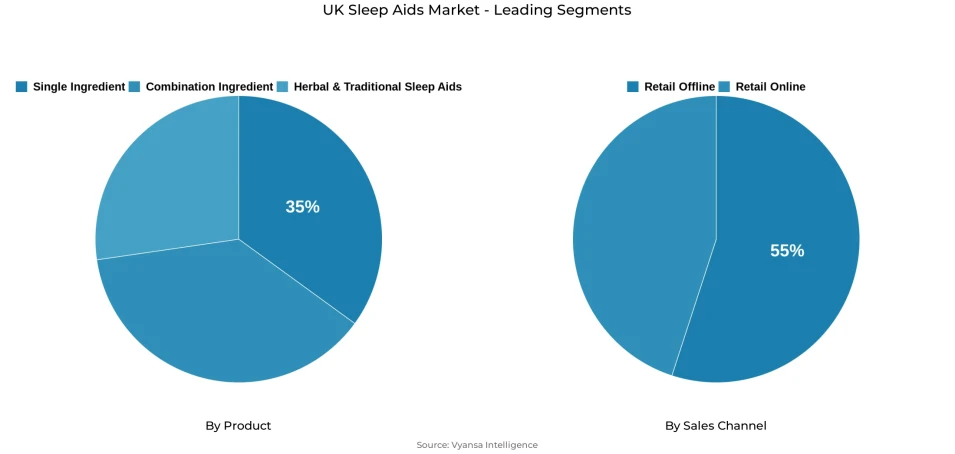
- Melatonin grabbed market share of 35%.
- Competition
- More than 5 companies are actively engaged in producing sleep aids in UK.
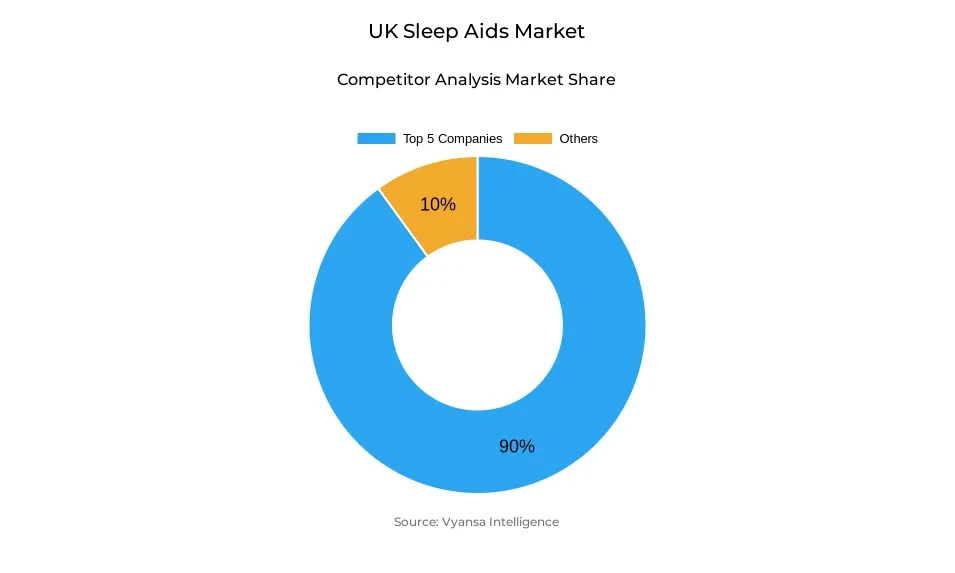
- Top 5 companies acquired around 90% of the market share.
- Boots UK Ltd, Actavis UK Ltd, Chefaro Proprietaries Ltd, Omega Pharma Ltd, Lane Health Products Ltd (GR) etc., are few of the top companies.
- Sales channel
- Retail offline grabbed 55% of the market.
UK Sleep Aids Market Outlook
The UK Sleep Aids Market size was valued at USD 130 million in 2025 and is projected to grow from USD 136.09 million in 2026 to USD 150 million by 2032, exhibiting a CAGR of 2.07% during the forecast period. This steady rise is driven by an aging population prone to sleep disorders and a shift toward hybrid working models that have disrupted traditional routines. As the cultural stigma around using pharmacological help fades, more end user are viewing these products as essential tools for managing the high stress and mental health challenges associated with modern British life.
The competitive landscape is currently led by Omega Pharma Ltd and its trusted Nytol brand, which offers a variety of traditional and herbal options. While melatonin has secured a 35% market share, there is a significant surge in demand for clean-label and plant-based sleep aids containing ingredients like valerian root and CBD. Retailer Boots is also gaining traction with its private label range, providing affordable alternatives for cost-conscious shoppers who still prioritize quality and effectiveness in their wellness routines.
Digital transformation is reshaping how end user interact with the industry, as brands begin to integrate smart supplements with wearable tech like Oura rings and Fitbits. These advancements allow for personalized dosing based on real-time data, making modern sleep aids more appealing to tech-savvy younger adults. Furthermore, the convenience of retail online platforms—offering subscription models and discreet home delivery—has made online shopping the largest distribution channel, providing a seamless experience for those seeking holistic health solutions.
Despite the digital shift, retail offline channels remain vital and currently account for 55% of the market. Supermarkets and pharmacies continue to be the primary choice for end user with immediate needs who value the professional advice of a pharmacist. As regulatory bodies like the MHRA tighten guidelines on health claims, manufacturers of various sleep aids must focus on transparent labeling and clinical validation to maintain end user trust while also adopting sustainable, eco-friendly packaging to meet the demands of an environmentally conscious public.
UK Sleep Aids Market Growth Driver
Hybrid Work and Wellness Make Sleep Support Routine
Hybrid work is changing the way people live and work, and the stress levels are on the rise. However, people are now considering sleep support a part of their daily wellness, not just a rare problem that needs a solution. Younger end user and those with a wellness mind-set are opting for clean and natural products, and this is creating a stronger trend towards over-the-counter sleep aids that are aligned with the holistic lifestyles of these end user.
According to the Office for National Statistics, in Great Britain, 28% of working adults were hybrid workers between January and March 2025, and this is creating a trend towards irregular work and sleep habits, thus creating a demand for sleep management products. Thus, the change in work habits is creating a trend towards sleep support products in the UK, and this trend is set to continue in the coming year.
UK Sleep Aids Market Challenge
Cost-of-Living Pressure Accelerates Private Label Switching
The cost of living is increasing, and this is creating a trend towards private labels in the sleep aids segment, though quality is also a critical consideration. However, the cost of living is forcing people to become increasingly price-sensitive, and this is creating a trend towards sleep support products, though the trend is also creating a demand for affordable sleep aids.
According to the Office for National Statistics, the CPI inflation in the year to December 2025 is 3.4%, and the inflation in food and non-alcoholic beverages is 4.5 in the year to December 2025. Thus, the cost of living is creating a trend towards sleep support products, and this trend is set to continue in the coming year.
Unlock Market Intelligence
Explore the market potential with our data-driven report
UK Sleep Aids Market Trend
Subscription-Led E-Commerce Strengthens Category Access
Retail online is becoming the new normal for how end user in the UK are discovering products online, providing a level of privacy, convenience, and access to niche wellness products that might not otherwise be available in physical stores. This trend is likely to strengthen the accessibility of sleep aids, particularly through auto-replenishment programs, which would encourage repeat business, especially among digitally native end user who are more inclined to use technology to shop rather than browsing physical stores.
According to the Office for National Statistics, online sales make up 28.3% of all retail sales in the UK, a trend that has been evident since December 2025, thus confirming a structural shift towards retail online-driven shopping, which would be a significant driver of sleep aids sales. This trend is likely to continue throughout the forecast period until 2032.
UK Sleep Aids Market Opportunity
Digital Health Ecosystems Enable Smarter Sleep Solutions
The rise of tech-enabled health solutions has created opportunities for more sophisticated solutions, particularly in the sleep aids market, where a regimen of supplements, wearables, and apps can be used to encourage better sleeping habits, including regular bedtimes. This would provide a level of sophistication, particularly in the UK market, where end user are more likely to engage in a regimen rather than a single remedy for addressing a particular health need.
According to NHS England, the NHS App has seen over 39 million registered users, with 67.8 million repeat prescriptions being generated via the app in the 12 months leading up to November 2025, thus demonstrating a level of confidence in health management solutions, which sleep aids can tap into, particularly throughout the forecast period until 2032.
Unlock Market Intelligence
Explore the market potential with our data-driven report
UK Sleep Aids Market Segmentation Analysis
By Product
- Single Ingredient
- Doxylamine Succinate
- Diphenhydramine
- Melatonin
- Combination Ingredient
- Diphenhydramine + Acetaminophen
- Other Antihistamine-Based Combinations
- Herbal & Traditional Sleep Aids
- Valerian root
- Passionflower
- Chamomile
- Kava
- Multi-Herbal Sleep Blends
The segment with highest market share under the active ingredient is Melatonin, holding approximately 35% of the total market. This leadership reflects strong end user preference for straightforward sleep support with familiar usage cues, and it underpins the strategies of established brands that offer melatonin lines alongside herbal variants to address both conventional and natural product preferences within the same end user base.
Melatonin's 35% share makes it the anchor ingredient around which brands compete through dosing format innovation, pack design differentiation, and trust-building marketing across both online and offline retail environments. As competition intensifies from herbal and botanical alternatives, clear dosage communication, credible safety positioning, and consistent brand messaging will remain the primary levers for sustaining melatonin's category leadership through 2032.
By Sales Channel
- Retail Online
- Retail Offline
The segment with highest market share under the sales channel is Retail Offline, accounting for approximately 55% of the total market. This leadership reflects the reality that many sleep aid purchases are driven by immediate need, with pharmacies and supermarkets remaining important for product visibility, impulse purchasing, and in-person reassurance — particularly among older shoppers and end user who continue to value direct pharmacist guidance when selecting health products.
Retail offline's 55% share keeps store-level merchandising quality and pharmacist-friendly product communication central to brand strategy in the UK market, even as online platforms grow their role through subscription models and the increasing availability of niche wellness brands. Physical retail is expected to retain its position as the primary conversion channel for immediate-need purchases while digital channels capture a growing share of planned and repeat buying through 2032.
List of Companies Covered in UK Sleep Aids Market
The companies listed below are highly influential in the UK sleep aids market, with a significant market share and a strong impact on industry developments.
- Boots UK Ltd
- Actavis UK Ltd
- Chefaro Proprietaries Ltd
- Omega Pharma Ltd
- Lane Health Products Ltd (GR)
- Lichtwer Pharma UK Ltd
Competitive Landscape
UK sleep aids market is set to record steady retail value growth in 2025, supported by rising consumer focus on sleep as a core element of overall wellbeing. Hybrid working patterns, higher stress levels and disrupted daily routines are encouraging more individuals to adopt over-the-counter sleep solutions. At the same time, wellness trends are strengthening demand for natural and non-habit forming products, particularly herbal formulations that align with clean-label and plant-based preferences among younger and health-conscious users. In the competitive landscape, Omega Pharma Ltd maintains leadership through its flagship brand Nytol and its variants including Nytol One-a-Night and Nytol Herbal, while private label offerings from Boots are gaining traction amid ongoing cost-of-living pressures.
Frequently Asked Questions
Related Report
- Market Segmentation
- Research Scope
- Research Methodology
- Definitions and Assumptions
- Executive Summary
- UK Sleep Aids Market Policies, Regulations, and Standards
- UK Sleep Aids Market Dynamics
- Growth Factors
- Challenges
- Trends
- Opportunities
- UK Sleep Aids Market Statistics, 2022-2032F
- Market Size & Growth Outlook
- By Revenues in USD Million
- Market Segmentation & Growth Outlook
- By Product
- Single Ingredient- Market Insights and Forecast 2022-2032, USD Million
- Doxylamine Succinate- Market Insights and Forecast 2022-2032, USD Million
- Diphenhydramine- Market Insights and Forecast 2022-2032, USD Million
- Melatonin- Market Insights and Forecast 2022-2032, USD Million
- Combination Ingredient- Market Insights and Forecast 2022-2032, USD Million
- Diphenhydramine + Acetaminophen- Market Insights and Forecast 2022-2032, USD Million
- Other Antihistamine-Based Combinations- Market Insights and Forecast 2022-2032, USD Million
- Herbal & Traditional Sleep Aids- Market Insights and Forecast 2022-2032, USD Million
- Valerian root- Market Insights and Forecast 2022-2032, USD Million
- Passionflower- Market Insights and Forecast 2022-2032, USD Million
- Chamomile- Market Insights and Forecast 2022-2032, USD Million
- Kava- Market Insights and Forecast 2022-2032, USD Million
- Multi-Herbal Sleep Blends- Market Insights and Forecast 2022-2032, USD Million
- Single Ingredient- Market Insights and Forecast 2022-2032, USD Million
- By Sleep Disorder
- Insomnia- Market Insights and Forecast 2022-2032, USD Million
- Sleep Apnea- Market Insights and Forecast 2022-2032, USD Million
- Restless Legs Syndrome- Market Insights and Forecast 2022-2032, USD Million
- Narcolepsy- Market Insights and Forecast 2022-2032, USD Million
- Sleep Walking- Market Insights and Forecast 2022-2032, USD Million
- Others- Market Insights and Forecast 2022-2032, USD Million
- By Age Group
- Young to Mid Adults (25-44 Years)- Market Insights and Forecast 2022-2032, USD Million
- Middle-Aged Adults (45-64 Years)- Market Insights and Forecast 2022-2032, USD Million
- Geriatric Population (65+ Years)- Market Insights and Forecast 2022-2032, USD Million
- By Sales Channel
- Retail Online- Market Insights and Forecast 2022-2032, USD Million
- Retail Offline- Market Insights and Forecast 2022-2032, USD Million
- By End User
- Homecare/Individual Consumers- Market Insights and Forecast 2022-2032, USD Million
- Hospitals- Market Insights and Forecast 2022-2032, USD Million
- Sleep Centers & Clinics- Market Insights and Forecast 2022-2032, USD Million
- By Formulation
- Tablets- Market Insights and Forecast 2022-2032, USD Million
- Gummies- Market Insights and Forecast 2022-2032, USD Million
- Capsules- Market Insights and Forecast 2022-2032, USD Million
- Liquid- Market Insights and Forecast 2022-2032, USD Million
- Sublingual- Market Insights and Forecast 2022-2032, USD Million
- By Region
- England
- Wales
- Scotland
- Northern Ireland
- By Competitors
- Competition Characteristics
- Market Share & Analysis
- By Product
- Market Size & Growth Outlook
- UK Single Ingredient Sleep Aids Market Statistics, 2022-2032
- Market Size & Growth Outlook
- By Revenues in USD Million
- Market Segmentation & Growth Outlook
- By Sleep Disorder- Market Insights and Forecast 2022-2032, USD Million
- By Age Group- Market Insights and Forecast 2022-2032, USD Million
- By Sales Channel- Market Insights and Forecast 2022-2032, USD Million
- By End User- Market Insights and Forecast 2022-2032, USD Million
- By Formulation- Market Insights and Forecast 2022-2032, USD Million
- By Region- Market Insights and Forecast 2022-2032, USD Million
- Market Size & Growth Outlook
- UK Combination Ingredient Sleep Aids Market Statistics, 2022-2032
- Market Size & Growth Outlook
- By Revenues in USD Million
- Market Segmentation & Growth Outlook
- By Sleep Disorder- Market Insights and Forecast 2022-2032, USD Million
- By Age Group- Market Insights and Forecast 2022-2032, USD Million
- By Sales Channel- Market Insights and Forecast 2022-2032, USD Million
- By End User- Market Insights and Forecast 2022-2032, USD Million
- By Formulation- Market Insights and Forecast 2022-2032, USD Million
- By Region- Market Insights and Forecast 2022-2032, USD Million
- Market Size & Growth Outlook
- UK Herbal & Traditional Sleep Aids Market Statistics, 2022-2032
- Market Size & Growth Outlook
- By Revenues in USD Million
- Market Segmentation & Growth Outlook
- By Sleep Disorder- Market Insights and Forecast 2022-2032, USD Million
- By Age Group- Market Insights and Forecast 2022-2032, USD Million
- By Sales Channel- Market Insights and Forecast 2022-2032, USD Million
- By End User- Market Insights and Forecast 2022-2032, USD Million
- By Formulation- Market Insights and Forecast 2022-2032, USD Million
- By Region- Market Insights and Forecast 2022-2032, USD Million
- Market Size & Growth Outlook
- Competitive Outlook
- Company Profiles
- Omega Pharma Ltd
- Business Description
- Product Portfolio
- Collaborations & Alliances
- Recent Developments
- Financial Details
- Others
- Lane Health Products Ltd GR
- Business Description
- Product Portfolio
- Collaborations & Alliances
- Recent Developments
- Financial Details
- Others
- Boots UK Ltd
- Business Description
- Product Portfolio
- Collaborations & Alliances
- Recent Developments
- Financial Details
- Others
- Actavis UK Ltd
- Business Description
- Product Portfolio
- Collaborations & Alliances
- Recent Developments
- Financial Details
- Others
- Chefaro Proprietaries Ltd
- Business Description
- Product Portfolio
- Collaborations & Alliances
- Recent Developments
- Financial Details
- Others
- Lichtwer Pharma UK Ltd
- Business Description
- Product Portfolio
- Collaborations & Alliances
- Recent Developments
- Financial Details
- Others
- Others
- Business Description
- Product Portfolio
- Collaborations & Alliances
- Recent Developments
- Financial Details
- Others
- Omega Pharma Ltd
- Company Profiles
- Disclaimer
| Segment | Sub-Segment |
|---|---|
| By Product |
|
| By Sleep Disorder |
|
| By Age Group |
|
| By Sales Channel |
|
| By End User |
|
| By Formulation |
|
| By Region |
|
Research Methodology
This study followed a structured approach comprising four key phases to assess the size and scope of the electro-oxidation market. The process began with thorough secondary research to collect data on the target market, related markets, and broader industry context. These findings, along with preliminary assumptions and estimates, were then validated through extensive primary research involving industry experts from across the value chain. To calculate the overall market size, both top-down and bottom-up methodologies were employed. Finally, market segmentation and data triangulation techniques were applied to refine and validate segment-level estimations.
Secondary Research
The secondary research phase involved gathering data from a wide range of credible and published sources. This step helped in identifying industry trends, defining market segmentation, and understanding the market landscape and value chain.
Sources consulted during this phase included:
- Company annual reports, investor presentations, and press releases
- Industry white papers and certified publications
- Trade directories and market-recognized databases
- Articles from authoritative authors and reputable journals
- Gold and silver standard websites
Secondary research was critical in mapping out the industry's value chain and monetary flow, identifying key market segments, understanding regional variations, and tracking significant industry developments.
Other key sources:
- Financial disclosures
- Industry associations and trade bodies
- News outlets and business magazines
- Academic journals and research studies
- Paid industry databases
Primary Research
To validate secondary data and gain deeper market insights, primary research was conducted with key stakeholders across both the supply and demand sides of the market.
On the demand side, participants included decision-makers and influencers from end-user industries—such as CIOs, CTOs, and CSOs—who provided first-hand perspectives on market needs, product usage, and future expectations.
On the supply side, interviews were conducted with manufacturers, industry associations, and institutional participants to gather insights into current offerings, product pipelines, and market challenges.
Primary interviews provided critical inputs such as:
- Market size and revenue data
- Product and service breakdowns
- Market forecasts
- Regional and application-specific trends
Stakeholders consulted included:
- Leading OEM and solution providers
- Channel and distribution partners
- End users across various applications
- Independent consultants and industry specialists
Market Size Estimation and Data Triangulation
- Identifying Key Market Participants (Secondary Research)
- Goal: To identify the major players or companies in the target market. This typically involves using publicly available data sources such as industry reports, market research publications, and financial statements of companies.
- Tools: Reports from firms like Gartner, Forrester, Euromonitor, Statista, IBISWorld, and others. Public financial statements, news articles, and press releases from top market players.
- Extracting Earnings of Key Market Participants
- Goal: To estimate the earnings generated from the product or service being analyzed. This step helps in understanding the revenue potential of each market player in a specific geography.
- Methods: Earnings data can be gathered from:
- Publicly available financial reports (for listed companies).
- Interviews and primary data sources from professionals, such as Directors, VPs, SVPs, etc. This is especially useful for understanding more nuanced, internal data that isn't publicly disclosed.
- Annual reports and investor presentations of key players.
- Data Collation and Development of a Relevant Data Model
- Goal: To collate inputs from both primary and secondary sources into a structured, data-driven model for market estimation. This model will incorporate key market KPIs and any independent variables relevant to the market.
- Key KPIs: These could include:
- Market size, growth rate, and demand drivers.
- Industry-specific metrics like market share, average revenue per customer (ARPC), or average deal size.
- External variables, such as economic growth rates, inflation rates, or commodity prices, that could affect the market.
- Data Modeling: Based on this data, the market forecasts are developed for the next 5 years. A combination of trend analysis, scenario modeling, and statistical regression might be used to generate projections.
- Scenario Analysis
- Goal: To test different assumptions and validate how sensitive the market is to changes in key variables (e.g., market demand, regulatory changes, technological disruptions).
- Types of Scenarios:
- Base Case: Based on current assumptions and historical data.
- Best-Case Scenario: Assuming favorable market conditions, regulatory environments, and technological advancements.
- Worst-Case Scenario: Accounting for adverse factors, such as economic downturns, stricter regulations, or unexpected disruptions.












