UK Room Air Conditioners Market Report: Trends, Growth and Forecast (2026-2032)
By Product Type (Split Air Conditioners (Up to 9,000 BTU/h, 9,001-12,000 BTU/h, 12,001-18,000 BTU/h, 18,001-24,000 BTU/h, Above 24,000 BTU/h), Window Air Conditioners (Up to 9,000 BTU/h, 9,001-12,000 BTU/h, 12,001-18,000 BTU/h, 18,001-24,000 BTU/h, Above 24,000 BTU/h), Others), By Technology (Inverter, Non-Inverter), By Price (Up to USD 300, USD 301 to USD 600, USD 601 to USD 1,000, Above USD 1,000), By End User (Residential (Individual Households, Apartments/Condominiums, Vacation/Secondary Homes), Commercial (Offices, Retail Stores/Showrooms, Hospitality, Healthcare Facilities, Educational Institutions, Small Commercial Establishments, Others)), By Sales Channel (Retail Online (Brand-Owned Websites/D2C, E-Commerce Marketplaces), Retail Offline (Exclusive Brand Stores, Multi-Brand Electronics & Appliance Stores, Specialty Stores, Hypermarkets/Supermarkets, Home Improvement Stores, Dealer/Distributor Network, Direct Sales/Institutional Sales, Local Independent Retailers)), By Refrigerant Type (R-32, R-410A, R-290, R-454B, Others), By Connectivity (Smart/Connected, Conventional/Non-Smart), By Energy Efficiency (1 Star, 2 Star, 3 Star, 4 Star, 5 Star), By Region (England, Wales, Scotland, Northern Ireland) ... Read more
|
Major Players
|
UK Room Air Conditioners Market Statistics and Insights, 2026
- Market Size Statistics
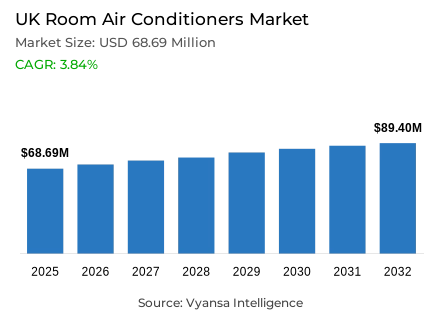
- Room air conditioners market size in UK was valued at USD 68.69 million in 2025 and is estimated at USD 71.82 million in 2026.
- The market size is expected to grow to USD 89.4 million by 2032.
- Market to register a CAGR of around 3.84% during 2026-32.
- Product Type Shares
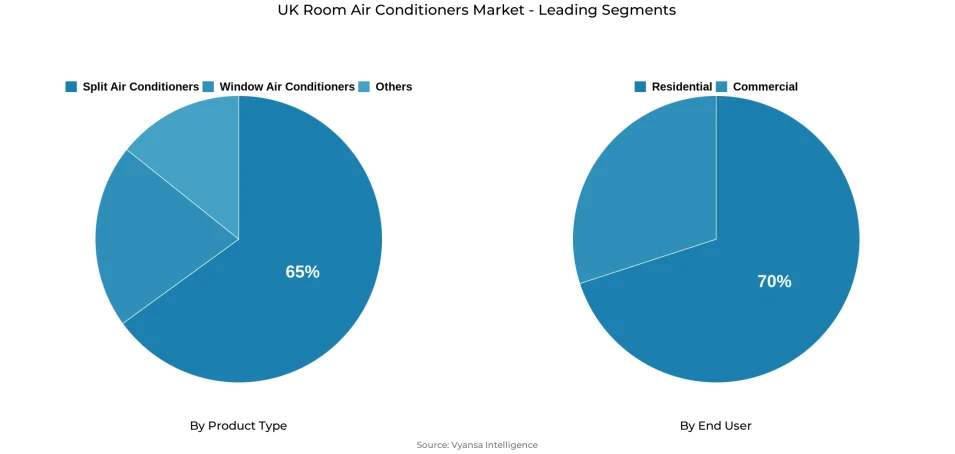
- Split air conditioners grabbed market share of 65%.
- Competition
- More than 5 companies are actively engaged in producing room air conditioners in UK.
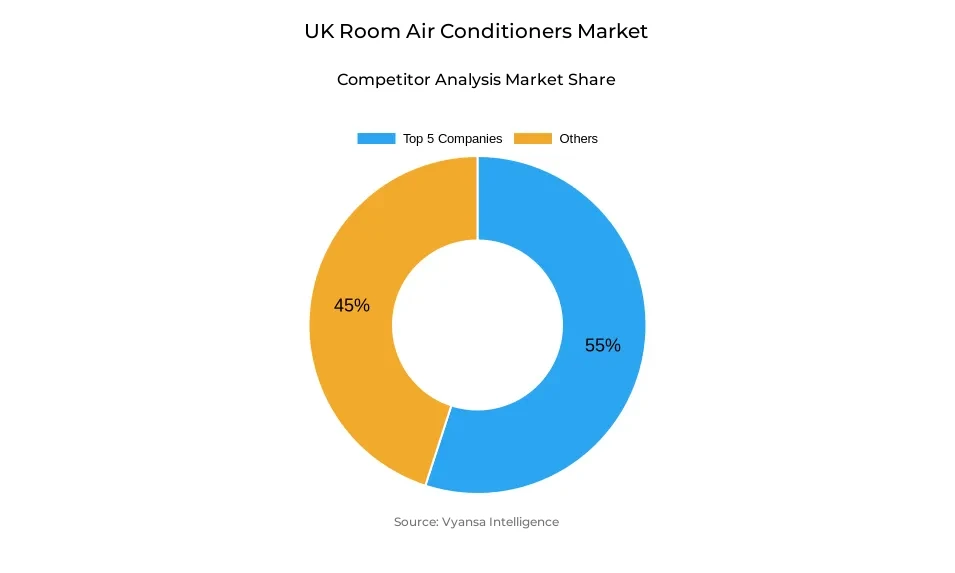
- Top 5 companies acquired around 55% of the market share.
- Mitsubishi Electric Corp, EcoAir Ltd, Panasonic Corp, De'Longhi SpA, Gree Electric Appliances Inc of Zhuhai etc., are few of the top companies.
- End User
- Residential grabbed 70% of the market.
UK Room Air Conditioners Market Outlook
UK room air conditioners market size was valued at USD 68.69 million in 2025 and is projected to grow from USD 71.82 million in 2026 to USD 89.4 million by 2032, exhibiting a CAGR of 3.84% during the forecast period. The outlook remains positive as warmer conditions continue to make indoor cooling more relevant across the UK. The Met Office says 2024 is provisionally the fourth warmest year on record for the UK, with a mean temperature of 9.78°C, which is 0.64°C above the 1991–2020 average. It also notes that every year in 2015–2024 stays above the long term average, keeping cooling demand visible.
Demand continues to be supported by the growing need for practical comfort in selected indoor spaces such as bedrooms, living rooms, and home office areas. This keeps room air conditioners relevant for households looking for quicker relief during hotter spells without depending on whole building cooling systems. At the same time, electricity cost remains an important restraint, as Office of Gas and Electricity Markets (Ofgem) says a typical household on a default tariff paying by Direct Debit faces an annualised energy price cap of GBP 1,720 from 1 July to 30 September 2025.
Product demand remains led by fixed systems, with split air conditioners holding around 65% of the market. This segment stays ahead because it better matches permanent room cooling needs where consumers want stronger performance, quieter operation, and better comfort. A clearer shift is also visible toward smarter room air conditioners, supported by stronger digital access. Ofcom says 20.7 million UK homes can now access full fibre broadband, while the average UK maximum download speed rises from 170 Mbit/s in 2023 to 223 Mbit/s in 2024.
Residential use continues to lead, with residential accounting for around 70% of the market. The Office for National Statistics says the UK has 28.6 million households in 2024, and 66.9% of them are one family households. This broad household base supports retrofit demand, where room air conditioners are added to existing homes for better comfort and easier control.
UK Room Air Conditioners Market Growth DriverHotter Summers Keep Cooling Need Visible
Warmer conditions are making indoor cooling more relevant across the UK. The Met Office says 2024 is provisionally the fourth warmest year on record for the UK, with a mean temperature of 9.78°C, which is 0.64°C above the 1991–2020 average. It also says all of the top 10 warmest years in the UK temperature series have occurred since 2000. This keeps room air conditioners more relevant in homes, bedrooms, and home office spaces when people want faster relief during warm periods.
The need for cooling also becomes easier to justify when warmer years are no longer rare. The same Met Office update notes that every year in 2015–2024 is warmer than the 1991–2020 long term average, showing a clear pattern rather than a one off event. As this continues, room air conditioner demand stays supported by the need for practical comfort in selected indoor spaces during hotter spells.
UK Room Air Conditioners Market ChallengeHigh Running Costs Hold Back Wider Adoption
Electricity cost remains a key restraint in the UK. Buyers do not only compare the purchase price of a unit; they also think about how much it will cost to operate through warmer weeks. This keeps energy efficiency central in purchase decisions, especially in a category where use can rise suddenly during short heat events.
Ofgem says that from 1 July to 30 September 2025, a typical household on a default tariff paying by direct debit faces an annualised energy price cap of £1,720. Even with the quarter on quarter reduction, this level still keeps households careful about extra appliance use, which makes it harder for room air conditioners to expand more quickly beyond need based purchases.
Unlock Market Intelligence
Explore the market potential with our data-driven report
UK Room Air Conditioners Market TrendSmarter Cooling Becomes More Relevant
A clearer shift in the UK is the stronger focus on connected and easy to manage cooling. Buyers increasingly value room air conditioners that can be adjusted through apps, scheduled remotely, and used more carefully around household energy habits. This is pushing attention toward products that combine cooling with convenience and better control.
The digital base for this is improving. Ofcom says 20.7 million UK homes can now access full fibre broadband, which is nearly 7 in 10 homes, and the average UK maximum download speed rises from 170 Mbit/s in 2023 to 223 Mbit/s in 2024. With better connectivity and wider network rollout, connected room air conditioners become easier to use in daily life, supporting stronger interest in app led and energy aware cooling.
UK Room Air Conditioners Market OpportunityLarge Household Base Supports Residential Retrofit
Residential retrofit creates a clear opening in the UK. A large household base gives suppliers room to target cooling needs in existing homes without depending only on new construction. This suits room air conditioners well because they can be added where households need cooling most, such as bedrooms, living rooms, and home working areas.
The Office for National Statistics says there are 28.6 million households in the UK in 2024, and 66.9% of them are one family households. This broad home base supports demand for room by room cooling products, especially where people want practical comfort upgrades inside existing homes rather than larger whole building systems.
Unlock Market Intelligence
Explore the market potential with our data-driven report
UK Room Air Conditioners Market Segmentation Analysis
By Product Type
- Split Air Conditioners
- Up to 9,000 BTU/h
- 9,001-12,000 BTU/h
- 12,001-18,000 BTU/h
- 18,001-24,000 BTU/h
- Above 24,000 BTU/h
- Window Air Conditioners
- Up to 9,000 BTU/h
- 9,001-12,000 BTU/h
- 12,001-18,000 BTU/h
- 18,001-24,000 BTU/h
- Above 24,000 BTU/h
- Others
The segment with the highest share under the product type is split air conditioners, holding around 66% of the UK room air conditioner market. This segment stays ahead because it suits permanent room cooling needs better than temporary options, especially where households want stronger cooling performance, quieter operation, and better comfort in bedrooms, living rooms, and work from home spaces.
Its strong position is supported by the UK’s warmer weather pattern. The Met Office says 2024 is provisionally the fourth warmest year on record at 9.78°C, and it is 0.64°C above the 1991–2020 average. This supports demand for fixed systems that can cool rooms effectively during repeated warm periods.
By End User
- Residential
- Individual Households
- Apartments/Condominiums
- Vacation/Secondary Homes
- Commercial
- Offices
- Retail Stores/Showrooms
- Hospitality
- Healthcare Facilities
- Educational Institutions
- Small Commercial Establishments
- Others
The segment with the highest share under the end user is residential, accounting for around 72% of the UK room air conditioner market. This segment leads because room air conditioners are mainly used to improve comfort inside homes during warm weather, especially where households prefer cooling selected rooms instead of installing full central systems.
Residential demand is also supported by the scale of the country’s housing base. The Office for National Statistics says the UK has 28.6 million households in 2024, while Ofcom says 20.7 million homes can now access full fibre broadband. Together, these factors support easier adoption of app controlled home cooling products and help keep residential use ahead in room air conditioners.
List of Companies Covered in UK Room Air Conditioners Market
The companies listed below are highly influential in the UK room air conditioners market, with a significant market share and a strong impact on industry developments.
- Mitsubishi Electric Corp
- EcoAir Ltd
- Panasonic Corp
- De'Longhi SpA
- Gree Electric Appliances Inc of Zhuhai
- Electrolux AB
- Daikin Industries Ltd
Market News & Updates
- Mitsubishi Electric Corp, 2026:
On 12 January 2026, Mitsubishi Electric’s UK business launched the City Multi R32 YXM VRF air-conditioning range, positioning it as a future-proof UK solution for retrofit and new-build projects, with claimed 20% lower running costs and operational carbon, 10% better energy efficiency, and installation availability from spring 2026.
- Panasonic Corp, 2026:
On 25 March 2026, Panasonic Heating & Cooling Solutions’ UK site announced a major upgrade to its residential air-conditioning portfolio, adding built-in Wi-Fi across all wall-mounted and floor-console units, stronger nanoe X air-quality technology, and refreshed Etherea, TZ, Floor Console, Free Multi, and RAC Solo ranges for smarter UK home cooling.
Frequently Asked Questions
Related Report
- Market Segmentation
- Research Scope
- Research Methodology
- Definitions and Assumptions
- Executive Summary
- UK Room Air Conditioners Market Policies, Regulations, and Standards
- UK Room Air Conditioners Market Dynamics
- Growth Factors
- Challenges
- Trends
- Opportunities
- UK Room Air Conditioners Market Statistics, 2022-2032F
- Market Size & Growth Outlook
- By Revenues in USD Million
- By Units Sold in Thousand Units
- Market Segmentation & Growth Outlook
- By Product Type
- Split Air Conditioners- Market Insights and Forecast 2022-2032, USD Million
- Up to 9,000 BTU/h- Market Insights and Forecast 2022-2032, USD Million
- 9,001-12,000 BTU/h- Market Insights and Forecast 2022-2032, USD Million
- 12,001-18,000 BTU/h- Market Insights and Forecast 2022-2032, USD Million
- 18,001-24,000 BTU/h- Market Insights and Forecast 2022-2032, USD Million
- Above 24,000 BTU/h- Market Insights and Forecast 2022-2032, USD Million
- Window Air Conditioners- Market Insights and Forecast 2022-2032, USD Million
- Up to 9,000 BTU/h- Market Insights and Forecast 2022-2032, USD Million
- 9,001-12,000 BTU/h- Market Insights and Forecast 2022-2032, USD Million
- 12,001-18,000 BTU/h- Market Insights and Forecast 2022-2032, USD Million
- 18,001-24,000 BTU/h- Market Insights and Forecast 2022-2032, USD Million
- Above 24,000 BTU/h- Market Insights and Forecast 2022-2032, USD Million
- Others- Market Insights and Forecast 2022-2032, USD Million
- Split Air Conditioners- Market Insights and Forecast 2022-2032, USD Million
- By Technology
- Inverter- Market Insights and Forecast 2022-2032, USD Million
- Non-Inverter- Market Insights and Forecast 2022-2032, USD Million
- By Price
- Up to USD 300- Market Insights and Forecast 2022-2032, USD Million
- USD 301 to USD 600- Market Insights and Forecast 2022-2032, USD Million
- USD 601 to USD 1,000- Market Insights and Forecast 2022-2032, USD Million
- Above USD 1,000- Market Insights and Forecast 2022-2032, USD Million
- By End User
- Residential- Market Insights and Forecast 2022-2032, USD Million
- Individual Households- Market Insights and Forecast 2022-2032, USD Million
- Apartments/Condominiums- Market Insights and Forecast 2022-2032, USD Million
- Vacation/Secondary Homes- Market Insights and Forecast 2022-2032, USD Million
- Commercial- Market Insights and Forecast 2022-2032, USD Million
- Offices- Market Insights and Forecast 2022-2032, USD Million
- Retail Stores/Showrooms- Market Insights and Forecast 2022-2032, USD Million
- Hospitality- Market Insights and Forecast 2022-2032, USD Million
- Healthcare Facilities- Market Insights and Forecast 2022-2032, USD Million
- Educational Institutions- Market Insights and Forecast 2022-2032, USD Million
- Small Commercial Establishments- Market Insights and Forecast 2022-2032, USD Million
- Others- Market Insights and Forecast 2022-2032, USD Million
- Residential- Market Insights and Forecast 2022-2032, USD Million
- By Sales Channel
- Retail Online- Market Insights and Forecast 2022-2032, USD Million
- Brand-Owned Websites/D2C- Market Insights and Forecast 2022-2032, USD Million
- E-Commerce Marketplaces- Market Insights and Forecast 2022-2032, USD Million
- Retail Offline- Market Insights and Forecast 2022-2032, USD Million
- Exclusive Brand Stores- Market Insights and Forecast 2022-2032, USD Million
- Multi-Brand Electronics & Appliance Stores- Market Insights and Forecast 2022-2032, USD Million
- Specialty Stores- Market Insights and Forecast 2022-2032, USD Million
- Hypermarkets/Supermarkets- Market Insights and Forecast 2022-2032, USD Million
- Home Improvement Stores- Market Insights and Forecast 2022-2032, USD Million
- Dealer/Distributor Network- Market Insights and Forecast 2022-2032, USD Million
- Direct Sales/Institutional Sales- Market Insights and Forecast 2022-2032, USD Million
- Local Independent Retailers- Market Insights and Forecast 2022-2032, USD Million
- Retail Online- Market Insights and Forecast 2022-2032, USD Million
- By Refrigerant Type
- R-32- Market Insights and Forecast 2022-2032, USD Million
- R-410A- Market Insights and Forecast 2022-2032, USD Million
- R-290- Market Insights and Forecast 2022-2032, USD Million
- R-454B- Market Insights and Forecast 2022-2032, USD Million
- Others- Market Insights and Forecast 2022-2032, USD Million
- By Connectivity
- Smart/Connected- Market Insights and Forecast 2022-2032, USD Million
- Conventional/Non-Smart- Market Insights and Forecast 2022-2032, USD Million
- By Energy Efficiency
- 1 Star- Market Insights and Forecast 2022-2032, USD Million
- 2 Star- Market Insights and Forecast 2022-2032, USD Million
- 3 Star- Market Insights and Forecast 2022-2032, USD Million
- 4 Star- Market Insights and Forecast 2022-2032, USD Million
- 5 Star- Market Insights and Forecast 2022-2032, USD Million
- By Region
- England
- Wales
- Scotland
- Northern Ireland
- By Competitors
- Competition Characteristics
- Market Share & Analysis
- By Product Type
- Market Size & Growth Outlook
- UK Split Air Conditioners Market Statistics, 2022-2032
- Market Size & Growth Outlook
- By Revenues in USD Million
- By Units Sold in Thousand Units
- Market Segmentation & Growth Outlook
- By Technology- Market Insights and Forecast 2022-2032, USD Million
- By Price- Market Insights and Forecast 2022-2032, USD Million
- By End User- Market Insights and Forecast 2022-2032, USD Million
- By Sales Channel- Market Insights and Forecast 2022-2032, USD Million
- By Refrigerant Type- Market Insights and Forecast 2022-2032, USD Million
- By Connectivity- Market Insights and Forecast 2022-2032, USD Million
- By Energy Efficiency- Market Insights and Forecast 2022-2032, USD Million
- By Region- Market Insights and Forecast 2022-2032, USD Million
- Market Size & Growth Outlook
- UK Window Air Conditioners Market Statistics, 2022-2032
- Market Size & Growth Outlook
- By Revenues in USD Million
- By Units Sold in Thousand Units
- Market Segmentation & Growth Outlook
- By Technology- Market Insights and Forecast 2022-2032, USD Million
- By Price- Market Insights and Forecast 2022-2032, USD Million
- By End User- Market Insights and Forecast 2022-2032, USD Million
- By Sales Channel- Market Insights and Forecast 2022-2032, USD Million
- By Refrigerant Type- Market Insights and Forecast 2022-2032, USD Million
- By Connectivity- Market Insights and Forecast 2022-2032, USD Million
- By Energy Efficiency- Market Insights and Forecast 2022-2032, USD Million
- By Region- Market Insights and Forecast 2022-2032, USD Million
- Market Size & Growth Outlook
- Competitive Outlook
- Company Profiles
- De'Longhi SpA
- Business Description
- Product Portfolio
- Collaborations & Alliances
- Recent Developments
- Financial Details
- Others
- Gree Electric Appliances Inc of Zhuhai
- Business Description
- Product Portfolio
- Collaborations & Alliances
- Recent Developments
- Financial Details
- Others
- Mitsubishi Electric Corp
- Business Description
- Product Portfolio
- Collaborations & Alliances
- Recent Developments
- Financial Details
- Others
- EcoAir Ltd
- Business Description
- Product Portfolio
- Collaborations & Alliances
- Recent Developments
- Financial Details
- Others
- Panasonic Corp
- Business Description
- Product Portfolio
- Collaborations & Alliances
- Recent Developments
- Financial Details
- Others
- Electrolux AB
- Business Description
- Product Portfolio
- Collaborations & Alliances
- Recent Developments
- Financial Details
- Others
- Daikin Industries Ltd
- Business Description
- Product Portfolio
- Collaborations & Alliances
- Recent Developments
- Financial Details
- Others
- Amcor Group
- Business Description
- Product Portfolio
- Collaborations & Alliances
- Recent Developments
- Financial Details
- Others
- Others
- Business Description
- Product Portfolio
- Collaborations & Alliances
- Recent Developments
- Financial Details
- Others
- De'Longhi SpA
- Company Profiles
- Disclaimer
| Segment | Sub-Segment |
|---|---|
| By Product Type |
|
| By Technology |
|
| By Price |
|
| By End User |
|
| By Sales Channel |
|
| By Refrigerant Type |
|
| By Connectivity |
|
| By Energy Efficiency |
|
| By Region |
|
Research Methodology
This study followed a structured approach comprising four key phases to assess the size and scope of the electro-oxidation market. The process began with thorough secondary research to collect data on the target market, related markets, and broader industry context. These findings, along with preliminary assumptions and estimates, were then validated through extensive primary research involving industry experts from across the value chain. To calculate the overall market size, both top-down and bottom-up methodologies were employed. Finally, market segmentation and data triangulation techniques were applied to refine and validate segment-level estimations.
Secondary Research
The secondary research phase involved gathering data from a wide range of credible and published sources. This step helped in identifying industry trends, defining market segmentation, and understanding the market landscape and value chain.
Sources consulted during this phase included:
- Company annual reports, investor presentations, and press releases
- Industry white papers and certified publications
- Trade directories and market-recognized databases
- Articles from authoritative authors and reputable journals
- Gold and silver standard websites
Secondary research was critical in mapping out the industry's value chain and monetary flow, identifying key market segments, understanding regional variations, and tracking significant industry developments.
Other key sources:
- Financial disclosures
- Industry associations and trade bodies
- News outlets and business magazines
- Academic journals and research studies
- Paid industry databases
Primary Research
To validate secondary data and gain deeper market insights, primary research was conducted with key stakeholders across both the supply and demand sides of the market.
On the demand side, participants included decision-makers and influencers from end-user industries—such as CIOs, CTOs, and CSOs—who provided first-hand perspectives on market needs, product usage, and future expectations.
On the supply side, interviews were conducted with manufacturers, industry associations, and institutional participants to gather insights into current offerings, product pipelines, and market challenges.
Primary interviews provided critical inputs such as:
- Market size and revenue data
- Product and service breakdowns
- Market forecasts
- Regional and application-specific trends
Stakeholders consulted included:
- Leading OEM and solution providers
- Channel and distribution partners
- End users across various applications
- Independent consultants and industry specialists
Market Size Estimation and Data Triangulation
- Identifying Key Market Participants (Secondary Research)
- Goal: To identify the major players or companies in the target market. This typically involves using publicly available data sources such as industry reports, market research publications, and financial statements of companies.
- Tools: Reports from firms like Gartner, Forrester, Euromonitor, Statista, IBISWorld, and others. Public financial statements, news articles, and press releases from top market players.
- Extracting Earnings of Key Market Participants
- Goal: To estimate the earnings generated from the product or service being analyzed. This step helps in understanding the revenue potential of each market player in a specific geography.
- Methods: Earnings data can be gathered from:
- Publicly available financial reports (for listed companies).
- Interviews and primary data sources from professionals, such as Directors, VPs, SVPs, etc. This is especially useful for understanding more nuanced, internal data that isn't publicly disclosed.
- Annual reports and investor presentations of key players.
- Data Collation and Development of a Relevant Data Model
- Goal: To collate inputs from both primary and secondary sources into a structured, data-driven model for market estimation. This model will incorporate key market KPIs and any independent variables relevant to the market.
- Key KPIs: These could include:
- Market size, growth rate, and demand drivers.
- Industry-specific metrics like market share, average revenue per customer (ARPC), or average deal size.
- External variables, such as economic growth rates, inflation rates, or commodity prices, that could affect the market.
- Data Modeling: Based on this data, the market forecasts are developed for the next 5 years. A combination of trend analysis, scenario modeling, and statistical regression might be used to generate projections.
- Scenario Analysis
- Goal: To test different assumptions and validate how sensitive the market is to changes in key variables (e.g., market demand, regulatory changes, technological disruptions).
- Types of Scenarios:
- Base Case: Based on current assumptions and historical data.
- Best-Case Scenario: Assuming favorable market conditions, regulatory environments, and technological advancements.
- Worst-Case Scenario: Accounting for adverse factors, such as economic downturns, stricter regulations, or unexpected disruptions.












