Morocco Room Air Conditioners Market Report: Trends, Growth and Forecast (2026-2032)
By Product Type (Split Air Conditioners (Up to 9,000 BTU/h, 9,001-12,000 BTU/h, 12,001-18,000 BTU/h, 18,001-24,000 BTU/h, Above 24,000 BTU/h), Window Air Conditioners (Up to 9,000 BTU/h, 9,001-12,000 BTU/h, 12,001-18,000 BTU/h, 18,001-24,000 BTU/h, Above 24,000 BTU/h), Others), By Technology (Inverter, Non-Inverter), By Price (Up to USD 300, USD 301 to USD 600, USD 601 to USD 1,000, Above USD 1,000), By End User (Residential (Individual Households, Apartments/Condominiums, Vacation/Secondary Homes), Commercial (Offices, Retail Stores/Showrooms, Hospitality, Healthcare Facilities, Educational Institutions, Small Commercial Establishments, Others)), By Sales Channel (Retail Online (Brand-Owned Websites/D2C, E-Commerce Marketplaces), Retail Offline (Exclusive Brand Stores, Multi-Brand Electronics & Appliance Stores, Specialty Stores, Hypermarkets/Supermarkets, Home Improvement Stores, Dealer/Distributor Network, Direct Sales/Institutional Sales, Local Independent Retailers)), By Refrigerant Type (R-32, R-410A, R-290, R-454B, Others), By Connectivity (Smart/Connected, Conventional/Non-Smart), By Energy Efficiency (1 Star, 2 Star, 3 Star, 4 Star, 5 Star) ... Read more
|
Major Players
|
Morocco Room Air Conditioners Market Statistics and Insights, 2026
- Market Size Statistics
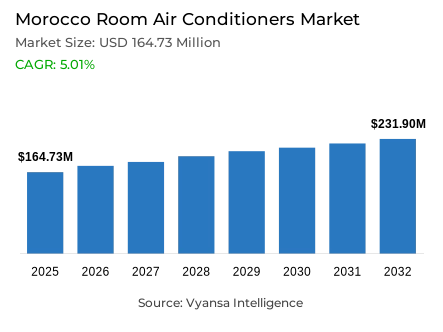
- Room air conditioners market size in Morocco was valued at USD 164.73 million in 2025 and is estimated at USD 172.33 million in 2026.
- The market size is expected to grow to USD 231.9 million by 2032.
- Market to register a CAGR of around 5.01% during 2026-32.
- Product Type Shares
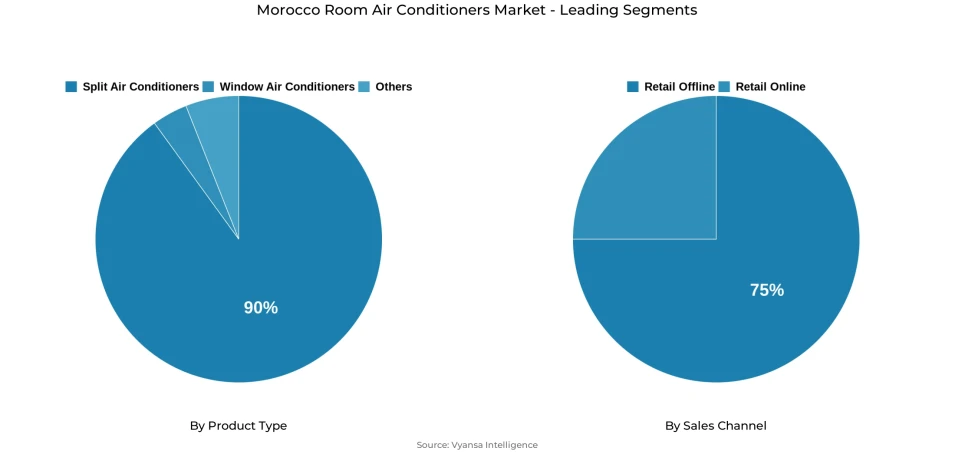
- Split air conditioners grabbed market share of 90%.
- Competition
- More than 10 companies are actively engaged in producing room air conditioners in Morocco.
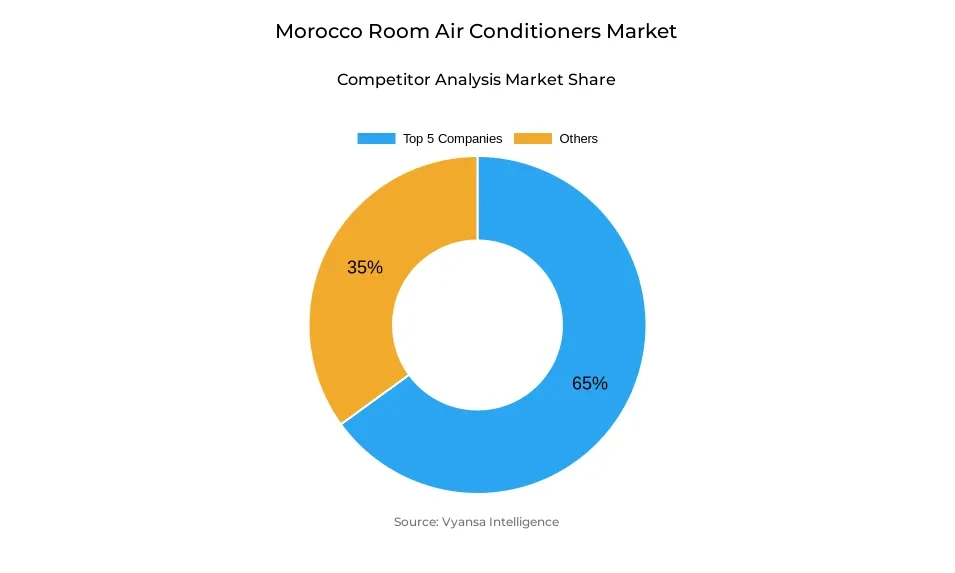
- Top 5 companies acquired around 65% of the market share.
- Midea Group Co Ltd, LG Corp, Samsung Corp, Carrier Global Corp, Airwell Group etc., are few of the top companies.
- Sales Channel
- Retail offline grabbed 75% of the market.
Morocco Room Air Conditioners Market Outlook
The Morocco room air conditioners market was valued at USD 164.73 million in 2025, establishing a commercially stable foundation within the country's expanding residential cooling appliance ecosystem. Projected to advance from USD 172.33 million in 2026 to USD 231.90 million by 2032, the sector registers a compound annual growth rate of approximately 5.01% across the forecast horizon, a measured but structurally grounded expansion trajectory reflecting the progressive normalization of room-based cooling as an essential household infrastructure investment rather than a discretionary comfort upgrade. This steady value progression is underpinned by the convergence of intensifying heat stress episodes, an expanding urban housing stock adding an average of 215,000 homes annually, and a regulatory environment that is actively reshaping product selection criteria around energy efficiency compliance and minimum performance standards.
The product logic driving this market's commercial architecture is defined by an exceptionally high degree of format concentration. Split air conditioners command approximately 90% of total product-type share a near-total dominance that reflects a definitive consumer judgment in favor of fixed, room-level cooling systems that deliver reliable performance, practical installation compatibility, and consistent daily-use dependability across Morocco's diverse urban residential typologies. This concentration creates a highly focused competitive environment where brand differentiation must be constructed on dimensions of energy efficiency rating, compliance with Morocco's mandatory labeling regulations, product reliability, and after-sales service accessibility rather than format innovation or category diversification. The regulatory implementation of Joint Order No. 1529-24 which entered into force on 12 March 2025 amplifies this efficiency-focused competitive axis by establishing formal minimum energy performance thresholds that progressively elevate the technical baseline across the split system segmennt.
Consumer demand behavior within this market reflects the dual influence of thermal necessity and cost consciousness operating simultaneously across Morocco's urban household base. World Meteorological Organization data documenting two consecutive heatwaves in July 2024 with temperatures reaching 47.6°C in Marrakech and a national heat warning for 40°C to 47°C during the week of 4 August 2025 confirms that Morocco's cooling demand intensity is climatically acute and structurally non-discretionary during peak summer periods. Against this thermal imperative, the country's 87.5% energy dependence rate and MAD 114 billion energy bill in 2024, as reported by Morocco's Ministry of Energy Transition and Sustainable Development, create a cost-sensitivity environment that shapes consumer product selection toward energy-efficient models whose long-term operational economics justify the upfront investment.
The forward outlook through 2032 is defined by the simultaneous operation of four structural demand catalysts: Morocco's intensifying heat stress profile, the progressive expansion of an urban housing stock with 96.3% electricity connectivity, the regulatory mandate for energy-efficient compliant products, and the continued dominance of offline retail as the primary consumer trust-building and purchase conversion channel. These converging forces create a market environment that rewards suppliers with energy-compliant product portfolios, strong physical retail distribution partnerships, and credible after-sales service networks positioning well-prepared market participants to capture sustained value from Morocco's steady cooling appliance demand expansion through 2032.
Morocco Room Air Conditioners Market Growth DriverIntensifying Heat Stress Episodes Elevate Cooling from Comfort to Necessity
The progressive intensification of Morocco's heat stress profile manifested through more frequent, more severe, and longer-duration extreme temperature events represents the primary structural demand driver for room air conditioners, functioning as a climatic imperative that systematically elevates residential cooling from a discretionary comfort preference into a non-negotiable household health and livability necessity. As extreme heat episodes become more regular features of the Moroccan summer calendar, the purchase decision calculus for room air conditioners shifts from a deliberate multi-year consideration into an urgent, health-motivated investment compressing the adoption timeline and expanding the addressable consumer base beyond the historically affluent early-adopter cohort into broader middle-income household segments where cooling need intensity now matches or exceeds purchasing motivation thresholds.
The official meteorological evidence validating this driver's structural intensity is documented comprehensively by the World Meteorological Organization. Morocco experienced two consecutive heatwaves during July 2024, with temperatures reaching 41.7°C in Nouasseur and 47.6°C in Marrakech representing thermal stress levels that render indoor spaces without mechanical cooling genuinely inhabitable for extended periods. The following summer, Morocco's national meteorological service issued a formal heat warning for temperatures between 40°C and 47°C during the week of 4 August 2025, confirming that extreme heat episodes are not isolated anomalies but recurring seasonal phenomena that sustain consistent room air conditioner demand activation across affected geographies. This climatically driven demand continuity creates a structurally reliable commercial foundation for market expansion through 2032.
Morocco Room Air Conditioners Market ChallengeHigh Energy Dependence and Cost Sensitivity Constrain Purchase Conversion
Morocco's structural energy dependence and the resulting consumer sensitivity to cooling appliance operating costs constitute a critical challenge for the room air conditioners market, creating a cost-consciousness environment that moderates purchase conversion velocity relative to the underlying cooling demand intensity generated by the country's thermal stress profile. For a category intrinsically associated with meaningful ongoing electricity consumption, the combination of high national energy import dependence, an elevated per-capita electricity demand of 1,223 kWh per inhabitant, and a total energy bill of MAD 114 billion in 2024 creates a consumer psychology in which total ownership cost calculations rather than upfront purchase price alone significantly influence both the timing and product specification of air conditioner acquisition decisions.
The structural depth of this energy cost challenge is quantified with precision by Morocco's Ministry of Energy Transition and Sustainable Development. The country's energy dependence rate reached 87.5% in 2024 a level that makes Morocco's electricity pricing structurally susceptible to international energy market volatility and creates persistent uncertainty around long-term operating cost projections for high-consumption household appliances. This uncertainty is most commercially consequential for first-time air conditioner adopters in middle-income household segments, where the decision to invest in a cooling system requires confidence in the affordability of ongoing electricity costs that the high dependence rate structurally undermines. For market participants, this challenge creates a strategic imperative to communicate energy efficiency benefits, total cost-of-ownership advantages, and energy label ratings with precision and prominence across all consumer-facing touchpoints through 2032.
Unlock Market Intelligence
Explore the market potential with our data-driven report
Morocco Room Air Conditioners Market TrendMandatory Energy Performance Regulation Reshapes Product Selection Criteria
The implementation of Morocco's mandatory energy labeling and minimum energy performance standards for air conditioners represents a defining structural trend, fundamentally reshaping the product selection criteria framework within which both consumers and retailers evaluate, compare, and recommend room air conditioning systems. This regulatory evolution moves the market's competitive differentiation axis decisively beyond cooling performance capacity and price positioning into the domain of certified energy efficiency ratings, compliance documentation, and long-term electricity cost advantage communication dimensions that favor technically sophisticated, compliance-invested suppliers over commodity product distributors operating with undifferentiated legacy portfolios.
The regulatory specificity and implementation timeline of this trend are documented with authority by Morocco's Official Bulletin and Ministry of Industry and Commerce. Joint Order No. 1529-24, dated 7 June 2024, establishes mandatory energy labeling requirements and minimum energy performance thresholds for electric air conditioners with nominal cooling or heating capacity of 12 kW or below covering the full range of residential split system applications that constitute 90% of Morocco's room air conditioner market. The regulation entered into force on 12 March 2025, formally initiating the transition to a compliance-structured market environment in which non-conforming products face progressive commercial disadvantage. As energy labels become standard fixtures in retail environments and consumer energy efficiency awareness deepens under Morocco's structurally high energy cost sensitivity, regulatory compliance will function as a minimum market participation threshold rather than a premium positioning differentiator through 2032.
Morocco Room Air Conditioners Market OpportunityUrban Housing Expansion Creates Scalable First-Installation Demand
The continuous expansion and modernization of Morocco's urban housing stock represents a strategically compelling and structurally durable commercial opportunity for room air conditioner market participants, creating a progressively larger pool of newly constructed and recently occupied residential units that represent first-installation cooling appliance opportunities across a near-universally electricity-connected urban base. The intersection of robust housing construction momentum with high electricity connectivity rates creates an unusually favorable addressable market condition where the primary growth constraint is consumer awareness and purchase motivation rather than infrastructure limitations, giving market participants a clear and actionable commercial expansion pathway through distribution development and targeted consumer education investment.
The quantitative foundation of this housing expansion opportunity is documented with precision by Morocco's High Commission for Planning. The urban housing stock reached 8.34 million units in 2024, reflecting an average addition of 215,000 new homes per year over the preceding decade a construction momentum that consistently generates fresh first-installation opportunities for room air conditioners at scale. Critically, 96.3% of urban homes are connected to the public electricity network in 2024 confirming that the infrastructure prerequisite for air conditioner adoption is already satisfied across virtually the entire urban housing base. The combination of annual housing stock additions averaging 215,000 units and near-universal electricity connectivity creates a compounding addressable market expansion dynamic that, aligned with Morocco's intensifying heat stress profile and mandatory efficiency standards implementation, generates a structurally favorable environment for sustained room air conditioner demand growth through 2032.
Unlock Market Intelligence
Explore the market potential with our data-driven report
Morocco Room Air Conditioners Market Segmentation Analysis
By Product Type
- Split Air Conditioners
- Up to 9,000 BTU/h
- 9,001-12,000 BTU/h
- 12,001-18,000 BTU/h
- 18,001-24,000 BTU/h
- Above 24,000 BTU/h
- Window Air Conditioners
- Up to 9,000 BTU/h
- 9,001-12,000 BTU/h
- 12,001-18,000 BTU/h
- 18,001-24,000 BTU/h
- Above 24,000 BTU/h
- Others
The segment with highest market share under the product type is split air conditioners, accounting for approximately 90% of the total market. This near-total dominance represents one of the most pronounced format concentration profiles within the regional room air conditioner landscape, reflecting a decisive and deeply entrenched consumer preference for fixed, wall-mounted cooling systems that deliver superior room-level temperature control, operational quietness, and aesthetic residential integration relative to portable or window-unit alternatives. With nine-tenths of total market value concentrated within a single product format, split air conditioners define the competitive, commercial, and innovation agenda of the Morocco room air conditioners industry establishing the product specifications, efficiency benchmarks, and service expectations against which all market participants must calibrate their strategic investments.
The structural leadership of split air conditioners is being actively reinforced by Morocco's regulatory evolution toward mandatory energy performance standards. Joint Order No. 1529-24, which entered into force on 12 March 2025 as confirmed by the Ministry of Industry and Commerce, establishes mandatory energy labeling and minimum energy performance thresholds for electric air conditioners with nominal cooling or heating capacity of 12 kW or below a specification range that encompasses the vast majority of residential split system purchases. This regulatory framework transforms energy efficiency from a voluntary premium feature into a compliance prerequisite, progressively elevating the technical baseline within the dominant split system segment and creating a structured product upgrade cycle that benefits efficiency-capable suppliers. The segment's commanding position as the primary revenue contributor and competitive focal point of the market is expected to deepen further through 2032.
By Sales Channel
- Retail Online
- Brand-Owned Websites/D2C
- E-Commerce Marketplaces
- Retail Offline
- Exclusive Brand Stores
- Multi-Brand Electronics & Appliance Stores
- Specialty Stores
- Hypermarkets/Supermarkets
- Home Improvement Stores
- Dealer/Distributor Network
- Direct Sales/Institutional Sales
- Local Independent Retailers
The segment with highest market share under the sales channel is retail offline, accounting for approximately 75% of the total market. This dominant share reflects the fundamental characteristics of air conditioner purchase decision-making in Morocco a high-value, technically complex, installation-dependent acquisition that consumers consistently approach through physical retail environments where direct product comparison, specification evaluation, installation suitability assessment, and brand credibility verification can be conducted with confidence. The 75% offline share confirms that despite the progressive growth of digital commerce infrastructure, the room air conditioner category's purchase journey remains anchored in the tangible, interactive evaluation experience that only physical retail environments can deliver comprehensively.
The structural entrenchment of offline retail as the dominant distribution channel is reinforced by the category's post-purchase installation and service dependencies, which physical retail touchpoints are better positioned to initiate, facilitate, and guarantee relative to online channels. In-store environments provide critical commercial functions beyond transaction processing enabling brand visibility, product demonstration, energy label communication, and the direct seller-buyer interaction through which consumer confidence in high-value durable appliance investments is established and converted into purchase commitment. As Morocco's mandatory energy labeling requirements create a more specification-literate consumer base that actively compares efficiency ratings before purchase, the physical retail environment's ability to facilitate direct label comparison and technical explanation becomes an increasingly important conversion advantage. Offline retail's structural dominance as the primary commercial touchpoint for brand consideration, product selection, and purchase finalization is expected to remain intact through 2032.
List of Companies Covered in Morocco Room Air Conditioners Market
The companies listed below are highly influential in the Morocco room air conditioners market, with a significant market share and a strong impact on industry developments.
- Midea Group Co Ltd
- LG Corp
- Samsung Corp
- Carrier Global Corp
- Airwell Group
- Manar SA
- De'Longhi SpA
- Beko Corp
- Electrolux AB
- Haier Group
Market News & Updates
- Samsung Corp, 2025:
Samsung’s official Morocco site lists the Bespoke WindFree AI 24,000 BTU wall-mounted air conditioner under model code F-24WF2025VD, signaling a 2025 local product rollout built around WindFree cooling, smart inverter operation, and premium wall-mounted residential positioning. This is important for the Morocco room AC market because it strengthens the premium split-AC segment with connected and comfort-led features in a country where residential cooling demand is increasingly shifting toward inverter and smarter wall-mounted formats.
- LG Corp, 2025:
LG globally unveiled the upgraded DUALCOOL AI Air in January 2025, emphasizing AI-powered airflow adjustment, energy efficiency, and air-care functions, while LG Morocco’s official site presents DUALCOOL IA / AI Air and residential inverter ACs for the local market. This is a meaningful Morocco room AC market update because it reflects the move toward AI-led, energy-saving split air conditioners in Morocco’s residential segment, even where the company’s local site relies more on product-rollout pages than classic press releases.
Frequently Asked Questions
Related Report
- Market Segmentation
- Research Scope
- Research Methodology
- Definitions and Assumptions
- Executive Summary
- Morocco Room Air Conditioners Market Policies, Regulations, and Standards
- Morocco Room Air Conditioners Market Dynamics
- Growth Factors
- Challenges
- Trends
- Opportunities
- Morocco Room Air Conditioners Market Statistics, 2022-2032F
- Market Size & Growth Outlook
- By Revenues in USD Million
- By Units Sold in Thousand Units
- Market Segmentation & Growth Outlook
- By Product Type
- Split Air Conditioners- Market Insights and Forecast 2022-2032, USD Million
- Up to 9,000 BTU/h- Market Insights and Forecast 2022-2032, USD Million
- 9,001-12,000 BTU/h- Market Insights and Forecast 2022-2032, USD Million
- 12,001-18,000 BTU/h- Market Insights and Forecast 2022-2032, USD Million
- 18,001-24,000 BTU/h- Market Insights and Forecast 2022-2032, USD Million
- Above 24,000 BTU/h- Market Insights and Forecast 2022-2032, USD Million
- Window Air Conditioners- Market Insights and Forecast 2022-2032, USD Million
- Up to 9,000 BTU/h- Market Insights and Forecast 2022-2032, USD Million
- 9,001-12,000 BTU/h- Market Insights and Forecast 2022-2032, USD Million
- 12,001-18,000 BTU/h- Market Insights and Forecast 2022-2032, USD Million
- 18,001-24,000 BTU/h- Market Insights and Forecast 2022-2032, USD Million
- Above 24,000 BTU/h- Market Insights and Forecast 2022-2032, USD Million
- Others- Market Insights and Forecast 2022-2032, USD Million
- Split Air Conditioners- Market Insights and Forecast 2022-2032, USD Million
- By Technology
- Inverter- Market Insights and Forecast 2022-2032, USD Million
- Non-Inverter- Market Insights and Forecast 2022-2032, USD Million
- By Price
- Up to USD 300- Market Insights and Forecast 2022-2032, USD Million
- USD 301 to USD 600- Market Insights and Forecast 2022-2032, USD Million
- USD 601 to USD 1,000- Market Insights and Forecast 2022-2032, USD Million
- Above USD 1,000- Market Insights and Forecast 2022-2032, USD Million
- By End User
- Residential- Market Insights and Forecast 2022-2032, USD Million
- Individual Households- Market Insights and Forecast 2022-2032, USD Million
- Apartments/Condominiums- Market Insights and Forecast 2022-2032, USD Million
- Vacation/Secondary Homes- Market Insights and Forecast 2022-2032, USD Million
- Commercial- Market Insights and Forecast 2022-2032, USD Million
- Offices- Market Insights and Forecast 2022-2032, USD Million
- Retail Stores/Showrooms- Market Insights and Forecast 2022-2032, USD Million
- Hospitality- Market Insights and Forecast 2022-2032, USD Million
- Healthcare Facilities- Market Insights and Forecast 2022-2032, USD Million
- Educational Institutions- Market Insights and Forecast 2022-2032, USD Million
- Small Commercial Establishments- Market Insights and Forecast 2022-2032, USD Million
- Others- Market Insights and Forecast 2022-2032, USD Million
- Residential- Market Insights and Forecast 2022-2032, USD Million
- By Sales Channel
- Retail Online- Market Insights and Forecast 2022-2032, USD Million
- Brand-Owned Websites/D2C- Market Insights and Forecast 2022-2032, USD Million
- E-Commerce Marketplaces- Market Insights and Forecast 2022-2032, USD Million
- Retail Offline- Market Insights and Forecast 2022-2032, USD Million
- Exclusive Brand Stores- Market Insights and Forecast 2022-2032, USD Million
- Multi-Brand Electronics & Appliance Stores- Market Insights and Forecast 2022-2032, USD Million
- Specialty Stores- Market Insights and Forecast 2022-2032, USD Million
- Hypermarkets/Supermarkets- Market Insights and Forecast 2022-2032, USD Million
- Home Improvement Stores- Market Insights and Forecast 2022-2032, USD Million
- Dealer/Distributor Network- Market Insights and Forecast 2022-2032, USD Million
- Direct Sales/Institutional Sales- Market Insights and Forecast 2022-2032, USD Million
- Local Independent Retailers- Market Insights and Forecast 2022-2032, USD Million
- Retail Online- Market Insights and Forecast 2022-2032, USD Million
- By Refrigerant Type
- R-32- Market Insights and Forecast 2022-2032, USD Million
- R-410A- Market Insights and Forecast 2022-2032, USD Million
- R-290- Market Insights and Forecast 2022-2032, USD Million
- R-454B- Market Insights and Forecast 2022-2032, USD Million
- Others- Market Insights and Forecast 2022-2032, USD Million
- By Connectivity
- Smart/Connected- Market Insights and Forecast 2022-2032, USD Million
- Conventional/Non-Smart- Market Insights and Forecast 2022-2032, USD Million
- By Energy Efficiency
- 1 Star- Market Insights and Forecast 2022-2032, USD Million
- 2 Star- Market Insights and Forecast 2022-2032, USD Million
- 3 Star- Market Insights and Forecast 2022-2032, USD Million
- 4 Star- Market Insights and Forecast 2022-2032, USD Million
- 5 Star- Market Insights and Forecast 2022-2032, USD Million
- By Competitors
- Competition Characteristics
- Market Share & Analysis
- By Product Type
- Market Size & Growth Outlook
- Morocco Split Air Conditioners Market Statistics, 2022-2032
- Market Size & Growth Outlook
- By Revenues in USD Million
- By Units Sold in Thousand Units
- Market Segmentation & Growth Outlook
- By Technology- Market Insights and Forecast 2022-2032, USD Million
- By Price- Market Insights and Forecast 2022-2032, USD Million
- By End User- Market Insights and Forecast 2022-2032, USD Million
- By Sales Channel- Market Insights and Forecast 2022-2032, USD Million
- By Refrigerant Type- Market Insights and Forecast 2022-2032, USD Million
- By Connectivity- Market Insights and Forecast 2022-2032, USD Million
- By Energy Efficiency- Market Insights and Forecast 2022-2032, USD Million
- Market Size & Growth Outlook
- Morocco Window Air Conditioners Market Statistics, 2022-2032
- Market Size & Growth Outlook
- By Revenues in USD Million
- By Units Sold in Thousand Units
- Market Segmentation & Growth Outlook
- By Technology- Market Insights and Forecast 2022-2032, USD Million
- By Price- Market Insights and Forecast 2022-2032, USD Million
- By End User- Market Insights and Forecast 2022-2032, USD Million
- By Sales Channel- Market Insights and Forecast 2022-2032, USD Million
- By Refrigerant Type- Market Insights and Forecast 2022-2032, USD Million
- By Connectivity- Market Insights and Forecast 2022-2032, USD Million
- By Energy Efficiency- Market Insights and Forecast 2022-2032, USD Million
- Market Size & Growth Outlook
- Competitive Outlook
- Company Profiles
- Carrier Global Corp
- Business Description
- Product Portfolio
- Collaborations & Alliances
- Recent Developments
- Financial Details
- Others
- Airwell Group
- Business Description
- Product Portfolio
- Collaborations & Alliances
- Recent Developments
- Financial Details
- Others
- Manar SA
- Business Description
- Product Portfolio
- Collaborations & Alliances
- Recent Developments
- Financial Details
- Others
- De'Longhi SpA
- Business Description
- Product Portfolio
- Collaborations & Alliances
- Recent Developments
- Financial Details
- Others
- Beko Corp
- Business Description
- Product Portfolio
- Collaborations & Alliances
- Recent Developments
- Financial Details
- Others
- Midea Group Co Ltd
- Business Description
- Product Portfolio
- Collaborations & Alliances
- Recent Developments
- Financial Details
- Others
- LG Corp
- Business Description
- Product Portfolio
- Collaborations & Alliances
- Recent Developments
- Financial Details
- Others
- Samsung Corp
- Business Description
- Product Portfolio
- Collaborations & Alliances
- Recent Developments
- Financial Details
- Others
- Electrolux AB
- Business Description
- Product Portfolio
- Collaborations & Alliances
- Recent Developments
- Financial Details
- Others
- Haier Group
- Business Description
- Product Portfolio
- Collaborations & Alliances
- Recent Developments
- Financial Details
- Others
- Carrier Global Corp
- Company Profiles
- Disclaimer
| Segment | Sub-Segment |
|---|---|
| By Product Type |
|
| By Technology |
|
| By Price |
|
| By End User |
|
| By Sales Channel |
|
| By Refrigerant Type |
|
| By Connectivity |
|
| By Energy Efficiency |
|
Research Methodology
This study followed a structured approach comprising four key phases to assess the size and scope of the electro-oxidation market. The process began with thorough secondary research to collect data on the target market, related markets, and broader industry context. These findings, along with preliminary assumptions and estimates, were then validated through extensive primary research involving industry experts from across the value chain. To calculate the overall market size, both top-down and bottom-up methodologies were employed. Finally, market segmentation and data triangulation techniques were applied to refine and validate segment-level estimations.
Secondary Research
The secondary research phase involved gathering data from a wide range of credible and published sources. This step helped in identifying industry trends, defining market segmentation, and understanding the market landscape and value chain.
Sources consulted during this phase included:
- Company annual reports, investor presentations, and press releases
- Industry white papers and certified publications
- Trade directories and market-recognized databases
- Articles from authoritative authors and reputable journals
- Gold and silver standard websites
Secondary research was critical in mapping out the industry's value chain and monetary flow, identifying key market segments, understanding regional variations, and tracking significant industry developments.
Other key sources:
- Financial disclosures
- Industry associations and trade bodies
- News outlets and business magazines
- Academic journals and research studies
- Paid industry databases
Primary Research
To validate secondary data and gain deeper market insights, primary research was conducted with key stakeholders across both the supply and demand sides of the market.
On the demand side, participants included decision-makers and influencers from end-user industries—such as CIOs, CTOs, and CSOs—who provided first-hand perspectives on market needs, product usage, and future expectations.
On the supply side, interviews were conducted with manufacturers, industry associations, and institutional participants to gather insights into current offerings, product pipelines, and market challenges.
Primary interviews provided critical inputs such as:
- Market size and revenue data
- Product and service breakdowns
- Market forecasts
- Regional and application-specific trends
Stakeholders consulted included:
- Leading OEM and solution providers
- Channel and distribution partners
- End users across various applications
- Independent consultants and industry specialists
Market Size Estimation and Data Triangulation
- Identifying Key Market Participants (Secondary Research)
- Goal: To identify the major players or companies in the target market. This typically involves using publicly available data sources such as industry reports, market research publications, and financial statements of companies.
- Tools: Reports from firms like Gartner, Forrester, Euromonitor, Statista, IBISWorld, and others. Public financial statements, news articles, and press releases from top market players.
- Extracting Earnings of Key Market Participants
- Goal: To estimate the earnings generated from the product or service being analyzed. This step helps in understanding the revenue potential of each market player in a specific geography.
- Methods: Earnings data can be gathered from:
- Publicly available financial reports (for listed companies).
- Interviews and primary data sources from professionals, such as Directors, VPs, SVPs, etc. This is especially useful for understanding more nuanced, internal data that isn't publicly disclosed.
- Annual reports and investor presentations of key players.
- Data Collation and Development of a Relevant Data Model
- Goal: To collate inputs from both primary and secondary sources into a structured, data-driven model for market estimation. This model will incorporate key market KPIs and any independent variables relevant to the market.
- Key KPIs: These could include:
- Market size, growth rate, and demand drivers.
- Industry-specific metrics like market share, average revenue per customer (ARPC), or average deal size.
- External variables, such as economic growth rates, inflation rates, or commodity prices, that could affect the market.
- Data Modeling: Based on this data, the market forecasts are developed for the next 5 years. A combination of trend analysis, scenario modeling, and statistical regression might be used to generate projections.
- Scenario Analysis
- Goal: To test different assumptions and validate how sensitive the market is to changes in key variables (e.g., market demand, regulatory changes, technological disruptions).
- Types of Scenarios:
- Base Case: Based on current assumptions and historical data.
- Best-Case Scenario: Assuming favorable market conditions, regulatory environments, and technological advancements.
- Worst-Case Scenario: Accounting for adverse factors, such as economic downturns, stricter regulations, or unexpected disruptions.












