UK NRT Smoking Cessation Aids Market Report: Trends, Growth and Forecast (2026-2032)
By Category (NRT Gum, NRT Inhalators, NRT Lozenges, NRT Patches, Other NRT Products), By Gender (Male, Female), By Sales Channel (Retail Online (Online Pharmacies, Brand-Owned Websites, E-commerce Marketplaces), Retail Offline (Hospital, Pharmacies, Drug Stores)), By End User (Individual / Consumer Self-Use, Healthcare-Professional-Supervised (Clinics, De-addiction Centers, Smoking Cessation Centers)), By Region (England, Wales, Scotland, Northern Ireland) ... Read more

|
Major Players
|
UK NRT Smoking Cessation Aids Market Statistics and Insights, 2026
- Market Size Statistics
- Nrt smoking cessation aids market size in UK was valued at USD 275 million in 2025 and is estimated at USD 278 Million in 2026.
- The market size is expected to grow to USD 300 million by 2032.
- Market to register a CAGR of around 1.25% during 2026-32.
- Category Shares
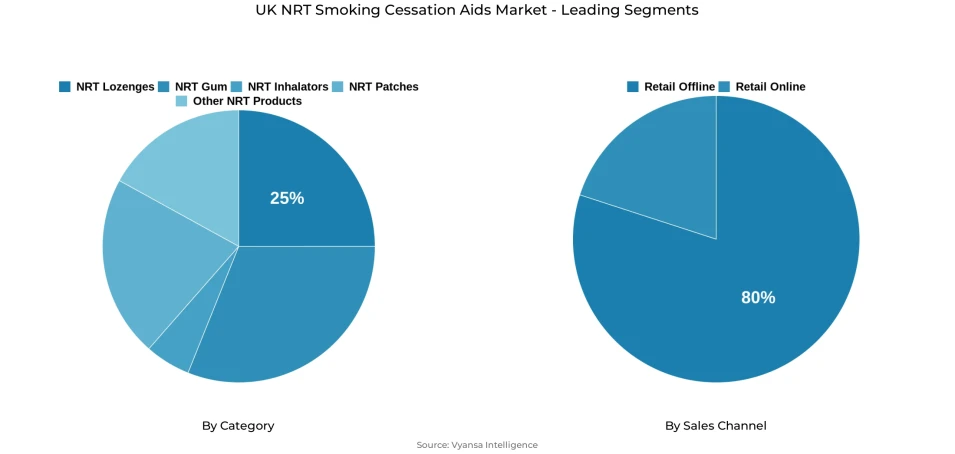
- Nrt lozenges grabbed market share of 25%.
- Competition
- More than 5 companies are actively engaged in producing nrt smoking cessation aids in UK.
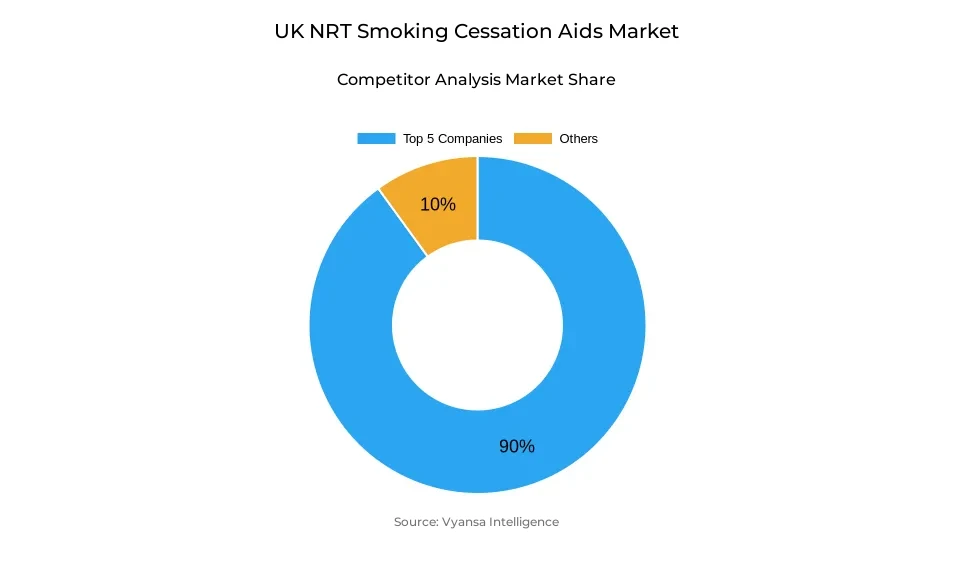
- Top 5 companies acquired around 90% of the market share.
- GlaxoSmithKline Plc, Boots UK Ltd, GalPharm Intl Ltd, McNeil Healthcare (UK) Ltd, Haleon Plc etc., are few of the top companies.
- Sales Channel
- Retail offline grabbed 80% of the market.
UK NRT Smoking Cessation Aids Market Outlook
The UK NRT smoking cessation aids market size was valued at USD 275 million in 2025 and is projected to grow from USD 278 million in 2026 to USD 300 million by 2032, exhibiting a CAGR of around 1.25% during the forecast period. Growth is supported by the continued public-health focus on smoking cessation and the presence of a meaningful smoking population. According to the Office for National Statistics, 10.6% of UK adults aged 18+ smoked in 2024, equivalent to around 5.3 million people, maintaining a strong base of potential users for quit-support products.
Demand for structured quitting tools remains supported by formal cessation services and awareness campaigns. NHS England Digital reports that Local Stop Smoking Services recorded 238,166 quit attempts in 2024/25, with 127,541 people (53.6%) reporting success at four weeks. In this environment, NRT smoking cessation aids continue to play an important role in supporting quit attempts. Within the category, NRT lozenges account for about 25% share, reflecting consumer preference for discreet, portable formats that fit daily routines and provide convenient craving control.
However, the category faces pricing pressure in a cost-sensitive environment. Growing availability of lower-cost alternatives, especially through online and discount channels, makes it harder for established brands to maintain pricing power. The Office for National Statistics reports that UK CPI inflation reached 3.2% in January 2026, reinforcing cautious spending behaviour. As a result, some consumers may choose cheaper options when purchasing NRT smoking cessation aids, limiting stronger value growth across premium branded products.
Distribution remains largely driven by physical retail channels. Retail offline accounts for around 80% of sales, reflecting the continued importance of pharmacies and large retail outlets where consumers can compare products and seek advice. Government policy also supports quitting efforts, with the Tobacco and Vapes Bill proposing a ban on selling tobacco to anyone born on or after 1 January 2009, alongside £70 million allocated for stop-smoking services in England for 2025/26, reinforcing a supportive environment for recognised cessation tools.
UK NRT Smoking Cessation Aids Market Growth DriverPublic Quit Support Keeps Demand Moving
A key driver for the UK NRT smoking cessation aids market is the continued public-health push behind quitting. Adult smoking remains meaningful enough to support demand, while official stop-smoking services are still bringing large numbers of smokers into structured quit attempts. The Office for National Statistics reports that 10.6% of UK adults aged 18+ smoked in 2024, equal to around 5.3 million people. That keeps a sizeable target audience in place for nicotine replacement products.
This demand is reinforced by formal cessation support. NHS England Digital reports that Local Stop Smoking Services in England record 238,166 quit attempts in 2024/25, with 127,541 people, or 53.6%, reporting a successful quit at four weeks. As public awareness rises and services remain visible, NRT smoking cessation aids continue to benefit from a quitting environment that is active, supported, and health-led.
UK NRT Smoking Cessation Aids Market ChallengePrice Pressure and Fragmentation Restrain Premium Growth
A clear challenge for UK NRT smoking cessation aids market is that it faces stiff competition for pricing and brand loyalty from low-cost entrants (including e-commerce and discount channels) in an environment where consumers are cost-conscious. As a result, established brands find it difficult to leverage innovation into higher value growth due to the growing number of consumers deciding to use cheaper, lower-cost alternative products instead of premium branded products.
This pressure sits inside a still-inflationary consumer setting. The Office for National Statistics states that UK CPI inflation is 3.2% in January 2026, while the government’s 30 December 2024 smoking campaign also links quitting more strongly to saving money during a time when smoking feels increasingly expensive. In that environment, affordability remains a central challenge, and value-focused buying behaviour can limit pricing power across branded NRT smoking cessation aids.
Unlock Market Intelligence
Explore the market potential with our data-driven report
UK NRT Smoking Cessation Aids Market TrendApp-Enabled Quitting Is Reshaping Consumer Engagement
A clear trend for UK NRT smoking cessation aids market is seeing an increasing trend of adding digital support to smoking cessation products. Interactive devices such as smart inhalers, quit trackers and nurture apps are making it easier for younger adult smokers to quit because they want health products and services to be integrated into their current digital lifestyle and habitual way of using technology; therefore the brands that offer NRT in conjunction with tracker/alerts/feedback are more applicable to them than ever before.
The Government's Position on this trend is supported by the target for success in quitting outlined in our most recent Government Healthy Living Campaigns, The Department of Health and Social Care currently has national quit smoking campaigning planned for 2026, which has clearly stated that users of proven cessation aids & supports are three times more successful at quitting compared to non-users by using the NHS Quit-Smoking App & Personal Quit Plan. That gives digital engagement a stronger role in how cessation products are discovered, used, and retained.
UK NRT Smoking Cessation Aids Market OpportunitySmokefree Legislation Opens More Room for Cessation Aids
One major opportunity that exists for the UK NRT smoking cessation aids market is the increasing support from the government and legislature to create a smoke-free society. Additionally, due to all of the strict tobacco-control regulations being implemented by the UK government, there will also be a more significant number of people using formal quitting tools, which will give NRT products an avenue to stay relevant in the marketplace.
That opportunity is backed by concrete policy action. The government’s Tobacco and Vapes Bill makes it an offence to sell tobacco to anyone born on or after 1 January 2009, while the Department of Health and Social Care also confirms an additional £70 million for stop smoking services in England for 2025/26. Together, stronger regulation and stronger cessation funding create a more supportive framework for NRT smoking cessation aids.
Unlock Market Intelligence
Explore the market potential with our data-driven report
UK NRT Smoking Cessation Aids Market Segmentation Analysis
By Category
- NRT Gum
- NRT Inhalators
- NRT Lozenges
- NRT Patches
- Other NRT Products
The segment has the highest share around segment under the category, with NRT lozenges grabbed market share of 25%. This leading position suggests that consumers continue to value practical, easy-to-carry, and discreet formats that fit daily routines. In a market where quitting products increasingly compete on convenience and user experience, lozenges benefit from being simple to use across different dayparts and settings.
Their position also fits the broader category movement toward more accessible and flexible nicotine-replacement formats. While innovation and digital support are shaping the market, a familiar oral format with convenient everyday use can still hold the strongest share when consumers want a product that feels easy to adopt and easy to continue.
By Sales Channel
- Retail Online
- Online Pharmacies
- Brand-Owned Websites
- E-commerce Marketplaces
- Retail Offline
- Hospital
- Pharmacies
- Drug Stores
The segment has the highest share around segment under the sales channel, where retail offline grabbed 80% of the market. Pharmacies and larger physical retailers play an essential role in providing direct access for smokers to cessation products, thereby reflecting the ongoing importance of these points of sale. Retailers linked to healthcare have been trusted resources for smokers because most smokers prefer to view cessation products before purchasing by physically seeing the product's format or colour. Many smokers also seek advice from retailers before finalising their decision for a cessation product.
This trend is consistent with the current structure of the UK market; pharmacies continue to provide the largest route to purchase and larger format retail stores invest in expanding shelf space and promotional visibility for these products. Despite the growth of digital channels, most users of NRT products will base their purchase decisions on awareness, recommendations and conversions generated through traditional retail channels.
List of Companies Covered in UK NRT Smoking Cessation Aids Market
The companies listed below are highly influential in the UK nrt smoking cessation aids market, with a significant market share and a strong impact on industry developments.
- GlaxoSmithKline Plc
- Boots UK Ltd
- GalPharm Intl Ltd
- McNeil Healthcare (UK) Ltd
- Haleon Plc
Competitive Landscape
In 2025, the competitive landscape of NRT smoking cessation aids in the UK was led by McNeil Healthcare (UK) Ltd with a 38.2% retail value share, followed by Haleon Plc with 20.8%. McNeil Healthcare maintains its leadership primarily through the strong performance of its Nicorette brand, which offers a wide range of nicotine replacement formats including gum, patches, lozenges and inhalators. The company continues to strengthen its position through ongoing product innovation, such as the launch of technology-enabled solutions like the SmartMist inhalator that integrates with mobile apps to help users track their quitting progress. Haleon also holds a significant position with its NiQuitin brand, benefiting from strong brand recognition and broad retail distribution. Overall category growth is supported by increased public health awareness, strong government support through NHS smoking cessation programmes and the UK’s “Smokefree 2030” strategy, although the presence of smaller emerging players offering competitively priced alternatives is gradually increasing competition in the market.
Frequently Asked Questions
Related Report
- Market Segmentation
- Research Scope
- Research Methodology
- Definitions and Assumptions
- Executive Summary
- UK NRT Smoking Cessation Aids Market Policies, Regulations, and Standards
- UK NRT Smoking Cessation Aids Market Dynamics
- Growth Factors
- Challenges
- Trends
- Opportunities
- UK NRT Smoking Cessation Aids Market Statistics, 2022-2032F
- Market Size & Growth Outlook
- By Revenues in USD Million
- Market Segmentation & Growth Outlook
- By Category
- NRT Gum- Market Insights and Forecast 2022-2032, USD Million
- NRT Inhalators- Market Insights and Forecast 2022-2032, USD Million
- NRT Lozenges- Market Insights and Forecast 2022-2032, USD Million
- NRT Patches- Market Insights and Forecast 2022-2032, USD Million
- Other NRT Products- Market Insights and Forecast 2022-2032, USD Million
- By Gender
- Male- Market Insights and Forecast 2022-2032, USD Million
- Female- Market Insights and Forecast 2022-2032, USD Million
- By Sales Channel
- Retail Online- Market Insights and Forecast 2022-2032, USD Million
- Online Pharmacies- Market Insights and Forecast 2022-2032, USD Million
- Brand-Owned Websites- Market Insights and Forecast 2022-2032, USD Million
- E-commerce Marketplaces- Market Insights and Forecast 2022-2032, USD Million
- Retail Offline- Market Insights and Forecast 2022-2032, USD Million
- Hospital- Market Insights and Forecast 2022-2032, USD Million
- Pharmacies- Market Insights and Forecast 2022-2032, USD Million
- Drug Stores- Market Insights and Forecast 2022-2032, USD Million
- Retail Online- Market Insights and Forecast 2022-2032, USD Million
- By End User
- Individual / Consumer Self-Use- Market Insights and Forecast 2022-2032, USD Million
- Healthcare-Professional-Supervised- Market Insights and Forecast 2022-2032, USD Million
- Clinics- Market Insights and Forecast 2022-2032, USD Million
- De-addiction Centers - Market Insights and Forecast 2022-2032, USD Million
- Smoking Cessation Centers- Market Insights and Forecast 2022-2032, USD Million
- By Region
- England
- Wales
- Scotland
- Northern Ireland
- By Competitors
- Competition Characteristics
- Market Share & Analysis
- By Category
- Market Size & Growth Outlook
- UK NRT Gum Market Statistics, 2022-2032
- Market Size & Growth Outlook
- By Revenues in USD Million
- Market Segmentation & Growth Outlook
- By Gender- Market Insights and Forecast 2022-2032, USD Million
- By Sales Channel- Market Insights and Forecast 2022-2032, USD Million
- By End User- Market Insights and Forecast 2022-2032, USD Million
- By Region- Market Insights and Forecast 2022-2032, USD Million
- Market Size & Growth Outlook
- UK NRT Inhalators Market Statistics, 2022-2032
- Market Size & Growth Outlook
- By Revenues in USD Million
- Market Segmentation & Growth Outlook
- By Gender- Market Insights and Forecast 2022-2032, USD Million
- By Sales Channel- Market Insights and Forecast 2022-2032, USD Million
- By End User- Market Insights and Forecast 2022-2032, USD Million
- By Region- Market Insights and Forecast 2022-2032, USD Million
- Market Size & Growth Outlook
- UK NRT Lozenges Market Statistics, 2022-2032
- Market Size & Growth Outlook
- By Revenues in USD Million
- Market Segmentation & Growth Outlook
- By Gender- Market Insights and Forecast 2022-2032, USD Million
- By Sales Channel- Market Insights and Forecast 2022-2032, USD Million
- By End User- Market Insights and Forecast 2022-2032, USD Million
- By Region- Market Insights and Forecast 2022-2032, USD Million
- Market Size & Growth Outlook
- UK NRT Patches Market Statistics, 2022-2032
- Market Size & Growth Outlook
- By Revenues in USD Million
- Market Segmentation & Growth Outlook
- By Gender- Market Insights and Forecast 2022-2032, USD Million
- By Sales Channel- Market Insights and Forecast 2022-2032, USD Million
- By End User- Market Insights and Forecast 2022-2032, USD Million
- By Region- Market Insights and Forecast 2022-2032, USD Million
- Market Size & Growth Outlook
- UK Other NRT Products Market Statistics, 2022-2032
- Market Size & Growth Outlook
- By Revenues in USD Million
- Market Segmentation & Growth Outlook
- By Gender- Market Insights and Forecast 2022-2032, USD Million
- By Sales Channel- Market Insights and Forecast 2022-2032, USD Million
- By End User- Market Insights and Forecast 2022-2032, USD Million
- By Region- Market Insights and Forecast 2022-2032, USD Million
- Market Size & Growth Outlook
- Competitive Outlook
- Company Profiles
- McNeil Healthcare (UK) Ltd
- Business Description
- Product Portfolio
- Collaborations & Alliances
- Recent Developments
- Financial Details
- Others
- Haleon Plc
- Business Description
- Product Portfolio
- Collaborations & Alliances
- Recent Developments
- Financial Details
- Others
- GlaxoSmithKline Plc
- Business Description
- Product Portfolio
- Collaborations & Alliances
- Recent Developments
- Financial Details
- Others
- Boots UK Ltd
- Business Description
- Product Portfolio
- Collaborations & Alliances
- Recent Developments
- Financial Details
- Others
- GalPharm Intl Ltd
- Business Description
- Product Portfolio
- Collaborations & Alliances
- Recent Developments
- Financial Details
- Others
- GSK Consumer Healthcare
- Business Description
- Product Portfolio
- Collaborations & Alliances
- Recent Developments
- Financial Details
- Others
- Others
- Business Description
- Product Portfolio
- Collaborations & Alliances
- Recent Developments
- Financial Details
- Others
- McNeil Healthcare (UK) Ltd
- Company Profiles
- Disclaimer
| Segment | Sub-Segment |
|---|---|
| By Category |
|
| By Gender |
|
| By Sales Channel |
|
| By End User |
|
| By Region |
|
Research Methodology
This study followed a structured approach comprising four key phases to assess the size and scope of the electro-oxidation market. The process began with thorough secondary research to collect data on the target market, related markets, and broader industry context. These findings, along with preliminary assumptions and estimates, were then validated through extensive primary research involving industry experts from across the value chain. To calculate the overall market size, both top-down and bottom-up methodologies were employed. Finally, market segmentation and data triangulation techniques were applied to refine and validate segment-level estimations.
Secondary Research
The secondary research phase involved gathering data from a wide range of credible and published sources. This step helped in identifying industry trends, defining market segmentation, and understanding the market landscape and value chain.
Sources consulted during this phase included:
- Company annual reports, investor presentations, and press releases
- Industry white papers and certified publications
- Trade directories and market-recognized databases
- Articles from authoritative authors and reputable journals
- Gold and silver standard websites
Secondary research was critical in mapping out the industry's value chain and monetary flow, identifying key market segments, understanding regional variations, and tracking significant industry developments.
Other key sources:
- Financial disclosures
- Industry associations and trade bodies
- News outlets and business magazines
- Academic journals and research studies
- Paid industry databases
Primary Research
To validate secondary data and gain deeper market insights, primary research was conducted with key stakeholders across both the supply and demand sides of the market.
On the demand side, participants included decision-makers and influencers from end-user industries—such as CIOs, CTOs, and CSOs—who provided first-hand perspectives on market needs, product usage, and future expectations.
On the supply side, interviews were conducted with manufacturers, industry associations, and institutional participants to gather insights into current offerings, product pipelines, and market challenges.
Primary interviews provided critical inputs such as:
- Market size and revenue data
- Product and service breakdowns
- Market forecasts
- Regional and application-specific trends
Stakeholders consulted included:
- Leading OEM and solution providers
- Channel and distribution partners
- End users across various applications
- Independent consultants and industry specialists
Market Size Estimation and Data Triangulation
- Identifying Key Market Participants (Secondary Research)
- Goal: To identify the major players or companies in the target market. This typically involves using publicly available data sources such as industry reports, market research publications, and financial statements of companies.
- Tools: Reports from firms like Gartner, Forrester, Euromonitor, Statista, IBISWorld, and others. Public financial statements, news articles, and press releases from top market players.
- Extracting Earnings of Key Market Participants
- Goal: To estimate the earnings generated from the product or service being analyzed. This step helps in understanding the revenue potential of each market player in a specific geography.
- Methods: Earnings data can be gathered from:
- Publicly available financial reports (for listed companies).
- Interviews and primary data sources from professionals, such as Directors, VPs, SVPs, etc. This is especially useful for understanding more nuanced, internal data that isn't publicly disclosed.
- Annual reports and investor presentations of key players.
- Data Collation and Development of a Relevant Data Model
- Goal: To collate inputs from both primary and secondary sources into a structured, data-driven model for market estimation. This model will incorporate key market KPIs and any independent variables relevant to the market.
- Key KPIs: These could include:
- Market size, growth rate, and demand drivers.
- Industry-specific metrics like market share, average revenue per customer (ARPC), or average deal size.
- External variables, such as economic growth rates, inflation rates, or commodity prices, that could affect the market.
- Data Modeling: Based on this data, the market forecasts are developed for the next 5 years. A combination of trend analysis, scenario modeling, and statistical regression might be used to generate projections.
- Scenario Analysis
- Goal: To test different assumptions and validate how sensitive the market is to changes in key variables (e.g., market demand, regulatory changes, technological disruptions).
- Types of Scenarios:
- Base Case: Based on current assumptions and historical data.
- Best-Case Scenario: Assuming favorable market conditions, regulatory environments, and technological advancements.
- Worst-Case Scenario: Accounting for adverse factors, such as economic downturns, stricter regulations, or unexpected disruptions.












