Turkey Digestive Remedies Market Report: Trends, Growth and Forecast (2026-2032)
By Product Type (Paediatric Digestive Remedies (Paediatric Diarrhoeal Remedies, Paediatric Indigestion & Heartburn Remedies, Paediatric Laxatives, Paediatric Motion Sickness Remedies), Diarrhoeal Remedies, IBS Treatments, Indigestion & Heartburn Remedies (Antacids, Antiflatulents, Digestive Enzymes, H2 Blockers, Proton Pump Inhibitors), Laxatives, Motion Sickness Remedies), By Age Group (Children & Adolescents (01-17 years), Adults (18-65 years), Geriatric (65+ years)), By Sales Channel (Retail Online, Retail Offline (Hospitals, Clinics, Pharmacies)) ... Read more
|
Major Players
|
Turkey Digestive Remedies Market Statistics and Insights, 2026
- Market Size Statistics
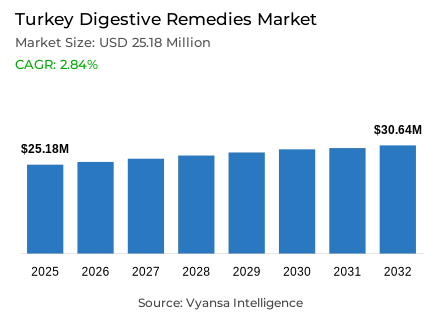
- Digestive remedies market size in Turkey was valued at USD 25.18 million in 2025 and is estimated at USD 26.35 Million in 2026.
- The market size is expected to grow to USD 30.64 million by 2032.
- Market to register a CAGR of around 2.84% during 2026-32.
- Product Type Shares
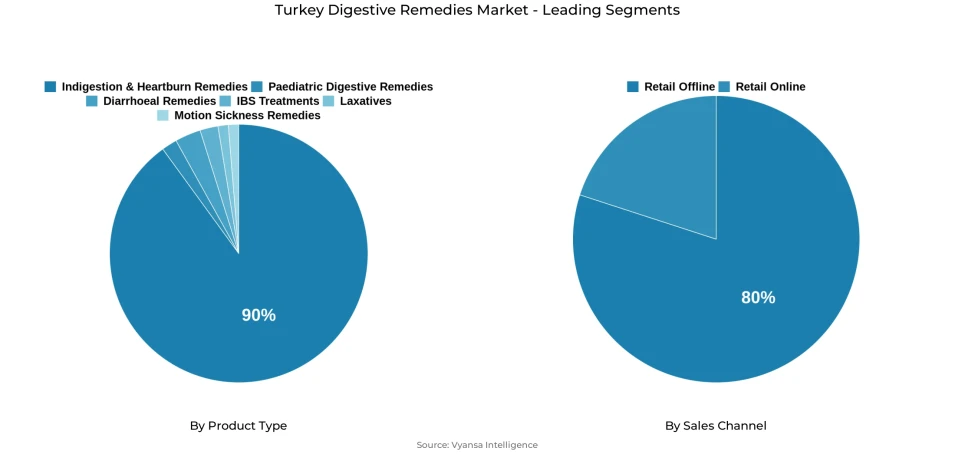
- Indigestion & heartburn remedies grabbed market share of 90%.
- Competition
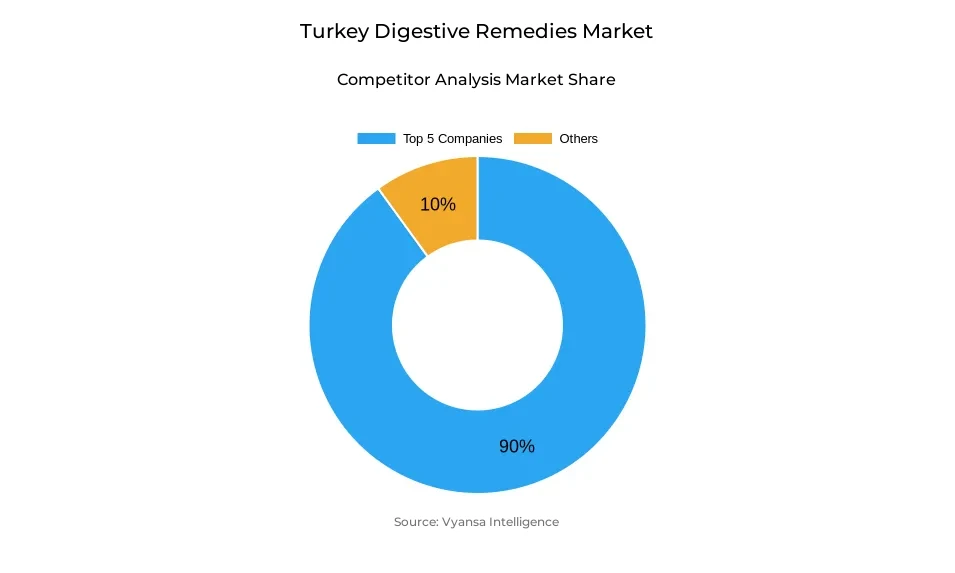
- More than 5 companies are actively engaged in producing digestive remedies in Turkey.
- Top 5 companies acquired around 90% of the market share.
- Berko Ilac ve Kimya Sanayi AS, Serana Pharma Ilac Ltd, Zed Ilac Feyza Farma Kimya ve Sanayi AS, Bayer Turk Kimya Sanayi Ltd Sti, GlaxoSmithKline Ilaclari Sanayi AS etc., are few of the top companies.
- Sales Channel
- Retail offline grabbed 80% of the market.
Turkey Digestive Remedies Market Outlook
Turkey digestive remedies market was valued at USD 25.18 million in 2025 and is projected to expand from USD 26.35 million in 2026 to USD 30.64 million by 2032, registering a CAGR of 2.84% over the forecast period. This expansion is supported by the rising stress rates, financial strain, and changing everyday habits, which continue to increase the rates of digestive uneasiness and maintain a consistent demand throughout the industry.
The increased anxiety related to financial strain and uncertainty still affects the gastrointestinal health negatively, triggering the increased frequency of indigestion, heartburn, and other gastric discomfort. This maintains the relevance of digestive remedies for consumers desiring swift and convenient relief in their quotidian lives. At the same time, the common trends of dining out, takeaway food, and inconsistent eating habits among busy consumers contribute to the aggravation of digestive problems and support the long-term need in the category.
The demand of products is still highly focused on fast-relief products. Within product type, indigestion & heartburn remedies comprise 90% of the market, mirroring a strong consumer preference for easily accessible and straightforward products. The convenient packs, including sachets and portable packs, are also becoming significant as working consumers are demanding convenient packs that can be used during long working hours, commuting, and on-the-go.
The category is also guided by competition, with probiotics, fibre supplements, fortified foods, and probiotic yoghurt increasingly being used as preventive against mild digestive problems. Nevertheless, digestive remedies retain a robust role in symptom relief and routine usage. Within sales channel, retail offline commands 80% of the market, underpinned by persistent consumer dependence on pharmacies and physical stores for credible products, repeat transactions, and prompt access to relief.
Turkey Digestive Remedies Market Growth DriverStress-Linked Digestive Discomfort Supports Everyday Relief
Persistently increasing stress levels sustain the demand for digestive remedies in Turkey. High anxiety is supported by economic pressure, political instability, and the consequences of recent crisis and often affects the gastrointestinal system. As a result, conditions like indigestion, heartburn, and other gastric related discomforts are becoming more common in daily life, thus continuing to make antacids and similar over-the-counter digestive products relevant in the quick and convenient relief of symptoms.
This pressure is supported by statistical evidence. Turkey’s consumer price index increased by 33.29% year‑on‑year in September 2025, whereas the composite labour under utilisation rate reached 28.5% in the first quarter of 2025. These circumstances sustain elevated financial and occupational stress, thereby encouraging the ongoing utilisation of digestive remedies for stress‑induced gastrointestinal complaints.
Turkey Digestive Remedies Market ChallengePreventive Nutrition Alternatives Create Competitive Pressure
The increasing adoption of probiotics, fibre supplements, fortified foods, and probiotic yoghurt exerts pressure on conventional digestive remedies in Turkey. Many consumers are increasingly preferring products that prevent digestive issues instead of treating them after they occur. This shift is especially important in the case of mild gastrointestinal disorders, where packaged foods and wellness supplements are increasingly being seen as more convenient, natural, and more appropriate to long-term digestive support.
Availability of these options is also increasing. According to the Ministry of Trade, the volume of e-commerce in Turkey in 2024 was more than TRY 3 trillion, with retail e-commerce being TRY 1.619 trillion, and total transactions amounting to 5.91 billion. This expanded digital footprint enhances the availability of preventive digestive health alternatives, thereby intensifying competition for conventional over‑the‑counter digestive remedies.
Unlock Market Intelligence
Explore the market potential with our data-driven report
Turkey Digestive Remedies Market TrendConvenient Formats Match Fast-Paced Daily Routines
In Turkey, the role of easy formats is increasing because consumers are demanding faster and simpler ways of dealing with digestive discomfort. Sachet-packaged and other portable packaged products are more suitable to the longer working hours, commuting, and irregular feeding patterns. This trend strengthens the attraction towards packaging and dosage forms that offer speed, convenience and ease of use without interfering with the daily routine.
This change is supported by the size of the workforce. In the first quarter of 2025, Turkey reported 32.389 million employed individuals, and the employment rate was 48.9%. A substantial active cohort with demanding schedules is more inclined to favor digestive remedies that are practical to transport and ingest, thereby sustaining the relevance of convenient formats and on‑the‑go packaging within the category.
Turkey Digestive Remedies Market OpportunityYounger Adults Create Space for More Tailored Solutions
A growing market opportunity exists in products that are customized to younger adults with active and unpredictable lifestyles. Frequent eating out, fast-food intake, takeaway food, and strict work schedules are making digestive discomfort more common among the younger generations. This situation gives brands the opportunity to create digestive solutions that are more appealing to younger consumers, with modern formats, simple dosing, and direct positioning around daily digestive support.
The size of Turkey gives this opportunity meaning. According to the Turkish Statistical Institute, the population stood at 86,092,168 in 2025. Within such an extensive consumer base, younger urban and working adults constitute a pivotal target segment for digestive remedies that address stress, hurried meals, and convenience‑driven eating habits. This provides a niche to products that are placed in the context of active lifestyles and frequent digestive discomfort.
Unlock Market Intelligence
Explore the market potential with our data-driven report
Turkey Digestive Remedies Market Segmentation Analysis
By Product Type
- Paediatric Digestive Remedies
- Paediatric Diarrhoeal Remedies
- Paediatric Indigestion & Heartburn Remedies
- Paediatric Laxatives
- Paediatric Motion Sickness Remedies
- Diarrhoeal Remedies
- IBS Treatments
- Indigestion & Heartburn Remedies
- Antacids
- Antiflatulents
- Digestive Enzymes
- H2 Blockers
- Proton Pump Inhibitors
- Laxatives
- Motion Sickness Remedies
The segment commands the greatest share within the product type category, wherein indigestion & heartburn remedies hold 90% of the market. This leading role is maintained because these products meet the most urgent and common digestive complaints in Turkey. Acidity, heartburn, and indigestion are often triggered by stress, irregular meals, eating out, and use of takeaways, making quick-relief products the most commonly chosen product group.
This segment has a strong everyday relevance as well. Consumers mainly want remedies that are fast acting, easily available and can be used without much inconvenience to everyday life. As a result, the indigestion and heartburn products still dominate the products demand and are the focus of the digestive care purchases in the country.
By Sales Channel
- Retail Online
- Retail Offline
- Hospitals
- Clinics
- Pharmacies
The segment attains the greatest share within the sales channel category, where retail offline commands 80% of the market. This channel prevails because digestive remedies are predominantly purchased for immediate relief, and numerous Turkish consumers continue to rely on pharmacies and physical outlets for swift access, trusted brands, and pharmacist guidance. Repeat purchases are also promoted by offline transactions especially when it comes to popular antacids and other digestive products that are used regularly.
The regulated pharmacy system in Turkey reinforces this position. Turkish Medicines and Medical Devices Agency (TİTCK) continued to offer pharmacy placement in 2025 under the Eczacı Yerleştirme Sistemi (EYS), which offered a formal placement application period between 12 June 2025 and 11 July 2025 in accordance with the legislation and regulations of pharmacists and pharmacies. This pharmacy-based system maintains the core of retail offline in the sale of digestive remedies.
List of Companies Covered in Turkey Digestive Remedies Market
The companies listed below are highly influential in the Turkey digestive remedies market, with a significant market share and a strong impact on industry developments.
- Berko Ilac ve Kimya Sanayi AS
- Serana Pharma Ilac Ltd
- Zed Ilac Feyza Farma Kimya ve Sanayi AS
- Bayer Turk Kimya Sanayi Ltd Sti
- GlaxoSmithKline Ilaclari Sanayi AS
- Johnson & Johnson Sihhi Malzeme San ve Tic AS
- OTC Istanbul Ilac Paz Ith Ihr Ltd
Competitive Landscape
The competitive landscape of digestive remedies in Turkey is largely dominated by multinational players, with Bayer Türk Kimya Sanayi Ltd Şti maintaining a leading position due to the strong recognition and trust associated with its key brands Rennie and Talcid. These products benefit from frequent doctor recommendations and widespread consumer acceptance, reinforcing Bayer’s dominance. However, competition is intensifying from both Rx alternatives and probiotic-based products. Prescription brands such as Lansol are perceived as more effective and are often more affordable due to reimbursement policies, posing a significant challenge to OTC players. Additionally, the growing popularity of probiotic foods and supplements is reshaping the market by shifting consumer focus toward preventive healthcare. As a result, while established OTC brands continue to rely on trust and efficacy, competitive pressure is increasing from both medical and wellness-oriented alternatives.
Frequently Asked Questions
Related Report
- Market Segmentation
- Research Scope
- Research Methodology
- Definitions and Assumptions
- Executive Summary
- Turkey Digestive Remedies Market Policies, Regulations, and Standards
- Turkey Digestive Remedies Market Dynamics
- Growth Factors
- Challenges
- Trends
- Opportunities
- Turkey Digestive Remedies Market Statistics, 2022-2032F
- Market Size & Growth Outlook
- By Revenues in USD Million
- Market Segmentation & Growth Outlook
- By Product Type
- Paediatric Digestive Remedies- Market Insights and Forecast 2022-2032, USD Million
- Paediatric Diarrhoeal Remedies- Market Insights and Forecast 2022-2032, USD Million
- Paediatric Indigestion & Heartburn Remedies- Market Insights and Forecast 2022-2032, USD Million
- Paediatric Laxatives- Market Insights and Forecast 2022-2032, USD Million
- Paediatric Motion Sickness Remedies- Market Insights and Forecast 2022-2032, USD Million
- Diarrhoeal Remedies- Market Insights and Forecast 2022-2032, USD Million
- IBS Treatments- Market Insights and Forecast 2022-2032, USD Million
- Indigestion & Heartburn Remedies- Market Insights and Forecast 2022-2032, USD Million
- Antacids- Market Insights and Forecast 2022-2032, USD Million
- Antiflatulents- Market Insights and Forecast 2022-2032, USD Million
- Digestive Enzymes- Market Insights and Forecast 2022-2032, USD Million
- H2 Blockers- Market Insights and Forecast 2022-2032, USD Million
- Proton Pump Inhibitors- Market Insights and Forecast 2022-2032, USD Million
- Laxatives- Market Insights and Forecast 2022-2032, USD Million
- Motion Sickness Remedies- Market Insights and Forecast 2022-2032, USD Million
- Paediatric Digestive Remedies- Market Insights and Forecast 2022-2032, USD Million
- By Age Group
- Children & Adolescents (01-17 years)- Market Insights and Forecast 2022-2032, USD Million
- Adults (18-65 years)- Market Insights and Forecast 2022-2032, USD Million
- Geriatric (65+ years)- Market Insights and Forecast 2022-2032, USD Million
- By Sales Channel
- Retail Online- Market Insights and Forecast 2022-2032, USD Million
- Retail Offline- Market Insights and Forecast 2022-2032, USD Million
- Hospitals- Market Insights and Forecast 2022-2032, USD Million
- Clinics- Market Insights and Forecast 2022-2032, USD Million
- Pharmacies- Market Insights and Forecast 2022-2032, USD Million
- By Competitors
- Competition Characteristics
- Market Share & Analysis
- By Product Type
- Market Size & Growth Outlook
- Turkey Paediatric Digestive Remedies Market Statistics, 2022-2032
- Market Size & Growth Outlook
- By Revenues in USD Million
- Market Segmentation & Growth Outlook
- By Age Group- Market Insights and Forecast 2022-2032, USD Million
- By Sales Channel- Market Insights and Forecast 2022-2032, USD Million
- Market Size & Growth Outlook
- Turkey Diarrhoeal Remedies Market Statistics, 2022-2032
- Market Size & Growth Outlook
- By Revenues in USD Million
- Market Segmentation & Growth Outlook
- By Age Group- Market Insights and Forecast 2022-2032, USD Million
- By Sales Channel- Market Insights and Forecast 2022-2032, USD Million
- Market Size & Growth Outlook
- Turkey IBS Treatments Market Statistics, 2022-2032
- Market Size & Growth Outlook
- By Revenues in USD Million
- Market Segmentation & Growth Outlook
- By Age Group- Market Insights and Forecast 2022-2032, USD Million
- By Sales Channel- Market Insights and Forecast 2022-2032, USD Million
- Market Size & Growth Outlook
- Turkey Indigestion & Heartburn Remedies Market Statistics, 2022-2032
- Market Size & Growth Outlook
- By Revenues in USD Million
- Market Segmentation & Growth Outlook
- By Age Group- Market Insights and Forecast 2022-2032, USD Million
- By Sales Channel- Market Insights and Forecast 2022-2032, USD Million
- Market Size & Growth Outlook
- Turkey Laxatives Market Statistics, 2022-2032
- Market Size & Growth Outlook
- By Revenues in USD Million
- Market Segmentation & Growth Outlook
- By Age Group- Market Insights and Forecast 2022-2032, USD Million
- By Sales Channel- Market Insights and Forecast 2022-2032, USD Million
- Market Size & Growth Outlook
- Turkey Motion Sickness Remedies Market Statistics, 2022-2032
- Market Size & Growth Outlook
- By Revenues in USD Million
- Market Segmentation & Growth Outlook
- By Age Group- Market Insights and Forecast 2022-2032, USD Million
- By Sales Channel- Market Insights and Forecast 2022-2032, USD Million
- Market Size & Growth Outlook
- Competitive Outlook
- Company Profiles
- Bayer Turk Kimya Sanayi Ltd Sti
- Business Description
- Product Portfolio
- Collaborations & Alliances
- Recent Developments
- Financial Details
- Others
- GlaxoSmithKline Ilaclari Sanayi AS
- Business Description
- Product Portfolio
- Collaborations & Alliances
- Recent Developments
- Financial Details
- Others
- Berko Ilac ve Kimya Sanayi AS
- Business Description
- Product Portfolio
- Collaborations & Alliances
- Recent Developments
- Financial Details
- Others
- Serana Pharma Ilac Ltd
- Business Description
- Product Portfolio
- Collaborations & Alliances
- Recent Developments
- Financial Details
- Others
- Zed Ilac Feyza Farma Kimya ve Sanayi AS
- Business Description
- Product Portfolio
- Collaborations & Alliances
- Recent Developments
- Financial Details
- Others
- Johnson & Johnson Sihhi Malzeme San ve Tic AS
- Business Description
- Product Portfolio
- Collaborations & Alliances
- Recent Developments
- Financial Details
- Others
- OTC Istanbul Ilac Paz Ith Ihr Ltd
- Business Description
- Product Portfolio
- Collaborations & Alliances
- Recent Developments
- Financial Details
- Others
- Others
- Business Description
- Product Portfolio
- Collaborations & Alliances
- Recent Developments
- Financial Details
- Others
- Bayer Turk Kimya Sanayi Ltd Sti
- Company Profiles
- Disclaimer
| Segment | Sub-Segment |
|---|---|
| By Product Type |
|
| By Age Group |
|
| By Sales Channel |
|
Research Methodology
This study followed a structured approach comprising four key phases to assess the size and scope of the electro-oxidation market. The process began with thorough secondary research to collect data on the target market, related markets, and broader industry context. These findings, along with preliminary assumptions and estimates, were then validated through extensive primary research involving industry experts from across the value chain. To calculate the overall market size, both top-down and bottom-up methodologies were employed. Finally, market segmentation and data triangulation techniques were applied to refine and validate segment-level estimations.
Secondary Research
The secondary research phase involved gathering data from a wide range of credible and published sources. This step helped in identifying industry trends, defining market segmentation, and understanding the market landscape and value chain.
Sources consulted during this phase included:
- Company annual reports, investor presentations, and press releases
- Industry white papers and certified publications
- Trade directories and market-recognized databases
- Articles from authoritative authors and reputable journals
- Gold and silver standard websites
Secondary research was critical in mapping out the industry's value chain and monetary flow, identifying key market segments, understanding regional variations, and tracking significant industry developments.
Other key sources:
- Financial disclosures
- Industry associations and trade bodies
- News outlets and business magazines
- Academic journals and research studies
- Paid industry databases
Primary Research
To validate secondary data and gain deeper market insights, primary research was conducted with key stakeholders across both the supply and demand sides of the market.
On the demand side, participants included decision-makers and influencers from end-user industries—such as CIOs, CTOs, and CSOs—who provided first-hand perspectives on market needs, product usage, and future expectations.
On the supply side, interviews were conducted with manufacturers, industry associations, and institutional participants to gather insights into current offerings, product pipelines, and market challenges.
Primary interviews provided critical inputs such as:
- Market size and revenue data
- Product and service breakdowns
- Market forecasts
- Regional and application-specific trends
Stakeholders consulted included:
- Leading OEM and solution providers
- Channel and distribution partners
- End users across various applications
- Independent consultants and industry specialists
Market Size Estimation and Data Triangulation
- Identifying Key Market Participants (Secondary Research)
- Goal: To identify the major players or companies in the target market. This typically involves using publicly available data sources such as industry reports, market research publications, and financial statements of companies.
- Tools: Reports from firms like Gartner, Forrester, Euromonitor, Statista, IBISWorld, and others. Public financial statements, news articles, and press releases from top market players.
- Extracting Earnings of Key Market Participants
- Goal: To estimate the earnings generated from the product or service being analyzed. This step helps in understanding the revenue potential of each market player in a specific geography.
- Methods: Earnings data can be gathered from:
- Publicly available financial reports (for listed companies).
- Interviews and primary data sources from professionals, such as Directors, VPs, SVPs, etc. This is especially useful for understanding more nuanced, internal data that isn't publicly disclosed.
- Annual reports and investor presentations of key players.
- Data Collation and Development of a Relevant Data Model
- Goal: To collate inputs from both primary and secondary sources into a structured, data-driven model for market estimation. This model will incorporate key market KPIs and any independent variables relevant to the market.
- Key KPIs: These could include:
- Market size, growth rate, and demand drivers.
- Industry-specific metrics like market share, average revenue per customer (ARPC), or average deal size.
- External variables, such as economic growth rates, inflation rates, or commodity prices, that could affect the market.
- Data Modeling: Based on this data, the market forecasts are developed for the next 5 years. A combination of trend analysis, scenario modeling, and statistical regression might be used to generate projections.
- Scenario Analysis
- Goal: To test different assumptions and validate how sensitive the market is to changes in key variables (e.g., market demand, regulatory changes, technological disruptions).
- Types of Scenarios:
- Base Case: Based on current assumptions and historical data.
- Best-Case Scenario: Assuming favorable market conditions, regulatory environments, and technological advancements.
- Worst-Case Scenario: Accounting for adverse factors, such as economic downturns, stricter regulations, or unexpected disruptions.












