Turkey Contact Lenses and Solutions Market Report: Trends, Growth and Forecast (2026-2032)
By Product Type (Contact Lenses (Standard Vision Correction Lenses, Myopia Control Lenses), Contact Lens Solutions), By Usage (Contact Lenses (Daily Disposable, Bi-Weekly, Monthly, Quarterly/Annual), Contact Lens Solutions (Daily-Use Care Solutions, Weekly/Periodic Deep-Clean Systems, Travel/Mini Packs)), By Material Type (Contact Lenses (Silicone Hydrogel, Hydrogel (Soft), Rigid Gas Permeable (RGP), Hybrid/Scleral/Specialty), Contact Lens Solutions (Multi-Purpose Solutions, Hydrogen Peroxide Systems, Saline Solutions, Enzymatic & Specialty Cleaners)), By Application (Contact Lenses (Spherical (Myopia/Hyperopia), Toric (Astigmatism), Multifocal (Presbyopia), Myopia Control, Cosmetic/Colored, Therapeutic/Medical), Contact Lens Solutions (Soft Lens Care, RGP Lens Care, Sensitive Eye/Preservative-Free Care)), By Sales Channel (Retail Offline (Optical Stores, Hospitals & Clinics, Others (Pharmacies, Beauty Centres, etc.)), Retail Online (Company-owned Portals, E-commerce Platforms)), By Pack Size (Contact Lenses (Trial Packs, Standard Packs, Bulk/Value Packs), Contact Lens Solutions (Up to 120 mL, 121–360 mL, Above 360 mL, Combo/Twin Packs)) ... Read more

|
Major Players
|
Turkey Contact Lenses and Solutions Market Statistics and Insights, 2026
- Market Size Statistics
- Contact lenses and solutions market size in Turkey was estimated at USD 45 million in 2025.
- The market size is expected to grow to USD 55 million by 2032.
- Market to register a CAGR of around 2.91% during 2026-32.
- Product Type Shares
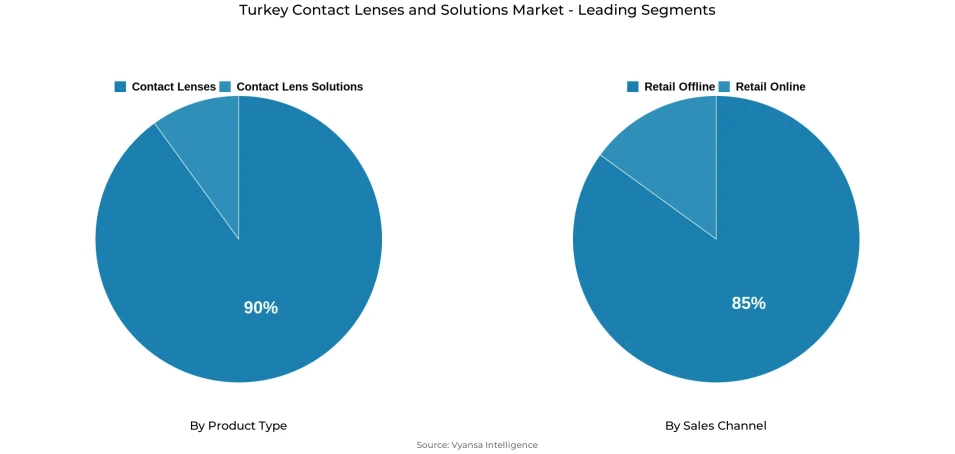
- Contact lenses grabbed market share of 90%.
- Competition
- More than 5 companies are actively engaged in producing contact lenses and solutions in Turkey.
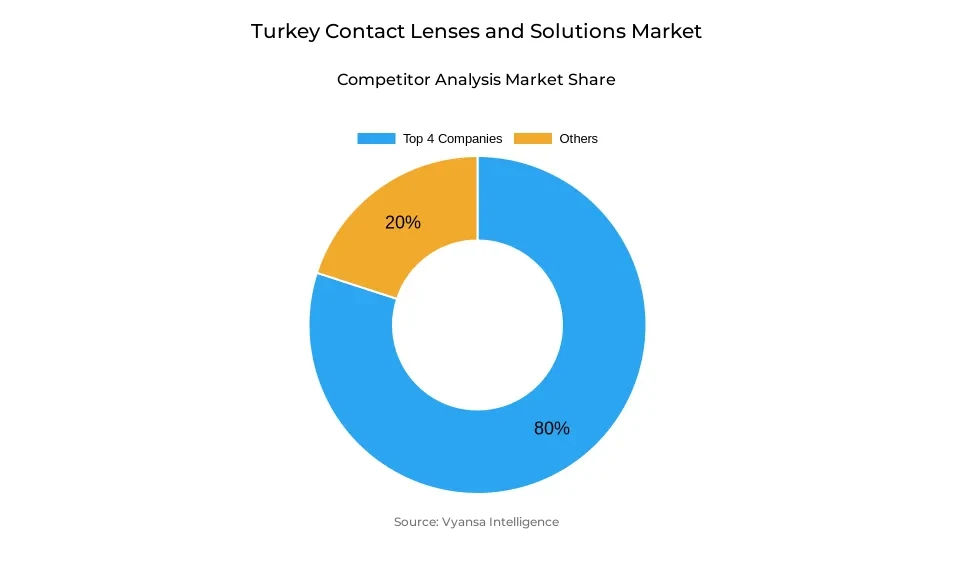
- Top 4 companies acquired around 80% of the market share.
- Cooper Cos Inc The, Alcon Laboratuvarları Tic AS, Johnson & Johnson Sıhhi Malzeme San ve Tic AS, Bausch & Lomb Saglık Optik Urunleri Tic AS etc., are few of the top companies.
- Sales Channel
- Retail offline grabbed 85% of the market.
Turkey Contact Lenses and Solutions Market Outlook
The Turkey contact lenses and solutions market size was valued at USD 45 million in 2025 and is projected to grow from USD 47 million in 2026 to USD 55 million by 2032, registering a CAGR of around 2.91% during 2026–32. Growth is primarily supported by rising digital exposure among children and adolescents. In 2024, 91.3% of children aged 6-15 in Turkey used the internet according to Turkish Statistical Institute (TURKSTAT), increasing concerns around screen-related vision issues and myopia. A 2024 JAMA Network Open meta-analysis (335,524 participants) reports that each additional hour of daily screen time raises the odds of myopia by 21%, reinforcing sustained demand for vision correction solutions.
At the same time, inflation also has an effect on purchasing decisions. Consumer price inflation stood at 30.65% year-over-year in January 2026 (Central Bank of the Republic of Türkiye). This impacts the replacement cycle and triggers price comparisons. Additionally, 23.3% of older people are at risk of poverty or social exclusion (TÜRKSTAT), thus creating affordability sensitivity among an important group for vision correction.
From a product point of view, the contact lens market has a 90% market share, which reflects a strong preference for corrective solutions over supportive ones. Looking at the distribution channel, offline retail contributes 85% to the market.
Demographic ageing further underpins steady demand. As of 2024, 10.6% of the population is aged 65+ (TURKSTAT), expanding the addressable base for multifocal and comfort-focused contact lenses and solutions, particularly among repeat users seeking reliable vision performance.
Turkey Contact Lenses and Solutions Market Growth DriverScreen-heavy childhood keeps myopia correction top-of-mind
Turkey’s children are deeply connected to digital devices, which keeps parents alert to vision issues that affect school performance and daily comfort. TURKSTAT reports that 91.3% of children aged 6–15 use the internet, highlighting how common sustained near-work and screen exposure is in this age group.
Medical evidence strengthens this awareness and supports earlier action. A 2024 systematic review and dose-response meta-analysis in JAMA Network Open (45 studies; 335,524 participants) finds that each additional hour of daily digital screen time is linked to 21% higher odds of myopia, with risk rising notably between 1 and 4 hours. That combination of high exposure and clear risk signals keeps demand for corrective options like contact lenses and related care solutions active.
Turkey Contact Lenses and Solutions Market ChallengeInflation-led price pressure strains affordability
High inflation keeps contact lenses and solutions expensive in day-to-day spending, even when consumers want better vision comfort. The Central Bank of the Republic of Türkiye lists TURKSTAT CPI inflation at 30.65% year-on-year in January 2026, with prices also up 4.84% month-on-month, so replacement cycles and solution purchases face constant budget scrutiny.
This pressure is clearest in older households that also need vision correction more often. TURKSTAT’s “Elderly Statistics 2024” shows 23.3% of elderly individuals are at risk of poverty or social exclusion (2024). With a meaningful share of the core user base under financial stress, shoppers actively compare prices, lean on promotions, and may delay upgrades—creating a structural affordability challenge for premium lenses and value-added solutions.
Unlock Market Intelligence
Explore the market potential with our data-driven report
Turkey Contact Lenses and Solutions Market TrendDigital guidance becomes part of lens usage
Lens wear and care is increasingly supported through digital touchpoints, not just in-store advice. TURKSTAT reports that 46.9% of people aged 65–74 use the internet, showing that even older, presbyopia-prone consumers are reachable through reminders, tutorials, and after-care content that improves handling and hygiene.
Health authorities are also shaping this digital lens journey indirectly by pushing safer viewing behavior on devices themselves. WHO and ITU issued a global standard for “safe viewing” devices and systems, aimed at building default features that influence viewing habits and screen time to protect eye health. Together, rising online reach and formal screen-health standards make app-based coaching, AI assistants, and digital adherence nudges a mainstream market trend.
Turkey Contact Lenses and Solutions Market OpportunityAgeing expands the pool for multifocal and comfort-focused lenses
Turkey’s demographic structure is already tilting older, which broadens the addressable base for contact lenses used for presbyopia and everyday visual comfort. TURKSTAT records 9,112,298 people aged 65+ in 2024, and this group accounts for 10.6% of the total population sizeable cohort that typically needs vision correction and professional follow-up during routine check-ups.
For the suppliers, the opportunity is to align these needs with products that can reduce friction in daily wear, particularly multifocal designs and materials that are positioned around comfort and dryness management. As optometrists and ophthalmologists reach out to older patients, brands that can provide easy fitting assistance, wear-and-care education, and availability can establish long-term loyalty with this growing market.
Unlock Market Intelligence
Explore the market potential with our data-driven report
Turkey Contact Lenses and Solutions Market Segmentation Analysis
By Product Type
- Contact Lenses
- Contact Lens Solutions
The segment has the highest share around segment under the product type is contact lenses, and this highest market share is 90%. This reflects how the main spend sits in the corrective device itself, while purchase decisions are closely tied to fit, comfort, and brand familiarity—factors that keep users anchored once they settle on a lens.
Solutions play a supporting role in the basket, mainly for cleaning, disinfecting, and storage routines among reusable-lens wearers. In practice, retailers and eye-care professionals often bundle solution recommendations with lens fittings, which helps maintain attachment rates even when consumers downtrade on pack sizes. Overall, the product mix remains dominated by lenses, with solutions purchased as a necessary companion for safe wear.
By Sales Channel
- Retail Offline
- Retail Online
The segment has the highest share around segment under the sales channel is retail offline, and this highest market share is 85%. Offline strength comes from the need for professional guidance—eye exams, first-time fittings, and power checks—plus the trust built through optical stores, clinics, and pharmacies.
Once users are established on a lens, offline outlets also stay relevant through refills and after-care, especially when consumers want quick availability or prefer to verify authenticity. Online purchasing exists, but it typically works best for repeat orders where the prescription is already set. In Turkey, the channel mix therefore stays anchored in offline retail, with digital options acting more as a convenience layer than a full replacement.
List of Companies Covered in Turkey Contact Lenses and Solutions Market
The companies listed below are highly influential in the Turkey contact lenses and solutions market, with a significant market share and a strong impact on industry developments.
- Cooper Cos Inc The
- Alcon Laboratuvarları Tic AS
- Johnson & Johnson Sıhhi Malzeme San ve Tic AS
- Bausch & Lomb Saglık Optik Urunleri Tic AS
Competitive Landscape
In 2025, Johnson & Johnson maintained its position as the leading company in Turkey’s contact lenses and solutions market. The competitive landscape at the national brand owner (NBO) level remained concentrated among four major international players—Johnson & Johnson, Bausch & Lomb, The Cooper Companies, and Alcon Laboratuvarları—reflecting a highly consolidated market structure. While Johnson & Johnson led in overall market presence, The Cooper Companies recorded the strongest growth performance during the year, supported by portfolio expansion and targeted commercial strategies. Market demand continued to favor lenses engineered for enhanced comfort, particularly products addressing dry eye concerns and incorporating additional benefits such as UV protection. Bausch & Lomb further strengthened its competitive standing through a strategic emphasis on innovation and operational excellence, highlighted by the introduction of ULTRA multifocal contact lenses, which contributed positively to brand visibility and value growth in the local market.
Frequently Asked Questions
Related Report
- Market Segmentation
- Research Scope
- Research Methodology
- Definitions and Assumptions
- Executive Summary
- Turkey Contact Lenses and Solution Market Policies, Regulations, and Standards
- Turkey Contact Lenses and Solution Market Dynamics
- Growth Factors
- Challenges
- Trends
- Opportunities
- Turkey Contact Lenses and Solution Market Statistics, 2022-2032F
- Market Size & Growth Outlook
- By Revenues in USD Million
- By Units Sold in Thousand Units
- Market Segmentation & Growth Outlook
- By Product Type
- Contact Lenses- Market Insights and Forecast 2022-2032, USD Million
- Standard Vision Correction Lenses- Market Insights and Forecast 2022-2032, USD Million
- Myopia Control Lenses- Market Insights and Forecast 2022-2032, USD Million
- Contact Lens Solutions- Market Insights and Forecast 2022-2032, USD Million
- Contact Lenses- Market Insights and Forecast 2022-2032, USD Million
- By Usage
- Contact Lenses- Market Insights and Forecast 2022-2032, USD Million
- Daily Disposable- Market Insights and Forecast 2022-2032, USD Million
- Bi-Weekly- Market Insights and Forecast 2022-2032, USD Million
- Monthly- Market Insights and Forecast 2022-2032, USD Million
- Quarterly/Annual- Market Insights and Forecast 2022-2032, USD Million
- Contact Lens Solutions- Market Insights and Forecast 2022-2032, USD Million
- Daily-Use Care Solutions- Market Insights and Forecast 2022-2032, USD Million
- Weekly/Periodic Deep-Clean Systems- Market Insights and Forecast 2022-2032, USD Million
- Travel/Mini Packs- Market Insights and Forecast 2022-2032, USD Million
- Contact Lenses- Market Insights and Forecast 2022-2032, USD Million
- By Material Type
- Contact Lenses- Market Insights and Forecast 2022-2032, USD Million
- Silicone Hydrogel- Market Insights and Forecast 2022-2032, USD Million
- Hydrogel (Soft)- Market Insights and Forecast 2022-2032, USD Million
- Rigid Gas Permeable (RGP)- Market Insights and Forecast 2022-2032, USD Million
- Hybrid/Scleral/Specialty- Market Insights and Forecast 2022-2032, USD Million
- Contact Lens Solutions- Market Insights and Forecast 2022-2032, USD Million
- Multi-Purpose Solutions- Market Insights and Forecast 2022-2032, USD Million
- Hydrogen Peroxide Systems- Market Insights and Forecast 2022-2032, USD Million
- Saline Solutions- Market Insights and Forecast 2022-2032, USD Million
- Enzymatic & Specialty Cleaners- Market Insights and Forecast 2022-2032, USD Million
- Contact Lenses- Market Insights and Forecast 2022-2032, USD Million
- By Application
- Contact Lenses- Market Insights and Forecast 2022-2032, USD Million
- Spherical (Myopia/Hyperopia)- Market Insights and Forecast 2022-2032, USD Million
- Toric (Astigmatism)- Market Insights and Forecast 2022-2032, USD Million
- Multifocal (Presbyopia)- Market Insights and Forecast 2022-2032, USD Million
- Myopia Control- Market Insights and Forecast 2022-2032, USD Million
- Cosmetic/Colored- Market Insights and Forecast 2022-2032, USD Million
- Therapeutic/Medical- Market Insights and Forecast 2022-2032, USD Million
- Contact Lens Solutions- Market Insights and Forecast 2022-2032, USD Million
- Soft Lens Care- Market Insights and Forecast 2022-2032, USD Million
- RGP Lens Care- Market Insights and Forecast 2022-2032, USD Million
- Sensitive Eye/Preservative-Free Care- Market Insights and Forecast 2022-2032, USD Million
- Contact Lenses- Market Insights and Forecast 2022-2032, USD Million
- By Sales Channel
- Retail Offline- Market Insights and Forecast 2022-2032, USD Million
- Optical Stores- Market Insights and Forecast 2022-2032, USD Million
- Hospitals & Clinics- Market Insights and Forecast 2022-2032, USD Million
- Others (Pharmacies, Beauty Centres, etc.)- Market Insights and Forecast 2022-2032, USD Million
- Retail Online- Market Insights and Forecast 2022-2032, USD Million
- Company-owned Portals- Market Insights and Forecast 2022-2032, USD Million
- E-commerce Platforms- Market Insights and Forecast 2022-2032, USD Million
- Retail Offline- Market Insights and Forecast 2022-2032, USD Million
- By Pack Size
- Contact Lenses- Market Insights and Forecast 2022-2032, USD Million
- Trial Packs- Market Insights and Forecast 2022-2032, USD Million
- Standard Packs- Market Insights and Forecast 2022-2032, USD Million
- Bulk/Value Packs- Market Insights and Forecast 2022-2032, USD Million
- Contact Lens Solutions- Market Insights and Forecast 2022-2032, USD Million
- Up to 120 mL- Market Insights and Forecast 2022-2032, USD Million
- 121–360 mL- Market Insights and Forecast 2022-2032, USD Million
- Above 360 mL- Market Insights and Forecast 2022-2032, USD Million
- Combo/Twin Packs- Market Insights and Forecast 2022-2032, USD Million
- Contact Lenses- Market Insights and Forecast 2022-2032, USD Million
- By Competitors
- Competition Characteristics
- Market Share & Analysis
- By Product Type
- Market Size & Growth Outlook
- Turkey Contact Lenses Market Statistics, 2022-2032
- Market Size & Growth Outlook
- By Revenues in USD Million
- By Units Sold in Thousand Units
- Market Segmentation & Growth Outlook
- By Usage- Market Insights and Forecast 2022-2032, USD Million
- By Material Type- Market Insights and Forecast 2022-2032, USD Million
- By Application- Market Insights and Forecast 2022-2032, USD Million
- By Sales Channel- Market Insights and Forecast 2022-2032, USD Million
- By Pack Size- Market Insights and Forecast 2022-2032, USD Million
- Market Size & Growth Outlook
- Turkey Contact Lens Solutions Market Statistics, 2022-2032
- Market Size & Growth Outlook
- By Revenues in USD Million
- By Units Sold in Thousand Units
- Market Segmentation & Growth Outlook
- By Usage- Market Insights and Forecast 2022-2032, USD Million
- By Material Type- Market Insights and Forecast 2022-2032, USD Million
- By Application- Market Insights and Forecast 2022-2032, USD Million
- By Sales Channel- Market Insights and Forecast 2022-2032, USD Million
- By Pack Size- Market Insights and Forecast 2022-2032, USD Million
- Market Size & Growth Outlook
- Competitive Outlook
- Company Profiles
- Johnson & Johnson Sihhi Malzeme San ve Tic AS
- Business Description
- Product Portfolio
- Collaborations & Alliances
- Recent Developments
- Financial Details
- Others
- Bausch & Lomb Saglik Optik Ürünleri Tic AS
- Business Description
- Product Portfolio
- Collaborations & Alliances
- Recent Developments
- Financial Details
- Others
- Cooper Cos Inc The
- Business Description
- Product Portfolio
- Collaborations & Alliances
- Recent Developments
- Financial Details
- Others
- Alcon Laboratuvarlari Tic AS
- Business Description
- Product Portfolio
- Collaborations & Alliances
- Recent Developments
- Financial Details
- Others
- Johnson & Johnson Sihhi Malzeme San ve Tic AS
- Company Profiles
- Disclaimer
| Segment | Sub-Segment |
|---|---|
| By Product Type |
|
| By Usage |
|
| By Material Type |
|
| By Application |
|
| By Sales Channel |
|
| By Pack Size |
|
Research Methodology
This study followed a structured approach comprising four key phases to assess the size and scope of the electro-oxidation market. The process began with thorough secondary research to collect data on the target market, related markets, and broader industry context. These findings, along with preliminary assumptions and estimates, were then validated through extensive primary research involving industry experts from across the value chain. To calculate the overall market size, both top-down and bottom-up methodologies were employed. Finally, market segmentation and data triangulation techniques were applied to refine and validate segment-level estimations.
Secondary Research
The secondary research phase involved gathering data from a wide range of credible and published sources. This step helped in identifying industry trends, defining market segmentation, and understanding the market landscape and value chain.
Sources consulted during this phase included:
- Company annual reports, investor presentations, and press releases
- Industry white papers and certified publications
- Trade directories and market-recognized databases
- Articles from authoritative authors and reputable journals
- Gold and silver standard websites
Secondary research was critical in mapping out the industry's value chain and monetary flow, identifying key market segments, understanding regional variations, and tracking significant industry developments.
Other key sources:
- Financial disclosures
- Industry associations and trade bodies
- News outlets and business magazines
- Academic journals and research studies
- Paid industry databases
Primary Research
To validate secondary data and gain deeper market insights, primary research was conducted with key stakeholders across both the supply and demand sides of the market.
On the demand side, participants included decision-makers and influencers from end-user industries—such as CIOs, CTOs, and CSOs—who provided first-hand perspectives on market needs, product usage, and future expectations.
On the supply side, interviews were conducted with manufacturers, industry associations, and institutional participants to gather insights into current offerings, product pipelines, and market challenges.
Primary interviews provided critical inputs such as:
- Market size and revenue data
- Product and service breakdowns
- Market forecasts
- Regional and application-specific trends
Stakeholders consulted included:
- Leading OEM and solution providers
- Channel and distribution partners
- End users across various applications
- Independent consultants and industry specialists
Market Size Estimation and Data Triangulation
- Identifying Key Market Participants (Secondary Research)
- Goal: To identify the major players or companies in the target market. This typically involves using publicly available data sources such as industry reports, market research publications, and financial statements of companies.
- Tools: Reports from firms like Gartner, Forrester, Euromonitor, Statista, IBISWorld, and others. Public financial statements, news articles, and press releases from top market players.
- Extracting Earnings of Key Market Participants
- Goal: To estimate the earnings generated from the product or service being analyzed. This step helps in understanding the revenue potential of each market player in a specific geography.
- Methods: Earnings data can be gathered from:
- Publicly available financial reports (for listed companies).
- Interviews and primary data sources from professionals, such as Directors, VPs, SVPs, etc. This is especially useful for understanding more nuanced, internal data that isn't publicly disclosed.
- Annual reports and investor presentations of key players.
- Data Collation and Development of a Relevant Data Model
- Goal: To collate inputs from both primary and secondary sources into a structured, data-driven model for market estimation. This model will incorporate key market KPIs and any independent variables relevant to the market.
- Key KPIs: These could include:
- Market size, growth rate, and demand drivers.
- Industry-specific metrics like market share, average revenue per customer (ARPC), or average deal size.
- External variables, such as economic growth rates, inflation rates, or commodity prices, that could affect the market.
- Data Modeling: Based on this data, the market forecasts are developed for the next 5 years. A combination of trend analysis, scenario modeling, and statistical regression might be used to generate projections.
- Scenario Analysis
- Goal: To test different assumptions and validate how sensitive the market is to changes in key variables (e.g., market demand, regulatory changes, technological disruptions).
- Types of Scenarios:
- Base Case: Based on current assumptions and historical data.
- Best-Case Scenario: Assuming favorable market conditions, regulatory environments, and technological advancements.
- Worst-Case Scenario: Accounting for adverse factors, such as economic downturns, stricter regulations, or unexpected disruptions.












