Thailand Room Air Conditioners Market Report: Trends, Growth and Forecast (2026-2032)
By Product Type (Split Air Conditioners (Up to 9,000 BTU/h, 9,001-12,000 BTU/h, 12,001-18,000 BTU/h, 18,001-24,000 BTU/h, Above 24,000 BTU/h), Window Air Conditioners (Up to 9,000 BTU/h, 9,001-12,000 BTU/h, 12,001-18,000 BTU/h, 18,001-24,000 BTU/h, Above 24,000 BTU/h), Others), By Technology (Inverter, Non-Inverter), By Price (Up to USD 300, USD 301 to USD 600, USD 601 to USD 1,000, Above USD 1,000), By End User (Residential (Individual Households, Apartments/Condominiums, Vacation/Secondary Homes), Commercial (Offices, Retail Stores/Showrooms, Hospitality, Healthcare Facilities, Educational Institutions, Small Commercial Establishments, Others)), By Sales Channel (Retail Online (Brand-Owned Websites/D2C, E-Commerce Marketplaces), Retail Offline (Exclusive Brand Stores, Multi-Brand Electronics & Appliance Stores, Specialty Stores, Hypermarkets/Supermarkets, Home Improvement Stores, Dealer/Distributor Network, Direct Sales/Institutional Sales, Local Independent Retailers)), By Refrigerant Type (R-32, R-410A, R-290, R-454B, Others), By Connectivity (Smart/Connected, Conventional/Non-Smart), By Energy Efficiency (1 Star, 2 Star, 3 Star, 4 Star, 5 Star) ... Read more
|
Major Players
|
Thailand Room Air Conditioners Market Statistics and Insights, 2026
- Market Size Statistics
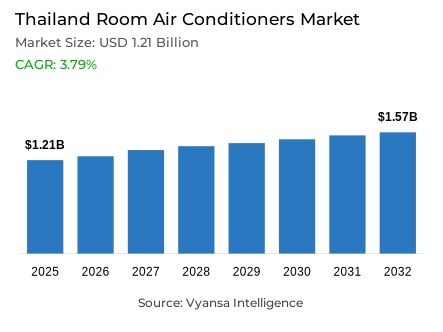
- Room air conditioners market size in Thailand was valued at USD 1.21 billion in 2025 and is estimated at USD 1.41 billion in 2026.
- The market size is expected to grow to USD 1.57 billion by 2032.
- Market to register a CAGR of around 3.79% during 2026-32.
- Product Type Shares
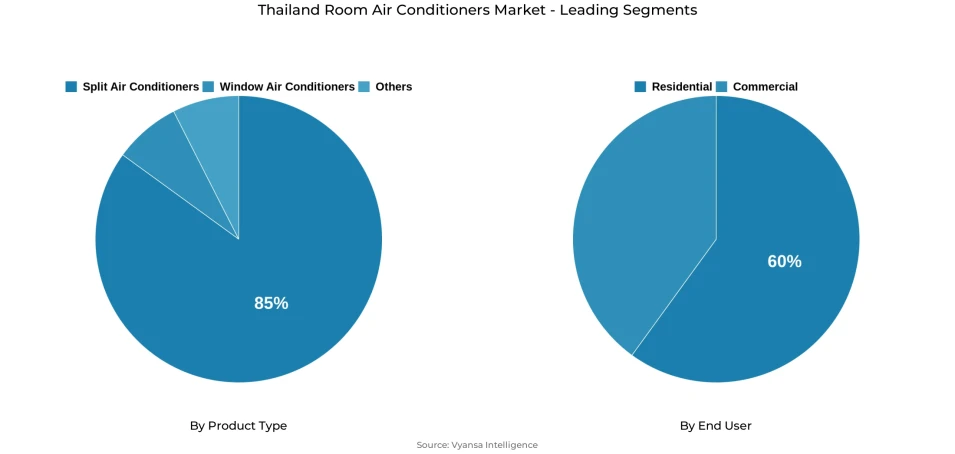
- Split air conditioners grabbed market share of 85%.
- Competition
- More than 10 companies are actively engaged in producing room air conditioners in Thailand.
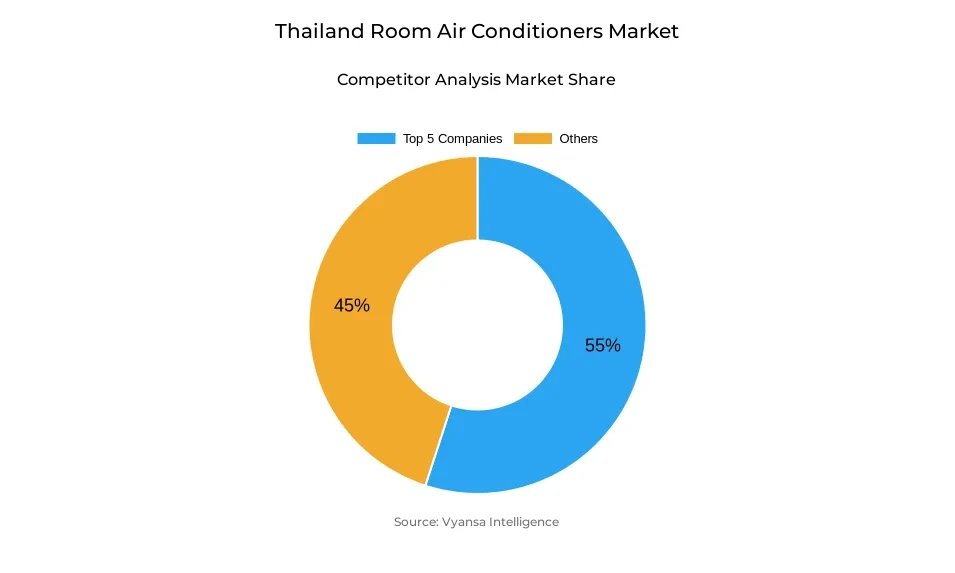
- Top 5 companies acquired around 55% of the market share.
- Daikin Industries Ltd, LG Corp, Carrier Global Corp, TCL Corp, Mitsubishi Electric Corp etc., are few of the top companies.
- End User
- Residential grabbed 60% of the market.
Thailand Room Air Conditioners Market Outlook
Thailand room air conditioners market was valued at USD 1.21 billion in 2025 and is projected to grow from USD 1.41 billion in 2026 to USD 1.57 billion by 2032, exhibiting a CAGR of 3.79% during the forecast period. This reflects a stable expansion trajectory supported by consistent cooling demand and structured product adoption. The implication is that growth is driven by sustained household usage and replacement cycles rather than short-term demand spikes.
The segment with highest market share under the Product Type is Split Air Conditioners, accounting for approximately 85% of the total market. This dominance reflects strong alignment with residential cooling needs and widespread acceptance of split systems. The implication is that product innovation, pricing, and competitive strategies remain concentrated within this segment, reinforcing its role as the primary revenue driver.
The segment with highest market share under the End User is Residential, accounting for approximately 60% of the total market. This reflects the strong linkage between air conditioners and daily household comfort requirements. The implication is that purchasing behavior is heavily influenced by home usage patterns, making residential demand the key determinant of market direction.
The market is expected to grow from USD 1.41 billion in 2026 to USD 1.57 billion by 2032, maintaining a steady upward trajectory. This growth is supported by strong split-system penetration and consistent residential demand. The implication is that the market will continue to expand through stable core demand and efficiency-led upgrades through 2032.
Thailand Room Air Conditioners Market Growth DriverRising Temperature Extremes Sustaining Continuous Cooling Demand
Monthly mean temperatures in April 2024 were recorded at 2.6°C above the national average, with the northeastern region experiencing an even higher deviation of 3.8°C above normal, according to the Thai Meteorological Department. These are not minor deviations. When temperatures consistently overshoot historical norms by that margin, cooling stops being seasonal and becomes something households depend on year-round. Demand pressure follows.
Thoen in Lampang hit 44.2°C a record with several other stations also logging new highs in April 2024. Heat at that intensity keeps replacement demand from softening; households that might otherwise defer an upgrade decision tend not to when the alternative is a failing unit in extreme heat. Temperature trends more than any single policy measure give this market its underlying resilience through 2032.
Thailand Room Air Conditioners Market ChallengeMandatory Efficiency Standards Increasing Compliance Complexity
Thailand's TIS 2134-2565 energy efficiency standard for room air conditioners becomes mandatory on 4 April 2026, covering units up to 18,000 W across defined voltage ranges, per the Thai Industrial Standards Institute. The deadline is fixed, and aligning product development timelines and certification processes across a broad portfolio before it arrives is operationally demanding. There is limited room for delay.
Complicating matters further, the regulation excludes HCFC-22 refrigerants and certain product categories meaning parts of existing portfolios may require redesign and recertification, not just documentation updates. For suppliers managing a wide range of SKUs, that combination of redesign scope and certification lead times creates real risk. Delayed launches and higher costs are the likely outcomes for those who don't get ahead of it before 2032.
Unlock Market Intelligence
Explore the market potential with our data-driven report
Thailand Room Air Conditioners Market TrendUnified Energy Labeling Strengthening Efficiency-Led Purchase Decisions
DEDE and EGAT signed an agreement in March 2025 to develop a unified national Energy Efficiency Label, according to the Electricity Generating Authority of Thailand. At the point of sale, that kind of standardization makes a difference Buyers comparing options benefit from consistent efficiency information, and when the signal is clearer, higher-rated products tend to win more often.
The new integrated Label No.5 covers 45 products and is scheduled to launch on 16 January 2026. As of August 2025, 520 million labels had already been distributed under the existing framework scale that gives the system genuine market reach from day one. Once the unified label is in place, the competitive advantage for higher-efficiency units becomes more visible and more consistent, which tends to pull adoption of energy-saving air conditioners forward through 2032.
Thailand Room Air Conditioners Market OpportunityService-Linked Efficiency Programs Creating Upgrade and Engagement Potential
EGAT's 2025 "Turn Summertime into Saving Season" campaign offers THB 200 discounts on air conditioner cleaning for Label No.5 units, with 15,000 quotas available across retail and online channels. Tying a service discount to a specific efficiency tier keeps existing users engaged with the product and that engagement matters because users who actively interact with their equipment are closer to upgrade decisions than those who aren't.
The numbers behind the campaign are concrete. Regular cleaning reduces electricity consumption by more than 23 units per month per unit, and across the full campaign, projected savings reach 2.14 million electricity units with emission reductions of 1,119 tCO2 per cycle. That's a measurable efficiency story, and brands that can tell it credibly have a real lever for driving upgrade cycles. Service programs with quantifiable running cost benefits are among the more practical tools available for expanding market penetration through 2032.
Unlock Market Intelligence
Explore the market potential with our data-driven report
Thailand Room Air Conditioners Market Segmentation Analysis
By Product Type
- Split Air Conditioners
- Up to 9,000 BTU/h
- 9,001-12,000 BTU/h
- 12,001-18,000 BTU/h
- 18,001-24,000 BTU/h
- Above 24,000 BTU/h
- Window Air Conditioners
- Up to 9,000 BTU/h
- 9,001-12,000 BTU/h
- 12,001-18,000 BTU/h
- 18,001-24,000 BTU/h
- Above 24,000 BTU/h
- Others
Split air conditioners hold approximately 85% of the total market. The format suits residential and light commercial settings well installation is flexible, end user are familiar with it, and it's available across a wide range of price points. That combination has made split systems the default across most buying situations, and both volume and revenue reflect that.
Competition is almost entirely concentrated within this one category as a result. Innovation investment, pricing moves, and brand differentiation all happen here. No other product type carries enough market weight to challenge that, and the segment will continue to define overall market structure and performance through 2032.
By End User
- Residential
- Individual Households
- Apartments/Condominiums
- Vacation/Secondary Homes
- Commercial
- Offices
- Retail Stores/Showrooms
- Hospitality
- Healthcare Facilities
- Educational Institutions
- Small Commercial Establishments
- Others
Residential end users account for approximately 60% of the market. The fundamentals are simple households need cooling, use it consistently, and replace units when performance slips or running costs become a problem. Seasonal patterns keep consumption regular, and that regularity makes the segment more predictable than commercial demand tends to be.
Beyond its size, the residential segment shapes how the broader market behaves. Replacement timing, energy-cost sensitivity, and uptake of efficiency incentives all run through household buyers. Anyone forecasting demand or building a go-to-market strategy has to account for how residential purchasing behavior moves it's the clearest signal the market produces through 2032.
List of Companies Covered in Thailand Room Air Conditioners Market
The companies listed below are highly influential in the Thailand room air conditioners market, with a significant market share and a strong impact on industry developments.
- Daikin Industries Ltd
- LG Corp
- Carrier Global Corp
- TCL Corp
- Mitsubishi Electric Corp
- Midea Group Co Ltd
- Haier Group
- Hisense Group
- Samsung Corp
- Gree Electric Appliances Inc of Zhuhai
Market News & Updates
- LG Corp, 2026:
LG Thailand launched its LG AI Experience 2026 appliance lineup in February 2026, including the LG DUALCOOL™ AI Air ArtCool air conditioner with Perfect Comfort AI, PM2.5 filtration, Plasmaster ionization, Freeze Cleaning, and AI kW Manager through the ThinQ app. This is a strong Thailand room air conditioners market development because it combines smart connectivity, energy management, and air-quality features in a product targeted directly at Thai households.
- Daikin Industries Ltd, 2026:
Daikin Industries (Thailand) launched the new AIR CREATOR AC brand in February 2026 for ASEAN, including Thailand, as part of a wider personalization-focused air experience platform. This is significant for the Thailand room air conditioners market because it shows Daikin introducing a new residential air-conditioning concept tied to individualized comfort, strengthening innovation-led competition in Thailand’s mainstream and premium split-AC segments.
Frequently Asked Questions
Related Report
- Market Segmentation
- Research Scope
- Research Methodology
- Definitions and Assumptions
- Executive Summary
- Thailand Room Air Conditioners Market Policies, Regulations, and Standards
- Thailand Room Air Conditioners Market Dynamics
- Growth Factors
- Challenges
- Trends
- Opportunities
- Thailand Room Air Conditioners Market Statistics, 2022-2032F
- Market Size & Growth Outlook
- By Revenues in USD Million
- By Units Sold in Thousand Units
- Market Segmentation & Growth Outlook
- By Product Type
- Split Air Conditioners- Market Insights and Forecast 2022-2032, USD Million
- Up to 9,000 BTU/h- Market Insights and Forecast 2022-2032, USD Million
- 9,001-12,000 BTU/h- Market Insights and Forecast 2022-2032, USD Million
- 12,001-18,000 BTU/h- Market Insights and Forecast 2022-2032, USD Million
- 18,001-24,000 BTU/h- Market Insights and Forecast 2022-2032, USD Million
- Above 24,000 BTU/h- Market Insights and Forecast 2022-2032, USD Million
- Window Air Conditioners- Market Insights and Forecast 2022-2032, USD Million
- Up to 9,000 BTU/h- Market Insights and Forecast 2022-2032, USD Million
- 9,001-12,000 BTU/h- Market Insights and Forecast 2022-2032, USD Million
- 12,001-18,000 BTU/h- Market Insights and Forecast 2022-2032, USD Million
- 18,001-24,000 BTU/h- Market Insights and Forecast 2022-2032, USD Million
- Above 24,000 BTU/h- Market Insights and Forecast 2022-2032, USD Million
- Others- Market Insights and Forecast 2022-2032, USD Million
- Split Air Conditioners- Market Insights and Forecast 2022-2032, USD Million
- By Technology
- Inverter- Market Insights and Forecast 2022-2032, USD Million
- Non-Inverter- Market Insights and Forecast 2022-2032, USD Million
- By Price
- Up to USD 300- Market Insights and Forecast 2022-2032, USD Million
- USD 301 to USD 600- Market Insights and Forecast 2022-2032, USD Million
- USD 601 to USD 1,000- Market Insights and Forecast 2022-2032, USD Million
- Above USD 1,000- Market Insights and Forecast 2022-2032, USD Million
- By End User
- Residential- Market Insights and Forecast 2022-2032, USD Million
- Individual Households- Market Insights and Forecast 2022-2032, USD Million
- Apartments/Condominiums- Market Insights and Forecast 2022-2032, USD Million
- Vacation/Secondary Homes- Market Insights and Forecast 2022-2032, USD Million
- Commercial- Market Insights and Forecast 2022-2032, USD Million
- Offices- Market Insights and Forecast 2022-2032, USD Million
- Retail Stores/Showrooms- Market Insights and Forecast 2022-2032, USD Million
- Hospitality- Market Insights and Forecast 2022-2032, USD Million
- Healthcare Facilities- Market Insights and Forecast 2022-2032, USD Million
- Educational Institutions- Market Insights and Forecast 2022-2032, USD Million
- Small Commercial Establishments- Market Insights and Forecast 2022-2032, USD Million
- Others- Market Insights and Forecast 2022-2032, USD Million
- Residential- Market Insights and Forecast 2022-2032, USD Million
- By Sales Channel
- Retail Online- Market Insights and Forecast 2022-2032, USD Million
- Brand-Owned Websites/D2C- Market Insights and Forecast 2022-2032, USD Million
- E-Commerce Marketplaces- Market Insights and Forecast 2022-2032, USD Million
- Retail Offline- Market Insights and Forecast 2022-2032, USD Million
- Exclusive Brand Stores- Market Insights and Forecast 2022-2032, USD Million
- Multi-Brand Electronics & Appliance Stores- Market Insights and Forecast 2022-2032, USD Million
- Specialty Stores- Market Insights and Forecast 2022-2032, USD Million
- Hypermarkets/Supermarkets- Market Insights and Forecast 2022-2032, USD Million
- Home Improvement Stores- Market Insights and Forecast 2022-2032, USD Million
- Dealer/Distributor Network- Market Insights and Forecast 2022-2032, USD Million
- Direct Sales/Institutional Sales- Market Insights and Forecast 2022-2032, USD Million
- Local Independent Retailers- Market Insights and Forecast 2022-2032, USD Million
- Retail Online- Market Insights and Forecast 2022-2032, USD Million
- By Refrigerant Type
- R-32- Market Insights and Forecast 2022-2032, USD Million
- R-410A- Market Insights and Forecast 2022-2032, USD Million
- R-290- Market Insights and Forecast 2022-2032, USD Million
- R-454B- Market Insights and Forecast 2022-2032, USD Million
- Others- Market Insights and Forecast 2022-2032, USD Million
- By Connectivity
- Smart/Connected- Market Insights and Forecast 2022-2032, USD Million
- Conventional/Non-Smart- Market Insights and Forecast 2022-2032, USD Million
- By Energy Efficiency
- 1 Star- Market Insights and Forecast 2022-2032, USD Million
- 2 Star- Market Insights and Forecast 2022-2032, USD Million
- 3 Star- Market Insights and Forecast 2022-2032, USD Million
- 4 Star- Market Insights and Forecast 2022-2032, USD Million
- 5 Star- Market Insights and Forecast 2022-2032, USD Million
- By Competitors
- Competition Characteristics
- Market Share & Analysis
- By Product Type
- Market Size & Growth Outlook
- Thailand Split Air Conditioners Market Statistics, 2022-2032
- Market Size & Growth Outlook
- By Revenues in USD Million
- By Units Sold in Thousand Units
- Market Segmentation & Growth Outlook
- By Technology- Market Insights and Forecast 2022-2032, USD Million
- By Price- Market Insights and Forecast 2022-2032, USD Million
- By End User- Market Insights and Forecast 2022-2032, USD Million
- By Sales Channel- Market Insights and Forecast 2022-2032, USD Million
- By Refrigerant Type- Market Insights and Forecast 2022-2032, USD Million
- By Connectivity- Market Insights and Forecast 2022-2032, USD Million
- By Energy Efficiency- Market Insights and Forecast 2022-2032, USD Million
- Market Size & Growth Outlook
- Thailand Window Air Conditioners Market Statistics, 2022-2032
- Market Size & Growth Outlook
- By Revenues in USD Million
- By Units Sold in Thousand Units
- Market Segmentation & Growth Outlook
- By Technology- Market Insights and Forecast 2022-2032, USD Million
- By Price- Market Insights and Forecast 2022-2032, USD Million
- By End User- Market Insights and Forecast 2022-2032, USD Million
- By Sales Channel- Market Insights and Forecast 2022-2032, USD Million
- By Refrigerant Type- Market Insights and Forecast 2022-2032, USD Million
- By Connectivity- Market Insights and Forecast 2022-2032, USD Million
- By Energy Efficiency- Market Insights and Forecast 2022-2032, USD Million
- Market Size & Growth Outlook
- Competitive Outlook
- Company Profiles
- TCL Corp
- Business Description
- Product Portfolio
- Collaborations & Alliances
- Recent Developments
- Financial Details
- Others
- Mitsubishi Electric Corp
- Business Description
- Product Portfolio
- Collaborations & Alliances
- Recent Developments
- Financial Details
- Others
- Midea Group Co Ltd
- Business Description
- Product Portfolio
- Collaborations & Alliances
- Recent Developments
- Financial Details
- Others
- Haier Group
- Business Description
- Product Portfolio
- Collaborations & Alliances
- Recent Developments
- Financial Details
- Others
- Hisense Group
- Business Description
- Product Portfolio
- Collaborations & Alliances
- Recent Developments
- Financial Details
- Others
- Daikin Industries Ltd
- Business Description
- Product Portfolio
- Collaborations & Alliances
- Recent Developments
- Financial Details
- Others
- LG Corp
- Business Description
- Product Portfolio
- Collaborations & Alliances
- Recent Developments
- Financial Details
- Others
- Carrier Global Corp
- Business Description
- Product Portfolio
- Collaborations & Alliances
- Recent Developments
- Financial Details
- Others
- Samsung Corp
- Business Description
- Product Portfolio
- Collaborations & Alliances
- Recent Developments
- Financial Details
- Others
- Gree Electric Appliances Inc of Zhuhai
- Business Description
- Product Portfolio
- Collaborations & Alliances
- Recent Developments
- Financial Details
- Others
- TCL Corp
- Company Profiles
- Disclaimer
| Segment | Sub-Segment |
|---|---|
| By Product Type |
|
| By Technology |
|
| By Price |
|
| By End User |
|
| By Sales Channel |
|
| By Refrigerant Type |
|
| By Connectivity |
|
| By Energy Efficiency |
|
Research Methodology
This study followed a structured approach comprising four key phases to assess the size and scope of the electro-oxidation market. The process began with thorough secondary research to collect data on the target market, related markets, and broader industry context. These findings, along with preliminary assumptions and estimates, were then validated through extensive primary research involving industry experts from across the value chain. To calculate the overall market size, both top-down and bottom-up methodologies were employed. Finally, market segmentation and data triangulation techniques were applied to refine and validate segment-level estimations.
Secondary Research
The secondary research phase involved gathering data from a wide range of credible and published sources. This step helped in identifying industry trends, defining market segmentation, and understanding the market landscape and value chain.
Sources consulted during this phase included:
- Company annual reports, investor presentations, and press releases
- Industry white papers and certified publications
- Trade directories and market-recognized databases
- Articles from authoritative authors and reputable journals
- Gold and silver standard websites
Secondary research was critical in mapping out the industry's value chain and monetary flow, identifying key market segments, understanding regional variations, and tracking significant industry developments.
Other key sources:
- Financial disclosures
- Industry associations and trade bodies
- News outlets and business magazines
- Academic journals and research studies
- Paid industry databases
Primary Research
To validate secondary data and gain deeper market insights, primary research was conducted with key stakeholders across both the supply and demand sides of the market.
On the demand side, participants included decision-makers and influencers from end-user industries—such as CIOs, CTOs, and CSOs—who provided first-hand perspectives on market needs, product usage, and future expectations.
On the supply side, interviews were conducted with manufacturers, industry associations, and institutional participants to gather insights into current offerings, product pipelines, and market challenges.
Primary interviews provided critical inputs such as:
- Market size and revenue data
- Product and service breakdowns
- Market forecasts
- Regional and application-specific trends
Stakeholders consulted included:
- Leading OEM and solution providers
- Channel and distribution partners
- End users across various applications
- Independent consultants and industry specialists
Market Size Estimation and Data Triangulation
- Identifying Key Market Participants (Secondary Research)
- Goal: To identify the major players or companies in the target market. This typically involves using publicly available data sources such as industry reports, market research publications, and financial statements of companies.
- Tools: Reports from firms like Gartner, Forrester, Euromonitor, Statista, IBISWorld, and others. Public financial statements, news articles, and press releases from top market players.
- Extracting Earnings of Key Market Participants
- Goal: To estimate the earnings generated from the product or service being analyzed. This step helps in understanding the revenue potential of each market player in a specific geography.
- Methods: Earnings data can be gathered from:
- Publicly available financial reports (for listed companies).
- Interviews and primary data sources from professionals, such as Directors, VPs, SVPs, etc. This is especially useful for understanding more nuanced, internal data that isn't publicly disclosed.
- Annual reports and investor presentations of key players.
- Data Collation and Development of a Relevant Data Model
- Goal: To collate inputs from both primary and secondary sources into a structured, data-driven model for market estimation. This model will incorporate key market KPIs and any independent variables relevant to the market.
- Key KPIs: These could include:
- Market size, growth rate, and demand drivers.
- Industry-specific metrics like market share, average revenue per customer (ARPC), or average deal size.
- External variables, such as economic growth rates, inflation rates, or commodity prices, that could affect the market.
- Data Modeling: Based on this data, the market forecasts are developed for the next 5 years. A combination of trend analysis, scenario modeling, and statistical regression might be used to generate projections.
- Scenario Analysis
- Goal: To test different assumptions and validate how sensitive the market is to changes in key variables (e.g., market demand, regulatory changes, technological disruptions).
- Types of Scenarios:
- Base Case: Based on current assumptions and historical data.
- Best-Case Scenario: Assuming favorable market conditions, regulatory environments, and technological advancements.
- Worst-Case Scenario: Accounting for adverse factors, such as economic downturns, stricter regulations, or unexpected disruptions.












