Thailand NRT Smoking Cessation Aids Market Report: Trends, Growth and Forecast (2026-2032)
By Category (NRT Gum, NRT Inhalators, NRT Lozenges, NRT Patches, Other NRT Products), By Gender (Male, Female), By Sales Channel (Retail Online (Online Pharmacies, Brand-Owned Websites, E-commerce Marketplaces), Retail Offline (Hospital, Pharmacies, Drug Stores)), By End User (Individual / Consumer Self-Use, Healthcare-Professional-Supervised (Clinics, De-addiction Centers, Smoking Cessation Centers)) ... Read more

|
Major Players
|
Thailand NRT Smoking Cessation Aids Market Statistics and Insights, 2026
- Market Size Statistics
- Nrt smoking cessation aids market size in Thailand was valued at USD 8.16 million in 2025 and is estimated at USD 8.32 Million in 2026.
- The market size is expected to grow to USD 9.34 million by 2032.
- Market to register a CAGR of around 1.95% during 2026-32.
- Category Shares
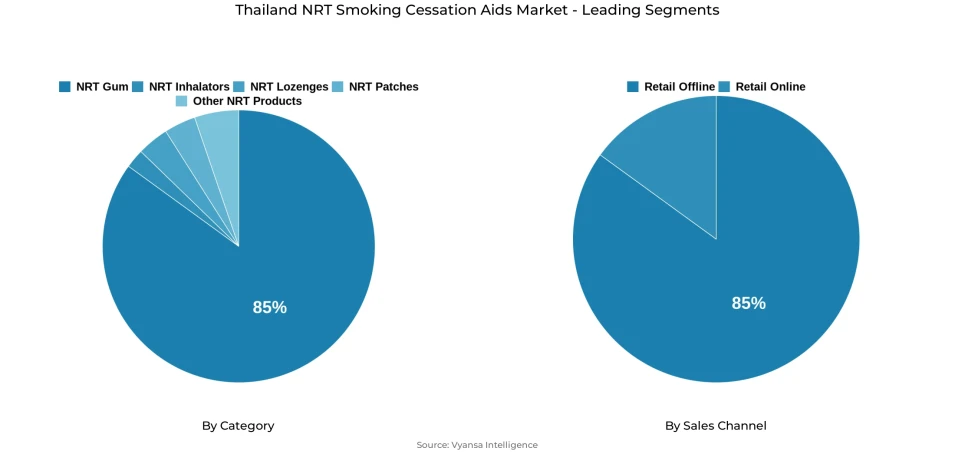
- Nrt gum grabbed market share of 85%.
- Competition
- More than 5 companies are actively engaged in producing nrt smoking cessation aids in Thailand.
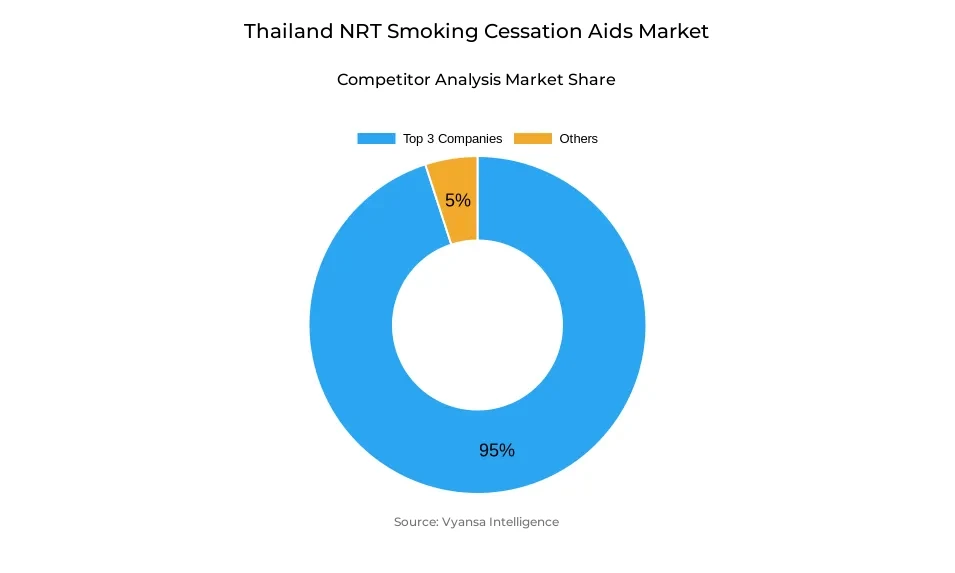
- Top 3 companies acquired around 95% of the market share.
- GSK Consumer Healthcare, Johnson & Johnson (Thailand) Ltd, Millimed Co Ltd etc., are few of the top companies.
- Sales Channel
- Retail offline grabbed 85% of the market.
Thailand NRT Smoking Cessation Aids Market Outlook
The Thailand NRT smoking cessation aids market size was valued at USD 8.16 million in 2025 and is projected to grow from USD 8.32 million in 2026 to USD 9.34 million by 2032, exhibiting a CAGR of around 1.95% during the forecast period. Growth is supported by the continued presence of a significant smoking population and strong public-health efforts to reduce tobacco use. According to the World Health Organization, 20% of adults in Thailand smoke and tobacco causes about 60,000 deaths annually, keeping smoking cessation a visible health priority and encouraging more smokers to explore structured quitting support.
Public-health programmes and healthcare support also help sustain demand for NRT smoking cessation aids. The WHO’s 2025 country profile notes that a toll-free quit line is available, while smoking-cessation services are offered in most primary care facilities and hospitals and are fully covered in those settings. Within the category, NRT gum accounts for about 85% share, reflecting its practicality, portability, and ability to address sudden cravings, which makes it the most familiar and accessible quitting aid for many smokers.
However, affordability remains a challenge for broader adoption. While NRT products are legally sold in pharmacies without a prescription, the WHO profile confirms that they are not cost-covered and are not included on the essential drugs list. At the same time, the prescription medicine cytisine is included on the essential drugs list, creating a lower-cost alternative that may reduce consumer willingness to purchase NRT products privately. This pricing difference can limit long-term use for smokers who need repeated support during the quitting process.
Distribution continues to be dominated by pharmacy channels, with retail offline accounting for around 85% of sales. Consumers often seek advice from pharmacists before choosing cessation products, which keeps physical pharmacy retail central to purchasing behaviour. Thailand’s strict tobacco-control environment also supports the relevance of NRT smoking cessation aids, as cigarette packs must carry health warnings covering 85% of the front and rear display areas and follow plain-packaging rules, while cigarettes are 78.6% less affordable in 2024 than in 2014, reinforcing pressure on smokers to consider quitting.
Thailand NRT Smoking Cessation Aids Market Growth DriverQuit Support Gains Stronger Public Backing
A major contributing factor to the growth of the Thailand NRT smoking cessation aids market is not only the size of the smoking population but also major efforts to actively promote smoking cessation through public awareness programs. According to the World Health Organisation’s website for tobacco control in Thailand, 20% of adults are smokers and 60,000 people are killed each year in Thailand as a result of tobacco use. In short, smoking cessation is highly visible as a priority for health care in Thailand, helping to create a large pool for nicotine replacement therapies, since more and more people are seeking formal assistance to stop smoking.
The above demand for NRTs is further supported by the quit system which has been set up in Thailand. As noted in the WHO’s 2025 country profile, a Quit Line with access to a real person is operating as a toll-free number, with support available through the majority of primary health care sites and hospitals with full cost coverage in those health care settings. The presence of this supportive healthcare system keeps quitting visible and creates demand for NRTs to help people who are trying to quit.
Thailand NRT Smoking Cessation Aids Market ChallengeFree Cytisine Puts Pressure on Paid NRT
A key challenge for the Thailand NRT smoking cessation aids market is that NRT products remain self-paid, while a lower-cost or free prescription alternative is now available. The WHO’s 2025 Thailand country profile states that NRT is legally sold in a pharmacy without a prescription, but it is not cost-covered and is not on the country’s essential drugs list. This makes long-term use harder for many smokers who need repeated support to quit successfully.
At the same time, the same WHO profile shows that cytisine is legally sold with a prescription and is on the country’s essential drugs list. Smoking cessation support is also fully covered in health clinics and hospitals. This creates a strong affordability challenge for paid NRT gum and patches, because smokers can increasingly turn to more formally supported cessation routes instead of buying NRT themselves.
Unlock Market Intelligence
Explore the market potential with our data-driven report
Thailand NRT Smoking Cessation Aids Market TrendPharmacy-Led Cessation Remains the Core Buying Pattern
A clear trend in the Thailand NRT smoking cessation aids market is that purchase decisions remain strongly guided by pharmacies and professional advice. The category is widening beyond classic gum and patches toward newer options, including herbal positioned formats, but the route to purchase still depends heavily on pharmacist consultation. This keeps the market practical, advice-led, and focused on real quit intent rather than on impulse or bulk buying.
Official data supports this pharmacy led structure. The WHO’s 2025 Thailand profile states that NRT is legally sold in a pharmacy without a prescription, while cessation support is available in most clinics and hospitals and a quit line is also in place. These features show that smoking cessation in Thailand remains closely connected to healthcare touchpoints, which continues to shape how NRT products are recommended and purchased.
Thailand NRT Smoking Cessation Aids Market OpportunityStronger Tobacco Controls Create More Room to Quit
The Thailand NRT smoking cessation aids market has a major opportunity due to increased tobacco control and a growing anti-smoking presence. This continued tobacco policy reform in Thailand has resulted in progressive steps toward the cessation of smoking; by reducing how attractive vaping products are to consumers and making them much less affordable through increased taxes. At the same time, the NRT sector also has opportunity to establish themselves as viable ways for those who want to quit smoking by providing them with tools that can ultimately help achieve this goal over the long term instead of constantly switching formats of nicotine use.
According to WHO’s 2025 profile of countries, tobacco packs produced and sold within Thailand must include 85% of the most important front and rear facets with health warning labels and all must be packaged according to some form of plain packaging regulations. Furthermore, this same profile indicates that in 2024 compared with 2014, cigarettes saw an approximate 78.6% decrease vs the cost to purchase them in terms of how affordable a pack will be. The outcome of such a combination of efforts will continue to place first-time smokers under increased temptation to quit smoking through available tools, which will also serve to enhance the long-term opportunity available for NRTs.
Unlock Market Intelligence
Explore the market potential with our data-driven report
Thailand NRT Smoking Cessation Aids Market Segmentation Analysis
By Category
- NRT Gum
- NRT Inhalators
- NRT Lozenges
- NRT Patches
- Other NRT Products
The segment has the highest share around segment under the category, with NRT gum grabbed market share of 85%. This leadership fits the Thailand market because gum remains the most familiar and most practical nicotine-replacement format for everyday users. It is easier to trial, easier to carry, and more closely linked to immediate craving control than other formats, which helps it stay central in a market where quitting support is still strongly pharmacy-led.
Its strong position also reflects the fact that consumers often want a simple and flexible quitting aid rather than a more complicated routine. Compared with other NRT formats, gum fits more naturally into daily use and gives oral stimulation that many smokers value. This keeps NRT gum clearly ahead of the rest of the category mix.
By Sales Channel
- Retail Online
- Online Pharmacies
- Brand-Owned Websites
- E-commerce Marketplaces
- Retail Offline
- Hospital
- Pharmacies
- Drug Stores
The segment has the highest share around segment under the sales channel, where retail offline grabbed 85% of the market. This dominance fits the Thailand market because pharmacies remain the main access point for smoking-cessation products. Consumers still prefer face-to-face advice before buying, especially when the purchase is linked to a serious decision to quit rather than a routine health refill.
This sales structure is also supported by the official regulatory setting. The WHO’s 2025 Thailand profile states that NRT is legally sold in a pharmacy without a prescription, while cessation support is available in most health facilities and a quit line is in place. That keeps physical pharmacy-led retail at the centre of category access and recommendation.
List of Companies Covered in Thailand NRT Smoking Cessation Aids Market
The companies listed below are highly influential in the Thailand nrt smoking cessation aids market, with a significant market share and a strong impact on industry developments.
- GSK Consumer Healthcare
- Johnson & Johnson (Thailand) Ltd
- Millimed Co Ltd
Competitive Landscape
In 2025, the competitive landscape of NRT smoking cessation aids in Thailand remained highly concentrated, led by Johnson & Johnson (Thailand) Ltd with a 70.3% retail value share, followed by Millimed Co Ltd with 16.2% and GSK Consumer Healthcare with 12.5%. Leading brands such as Nicorette, Nicomild-2 and Nicotinell dominate the category, primarily through NRT gum and patches which remain the most widely used formats for managing nicotine cravings. Demand for these products continues to grow due to Thailand’s relatively high smoking prevalence, particularly among adult males, alongside ongoing government initiatives that encourage smoking cessation through public health programmes and consultation services. However, the category also faces emerging competition from herbal-positioned alternatives containing ingredients such as Vernonia cinerea and from alternative nicotine products such as e-cigarettes, which remain popular despite being illegal. Additionally, the government’s introduction of cytisine as a free smoking cessation medicine under the Universal Coverage Scheme may limit stronger growth for paid NRT products in the future, although pharmacies are expected to remain the primary distribution channel due to the importance of professional consultation when consumers attempt to quit smoking.
Frequently Asked Questions
Related Report
- Market Segmentation
- Research Scope
- Research Methodology
- Definitions and Assumptions
- Executive Summary
- Thailand NRT Smoking Cessation Aids Market Policies, Regulations, and Standards
- Thailand NRT Smoking Cessation Aids Market Dynamics
- Growth Factors
- Challenges
- Trends
- Opportunities
- Thailand NRT Smoking Cessation Aids Market Statistics, 2022-2032F
- Market Size & Growth Outlook
- By Revenues in USD Million
- Market Segmentation & Growth Outlook
- By Category
- NRT Gum- Market Insights and Forecast 2022-2032, USD Million
- NRT Inhalators- Market Insights and Forecast 2022-2032, USD Million
- NRT Lozenges- Market Insights and Forecast 2022-2032, USD Million
- NRT Patches- Market Insights and Forecast 2022-2032, USD Million
- Other NRT Products- Market Insights and Forecast 2022-2032, USD Million
- By Gender
- Male- Market Insights and Forecast 2022-2032, USD Million
- Female- Market Insights and Forecast 2022-2032, USD Million
- By Sales Channel
- Retail Online- Market Insights and Forecast 2022-2032, USD Million
- Online Pharmacies- Market Insights and Forecast 2022-2032, USD Million
- Brand-Owned Websites- Market Insights and Forecast 2022-2032, USD Million
- E-commerce Marketplaces- Market Insights and Forecast 2022-2032, USD Million
- Retail Offline- Market Insights and Forecast 2022-2032, USD Million
- Hospital- Market Insights and Forecast 2022-2032, USD Million
- Pharmacies- Market Insights and Forecast 2022-2032, USD Million
- Drug Stores- Market Insights and Forecast 2022-2032, USD Million
- Retail Online- Market Insights and Forecast 2022-2032, USD Million
- By End User
- Individual / Consumer Self-Use- Market Insights and Forecast 2022-2032, USD Million
- Healthcare-Professional-Supervised- Market Insights and Forecast 2022-2032, USD Million
- Clinics- Market Insights and Forecast 2022-2032, USD Million
- De-addiction Centers - Market Insights and Forecast 2022-2032, USD Million
- Smoking Cessation Centers- Market Insights and Forecast 2022-2032, USD Million
- By Competitors
- Competition Characteristics
- Market Share & Analysis
- By Category
- Market Size & Growth Outlook
- Thailand NRT Gum Market Statistics, 2022-2032
- Market Size & Growth Outlook
- By Revenues in USD Million
- Market Segmentation & Growth Outlook
- By Gender- Market Insights and Forecast 2022-2032, USD Million
- By Sales Channel- Market Insights and Forecast 2022-2032, USD Million
- By End User- Market Insights and Forecast 2022-2032, USD Million
- Market Size & Growth Outlook
- Thailand NRT Inhalators Market Statistics, 2022-2032
- Market Size & Growth Outlook
- By Revenues in USD Million
- Market Segmentation & Growth Outlook
- By Gender- Market Insights and Forecast 2022-2032, USD Million
- By Sales Channel- Market Insights and Forecast 2022-2032, USD Million
- By End User- Market Insights and Forecast 2022-2032, USD Million
- Market Size & Growth Outlook
- Thailand NRT Lozenges Market Statistics, 2022-2032
- Market Size & Growth Outlook
- By Revenues in USD Million
- Market Segmentation & Growth Outlook
- By Gender- Market Insights and Forecast 2022-2032, USD Million
- By Sales Channel- Market Insights and Forecast 2022-2032, USD Million
- By End User- Market Insights and Forecast 2022-2032, USD Million
- Market Size & Growth Outlook
- Thailand NRT Patches Market Statistics, 2022-2032
- Market Size & Growth Outlook
- By Revenues in USD Million
- Market Segmentation & Growth Outlook
- By Gender- Market Insights and Forecast 2022-2032, USD Million
- By Sales Channel- Market Insights and Forecast 2022-2032, USD Million
- By End User- Market Insights and Forecast 2022-2032, USD Million
- Market Size & Growth Outlook
- Thailand Other NRT Products Market Statistics, 2022-2032
- Market Size & Growth Outlook
- By Revenues in USD Million
- Market Segmentation & Growth Outlook
- By Gender- Market Insights and Forecast 2022-2032, USD Million
- By Sales Channel- Market Insights and Forecast 2022-2032, USD Million
- By End User- Market Insights and Forecast 2022-2032, USD Million
- Market Size & Growth Outlook
- Competitive Outlook
- Company Profiles
- Johnson & Johnson (Thailand) Ltd
- Business Description
- Product Portfolio
- Collaborations & Alliances
- Recent Developments
- Financial Details
- Others
- Millimed Co Ltd
- Business Description
- Product Portfolio
- Collaborations & Alliances
- Recent Developments
- Financial Details
- Others
- Others
- Business Description
- Product Portfolio
- Collaborations & Alliances
- Recent Developments
- Financial Details
- Others
- Johnson & Johnson (Thailand) Ltd
- Company Profiles
- Disclaimer
| Segment | Sub-Segment |
|---|---|
| By Category |
|
| By Gender |
|
| By Sales Channel |
|
| By End User |
|
Research Methodology
This study followed a structured approach comprising four key phases to assess the size and scope of the electro-oxidation market. The process began with thorough secondary research to collect data on the target market, related markets, and broader industry context. These findings, along with preliminary assumptions and estimates, were then validated through extensive primary research involving industry experts from across the value chain. To calculate the overall market size, both top-down and bottom-up methodologies were employed. Finally, market segmentation and data triangulation techniques were applied to refine and validate segment-level estimations.
Secondary Research
The secondary research phase involved gathering data from a wide range of credible and published sources. This step helped in identifying industry trends, defining market segmentation, and understanding the market landscape and value chain.
Sources consulted during this phase included:
- Company annual reports, investor presentations, and press releases
- Industry white papers and certified publications
- Trade directories and market-recognized databases
- Articles from authoritative authors and reputable journals
- Gold and silver standard websites
Secondary research was critical in mapping out the industry's value chain and monetary flow, identifying key market segments, understanding regional variations, and tracking significant industry developments.
Other key sources:
- Financial disclosures
- Industry associations and trade bodies
- News outlets and business magazines
- Academic journals and research studies
- Paid industry databases
Primary Research
To validate secondary data and gain deeper market insights, primary research was conducted with key stakeholders across both the supply and demand sides of the market.
On the demand side, participants included decision-makers and influencers from end-user industries—such as CIOs, CTOs, and CSOs—who provided first-hand perspectives on market needs, product usage, and future expectations.
On the supply side, interviews were conducted with manufacturers, industry associations, and institutional participants to gather insights into current offerings, product pipelines, and market challenges.
Primary interviews provided critical inputs such as:
- Market size and revenue data
- Product and service breakdowns
- Market forecasts
- Regional and application-specific trends
Stakeholders consulted included:
- Leading OEM and solution providers
- Channel and distribution partners
- End users across various applications
- Independent consultants and industry specialists
Market Size Estimation and Data Triangulation
- Identifying Key Market Participants (Secondary Research)
- Goal: To identify the major players or companies in the target market. This typically involves using publicly available data sources such as industry reports, market research publications, and financial statements of companies.
- Tools: Reports from firms like Gartner, Forrester, Euromonitor, Statista, IBISWorld, and others. Public financial statements, news articles, and press releases from top market players.
- Extracting Earnings of Key Market Participants
- Goal: To estimate the earnings generated from the product or service being analyzed. This step helps in understanding the revenue potential of each market player in a specific geography.
- Methods: Earnings data can be gathered from:
- Publicly available financial reports (for listed companies).
- Interviews and primary data sources from professionals, such as Directors, VPs, SVPs, etc. This is especially useful for understanding more nuanced, internal data that isn't publicly disclosed.
- Annual reports and investor presentations of key players.
- Data Collation and Development of a Relevant Data Model
- Goal: To collate inputs from both primary and secondary sources into a structured, data-driven model for market estimation. This model will incorporate key market KPIs and any independent variables relevant to the market.
- Key KPIs: These could include:
- Market size, growth rate, and demand drivers.
- Industry-specific metrics like market share, average revenue per customer (ARPC), or average deal size.
- External variables, such as economic growth rates, inflation rates, or commodity prices, that could affect the market.
- Data Modeling: Based on this data, the market forecasts are developed for the next 5 years. A combination of trend analysis, scenario modeling, and statistical regression might be used to generate projections.
- Scenario Analysis
- Goal: To test different assumptions and validate how sensitive the market is to changes in key variables (e.g., market demand, regulatory changes, technological disruptions).
- Types of Scenarios:
- Base Case: Based on current assumptions and historical data.
- Best-Case Scenario: Assuming favorable market conditions, regulatory environments, and technological advancements.
- Worst-Case Scenario: Accounting for adverse factors, such as economic downturns, stricter regulations, or unexpected disruptions.












