Thailand Digestive Remedies Market Report: Trends, Growth and Forecast (2026-2032)
By Product Type (Paediatric Digestive Remedies (Paediatric Diarrhoeal Remedies, Paediatric Indigestion & Heartburn Remedies, Paediatric Laxatives, Paediatric Motion Sickness Remedies), Diarrhoeal Remedies, IBS Treatments, Indigestion & Heartburn Remedies (Antacids, Antiflatulents, Digestive Enzymes, H2 Blockers, Proton Pump Inhibitors), Laxatives, Motion Sickness Remedies), By Age Group (Children & Adolescents (01-17 years), Adults (18-65 years), Geriatric (65+ years)), By Sales Channel (Retail Online, Retail Offline (Hospitals, Clinics, Pharmacies)) ... Read more
|
Major Players
|
Thailand Digestive Remedies Market Statistics and Insights, 2026
- Market Size Statistics
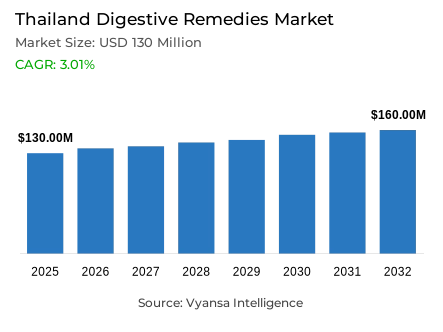
- Digestive remedies market size in Thailand was valued at USD 130 million in 2025 and is estimated at USD 137 Million in 2026.
- The market size is expected to grow to USD 160 million by 2032.
- Market to register a CAGR of around 3.01% during 2026-32.
- Product Type Shares
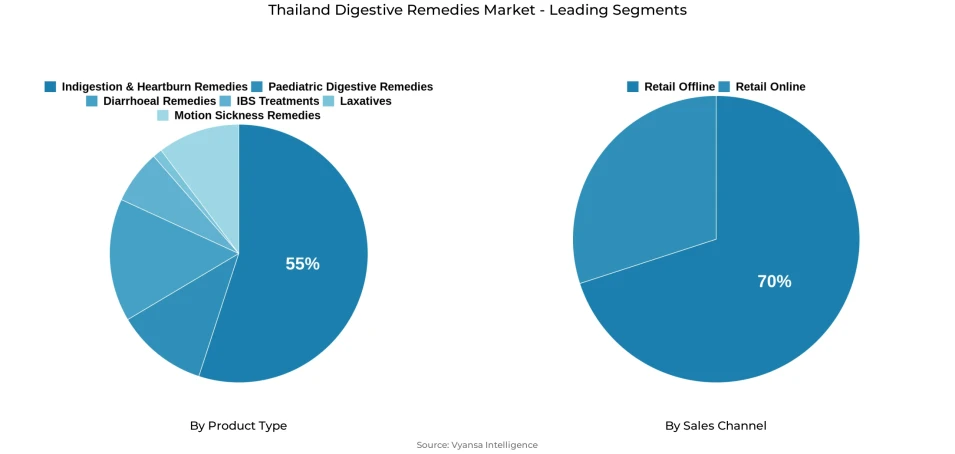
- Indigestion & heartburn remedies grabbed market share of 55%.
- Competition
- More than 20 companies are actively engaged in producing digestive remedies in Thailand.
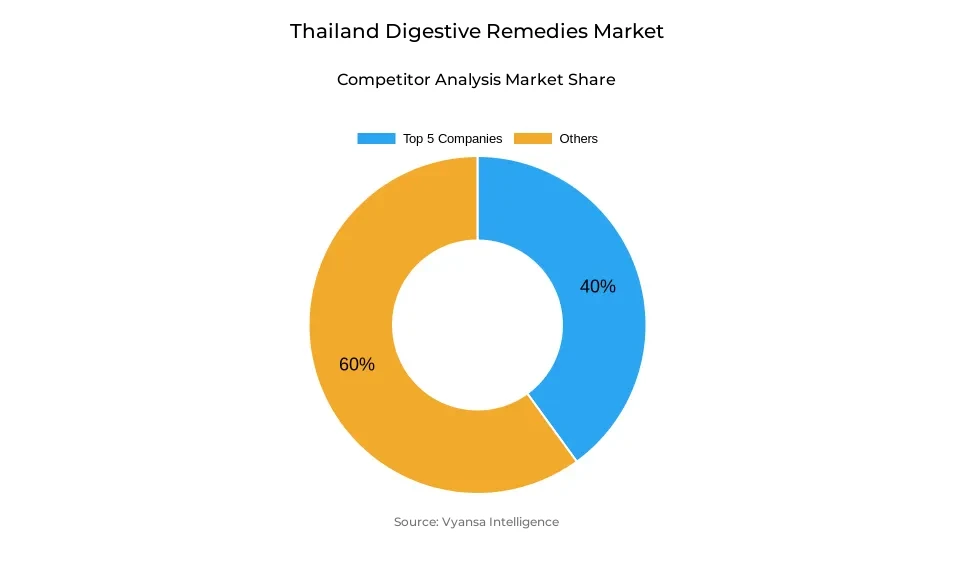
- Top 5 companies acquired around 40% of the market share.
- Merck (Thailand) Ltd, Nakorn Pattana Pharmacy Co Ltd, Boehringer Ingelheim (Thai) Ltd, Boss Pharmacare Co Ltd, Berlin Pharmaceutical Industry Co Ltd etc., are few of the top companies.
- Sales Channel
- Retail offline grabbed 70% of the market.
Thailand Digestive Remedies Market Outlook
Thailand digestive remedies market is valued at USD 130 million in 2025 and is projected to expand from USD 137 million in 2026 to USD 160 million by 2032, reflecting a CAGR of 3.01% over the forecast period. The continuous demand is associated with lifestyle habits and food consumption patterns that drive growth.
The nature of business in Thailand is marked by hectic work schedules, less time to eat, frequent intake of fast foods and hot street foods, which continue to make digestive discomfort frequent. Many consumers treat heartburn, indigestion, diarrhoea, and gastric pain as minor issues and manage them at home, thereby supporting the routine use of digestive remedies. High food‑related spending further reinforces this pattern, as households allocate THB 8,005 per month in 2024, matching 35.9% of total expenditure, while restaurant activity continues to improve with rising consumption.
At the same time, the presence of herbal, traditional, and supplement-type substitutes affects the choice of products. Other ingredients like turmeric, noni, aloe vera and Indian gooseberry are increasingly viewed as softer alternatives, and probiotics and packaged natural forms are increasingly on the radar. Growing internet penetration, reaching 59.0 million users or 89.5% of the population aged six and older in 2024, further promotes awareness of these alternatives alongside conventional digestive remedies.
Indigestion and heartburn remedies dominate product demand with a 55% share, as they address the most common post‑meal discomfort linked to everyday eating habits. Retail offline channels account for 70% of sales, supported by a robust network of 19,126 pharmacies across the country, ensuring that digestive remedies remain readily available for immediate purchase and repeat use when symptoms arise.
Thailand Digestive Remedies Market Growth DriverFast-Paced Living Keeps Quick Relief Relevant
The nature of business in Thailand is described by hectic work schedules, limited time to cook, and high consumption of fast foods and spicy street food, which, in turn, leads to a high rate of digestive discomfort. Consumers regard conditions such as heartburn, indigestion, diarrhoea and gastric pain as minor ailments and generally manage them at home, thereby sustaining a regular demand for digestive remedies. The substantial expenditure on food and related items further reinforces this pattern, with households allocating THB 8,005 per month in 2024, representing 35.9% of total household expenditure While dining‑out activity continues to expand with rising consumption levels.
Statistical evidence confirms that food‑related spending constitutes the dominant component of household outlays, and that private consumption increased by 1.1% month‑on‑month in January 2025. The Bank of Thailand observes that the hotel and restaurant business increases with the increase in the number of tourists and the amount of revenue generated, which supports the out-of-home consumption market.
Thailand Digestive Remedies Market ChallengeHerbal Alternatives Create Competitive Pressure
Herbal, traditional, and supplement‑style alternatives are intensifying competition against conventional digestive remedies. Most consumers view ingredients like turmeric, noni, Indian gooseberry, raw banana, aloe vera and probiotic-based formulations as less aggressive and with fewer side effects, and it becomes harder to distinguish standard products, especially international brands, when consumers are looking to support their digestive system over the long term, not just temporarily.
New regulatory trends put further strain on traditional solutions. The Thai Herbal Preparation Pharmacopoeia 2022 lists 41 monographs, and the 2025 supplement added five more. At the same time, the Thai Food and Drug Authority declared that new food supplement laws came into force on 2 July 2024, and a transition period will end on 1 July 2027. These actions reinforce the official existence of herbal and supplement products, thus augmenting rivalry to traditional digestive solutions.
Unlock Market Intelligence
Explore the market potential with our data-driven report
Thailand Digestive Remedies Market TrendNatural Formats Gain More Everyday Visibility
In Thailand, natural, packaged and convenient digestive aids are becoming more visible. Consumers with limited time are more likely to use easily accessible forms like powders and capsules, instead of preparing raw banana or turmeric by hand. Probiotic products in the form of yoghurt or supplements also fit this trend, with consumers looking to lightweight products that can help maintain gut health and daily habits.
Formal signals are favorable to increased product awareness and strong regulatory support of natural digestive care. The National Statistical Office reports that 59.0 million individuals aged six or older, equivalent to 89.5% of that demographic use the internet in Thailand in Q1 2024. Also, the 2022 Thai Herbal Preparation Pharmacopoeia and its 2025 supplement jointly identify 46 monographs, which give increased visibility and acceptance to standardized natural digestive products.
Thailand Digestive Remedies Market OpportunityPharmacy Reach Opens Room for Faster Access
An extensive pharmacy and retail network affords brands greater access to easy‑take digestive remedies. When diarrhoea, acidity, bloating, or stomach discomfort are experienced, many consumers are looking to find an immediate remedy and will often resort to self-medication instead of visiting a doctor, which presents an opportunity to products that provide quick access, easy application, and home storage.
Thailand already enjoys a pervasive pharmacy network that facilitates this strategy. According to Thai FDA licensing data, as of 2024, WHO lists 19,126 retail pharmacies in Thailand in its 2025 Pharmaceutical Country Profile. The same profile indicates that Thailand’s licensing system encompasses retailers across the entire pharmaceutical channel, thereby providing a practical avenue for enhanced visibility, immediate purchase, and repeat buying of digestive remedies.
Unlock Market Intelligence
Explore the market potential with our data-driven report
Thailand Digestive Remedies Market Segmentation Analysis
By Product Type
- Paediatric Digestive Remedies
- Paediatric Diarrhoeal Remedies
- Paediatric Indigestion & Heartburn Remedies
- Paediatric Laxatives
- Paediatric Motion Sickness Remedies
- Diarrhoeal Remedies
- IBS Treatments
- Indigestion & Heartburn Remedies
- Antacids
- Antiflatulents
- Digestive Enzymes
- H2 Blockers
- Proton Pump Inhibitors
- Laxatives
- Motion Sickness Remedies
The segment with the highest market share in the product category is indigestion and heartburn remedies, commanding 55% of the market. This preeminence can be explained by the fact that it coincides with the most frequent day-to-day digestive issues related to rushed meals, spicy food, overeating, and eating habits. The need to get quick, well-known relief, easily administered at home, is what keeps indigestion and heartburn remedies the most popular self-medication option.
This market position is supported by official consumption data. The National Statistical Office indicates that households spend THB 8,005 per month on food, beverages, and tobacco, representing 35.9% of total household expenditure, while the Bank of Thailand reports a 1.1% monthly rise in private consumption in January 2025. Hotel and restaurant operations are still on the rise with the rise in the number of tourists and the amount of money they generate, thus maintaining a strong correlation between indigestion and heartburn solutions and post-meal pain.
By Sales Channel
- Retail Online
- Retail Offline
- Hospitals
- Clinics
- Pharmacies
The retail offline channel holds the highest share, with 70% of sales occurring through this avenue. This channel prevails because digestive remedies are often purchased for immediate use when consumers experience acidity, diarrhoea, bloating, or stomach pain, seeking same‑day relief. Physical pharmacies and stores are still central because consumers can easily find familiar brands and repeat purchases without having to wait to be delivered.
The power of this distribution channel is emphasized by official data. According to Thai FDA licensing data as of 2024, WHO 2025 Pharmaceutical Country Profile of Thailand lists 19,126 retail pharmacies. The profile confirms that the licensing infrastructure covers retailers across the pharmaceutical system, which reinforces the robustness of offline access especially for digestive remedies that are widely self‑medicated and purchased in response to sudden discomfort.
List of Companies Covered in Thailand Digestive Remedies Market
The companies listed below are highly influential in the Thailand digestive remedies market, with a significant market share and a strong impact on industry developments.
- Merck (Thailand) Ltd
- Nakorn Pattana Pharmacy Co Ltd
- Boehringer Ingelheim (Thai) Ltd
- Boss Pharmacare Co Ltd
- Berlin Pharmaceutical Industry Co Ltd
- Reckitt Benckiser (Thailand) Ltd
- Government Pharmaceutical Organization The
- GSK Consumer Healthcare
- Thai Nakorn Patana Co Ltd
- Bai Hor Dispensary Ltd
Competitive Landscape
The competitive landscape of digestive remedies in Thailand is characterised by strong competition between multinational brands and emerging herbal/traditional alternatives. Global players such as Reckitt Benckiser (Thailand) Ltd and GSK Consumer Healthcare maintain a solid presence through well-known brands like Gaviscon and Eno, supported by extensive marketing and high consumer awareness. However, their dominance is increasingly challenged by local manufacturers focusing on herbal and traditional remedies, which are widely perceived as safer and more natural. These players are leveraging ingredients such as turmeric, aloe vera, and Indian gooseberry to differentiate their offerings. In addition, the growing adoption of probiotics and supplement-based solutions is intensifying competition, gradually shifting consumer preference toward preventive digestive health, while traditional OTC brands continue to rely on convenience, efficacy, and strong pharmacy distribution to retain market share.
Frequently Asked Questions
Related Report
- Market Segmentation
- Research Scope
- Research Methodology
- Definitions and Assumptions
- Executive Summary
- Thailand Digestive Remedies Market Policies, Regulations, and Standards
- Thailand Digestive Remedies Market Dynamics
- Growth Factors
- Challenges
- Trends
- Opportunities
- Thailand Digestive Remedies Market Statistics, 2022-2032F
- Market Size & Growth Outlook
- By Revenues in USD Million
- Market Segmentation & Growth Outlook
- By Product Type
- Paediatric Digestive Remedies- Market Insights and Forecast 2022-2032, USD Million
- Paediatric Diarrhoeal Remedies- Market Insights and Forecast 2022-2032, USD Million
- Paediatric Indigestion & Heartburn Remedies- Market Insights and Forecast 2022-2032, USD Million
- Paediatric Laxatives- Market Insights and Forecast 2022-2032, USD Million
- Paediatric Motion Sickness Remedies- Market Insights and Forecast 2022-2032, USD Million
- Diarrhoeal Remedies- Market Insights and Forecast 2022-2032, USD Million
- IBS Treatments- Market Insights and Forecast 2022-2032, USD Million
- Indigestion & Heartburn Remedies- Market Insights and Forecast 2022-2032, USD Million
- Antacids- Market Insights and Forecast 2022-2032, USD Million
- Antiflatulents- Market Insights and Forecast 2022-2032, USD Million
- Digestive Enzymes- Market Insights and Forecast 2022-2032, USD Million
- H2 Blockers- Market Insights and Forecast 2022-2032, USD Million
- Proton Pump Inhibitors- Market Insights and Forecast 2022-2032, USD Million
- Laxatives- Market Insights and Forecast 2022-2032, USD Million
- Motion Sickness Remedies- Market Insights and Forecast 2022-2032, USD Million
- Paediatric Digestive Remedies- Market Insights and Forecast 2022-2032, USD Million
- By Age Group
- Children & Adolescents (01-17 years)- Market Insights and Forecast 2022-2032, USD Million
- Adults (18-65 years)- Market Insights and Forecast 2022-2032, USD Million
- Geriatric (65+ years)- Market Insights and Forecast 2022-2032, USD Million
- By Sales Channel
- Retail Online- Market Insights and Forecast 2022-2032, USD Million
- Retail Offline- Market Insights and Forecast 2022-2032, USD Million
- Hospitals- Market Insights and Forecast 2022-2032, USD Million
- Clinics- Market Insights and Forecast 2022-2032, USD Million
- Pharmacies- Market Insights and Forecast 2022-2032, USD Million
- By Competitors
- Competition Characteristics
- Market Share & Analysis
- By Product Type
- Market Size & Growth Outlook
- Thailand Paediatric Digestive Remedies Market Statistics, 2022-2032
- Market Size & Growth Outlook
- By Revenues in USD Million
- Market Segmentation & Growth Outlook
- By Age Group- Market Insights and Forecast 2022-2032, USD Million
- By Sales Channel- Market Insights and Forecast 2022-2032, USD Million
- Market Size & Growth Outlook
- Thailand Diarrhoeal Remedies Market Statistics, 2022-2032
- Market Size & Growth Outlook
- By Revenues in USD Million
- Market Segmentation & Growth Outlook
- By Age Group- Market Insights and Forecast 2022-2032, USD Million
- By Sales Channel- Market Insights and Forecast 2022-2032, USD Million
- Market Size & Growth Outlook
- Thailand IBS Treatments Market Statistics, 2022-2032
- Market Size & Growth Outlook
- By Revenues in USD Million
- Market Segmentation & Growth Outlook
- By Age Group- Market Insights and Forecast 2022-2032, USD Million
- By Sales Channel- Market Insights and Forecast 2022-2032, USD Million
- Market Size & Growth Outlook
- Thailand Indigestion & Heartburn Remedies Market Statistics, 2022-2032
- Market Size & Growth Outlook
- By Revenues in USD Million
- Market Segmentation & Growth Outlook
- By Age Group- Market Insights and Forecast 2022-2032, USD Million
- By Sales Channel- Market Insights and Forecast 2022-2032, USD Million
- Market Size & Growth Outlook
- Thailand Laxatives Market Statistics, 2022-2032
- Market Size & Growth Outlook
- By Revenues in USD Million
- Market Segmentation & Growth Outlook
- By Age Group- Market Insights and Forecast 2022-2032, USD Million
- By Sales Channel- Market Insights and Forecast 2022-2032, USD Million
- Market Size & Growth Outlook
- Thailand Motion Sickness Remedies Market Statistics, 2022-2032
- Market Size & Growth Outlook
- By Revenues in USD Million
- Market Segmentation & Growth Outlook
- By Age Group- Market Insights and Forecast 2022-2032, USD Million
- By Sales Channel- Market Insights and Forecast 2022-2032, USD Million
- Market Size & Growth Outlook
- Competitive Outlook
- Company Profiles
- Boss Pharmacare Co Ltd
- Business Description
- Product Portfolio
- Collaborations & Alliances
- Recent Developments
- Financial Details
- Others
- Berlin Pharmaceutical Industry Co Ltd
- Business Description
- Product Portfolio
- Collaborations & Alliances
- Recent Developments
- Financial Details
- Others
- Reckitt Benckiser (Thailand) Ltd
- Business Description
- Product Portfolio
- Collaborations & Alliances
- Recent Developments
- Financial Details
- Others
- Government Pharmaceutical Organization The
- Business Description
- Product Portfolio
- Collaborations & Alliances
- Recent Developments
- Financial Details
- Others
- GSK Consumer Healthcare
- Business Description
- Product Portfolio
- Collaborations & Alliances
- Recent Developments
- Financial Details
- Others
- Merck (Thailand) Ltd
- Business Description
- Product Portfolio
- Collaborations & Alliances
- Recent Developments
- Financial Details
- Others
- Nakorn Pattana Pharmacy Co Ltd
- Business Description
- Product Portfolio
- Collaborations & Alliances
- Recent Developments
- Financial Details
- Others
- Boehringer Ingelheim (Thai) Ltd
- Business Description
- Product Portfolio
- Collaborations & Alliances
- Recent Developments
- Financial Details
- Others
- Thai Nakorn Patana Co Ltd
- Business Description
- Product Portfolio
- Collaborations & Alliances
- Recent Developments
- Financial Details
- Others
- Bai Hor Dispensary Ltd
- Business Description
- Product Portfolio
- Collaborations & Alliances
- Recent Developments
- Financial Details
- Others
- Boss Pharmacare Co Ltd
- Company Profiles
- Disclaimer
| Segment | Sub-Segment |
|---|---|
| By Product Type |
|
| By Age Group |
|
| By Sales Channel |
|
Research Methodology
This study followed a structured approach comprising four key phases to assess the size and scope of the electro-oxidation market. The process began with thorough secondary research to collect data on the target market, related markets, and broader industry context. These findings, along with preliminary assumptions and estimates, were then validated through extensive primary research involving industry experts from across the value chain. To calculate the overall market size, both top-down and bottom-up methodologies were employed. Finally, market segmentation and data triangulation techniques were applied to refine and validate segment-level estimations.
Secondary Research
The secondary research phase involved gathering data from a wide range of credible and published sources. This step helped in identifying industry trends, defining market segmentation, and understanding the market landscape and value chain.
Sources consulted during this phase included:
- Company annual reports, investor presentations, and press releases
- Industry white papers and certified publications
- Trade directories and market-recognized databases
- Articles from authoritative authors and reputable journals
- Gold and silver standard websites
Secondary research was critical in mapping out the industry's value chain and monetary flow, identifying key market segments, understanding regional variations, and tracking significant industry developments.
Other key sources:
- Financial disclosures
- Industry associations and trade bodies
- News outlets and business magazines
- Academic journals and research studies
- Paid industry databases
Primary Research
To validate secondary data and gain deeper market insights, primary research was conducted with key stakeholders across both the supply and demand sides of the market.
On the demand side, participants included decision-makers and influencers from end-user industries—such as CIOs, CTOs, and CSOs—who provided first-hand perspectives on market needs, product usage, and future expectations.
On the supply side, interviews were conducted with manufacturers, industry associations, and institutional participants to gather insights into current offerings, product pipelines, and market challenges.
Primary interviews provided critical inputs such as:
- Market size and revenue data
- Product and service breakdowns
- Market forecasts
- Regional and application-specific trends
Stakeholders consulted included:
- Leading OEM and solution providers
- Channel and distribution partners
- End users across various applications
- Independent consultants and industry specialists
Market Size Estimation and Data Triangulation
- Identifying Key Market Participants (Secondary Research)
- Goal: To identify the major players or companies in the target market. This typically involves using publicly available data sources such as industry reports, market research publications, and financial statements of companies.
- Tools: Reports from firms like Gartner, Forrester, Euromonitor, Statista, IBISWorld, and others. Public financial statements, news articles, and press releases from top market players.
- Extracting Earnings of Key Market Participants
- Goal: To estimate the earnings generated from the product or service being analyzed. This step helps in understanding the revenue potential of each market player in a specific geography.
- Methods: Earnings data can be gathered from:
- Publicly available financial reports (for listed companies).
- Interviews and primary data sources from professionals, such as Directors, VPs, SVPs, etc. This is especially useful for understanding more nuanced, internal data that isn't publicly disclosed.
- Annual reports and investor presentations of key players.
- Data Collation and Development of a Relevant Data Model
- Goal: To collate inputs from both primary and secondary sources into a structured, data-driven model for market estimation. This model will incorporate key market KPIs and any independent variables relevant to the market.
- Key KPIs: These could include:
- Market size, growth rate, and demand drivers.
- Industry-specific metrics like market share, average revenue per customer (ARPC), or average deal size.
- External variables, such as economic growth rates, inflation rates, or commodity prices, that could affect the market.
- Data Modeling: Based on this data, the market forecasts are developed for the next 5 years. A combination of trend analysis, scenario modeling, and statistical regression might be used to generate projections.
- Scenario Analysis
- Goal: To test different assumptions and validate how sensitive the market is to changes in key variables (e.g., market demand, regulatory changes, technological disruptions).
- Types of Scenarios:
- Base Case: Based on current assumptions and historical data.
- Best-Case Scenario: Assuming favorable market conditions, regulatory environments, and technological advancements.
- Worst-Case Scenario: Accounting for adverse factors, such as economic downturns, stricter regulations, or unexpected disruptions.












