Taiwan Sleep Aids Market Report: Trends, Growth and Forecast (2026-2032)
By Product (Single Ingredient (Doxylamine Succinate, Diphenhydramine, Melatonin), Combination Ingredient (Diphenhydramine + Acetaminophen, Other Antihistamine-Based Combinations), Herbal & Traditional Sleep Aids (Valerian root, Passionflower, Chamomile, Kava, Multi-Herbal Sleep Blends)), By Sleep Disorder (Insomnia, Sleep Apnea, Restless Legs Syndrome, Narcolepsy, Sleep Walking, Others), By Age Group (Young to Mid Adults (25-44 Years), Middle-Aged Adults (45-64 Years), Geriatric Population (65+ Years)), By Sales Channel (Retail Online, Retail Offline), By End User (Homecare/Individual Consumers, Hospitals, Sleep Centers & Clinics), By Formulation (Tablets, Gummies, Capsules, Liquid, Sublingual) ... Read more
|
Major Players
|
Taiwan Sleep Aids Market Statistics and Insights, 2026
- Market Size Statistics
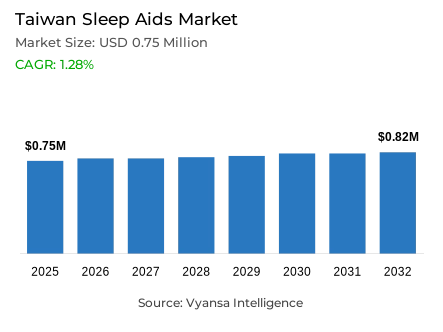
- Sleep aids market size in Taiwan was estimated at USD 0.79 million in 2025 and is estimated at USD 0.81 million in 2026.
- The market size is expected to grow to USD 0.86 million by 2032.
- Market to register a CAGR of around 1.28% during 2026-32.
- Product Shares
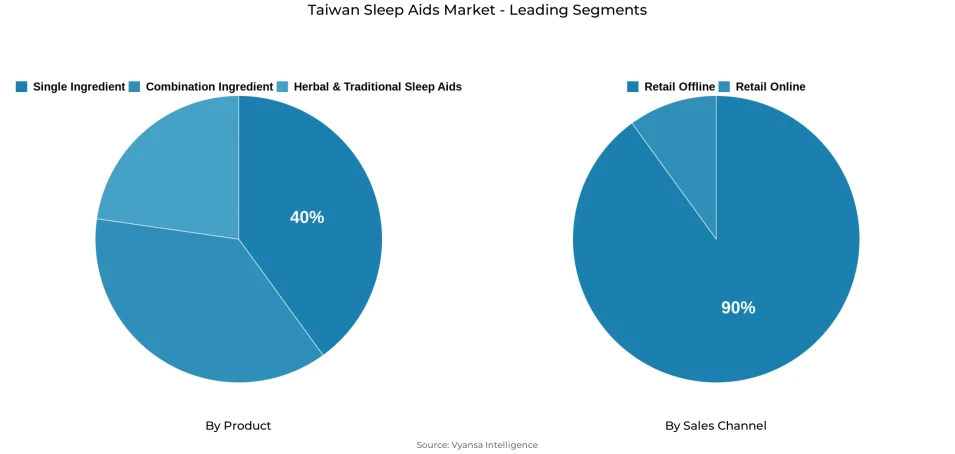
- Melatonin grabbed market share of 40%.
- Competition
- More than 5 companies are actively engaged in producing sleep aids in Taiwan.
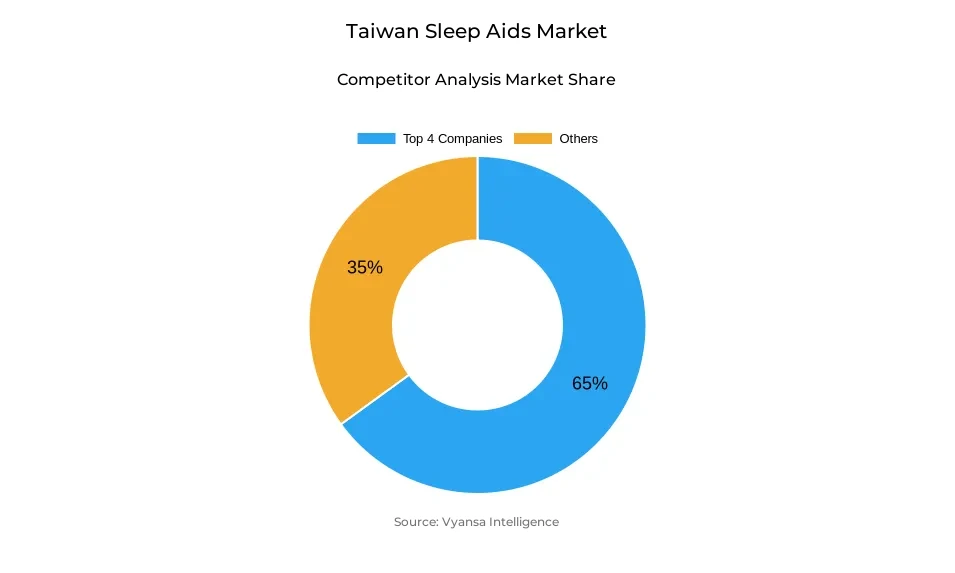
- Top 4 companies acquired around 65% of the market share.
- Sweet River Valley Medical Biotech Co Ltd, Suntory Holdings Ltd, Sentosa Co Ltd, Sun You Biotech Pharm Ltd etc., are few of the top companies.
- Sales channel
- Retail offline grabbed 90% of the market.
Taiwan Sleep Aids Market Outlook
The Taiwan sleep aids market was valued at USD 0.79 million in 2025 and is projected to grow from USD 0.81 million in 2026 to USD 0.86 million by 2032, registering a CAGR of 1.28% over the forecast period. This steady growth is primarily driven by a rapidly ageing population and the high-stress, fast-paced lifestyles prevalent across Taiwan's urban centres. With chronic insomnia affecting a significant portion of the population, consumers are increasingly turning to over-the-counter solutions and social media-driven health trends to actively manage their sleep quality.
Current market dynamics reflect strong preference for well-established brands such as Sentosa's Sleeping Beauty Plus, though competition from Japanese imports and smaller local manufacturers is intensifying across both physical and digital retail channels. Melatonin remains the dominant active ingredient, holding a 40% product share, while growing demand among elderly consumers for safer alternatives to prescription drugs is driving increased interest in natural and herbal options containing ingredients such as sesame GABA and valerian, perceived as gentler and less intrusive.
Distribution remains heavily concentrated in physical retail, with offline channels accounting for 90% of the market. Pharmacies serve as the primary consumer touchpoint for expert consultation, particularly given that prescription sleep medications are strictly regulated and excluded from e-commerce platforms. Despite this, digital channels are becoming increasingly important for marketing herbal sleep aids and establishing partnerships with technology firms offering sleep-tracking wearables and virtual relaxation devices.
The market also faces ongoing competition from Traditional Chinese Medicine and non-medical lifestyle practices such as yoga and meditation, which many Taiwanese consumers prefer as time-honoured alternatives to chemical interventions. In response, manufacturers are focusing on developing specialised nutritional supplements designed to attract consumers who remain cautious about conventional sleep aids, balancing innovation with the reassurance and natural positioning that the Taiwanese market increasingly demands through 2032.
Taiwan Sleep Aids Market Growth DriverLong Working Hours Sustain Demand for Convenient Sleep Support
The need to sleep aids in Taiwan is deeply entrenched in an urban lifestyle that is fast-paced with long working hours, heavy family demands, and continuous economic strain, which contribute to increasing stress levels and hindering the ability of many people to relax at night. The evening routines like caffeine use, alcohol use, and excessive use of digital devices before sleep further interfere with sleep patterns, which make consumers turn to convenient and perceived-safety products that do not involve complex medical advice.
According to the Taiwan Directorate-General of Budget, Accounting and Statistics, the average number of total working hours per month in 2025 is 168.9, which is a high work intensity that is closely related to fatigue, anxiety, and chronic sleep disruption. This hectic setting keeps the demand of the supplement based sleep support and branded over the counter solutions in the pharmacies and major retail stores across the market at a constant level.
Taiwan Sleep Aids Market ChallengeTCM and Prescription Pathways Divert Chronic Users from OTC
The main structural threat of sleep-aid brands is substitution: many consumers with chronic insomnia choose to visit Traditional Chinese Medicine clinics or to take prescription drugs sold in licensed pharmacies after a doctor visit. These channels are viewed as stricter and more specific to chronic illnesses, thus making it much harder to convert users who already have high confidence in medical or traditional treatment options.
According to Taiwan’s Ministry of Health and Welfare, online surveillance undertaken between January and July 2025 documented 10,578 illegal sales of regulated nicotine products, accompanied by a 96.9% takedown rate, thereby signalling vigorous enforcement within health‑related e‑commerce. This compliance environment imposes strict boundaries on internet sales and maintains the hegemony of professionally controlled retail outlets, further increasing the competition of over-the-counter sleep aids seeking broader digital distribution.
Unlock Market Intelligence
Explore the market potential with our data-driven report
Taiwan Sleep Aids Market TrendOnline Discovery Accelerates Switching and Imported Brand Trial
Digital discovery is becoming more important in the acquisition of sleep aids, with consumers comparing imported and domestic products through e-commerce marketplaces, peer reviews, and influencer-created content. This behaviour lowers switching costs and actively encourages the experimentation of newer brands, such as Japanese products that focus on high quality, and gives preference to formats and claims that can be easily communicated and understood in an online environment.
Data from Taiwan’s Ministry of Economic Affairs Department of Statistics indicate that the electronic shopping and mail‑order sector’s revenue increased by 3.4% in 2025, with 80.3% of e‑shopping operators reporting that the operation of online communities constitutes a core business strategy. These trends support social media marketing and platform presence as increasingly decisive tools of sleep-aid brands that seek to expand their reach substantively beyond the traditional physical pharmacy shelves by 2032.
Taiwan Sleep Aids Market OpportunityAgeing Population Supports Senior-Focused, Gentle Sleep Solutions
A clear and commercially relevant opportunity lies in the customization of sleep-aid products specifically to older adults, who tend to have natural declines in sleep-regulating hormones and have comorbidities that predispose them to be cautious of strong drugs. The products that focus on mild routine assistance, such as providing easy dosage, low-interaction ingredient choices, and easy-to-use consumption forms, are more appropriate to address the needs of middle-aged and older consumers who want to receive help without feeling that they are taking traditional medicine.
According to Taiwan’s Ministry of the Interior, the population aged 65 and over reached 4.573 million by the end of June 2025, with single‑person elderly households numbering 1.182 million, corresponding to 25.8% of all seniors. This large group of older consumers, with many having sleep problems independently, offers a lot of potential to pharmacy-led counselling, senior-specific product ranges, and educational programs that build trust and reliably convert perceived need into regular repeat buying up to 2032.
Unlock Market Intelligence
Explore the market potential with our data-driven report
Taiwan Sleep Aids Market Segmentation Analysis
By Product
- Single Ingredient
- Doxylamine Succinate
- Diphenhydramine
- Melatonin
- Combination Ingredient
- Diphenhydramine + Acetaminophen
- Other Antihistamine-Based Combinations
- Herbal & Traditional Sleep Aids
- Valerian root
- Passionflower
- Chamomile
- Kava
- Multi-Herbal Sleep Blends
The product type with the greatest market share is melatonin, representing roughly 40% of the total market. This leadership refers to the intuitive connection of melatonin with sleep regulation in a simple and accessible way by consumers, which is in line with the overall market need to find a solution that is perceived to be safe and familiar, particularly among consumers who are seeking support in mild-to-moderate sleep disorders without the need to advance to prescription drugs.
To maintain this preference, brands regularly combine melatonin with other supportive nutrients like magnesium or vitamins, or offer convenient forms that fit busy daily routines. With newer and imported products increasingly threatening to take the place of melatonin-dominant product mix, clear dosage communication and perceived quality are becoming key differentiators in the product mix, allowing leading brands to maintain a strong shelf presence in pharmacies and maintain strong visibility in e-commerce platforms through 2032.
By Sales Channel
- Retail Online
- Retail Offline
The sales channel commanding the highest market share is retail offline, accounting for approximately 90% of the total market. The pharmacies and health-and-beauty chains remain the default purchase locations, because sleep aids are strongly linked with personal health; consumers regularly require quick confirmation about the product appropriateness, proper dosage, and possible interactions with other drugs before making a purchase decision.
The regulatory and categorical framework further supports offline dominance, whereby more potent prescription sleep drugs require professional consultation and dispensing, thus tying consumers to licensed outlets despite preliminary product research being done online. Retailers take advantage of extensive brand selections, in-store advertising, and pharmacist suggestions to influence buying choices, and e-commerce plays an auxiliary role in reorders and price comparisons, but not replacing the familiar pharmacy visit by 2032.
List of Companies Covered in Taiwan Sleep Aids Market
The companies listed below are highly influential in the Taiwan sleep aids market, with a significant market share and a strong impact on industry developments.
- Sweet River Valley Medical Biotech Co Ltd
- Suntory Holdings Ltd
- Sentosa Co Ltd
- Sun You Biotech Pharm Ltd
Competitive Landscape
Taiwan’s sleep aids market is led by Sentosa’s Sleeping Beauty Plus, followed by Jalosleep Capsules, Comfortable Sleeping, and Suntory’s Royal Jelly, all benefiting from strong brand recognition and pharmacy-led distribution. However, their shares are under pressure from smaller domestic entrants and imported Japanese brands such as Kobayashi and Yamamoto, widely sold via ETMall and specialised online stores, reflecting consumer preference for perceived premium quality. Pharmacies remain dominant due to regulatory controls, though herbal and melatonin supplements gain traction online. Indirect competition from traditional Chinese medicine, prescription hypnotics, and lifestyle interventions is intensifying. Differentiation opportunities lie in senior-targeted herbal formulations, influencer-driven digital marketing, and partnerships with sleep-tracking apps and wearable tech to deliver data-informed, personalised positioning.
Frequently Asked Questions
Related Report
- Market Segmentation
- Research Scope
- Research Methodology
- Definitions and Assumptions
- Executive Summary
- Taiwan Sleep Aids Market Policies, Regulations, and Standards
- Taiwan Sleep Aids Market Dynamics
- Growth Factors
- Challenges
- Trends
- Opportunities
- Taiwan Sleep Aids Market Statistics, 2022-2032F
- Market Size & Growth Outlook
- By Revenues in USD Million
- Market Segmentation & Growth Outlook
- By Product
- Single Ingredient- Market Insights and Forecast 2022-2032, USD Million
- Doxylamine Succinate- Market Insights and Forecast 2022-2032, USD Million
- Diphenhydramine- Market Insights and Forecast 2022-2032, USD Million
- Melatonin- Market Insights and Forecast 2022-2032, USD Million
- Combination Ingredient- Market Insights and Forecast 2022-2032, USD Million
- Diphenhydramine + Acetaminophen- Market Insights and Forecast 2022-2032, USD Million
- Other Antihistamine-Based Combinations- Market Insights and Forecast 2022-2032, USD Million
- Herbal & Traditional Sleep Aids- Market Insights and Forecast 2022-2032, USD Million
- Valerian root- Market Insights and Forecast 2022-2032, USD Million
- Passionflower- Market Insights and Forecast 2022-2032, USD Million
- Chamomile- Market Insights and Forecast 2022-2032, USD Million
- Kava- Market Insights and Forecast 2022-2032, USD Million
- Multi-Herbal Sleep Blends- Market Insights and Forecast 2022-2032, USD Million
- Single Ingredient- Market Insights and Forecast 2022-2032, USD Million
- By Sleep Disorder
- Insomnia- Market Insights and Forecast 2022-2032, USD Million
- Sleep Apnea- Market Insights and Forecast 2022-2032, USD Million
- Restless Legs Syndrome- Market Insights and Forecast 2022-2032, USD Million
- Narcolepsy- Market Insights and Forecast 2022-2032, USD Million
- Sleep Walking- Market Insights and Forecast 2022-2032, USD Million
- Others- Market Insights and Forecast 2022-2032, USD Million
- By Age Group
- Young to Mid Adults (25-44 Years)- Market Insights and Forecast 2022-2032, USD Million
- Middle-Aged Adults (45-64 Years)- Market Insights and Forecast 2022-2032, USD Million
- Geriatric Population (65+ Years)- Market Insights and Forecast 2022-2032, USD Million
- By Sales Channel
- Retail Online- Market Insights and Forecast 2022-2032, USD Million
- Retail Offline- Market Insights and Forecast 2022-2032, USD Million
- By End User
- Homecare/Individual Consumers- Market Insights and Forecast 2022-2032, USD Million
- Hospitals- Market Insights and Forecast 2022-2032, USD Million
- Sleep Centers & Clinics- Market Insights and Forecast 2022-2032, USD Million
- By Formulation
- Tablets- Market Insights and Forecast 2022-2032, USD Million
- Gummies- Market Insights and Forecast 2022-2032, USD Million
- Capsules- Market Insights and Forecast 2022-2032, USD Million
- Liquid- Market Insights and Forecast 2022-2032, USD Million
- Sublingual- Market Insights and Forecast 2022-2032, USD Million
- By Competitors
- Competition Characteristics
- Market Share & Analysis
- By Product
- Market Size & Growth Outlook
- Taiwan Single Ingredient Sleep Aids Market Statistics, 2022-2032
- Market Size & Growth Outlook
- By Revenues in USD Million
- Market Segmentation & Growth Outlook
- By Sleep Disorder- Market Insights and Forecast 2022-2032, USD Million
- By Age Group- Market Insights and Forecast 2022-2032, USD Million
- By Sales Channel- Market Insights and Forecast 2022-2032, USD Million
- By End User- Market Insights and Forecast 2022-2032, USD Million
- By Formulation- Market Insights and Forecast 2022-2032, USD Million
- Market Size & Growth Outlook
- Taiwan Combination Ingredient Sleep Aids Market Statistics, 2022-2032
- Market Size & Growth Outlook
- By Revenues in USD Million
- Market Segmentation & Growth Outlook
- By Sleep Disorder- Market Insights and Forecast 2022-2032, USD Million
- By Age Group- Market Insights and Forecast 2022-2032, USD Million
- By Sales Channel- Market Insights and Forecast 2022-2032, USD Million
- By End User- Market Insights and Forecast 2022-2032, USD Million
- By Formulation- Market Insights and Forecast 2022-2032, USD Million
- Market Size & Growth Outlook
- Taiwan Herbal & Traditional Sleep Aids Market Statistics, 2022-2032
- Market Size & Growth Outlook
- By Revenues in USD Million
- Market Segmentation & Growth Outlook
- By Sleep Disorder- Market Insights and Forecast 2022-2032, USD Million
- By Age Group- Market Insights and Forecast 2022-2032, USD Million
- By Sales Channel- Market Insights and Forecast 2022-2032, USD Million
- By End User- Market Insights and Forecast 2022-2032, USD Million
- By Formulation- Market Insights and Forecast 2022-2032, USD Million
- Market Size & Growth Outlook
- Competitive Outlook
- Company Profiles
- Sentosa Co Ltd
- Business Description
- Product Portfolio
- Collaborations & Alliances
- Recent Developments
- Financial Details
- Others
- Sun You Biotech Pharm Ltd
- Business Description
- Product Portfolio
- Collaborations & Alliances
- Recent Developments
- Financial Details
- Others
- Sweet River Valley Medical Biotech Co Ltd
- Business Description
- Product Portfolio
- Collaborations & Alliances
- Recent Developments
- Financial Details
- Others
- Suntory Holdings Ltd
- Business Description
- Product Portfolio
- Collaborations & Alliances
- Recent Developments
- Financial Details
- Others
- Others
- Business Description
- Product Portfolio
- Collaborations & Alliances
- Recent Developments
- Financial Details
- Others
- Sentosa Co Ltd
- Company Profiles
- Disclaimer
| Segment | Sub-Segment |
|---|---|
| By Product |
|
| By Sleep Disorder |
|
| By Age Group |
|
| By Sales Channel |
|
| By End User |
|
| By Formulation |
|
Research Methodology
This study followed a structured approach comprising four key phases to assess the size and scope of the electro-oxidation market. The process began with thorough secondary research to collect data on the target market, related markets, and broader industry context. These findings, along with preliminary assumptions and estimates, were then validated through extensive primary research involving industry experts from across the value chain. To calculate the overall market size, both top-down and bottom-up methodologies were employed. Finally, market segmentation and data triangulation techniques were applied to refine and validate segment-level estimations.
Secondary Research
The secondary research phase involved gathering data from a wide range of credible and published sources. This step helped in identifying industry trends, defining market segmentation, and understanding the market landscape and value chain.
Sources consulted during this phase included:
- Company annual reports, investor presentations, and press releases
- Industry white papers and certified publications
- Trade directories and market-recognized databases
- Articles from authoritative authors and reputable journals
- Gold and silver standard websites
Secondary research was critical in mapping out the industry's value chain and monetary flow, identifying key market segments, understanding regional variations, and tracking significant industry developments.
Other key sources:
- Financial disclosures
- Industry associations and trade bodies
- News outlets and business magazines
- Academic journals and research studies
- Paid industry databases
Primary Research
To validate secondary data and gain deeper market insights, primary research was conducted with key stakeholders across both the supply and demand sides of the market.
On the demand side, participants included decision-makers and influencers from end-user industries—such as CIOs, CTOs, and CSOs—who provided first-hand perspectives on market needs, product usage, and future expectations.
On the supply side, interviews were conducted with manufacturers, industry associations, and institutional participants to gather insights into current offerings, product pipelines, and market challenges.
Primary interviews provided critical inputs such as:
- Market size and revenue data
- Product and service breakdowns
- Market forecasts
- Regional and application-specific trends
Stakeholders consulted included:
- Leading OEM and solution providers
- Channel and distribution partners
- End users across various applications
- Independent consultants and industry specialists
Market Size Estimation and Data Triangulation
- Identifying Key Market Participants (Secondary Research)
- Goal: To identify the major players or companies in the target market. This typically involves using publicly available data sources such as industry reports, market research publications, and financial statements of companies.
- Tools: Reports from firms like Gartner, Forrester, Euromonitor, Statista, IBISWorld, and others. Public financial statements, news articles, and press releases from top market players.
- Extracting Earnings of Key Market Participants
- Goal: To estimate the earnings generated from the product or service being analyzed. This step helps in understanding the revenue potential of each market player in a specific geography.
- Methods: Earnings data can be gathered from:
- Publicly available financial reports (for listed companies).
- Interviews and primary data sources from professionals, such as Directors, VPs, SVPs, etc. This is especially useful for understanding more nuanced, internal data that isn't publicly disclosed.
- Annual reports and investor presentations of key players.
- Data Collation and Development of a Relevant Data Model
- Goal: To collate inputs from both primary and secondary sources into a structured, data-driven model for market estimation. This model will incorporate key market KPIs and any independent variables relevant to the market.
- Key KPIs: These could include:
- Market size, growth rate, and demand drivers.
- Industry-specific metrics like market share, average revenue per customer (ARPC), or average deal size.
- External variables, such as economic growth rates, inflation rates, or commodity prices, that could affect the market.
- Data Modeling: Based on this data, the market forecasts are developed for the next 5 years. A combination of trend analysis, scenario modeling, and statistical regression might be used to generate projections.
- Scenario Analysis
- Goal: To test different assumptions and validate how sensitive the market is to changes in key variables (e.g., market demand, regulatory changes, technological disruptions).
- Types of Scenarios:
- Base Case: Based on current assumptions and historical data.
- Best-Case Scenario: Assuming favorable market conditions, regulatory environments, and technological advancements.
- Worst-Case Scenario: Accounting for adverse factors, such as economic downturns, stricter regulations, or unexpected disruptions.












