Sweden Contact Lenses and Solutions Market Report: Trends, Growth and Forecast (2026-2032)
By Product Type (Contact Lenses (Standard Vision Correction Lenses, Myopia Control Lenses), Contact Lens Solutions), By Usage (Contact Lenses (Daily Disposable, Bi-Weekly, Monthly, Quarterly/Annual), Contact Lens Solutions (Daily-Use Care Solutions, Weekly/Periodic Deep-Clean Systems, Travel/Mini Packs)), By Material Type (Contact Lenses (Silicone Hydrogel, Hydrogel (Soft), Rigid Gas Permeable (RGP), Hybrid/Scleral/Specialty), Contact Lens Solutions (Multi-Purpose Solutions, Hydrogen Peroxide Systems, Saline Solutions, Enzymatic & Specialty Cleaners)), By Application (Contact Lenses (Spherical (Myopia/Hyperopia), Toric (Astigmatism), Multifocal (Presbyopia), Myopia Control, Cosmetic/Colored, Therapeutic/Medical), Contact Lens Solutions (Soft Lens Care, RGP Lens Care, Sensitive Eye/Preservative-Free Care)), By Sales Channel (Retail Offline (Optical Stores, Hospitals & Clinics, Others (Pharmacies, Beauty Centres, etc.)), Retail Online (Company-owned Portals, E-commerce Platforms)), By Pack Size (Contact Lenses (Trial Packs, Standard Packs, Bulk/Value Packs), Contact Lens Solutions (Up to 120 mL, 121–360 mL, Above 360 mL, Combo/Twin Packs)) ... Read more

|
Major Players
|
Sweden Contact Lenses and Solutions Market Statistics and Insights, 2026
- Market Size Statistics
- Contact lenses and solutions market size in Sweden was estimated at USD 255 million in 2025.
- The market size is expected to grow to USD 285 million by 2032.
- Market to register a CAGR of around 1.6% during 2026-32.
- Product Type Shares
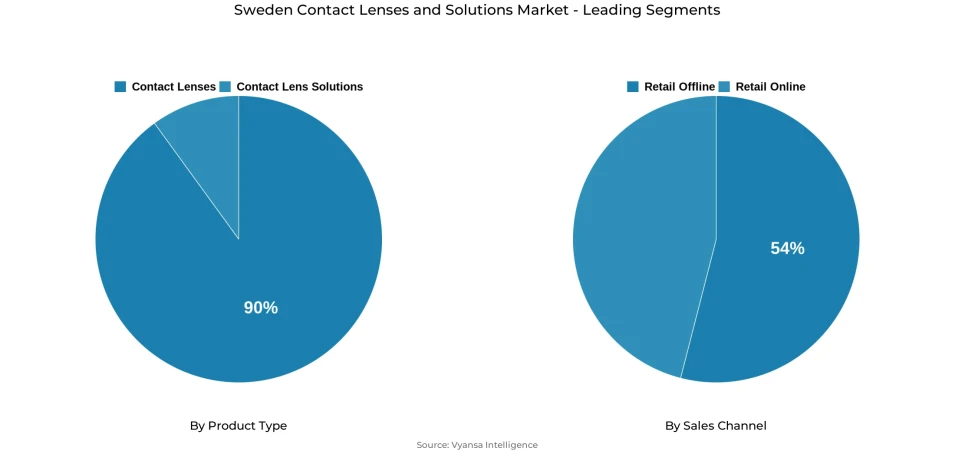
- Contact lenses grabbed market share of 90%.
- Competition
- More than 10 companies are actively engaged in producing contact lenses and solutions in Sweden.
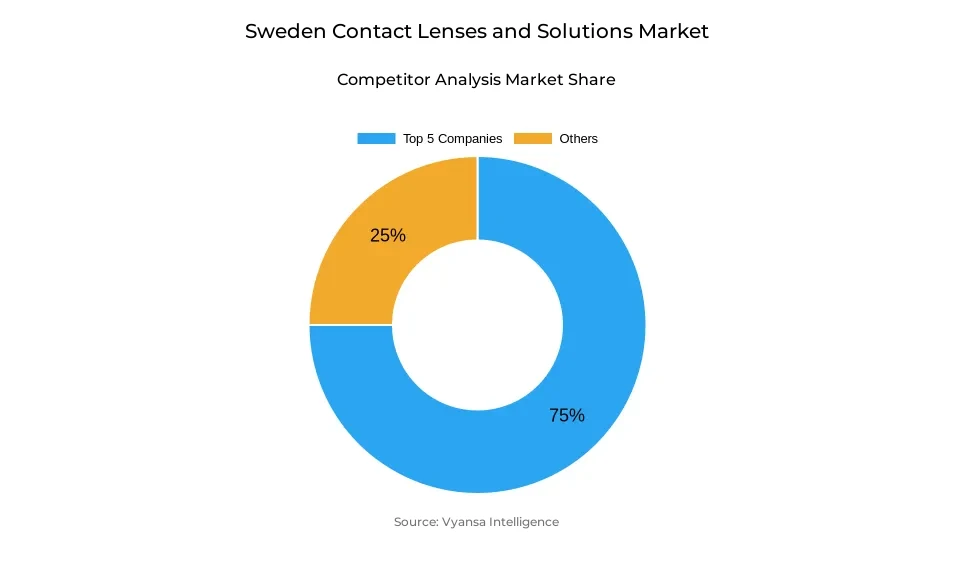
- Top 5 companies acquired around 75% of the market share.
- Clearlii AB, Specsavers Sweden AB, Synoptik Sweden AB, Synsam Group Sweden AB, CooperVision Nordic AB etc., are few of the top companies.
- Sales Channel
- Retail offline grabbed 54% of the market.
Sweden Contact Lenses and Solutions Market Outlook
Sweden Contact Lenses and Solutions Market was valued at USD 255 million in 2025 and is projected to grow from 2026 onwards to reach USD 285 million by 2032, registering a CAGR of around 1.6% during 2026-2032. Growth remains steady, supported by lifestyle-driven usage and stable replacement demand. According to Central Statistical Office of Sweden (SCB, 2025), approximately two-third of adults aged 16 and above are involved in at least 150 minutes per day of physical activity, supporting flexible vision correction use during sports and outdoor activities. Additionally, 95% of individuals aged 16–85 use the internet daily (SCB, 2025), reinforcing screen exposure and the need for comfortable corrective solutions. Contact lenses and solutions continue to benefit from high digital engagement and an active population base.
In addition, the ageing population of Sweden limits fast adoption. Central Statistical Office of Sweden (SCB, 2025) reports that more than 20% of the population is aged 65 and older, a demographic that generally prefers spectacles for their ease of handling. All these contribute to the weakening of category expansion, even when demand remains steady.
Public awareness of childhood myopia remains a driving force in product development. The Swedish National Board of Health and Welfare (Socialstyrelsen, 2025) points out the growing concern over screen-related eye strain in children, making optician-led consultations and growing interest in specialized vision correction lenses more desirable.
By segmentation, contact lenses represent 90% of the product, and retail offline represents 54% of sales. Sweden’s strong digital participation, with 85% of end users aged 16 and above shopping online in 2025 (SCB), supports complementary online reordering alongside established optician-led retail channels.
Sweden Contact Lenses and Solutions Market Growth DriverActive Lifestyle and High Digital Engagement Support Usage
The strong culture of outdoor and fitness in Sweden is still the foundation of the adoption of lenses in 2026. According to Central Statistical Office of Sweden (SCB, 2025), approximately two-third of adults aged 16 and above are involved in at least 150 minutes per day of physical activity , reflecting an active lifestyle in which flexible vision correction is preferred for sports and gym use. This trend in behaviour justifies the continued wearing of lenses in combination with spectacles especially by younger and working-age end users.
At the same time, Sweden maintains very high digital engagement. SCB(2025) reports that approximately 95% of individuals aged 16–85 use the internet daily, increasing screen exposure and demand for comfortable vision correction. These factors together act as a steady usage driver, encouraging consistent wear and trial of advanced comfort-focused lenses.
Sweden Contact Lenses and Solutions Market ChallengeHigh Prevalence of Pollen Allergies Restrains Adoption
Seasonal allergies remain a structural constraint in 2026. According to the Swedish Asthma and Allergy Association (2025), approximately 30% of the Swedish population suffers from pollen allergies. During peak allergy seasons, many end users avoid wearing lenses due to irritation and dry eye concerns.
In addition, Sweden’s ageing population limits faster adoption. Central Statistical Office of Sweden (SCB, 2025) states that over 20% of the population is aged 65 and above, a demographic group that typically prefers spectacles for ease of handling. These factors collectively moderate stronger category expansion despite stable demand.
Unlock Market Intelligence
Explore the market potential with our data-driven report
Sweden Contact Lenses and Solutions Market TrendGrowing Attention to Myopia Management
In 2026, awareness of childhood myopia continues to increase. The Swedish National Board of Health and Welfare (Socialstyrelsen, 2025) highlights rising concerns about screen-related eye strain among children and adolescents. This encourages opticians to provide more consultations focused on long-term vision management.
Education-led discussions around myopia control influence feature development, particularly moisture retention and comfort technologies. While still niche, structured optician-led guidance improves parental awareness, positioning specialised lenses as a practical solution for active children and teenagers.
Sweden Contact Lenses and Solutions Market OpportunityDigital Retail Maturity Enhances Accessibility
Sweden’s advanced digital infrastructure creates accessibility opportunities. According to SCB (2025), over 85% of Swedish people aged 16 and above made online purchases during the past year, reflecting one of the highest e-commerce participation rates in Europe. This supports repeat purchasing behaviour and convenient reordering of prescribed products.
With most end users starting purchases at opticians and later shifting online for refills, digital platforms complement traditional retail. Strong digital literacy and secure payment adoption reinforce structured growth opportunities within the category.
Unlock Market Intelligence
Explore the market potential with our data-driven report
Sweden Contact Lenses and Solutions Market Segmentation Analysis
By Product Type
- Contact Lenses
- Contact Lens Solutions
The segment that has the highest share under the product type is contact lenses, accounting for 90% of the market share. This reflects the dominant contribution of lens products within the category, driven by recurring replacement cycles and widespread corrective use.
Solutions remain essential for maintenance; however, value concentration remains primarily within lens formats. Comfort-focused innovations and specialised corrective features continue to reinforce the leading role of contact lenses in overall product segmentation.
By Sales Channel
- Retail Offline
- Retail Online
The segment that has the highest share under the sales channel is retail offline, accounting for 54% of the market share. Licensed opticians remain central due to prescription requirements and professional eye examinations.
Swedish end users typically initiate purchases through physical optical stores before shifting to online reordering. The strong regulatory framework and emphasis on patient safety sustain offline channel dominance, while digital channels complement rather than replace traditional retail structures.
List of Companies Covered in Sweden Contact Lenses and Solutions Market
The companies listed below are highly influential in the Sweden contact lenses and solutions market, with a significant market share and a strong impact on industry developments.
- Clearlii AB
- Specsavers Sweden AB
- Synoptik Sweden AB
- Synsam Group Sweden AB
- CooperVision Nordic AB
- Alcon Nordic A/S
- Johnson & Johnson AB
- Bausch & Lomb Nordic AB
- Carl Zeiss Vision AB
Competitive Landscape
The competitive landscape in Sweden remains moderately consolidated, led by strong retail-integrated and manufacturer-backed players. Synsam Group Sweden AB holds a leading position with a 21% share, supported by its extensive optical retail network and the strong performance of its private label brand, EyeQ. The company benefits from vertical integration, customer loyalty programs, and optician-led recommendations, reinforcing its competitive edge in both physical and online channels. CooperVision Nordic AB follows closely with a 19.8% share, driven by well-established brands such as Biofinity and its leadership in myopia control through MiSight 1 Day. CooperVision also strengthens its presence through private label manufacturing partnerships, enhancing trust and distribution reach. Competition remains focused on innovation in moisture retention, digital eye strain solutions, and myopia management, while established optician relationships continue to shape brand positioning and long-term
Frequently Asked Questions
Related Report
- Market Segmentation
- Research Scope
- Research Methodology
- Definitions and Assumptions
- Executive Summary
- Sweden Contact Lenses and Solution Market Policies, Regulations, and Standards
- Sweden Contact Lenses and Solution Market Dynamics
- Growth Factors
- Challenges
- Trends
- Opportunities
- Sweden Contact Lenses and Solution Market Statistics, 2022-2032F
- Market Size & Growth Outlook
- By Revenues in USD Million
- By Units Sold in Thousand Units
- Market Segmentation & Growth Outlook
- By Product Type
- Contact Lenses- Market Insights and Forecast 2022-2032, USD Million
- Standard Vision Correction Lenses- Market Insights and Forecast 2022-2032, USD Million
- Myopia Control Lenses- Market Insights and Forecast 2022-2032, USD Million
- Contact Lens Solutions- Market Insights and Forecast 2022-2032, USD Million
- Contact Lenses- Market Insights and Forecast 2022-2032, USD Million
- By Usage
- Contact Lenses- Market Insights and Forecast 2022-2032, USD Million
- Daily Disposable- Market Insights and Forecast 2022-2032, USD Million
- Bi-Weekly- Market Insights and Forecast 2022-2032, USD Million
- Monthly- Market Insights and Forecast 2022-2032, USD Million
- Quarterly/Annual- Market Insights and Forecast 2022-2032, USD Million
- Contact Lens Solutions- Market Insights and Forecast 2022-2032, USD Million
- Daily-Use Care Solutions- Market Insights and Forecast 2022-2032, USD Million
- Weekly/Periodic Deep-Clean Systems- Market Insights and Forecast 2022-2032, USD Million
- Travel/Mini Packs- Market Insights and Forecast 2022-2032, USD Million
- Contact Lenses- Market Insights and Forecast 2022-2032, USD Million
- By Material Type
- Contact Lenses- Market Insights and Forecast 2022-2032, USD Million
- Silicone Hydrogel- Market Insights and Forecast 2022-2032, USD Million
- Hydrogel (Soft)- Market Insights and Forecast 2022-2032, USD Million
- Rigid Gas Permeable (RGP)- Market Insights and Forecast 2022-2032, USD Million
- Hybrid/Scleral/Specialty- Market Insights and Forecast 2022-2032, USD Million
- Contact Lens Solutions- Market Insights and Forecast 2022-2032, USD Million
- Multi-Purpose Solutions- Market Insights and Forecast 2022-2032, USD Million
- Hydrogen Peroxide Systems- Market Insights and Forecast 2022-2032, USD Million
- Saline Solutions- Market Insights and Forecast 2022-2032, USD Million
- Enzymatic & Specialty Cleaners- Market Insights and Forecast 2022-2032, USD Million
- Contact Lenses- Market Insights and Forecast 2022-2032, USD Million
- By Application
- Contact Lenses- Market Insights and Forecast 2022-2032, USD Million
- Spherical (Myopia/Hyperopia)- Market Insights and Forecast 2022-2032, USD Million
- Toric (Astigmatism)- Market Insights and Forecast 2022-2032, USD Million
- Multifocal (Presbyopia)- Market Insights and Forecast 2022-2032, USD Million
- Myopia Control- Market Insights and Forecast 2022-2032, USD Million
- Cosmetic/Colored- Market Insights and Forecast 2022-2032, USD Million
- Therapeutic/Medical- Market Insights and Forecast 2022-2032, USD Million
- Contact Lens Solutions- Market Insights and Forecast 2022-2032, USD Million
- Soft Lens Care- Market Insights and Forecast 2022-2032, USD Million
- RGP Lens Care- Market Insights and Forecast 2022-2032, USD Million
- Sensitive Eye/Preservative-Free Care- Market Insights and Forecast 2022-2032, USD Million
- Contact Lenses- Market Insights and Forecast 2022-2032, USD Million
- By Sales Channel
- Retail Offline- Market Insights and Forecast 2022-2032, USD Million
- Optical Stores- Market Insights and Forecast 2022-2032, USD Million
- Hospitals & Clinics- Market Insights and Forecast 2022-2032, USD Million
- Others (Pharmacies, Beauty Centres, etc.)- Market Insights and Forecast 2022-2032, USD Million
- Retail Online- Market Insights and Forecast 2022-2032, USD Million
- Company-owned Portals- Market Insights and Forecast 2022-2032, USD Million
- E-commerce Platforms- Market Insights and Forecast 2022-2032, USD Million
- Retail Offline- Market Insights and Forecast 2022-2032, USD Million
- By Pack Size
- Contact Lenses- Market Insights and Forecast 2022-2032, USD Million
- Trial Packs- Market Insights and Forecast 2022-2032, USD Million
- Standard Packs- Market Insights and Forecast 2022-2032, USD Million
- Bulk/Value Packs- Market Insights and Forecast 2022-2032, USD Million
- Contact Lens Solutions- Market Insights and Forecast 2022-2032, USD Million
- Up to 120 mL- Market Insights and Forecast 2022-2032, USD Million
- 121–360 mL- Market Insights and Forecast 2022-2032, USD Million
- Above 360 mL- Market Insights and Forecast 2022-2032, USD Million
- Combo/Twin Packs- Market Insights and Forecast 2022-2032, USD Million
- Contact Lenses- Market Insights and Forecast 2022-2032, USD Million
- By Competitors
- Competition Characteristics
- Market Share & Analysis
- By Product Type
- Market Size & Growth Outlook
- Sweden Contact Lenses Market Statistics, 2022-2032
- Market Size & Growth Outlook
- By Revenues in USD Million
- By Units Sold in Thousand Units
- Market Segmentation & Growth Outlook
- By Usage- Market Insights and Forecast 2022-2032, USD Million
- By Material Type- Market Insights and Forecast 2022-2032, USD Million
- By Application- Market Insights and Forecast 2022-2032, USD Million
- By Sales Channel- Market Insights and Forecast 2022-2032, USD Million
- By Pack Size- Market Insights and Forecast 2022-2032, USD Million
- Market Size & Growth Outlook
- Sweden Contact Lens Solutions Market Statistics, 2022-2032
- Market Size & Growth Outlook
- By Revenues in USD Million
- By Units Sold in Thousand Units
- Market Segmentation & Growth Outlook
- By Usage- Market Insights and Forecast 2022-2032, USD Million
- By Material Type- Market Insights and Forecast 2022-2032, USD Million
- By Application- Market Insights and Forecast 2022-2032, USD Million
- By Sales Channel- Market Insights and Forecast 2022-2032, USD Million
- By Pack Size- Market Insights and Forecast 2022-2032, USD Million
- Market Size & Growth Outlook
- Competitive Outlook
- Company Profiles
- CooperVision Nordic AB
- Business Description
- Product Portfolio
- Collaborations & Alliances
- Recent Developments
- Financial Details
- Others
- Synsam Group Sweden AB
- Business Description
- Product Portfolio
- Collaborations & Alliances
- Recent Developments
- Financial Details
- Others
- Alcon Nordic A/S
- Business Description
- Product Portfolio
- Collaborations & Alliances
- Recent Developments
- Financial Details
- Others
- Johnson & Johnson AB
- Business Description
- Product Portfolio
- Collaborations & Alliances
- Recent Developments
- Financial Details
- Others
- Bausch & Lomb Nordic AB
- Business Description
- Product Portfolio
- Collaborations & Alliances
- Recent Developments
- Financial Details
- Others
- Clearlii AB
- Business Description
- Product Portfolio
- Collaborations & Alliances
- Recent Developments
- Financial Details
- Others
- Specsavers Sweden AB
- Business Description
- Product Portfolio
- Collaborations & Alliances
- Recent Developments
- Financial Details
- Others
- Synoptik Sweden AB
- Business Description
- Product Portfolio
- Collaborations & Alliances
- Recent Developments
- Financial Details
- Others
- Carl Zeiss Vision AB
- Business Description
- Product Portfolio
- Collaborations & Alliances
- Recent Developments
- Financial Details
- Others
- CooperVision Nordic AB
- Company Profiles
- Disclaimer
| Segment | Sub-Segment |
|---|---|
| By Product Type |
|
| By Usage |
|
| By Material Type |
|
| By Application |
|
| By Sales Channel |
|
| By Pack Size |
|
Research Methodology
This study followed a structured approach comprising four key phases to assess the size and scope of the electro-oxidation market. The process began with thorough secondary research to collect data on the target market, related markets, and broader industry context. These findings, along with preliminary assumptions and estimates, were then validated through extensive primary research involving industry experts from across the value chain. To calculate the overall market size, both top-down and bottom-up methodologies were employed. Finally, market segmentation and data triangulation techniques were applied to refine and validate segment-level estimations.
Secondary Research
The secondary research phase involved gathering data from a wide range of credible and published sources. This step helped in identifying industry trends, defining market segmentation, and understanding the market landscape and value chain.
Sources consulted during this phase included:
- Company annual reports, investor presentations, and press releases
- Industry white papers and certified publications
- Trade directories and market-recognized databases
- Articles from authoritative authors and reputable journals
- Gold and silver standard websites
Secondary research was critical in mapping out the industry's value chain and monetary flow, identifying key market segments, understanding regional variations, and tracking significant industry developments.
Other key sources:
- Financial disclosures
- Industry associations and trade bodies
- News outlets and business magazines
- Academic journals and research studies
- Paid industry databases
Primary Research
To validate secondary data and gain deeper market insights, primary research was conducted with key stakeholders across both the supply and demand sides of the market.
On the demand side, participants included decision-makers and influencers from end-user industries—such as CIOs, CTOs, and CSOs—who provided first-hand perspectives on market needs, product usage, and future expectations.
On the supply side, interviews were conducted with manufacturers, industry associations, and institutional participants to gather insights into current offerings, product pipelines, and market challenges.
Primary interviews provided critical inputs such as:
- Market size and revenue data
- Product and service breakdowns
- Market forecasts
- Regional and application-specific trends
Stakeholders consulted included:
- Leading OEM and solution providers
- Channel and distribution partners
- End users across various applications
- Independent consultants and industry specialists
Market Size Estimation and Data Triangulation
- Identifying Key Market Participants (Secondary Research)
- Goal: To identify the major players or companies in the target market. This typically involves using publicly available data sources such as industry reports, market research publications, and financial statements of companies.
- Tools: Reports from firms like Gartner, Forrester, Euromonitor, Statista, IBISWorld, and others. Public financial statements, news articles, and press releases from top market players.
- Extracting Earnings of Key Market Participants
- Goal: To estimate the earnings generated from the product or service being analyzed. This step helps in understanding the revenue potential of each market player in a specific geography.
- Methods: Earnings data can be gathered from:
- Publicly available financial reports (for listed companies).
- Interviews and primary data sources from professionals, such as Directors, VPs, SVPs, etc. This is especially useful for understanding more nuanced, internal data that isn't publicly disclosed.
- Annual reports and investor presentations of key players.
- Data Collation and Development of a Relevant Data Model
- Goal: To collate inputs from both primary and secondary sources into a structured, data-driven model for market estimation. This model will incorporate key market KPIs and any independent variables relevant to the market.
- Key KPIs: These could include:
- Market size, growth rate, and demand drivers.
- Industry-specific metrics like market share, average revenue per customer (ARPC), or average deal size.
- External variables, such as economic growth rates, inflation rates, or commodity prices, that could affect the market.
- Data Modeling: Based on this data, the market forecasts are developed for the next 5 years. A combination of trend analysis, scenario modeling, and statistical regression might be used to generate projections.
- Scenario Analysis
- Goal: To test different assumptions and validate how sensitive the market is to changes in key variables (e.g., market demand, regulatory changes, technological disruptions).
- Types of Scenarios:
- Base Case: Based on current assumptions and historical data.
- Best-Case Scenario: Assuming favorable market conditions, regulatory environments, and technological advancements.
- Worst-Case Scenario: Accounting for adverse factors, such as economic downturns, stricter regulations, or unexpected disruptions.












