South Korea Weight Management and Wellbeing Market Report: Trends, Growth and Forecast (2026-2032)
By Category (Meal Replacement Products (Shakes, Bars, Ready-to-Drink (RTD) Beverages, Powder Mixes), OTC Obesity Products (Fat Absorption Inhibitors, Appetite Suppressants, Metabolism Boosters), Supplement Nutrition Drinks, Slimming Teas, Weight Loss Supplements), By Application (Obesity Management, Diabetes-Associated Weight Control, Cardiovascular Risk Reduction, Post-Bariatric Surgery Weight Maintenance, General Fitness & Lifestyle Weight Control), By End User (Hospitals, Specialty & Bariatric Clinics, Weight Loss Centers, Homecare/Individual Consumers), By Sales Channel (Retail Offline (Pharmacies & Drug Stores, Supermarkets/Hypermarkets, Specialty Nutrition Stores), Retail Online (E-commerce Platforms, Brand-Owned Websites)) ... Read more
|
Major Players
|
South Korea Weight Management and Wellbeing Market Statistics and Insights, 2026
- Market Size Statistics
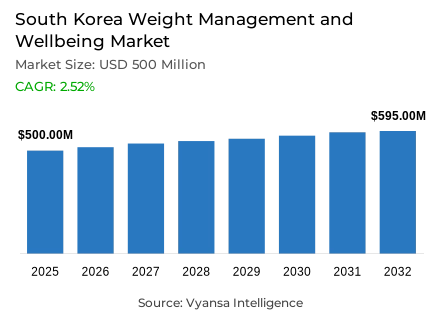
- Weight management and wellbeing market size in South Korea was valued at USD 500 million in 2025 and is estimated at USD 510 million in 2026.
- The market size is expected to grow to USD 595 million by 2032.
- Market to register a CAGR of around 2.52% during 2026-32.
- Category Shares
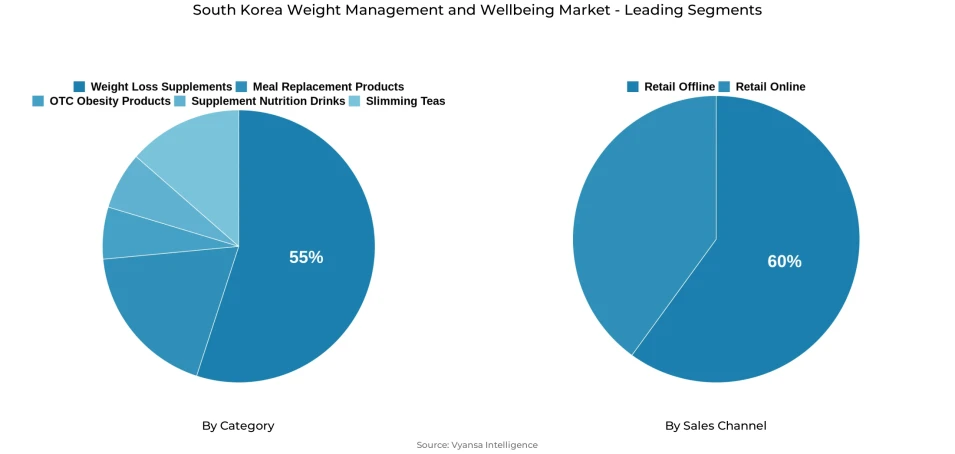
- Weight loss supplements grabbed market share of 55%.
- Competition
- More than 15 companies are actively engaged in producing weight management and wellbeing in South Korea.
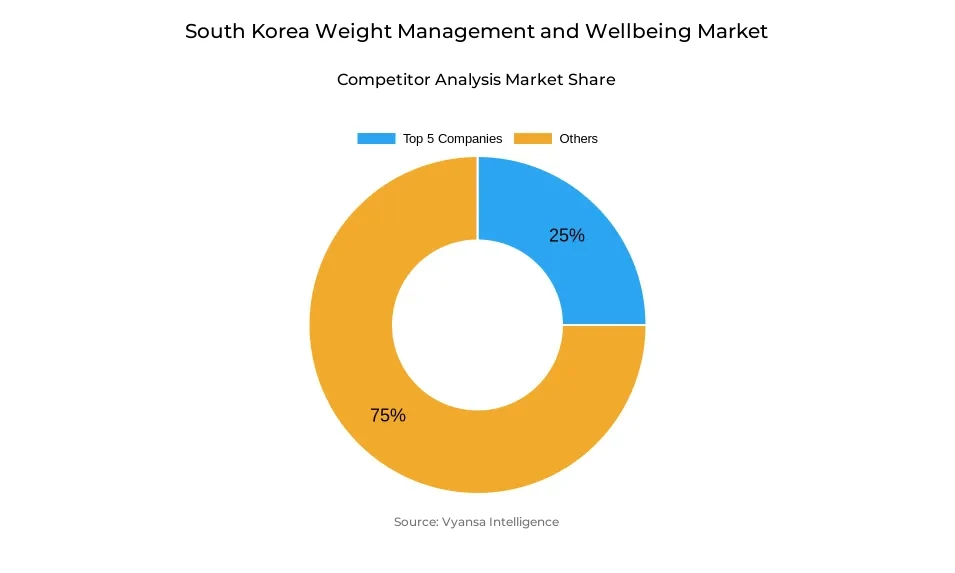
- Top 5 companies acquired around 25% of the market share.
- TGRN Inc, Dodream Corp, USANA Health Sciences Korea Ltd, Daesang Corp, Herbalife Korea Co Ltd etc., are few of the top companies.
- Sales Channel
- Retail offline grabbed 60% of the market.
South Korea Weight Management and Wellbeing Market Outlook
The South Korea weight management and wellbeing market size was valued at USD 500 million in 2025 and is projected to grow from USD 510 million in 2026 to USD 595 million by 2032, exhibiting a CAGR of 2.52% during the forecast period. Growth is supported by continuous ingredient innovation and the country’s strict regulatory approval system for functional ingredients. According to the Ministry of Food and Drug Safety (MFDS), 2025, Korea recognizes 444 individually approved functional ingredients under the Health Functional Food framework, and each approval requires clinical data submission. This structured pipeline encourages brands to invest in differentiated formulations such as plant extracts designed to support metabolism or body-fat reduction, helping companies position weight management and wellbeing products with more credible functional claims rather than broad “diet” messaging.
However, the industry faces a key challenge due to heavy product clutter and a fragmented competitive landscape. Many detox and fat-burning items compete across retail channels and overseas direct-purchase platforms, making it harder for end users to judge product credibility. The scale of this saturation is visible in regulatory data. According to the United States International Trade Administration (2024), Korea has registered over 37,000 kinds of health supplements up to the mid-2024 period, of which 5,000 products are launched every year. This increase in the number of products has increased the level of competition and has made it more challenging for brands to differentiate in the weight management and wellbeing space.
Another important trend in the weight management and wellbeing industry in Korea, from a structural standpoint, has been the rapid shift to digital channels for shopping. The younger population in Korea has been increasingly interested in buying weight management and wellbeing products online, where they can easily compare product ingredients and prices. According to retail statistics released by Statistics Korea (2025), the transaction value of online shopping in the country was 24.29 trillion won in December 2025, increasing by 6.2% compared to the prior year, of which mobile transactions accounted for 77.4% of total online transactions.
There has been a tremendous opportunity to capitalize on the weight management and wellbeing space, especially in the development of evidence-based, non-injection products to attract the interest of end users who want to support their metabolic and appetite functions. This trend has been fueled by the increasing obesity rate in the country. According to Korea’s national health statistics (2024), approximately 34.4% of adults in the country are suffering from obesity, increasing from 26.3% a decade ago. The industry is segmented by product type and sales channel, where weight loss supplements account for 55% share, while retail offline leads distribution with around 60% due to strong consumer trust in pharmacies and health stores for weight management and wellbeing products.
South Korea Weight Management and Wellbeing Market Growth DriverIngredient-led Innovation Raises Category Credibility
The biggest growth push is ingredient innovation built around individually approved functional ingredients. Brands keep investing in R&D to launch differentiated formulas, such as Cosmax Bio’s hydrangea leaf extract positioned for body-fat reduction plus skin health helping products stand out without relying on generic diet claims.
This innovation cycle is reinforced by Korea’s formal approval pipeline. As of June 27, 2025, Korea recognizes 444 individually approved functional ingredients under the Health Functional Food framework, and approvals require clinical data submission to the Ministry of Food and Drug Safety (MFDS).
South Korea Weight Management and Wellbeing Market ChallengeToo Many Choices Dilute Differentiation
A core challenge is severe product clutter, which makes it harder for end users to judge quality and for brands to defend premium positioning. The landscape stays highly fragmented, with many detox and fat-burning items, often sold via overseas direct purchase routes, competing for attention and making claim control and trust harder to manage at scale for everyone.
The registration base shows just how crowded the field is. By mid-2024, over 37,000 health supplement products are registered in Korea, and the ecosystem introduces about 5,000 new products annually, per the U.S. International Trade Administration’s regulatory overview.
Unlock Market Intelligence
Explore the market potential with our data-driven report
South Korea Weight Management and Wellbeing Market TrendOnline Purchase Habit Replaces Membership Selling
A clear structural trend is the shift away from direct selling toward digital first retail. As direct selling brands lose momentum, shoppers, especially younger buyers move to online platforms where they can compare products, read reviews, and purchase instantly without memberships or consultations. Frequent new-product launches also fit better online, where discovery is faster and shelf space is unlimited for many urban end users today.
This channel swing is visible in the latest national retail data. Statistics Korea reports online shopping transaction value reaches 24.2904 trillion won in December 2025 (+6.2% YoY), with mobile shopping at 77.4% of online value.
South Korea Weight Management and Wellbeing Market OpportunityGLP Messaging Opens a New White Space
An emerging opportunity is to build clear, compliant “GLP-1-adjacent” positioning for end users who want non-injection support. Brands already use suggestive naming (adding “GLP” to product names) and launch natural extract formulas framed around appetite or metabolism support, showing a demand signal that rewards evidence-led branding over hype.
Underlying health need remains large. The adult obesity rate in Korea has been steadily increasing, with approximately 1 in 3 adults (34.4%) projected to be obese by 2024. This represents a 30.8% increase in self-reported obesity compared to 1 in 4 adults (26.3%) a decade ago.
Unlock Market Intelligence
Explore the market potential with our data-driven report
South Korea Weight Management and Wellbeing Market Segmentation Analysis
By Category
- Meal Replacement Products
- Shakes
- Bars
- Ready-to-Drink (RTD) Beverages
- Powder Mixes
- OTC Obesity Products
- Fat Absorption Inhibitors
- Appetite Suppressants
- Metabolism Boosters
- Supplement Nutrition Drinks
- Slimming Teas
- Weight Loss Supplements
The segment has the highest share around segment under the product type, where weight loss supplements grabbed 55%. This dominance reflects the current end user preference for concentrated, easy-to-dose solutions and the way brands keep differentiating through functional ingredients and benefit-led positioning.
Other product types compete mainly on convenience and lifestyle fit rather than strong differentiation. Natural daily routines (such as teas positioned for cleansing or fat-burning) keep drawing attention, but the brand set stays fragmented and crowded. That leaves the category mix anchored by supplements that feel more standardized and functional to shoppers.
By Sales Channel
- Retail Offline
- Pharmacies & Drug Stores
- Supermarkets/Hypermarkets
- Specialty Nutrition Stores
- Retail Online
- E-commerce Platforms
- Brand-Owned Websites
The segment has the highest share around segment under the sales channel, where retail offline grabbed 60%. Pharmacies, health and personal care stores, and other physical outlets remain important because they offer immediate availability and a sense of reassurance for products tied to personal health goals.
At the same time, buying behavior is shifting. Direct selling loses momentum, while e-commerce expands the range of brands end users can access and makes comparison shopping easy. This is strongest among younger buyers who prefer speed and variety over consultations. Yet offline still leads because it anchors trust and visibility for mainstream brands.
List of Companies Covered in South Korea Weight Management and Wellbeing Market
The companies listed below are highly influential in the South Korea weight management and wellbeing market, with a significant market share and a strong impact on industry developments.
- TGRN Inc
- Dodream Corp
- USANA Health Sciences Korea Ltd
- Daesang Corp
- Herbalife Korea Co Ltd
- Aplnature Corp
- Nu Skin Korea Ltd
- Amway Korea Co Ltd
- Haitai Confectionery & Foods Co Ltd
- Chong Kun Dang Healthcare Corp
Competitive Landscape
In 2025, the competitive landscape of weight management and wellbeing in South Korea remains fragmented, with Daesang Corp leading at 9.6% value share, followed by Herbalife Korea Co Ltd at 5.3%. Daesang maintains leadership through its Nu Care brand, although its growth momentum has moderated as the segment matures and the company gradually shifts strategic focus toward the expanding RTD protein supplement category. Herbalife, historically reliant on direct selling, is experiencing slowing momentum as consumers increasingly migrate toward retail e-commerce and health and personal care stores for convenience and broader product variety. Competitive dynamics are also shaped by strong innovation in functional ingredients, such as Cosmax Bio’s hydrangea leaf extract, which supports body fat reduction and skin health benefits. Meanwhile, the market is seeing intensified competition from drinkable alternatives and supplements leveraging GLP-1-inspired positioning to capture consumer interest in non-invasive weight management solutions.
Frequently Asked Questions
Related Report
- Market Segmentation
- Research Scope
- Research Methodology
- Definitions and Assumptions
- Executive Summary
- South Korea Weight Management and Wellbeing Market Policies, Regulations, and Standards
- South Korea Weight Management and Wellbeing Market Dynamics
- Growth Factors
- Challenges
- Trends
- Opportunities
- South Korea Weight Management and Wellbeing Market Statistics, 2022-2032F
- Market Size & Growth Outlook
- By Revenues in USD Million
- Market Segmentation & Growth Outlook
- By Category
- Meal Replacement Products- Market Insights and Forecast 2022-2032, USD Million
- Shakes- Market Insights and Forecast 2022-2032, USD Million
- Bars- Market Insights and Forecast 2022-2032, USD Million
- Ready-to-Drink (RTD) Beverages- Market Insights and Forecast 2022-2032, USD Million
- Powder Mixes- Market Insights and Forecast 2022-2032, USD Million
- OTC Obesity Products- Market Insights and Forecast 2022-2032, USD Million
- Fat Absorption Inhibitors- Market Insights and Forecast 2022-2032, USD Million
- Appetite Suppressants- Market Insights and Forecast 2022-2032, USD Million
- Metabolism Boosters- Market Insights and Forecast 2022-2032, USD Million
- Supplement Nutrition Drinks- Market Insights and Forecast 2022-2032, USD Million
- Slimming Teas- Market Insights and Forecast 2022-2032, USD Million
- Weight Loss Supplements- Market Insights and Forecast 2022-2032, USD Million
- Meal Replacement Products- Market Insights and Forecast 2022-2032, USD Million
- By Application
- Obesity Management- Market Insights and Forecast 2022-2032, USD Million
- Diabetes-Associated Weight Control- Market Insights and Forecast 2022-2032, USD Million
- Cardiovascular Risk Reduction- Market Insights and Forecast 2022-2032, USD Million
- Post-Bariatric Surgery Weight Maintenance- Market Insights and Forecast 2022-2032, USD Million
- General Fitness & Lifestyle Weight Control- Market Insights and Forecast 2022-2032, USD Million
- By End User
- Hospitals- Market Insights and Forecast 2022-2032, USD Million
- Specialty & Bariatric Clinics- Market Insights and Forecast 2022-2032, USD Million
- Weight Loss Centers- Market Insights and Forecast 2022-2032, USD Million
- Homecare/Individual Consumers- Market Insights and Forecast 2022-2032, USD Million
- By Sales Channel
- Retail Offline- Market Insights and Forecast 2022-2032, USD Million
- Pharmacies & Drug Stores- Market Insights and Forecast 2022-2032, USD Million
- Supermarkets/Hypermarkets- Market Insights and Forecast 2022-2032, USD Million
- Specialty Nutrition Stores- Market Insights and Forecast 2022-2032, USD Million
- Retail Online- Market Insights and Forecast 2022-2032, USD Million
- E-commerce Platforms- Market Insights and Forecast 2022-2032, USD Million
- Brand-Owned Websites- Market Insights and Forecast 2022-2032, USD Million
- Retail Offline- Market Insights and Forecast 2022-2032, USD Million
- By Competitors
- Competition Characteristics
- Market Share & Analysis
- By Category
- Market Size & Growth Outlook
- South Korea Meal Replacement Products Market Statistics, 2022-2032
- Market Size & Growth Outlook
- By Revenues in USD Million
- Market Segmentation & Growth Outlook
- By Application- Market Insights and Forecast 2022-2032, USD Million
- By End User- Market Insights and Forecast 2022-2032, USD Million
- By Sales Channel- Market Insights and Forecast 2022-2032, USD Million
- Market Size & Growth Outlook
- South Korea OTC Obesity Products Market Statistics, 2022-2032
- Market Size & Growth Outlook
- By Revenues in USD Million
- Market Segmentation & Growth Outlook
- By Application- Market Insights and Forecast 2022-2032, USD Million
- By End User- Market Insights and Forecast 2022-2032, USD Million
- By Sales Channel- Market Insights and Forecast 2022-2032, USD Million
- Market Size & Growth Outlook
- South Korea Supplement Nutrition Drinks Market Statistics, 2022-2032
- Market Size & Growth Outlook
- By Revenues in USD Million
- Market Segmentation & Growth Outlook
- By Application- Market Insights and Forecast 2022-2032, USD Million
- By End User- Market Insights and Forecast 2022-2032, USD Million
- By Sales Channel- Market Insights and Forecast 2022-2032, USD Million
- Market Size & Growth Outlook
- South Korea Slimming Teas Market Statistics, 2022-2032
- Market Size & Growth Outlook
- By Revenues in USD Million
- Market Segmentation & Growth Outlook
- By Application- Market Insights and Forecast 2022-2032, USD Million
- By End User- Market Insights and Forecast 2022-2032, USD Million
- By Sales Channel- Market Insights and Forecast 2022-2032, USD Million
- Market Size & Growth Outlook
- South Korea Weight Loss Supplements Market Statistics, 2022-2032
- Market Size & Growth Outlook
- By Revenues in USD Million
- Market Segmentation & Growth Outlook
- By Application- Market Insights and Forecast 2022-2032, USD Million
- By End User- Market Insights and Forecast 2022-2032, USD Million
- By Sales Channel- Market Insights and Forecast 2022-2032, USD Million
- Market Size & Growth Outlook
- Competitive Outlook
- Company Profiles
- Daesang Corp
- Business Description
- Product Portfolio
- Collaborations & Alliances
- Recent Developments
- Financial Details
- Others
- Herbalife Korea Co Ltd
- Business Description
- Product Portfolio
- Collaborations & Alliances
- Recent Developments
- Financial Details
- Others
- Aplnature Corp
- Business Description
- Product Portfolio
- Collaborations & Alliances
- Recent Developments
- Financial Details
- Others
- Nu Skin Korea Ltd
- Business Description
- Product Portfolio
- Collaborations & Alliances
- Recent Developments
- Financial Details
- Others
- Amway Korea Co Ltd
- Business Description
- Product Portfolio
- Collaborations & Alliances
- Recent Developments
- Financial Details
- Others
- TGRN Inc
- Business Description
- Product Portfolio
- Collaborations & Alliances
- Recent Developments
- Financial Details
- Others
- Dodream Corp
- Business Description
- Product Portfolio
- Collaborations & Alliances
- Recent Developments
- Financial Details
- Others
- USANA Health Sciences Korea Ltd
- Business Description
- Product Portfolio
- Collaborations & Alliances
- Recent Developments
- Financial Details
- Others
- Haitai Confectionery & Foods Co Ltd
- Business Description
- Product Portfolio
- Collaborations & Alliances
- Recent Developments
- Financial Details
- Others
- Chong Kun Dang Healthcare Corp
- Business Description
- Product Portfolio
- Collaborations & Alliances
- Recent Developments
- Financial Details
- Others
- Daesang Corp
- Company Profiles
- Disclaimer
| Segment | Sub-Segment |
|---|---|
| By Category |
|
| By Application |
|
| By End User |
|
| By Sales Channel |
|
Research Methodology
This study followed a structured approach comprising four key phases to assess the size and scope of the electro-oxidation market. The process began with thorough secondary research to collect data on the target market, related markets, and broader industry context. These findings, along with preliminary assumptions and estimates, were then validated through extensive primary research involving industry experts from across the value chain. To calculate the overall market size, both top-down and bottom-up methodologies were employed. Finally, market segmentation and data triangulation techniques were applied to refine and validate segment-level estimations.
Secondary Research
The secondary research phase involved gathering data from a wide range of credible and published sources. This step helped in identifying industry trends, defining market segmentation, and understanding the market landscape and value chain.
Sources consulted during this phase included:
- Company annual reports, investor presentations, and press releases
- Industry white papers and certified publications
- Trade directories and market-recognized databases
- Articles from authoritative authors and reputable journals
- Gold and silver standard websites
Secondary research was critical in mapping out the industry's value chain and monetary flow, identifying key market segments, understanding regional variations, and tracking significant industry developments.
Other key sources:
- Financial disclosures
- Industry associations and trade bodies
- News outlets and business magazines
- Academic journals and research studies
- Paid industry databases
Primary Research
To validate secondary data and gain deeper market insights, primary research was conducted with key stakeholders across both the supply and demand sides of the market.
On the demand side, participants included decision-makers and influencers from end-user industries—such as CIOs, CTOs, and CSOs—who provided first-hand perspectives on market needs, product usage, and future expectations.
On the supply side, interviews were conducted with manufacturers, industry associations, and institutional participants to gather insights into current offerings, product pipelines, and market challenges.
Primary interviews provided critical inputs such as:
- Market size and revenue data
- Product and service breakdowns
- Market forecasts
- Regional and application-specific trends
Stakeholders consulted included:
- Leading OEM and solution providers
- Channel and distribution partners
- End users across various applications
- Independent consultants and industry specialists
Market Size Estimation and Data Triangulation
- Identifying Key Market Participants (Secondary Research)
- Goal: To identify the major players or companies in the target market. This typically involves using publicly available data sources such as industry reports, market research publications, and financial statements of companies.
- Tools: Reports from firms like Gartner, Forrester, Euromonitor, Statista, IBISWorld, and others. Public financial statements, news articles, and press releases from top market players.
- Extracting Earnings of Key Market Participants
- Goal: To estimate the earnings generated from the product or service being analyzed. This step helps in understanding the revenue potential of each market player in a specific geography.
- Methods: Earnings data can be gathered from:
- Publicly available financial reports (for listed companies).
- Interviews and primary data sources from professionals, such as Directors, VPs, SVPs, etc. This is especially useful for understanding more nuanced, internal data that isn't publicly disclosed.
- Annual reports and investor presentations of key players.
- Data Collation and Development of a Relevant Data Model
- Goal: To collate inputs from both primary and secondary sources into a structured, data-driven model for market estimation. This model will incorporate key market KPIs and any independent variables relevant to the market.
- Key KPIs: These could include:
- Market size, growth rate, and demand drivers.
- Industry-specific metrics like market share, average revenue per customer (ARPC), or average deal size.
- External variables, such as economic growth rates, inflation rates, or commodity prices, that could affect the market.
- Data Modeling: Based on this data, the market forecasts are developed for the next 5 years. A combination of trend analysis, scenario modeling, and statistical regression might be used to generate projections.
- Scenario Analysis
- Goal: To test different assumptions and validate how sensitive the market is to changes in key variables (e.g., market demand, regulatory changes, technological disruptions).
- Types of Scenarios:
- Base Case: Based on current assumptions and historical data.
- Best-Case Scenario: Assuming favorable market conditions, regulatory environments, and technological advancements.
- Worst-Case Scenario: Accounting for adverse factors, such as economic downturns, stricter regulations, or unexpected disruptions.












