South Korea Room Air Conditioners Market Report: Trends, Growth and Forecast (2026-2032)
By Product Type (Split Air Conditioners (Up to 9,000 BTU/h, 9,001-12,000 BTU/h, 12,001-18,000 BTU/h, 18,001-24,000 BTU/h, Above 24,000 BTU/h), Window Air Conditioners (Up to 9,000 BTU/h, 9,001-12,000 BTU/h, 12,001-18,000 BTU/h, 18,001-24,000 BTU/h, Above 24,000 BTU/h), Others), By Technology (Inverter, Non-Inverter), By Price (Up to USD 300, USD 301 to USD 600, USD 601 to USD 1,000, Above USD 1,000), By End User (Residential (Individual Households, Apartments/Condominiums, Vacation/Secondary Homes), Commercial (Offices, Retail Stores/Showrooms, Hospitality, Healthcare Facilities, Educational Institutions, Small Commercial Establishments, Others)), By Sales Channel (Retail Online (Brand-Owned Websites/D2C, E-Commerce Marketplaces), Retail Offline (Exclusive Brand Stores, Multi-Brand Electronics & Appliance Stores, Specialty Stores, Hypermarkets/Supermarkets, Home Improvement Stores, Dealer/Distributor Network, Direct Sales/Institutional Sales, Local Independent Retailers)), By Refrigerant Type (R-32, R-410A, R-290, R-454B, Others), By Connectivity (Smart/Connected, Conventional/Non-Smart), By Energy Efficiency (1 Star, 2 Star, 3 Star, 4 Star, 5 Star) ... Read more
|
Major Players
|
South Korea Room Air Conditioners Market Statistics and Insights, 2026
- Market Size Statistics
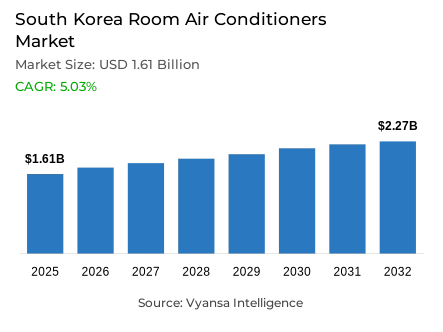
- Room air conditioners market size in South Korea was valued at USD 1.61 billion in 2025 and is estimated at USD 1.69 billion in 2026.
- The market size is expected to grow to USD 2.27 billion by 2032.
- Market to register a CAGR of around 5.03% during 2026-32.
- Product Type Shares
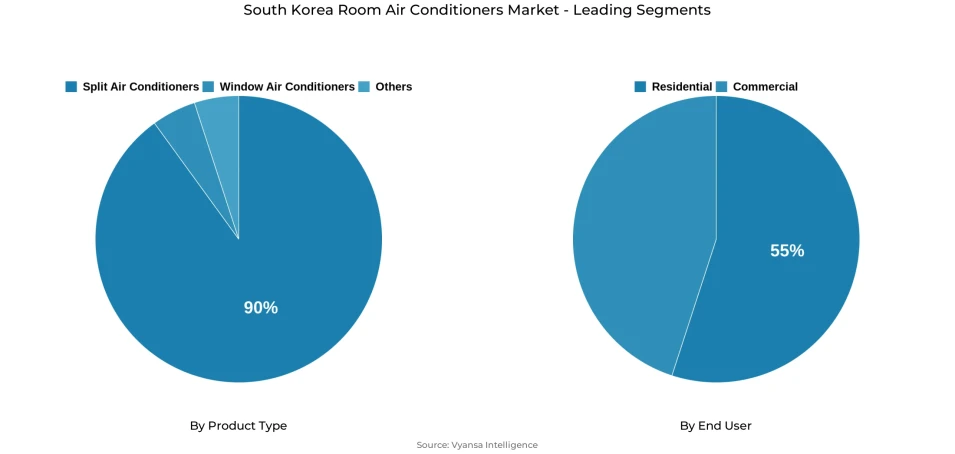
- Split air conditioners grabbed market share of 90%.
- Competition
- More than 5 companies are actively engaged in producing room air conditioners in South Korea.
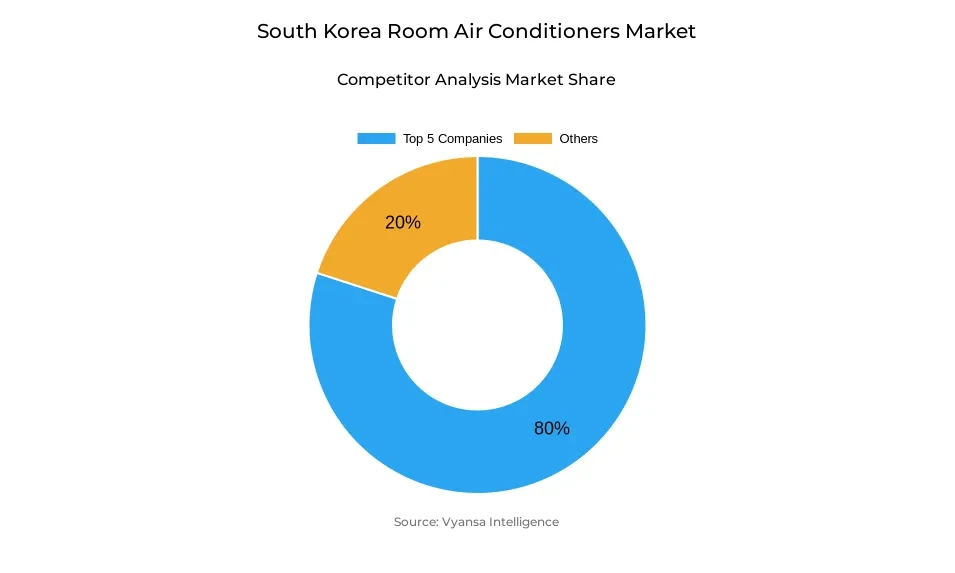
- Top 5 companies acquired around 80% of the market share.
- Carrier Global Corp, Paseco Co Ltd, Haier Group, Samsung Corp, LG Corp etc., are few of the top companies.
- End User
- Residential grabbed 55% of the market.
South Korea Room Air Conditioners Market Outlook
South Korea room air conditioners market was valued at USD 1.61 billion in 2025, projected to reach USD 1.69 billion in 2026 and USD 2.27 billion by 2032 at a CAGR of 5.03%. That rate is steady rather than exceptional. It reflects a market driven by consistent, recurring demand rather than speculative uptake or first-time adoption. Given the maturity of South Korea’s consumption landscape, growth is largely supported by replacement cycles and stable household usage rather than population-driven expansion.
At approximately 90% of the total market, split air conditioners do not just lead the category—they define pricing, product development, and competitive positioning across the market. Room cooling needs and standardized installation formats in South Korea's apartment-dominant housing stock favor split systems in ways that leave limited commercial space for alternative formats. That concentration is not incidental it maps directly onto how most of the country's population actually lives.
Residential end users account for around 55% of total demand. That makes household behavior the single most important variable in how this market moves-seasonal usage patterns, replacement timing, and upgrade decisions tied to efficiency preferences all play out at the household level. Room air conditioners here are closely linked to everyday indoor comfort, and that keeps demand relatively stable even when broader consumer sentiment shifts.
The market’s direction is consistent and supported by stable underlying demand conditions. Split systems supply, residential buyers demand, and the consumption environment is mature enough that growth comes primarily from replacement cycles and efficiency-led upgrades rather than expansion into new buyer segments. For brands making product pipeline and distribution decisions over the forecast period, that predictability has real commercial value.
South Korea Room Air Conditioners Market Growth DriverIntensifying Heat Patterns Strengthening Continuous Household Cooling Demand
South Korea average summer temperature hit 25.6°C in 2024 which is 1.9°C above normal temperature and the highest recorded since 1973, according to the Korea Meteorological Administration, Average tropical-night days reached 20.2°C, the highest on record, while average heatwave days came in at 24.0°C, the third-highest level. Longer cooling hours, reduced nighttime temperature relief, and higher daytime heat increase household dependence on air conditioners, compressing replacement cycles and sustaining point-of-sale activity.
The rise in tropical nights is particularly relevant commercially. Continuous overnight operation increases system load, accelerating wear and shortening replacement cycles. Combined with higher heatwave frequency, that dynamic shifts air conditioners from seasonal appliances toward something closer to essential household infrastructure-and that shift tends to compress the price sensitivity typically associated with discretionary categories, keeping the demand floor relatively stable through 2032.
South Korea Room Air Conditioners Market ChallengeDemographic Maturity Limiting Expansion of New Consumer Base
South Korea's total population stood at 51.81 million in 2024, up just 0.1% from the prior year, according to Statistics Korea. The Korean-born population declined by 0.2%, the child population fell to 5.42 million, and the working-age population contracted to 36.26 million. Taken together, those figures point to a demographic base that is aging and slowly shrinking-new household formation is constrained, and the pipeline of first-time appliance buyers is narrowing rather than expanding.
That demographic profile shifts the market's commercial logic away from volume growth and toward value extraction per household. Replacement cycles and premium upgrades carry more weight than they would where strong first-time buyer inflows exist. brands relying on population-driven demand face structural limitations in this market-the more durable path through 2032 runs through efficiency-led premiumization and replacement timing, not new customer acquisition.
Unlock Market Intelligence
Explore the market potential with our data-driven report
South Korea Room Air Conditioners Market TrendPolicy-Backed Efficiency Standards Accelerating Shift Toward High-Performance Systems
The South Korean government allocated KRW 49.8 billion in 2026 to support high-efficiency appliance purchases for small businesses and vulnerable groups, according to Korea Policy Briefing. Support covers up to 40% of purchase cost for Grade 1 equipment, and vulnerable households can receive up to KRW 300,000 per household. Subsidies at that scale do not just reduce cost-they actively bring upgrade decisions forward and concentrate demand on higher-efficiency models faster than organic market forces would alone.
Energy labels in South Korea display annual energy cost, power consumption, and carbon-dioxide impact, with Grade 1 representing the highest efficiency tier, according to the Korea Energy Agency. At the point of sale, that transparency changes what buyers compare-lifecycle running costs sit alongside upfront price rather than being treated as a separate calculation. Grade 1 models gain a commercial advantage that goes beyond branding, and market preference has been shifting toward premium, high-efficiency units as a result. That direction is expected to hold through 2032.
South Korea Room Air Conditioners Market OpportunityExpansion of Compact Households Driving Demand for Space-Efficient Cooling Solutions
South Korea had 23.00 million households in 2024, up 1.2% from 2023, according to Statistics Korea. One-person households reached 8.04 million and accounted for 36.1% of the total, while one- and two-person households together made up 65.1% of all households. The average household is getting smaller, and the demand profile for cooling appliances is moving with it-toward compact, efficient, easy-to-install systems suited to limited living spaces.
Apartments account for 53.9% of households, according to Statistics Korea, which keeps demand pointed toward room-specific cooling solutions rather than whole-home formats. Smaller unit sizes and urban layouts favor models that are quieter, energy-efficient, and straightforward to install without significant structural modification. This combination of smaller household sizes and apartment-dominant living creates a clear product opportunity for compact, high-efficiency split systems through 2032
Unlock Market Intelligence
Explore the market potential with our data-driven report
South Korea Room Air Conditioners Market Segmentation Analysis
By Product Type
- Split Air Conditioners
- Up to 9,000 BTU/h
- 9,001-12,000 BTU/h
- 12,001-18,000 BTU/h
- 18,001-24,000 BTU/h
- Above 24,000 BTU/h
- Window Air Conditioners
- Up to 9,000 BTU/h
- 9,001-12,000 BTU/h
- 12,001-18,000 BTU/h
- 18,001-24,000 BTU/h
- Above 24,000 BTU/h
- Others
The segment with highest market share under product type is Split air conditioners account for approximately 90% of South Korea's room air conditioner market-a share large enough that the segment functionally defines the market rather than simply leading it. The practical fit is direct: split systems offer room-level cooling flexibility, manageable installation requirements, and efficient performance in the compact residential layouts that make up the majority of the country's housing stock. That alignment has held across multiple product cycles and shows no meaningful sign of shifting.
Competitive activity plays out almost entirely within this one segment, which means pricing benchmarks, feature development, and brand differentiation all revolve around split systems. Any meaningful movement in overall market performance-whether from policy incentives, replacement cycles running faster, or efficiency regulation tightening-flows primarily through this category. That is where the volume sits, and through 2032, that is where the commercial outcomes get decided.
By End User
- Residential
- Individual Households
- Apartments/Condominiums
- Vacation/Secondary Homes
- Commercial
- Offices
- Retail Stores/Showrooms
- Hospitality
- Healthcare Facilities
- Educational Institutions
- Small Commercial Establishments
- Others
Residential buyers account for approximately 55% of South Korea's room air conditioner market, making household demand the clearest indicator of where the market is heading. This is in contrast to other types of appliances where buying is highly deferred, air conditioners here are linked to everyday comfort and seasonal cooling requirements in a climate where summer heat intensity has been steadily increasing. The pressure of demand remains relatively stable despite the weakening of the broader consumer conditions.
The practical constraints-efficiency ratings, running costs, unit sizing, installation requirements influence household-level decisions. The residential segment reacts to both signals when government subsidies are directed to eligible households and energy labels are a standard comparison tool at retail. That price sensitivity and policy incentives, and consistent underlying usage trends, make residential demand the most predictable prism through which to monitor where this market is headed over the next five years, 2032.
List of Companies Covered in South Korea Room Air Conditioners Market
The companies listed below are highly influential in the South Korea room air conditioners market, with a significant market share and a strong impact on industry developments.
- Carrier Global Corp
- Paseco Co Ltd
- Haier Group
- Samsung Corp
- LG Corp
- Shinil Electronics Co Ltd
Market News & Updates
- Samsung Corp, 2026:
Samsung launched its 2026 AI WindFree air conditioner lineup in South Korea in February 2026, introducing redesigned models including the Bespoke AI WindFree Combo Gallery Pro and Bespoke AI WindFree Combo Pro Wall-Mounted. This is a major South Korea room air conditioners market update because it advances AI-based cooling optimization, premium design, and smart-home positioning in one of Asia’s most technology-driven residential AC markets.
- LG Corp, 2026:
LG launched its 2026 Whisen Objet Collection air conditioners in Korea in January 2026, debuting the new AI Cold Free feature designed to control both temperature and humidity simultaneously while adding AI airflow, AI sleep, and upgraded voice-recognition functions. This is important for the South Korea room air conditioners market because it pushes premium residential AC competition toward more intelligent, personalized comfort rather than cooling-only performance.
Frequently Asked Questions
Related Report
- Market Segmentation
- Research Scope
- Research Methodology
- Definitions and Assumptions
- Executive Summary
- South Korea Room Air Conditioners Market Policies, Regulations, and Standards
- South Korea Room Air Conditioners Market Dynamics
- Growth Factors
- Challenges
- Trends
- Opportunities
- South Korea Room Air Conditioners Market Statistics, 2022-2032F
- Market Size & Growth Outlook
- By Revenues in USD Million
- By Units Sold in Thousand Units
- Market Segmentation & Growth Outlook
- By Product Type
- Split Air Conditioners- Market Insights and Forecast 2022-2032, USD Million
- Up to 9,000 BTU/h- Market Insights and Forecast 2022-2032, USD Million
- 9,001-12,000 BTU/h- Market Insights and Forecast 2022-2032, USD Million
- 12,001-18,000 BTU/h- Market Insights and Forecast 2022-2032, USD Million
- 18,001-24,000 BTU/h- Market Insights and Forecast 2022-2032, USD Million
- Above 24,000 BTU/h- Market Insights and Forecast 2022-2032, USD Million
- Window Air Conditioners- Market Insights and Forecast 2022-2032, USD Million
- Up to 9,000 BTU/h- Market Insights and Forecast 2022-2032, USD Million
- 9,001-12,000 BTU/h- Market Insights and Forecast 2022-2032, USD Million
- 12,001-18,000 BTU/h- Market Insights and Forecast 2022-2032, USD Million
- 18,001-24,000 BTU/h- Market Insights and Forecast 2022-2032, USD Million
- Above 24,000 BTU/h- Market Insights and Forecast 2022-2032, USD Million
- Others- Market Insights and Forecast 2022-2032, USD Million
- Split Air Conditioners- Market Insights and Forecast 2022-2032, USD Million
- By Technology
- Inverter- Market Insights and Forecast 2022-2032, USD Million
- Non-Inverter- Market Insights and Forecast 2022-2032, USD Million
- By Price
- Up to USD 300- Market Insights and Forecast 2022-2032, USD Million
- USD 301 to USD 600- Market Insights and Forecast 2022-2032, USD Million
- USD 601 to USD 1,000- Market Insights and Forecast 2022-2032, USD Million
- Above USD 1,000- Market Insights and Forecast 2022-2032, USD Million
- By End User
- Residential- Market Insights and Forecast 2022-2032, USD Million
- Individual Households- Market Insights and Forecast 2022-2032, USD Million
- Apartments/Condominiums- Market Insights and Forecast 2022-2032, USD Million
- Vacation/Secondary Homes- Market Insights and Forecast 2022-2032, USD Million
- Commercial- Market Insights and Forecast 2022-2032, USD Million
- Offices- Market Insights and Forecast 2022-2032, USD Million
- Retail Stores/Showrooms- Market Insights and Forecast 2022-2032, USD Million
- Hospitality- Market Insights and Forecast 2022-2032, USD Million
- Healthcare Facilities- Market Insights and Forecast 2022-2032, USD Million
- Educational Institutions- Market Insights and Forecast 2022-2032, USD Million
- Small Commercial Establishments- Market Insights and Forecast 2022-2032, USD Million
- Others- Market Insights and Forecast 2022-2032, USD Million
- Residential- Market Insights and Forecast 2022-2032, USD Million
- By Sales Channel
- Retail Online- Market Insights and Forecast 2022-2032, USD Million
- Brand-Owned Websites/D2C- Market Insights and Forecast 2022-2032, USD Million
- E-Commerce Marketplaces- Market Insights and Forecast 2022-2032, USD Million
- Retail Offline- Market Insights and Forecast 2022-2032, USD Million
- Exclusive Brand Stores- Market Insights and Forecast 2022-2032, USD Million
- Multi-Brand Electronics & Appliance Stores- Market Insights and Forecast 2022-2032, USD Million
- Specialty Stores- Market Insights and Forecast 2022-2032, USD Million
- Hypermarkets/Supermarkets- Market Insights and Forecast 2022-2032, USD Million
- Home Improvement Stores- Market Insights and Forecast 2022-2032, USD Million
- Dealer/Distributor Network- Market Insights and Forecast 2022-2032, USD Million
- Direct Sales/Institutional Sales- Market Insights and Forecast 2022-2032, USD Million
- Local Independent Retailers- Market Insights and Forecast 2022-2032, USD Million
- Retail Online- Market Insights and Forecast 2022-2032, USD Million
- By Refrigerant Type
- R-32- Market Insights and Forecast 2022-2032, USD Million
- R-410A- Market Insights and Forecast 2022-2032, USD Million
- R-290- Market Insights and Forecast 2022-2032, USD Million
- R-454B- Market Insights and Forecast 2022-2032, USD Million
- Others- Market Insights and Forecast 2022-2032, USD Million
- By Connectivity
- Smart/Connected- Market Insights and Forecast 2022-2032, USD Million
- Conventional/Non-Smart- Market Insights and Forecast 2022-2032, USD Million
- By Energy Efficiency
- 1 Star- Market Insights and Forecast 2022-2032, USD Million
- 2 Star- Market Insights and Forecast 2022-2032, USD Million
- 3 Star- Market Insights and Forecast 2022-2032, USD Million
- 4 Star- Market Insights and Forecast 2022-2032, USD Million
- 5 Star- Market Insights and Forecast 2022-2032, USD Million
- By Competitors
- Competition Characteristics
- Market Share & Analysis
- By Product Type
- Market Size & Growth Outlook
- South Korea Split Air Conditioners Market Statistics, 2022-2032
- Market Size & Growth Outlook
- By Revenues in USD Million
- By Units Sold in Thousand Units
- Market Segmentation & Growth Outlook
- By Technology- Market Insights and Forecast 2022-2032, USD Million
- By Price- Market Insights and Forecast 2022-2032, USD Million
- By End User- Market Insights and Forecast 2022-2032, USD Million
- By Sales Channel- Market Insights and Forecast 2022-2032, USD Million
- By Refrigerant Type- Market Insights and Forecast 2022-2032, USD Million
- By Connectivity- Market Insights and Forecast 2022-2032, USD Million
- By Energy Efficiency- Market Insights and Forecast 2022-2032, USD Million
- Market Size & Growth Outlook
- South Korea Window Air Conditioners Market Statistics, 2022-2032
- Market Size & Growth Outlook
- By Revenues in USD Million
- By Units Sold in Thousand Units
- Market Segmentation & Growth Outlook
- By Technology- Market Insights and Forecast 2022-2032, USD Million
- By Price- Market Insights and Forecast 2022-2032, USD Million
- By End User- Market Insights and Forecast 2022-2032, USD Million
- By Sales Channel- Market Insights and Forecast 2022-2032, USD Million
- By Refrigerant Type- Market Insights and Forecast 2022-2032, USD Million
- By Connectivity- Market Insights and Forecast 2022-2032, USD Million
- By Energy Efficiency- Market Insights and Forecast 2022-2032, USD Million
- Market Size & Growth Outlook
- Competitive Outlook
- Company Profiles
- Samsung Corp
- Business Description
- Product Portfolio
- Collaborations & Alliances
- Recent Developments
- Financial Details
- Others
- LG Corp
- Business Description
- Product Portfolio
- Collaborations & Alliances
- Recent Developments
- Financial Details
- Others
- Carrier Global Corp
- Business Description
- Product Portfolio
- Collaborations & Alliances
- Recent Developments
- Financial Details
- Others
- Paseco Co Ltd
- Business Description
- Product Portfolio
- Collaborations & Alliances
- Recent Developments
- Financial Details
- Others
- Haier Group
- Business Description
- Product Portfolio
- Collaborations & Alliances
- Recent Developments
- Financial Details
- Others
- Shinil Electronics Co Ltd
- Business Description
- Product Portfolio
- Collaborations & Alliances
- Recent Developments
- Financial Details
- Others
- Others
- Business Description
- Product Portfolio
- Collaborations & Alliances
- Recent Developments
- Financial Details
- Others
- Samsung Corp
- Company Profiles
- Disclaimer
| Segment | Sub-Segment |
|---|---|
| By Product Type |
|
| By Technology |
|
| By Price |
|
| By End User |
|
| By Sales Channel |
|
| By Refrigerant Type |
|
| By Connectivity |
|
| By Energy Efficiency |
|
Research Methodology
This study followed a structured approach comprising four key phases to assess the size and scope of the electro-oxidation market. The process began with thorough secondary research to collect data on the target market, related markets, and broader industry context. These findings, along with preliminary assumptions and estimates, were then validated through extensive primary research involving industry experts from across the value chain. To calculate the overall market size, both top-down and bottom-up methodologies were employed. Finally, market segmentation and data triangulation techniques were applied to refine and validate segment-level estimations.
Secondary Research
The secondary research phase involved gathering data from a wide range of credible and published sources. This step helped in identifying industry trends, defining market segmentation, and understanding the market landscape and value chain.
Sources consulted during this phase included:
- Company annual reports, investor presentations, and press releases
- Industry white papers and certified publications
- Trade directories and market-recognized databases
- Articles from authoritative authors and reputable journals
- Gold and silver standard websites
Secondary research was critical in mapping out the industry's value chain and monetary flow, identifying key market segments, understanding regional variations, and tracking significant industry developments.
Other key sources:
- Financial disclosures
- Industry associations and trade bodies
- News outlets and business magazines
- Academic journals and research studies
- Paid industry databases
Primary Research
To validate secondary data and gain deeper market insights, primary research was conducted with key stakeholders across both the supply and demand sides of the market.
On the demand side, participants included decision-makers and influencers from end-user industries—such as CIOs, CTOs, and CSOs—who provided first-hand perspectives on market needs, product usage, and future expectations.
On the supply side, interviews were conducted with manufacturers, industry associations, and institutional participants to gather insights into current offerings, product pipelines, and market challenges.
Primary interviews provided critical inputs such as:
- Market size and revenue data
- Product and service breakdowns
- Market forecasts
- Regional and application-specific trends
Stakeholders consulted included:
- Leading OEM and solution providers
- Channel and distribution partners
- End users across various applications
- Independent consultants and industry specialists
Market Size Estimation and Data Triangulation
- Identifying Key Market Participants (Secondary Research)
- Goal: To identify the major players or companies in the target market. This typically involves using publicly available data sources such as industry reports, market research publications, and financial statements of companies.
- Tools: Reports from firms like Gartner, Forrester, Euromonitor, Statista, IBISWorld, and others. Public financial statements, news articles, and press releases from top market players.
- Extracting Earnings of Key Market Participants
- Goal: To estimate the earnings generated from the product or service being analyzed. This step helps in understanding the revenue potential of each market player in a specific geography.
- Methods: Earnings data can be gathered from:
- Publicly available financial reports (for listed companies).
- Interviews and primary data sources from professionals, such as Directors, VPs, SVPs, etc. This is especially useful for understanding more nuanced, internal data that isn't publicly disclosed.
- Annual reports and investor presentations of key players.
- Data Collation and Development of a Relevant Data Model
- Goal: To collate inputs from both primary and secondary sources into a structured, data-driven model for market estimation. This model will incorporate key market KPIs and any independent variables relevant to the market.
- Key KPIs: These could include:
- Market size, growth rate, and demand drivers.
- Industry-specific metrics like market share, average revenue per customer (ARPC), or average deal size.
- External variables, such as economic growth rates, inflation rates, or commodity prices, that could affect the market.
- Data Modeling: Based on this data, the market forecasts are developed for the next 5 years. A combination of trend analysis, scenario modeling, and statistical regression might be used to generate projections.
- Scenario Analysis
- Goal: To test different assumptions and validate how sensitive the market is to changes in key variables (e.g., market demand, regulatory changes, technological disruptions).
- Types of Scenarios:
- Base Case: Based on current assumptions and historical data.
- Best-Case Scenario: Assuming favorable market conditions, regulatory environments, and technological advancements.
- Worst-Case Scenario: Accounting for adverse factors, such as economic downturns, stricter regulations, or unexpected disruptions.












