South Korea Plant-Based Dairy Market Report: Trends, Growth and Forecast (2026-2032)
By Product Type (Plant-Based Milk (Soy Drinks, Almond, Blends, Coconut, Oat, Rice, Other Plant-Based Milk), Plant-Based Yoghurt, Plant-Based Cheese), By Sales Channel (Offline (Grocery Retailers, Convenience Retailers, Supermarkets, Hypermarkets), Online) ... Read more
|
Major Players
|
South Korea Plant-Based Dairy Market Statistics and Insights, 2026
- Market Size Statistics
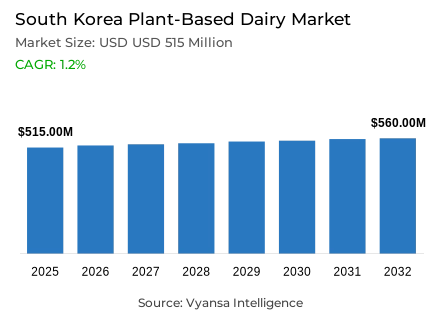
- Plant-based dairy in South Korea is estimated at USD 515 million in 2025.
- The market size is expected to grow to USD 560 million by 2032.
- Market to register a cagr of around 1.2% during 2026-32.
- Product Type Shares
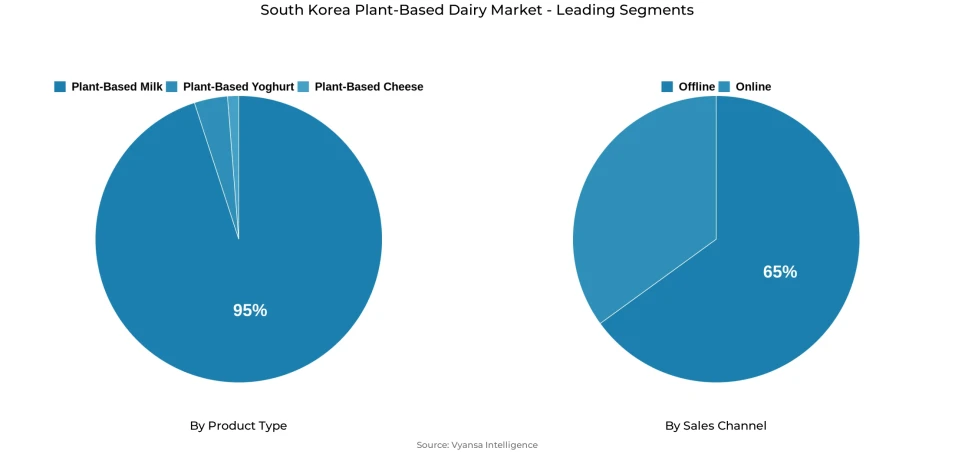
- Plant-based milk grabbed market share of 95%.
- Competition
- More than 5 companies are actively engaged in producing plant-based dairy in South Korea.
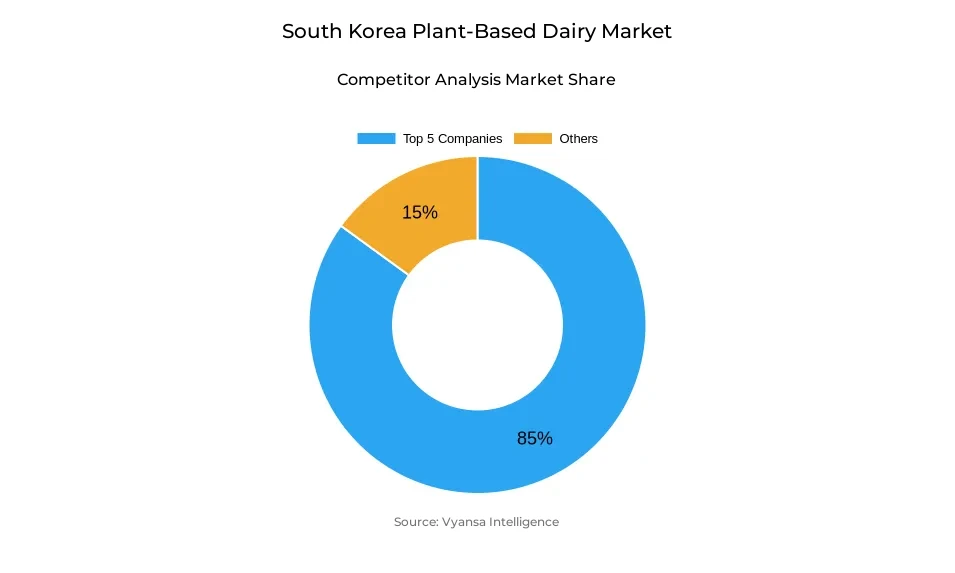
- Top 5 companies acquired around 85% of the market share.
- Bobsnu Co Ltd; Lotte Chilsung Beverage Co Ltd; Yonsei Milk; Dr Chung's Food Co Ltd; Maeil Dairies Co Ltd etc., are few of the top companies.
- Sales Channel
- Retail offline grabbed 65% of the market.
South Korea Plant-Based Dairy Market Outlook
The South Korea plant-based dairy market further reinforces its foothold as a mainstream choice against conventional dairy products. In 2025, the plant-based dairy market is estimated to be at USD 515 million, which indicates an increasing acceptance level for plant-based offerings within the broader end users base. It can be said that plant-based dairy was an emerging trend associated with young end users to begin with; however, the trend has now matured to be widely adopted by end users across all age groups. The plant-based milk variant has moved from being an alternate to being a preferred choice for consumption on a daily basis.
Plant-based milk leads in the offerings, as it nearly constitutes the whole non-dairy plant-based market. Its popularity is fueled by the high incidence of lactose intolerance in the population, changes in end users eating habits, as well as increased knowledge and awareness on environmental issues among end users. This category is also supplemented by demand from flavoring milk drinks and conventional soy products, thus cementing its position in the market. With more local manufacturers in the market, visibility is enhanced through increased familiarity among end users.
The distribution is mostly offline, with retail stores acting as conduits for end users. However, UGC is more online than traditional dairy because of its online affinity, which was prevalent in its earliest adopters. end users-to-brand platforms and online offerings have been increasing in importance for product recommendations and re-ordering, especially within younger generations.
Looking ahead, market size is anticipated to become USD 560 million by 2032, registering a CAGR of approximately 1.2%. Though moderate, the market is aided by its existing customer base, increasing foodservice consumption, and new product offerings by key players. Thus, this market of plant-based dairy stands out as a robust and key market in South Korea’s dairy market.
South Korea Plant-Based Dairy Market Growth Driver
Widening Daily Use of Plant-Based Milk Supports Market Growth
A central factor supporting sales of plant-based dairy alternatives is the widespread acceptance of plant-based milk as a beverage suitable for daily consumption. Plant-based milk becomes an ideal alternative to milk in a marketplace where people are lactose intolerant. At first, it was consumed by the youth, who preferred it to milk based on its new packaging.
Plant-based milk has moved out of its traditional role as an alternative to cow’s milk. Currently, it is increasingly being used as a substitute for other dairy alternatives such as soy-based drinks, other plant-based dairy alternatives, as well as flavored milk. As the key local food manufacturing companies gain traction within this market, awareness and trust with the end users also increases.
South Korea Plant-Based Dairy Market Challenge
Rising Competitive Tension in Dairy and Beverage Markets
The market is increasingly being challenged by traditional and related beverage alternatives. Conventional milk, flavored beverages, and RTD functional beverages are deeply entrenched in end users behavior, thereby providing stiff competition to plant-based beverages. Price sensitivity is another fact that impacts purchasing decisions, especially with stiff competition in the marketplace.
Now, within the plant-based dairy range, overlapping functional claims mean a lack of differentiation, whereas soy drinks, which served as a major alternative option, have seen little relevance with the proliferation of new plant-based milks, thereby prompting a need for justification of value beyond core health positioning, thus making it more difficult to build brand loyalty with a crowded market.
Unlock Market Intelligence
Explore the market potential with our data-driven report
South Korea Plant-Based Dairy Market Trend
Paradigm Shift from Functional to Brand Related Differentiation
The maturation of the milk alternatives market is reshaping competitive dynamics, with health and nutritional benefits increasingly regarded as standard attributes rather than distinguishing factors. Instead, identity and beauty are the areas brands compete for among increasingly health-savvy and nutrition-conscious end users. Packaging esthetics, communication tone, and living style alignment have increasingly been taken into account in purchasing decisions.
Brands that create distinctiveness in retail, digital, foodservice, or both channels have a greater opportunity to differentiate themselves. This shift towards brands indicates a shift in competitive patterns in the market from being functionality-oriented to being brands-oriented.
South Korea Plant-Based Dairy Market Opportunity
Expansion Across Foodservice and Digital Channels
An emerging avenue for future market expansion lies in the increasing integration of plant-based milks within the foodservice sector. Cafes, bakeries, and other institutional end users feel compelled to carry plant-based milks, thus making them essential commodities rather than innovations.
At the same time, the emergence of digital technologies opens up new avenues for growing the market. Direct-to-end users, carefully curated digital products, and subscription-service options all work to strengthen convenience and facilitate repeat business. Such options empower the brand to enhance end users engagement, to promote a wider array of products, and to better strengthen long-term loyalty.
Unlock Market Intelligence
Explore the market potential with our data-driven report
South Korea Plant-Based Dairy Market Segmentation Analysis
By Product Type
- Plant-Based Milk
- Soy Drinks
- Almond
- Blends
- Coconut
- Oat
- Rice
- Other Plant-Based Milk
- Plant-Based Yoghurt
- Plant-Based Cheese
The segment with the highest share under the product type is Plant-Based Milk, which accounts for around 95% of the market. Its dominance reflects strong end users acceptance as a daily dairy alternative rather than a niche substitute. High lactose intolerance levels, combined with evolving dietary habits, have positioned plant-based milk as the most practical and widely consumed format within plant-based dairy.
Plant-based milk has also absorbed demand from flavoured milk drinks and traditional soy beverages, reinforcing its leadership. Continuous innovation, wider retail availability, and growing use in both household and foodservice settings further support its strong position. As the category matures, plant-based milk continues to anchor overall market performance.
By Sales Channel
- Offline
- Grocery Retailers
- Convenience Retailers
- Supermarkets
- Hypermarkets
- Online
The segment with the highest share under the sales channel is retail offline, capturing around 65% of the market. Offline retail remains the preferred purchasing channel, supported by strong visibility across convenience stores, supermarkets, and hypermarkets. Wider shelf presence has helped plant-based dairy reach end users beyond its early adopter base.
While retail online play an important role, particularly among younger end users, retail offline continues to dominate due to immediacy, familiarity, and impulse purchasing behaviour. As the category expands to older demographics, physical retail formats remain critical for sustaining volume and accessibility.
List of Companies Covered in South Korea Plant-Based Dairy Market
The companies listed below are highly influential in the South Korea plant-based dairy market, with a significant market share and a strong impact on industry developments.
- Bobsnu Co Ltd
- Lotte Chilsung Beverage Co Ltd
- Yonsei Milk
- Dr Chung's Food Co Ltd
- Maeil Dairies Co Ltd
- Sahmyook Foods Co Ltd
- Namyang Dairy Products Co Ltd
Frequently Asked Questions
Related Report
1. Market Segmentation
1.1. Research Scope
1.2. Research Methodology
1.3. Definitions and Assumptions
2. Executive Summary
3. South Korea Plant Based Dairy Market Policies, Regulations, and Standards
4. South Korea Plant Based Dairy Market Dynamics
4.1. Growth Factors
4.2. Challenges
4.3. Trends
4.4. Opportunities
5. South Korea Plant Based Dairy Market Statistics, 2020-2030F
5.1. Market Size & Growth Outlook
5.1.1.By Revenues in US$ Million
5.2. Market Segmentation & Growth Outlook
5.2.1.By Product Type
5.2.1.1. Plant-Based Milk- Market Insights and Forecast 2020-2030, USD Million
5.2.1.1.1. Soy Drinks- Market Insights and Forecast 2020-2030, USD Million
5.2.1.1.2. Almond- Market Insights and Forecast 2020-2030, USD Million
5.2.1.1.3. Blends- Market Insights and Forecast 2020-2030, USD Million
5.2.1.1.4. Coconut- Market Insights and Forecast 2020-2030, USD Million
5.2.1.1.5. Oat- Market Insights and Forecast 2020-2030, USD Million
5.2.1.1.6. Rice- Market Insights and Forecast 2020-2030, USD Million
5.2.1.1.7. Other Plant-Based Milk- Market Insights and Forecast 2020-2030, USD Million
5.2.1.2. Plant-Based Yoghurt- Market Insights and Forecast 2020-2030, USD Million
5.2.1.3. Plant-Based Cheese- Market Insights and Forecast 2020-2030, USD Million
5.2.2.By Sales Channel
5.2.2.1. Offline- Market Insights and Forecast 2020-2030, USD Million
5.2.2.1.1. Grocery Retailers- Market Insights and Forecast 2020-2030, USD Million
5.2.2.1.2. Convenience Retailers- Market Insights and Forecast 2020-2030, USD Million
5.2.2.1.3. Supermarkets- Market Insights and Forecast 2020-2030, USD Million
5.2.2.1.4. Hypermarkets- Market Insights and Forecast 2020-2030, USD Million
5.2.2.2. Online- Market Insights and Forecast 2020-2030, USD Million
5.2.3.By Competitors
5.2.3.1. Competition Characteristics
5.2.3.2. Market Share & Analysis
6. South Korea Plant-Based Milk Market Outlook, 2020-2030F
6.1. Market Size & Growth Outlook
6.1.1.By Revenues in US$ Million
6.2. Market Segmentation & Growth Outlook
6.2.1.By Sales Channel- Market Insights and Forecast 2020-2030, USD Million
7. South Korea Plant-Based Yoghurt Market Outlook, 2020-2030F
7.1. Market Size & Growth Outlook
7.1.1.By Revenues in US$ Million
7.2. Market Segmentation & Growth Outlook
7.2.1.By Sales Channel- Market Insights and Forecast 2020-2030, USD Million
8. South Korea Plant-Based Cheese Market Outlook, 2020-2030F
8.1. Market Size & Growth Outlook
8.1.1.By Revenues in US$ Million
8.2. Market Segmentation & Growth Outlook
8.2.1.By Sales Channel- Market Insights and Forecast 2020-2030, USD Million
9. Competitive Outlook
9.1. Company Profiles
9.1.1.Dr Chung's Food Co Ltd
9.1.1.1. Business Description
9.1.1.2. Product Portfolio
9.1.1.3. Collaborations & Alliances
9.1.1.4. Recent Developments
9.1.1.5. Financial Details
9.1.1.6. Others
9.1.2.Maeil Dairies Co Ltd
9.1.2.1. Business Description
9.1.2.2. Product Portfolio
9.1.2.3. Collaborations & Alliances
9.1.2.4. Recent Developments
9.1.2.5. Financial Details
9.1.2.6. Others
9.1.3.Sahmyook Foods Co Ltd
9.1.3.1. Business Description
9.1.3.2. Product Portfolio
9.1.3.3. Collaborations & Alliances
9.1.3.4. Recent Developments
9.1.3.5. Financial Details
9.1.3.6. Others
9.1.4.Yonsei Milk
9.1.4.1. Business Description
9.1.4.2. Product Portfolio
9.1.4.3. Collaborations & Alliances
9.1.4.4. Recent Developments
9.1.4.5. Financial Details
9.1.4.6. Others
9.1.5.Namyang Dairy Products Co Ltd
9.1.5.1. Business Description
9.1.5.2. Product Portfolio
9.1.5.3. Collaborations & Alliances
9.1.5.4. Recent Developments
9.1.5.5. Financial Details
9.1.5.6. Others
9.1.6.Bobsnu Co Ltd
9.1.6.1. Business Description
9.1.6.2. Product Portfolio
9.1.6.3. Collaborations & Alliances
9.1.6.4. Recent Developments
9.1.6.5. Financial Details
9.1.6.6. Others
9.1.7.Lotte Chilsung Beverage Co Ltd
9.1.7.1. Business Description
9.1.7.2. Product Portfolio
9.1.7.3. Collaborations & Alliances
9.1.7.4. Recent Developments
9.1.7.5. Financial Details
9.1.7.6. Others
10. Disclaimer
| Segment | Sub-Segment |
|---|---|
| By Product Type |
|
| By Sales Channel |
|
Research Methodology
This study followed a structured approach comprising four key phases to assess the size and scope of the electro-oxidation market. The process began with thorough secondary research to collect data on the target market, related markets, and broader industry context. These findings, along with preliminary assumptions and estimates, were then validated through extensive primary research involving industry experts from across the value chain. To calculate the overall market size, both top-down and bottom-up methodologies were employed. Finally, market segmentation and data triangulation techniques were applied to refine and validate segment-level estimations.
Secondary Research
The secondary research phase involved gathering data from a wide range of credible and published sources. This step helped in identifying industry trends, defining market segmentation, and understanding the market landscape and value chain.
Sources consulted during this phase included:
- Company annual reports, investor presentations, and press releases
- Industry white papers and certified publications
- Trade directories and market-recognized databases
- Articles from authoritative authors and reputable journals
- Gold and silver standard websites
Secondary research was critical in mapping out the industry's value chain and monetary flow, identifying key market segments, understanding regional variations, and tracking significant industry developments.
Other key sources:
- Financial disclosures
- Industry associations and trade bodies
- News outlets and business magazines
- Academic journals and research studies
- Paid industry databases
Primary Research
To validate secondary data and gain deeper market insights, primary research was conducted with key stakeholders across both the supply and demand sides of the market.
On the demand side, participants included decision-makers and influencers from end-user industries—such as CIOs, CTOs, and CSOs—who provided first-hand perspectives on market needs, product usage, and future expectations.
On the supply side, interviews were conducted with manufacturers, industry associations, and institutional participants to gather insights into current offerings, product pipelines, and market challenges.
Primary interviews provided critical inputs such as:
- Market size and revenue data
- Product and service breakdowns
- Market forecasts
- Regional and application-specific trends
Stakeholders consulted included:
- Leading OEM and solution providers
- Channel and distribution partners
- End users across various applications
- Independent consultants and industry specialists
Market Size Estimation and Data Triangulation
- Identifying Key Market Participants (Secondary Research)
- Goal: To identify the major players or companies in the target market. This typically involves using publicly available data sources such as industry reports, market research publications, and financial statements of companies.
- Tools: Reports from firms like Gartner, Forrester, Euromonitor, Statista, IBISWorld, and others. Public financial statements, news articles, and press releases from top market players.
- Extracting Earnings of Key Market Participants
- Goal: To estimate the earnings generated from the product or service being analyzed. This step helps in understanding the revenue potential of each market player in a specific geography.
- Methods: Earnings data can be gathered from:
- Publicly available financial reports (for listed companies).
- Interviews and primary data sources from professionals, such as Directors, VPs, SVPs, etc. This is especially useful for understanding more nuanced, internal data that isn't publicly disclosed.
- Annual reports and investor presentations of key players.
- Data Collation and Development of a Relevant Data Model
- Goal: To collate inputs from both primary and secondary sources into a structured, data-driven model for market estimation. This model will incorporate key market KPIs and any independent variables relevant to the market.
- Key KPIs: These could include:
- Market size, growth rate, and demand drivers.
- Industry-specific metrics like market share, average revenue per customer (ARPC), or average deal size.
- External variables, such as economic growth rates, inflation rates, or commodity prices, that could affect the market.
- Data Modeling: Based on this data, the market forecasts are developed for the next 5 years. A combination of trend analysis, scenario modeling, and statistical regression might be used to generate projections.
- Scenario Analysis
- Goal: To test different assumptions and validate how sensitive the market is to changes in key variables (e.g., market demand, regulatory changes, technological disruptions).
- Types of Scenarios:
- Base Case: Based on current assumptions and historical data.
- Best-Case Scenario: Assuming favorable market conditions, regulatory environments, and technological advancements.
- Worst-Case Scenario: Accounting for adverse factors, such as economic downturns, stricter regulations, or unexpected disruptions.












