Saudi Arabia Hair Serum Market Report: Trends, Growth and Forecast (2026-2032)
By Product Type (Anti-Frizz Serum, Shine Serum, Heat Protection Serum, Damage Repair Serum, Scalp Serum, Others), By Ingredient Base (Silicone-Based, Oil-Based, Water-Based, Herbal/Botanical, Keratin/Protein-Based, Others), By Hair Type (Dry & Frizzy Hair, Curly & Wavy Hair, Damaged Hair, Colored/Chemically Treated Hair, Normal Hair, Others), By End User (Women, Men, Unisex, Kids), By Sales Channel (Retail Online (E-Commerce Marketplaces, Brand-Owned Websites, Beauty E-Retailers), Retail Offline (Supermarkets & Hypermarkets, Pharmacies & Drugstores, Beauty Specialty Stores, Salons & Professional Stores)), By Regions (East, West, South, Central) ... Read more
|
Major Players
|
Saudi Arabia Hair Serum Market Statistics and Insights, 2026
- Market Size Statistics
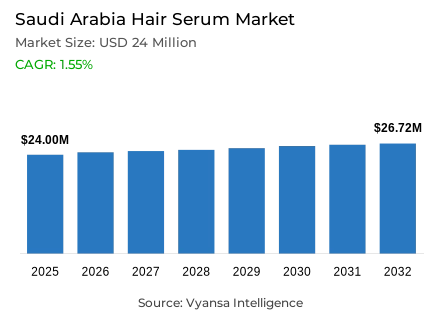
- Hair serum market size in Saudi Arabia was valued at USD 24 million in 2025 and is estimated at USD 24.37 million in 2026.
- The market size is expected to grow to USD 26.72 million by 2032.
- Market to register a CAGR of around 1.55% during 2026-32.
- Product Type Shares
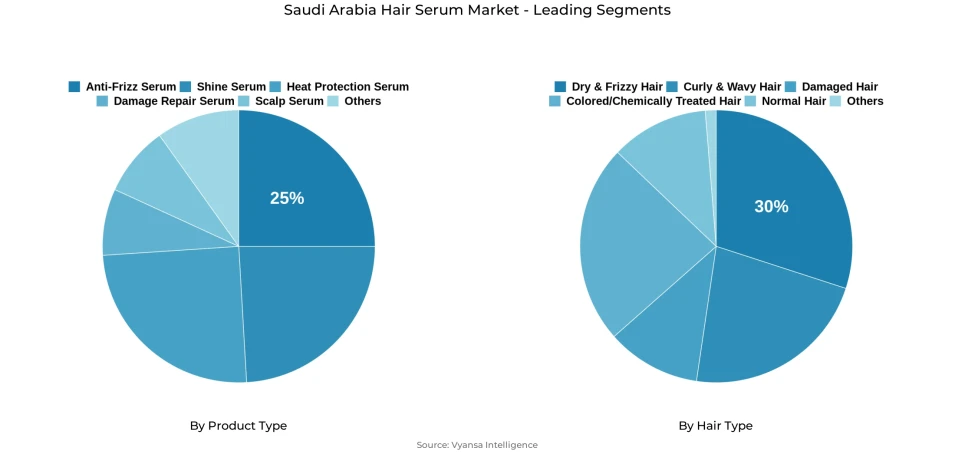
- Anti-frizz serum grabbed market share of 25%.
- Competition
- More than 10 companies are actively engaged in producing hair serum in Saudi Arabia.
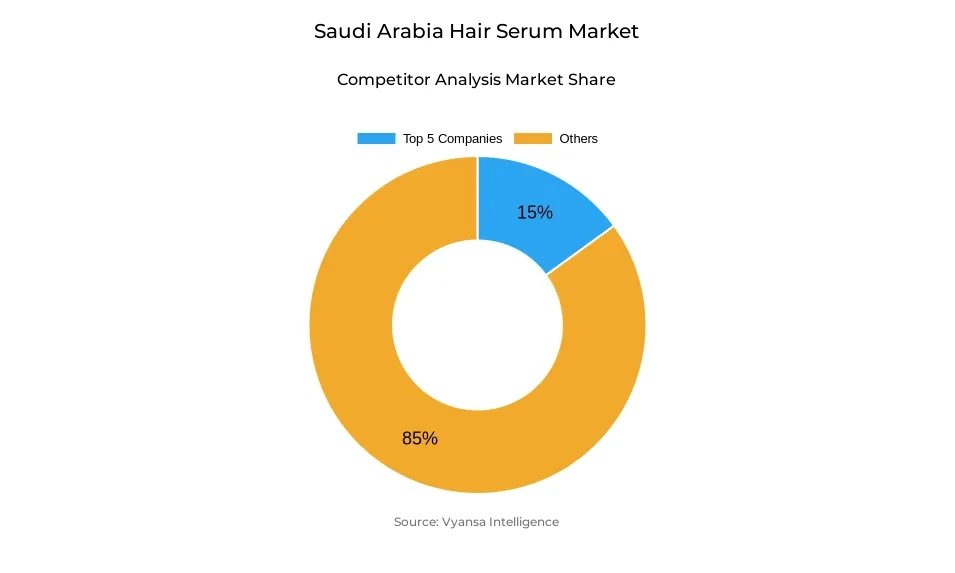
- Top 5 companies acquired around 15% of the market share.
- The Estee Lauder Companies Inc. , Moroccanoil Inc. , Sephora Emirates L.L.C., L’Oreal S.A. , Unilever PLC etc., are few of the top companies.
- Hair Type
- Dry & frizzy hair grabbed 30% of the market.
Saudi Arabia Hair Serum Market Outlook
The Saudi Arabia Hair Serum Market was valued at USD 24 million in 2025 and is projected to grow from USD 24.37 million in 2026 to USD 26.72 million by 2032, registering a CAGR of 1.55% across the forecast period. This measured and steady expansion reflects consistent consumer interest in hair care products that address daily styling, texture management, and hair finishing needs across a digitally active and increasingly brand-aware population. The market is advancing on the strength of strong online retail penetration, growing personal care awareness, and a beauty and personal care industry environment that continues to reward performance-driven and problem-solving product positioning.
At the product level, Anti-Frizz Serum accounts for 25% of the overall market, holding the leading position within the product type segment. This share reflects sustained consumer preference for solutions that improve hair smoothness, control flyaways, and support easier styling in everyday grooming routines, making practical daily-use performance the most commercially durable product selection criterion across Saudi Arabia. The segment's strength confirms that products for fine lines and wrinkles aside, efficacy-first positioning in personal care categories consistently commands the highest consumer loyalty and repeat purchase intent.
Hair type demand is equally shaping category structure, with Dry and Frizzy Hair commanding 30% of the total market. A significant portion of category consumption is being driven by concerns around visible dryness, rough texture, and difficult-to-manage hair conditions, as consumers seek leave-in solutions that deliver softer texture, smoother appearance, and more controlled daily handling. This demand concentration confirms that condition-specific, repair-oriented product positioning remains the most effective commercial strategy across the Saudi Arabia hair serum landscape.
These twin demand pillars jointly sustain a stable commercial trajectory through 2032. Anti-frizz performance products and dry hair-oriented formulations are reinforcing each other at the category level, and the India anti-aging products market parallel confirms that problem-solving beauty categories with clearly defined consumer concerns consistently maintain durable commercial relevance even in measured-growth market environments.
Saudi Arabia Hair Serum Market Growth Driver
Online Beauty Buying Keeps Demand Moving
Saudi Arabia's advanced digital buying environment is creating a strong and broad-based demand foundation for routine and premium hair care products across the Kingdom. As per data published by the General Authority for Statistics of Saudi Arabia, 80.2% of Saudis purchased goods and services online in 2025, with 82.8% of Saudi females making online purchases during the same period. This scale of digital consumer participation is directly sustaining product discovery, comparison, and repurchase behavior for hair serum across both e-commerce beauty products platforms and direct brand channels in Saudi Arabia.
Category-level purchase patterns are reinforcing this demand further. According to statistics released by the General Authority for Statistics of Saudi Arabia, cosmetics accounted for 40.2% of goods and services bought online in 2025, while 57.2% of internet users used the internet to obtain information about goods or services. This combination of active beauty browsing and high cosmetics purchase intent is keeping online skincare sales growth strongly aligned with hair serum demand, as consumers benefit from easier access to both premium and mass offerings through expanding digital retail infrastructure.
Saudi Arabia Hair Serum Market Challenge
Compliance Layers Keep Launches Complex
Cosmetic product regulations in Saudi Arabia impose a structured and documentation-intensive compliance process that creates a persistent barrier for new market entrants and expanding product lines. Based on data from the Saudi Food and Drug Authority, the current cosmetics laws and regulations framework includes a requirement dated 26 November 2024 covering conditions for cosmetic product clearance and raw materials used in manufacturing, making product launches more process-driven and increasing the documentation burden for brands operating across retail skincare distribution and import channels in Saudi Arabia.
The compliance environment intensifies further because formal listing is a prerequisite for all commercial activity. As indicated by authoritative sources at the Saudi Food and Drug Authority, a cosmetic product cannot be imported or traded in Saudi Arabia until it is listed and holds a valid listing certificate, while notification through the eCosma system does not constitute a safety evaluation by the authority, leaving full responsibility for product information and safety with the notifier. These conditions raise the operational and compliance burden for direct-to-consumer skincare brands and importers seeking to scale hair serum portfolios across Saudi Arabia's regulated beauty market.
Unlock Market Intelligence
Explore the market potential with our data-driven report
Saudi Arabia Hair Serum Market Trend
Social-First Discovery Shapes Product Trends
Visual and creator-led beauty content is becoming the dominant discovery channel for hair care products across Saudi Arabia, reshaping how consumers evaluate and purchase hair serum. Evidence drawn from public data released by the General Authority for Statistics of Saudi Arabia confirms that 96.2% of individuals aged 15 to 74 participated in social media networks in 2025, while 79.4% watched video content via the internet during the same period. This environment is keeping beauty marketing more visual, education-based, and performance-demonstrative, with premium skincare consumers increasingly relying on texture, shine, and before-and-after content before committing to purchase decisions.
The trend is becoming more embedded in daily digital behavior across Saudi Arabia. In line with findings from the General Authority for Statistics of Saudi Arabia, 98.4% of individuals used a mobile phone to access the internet and 96.8% accessed the internet at least once daily. This level of mobile engagement supports short-form product content, faster beauty discovery, and stronger repeat brand exposure for hair serum companies that prioritize urban skincare adoption narratives and daily-use relevance through digital storytelling rather than relying solely on shelf visibility and traditional retail presence.
Saudi Arabia Hair Serum Market Opportunity
Digital Commerce Opens a Wider Premium Runway
Saudi Arabia's expanding digital economy is creating a commercially significant and well-supported opportunity for premium, niche, and treatment-led hair serum brands to scale through direct and platform-based distribution channels. As per official figures from the General Authority for Statistics of Saudi Arabia, the digital economy accounted for 16.0% of Saudi Arabia's GDP in 2024, while e-commerce records rose from 37,481 in 2023 to 40,953 in 2024. This growth is improving the commercial conditions for new product launches and more specialized beauty positioning, creating better headroom for personalized anti-aging products and condition-targeted hair care formats across Saudi Arabia's digitally integrated consumer base.
The broader digital business ecosystem is amplifying this opportunity at the infrastructure level. Data compiled from internationally recognized public authorities at the General Authority for Statistics of Saudi Arabia confirms that application development activity records rose from 11,605 to 15,775 in 2024, while cloud computing service records increased from 1,759 to 3,005 in the same year. These infrastructure improvements are strengthening the operating environment for subscription models, loyalty programs, and personalized beauty journeys, giving organic and natural skincare demand and innovation-led hair serum brands a more capable and scalable digital platform for sustained consumer engagement across Saudi Arabia.
Unlock Market Intelligence
Explore the market potential with our data-driven report
Saudi Arabia Hair Serum Market Segmentation Analysis
By Product Type
- Anti-Frizz Serum
- Shine Serum
- Heat Protection Serum
- Damage Repair Serum
- Scalp Serum
- Others
Anti-frizz serum commands the highest share within the product type category at 25%, reflecting strong and consistent consumer preference for solutions that manage rough texture, control visible flyaways, and improve hair handling in routine grooming and styling habits. Brands across Saudi Arabia are investing in formulations that deliver visible and practical results, with advanced dermatological treatments and ingredient-backed positioning being used as commercial differentiators within this commercially active product segment. Its leading position confirms that immediate, everyday performance remains the primary purchase driver across the hair serum category in Saudi Arabia.
This segment's strength also reflects the value consumers place on products that address clear, daily-use concerns without requiring complex application routines. Anti-frizz serum continues to shape retail focus, shelf allocation, and innovation investment within the broader category because it delivers consistently understood benefits to a well-defined consumer need. As clean beauty anti-aging trend principles extend into hair care formulation across Saudi Arabia, this segment is well positioned to sustain its commercial lead through the forecast period.
By Hair Type
- Dry & Frizzy Hair
- Curly & Wavy Hair
- Damaged Hair
- Colored/Chemically Treated Hair
- Normal Hair
- Others
The dry and frizzy hair segment commands the highest share within the hair type category at 30%, driven by a large consumer base seeking smoother texture, softness, and improved control over difficult hair conditions that are closely tied to climate and daily styling habits in Saudi Arabia. Brands are directing formulation investment toward solutions that address visible dryness and everyday frizz with greater precision, with natural anti-aging ingredients and nourishment-led positioning being adapted into hair care applications to meet rising consumer expectations for ingredient transparency and performance depth. Its lead position confirms that condition-specific demand is the most powerful commercial organizer within the Saudi Arabia Hair Serum Market.
The segment's dominance also reflects a broader consumer preference for products that deliver noticeable improvement without adding complexity to daily grooming routines. Hair serum usage within this segment remains high because the format aligns closely with the texture, appearance, and manageability outcomes that consumers in Saudi Arabia associate with effective personal care. As sustainable beauty products positioning and performance-driven formulation claims gain stronger commercial relevance, this segment is expected to continue influencing formulation priorities, product messaging, and development focus across the Saudi Arabia Hair Serum Market through 2032.
List of Companies Covered in Saudi Arabia Hair Serum Market
The companies listed below are highly influential in the Saudi Arabia hair serum market, with a significant market share and a strong impact on industry developments.
- The Estee Lauder Companies Inc.
- Moroccanoil Inc.
- Sephora Emirates L.L.C.
- L’Oreal S.A.
- Unilever PLC
- The Procter & Gamble Company
- Dabur India Limited
- Wella Company
- Henkel AG & Co. KGaA
- Kao Corporation
Market News & Updates
- L’Oréal S.A., 2026:
In 2026, L’Oréal continues expanding hair serum visibility in Saudi Arabia. Its official Kérastase Saudi store actively markets multiple serums locally. These include Genesis Anti-Hair Fall Serum and Chronologiste Serum Universel. The store also highlights new refillable oil-serum products. Local pricing appears in Saudi riyals with direct delivery options. This confirms active commercialization, not just passive brand presence. For Saudi Arabia’s hair serum market, this matters significantly. It strengthens premium product access across repair, anti-hair-fall, and scalp care. It also supports category premiumization and higher consumer engagement with serum-led routines.
- Wella Company, 2025:
In February 2025, Wella added Ultimate Repair Night Serum to its range. Wella’s official training platform called it a new addition. The official product page says it targets dullness, dryness, and breakage. It uses Omega-9 and defense polymers for overnight repair support. Wella also operates an official Arabic consumer platform for the region. For Saudi Arabia’s hair serum market, this launch is relevant. It broadens professional-led serum innovation in hair repair and night care. It also increases competition in premium damage-repair serum formats.
Frequently Asked Questions
Related Report
- Market Segmentation
- Research Scope
- Research Methodology
- Definitions and Assumptions
- Executive Summary
- Saudi Arabia Hair Serum Market Policies, Regulations, and Standards
- Saudi Arabia Hair Serum Market Dynamics
- Growth Factors
- Challenges
- Trends
- Opportunities
- Saudi Arabia Hair Serum Market Statistics, 2022-2032F
- Market Size & Growth Outlook
- By Revenues in USD Million
- Market Segmentation & Growth Outlook
- By Product Type
- Anti-Frizz Serum- Market Insights and Forecast 2022-2032, USD Million
- Shine Serum- Market Insights and Forecast 2022-2032, USD Million
- Heat Protection Serum- Market Insights and Forecast 2022-2032, USD Million
- Damage Repair Serum- Market Insights and Forecast 2022-2032, USD Million
- Scalp Serum- Market Insights and Forecast 2022-2032, USD Million
- Others- Market Insights and Forecast 2022-2032, USD Million
- By Ingredient Base
- Silicone-Based- Market Insights and Forecast 2022-2032, USD Million
- Oil-Based- Market Insights and Forecast 2022-2032, USD Million
- Water-Based- Market Insights and Forecast 2022-2032, USD Million
- Herbal/Botanical- Market Insights and Forecast 2022-2032, USD Million
- Keratin/Protein-Based- Market Insights and Forecast 2022-2032, USD Million
- Others- Market Insights and Forecast 2022-2032, USD Million
- By Hair Type
- Dry & Frizzy Hair- Market Insights and Forecast 2022-2032, USD Million
- Curly & Wavy Hair- Market Insights and Forecast 2022-2032, USD Million
- Damaged Hair- Market Insights and Forecast 2022-2032, USD Million
- Colored/Chemically Treated Hair- Market Insights and Forecast 2022-2032, USD Million
- Normal Hair- Market Insights and Forecast 2022-2032, USD Million
- Others- Market Insights and Forecast 2022-2032, USD Million
- By End User
- Women- Market Insights and Forecast 2022-2032, USD Million
- Men- Market Insights and Forecast 2022-2032, USD Million
- Unisex- Market Insights and Forecast 2022-2032, USD Million
- Kids- Market Insights and Forecast 2022-2032, USD Million
- By Sales Channel
- Retail Online- Market Insights and Forecast 2022-2032, USD Million
- E-Commerce Marketplaces- Market Insights and Forecast 2022-2032, USD Million
- Brand-Owned Websites- Market Insights and Forecast 2022-2032, USD Million
- Beauty E-Retailers- Market Insights and Forecast 2022-2032, USD Million
- Retail Offline- Market Insights and Forecast 2022-2032, USD Million
- Supermarkets & Hypermarkets- Market Insights and Forecast 2022-2032, USD Million
- Pharmacies & Drugstores- Market Insights and Forecast 2022-2032, USD Million
- Beauty Specialty Stores- Market Insights and Forecast 2022-2032, USD Million
- Salons & Professional Stores- Market Insights and Forecast 2022-2032, USD Million
- Retail Online- Market Insights and Forecast 2022-2032, USD Million
- By Regions
- East- Market Insights and Forecast 2022-2032, USD Million
- West- Market Insights and Forecast 2022-2032, USD Million
- South- Market Insights and Forecast 2022-2032, USD Million
- Central- Market Insights and Forecast 2022-2032, USD Million
- By Competitors
- Competition Characteristics
- Market Share & Analysis
- By Product Type
- Market Size & Growth Outlook
- Saudi Arabia Anti-Frizz Serum Market Statistics, 2022-2032
- Market Size & Growth Outlook
- By Revenues in USD Million
- Market Segmentation & Growth Outlook
- By Ingredient Base- Market Insights and Forecast 2022-2032, USD Million
- By Hair Type- Market Insights and Forecast 2022-2032, USD Million
- By End User- Market Insights and Forecast 2022-2032, USD Million
- By Sales Channel- Market Insights and Forecast 2022-2032, USD Million
- By Regions- Market Insights and Forecast 2022-2032, USD Million
- Market Size & Growth Outlook
- Saudi Arabia Shine Serum Market Statistics, 2022-2032
- Market Size & Growth Outlook
- By Revenues in USD Million
- Market Segmentation & Growth Outlook
- By Ingredient Base- Market Insights and Forecast 2022-2032, USD Million
- By Hair Type- Market Insights and Forecast 2022-2032, USD Million
- By End User- Market Insights and Forecast 2022-2032, USD Million
- By Sales Channel- Market Insights and Forecast 2022-2032, USD Million
- By Regions- Market Insights and Forecast 2022-2032, USD Million
- Market Size & Growth Outlook
- Saudi Arabia Heat Protection Serum Market Statistics, 2022-2032
- Market Size & Growth Outlook
- By Revenues in USD Million
- Market Segmentation & Growth Outlook
- By Ingredient Base- Market Insights and Forecast 2022-2032, USD Million
- By Hair Type- Market Insights and Forecast 2022-2032, USD Million
- By End User- Market Insights and Forecast 2022-2032, USD Million
- By Sales Channel- Market Insights and Forecast 2022-2032, USD Million
- By Regions- Market Insights and Forecast 2022-2032, USD Million
- Market Size & Growth Outlook
- Saudi Arabia Damage Repair Serum Market Statistics, 2022-2032
- Market Size & Growth Outlook
- By Revenues in USD Million
- Market Segmentation & Growth Outlook
- By Ingredient Base- Market Insights and Forecast 2022-2032, USD Million
- By Hair Type- Market Insights and Forecast 2022-2032, USD Million
- By End User- Market Insights and Forecast 2022-2032, USD Million
- By Sales Channel- Market Insights and Forecast 2022-2032, USD Million
- By Regions- Market Insights and Forecast 2022-2032, USD Million
- Market Size & Growth Outlook
- Saudi Arabia Scalp Serum Market Statistics, 2022-2032
- Market Size & Growth Outlook
- By Revenues in USD Million
- Market Segmentation & Growth Outlook
- By Ingredient Base- Market Insights and Forecast 2022-2032, USD Million
- By Hair Type- Market Insights and Forecast 2022-2032, USD Million
- By End User- Market Insights and Forecast 2022-2032, USD Million
- By Sales Channel- Market Insights and Forecast 2022-2032, USD Million
- By Regions- Market Insights and Forecast 2022-2032, USD Million
- Market Size & Growth Outlook
- Competitive Outlook
- Company Profiles
- L’Oreal S.A.
- Business Description
- Product Portfolio
- Collaborations & Alliances
- Recent Developments
- Financial Details
- Others
- Unilever PLC
- Business Description
- Product Portfolio
- Collaborations & Alliances
- Recent Developments
- Financial Details
- Others
- The Procter & Gamble Company
- Business Description
- Product Portfolio
- Collaborations & Alliances
- Recent Developments
- Financial Details
- Others
- Dabur India Limited
- Business Description
- Product Portfolio
- Collaborations & Alliances
- Recent Developments
- Financial Details
- Others
- Wella Company
- Business Description
- Product Portfolio
- Collaborations & Alliances
- Recent Developments
- Financial Details
- Others
- The Estee Lauder Companies Inc.
- Business Description
- Product Portfolio
- Collaborations & Alliances
- Recent Developments
- Financial Details
- Others
- Moroccanoil Inc.
- Business Description
- Product Portfolio
- Collaborations & Alliances
- Recent Developments
- Financial Details
- Others
- OLAPLEX Holdings Inc.
- Business Description
- Product Portfolio
- Collaborations & Alliances
- Recent Developments
- Financial Details
- Others
- Henkel AG & Co. KGaA
- Business Description
- Product Portfolio
- Collaborations & Alliances
- Recent Developments
- Financial Details
- Others
- Kao Corporation
- Business Description
- Product Portfolio
- Collaborations & Alliances
- Recent Developments
- Financial Details
- Others
- L’Oreal S.A.
- Company Profiles
- Disclaimer
| Segment | Sub-Segment |
|---|---|
| By Product Type |
|
| By Ingredient Base |
|
| By Hair Type |
|
| By End User |
|
| By Sales Channel |
|
| By Regions |
|
Research Methodology
This study followed a structured approach comprising four key phases to assess the size and scope of the electro-oxidation market. The process began with thorough secondary research to collect data on the target market, related markets, and broader industry context. These findings, along with preliminary assumptions and estimates, were then validated through extensive primary research involving industry experts from across the value chain. To calculate the overall market size, both top-down and bottom-up methodologies were employed. Finally, market segmentation and data triangulation techniques were applied to refine and validate segment-level estimations.
Secondary Research
The secondary research phase involved gathering data from a wide range of credible and published sources. This step helped in identifying industry trends, defining market segmentation, and understanding the market landscape and value chain.
Sources consulted during this phase included:
- Company annual reports, investor presentations, and press releases
- Industry white papers and certified publications
- Trade directories and market-recognized databases
- Articles from authoritative authors and reputable journals
- Gold and silver standard websites
Secondary research was critical in mapping out the industry's value chain and monetary flow, identifying key market segments, understanding regional variations, and tracking significant industry developments.
Other key sources:
- Financial disclosures
- Industry associations and trade bodies
- News outlets and business magazines
- Academic journals and research studies
- Paid industry databases
Primary Research
To validate secondary data and gain deeper market insights, primary research was conducted with key stakeholders across both the supply and demand sides of the market.
On the demand side, participants included decision-makers and influencers from end-user industries—such as CIOs, CTOs, and CSOs—who provided first-hand perspectives on market needs, product usage, and future expectations.
On the supply side, interviews were conducted with manufacturers, industry associations, and institutional participants to gather insights into current offerings, product pipelines, and market challenges.
Primary interviews provided critical inputs such as:
- Market size and revenue data
- Product and service breakdowns
- Market forecasts
- Regional and application-specific trends
Stakeholders consulted included:
- Leading OEM and solution providers
- Channel and distribution partners
- End users across various applications
- Independent consultants and industry specialists
Market Size Estimation and Data Triangulation
- Identifying Key Market Participants (Secondary Research)
- Goal: To identify the major players or companies in the target market. This typically involves using publicly available data sources such as industry reports, market research publications, and financial statements of companies.
- Tools: Reports from firms like Gartner, Forrester, Euromonitor, Statista, IBISWorld, and others. Public financial statements, news articles, and press releases from top market players.
- Extracting Earnings of Key Market Participants
- Goal: To estimate the earnings generated from the product or service being analyzed. This step helps in understanding the revenue potential of each market player in a specific geography.
- Methods: Earnings data can be gathered from:
- Publicly available financial reports (for listed companies).
- Interviews and primary data sources from professionals, such as Directors, VPs, SVPs, etc. This is especially useful for understanding more nuanced, internal data that isn't publicly disclosed.
- Annual reports and investor presentations of key players.
- Data Collation and Development of a Relevant Data Model
- Goal: To collate inputs from both primary and secondary sources into a structured, data-driven model for market estimation. This model will incorporate key market KPIs and any independent variables relevant to the market.
- Key KPIs: These could include:
- Market size, growth rate, and demand drivers.
- Industry-specific metrics like market share, average revenue per customer (ARPC), or average deal size.
- External variables, such as economic growth rates, inflation rates, or commodity prices, that could affect the market.
- Data Modeling: Based on this data, the market forecasts are developed for the next 5 years. A combination of trend analysis, scenario modeling, and statistical regression might be used to generate projections.
- Scenario Analysis
- Goal: To test different assumptions and validate how sensitive the market is to changes in key variables (e.g., market demand, regulatory changes, technological disruptions).
- Types of Scenarios:
- Base Case: Based on current assumptions and historical data.
- Best-Case Scenario: Assuming favorable market conditions, regulatory environments, and technological advancements.
- Worst-Case Scenario: Accounting for adverse factors, such as economic downturns, stricter regulations, or unexpected disruptions.












