Saudi Arabia Anti-Aging Products Market Report: Trends, Growth and Forecast (2026-2032)
By Product Type (Creams & Moisturizers, Serums, Sunscreens/SPF Day Creams, Exfoliators/Peels, Masks, Targeted Treatments/Spot Correctors), By Claim/Benefit Type (Wrinkle & Fine-Line Reduction, Firming/Lifting Appearance, Hydration/Plumping, Brightening/Age-Spot Correction, Barrier Repair/Sensitive Mature Skin, Sun Protection/Photoaging Prevention), By Sales Channel (Retail Offline (Supermarkets/Hypermarkets, Pharmacy/Drugstores, Specialty Beauty Stores, Department Stores, Brand Exclusive Stores, Clinics/Salons/Spas, Other Offline Retail), Retail Online (Brand-Owned Websites, E-commerce Marketplaces, Online Beauty Retailers, Online Pharmacy Platforms, Social Commerce Platforms, Quick Commerce/On-Demand Delivery Platforms, Other Online Retail)), By Ingredient Platform (Retinoids, Hyaluronic Acid, Niacinamide, Vitamin C, Peptides, AHAs/BHAs, Ceramides, Botanical/Natural Actives, Others), By Consumer Age Group (18-34 Years, 35-54 Years, 55 Years & Above), By End User (Women, Men, Unisex), By Price Tier (Mass, Premium), By Regions (East, West, South, Central) ... Read more
|
Major Players
|
Saudi Arabia Anti-Aging Products Market Statistics and Insights, 2026
- Market Size Statistics
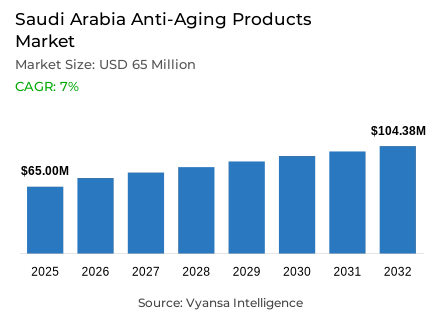
- Anti-aging products market size in Saudi Arabia was valued at USD 65 million in 2025 and is estimated at USD 69.55 million in 2026.
- The market size is expected to grow to USD 104.38 million by 2032.
- Market to register a CAGR of around 7% during 2026-32.
- Product Type Shares
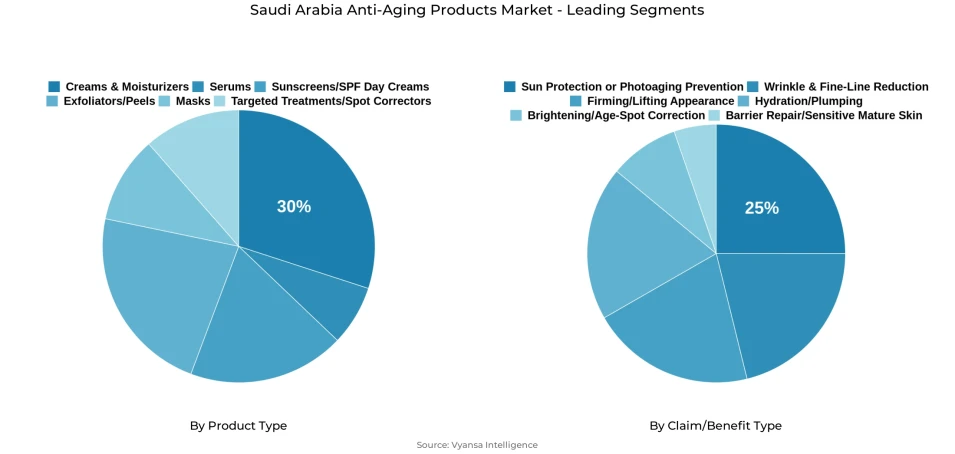
- Creams & moisturizers grabbed market share of 30%.
- Competition
- More than 10 companies are actively engaged in producing anti-aging products in Saudi Arabia.
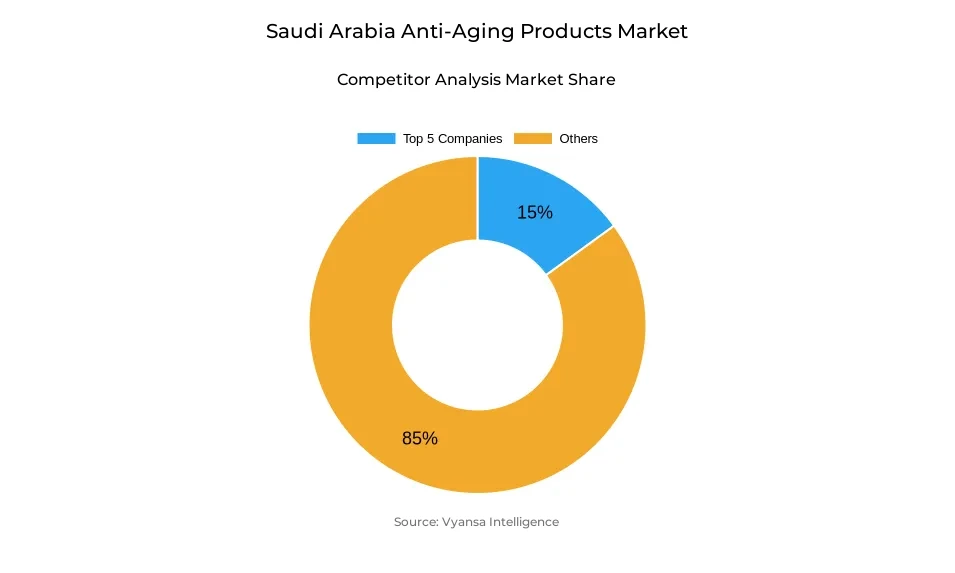
- Top 5 companies acquired around 15% of the market share.
- Beiersdorf Middle East FZCO, Kao Corporation, Miranda Kerr Pty Ltd., Estee Lauder Inc., Unilever Gulf FZE etc., are few of the top companies.
- Claim/Benefit Type
- Sun protection/photoaging prevention grabbed 25% of the market.
Saudi Arabia Anti-Aging Products Market Outlook
Valued at USD 65 million in 2025, Saudi Arabia's anti-aging products market is positioned to expand from USD 69.55 million in 2026 to USD 104.38 million by 2032, representing 7% compound annual growth rate throughout the forecast window. This market expansion reflects steady growth supported by rising interest in preventive skincare, strengthened product visibility, and growing consumer focus on daily routines supporting long-term skin maintenance. Market momentum remains underpinned by rising female economic participation creating repeat skincare purchasing behavior, enhanced digital retail infrastructure enabling broader accessibility, and preventive skincare trend emphasizing sun protection integration into daily routines.
Rising female economic participation establishes foundational market driver sustaining consumer investment in appearance-focused anti-aging products and regular skincare maintenance routines. Evidence from General Authority for Statistics (GASTAT) reveals Saudi female labor force participation reaches 34.5% in Q4 2025, up 0.8 percentage points from Q3 2025, while female employment-to-population ratio reaches 31%, showing 1.3 percentage point quarterly increase. This workforce expansion directly supports market growth through financial independence and stronger workplace visibility driving repeat anti-aging skincare purchasing behavior. Financial autonomy enables greater willingness to spend on premium anti-aging creams, serums, and preventive skincare solutions among women establishing structured daily routines requiring regular grooming habits and appearance maintenance.
Preventive skincare positioning and sun protection integration strengthen market relevance for daily-use anti-aging product adoption. Data from Saudi Food and Drug Authority (SFDA) indicates exposure to sunlight and tanning cause premature skin aging, with authority guidance recommending sunscreen use with SPF of at least 30. This regulatory positioning supports market expansion by integrating sun protection messaging into anti-aging skincare narratives, creating commercial opportunity for brands emphasizing photoaging prevention and daily defense benefits. Prevention-focused positioning aligns with consumer preference for simple, everyday skincare routines where moisturizers, creams, and serums combining hydration, repair, and protection benefits address multiple aging concerns within accessible daily-use formats.
Market segmentation demonstrates pronounced consumer preference for practical formats and preventive benefit positioning. Creams and moisturizers command 30% market share through alignment with daily-use routines delivering visible hydration and skin comfort, while sun protection and photoaging prevention claims account for 25% of demand reflecting consumer prioritization of preventive benefits. This Saudi Arabia anti-aging products market structure indicates consumers increasingly select familiar formats supporting both preventive and corrective skincare use, enabling brands to deliver multiple benefits through accessible daily-use products maintaining strong retail visibility and competitive positioning throughout the category.
Saudi Arabia Anti-Aging Products Market Growth Driver
Working Women Keep Premium Skincare Demand Advancing
Expanding female economic participation creates sustained demand for anti-aging market solutions addressing appearance maintenance and skincare investment among financially independent consumers. Statistics from GASTAT confirm Saudi female labor force participation reaches 34.5% in Q4 2025, up 0.8 percentage points from Q3 2025, with female employment-to-population ratio reaching 31%, demonstrating 1.3 percentage point quarterly increase. This workforce expansion directly translates into heightened willingness to invest in premium anti-aging creams and preventive skincare solutions as women establish structured daily routines requiring regular grooming habits and appearance maintenance.
Financial independence and stronger workplace visibility support routine anti-aging market purchasing behavior among expanding female consumer base. Published data from GASTAT shows labor-market improvement reflects broader population of women with regular grooming habits and greater willingness to spend on serums and preventive skincare products. This consumer segment represents practical demand engine for age-defying skincare across Saudi Arabia, supporting market expansion through sustained purchasing of beauty and personal care anti-aging products addressing visible aging concerns and long-term skin health maintenance throughout professional and social environments.
Saudi Arabia Anti-Aging Products Market Challenge
Compliance Layers Keep Brand Execution Tight
Anti-aging market manufacturers face substantial compliance burdens navigating formal notification systems and documentation requirements before product entry into Saudi regulatory framework. Official records from SFDA indicate January 2025 guidance explains cosmetic products must be notified through Unified Electronic System General Household Affairs Department (GHAD) under Cosmetics Products Law and executive regulations. This formal notification system increases documentation work for anti-aging brands, slows launch cycles, and makes market expansion particularly difficult for smaller manufacturers lacking dedicated compliance resources and regulatory expertise supporting rapid market response.
E-commerce compliance evaluation and consumer protection standards create additional execution pressure on online beauty retail channels. Evidence from Saudi Ministry of Commerce reveals 2025 first-phase evaluation covers most prominent 100 e-commerce stores checking compliance against 10 core criteria including return policies, consumer rights, data protection, licensing, and cybersecurity. This regulatory scrutiny raises execution pressure for beauty sellers using online channels throughout Saudi Arabia anti-aging market, requiring enhanced operational standards and transparent consumer protection mechanisms supporting compliance with formal government oversight and evaluation frameworks.
Unlock Market Intelligence
Explore the market potential with our data-driven report
Saudi Arabia Anti-Aging Products Market Trend
Photoaging Prevention Moves to the Forefront
Consumer purchasing behavior demonstrates pronounced shift toward preventive skincare positioning integrating sun protection into daily anti-aging routines rather than relying solely on corrective treatment approaches. Market data from SFDA indicates exposure to sunlight and tanning cause premature skin aging, with official guidance recommending sunscreen use with SPF of at least 30 establishing regulatory support for prevention-focused messaging. This trend strengthens market interest in anti-aging products linked to daily protection benefits, pushing prevention-led messaging higher in consumer skincare choices and supporting brand positioning around photoaging prevention as central category benefit.
Preventive positioning aligns with consumer preference for simplified daily-use skincare routines addressing multiple aging concerns through accessible formats. Analysis from SFDA guidance indicates prevention fits everyday use patterns and supports simpler skincare routines where consumers increasingly connect sun exposure with visible aging. This awareness creates market opportunity for moisturizers, creams, and serums combining hydration, repair, and protection benefits addressing comprehensive anti-aging needs within practical daily-use formats. Photoaging prevention positioning remains close to center of product positioning throughout Saudi Arabia anti-aging market as consumers increasingly prioritize preventive approaches supporting long-term skin health maintenance over exclusively corrective skincare strategies.
Saudi Arabia Anti-Aging Products Market Opportunity
Digital Commerce Opens the Widest Growth Lane
Strong opportunities emerge in expanding digital retail infrastructure enabling anti-aging brands to reach consumers beyond traditional store-based distribution through structured online beauty channels. Market data from GASTAT indicates digital economy accounts for 16% of Saudi Arabia's GDP in 2024, with active e-commerce registrations rising from 37,481 in 2023 to 40,953 in 2024. This expanding online infrastructure creates wider route for skincare brands to reach consumers throughout Saudi Arabia anti-aging market, supporting product discovery, consumer education, and repeat-purchase convenience previously constrained by limited physical retail networks in secondary markets.
Structured digital channels and government consumer protection initiatives strengthen commercial viability of premium online beauty retail and education-led selling approaches. Published data from Saudi Ministry of Commerce indicates 2025 evaluation of major e-commerce stores aims to protect consumers and improve service quality through clear operating criteria, establishing trustworthy digital environment supporting premium brand positioning. For anti-aging brands, this regulatory framework creates enhanced opportunity for premium assortments, subscription-based purchasing, and education-led selling across online beauty channels, enabling direct consumer engagement and bypassing traditional retail intermediaries constraining brand communication and customer relationship development.
Unlock Market Intelligence
Explore the market potential with our data-driven report
Saudi Arabia Anti-Aging Products Market Segmentation Analysis
By Product Type
- Creams & Moisturizers
- Serums
- Sunscreens/SPF Day Creams
- Exfoliators/Peels
- Masks
- Targeted Treatments/Spot Correctors
Creams and moisturizers command market leadership at 30% share within Saudi Arabia anti-aging products market, establishing dominant product type positioning through superior alignment with consumer preferences for practical daily-use formats. This market segment maintains leading position due to strong consumer preference for easy-to-apply, familiar formats integrated into established skincare routines emphasizing hydration, nourishment, and visible skin comfort. Cream and moisturizer formulations deliver accessible positioning supporting routine daily application while maintaining adequate performance for preventive skincare use supporting broad appeal across demographic segments seeking hydration-focused anti-aging creams.
This market leadership position reflects consumers' continued selection of practical product types supporting daily use integration without specialized techniques or complexity. Creams and moisturizers support repeated morning and night application, delivering hydration and nourishment benefits alongside multiple anti-aging claims within single accessible format. The 30% market share indicates this segment continues shaping product demand, retail visibility, and competitive positioning throughout Saudi Arabia anti-aging industry. Moisturization remains closely linked with anti-aging needs in current industry structure, enabling brands to communicate clear benefits around firmness, hydration, and skin comfort supporting category expansion and market growth throughout forecast period.
By Claim/Benefit Type
- Wrinkle & Fine-Line Reduction
- Firming/Lifting Appearance
- Hydration/Plumping
- Brightening/Age-Spot Correction
- Barrier Repair/Sensitive Mature Skin
- Sun Protection/Photoaging Prevention
Sun protection and photoaging prevention claims command market leadership at 25% share within Saudi Arabia anti-aging products market benefit segment, establishing categorical dominance reflecting consumer prioritization of preventive benefits over purely corrective approaches. This market segment demonstrates consumers increasingly assign importance to preventive skincare claims and actively seek anti-aging market solutions designed to delay visible skin damage before appearance occurs. Consumers across age groups expect anti-aging market products demonstrating efficacy around sun protection, photoaging prevention, and daily defense benefits supporting long-term skin health maintenance.
Product development continues being shaped by prevention-driven requirements as manufacturers integrate sun protection actives and photoaging prevention messaging into competitive anti-aging market environments. Brands formulating sun protection claims emphasize daily-use convenience and alignment with consumer awareness of sun exposure and visible aging connections. The 25% market share indicates this benefit segment continues influencing anti-aging market messaging direction, formulation priorities, and portfolio planning throughout Saudi Arabia. As consumer awareness around photoaging and sun damage intensifies, manufacturers maintaining sun protection and photoaging prevention claim leadership develop product innovation capturing sustained demand through educational positioning emphasizing daily skin protection supporting category expansion and market growth throughout forecast period.
List of Companies Covered in Saudi Arabia Anti-Aging Products Market
The companies listed below are highly influential in the Saudi Arabia anti-aging products market, with a significant market share and a strong impact on industry developments.
- Beiersdorf Middle East FZCO
- Kao Corporation
- Miranda Kerr Pty Ltd.
- Estee Lauder Inc.
- Unilever Gulf FZE
- The Procter & Gamble Company
- L’Oreal Saudi Arabia
- Johnson & Johnson Services Inc.
- Amway Corporation
- Shiseido Company Limited
Market News & Updates
- L’Oréal Saudi Arabia, 2025:
In 2025, L’Oréal introduced Lancôme Cell BioPrint, a longevity-based skin diagnostic device. The company unveiled it at CES 2025 as a proteomics-powered tool. It helps users understand skin aging and suitable skincare solutions. L’Oréal then showcased beauty tech innovations at LEAP 2025 in Riyadh. Lancôme’s Saudi website also lists Absolue Longevity The Soft Cream. This directly links the innovation pipeline with Saudi anti-aging offerings. For Saudi Arabia, this strengthens premium anti-aging product personalization and science-led positioning.
- Beiersdorf Middle East FZCO, 2025:
In August 2025, Beiersdorf launched NIVEA Cellular Epigenetics Rejuvenating Serum. The company called it its first mass-market epigenetic serum. It uses EPICELLINE® to target skin rejuvenation and longevity. Beiersdorf said the ingredient had first entered skincare through Eucerin. Eucerin Middle East now markets the Hyaluron-Filler Epicelline Serum online. That gives the innovation direct relevance for Saudi consumers in the region. For Saudi Arabia, this broadens access to advanced anti-aging serums beyond prestige tiers.
Frequently Asked Questions
Related Report
- Market Segmentation
- Research Scope
- Research Methodology
- Definitions and Assumptions
- Executive Summary
- Saudi Arabia Anti-Aging Products Market Policies, Regulations, and Standards
- Saudi Arabia Anti-Aging Products Market Dynamics
- Growth Factors
- Challenges
- Trends
- Opportunities
- Saudi Arabia Anti-Aging Products Market Statistics, 2022-2032F
- Market Size & Growth Outlook
- By Revenues in USD Million
- Market Segmentation & Growth Outlook
- By Product Type
- Creams & Moisturizers- Market Insights and Forecast 2022-2032, USD Million
- Serums- Market Insights and Forecast 2022-2032, USD Million
- Sunscreens/SPF Day Creams- Market Insights and Forecast 2022-2032, USD Million
- Exfoliators/Peels- Market Insights and Forecast 2022-2032, USD Million
- Masks- Market Insights and Forecast 2022-2032, USD Million
- Targeted Treatments/Spot Correctors- Market Insights and Forecast 2022-2032, USD Million
- By Claim/Benefit Type
- Wrinkle & Fine-Line Reduction- Market Insights and Forecast 2022-2032, USD Million
- Firming/Lifting Appearance- Market Insights and Forecast 2022-2032, USD Million
- Hydration/Plumping- Market Insights and Forecast 2022-2032, USD Million
- Brightening/Age-Spot Correction- Market Insights and Forecast 2022-2032, USD Million
- Barrier Repair/Sensitive Mature Skin- Market Insights and Forecast 2022-2032, USD Million
- Sun Protection/Photoaging Prevention- Market Insights and Forecast 2022-2032, USD Million
- By Sales Channel
- Retail Offline- Market Insights and Forecast 2022-2032, USD Million
- Supermarkets/Hypermarkets- Market Insights and Forecast 2022-2032, USD Million
- Pharmacy/Drugstores- Market Insights and Forecast 2022-2032, USD Million
- Specialty Beauty Stores- Market Insights and Forecast 2022-2032, USD Million
- Department Stores- Market Insights and Forecast 2022-2032, USD Million
- Brand Exclusive Stores- Market Insights and Forecast 2022-2032, USD Million
- Clinics/Salons/Spas- Market Insights and Forecast 2022-2032, USD Million
- Other Offline Retail- Market Insights and Forecast 2022-2032, USD Million
- Retail Online- Market Insights and Forecast 2022-2032, USD Million
- Brand-Owned Websites- Market Insights and Forecast 2022-2032, USD Million
- E-commerce Marketplaces- Market Insights and Forecast 2022-2032, USD Million
- Online Beauty Retailers- Market Insights and Forecast 2022-2032, USD Million
- Online Pharmacy Platforms- Market Insights and Forecast 2022-2032, USD Million
- Social Commerce Platforms- Market Insights and Forecast 2022-2032, USD Million
- Quick Commerce/On-Demand Delivery Platforms- Market Insights and Forecast 2022-2032, USD Million
- Other Online Retail- Market Insights and Forecast 2022-2032, USD Million
- Retail Offline- Market Insights and Forecast 2022-2032, USD Million
- By Ingredient Platform
- Retinoids- Market Insights and Forecast 2022-2032, USD Million
- Hyaluronic Acid- Market Insights and Forecast 2022-2032, USD Million
- Niacinamide- Market Insights and Forecast 2022-2032, USD Million
- Vitamin C- Market Insights and Forecast 2022-2032, USD Million
- Peptides- Market Insights and Forecast 2022-2032, USD Million
- AHAs/BHAs- Market Insights and Forecast 2022-2032, USD Million
- Ceramides- Market Insights and Forecast 2022-2032, USD Million
- Botanical/Natural Actives- Market Insights and Forecast 2022-2032, USD Million
- Others- Market Insights and Forecast 2022-2032, USD Million
- By Consumer Age Group
- 18-34 Years- Market Insights and Forecast 2022-2032, USD Million
- 35-54 Years- Market Insights and Forecast 2022-2032, USD Million
- 55 Years & Above- Market Insights and Forecast 2022-2032, USD Million
- By End User
- Women- Market Insights and Forecast 2022-2032, USD Million
- Men- Market Insights and Forecast 2022-2032, USD Million
- Unisex- Market Insights and Forecast 2022-2032, USD Million
- By Price Tier
- Mass- Market Insights and Forecast 2022-2032, USD Million
- Premium- Market Insights and Forecast 2022-2032, USD Million
- By Regions
- East- Market Insights and Forecast 2022-2032, USD Million
- West- Market Insights and Forecast 2022-2032, USD Million
- South- Market Insights and Forecast 2022-2032, USD Million
- Central- Market Insights and Forecast 2022-2032, USD Million
- By Competitors
- Competition Characteristics
- Market Share & Analysis
- By Product Type
- Market Size & Growth Outlook
- Saudi Arabia Creams & Moisturizers Market Statistics, 2022-2032
- Market Size & Growth Outlook
- By Revenues in USD Million
- Market Segmentation & Growth Outlook
- By Claim/Benefit Type- Market Insights and Forecast 2022-2032, USD Million
- By Sales Channel- Market Insights and Forecast 2022-2032, USD Million
- By Ingredient Platform- Market Insights and Forecast 2022-2032, USD Million
- By Consumer Age Group- Market Insights and Forecast 2022-2032, USD Million
- By End User- Market Insights and Forecast 2022-2032, USD Million
- By Price Tier- Market Insights and Forecast 2022-2032, USD Million
- By Regions- Market Insights and Forecast 2022-2032, USD Million
- Market Size & Growth Outlook
- Saudi Arabia Serums Market Statistics, 2022-2032
- Market Size & Growth Outlook
- By Revenues in USD Million
- Market Segmentation & Growth Outlook
- By Claim/Benefit Type- Market Insights and Forecast 2022-2032, USD Million
- By Sales Channel- Market Insights and Forecast 2022-2032, USD Million
- By Ingredient Platform- Market Insights and Forecast 2022-2032, USD Million
- By Consumer Age Group- Market Insights and Forecast 2022-2032, USD Million
- By End User- Market Insights and Forecast 2022-2032, USD Million
- By Price Tier- Market Insights and Forecast 2022-2032, USD Million
- By Regions- Market Insights and Forecast 2022-2032, USD Million
- Market Size & Growth Outlook
- Saudi Arabia Sunscreens/SPF Day Creams Market Statistics, 2022-2032
- Market Size & Growth Outlook
- By Revenues in USD Million
- Market Segmentation & Growth Outlook
- By Claim/Benefit Type- Market Insights and Forecast 2022-2032, USD Million
- By Sales Channel- Market Insights and Forecast 2022-2032, USD Million
- By Ingredient Platform- Market Insights and Forecast 2022-2032, USD Million
- By Consumer Age Group- Market Insights and Forecast 2022-2032, USD Million
- By End User- Market Insights and Forecast 2022-2032, USD Million
- By Price Tier- Market Insights and Forecast 2022-2032, USD Million
- By Regions- Market Insights and Forecast 2022-2032, USD Million
- Market Size & Growth Outlook
- Saudi Arabia Exfoliators/Peels Market Statistics, 2022-2032
- Market Size & Growth Outlook
- By Revenues in USD Million
- Market Segmentation & Growth Outlook
- By Claim/Benefit Type- Market Insights and Forecast 2022-2032, USD Million
- By Sales Channel- Market Insights and Forecast 2022-2032, USD Million
- By Ingredient Platform- Market Insights and Forecast 2022-2032, USD Million
- By Consumer Age Group- Market Insights and Forecast 2022-2032, USD Million
- By End User- Market Insights and Forecast 2022-2032, USD Million
- By Price Tier- Market Insights and Forecast 2022-2032, USD Million
- By Regions- Market Insights and Forecast 2022-2032, USD Million
- Market Size & Growth Outlook
- Saudi Arabia Masks Market Statistics, 2022-2032
- Market Size & Growth Outlook
- By Revenues in USD Million
- Market Segmentation & Growth Outlook
- By Claim/Benefit Type- Market Insights and Forecast 2022-2032, USD Million
- By Sales Channel- Market Insights and Forecast 2022-2032, USD Million
- By Ingredient Platform- Market Insights and Forecast 2022-2032, USD Million
- By Consumer Age Group- Market Insights and Forecast 2022-2032, USD Million
- By End User- Market Insights and Forecast 2022-2032, USD Million
- By Price Tier- Market Insights and Forecast 2022-2032, USD Million
- By Regions- Market Insights and Forecast 2022-2032, USD Million
- Market Size & Growth Outlook
- Saudi Arabia Targeted Treatments/Spot Correctors Market Statistics, 2022-2032
- Market Size & Growth Outlook
- By Revenues in USD Million
- Market Segmentation & Growth Outlook
- By Claim/Benefit Type- Market Insights and Forecast 2022-2032, USD Million
- By Sales Channel- Market Insights and Forecast 2022-2032, USD Million
- By Ingredient Platform- Market Insights and Forecast 2022-2032, USD Million
- By Consumer Age Group- Market Insights and Forecast 2022-2032, USD Million
- By End User- Market Insights and Forecast 2022-2032, USD Million
- By Price Tier- Market Insights and Forecast 2022-2032, USD Million
- By Regions- Market Insights and Forecast 2022-2032, USD Million
- Market Size & Growth Outlook
- Competitive Outlook
- Company Profiles
- Estee Lauder Inc.
- Business Description
- Product Portfolio
- Collaborations & Alliances
- Recent Developments
- Financial Details
- Others
- Unilever Gulf FZE
- Business Description
- Product Portfolio
- Collaborations & Alliances
- Recent Developments
- Financial Details
- Others
- The Procter & Gamble Company
- Business Description
- Product Portfolio
- Collaborations & Alliances
- Recent Developments
- Financial Details
- Others
- L’Oreal Saudi Arabia
- Business Description
- Product Portfolio
- Collaborations & Alliances
- Recent Developments
- Financial Details
- Others
- Johnson & Johnson Services Inc.
- Business Description
- Product Portfolio
- Collaborations & Alliances
- Recent Developments
- Financial Details
- Others
- Beiersdorf Middle East FZCO
- Business Description
- Product Portfolio
- Collaborations & Alliances
- Recent Developments
- Financial Details
- Others
- Kao Corporation
- Business Description
- Product Portfolio
- Collaborations & Alliances
- Recent Developments
- Financial Details
- Others
- Miranda Kerr Pty Ltd.
- Business Description
- Product Portfolio
- Collaborations & Alliances
- Recent Developments
- Financial Details
- Others
- Amway Corporation
- Business Description
- Product Portfolio
- Collaborations & Alliances
- Recent Developments
- Financial Details
- Others
- Shiseido Company Limited
- Business Description
- Product Portfolio
- Collaborations & Alliances
- Recent Developments
- Financial Details
- Others
- Estee Lauder Inc.
- Company Profiles
- Disclaimer
| Segment | Sub-Segment |
|---|---|
| By Product Type |
|
| By Claim/Benefit Type |
|
| By Sales Channel |
|
| By Ingredient Platform |
|
| By Consumer Age Group |
|
| By End User |
|
| By Price Tier |
|
| By Regions |
|
Research Methodology
This study followed a structured approach comprising four key phases to assess the size and scope of the electro-oxidation market. The process began with thorough secondary research to collect data on the target market, related markets, and broader industry context. These findings, along with preliminary assumptions and estimates, were then validated through extensive primary research involving industry experts from across the value chain. To calculate the overall market size, both top-down and bottom-up methodologies were employed. Finally, market segmentation and data triangulation techniques were applied to refine and validate segment-level estimations.
Secondary Research
The secondary research phase involved gathering data from a wide range of credible and published sources. This step helped in identifying industry trends, defining market segmentation, and understanding the market landscape and value chain.
Sources consulted during this phase included:
- Company annual reports, investor presentations, and press releases
- Industry white papers and certified publications
- Trade directories and market-recognized databases
- Articles from authoritative authors and reputable journals
- Gold and silver standard websites
Secondary research was critical in mapping out the industry's value chain and monetary flow, identifying key market segments, understanding regional variations, and tracking significant industry developments.
Other key sources:
- Financial disclosures
- Industry associations and trade bodies
- News outlets and business magazines
- Academic journals and research studies
- Paid industry databases
Primary Research
To validate secondary data and gain deeper market insights, primary research was conducted with key stakeholders across both the supply and demand sides of the market.
On the demand side, participants included decision-makers and influencers from end-user industries—such as CIOs, CTOs, and CSOs—who provided first-hand perspectives on market needs, product usage, and future expectations.
On the supply side, interviews were conducted with manufacturers, industry associations, and institutional participants to gather insights into current offerings, product pipelines, and market challenges.
Primary interviews provided critical inputs such as:
- Market size and revenue data
- Product and service breakdowns
- Market forecasts
- Regional and application-specific trends
Stakeholders consulted included:
- Leading OEM and solution providers
- Channel and distribution partners
- End users across various applications
- Independent consultants and industry specialists
Market Size Estimation and Data Triangulation
- Identifying Key Market Participants (Secondary Research)
- Goal: To identify the major players or companies in the target market. This typically involves using publicly available data sources such as industry reports, market research publications, and financial statements of companies.
- Tools: Reports from firms like Gartner, Forrester, Euromonitor, Statista, IBISWorld, and others. Public financial statements, news articles, and press releases from top market players.
- Extracting Earnings of Key Market Participants
- Goal: To estimate the earnings generated from the product or service being analyzed. This step helps in understanding the revenue potential of each market player in a specific geography.
- Methods: Earnings data can be gathered from:
- Publicly available financial reports (for listed companies).
- Interviews and primary data sources from professionals, such as Directors, VPs, SVPs, etc. This is especially useful for understanding more nuanced, internal data that isn't publicly disclosed.
- Annual reports and investor presentations of key players.
- Data Collation and Development of a Relevant Data Model
- Goal: To collate inputs from both primary and secondary sources into a structured, data-driven model for market estimation. This model will incorporate key market KPIs and any independent variables relevant to the market.
- Key KPIs: These could include:
- Market size, growth rate, and demand drivers.
- Industry-specific metrics like market share, average revenue per customer (ARPC), or average deal size.
- External variables, such as economic growth rates, inflation rates, or commodity prices, that could affect the market.
- Data Modeling: Based on this data, the market forecasts are developed for the next 5 years. A combination of trend analysis, scenario modeling, and statistical regression might be used to generate projections.
- Scenario Analysis
- Goal: To test different assumptions and validate how sensitive the market is to changes in key variables (e.g., market demand, regulatory changes, technological disruptions).
- Types of Scenarios:
- Base Case: Based on current assumptions and historical data.
- Best-Case Scenario: Assuming favorable market conditions, regulatory environments, and technological advancements.
- Worst-Case Scenario: Accounting for adverse factors, such as economic downturns, stricter regulations, or unexpected disruptions.












