Portugal Sleep Aids Market Report: Trends, Growth and Forecast (2026-2032)
By Product (Single Ingredient (Doxylamine Succinate, Diphenhydramine, Melatonin), Combination Ingredient (Diphenhydramine + Acetaminophen, Other Antihistamine-Based Combinations), Herbal & Traditional Sleep Aids (Valerian root, Passionflower, Chamomile, Kava, Multi-Herbal Sleep Blends)), By Sleep Disorder (Insomnia, Sleep Apnea, Restless Legs Syndrome, Narcolepsy, Sleep Walking, Others), By Age Group (Young to Mid Adults (25-44 Years), Middle-Aged Adults (45-64 Years), Geriatric Population (65+ Years)), By Sales Channel (Retail Online, Retail Offline), By End User (Homecare/Individual Consumers, Hospitals, Sleep Centers & Clinics), By Formulation (Tablets, Gummies, Capsules, Liquid, Sublingual) ... Read more
|
Major Players
|
Portugal Sleep Aids Market Statistics and Insights, 2026
- Market Size Statistics
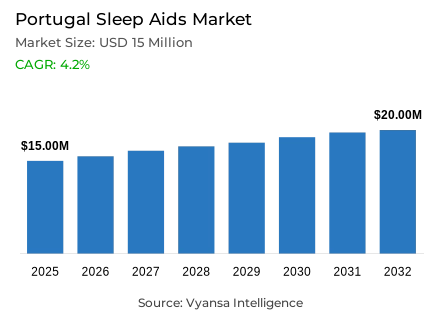
- Sleep aids market size in Portugal was estimated at USD 15 million in 2025.
- The market size is expected to grow to USD 20 million by 2032.
- Market to register a CAGR of around 4.2% during 2026-32.
- Product Shares
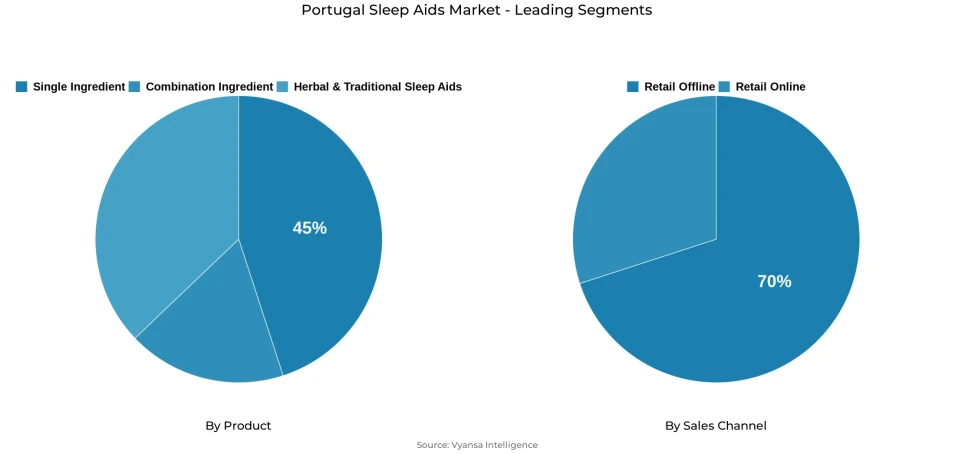
- Single ingredient grabbed market share of 45%.
- Competition
- More than 10 companies are actively engaged in producing sleep aids in Portugal.
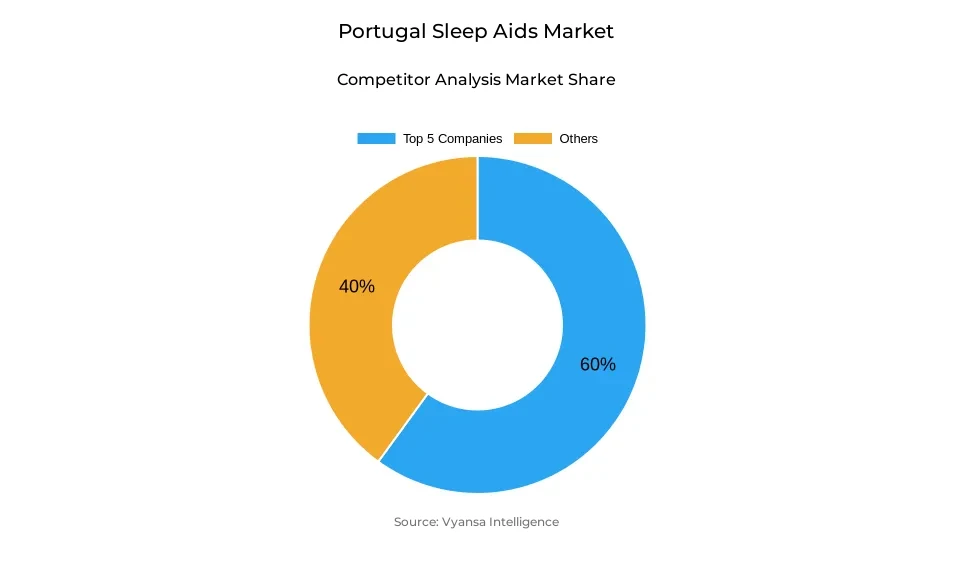
- Top 5 companies acquired around 60% of the market share.
- Procter & Gamble Portugal SA, Sanofi Produtos Farmacêuticos Lda, Grünenthal SA, Vemedia Pharma Iberia SA, Humana Portugal Lda etc., are few of the top companies.
- Sales channel
- Retail offline grabbed 70% of the market.
Portugal Sleep Aids Market Outlook
The Portugal sleep aids market is demonstrating steady expansion, supported by ageing demographics, elevated stress levels, and persistent digital screen exposure. The sleep aids is valued at USD 15 million in 2025 and is projected to reach USD 20 million by 2032, reflecting a CAGR of 4.2%. Increasing recognition of sleep as a preventive health priority is reinforcing category relevance, particularly among older adults and working-age populations managing demanding routines.
Manufacturers are responding through a stronger focus on natural, over-the-counter solutions positioned as lower risk compared to prescription sedatives. Format innovation is a key growth lever, with sprays and gummies gaining visibility alongside traditional tablets. Brands such as Vicks ZzzQuil Natura leverage botanical ingredients including valerian, chamomile, and passionflower to appeal to health-conscious end users seeking gentle yet effective support.
Competitive intensity remains high, characterized by promotional activity and advertising investment aimed at sustaining shelf visibility. Potential EU-level regulatory adjustments regarding melatonin dosage and ingredient claims may reshape product portfolios in the coming years.
Retail Offline channels, particularly pharmacies and parapharmacies, continue to dominate with approximately 70% market share. Pharmacist guidance plays a decisive role in influencing trial and repeat purchase, especially in a category where dosage clarity and dependency concerns shape consumer confidence. As the broader “better sleep” movement gains momentum, professional advisory support and innovation in natural formulations are expected to sustain long-term market growth through 2032.
Portugal Sleep Aids Market Growth DriverAn Ageing Population Structure Expands the Structural Base for Sleep Disorder Prevalence
Portugal mature demographic profile provides a long-term structural base for sleep-support product demand. According to the United Nations Department of Economic and Social Affairs World Population Prospects (referenced via the UNECE Ageing Policies Database), individuals aged 65 years and above account for 24.9% of the population in 2025, while the national median age stands at 46.92 years. This ageing structure increases vulnerability to insomnia, fragmented sleep, and reduced sleep continuity.
Older end users are more inclined toward accessible, non-prescription solutions that can be integrated into daily self-care routines. As the proportion of elderly individuals rises within households, sleep quality becomes a routine wellbeing concern, reinforcing stable demand for over-the-counter formats positioned around safety and ease of use.
Portugal Sleep Aids Market ChallengeCost of Living Pressures Intensify Price Competition and Erode Category Margin
Persistent inflationary pressure is heightening price sensitivity within discretionary health categories. According to the Instituto Nacional de Estatística, Portugal’s Consumer Price Index increased 2.4% year-on-year in June 2025, while unprocessed food prices rose 4.7% during the same period. These dynamics constrain household budgets and increase down-trading behavior.
In a saturated sleep-aid market, brands become increasingly reliant on promotions and shelf visibility to sustain volume. Prolonged promotional dependency risks margin erosion and weakened value perception, particularly for premium or multi-format formulations. As end users intensify price comparison, switching risk toward lower-cost alternatives rises.
Unlock Market Intelligence
Explore the market potential with our data-driven report
Portugal Sleep Aids Market TrendDeepening Digital Engagement Reinforces Screen-Driven Sleep Disruption Patterns
Digital behaviors remain deeply embedded in Portuguese daily life, indirectly contributing to sleep disturbance linked to screen exposure. The Instituto Nacional de Estatística reports that 49.6% of individuals aged 16–74 made online purchases in the three months preceding the 2025 survey. Additionally, 38.7% used artificial intelligence-based tools within the same period, highlighting sustained digital immersion.
This high level of device engagement supports lifestyle patterns associated with delayed sleep onset. Simultaneously, digital familiarity enables effective promotion of convenient formats such as oral sprays and gummies that align with fast-paced, digitally oriented routines.
Portugal Sleep Aids Market OpportunityCommunity Pharmacy Networks Provide a Scalable and Trust-Based Route for Over-the-Counter Growth
Community pharmacies provide a trusted and scalable channel for over-the-counter sleep solutions. According to the Serviço Nacional de Saúde dispensing data, 152 million medicine packs were distributed in ambulatory care between January and September 2025, representing a 6% increase compared with the same period in 2024.
This dispensing scale underscores strong pharmacy engagement and positions pharmacist recommendation as a critical lever for OTC sleep-aid adoption. Brands investing in structured pharmacist education, transparent dosing instructions, and natural-ingredient positioning can leverage this network to stimulate uptake of innovative formats such as oral sprays and gummies, reinforcing repeat purchasing within a regulated and credibility-driven retail environment.
Unlock Market Intelligence
Explore the market potential with our data-driven report
Portugal Sleep Aids Market Segmentation Analysis
By Product
- Single Ingredient
- Combination Ingredient
- Herbal & Traditional Sleep Aids
The segment with highest market share under Products is Single-Ingredient products, accounting for approximately 45% of total market value. This dominance is largely driven by the popularity of melatonin-based supplements, which end users associate with targeted regulation of sleep cycles and predictable efficacy. Clear labeling and simplified dosing enhance confidence among first-time users and those seeking straightforward management of insomnia or jet lag.
The preference for simplicity aligns with a broader shift from prescription-based management toward over-the-counter self-care. Although combination formulations incorporating herbal extracts such as valerian are gradually expanding, single-ingredient products remain the anchor of the portfolio due to dosing clarity and ease of communication at both shelf and digital touchpoints.
By Sales Channel
- Retail Online
- Retail Offline
Retail Offline is the dominant sales channel, holding approximately 70% market share. Physical pharmacies and parapharmacies serve as trusted advisory centers, where end users value direct consultation—particularly when evaluating melatonin dosage and short-term usage considerations. Professional reassurance significantly reduces perceived risk in sleep-related purchases.
While online platforms are increasingly used for price comparison, immediate access and personalized guidance sustain offline leadership. Pharmacies are also adapting to wellness trends by prominently displaying innovative formats such as sprays and gummies alongside traditional tablets. This combination of trust, immediacy, and curated assortment positions offline retail as the primary distribution channel through 2032.
List of Companies Covered in Portugal Sleep Aids Market
The companies listed below are highly influential in the Portugal sleep aids market, with a significant market share and a strong impact on industry developments.
- Procter & Gamble Portugal SA
- Sanofi Produtos Farmacêuticos Lda
- Grünenthal SA
- Vemedia Pharma Iberia SA
- Humana Portugal Lda
- Arkopharma Laboratorios SA
- Laboratórios Bial SA (Portela & Ca SA)
- Uriach Lusa SA
- Perrigo Portugal Lda
- Korangi - Produtos Farmacêuticos Lda
Competitive Landscape
Portugal sleep aids market is highly competitive and led by Procter & Gamble’s Vicks ZzzQuil and Humana’s Melamil, both leveraging strong advertising, brand recognition, and innovation in gummies and spray formats. Vicks ZzzQuil Natura differentiates through herbal positioning with melatonin, valerian and chamomile, aligning with the consumer shift from prescription to OTC solutions perceived as safer and non-habit-forming. Price competition is intensifying amid inflation, prompting heavy promotional activity, while smaller players such as Perrigo are reducing marketing support due to rising visibility costs. Regulatory scrutiny around melatonin dosage presents compliance risks. Key opportunities lie in natural formulations, pharmacist-led recommendation strategies, convenient delivery systems, and premium yet compliant products that balance efficacy with stricter EU oversight.
Frequently Asked Questions
Related Report
- Market Segmentation
- Research Scope
- Research Methodology
- Definitions and Assumptions
- Executive Summary
- Portugal Sleep Aids Market Policies, Regulations, and Standards
- Portugal Sleep Aids Market Dynamics
- Growth Factors
- Challenges
- Trends
- Opportunities
- Portugal Sleep Aids Market Statistics, 2022-2032F
- Market Size & Growth Outlook
- By Revenues in USD Million
- Market Segmentation & Growth Outlook
- By Product
- Single Ingredient- Market Insights and Forecast 2022-2032, USD Million
- Doxylamine Succinate- Market Insights and Forecast 2022-2032, USD Million
- Diphenhydramine- Market Insights and Forecast 2022-2032, USD Million
- Melatonin- Market Insights and Forecast 2022-2032, USD Million
- Combination Ingredient- Market Insights and Forecast 2022-2032, USD Million
- Diphenhydramine + Acetaminophen- Market Insights and Forecast 2022-2032, USD Million
- Other Antihistamine-Based Combinations- Market Insights and Forecast 2022-2032, USD Million
- Herbal & Traditional Sleep Aids- Market Insights and Forecast 2022-2032, USD Million
- Valerian root- Market Insights and Forecast 2022-2032, USD Million
- Passionflower- Market Insights and Forecast 2022-2032, USD Million
- Chamomile- Market Insights and Forecast 2022-2032, USD Million
- Kava- Market Insights and Forecast 2022-2032, USD Million
- Multi-Herbal Sleep Blends- Market Insights and Forecast 2022-2032, USD Million
- Single Ingredient- Market Insights and Forecast 2022-2032, USD Million
- By Sleep Disorder
- Insomnia- Market Insights and Forecast 2022-2032, USD Million
- Sleep Apnea- Market Insights and Forecast 2022-2032, USD Million
- Restless Legs Syndrome- Market Insights and Forecast 2022-2032, USD Million
- Narcolepsy- Market Insights and Forecast 2022-2032, USD Million
- Sleep Walking- Market Insights and Forecast 2022-2032, USD Million
- Others- Market Insights and Forecast 2022-2032, USD Million
- By Age Group
- Young to Mid Adults (25-44 Years)- Market Insights and Forecast 2022-2032, USD Million
- Middle-Aged Adults (45-64 Years)- Market Insights and Forecast 2022-2032, USD Million
- Geriatric Population (65+ Years)- Market Insights and Forecast 2022-2032, USD Million
- By Sales Channel
- Retail Online- Market Insights and Forecast 2022-2032, USD Million
- Retail Offline- Market Insights and Forecast 2022-2032, USD Million
- By End User
- Homecare/Individual Consumers- Market Insights and Forecast 2022-2032, USD Million
- Hospitals- Market Insights and Forecast 2022-2032, USD Million
- Sleep Centers & Clinics- Market Insights and Forecast 2022-2032, USD Million
- By Formulation
- Tablets- Market Insights and Forecast 2022-2032, USD Million
- Gummies- Market Insights and Forecast 2022-2032, USD Million
- Capsules- Market Insights and Forecast 2022-2032, USD Million
- Liquid- Market Insights and Forecast 2022-2032, USD Million
- Sublingual- Market Insights and Forecast 2022-2032, USD Million
- By Competitors
- Competition Characteristics
- Market Share & Analysis
- By Product
- Market Size & Growth Outlook
- Portugal Single Ingredient Sleep Aids Market Statistics, 2022-2032
- Market Size & Growth Outlook
- By Revenues in USD Million
- Market Segmentation & Growth Outlook
- By Sleep Disorder- Market Insights and Forecast 2022-2032, USD Million
- By Age Group- Market Insights and Forecast 2022-2032, USD Million
- By Sales Channel- Market Insights and Forecast 2022-2032, USD Million
- By End User- Market Insights and Forecast 2022-2032, USD Million
- By Formulation- Market Insights and Forecast 2022-2032, USD Million
- Market Size & Growth Outlook
- Portugal Combination Ingredient Sleep Aids Market Statistics, 2022-2032
- Market Size & Growth Outlook
- By Revenues in USD Million
- Market Segmentation & Growth Outlook
- By Sleep Disorder- Market Insights and Forecast 2022-2032, USD Million
- By Age Group- Market Insights and Forecast 2022-2032, USD Million
- By Sales Channel- Market Insights and Forecast 2022-2032, USD Million
- By End User- Market Insights and Forecast 2022-2032, USD Million
- By Formulation- Market Insights and Forecast 2022-2032, USD Million
- Market Size & Growth Outlook
- Portugal Herbal & Traditional Sleep Aids Market Statistics, 2022-2032
- Market Size & Growth Outlook
- By Revenues in USD Million
- Market Segmentation & Growth Outlook
- By Sleep Disorder- Market Insights and Forecast 2022-2032, USD Million
- By Age Group- Market Insights and Forecast 2022-2032, USD Million
- By Sales Channel- Market Insights and Forecast 2022-2032, USD Million
- By End User- Market Insights and Forecast 2022-2032, USD Million
- By Formulation- Market Insights and Forecast 2022-2032, USD Million
- Market Size & Growth Outlook
- Competitive Outlook
- Company Profiles
- Vemedia Pharma Iberia SA
- Business Description
- Product Portfolio
- Collaborations & Alliances
- Recent Developments
- Financial Details
- Others
- Humana Portugal Lda
- Business Description
- Product Portfolio
- Collaborations & Alliances
- Recent Developments
- Financial Details
- Others
- Arkopharma Laboratorios SA
- Business Description
- Product Portfolio
- Collaborations & Alliances
- Recent Developments
- Financial Details
- Others
- Laboratórios Bial SA Portela & Ca SA
- Business Description
- Product Portfolio
- Collaborations & Alliances
- Recent Developments
- Financial Details
- Others
- Uriach Lusa SA
- Business Description
- Product Portfolio
- Collaborations & Alliances
- Recent Developments
- Financial Details
- Others
- Procter & Gamble Portugal SA
- Business Description
- Product Portfolio
- Collaborations & Alliances
- Recent Developments
- Financial Details
- Others
- Sanofi Produtos Farmacêuticos Lda
- Business Description
- Product Portfolio
- Collaborations & Alliances
- Recent Developments
- Financial Details
- Others
- Grünenthal SA
- Business Description
- Product Portfolio
- Collaborations & Alliances
- Recent Developments
- Financial Details
- Others
- Perrigo Portugal Lda
- Business Description
- Product Portfolio
- Collaborations & Alliances
- Recent Developments
- Financial Details
- Others
- Korangi - Produtos Farmacêuticos Lda
- Business Description
- Product Portfolio
- Collaborations & Alliances
- Recent Developments
- Financial Details
- Others
- Vemedia Pharma Iberia SA
- Company Profiles
- Disclaimer
| Segment | Sub-Segment |
|---|---|
| By Product |
|
| By Sleep Disorder |
|
| By Age Group |
|
| By Sales Channel |
|
| By End User |
|
| By Formulation |
|
Research Methodology
This study followed a structured approach comprising four key phases to assess the size and scope of the electro-oxidation market. The process began with thorough secondary research to collect data on the target market, related markets, and broader industry context. These findings, along with preliminary assumptions and estimates, were then validated through extensive primary research involving industry experts from across the value chain. To calculate the overall market size, both top-down and bottom-up methodologies were employed. Finally, market segmentation and data triangulation techniques were applied to refine and validate segment-level estimations.
Secondary Research
The secondary research phase involved gathering data from a wide range of credible and published sources. This step helped in identifying industry trends, defining market segmentation, and understanding the market landscape and value chain.
Sources consulted during this phase included:
- Company annual reports, investor presentations, and press releases
- Industry white papers and certified publications
- Trade directories and market-recognized databases
- Articles from authoritative authors and reputable journals
- Gold and silver standard websites
Secondary research was critical in mapping out the industry's value chain and monetary flow, identifying key market segments, understanding regional variations, and tracking significant industry developments.
Other key sources:
- Financial disclosures
- Industry associations and trade bodies
- News outlets and business magazines
- Academic journals and research studies
- Paid industry databases
Primary Research
To validate secondary data and gain deeper market insights, primary research was conducted with key stakeholders across both the supply and demand sides of the market.
On the demand side, participants included decision-makers and influencers from end-user industries—such as CIOs, CTOs, and CSOs—who provided first-hand perspectives on market needs, product usage, and future expectations.
On the supply side, interviews were conducted with manufacturers, industry associations, and institutional participants to gather insights into current offerings, product pipelines, and market challenges.
Primary interviews provided critical inputs such as:
- Market size and revenue data
- Product and service breakdowns
- Market forecasts
- Regional and application-specific trends
Stakeholders consulted included:
- Leading OEM and solution providers
- Channel and distribution partners
- End users across various applications
- Independent consultants and industry specialists
Market Size Estimation and Data Triangulation
- Identifying Key Market Participants (Secondary Research)
- Goal: To identify the major players or companies in the target market. This typically involves using publicly available data sources such as industry reports, market research publications, and financial statements of companies.
- Tools: Reports from firms like Gartner, Forrester, Euromonitor, Statista, IBISWorld, and others. Public financial statements, news articles, and press releases from top market players.
- Extracting Earnings of Key Market Participants
- Goal: To estimate the earnings generated from the product or service being analyzed. This step helps in understanding the revenue potential of each market player in a specific geography.
- Methods: Earnings data can be gathered from:
- Publicly available financial reports (for listed companies).
- Interviews and primary data sources from professionals, such as Directors, VPs, SVPs, etc. This is especially useful for understanding more nuanced, internal data that isn't publicly disclosed.
- Annual reports and investor presentations of key players.
- Data Collation and Development of a Relevant Data Model
- Goal: To collate inputs from both primary and secondary sources into a structured, data-driven model for market estimation. This model will incorporate key market KPIs and any independent variables relevant to the market.
- Key KPIs: These could include:
- Market size, growth rate, and demand drivers.
- Industry-specific metrics like market share, average revenue per customer (ARPC), or average deal size.
- External variables, such as economic growth rates, inflation rates, or commodity prices, that could affect the market.
- Data Modeling: Based on this data, the market forecasts are developed for the next 5 years. A combination of trend analysis, scenario modeling, and statistical regression might be used to generate projections.
- Scenario Analysis
- Goal: To test different assumptions and validate how sensitive the market is to changes in key variables (e.g., market demand, regulatory changes, technological disruptions).
- Types of Scenarios:
- Base Case: Based on current assumptions and historical data.
- Best-Case Scenario: Assuming favorable market conditions, regulatory environments, and technological advancements.
- Worst-Case Scenario: Accounting for adverse factors, such as economic downturns, stricter regulations, or unexpected disruptions.












