Poland & Baltic States Air Defense Systems Market Report: Trends, Growth and Forecast (2026-2032)
By Product Type (Missile Defense System, Anti-Aircraft System, Counter-Unmanned Aerial Systems (C-UAS), Counter Rocket, Artillery, and Mortar (C-RAM) System), By Platform (Land-Based, Vehicular, Portable (MANPADS), Sea-Based/Naval, Air-Based/Airborne, Space-Based Early-Warning Assets), By Range (Short Range Air Defense System, Medium Range Air Defense System, Long Range Air Defense System), By Component (Weapon System (Gun/Turret System (20mm, 23mm, 25mm, 30mm, 35mm), Missile Launching System), Fire Control System (Air Defense Radar (Fire Control Radar (I/J-Band, X-Band, C-Band), Surveillance Radar (X-Band, C-Band, D/L-Band, S-Band)), Electro-Optic and Laser Range Finder), Command and Control System, Others), By System (Missile Defense Systems, Anti-Aircraft Gun and SAM Systems, Counter-Unmanned Aerial Systems (C-UAS), Counter-Rocket, Artillery and Mortar (C-RAM)), By Sub-system (Weapon System, Fire Control System, Command and Control System, Others), By Technology (Kinetic-Kill Effectors, High-Energy Laser Systems, High-Power Microwave Systems, Electronic Warfare (EW) Soft-Kill Solutions), By Country (Estonia, Latvia, Lithuania) ... Read more

|
Major Players
|
Poland & Baltic States Air Defense Systems Market Statistics and Insights, 2026
- Market Size Statistics
- Air defense systems market size in Poland & Baltic States was estimated at USD 325 million in 2025.
- The market size is expected to grow to USD 400 million by 2032.
- Market to register a CAGR of around 3.01% during 2026-32.
- Product Type Shares
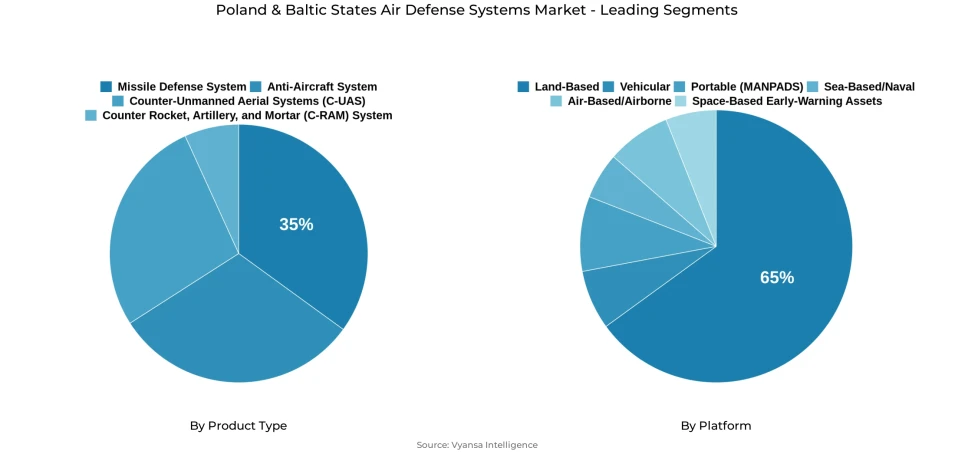
- Missile defense system grabbed market share of 35%.
- Competition
- Air defense systems in Poland & Baltic States is currently being catered to by more than 5 companies.
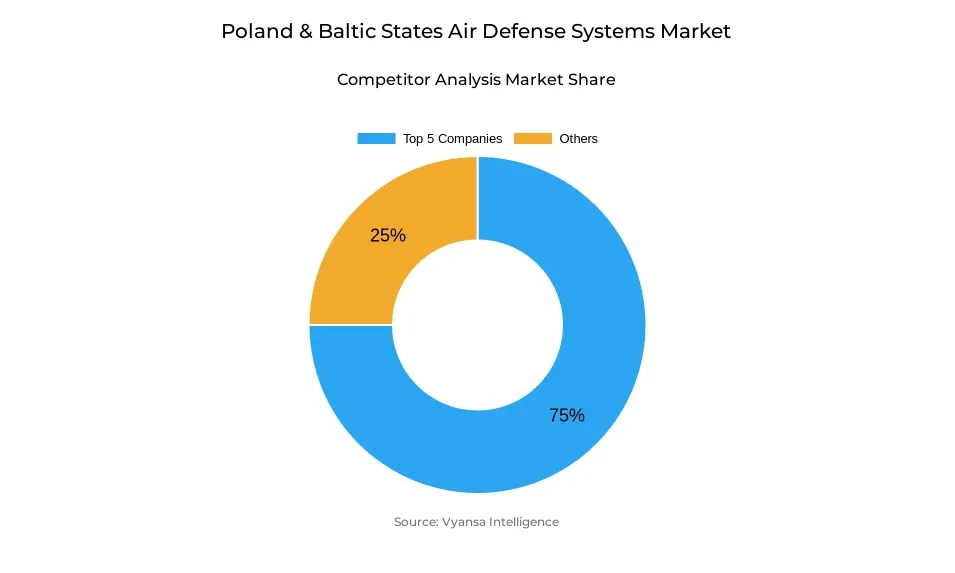
- Top 5 companies acquired around 75% of the market share.
- Kongsberg Defence & Aerospace, Lockheed Martin, Diehl Defence, RTX (Raytheon), Saab etc., are few of the top companies.
- Platform
- Land-Based grabbed 65% of the market.
- Country
- Poland leads with a 55% share of the Poland & Baltic States market.
Poland & Baltic States Air Defense Systems Market Outlook
The Poland & Baltic States air defense systems market size was valued at USD 325 million in 2025 and is projected to grow from USD 335 million in 2026 to USD 400 million by 2032, exhibiting a CAGR of 3.01% during the forecast period. Growth is expected to remain structurally strong as governments continue prioritizing territorial protection, interceptor depth, and integrated command architectures. Elevated 2026 defence budgets across the region provide a stable funding baseline, ensuring that procurement cycles remain insulated from short-term fiscal pressures while reinforcing predictable contract pipelines.
Spending momentum is closely aligned with layered capability development. In the Poland & Baltic States Air Defense Systems market, the Missile Defense System solutions were seen to hold a 35% share in 2025, emphasizing the importance of these systems in combating ballistic and cruise missile threats. The procurement strategies are also shifting towards the replenishment of interceptors, radars, and command software integration, as opposed to the procurement of individual launchers. On the other hand, the participation in multinational programs such as the European Sky Shield Initiative is enhancing interoperability standards, and shaping vendor selection toward NATO-compatible systems.
The platform dynamics are largely focused on land-based systems, with a 65% share held by Land-Based systems in 2025. The need for territorial defense, protection of vital infrastructure, and flexibility in deployment is still a major factor in investment decisions, but manpower availability in the Baltic states may impact the activation of these systems, as highly skilled manpower is required to operate these sophisticated systems on a 24/7 basis.
Country-level demand remains concentrated, with Poland holding a 55% share of the combined regional landscape in 2025. Large-scale programmes including Wisła, Narew, and Pilica position the country as the primary integration and procurement hub. Continued financial backing at both national and EU levels is expected to sustain interceptor inventories, sensor expansion, and infrastructure upgrades through 2032.
Poland & Baltic States Air Defense Systems Market Growth DriverSustained Record-Level Defence Allocations Reinforcing Air-Defence Commitments
The defence expenditure in Poland and the Baltic countries continues to remain at record levels in 2026, thus ensuring a supportive environment for the Poland & Baltic States air defence systems market. Poland has fixed its defence spending for 2026 at PLN 200.1 billion, which is 4.81% of its GDP, while Lithuania has allocated 5.38% of its GDP to defence spending and Latvia has allocated €2.16 billion, which is 4.91% of its GDP. Estonia has fixed a minimum defence allocation of at least 5% of its GDP in 2026, with a focus on air defence systems.
Air defence is a capital-intensive sector that needs not only the initial purchase of platforms but also periodic investments in interceptors, radar modernisation, command software, training, and maintenance. The uniformity of the 2026 budget baselines will guarantee that the procurement pipelines are not exposed to short-term fiscal instability. To the end users, this funding predictability equates to shorter contracting cycles, quicker systems fielding, and enhanced lifecycle support frameworks- aspects that together ensure that air-defence expenditure remains robust and strategically rooted throughout the region.
Poland & Baltic States Air Defense Systems Market ChallengeLimited Demographic Base Constraining Operational Scaling
The Poland & Baltic States air defence systems market is constrained structurally due to the limited manpower pools despite the high fiscal support. The population of Estonia is 1,372,341, Latvia is 1,866,124, and Lithuania is 2,888,278 according to 2024 World Bank population data (via FRED). Such comparatively small population bases restrict the supply of trained manpower needed to run sophisticated ground-based air-defence systems, which need 24/7 manpower in launch units, sensor arrays, and networked command nodes.
The contemporary air-defence systems demand very specialised operators, cyber-secure communications engineers, radar technicians, and depot-level maintenance specialists. Other modernisation priorities also demand the same skilled workforce, which puts pressure on national armed forces in terms of talent competition. Consequently, unit activation schedules and complete operational capability milestones can be postponed even with the secured funding. To end users, bottlenecks in personnel may slow down readiness cycles and limit rapid scaling of newly inducted systems across layered defence structures.
Unlock Market Intelligence
Explore the market potential with our data-driven report
Poland & Baltic States Air Defense Systems Market TrendExpansion of Interoperable and Layered Defence Architectures
The procurement strategies in the region are being redefined by a sharp move towards integrated, layered air-defence networks. By 2026, 23 European countries are members of the European Sky Shield Initiative, as reported by the Ministry of Defence of Germany, with Estonia, Latvia, and Lithuania being among the original signatories. The program encourages joint procurement, operation, and maintenance of air-defence systems, speeding up the bridging of capability gaps and enhancing interoperability in the NATO integrated air and missile defence system.
This transition moves procurement away from stand-alone batteries toward multi-layered frameworks integrating sensors, interceptors, and command-and-control systems across borders. Standardised interfaces, shared training doctrines, and pooled logistics structures are becoming baseline requirements in new programmes. Interoperability is no longer a choice but a necessity to end users, and is a factor in the selection of vendors, and in the demand of systems that can be smoothly integrated into NATO command structures and multinational operational settings.
Poland & Baltic States Air Defense Systems Market OpportunityEU-Financed Collaborative Procurement Strengthening Acquisition Pathways
Financing mechanisms at the European level that are being introduced in 2025-2026 are enhancing the feasibility of procuring high-value air-defence systems. In September 2025, the European Commission announced a tentative €150 billion allocation under the SAFE programme to boost defence preparedness by joint procurement, with 19 Member States indicating their participation and initial payments expected in early 2026. This system offers organized financial support that lowers capital obstacles to massive, joint acquisitions.
In addition to SAFE, the European Defence Industry Programme 2025-2027 offers grants of EUR 1.5 billion, including EUR 300 million to a Ukraine Support Instrument. These frameworks together with low-cost loans and direct grants enable cross-border procurement and industrial collaboration. In the case of the Poland & Baltic States air defence systems market, this financial structure increases predictability in interceptor replenishment, sensor upgrades, and infrastructure expansion, and allows end users to pursue pooled procurement approaches with less fiscal burden.
Poland & Baltic States Air Defense Systems Market Country Analysis
By Country
- Estonia
- Latvia
- Lithuania
Poland accounts for 55% share of the combined Poland-Baltic landscape, positioning it as the principal demand anchor within the Poland & Baltic States air defense systems market. This leadership is reinforced by an extensive pipeline of signed contracts. On 12 August 2024, Poland’s Ministry of National Defence confirmed a contract for domestic production of 48 M903 launchers under Phase II of the Wisła Patriot programme, strengthening both capability depth and local industrial participation.
Further scaling occurred in 2025, including a PLN 5.8 billion investment decision into the PGZ Narew consortium and a contract for 46 PET/PCL passive-location radars for the NAREW programme. In November 2025, the first serial PILICA system was delivered, part of 16 planned units, while PLN 3 billion was allocated to PGZ companies for Narew-related investments. These commitments consolidate Poland’s role as the central procurement and integration hub across the regional air-defence ecosystem.
Unlock Market Intelligence
Explore the market potential with our data-driven report
Poland & Baltic States Air Defense Systems Market Segmentation Analysis
By Product Type
- Missile Defense System
- Anti-Aircraft System
- Counter-Unmanned Aerial Systems (C-UAS)
- Counter Rocket, Artillery, and Mortar (C-RAM) System
Within the Poland & Baltic States air defense systems market, the Missile Defense System segment holds the highest share at 35%, reflecting its central role in layered defensive doctrines. End users prioritize missile-capable platforms as core engagement assets capable of countering a broad spectrum of aerial threats, including ballistic and cruise missiles. These systems typically anchor wider air-defence architectures, integrating advanced radar arrays and networked command modules to ensure coordinated interception across multiple engagement zones.
The leading share also underscores sustained demand for interceptor inventory depth and upgradeable software-defined engagement capabilities. Procurement strategies extend beyond launcher acquisition to include compatible surveillance systems, performance testing frameworks, and lifecycle sustainment packages. For end users, readiness is increasingly defined by interceptor availability, rapid reload cycles, and integration flexibility, reinforcing missile defence systems as the foundational product category within regional modernization roadmaps.
By Platform
- Land-Based
- Vehicular
- Portable (MANPADS)
- Sea-Based/Naval
- Air-Based/Airborne
- Space-Based Early-Warning Assets
Under the platform segment, Land-Based systems command 65% share of the Poland & Baltic States air defense systems market, underscoring their primacy in territorial defence strategies. Ground-based deployments provide scalable coverage for critical infrastructure, energy facilities, logistics corridors, and urban centres. Fixed and semi-mobile launch units enable layered positioning across national territories, offering flexibility in defending both strategic and tactical assets under evolving threat scenarios.
This dominance is further supported by the relative ease of integrating land-based systems into national air-surveillance grids and NATO-compatible command-and-control frameworks. End users emphasize mobility, rapid emplacement capability, and cross-border interoperability to ensure reinforcement and coordinated operations during joint missions. The high share of land-based platforms reflects their structural suitability for persistent airspace monitoring and sustained deterrence posture across the region.
Various Market Players in Poland & Baltic States Air Defense Systems Market
The companies mentioned below are highly active in the Poland & Baltic States air defense systems market, occupying a considerable portion of the market and shaping industry progress.
- Kongsberg Defence & Aerospace
- Lockheed Martin
- Diehl Defence
- RTX (Raytheon)
- Saab
- MBDA
- Northrop Grumman
- Polska Grupa Zbrojeniowa (PGZ)/Huta Stalowa Wola (HSW)
Market News & Updates
- RTX (Raytheon), 2025:
On September 23, 2025, Raytheon (RTX) disclosed a $1.7B U.S. Army contract for the Lower Tier Air and Missile Defense Sensor (LTAMDS) that explicitly includes nine radars for the U.S. Army and Poland (as the first international LTAMDS customer), plus spares/support/development and testing—an inflection-point sensor modernization that strengthens Poland’s 360-degree air-and-missile-defense detection layer and, by moving Poland earlier into the LTAMDS production queue, can accelerate regional integration work, sustainment demand, and follow-on procurements (C2 integration, spares, training) that shape competitive positioning for radar and IAMD ecosystem vendors across Poland and NATO’s eastern flank.
- Saab, 2025:
On March 31, 2025, Saab announced it received an order under a framework agreement with Latvia’s Ministry of Defence for the RBS 70 NG short-range ground-based air defence system valued at SEK 2.1B, with deliveries scheduled for 2026–2030 and scope including firing units, missiles, and trainer units (Saab also notes a capability set including automatic target tracking, built-in night sight, and engagement ranges “up to nine kilometres”); this order materially deepens Saab’s installed base in the Baltics and, as deliveries ramp from 2026, it is likely to expand Latvia’s layered point-defense coverage against aircraft/drones/missiles while creating durable downstream demand for missiles, training, and lifecycle support—dynamics that can influence broader Baltic procurement preferences and interoperability choices.
Frequently Asked Questions
Related Report
- Market Segmentation
- Research Scope
- Research Methodology
- Definitions and Assumptions
- Executive Summary
- Poland & Baltic States Air Defense Systems Market Policies, Regulations, and Standards
- Poland & Baltic States Air Defense Systems Market Dynamics
- Growth Factors
- Challenges
- Trends
- Opportunities
- Poland & Baltic States Air Defense Systems Market Statistics, 2022-2032F
- Market Size & Growth Outlook
- By Revenues in USD Million
- Market Segmentation & Growth Outlook
- By Product Type
- Missile Defense System- Market Insights and Forecast 2022-2032, USD Million
- Anti-Aircraft System- Market Insights and Forecast 2022-2032, USD Million
- Counter-Unmanned Aerial Systems (C-UAS)- Market Insights and Forecast 2022-2032, USD Million
- Counter Rocket, Artillery, and Mortar (C-RAM) System- Market Insights and Forecast 2022-2032, USD Million
- By Platform
- Land-Based- Market Insights and Forecast 2022-2032, USD Million
- Vehicular- Market Insights and Forecast 2022-2032, USD Million
- Portable (MANPADS)- Market Insights and Forecast 2022-2032, USD Million
- Sea-Based/Naval- Market Insights and Forecast 2022-2032, USD Million
- Air-Based/Airborne- Market Insights and Forecast 2022-2032, USD Million
- Space-Based Early-Warning Assets- Market Insights and Forecast 2022-2032, USD Million
- By Range
- Short Range Air Defense System- Market Insights and Forecast 2022-2032, USD Million
- Medium Range Air Defense System- Market Insights and Forecast 2022-2032, USD Million
- Long Range Air Defense System- Market Insights and Forecast 2022-2032, USD Million
- By Component
- Weapon System- Market Insights and Forecast 2022-2032, USD Million
- Gun/Turret System- Market Insights and Forecast 2022-2032, USD Million
- 20mm- Market Insights and Forecast 2022-2032, USD Million
- 23mm- Market Insights and Forecast 2022-2032, USD Million
- 25mm- Market Insights and Forecast 2022-2032, USD Million
- 30mm- Market Insights and Forecast 2022-2032, USD Million
- 35mm- Market Insights and Forecast 2022-2032, USD Million
- Missile Launching System- Market Insights and Forecast 2022-2032, USD Million
- Gun/Turret System- Market Insights and Forecast 2022-2032, USD Million
- Fire Control System- Market Insights and Forecast 2022-2032, USD Million
- Air Defense Radar- Market Insights and Forecast 2022-2032, USD Million
- Fire Control Radar- Market Insights and Forecast 2022-2032, USD Million
- I/J-Band- Market Insights and Forecast 2022-2032, USD Million
- X-Band- Market Insights and Forecast 2022-2032, USD Million
- C-Band- Market Insights and Forecast 2022-2032, USD Million
- Surveillance Radar- Market Insights and Forecast 2022-2032, USD Million
- X-Band- Market Insights and Forecast 2022-2032, USD Million
- C-Band- Market Insights and Forecast 2022-2032, USD Million
- D/L-Band- Market Insights and Forecast 2022-2032, USD Million
- S-Band- Market Insights and Forecast 2022-2032, USD Million
- Fire Control Radar- Market Insights and Forecast 2022-2032, USD Million
- Electro-Optic and Laser Range Finder- Market Insights and Forecast 2022-2032, USD Million
- Air Defense Radar- Market Insights and Forecast 2022-2032, USD Million
- Command and Control System- Market Insights and Forecast 2022-2032, USD Million
- Others- Market Insights and Forecast 2022-2032, USD Million
- Weapon System- Market Insights and Forecast 2022-2032, USD Million
- By System
- Missile Defense Systems- Market Insights and Forecast 2022-2032, USD Million
- Anti-Aircraft Gun and SAM Systems- Market Insights and Forecast 2022-2032, USD Million
- Counter-Unmanned Aerial Systems (C-UAS)- Market Insights and Forecast 2022-2032, USD Million
- Counter-Rocket, Artillery and Mortar (C-RAM)- Market Insights and Forecast 2022-2032, USD Million
- By Sub-system
- Weapon System- Market Insights and Forecast 2022-2032, USD Million
- Fire Control System- Market Insights and Forecast 2022-2032, USD Million
- Command and Control System- Market Insights and Forecast 2022-2032, USD Million
- Others- Market Insights and Forecast 2022-2032, USD Million
- By Technology
- Kinetic-Kill Effectors- Market Insights and Forecast 2022-2032, USD Million
- High-Energy Laser Systems- Market Insights and Forecast 2022-2032, USD Million
- High-Power Microwave Systems- Market Insights and Forecast 2022-2032, USD Million
- Electronic Warfare (EW) Soft-Kill Solutions- Market Insights and Forecast 2022-2032, USD Million
- By Country
- Estonia
- Latvia
- Lithuania
- By Competitors
- Competition Characteristics
- Market Share & Analysis
- By Product Type
- Market Size & Growth Outlook
- Poland Air Defense Systems Market Statistics, 2022-2032F
- Market Size & Growth Outlook
- By Revenues in USD Million
- Market Segmentation & Growth Outlook
- By Product Type- Market Insights and Forecast 2022-2032, USD Million
- By Platform- Market Insights and Forecast 2022-2032, USD Million
- By Range- Market Insights and Forecast 2022-2032, USD Million
- By Component- Market Insights and Forecast 2022-2032, USD Million
- By System- Market Insights and Forecast 2022-2032, USD Million
- By Sub-system- Market Insights and Forecast 2022-2032, USD Million
- By Technology- Market Insights and Forecast 2022-2032, USD Million
- Market Size & Growth Outlook
- Estonia Air Defense Systems Market Statistics, 2022-2032F
- Market Size & Growth Outlook
- By Revenues in USD Million
- Market Segmentation & Growth Outlook
- By Product Type- Market Insights and Forecast 2022-2032, USD Million
- By Platform- Market Insights and Forecast 2022-2032, USD Million
- By Range- Market Insights and Forecast 2022-2032, USD Million
- By Component- Market Insights and Forecast 2022-2032, USD Million
- By System- Market Insights and Forecast 2022-2032, USD Million
- By Sub-system- Market Insights and Forecast 2022-2032, USD Million
- By Technology- Market Insights and Forecast 2022-2032, USD Million
- Market Size & Growth Outlook
- Latvia Air Defense Systems Market Statistics, 2022-2032F
- Market Size & Growth Outlook
- By Revenues in USD Million
- Market Segmentation & Growth Outlook
- By Product Type- Market Insights and Forecast 2022-2032, USD Million
- By Platform- Market Insights and Forecast 2022-2032, USD Million
- By Range- Market Insights and Forecast 2022-2032, USD Million
- By Component- Market Insights and Forecast 2022-2032, USD Million
- By System- Market Insights and Forecast 2022-2032, USD Million
- By Sub-system- Market Insights and Forecast 2022-2032, USD Million
- By Technology- Market Insights and Forecast 2022-2032, USD Million
- Market Size & Growth Outlook
- Lithuania Air Defense Systems Market Statistics, 2022-2032F
- Market Size & Growth Outlook
- By Revenues in USD Million
- Market Segmentation & Growth Outlook
- By Product Type- Market Insights and Forecast 2022-2032, USD Million
- By Platform- Market Insights and Forecast 2022-2032, USD Million
- By Range- Market Insights and Forecast 2022-2032, USD Million
- By Component- Market Insights and Forecast 2022-2032, USD Million
- By System- Market Insights and Forecast 2022-2032, USD Million
- By Sub-system- Market Insights and Forecast 2022-2032, USD Million
- By Technology- Market Insights and Forecast 2022-2032, USD Million
- Market Size & Growth Outlook
- Competitive Outlook
- Company Profiles
- RTX (Raytheon)
- Business Description
- Product Portfolio
- Collaborations & Alliances
- Recent Developments
- Financial Details
- Others
- Saab
- Business Description
- Product Portfolio
- Collaborations & Alliances
- Recent Developments
- Financial Details
- Others
- MBDA
- Business Description
- Product Portfolio
- Collaborations & Alliances
- Recent Developments
- Financial Details
- Others
- Northrop Grumman
- Business Description
- Product Portfolio
- Collaborations & Alliances
- Recent Developments
- Financial Details
- Others
- Polska Grupa Zbrojeniowa (PGZ)/Huta Stalowa Wola (HSW)
- Business Description
- Product Portfolio
- Collaborations & Alliances
- Recent Developments
- Financial Details
- Others
- Kongsberg Defence & Aerospace
- Business Description
- Product Portfolio
- Collaborations & Alliances
- Recent Developments
- Financial Details
- Others
- Lockheed Martin
- Business Description
- Product Portfolio
- Collaborations & Alliances
- Recent Developments
- Financial Details
- Others
- Diehl Defence
- Business Description
- Product Portfolio
- Collaborations & Alliances
- Recent Developments
- Financial Details
- Others
- RTX (Raytheon)
- Company Profiles
- Disclaimer
| Segment | Sub-Segment |
|---|---|
| By Product Type |
|
| By Platform |
|
| By Range |
|
| By Component |
|
| By System |
|
| By Sub-system |
|
| By Technology |
|
| By Country |
|
Research Methodology
This study followed a structured approach comprising four key phases to assess the size and scope of the electro-oxidation market. The process began with thorough secondary research to collect data on the target market, related markets, and broader industry context. These findings, along with preliminary assumptions and estimates, were then validated through extensive primary research involving industry experts from across the value chain. To calculate the overall market size, both top-down and bottom-up methodologies were employed. Finally, market segmentation and data triangulation techniques were applied to refine and validate segment-level estimations.
Secondary Research
The secondary research phase involved gathering data from a wide range of credible and published sources. This step helped in identifying industry trends, defining market segmentation, and understanding the market landscape and value chain.
Sources consulted during this phase included:
- Company annual reports, investor presentations, and press releases
- Industry white papers and certified publications
- Trade directories and market-recognized databases
- Articles from authoritative authors and reputable journals
- Gold and silver standard websites
Secondary research was critical in mapping out the industry's value chain and monetary flow, identifying key market segments, understanding regional variations, and tracking significant industry developments.
Other key sources:
- Financial disclosures
- Industry associations and trade bodies
- News outlets and business magazines
- Academic journals and research studies
- Paid industry databases
Primary Research
To validate secondary data and gain deeper market insights, primary research was conducted with key stakeholders across both the supply and demand sides of the market.
On the demand side, participants included decision-makers and influencers from end-user industries—such as CIOs, CTOs, and CSOs—who provided first-hand perspectives on market needs, product usage, and future expectations.
On the supply side, interviews were conducted with manufacturers, industry associations, and institutional participants to gather insights into current offerings, product pipelines, and market challenges.
Primary interviews provided critical inputs such as:
- Market size and revenue data
- Product and service breakdowns
- Market forecasts
- Regional and application-specific trends
Stakeholders consulted included:
- Leading OEM and solution providers
- Channel and distribution partners
- End users across various applications
- Independent consultants and industry specialists
Market Size Estimation and Data Triangulation
- Identifying Key Market Participants (Secondary Research)
- Goal: To identify the major players or companies in the target market. This typically involves using publicly available data sources such as industry reports, market research publications, and financial statements of companies.
- Tools: Reports from firms like Gartner, Forrester, Euromonitor, Statista, IBISWorld, and others. Public financial statements, news articles, and press releases from top market players.
- Extracting Earnings of Key Market Participants
- Goal: To estimate the earnings generated from the product or service being analyzed. This step helps in understanding the revenue potential of each market player in a specific geography.
- Methods: Earnings data can be gathered from:
- Publicly available financial reports (for listed companies).
- Interviews and primary data sources from professionals, such as Directors, VPs, SVPs, etc. This is especially useful for understanding more nuanced, internal data that isn't publicly disclosed.
- Annual reports and investor presentations of key players.
- Data Collation and Development of a Relevant Data Model
- Goal: To collate inputs from both primary and secondary sources into a structured, data-driven model for market estimation. This model will incorporate key market KPIs and any independent variables relevant to the market.
- Key KPIs: These could include:
- Market size, growth rate, and demand drivers.
- Industry-specific metrics like market share, average revenue per customer (ARPC), or average deal size.
- External variables, such as economic growth rates, inflation rates, or commodity prices, that could affect the market.
- Data Modeling: Based on this data, the market forecasts are developed for the next 5 years. A combination of trend analysis, scenario modeling, and statistical regression might be used to generate projections.
- Scenario Analysis
- Goal: To test different assumptions and validate how sensitive the market is to changes in key variables (e.g., market demand, regulatory changes, technological disruptions).
- Types of Scenarios:
- Base Case: Based on current assumptions and historical data.
- Best-Case Scenario: Assuming favorable market conditions, regulatory environments, and technological advancements.
- Worst-Case Scenario: Accounting for adverse factors, such as economic downturns, stricter regulations, or unexpected disruptions.












