Poland 120mm Tank Ammunition Market Report: Trends, Growth and Forecast (2026-2032)
By Ammunition Type (APFSDS (Armor-Piercing Fin-Stabilized Discarding Sabot), HEAT (High-Explosive Anti-Tank), HE (High-Explosive), MP/Multi-Purpose, Programmable/Smart Ammunition, Training/Practice Rounds), By Tank Platform Compatibility (NATO Standard 120mm (Smoothbore), Non-NATO/Other 120mm Systems), By End User (Army/Land Forces, Defense Contractors, Training & Testing Institutions), By Guidance Type (Unguided, Programmable/Airburst, Precision-Guided) ... Read more

|
Major Players
|
Poland 120mm Tank Ammunition Market Statistics and Insights, 2026
- Market Size Statistics
- 120mm tank ammunition market size in Poland was estimated at USD 90 million in 2025.
- The market size is expected to grow to USD 130 million by 2032.
- Market to register a CAGR of around 5.39% during 2026-32.
- Ammunition Type Shares
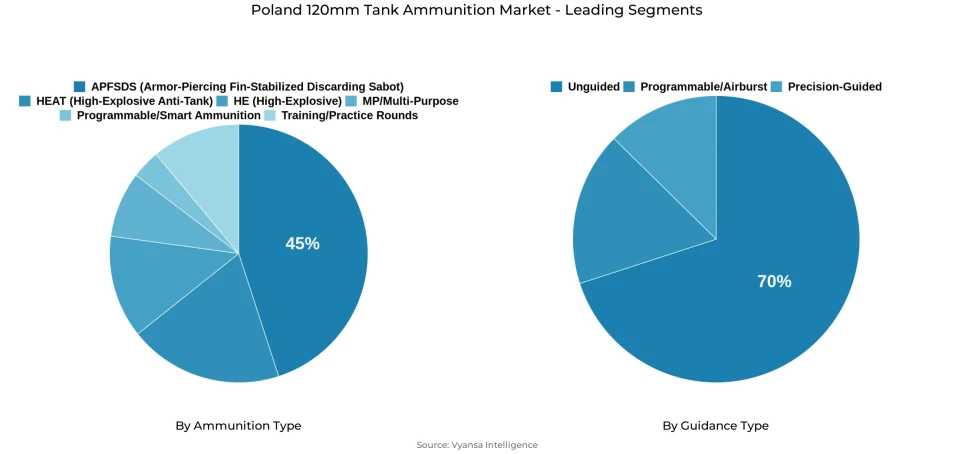
- Apfsds (armor-piercing fin-stabilized discarding sabot) grabbed market share of 45%.
- Competition
- 120mm tank ammunition in Poland is currently being catered to by more than 10 companies.
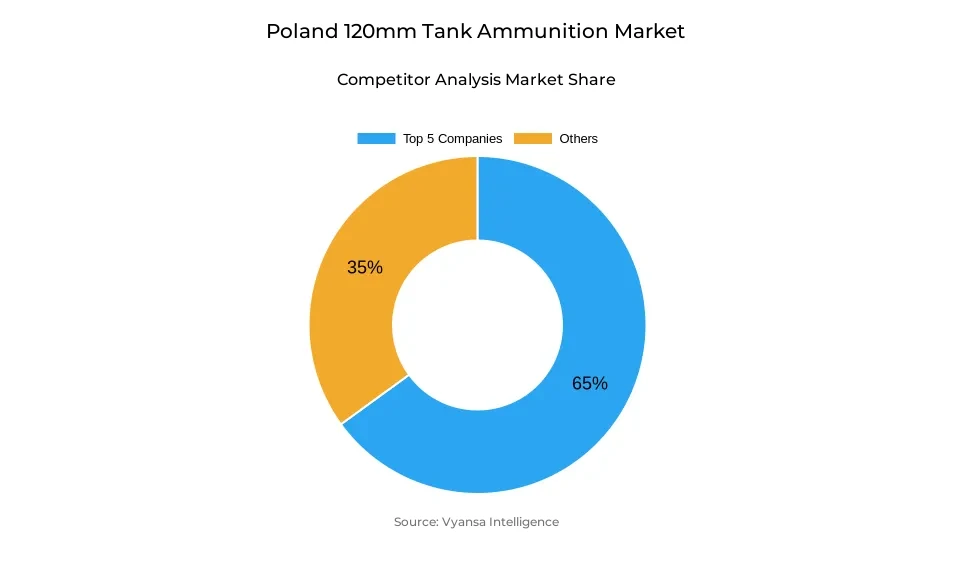
- Top 5 companies acquired around 65% of the market share.
- Nammo, Elbit Systems, ZVS Holding, MESKO (PGZ), Rheinmetall etc., are few of the top companies.
- Guidance Type
- Unguided grabbed 70% of the market.
Poland 120mm Tank Ammunition Market Outlook
The Poland 120mm Tank Ammunition Market size was valued at USD 90 million in 2025 and is projected to grow from USD 100 million in 2026 to USD 130 million by 2032, exhibiting a CAGR of around 5.39% during the forecast period. This steady growth reflects Poland's sustained commitment to defence spending, with the 2026 budget allocating PLN 200 billion for defence-equivalent to roughly 4.8% of GDP-ensuring continuous procurement cycles and active stockpile-building across armored units.
A significant driver of this growth is Poland's push toward domestic production. MESKO's "Project 400" initiative, backed by PLN 651 million in investment including public capital, has stood up a new WNL facility already producing over 1,500 rounds of 120mm tank ammunition since launch. The Armaments Agency's May 2025 contract with MESKO-covering thousands of 120×570mm rounds worth PLN 150 million-signals that procurement pipelines remain active through 2026–2027, even as ramp-up timelines and lot qualification keep near-term supply tight.
In the Ammunition Type category, APFSDS stands at the forefront with a 45% market share due to its position as the ‘default’ round for high-threat armored missions. Its compatibility with conventional 120mm smoothbore tanks and stable ballistics puts it at the forefront of both combat preparedness and training. Unguided types account for the majority of the preferences for the type of guidance at 70%, as tank units value rapid loading cycles, simplified logistics, and predictable field performance over the complexity of guided ammunition, making unguided 120mm tank ammunition the workhorse of regular stock accumulation and live-fire drills.
Looking ahead, Poland’s strong defence spending, growing domestic production capacity through PGZ and MESKO, and secured raw material agreements with partners such as EURENCO puts the country on track to decrease import dependence while maintaining strong demand through 2032.
Poland 120mm Tank Ammunition Market Growth DriverElevated Defence Allocation Sustains Continuous Ammunition Procurement
Poland keeps defence funding at a level that supports continuous ammunition buying and reserve-building. The Polish defence minister states the draft 2026 budget allocates PLN 200 billion for defence (expected to translate into 4.8% of GDP), while 2025 plans include around PLN 187 billion (about 4.7% of GDP).
This budget headroom converts into executable 120mm contracts that feed both readiness and training consumption. The Armaments Agency signs a contract (30 May 2025) with MESKO for thousands of 120×570 mm tank rounds worth about PLN 150 million gross, with deliveries scheduled for 2026-2027. High funding plus scheduled deliveries keeps procurement cycles active and lifts baseline demand for 120mm tank ammunition.
Poland 120mm Tank Ammunition Market ChallengeIndustrial Production Scaling Constraints Limit Immediate Output Expansion
Large-calibre ammunition output is scaling up, but throughput is still tight versus the volumes needed to keep armored units fully stocked. In a government briefing, Poland highlights that domestic production reaches nearly 30,000 large-calibre rounds “this year” after two years of ramp work-an indicator that new lines, safety approvals, and skilled staffing remain time-consuming.
For 120mm specifically, MESKO’s new WNL facility (Project 400) is already running, yet it reports producing over 1,500 rounds of 120mm tank ammunition since launch-evidence that early-stage lines need time to stabilize, qualify lots, and scale. With deliveries on major 120mm contracts also scheduled across 2026-2027, lead times and ramp risk stay a practical constraint for buyers.
Unlock Market Intelligence
Explore the market potential with our data-driven report
Poland 120mm Tank Ammunition Market TrendShift toward domestic large-calibre manufacturing ecosystems
Poland increasingly anchors ammunition availability in domestic plants instead of import-only channels. In June 2025, the Prime Minister highlights MESKO’s capacity jump in small-calibre output to 250 million rounds annually (about 1 million per working day), reflecting a broader push for high-volume, repeatable production methods.
The same industrial logic moves into heavy calibres. Under MESKO’s “Project 400,” the new WNL building expands tank-ammunition assembly and packaging, and-since start-up-reports over 10,000 BCME modular charges and over 1,500 rounds of 120mm already produced. PGZ and MESKO also sign agreements with EURENCO to secure raw materials and modular-ammunition technology, with the initiative anticipating at least 600,000 modular units per year in Poland.
Poland 120mm Tank Ammunition Market OpportunityPublic Capital Infusion Accelerates Local Ammunition Capacity Development
Public funding now de-risks new ammunition lines, opening room for Polish producers to expand 120mm output and shorten supply chains for the army. The Ministry of State Assets confirms over PLN 2.4 billion from the Capital Investment Fund flows to PGZ-linked companies to build infrastructure and add technology lines, with the stated aim of reducing dependence on foreign suppliers.
On the factory side, MESKO reports “Project 400” investment outlays of PLN 651.254 million (including PLN 150 million from the Capital Investment Fund) and documents early production at the WNL facility, including over 1,500 rounds of 120mm since start-up. With Armaments Agency contracts already covering thousands of 120mm rounds, additional capacity directly increases the share that can be met from local plants.
Unlock Market Intelligence
Explore the market potential with our data-driven report
Poland 120mm Tank Ammunition Market Segmentation Analysis
By Ammunition Type
- APFSDS (Armor-Piercing Fin-Stabilized Discarding Sabot)
- HEAT (High-Explosive Anti-Tank)
- HE (High-Explosive)
- MP/Multi-Purpose
- Programmable/Smart Ammunition
- Training/Practice Rounds
The segment with the highest share under the Ammunition Type is APFSDS (Armor-Piercing Fin-Stabilized Discarding Sabot) with market share of around 45%. This lead links to how tank units plan for high-threat encounters-APFSDS stays the default round when crews expect armored targets and need maximum penetration.
In day-to-day procurement, APFSDS also benefits from broad compatibility with standard 120mm smoothbore guns and strong training relevance: consistent ballistics help crews rehearse range estimation, fire-control routines, and first-round hit probability under realistic conditions. As a result, buyers typically keep APFSDS as the core stock item, while other round types serve more specialized roles.
By Guidance Type
- Unguided
- Programmable/Airburst
- Precision-Guided
The segment with the highest share under the Guidance Type is Unguided with market share of around 70%. Tanks are built around direct-fire engagements and fast target cycles, so commanders prefer rounds that load, fire, and resupply quickly in the field with minimal extra kit, software, or seeker maintenance.
Unguided 120mm rounds also simplify storage, transport, and live-fire training because performance stays consistent without relying on electronics. For most routine qualification and maneuver drills, this reliability matters more than advanced guidance features. Guided variants can still add value in niche scenarios, but the armored-unit operating model keeps unguided rounds as the default choice for building depth in stocks and sustaining training tempo.
List of Companies Covered in Poland 120mm Tank Ammunition Market
The companies listed below are highly influential in the Poland 120mm tank ammunition market, with a significant market share and a strong impact on industry developments.
- Nammo
- Elbit Systems
- ZVS Holding
- MESKO (PGZ)
- Rheinmetall
- Northrop Grumman
- General Dynamics Ordnance and Tactical Systems
- KNDS
- MSM Group
- Poongsan
Market News & Updates
- Rheinmetall, 2026:
On February 13, 2026, Rheinmetall announced it had received a major NATO Support and Procurement Agency (NSPA) order for 35,000 rounds of 120mm tank ammunition under a framework that streamlines contracting for NATO nations and partners—an update that matters for Poland’s 120mm market because it signals that large, multi-country call-offs are actively absorbing Rheinmetall’s 120mm output in 2026, which can tighten regional lead-times and pricing for any Polish replenishment sourced via NATO channels and intensifies competitive pressure on domestic producers to meet NATO-standard performance and delivery expectations.
- MESKO (PGZ), 2025:
On May 30, 2025, MESKO S.A. signed a contract with Poland’s Armaments Agency to supply thousands of 120×570 mm APFSDS-T tank rounds (contract value ~PLN 150 million gross), with deliveries scheduled for 2026–2027—a material, schedule-backed reinforcement of Poland’s domestic 120mm supply base that directly supports Leopard 2 readiness and reduces near-term dependence on imported kinetic-energy stocks, while also setting a concrete price/volume benchmark that will shape competitive positioning for subsequent Polish 120mm procurements.
Frequently Asked Questions
Related Report
- Market Segmentation
- Research Scope
- Research Methodology
- Definitions and Assumptions
- Executive Summary
- Poland 120mm Tank Ammunition Market Policies, Regulations, and Standards
- Poland 120mm Tank Ammunition Market Dynamics
- Growth Factors
- Challenges
- Trends
- Opportunities
- Poland 120mm Tank Ammunition Market Statistics, 2022-2032F
- Market Size & Growth Outlook
- By Revenues in USD Million
- Market Segmentation & Growth Outlook
- By Ammunition Type
- APFSDS (Armor-Piercing Fin-Stabilized Discarding Sabot)- Market Insights and Forecast 2022-2032, USD Million
- HEAT (High-Explosive Anti-Tank)- Market Insights and Forecast 2022-2032, USD Million
- HE (High-Explosive)- Market Insights and Forecast 2022-2032, USD Million
- MP/Multi-Purpose- Market Insights and Forecast 2022-2032, USD Million
- Programmable/Smart Ammunition- Market Insights and Forecast 2022-2032, USD Million
- Training/Practice Rounds- Market Insights and Forecast 2022-2032, USD Million
- By Tank Platform Compatibility
- NATO Standard 120mm (Smoothbore)- Market Insights and Forecast 2022-2032, USD Million
- Non-NATO/Other 120mm Systems- Market Insights and Forecast 2022-2032, USD Million
- By End User
- Army/Land Forces- Market Insights and Forecast 2022-2032, USD Million
- Defense Contractors- Market Insights and Forecast 2022-2032, USD Million
- Training & Testing Institutions- Market Insights and Forecast 2022-2032, USD Million
- By Guidance Type
- Unguided- Market Insights and Forecast 2022-2032, USD Million
- Programmable/Airburst- Market Insights and Forecast 2022-2032, USD Million
- Precision-Guided- Market Insights and Forecast 2022-2032, USD Million
- By Competitors
- Competition Characteristics
- Market Share & Analysis
- By Ammunition Type
- Market Size & Growth Outlook
- Poland APFSDS (Armor-Piercing Fin-Stabilized Discarding Sabot) Tank Ammunition Market Statistics, 2022-2032
- Market Size & Growth Outlook
- By Revenues in USD Million
- Market Segmentation & Growth Outlook
- By Tank Platform Compatibility- Market Insights and Forecast 2022-2032, USD Million
- By End User- Market Insights and Forecast 2022-2032, USD Million
- By Guidance Type- Market Insights and Forecast 2022-2032, USD Million
- Market Size & Growth Outlook
- Poland HEAT (High-Explosive Anti-Tank) Tank Ammunition Market Statistics, 2022-2032
- Market Size & Growth Outlook
- By Revenues in USD Million
- Market Segmentation & Growth Outlook
- By Tank Platform Compatibility- Market Insights and Forecast 2022-2032, USD Million
- By End User- Market Insights and Forecast 2022-2032, USD Million
- By Guidance Type- Market Insights and Forecast 2022-2032, USD Million
- Market Size & Growth Outlook
- Poland HE (High-Explosive) Tank Ammunition Market Statistics, 2022-2032
- Market Size & Growth Outlook
- By Revenues in USD Million
- Market Segmentation & Growth Outlook
- By Tank Platform Compatibility- Market Insights and Forecast 2022-2032, USD Million
- By End User- Market Insights and Forecast 2022-2032, USD Million
- By Guidance Type- Market Insights and Forecast 2022-2032, USD Million
- Market Size & Growth Outlook
- Poland MP/Multi-Purpose Tank Ammunition Market Statistics, 2022-2032
- Market Size & Growth Outlook
- By Revenues in USD Million
- Market Segmentation & Growth Outlook
- By Tank Platform Compatibility- Market Insights and Forecast 2022-2032, USD Million
- By End User- Market Insights and Forecast 2022-2032, USD Million
- By Guidance Type- Market Insights and Forecast 2022-2032, USD Million
- Market Size & Growth Outlook
- Poland Programmable/Smart Tank Ammunition Market Statistics, 2022-2032
- Market Size & Growth Outlook
- By Revenues in USD Million
- Market Segmentation & Growth Outlook
- By Tank Platform Compatibility- Market Insights and Forecast 2022-2032, USD Million
- By End User- Market Insights and Forecast 2022-2032, USD Million
- By Guidance Type- Market Insights and Forecast 2022-2032, USD Million
- Market Size & Growth Outlook
- Poland Training/Practice Rounds Tank Ammunition Market Statistics, 2022-2032
- Market Size & Growth Outlook
- By Revenues in USD Million
- Market Segmentation & Growth Outlook
- By Tank Platform Compatibility- Market Insights and Forecast 2022-2032, USD Million
- By End User- Market Insights and Forecast 2022-2032, USD Million
- By Guidance Type- Market Insights and Forecast 2022-2032, USD Million
- Market Size & Growth Outlook
- Competitive Outlook
- Company Profiles
- MESKO (PGZ)
- Business Description
- Product Portfolio
- Collaborations & Alliances
- Recent Developments
- Financial Details
- Others
- Rheinmetall
- Business Description
- Product Portfolio
- Collaborations & Alliances
- Recent Developments
- Financial Details
- Others
- Northrop Grumman
- Business Description
- Product Portfolio
- Collaborations & Alliances
- Recent Developments
- Financial Details
- Others
- General Dynamics Ordnance and Tactical Systems
- Business Description
- Product Portfolio
- Collaborations & Alliances
- Recent Developments
- Financial Details
- Others
- KNDS
- Business Description
- Product Portfolio
- Collaborations & Alliances
- Recent Developments
- Financial Details
- Others
- Nammo
- Business Description
- Product Portfolio
- Collaborations & Alliances
- Recent Developments
- Financial Details
- Others
- Elbit Systems
- Business Description
- Product Portfolio
- Collaborations & Alliances
- Recent Developments
- Financial Details
- Others
- ZVS Holding
- Business Description
- Product Portfolio
- Collaborations & Alliances
- Recent Developments
- Financial Details
- Others
- MSM Group
- Business Description
- Product Portfolio
- Collaborations & Alliances
- Recent Developments
- Financial Details
- Others
- Poongsan
- Business Description
- Product Portfolio
- Collaborations & Alliances
- Recent Developments
- Financial Details
- Others
- MESKO (PGZ)
- Company Profiles
- Disclaimer
| Segment | Sub-Segment |
|---|---|
| By Ammunition Type |
|
| By Tank Platform Compatibility |
|
| By End User |
|
| By Guidance Type |
|
Research Methodology
This study followed a structured approach comprising four key phases to assess the size and scope of the electro-oxidation market. The process began with thorough secondary research to collect data on the target market, related markets, and broader industry context. These findings, along with preliminary assumptions and estimates, were then validated through extensive primary research involving industry experts from across the value chain. To calculate the overall market size, both top-down and bottom-up methodologies were employed. Finally, market segmentation and data triangulation techniques were applied to refine and validate segment-level estimations.
Secondary Research
The secondary research phase involved gathering data from a wide range of credible and published sources. This step helped in identifying industry trends, defining market segmentation, and understanding the market landscape and value chain.
Sources consulted during this phase included:
- Company annual reports, investor presentations, and press releases
- Industry white papers and certified publications
- Trade directories and market-recognized databases
- Articles from authoritative authors and reputable journals
- Gold and silver standard websites
Secondary research was critical in mapping out the industry's value chain and monetary flow, identifying key market segments, understanding regional variations, and tracking significant industry developments.
Other key sources:
- Financial disclosures
- Industry associations and trade bodies
- News outlets and business magazines
- Academic journals and research studies
- Paid industry databases
Primary Research
To validate secondary data and gain deeper market insights, primary research was conducted with key stakeholders across both the supply and demand sides of the market.
On the demand side, participants included decision-makers and influencers from end-user industries—such as CIOs, CTOs, and CSOs—who provided first-hand perspectives on market needs, product usage, and future expectations.
On the supply side, interviews were conducted with manufacturers, industry associations, and institutional participants to gather insights into current offerings, product pipelines, and market challenges.
Primary interviews provided critical inputs such as:
- Market size and revenue data
- Product and service breakdowns
- Market forecasts
- Regional and application-specific trends
Stakeholders consulted included:
- Leading OEM and solution providers
- Channel and distribution partners
- End users across various applications
- Independent consultants and industry specialists
Market Size Estimation and Data Triangulation
- Identifying Key Market Participants (Secondary Research)
- Goal: To identify the major players or companies in the target market. This typically involves using publicly available data sources such as industry reports, market research publications, and financial statements of companies.
- Tools: Reports from firms like Gartner, Forrester, Euromonitor, Statista, IBISWorld, and others. Public financial statements, news articles, and press releases from top market players.
- Extracting Earnings of Key Market Participants
- Goal: To estimate the earnings generated from the product or service being analyzed. This step helps in understanding the revenue potential of each market player in a specific geography.
- Methods: Earnings data can be gathered from:
- Publicly available financial reports (for listed companies).
- Interviews and primary data sources from professionals, such as Directors, VPs, SVPs, etc. This is especially useful for understanding more nuanced, internal data that isn't publicly disclosed.
- Annual reports and investor presentations of key players.
- Data Collation and Development of a Relevant Data Model
- Goal: To collate inputs from both primary and secondary sources into a structured, data-driven model for market estimation. This model will incorporate key market KPIs and any independent variables relevant to the market.
- Key KPIs: These could include:
- Market size, growth rate, and demand drivers.
- Industry-specific metrics like market share, average revenue per customer (ARPC), or average deal size.
- External variables, such as economic growth rates, inflation rates, or commodity prices, that could affect the market.
- Data Modeling: Based on this data, the market forecasts are developed for the next 5 years. A combination of trend analysis, scenario modeling, and statistical regression might be used to generate projections.
- Scenario Analysis
- Goal: To test different assumptions and validate how sensitive the market is to changes in key variables (e.g., market demand, regulatory changes, technological disruptions).
- Types of Scenarios:
- Base Case: Based on current assumptions and historical data.
- Best-Case Scenario: Assuming favorable market conditions, regulatory environments, and technological advancements.
- Worst-Case Scenario: Accounting for adverse factors, such as economic downturns, stricter regulations, or unexpected disruptions.












