Global Phytonutrients Market Report: Trends, Growth and Forecast (2026-2032)
By Type (Carotenoids, Flavonoids, Polyphenols, Phytosterols/Plant Sterols, Specialty Phytonutrients (Curcumin, Organosulfur Compounds, Phytoestrogens), Others), By Functional Positioning (Antioxidant Support, Eye Health, Heart Health, Immune Support, Cognitive Health, Skin Health, Gut/Metabolic Health, Healthy Aging), By Regulatory Use Case (Dietary Supplement Ingredient, Conventional Food Ingredient, Functional Beverage Ingredient, Natural Colorant, Cosmetic Active, Feed/Animal Nutrition Ingredient), By Delivery Technology (Standard Extract Powder, Oil Suspension/Oleoresin, Water-Dispersible Format, Microencapsulated/Beadlet, Emulsified/Liposomal, Ready-to-Blend Premix), By Source (Fruits & Vegetables, Grains & Cereals, Legumes & Pulses, Herbs & Spices, Oilseeds, Others), By Form (Dry/Powder, Liquid, Others), By Sales Channel (Retail Online (Brand-Owned Websites, Third-Party E-commerce Marketplaces, Online Health & Wellness Stores), Retail Offline (Supermarkets & Hypermarkets, Pharmacies & Drug Stores, Specialty Health & Nutrition Stores)), By End-use Industry (Food & Beverages, Nutraceuticals & Dietary Supplements, Pharmaceuticals, Cosmetics & Personal Care, Animal Nutrition, Others), By Region (North America, South America, Europe, Middle East & Africa, Asia Pacific) ... Read more
|
Major Players
|
Global Phytonutrients Market Statistics and Insights, 2026
- Market Size Statistics
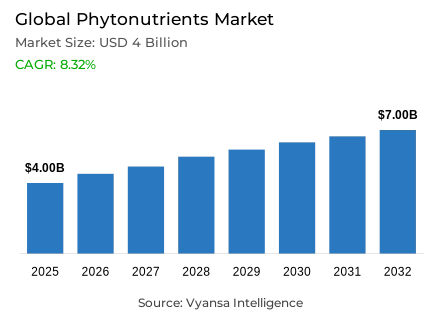
- Phytonutrients market size in Global was valued at USD 4 billion in 2025 and is estimated at USD 4.8 billion in 2026.
- The market size is expected to grow to USD 7 billion by 2032.
- Market to register a CAGR of around 8.32% during 2026-32.
- Type Shares
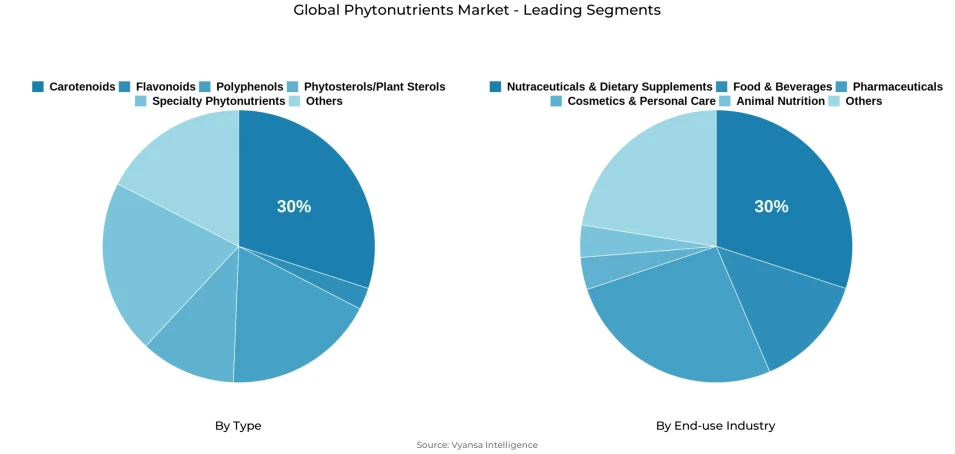
- Carotenoids grabbed market share of 30%.
- Competition
- More than 20 companies are actively engaged in producing phytonutrients.
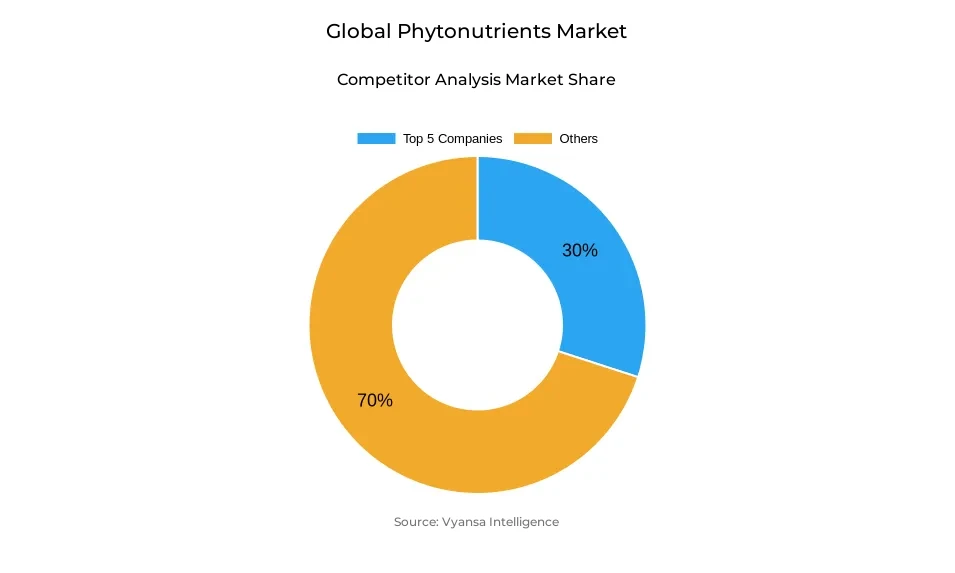
- Top 5 companies acquired around 30% of the market share.
- Döhler, Kalsec, Indena, ADM, Givaudan etc., are few of the top companies.
- End-use Industry
- Nutraceuticals & dietary supplements grabbed 30% of the market.
- Region
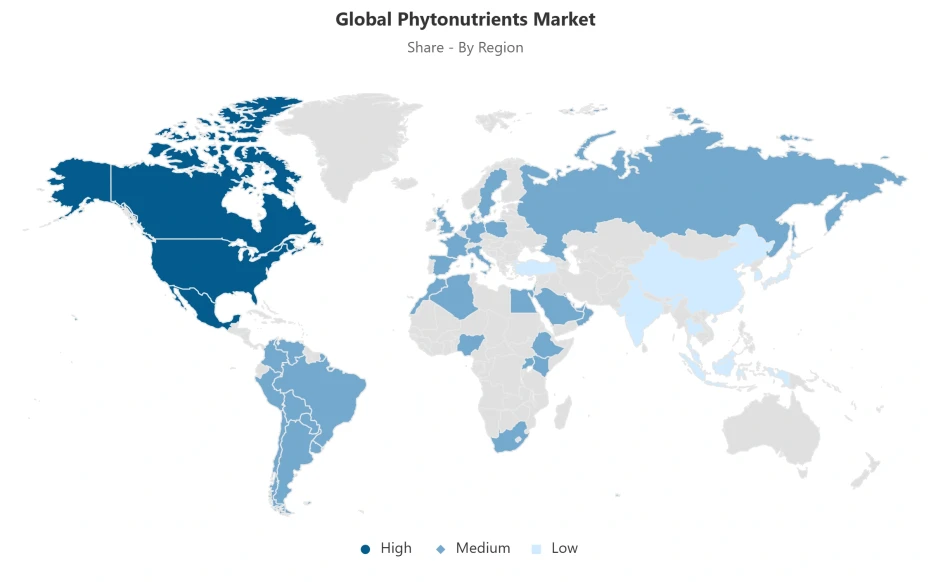
- North America leads with a 35% share of the global market.
Global Phytonutrients Market Outlook
The Global phytonutrients market was valued at USD 4 billion in 2025, establishing a commercially dynamic and health-trend-supported foundation within the world's most rapidly expanding functional nutrition and plant-based wellness ingredient ecosystem. Projected to advance from USD 4.8 billion in 2026 to USD 7 billion by 2032, the sector registers a CAGR of 8.32% across the forecast horizon. This steady and structurally well-supported expansion trajectory reflects the sustained and deepening global end user shift toward diet-linked health management, preventive nutrition investment, and the growing formulator preference for naturally derived bioactive ingredients across food, supplement, and wellness product categories worldwide. Growth is anchored in durable behavioral and demographic forces rather than transient wellness trends, giving this market a commercial resilience that sustains consistent ingredient demand across diverse end-use applications and geographic markets.
The type architecture defining this market's commercial structure is anchored in carotenoid compounds. Carotenoids command approximately 30% of total type market share, reflecting the consistent and broad commercial preference for plant-derived compounds whose scientific recognition, end user familiarity, and multi-application versatility make them the reference ingredient category across health-oriented food, supplement, and functional beverage formulations globally. This type concentration confirms that phytonutrient buyers consistently prioritize well-documented, widely recognized plant compounds whose end user communication credentials and formulation adaptability create natural and durable demand advantages over less-established botanical ingredient categories across both mainstream retail and premium wellness product development contexts.
The end-use architecture reinforces the structural centrality of the nutraceuticals and dietary supplements sector as the category's dominant application domain. Nutraceuticals and Dietary Supplements account for approximately 30% of total end-use market share, reflecting the deep commercial alignment between plant-derived bioactive compounds and the wellness-focused, nutrition-led product development priorities that define mainstream supplement category innovation. WHO's documentation that healthy diets help protect against noncommunicable diseases including diabetes, heart disease, stroke, and cancer, combined with the organization's observation that many people still do not consume sufficient fruit, vegetables, and dietary fiber, confirms the nutritional gap narrative that sustains consistent end user motivation for phytonutrient-containing dietary supplement products across global health-conscious buyer populations.
The future outlook is defined by four converging structural forces whose combined commercial impact creates a phytonutrients market of sustained and well-grounded expansion momentum. WHO's documentation of approximately 2.5 billion overweight adults and 890 million people living with obesity globally in 2022 confirms the population health burden that sustains institutional and end user-level demand for plant-based nutrition ingredients positioned around preventive health and better dietary quality. EFSA's fourth edition Compendium of Botanicals, now covering 2,701 plant species and 1,538 naturally occurring substances of potential concern, confirms the advancing scientific standardization infrastructure that is progressively elevating evidence requirements and creating differentiation advantages for ingredient suppliers with robust documentation and quality assurance capabilities. The FAO's SOFI 2025 report's identification of inflation-driven purchasing power erosion as a barrier to healthy diet access creates white space for affordable phytonutrient-fortified food and supplement formats positioned around accessible daily wellness support. North America's 35% global market share leadership establishes the geographic commercial center around which brand investment, retail innovation, and category expansion priorities are organized over the forecast period.
Global Phytonutrients Market Growth Driver
Global Chronic Disease and Obesity Burden Sustains Plant Nutrition Demand
The escalating and institutionally documented global burden of overweight, obesity, and diet-linked chronic disease represents the primary structural driver of phytonutrient demand, functioning as a persistent end user and institutional health imperative that sustains consistent ingredient adoption across preventive nutrition, functional food, and dietary supplement product categories worldwide. This disease burden-driven demand dynamic transcends fashion-cycle wellness trends, reflecting a durable health necessity whose commercial volume generation is structurally anchored in the growing end user recognition that dietary quality and plant-based nutrition investment represent practical and accessible strategies for chronic disease risk reduction across everyday lifestyle management.
The quantitative evidence validating this health burden-driven demand dynamic is documented with precision by WHO. In 2022, approximately 2.5 billion adults were overweight and 890 million were living with obesity, while 43% of adults aged 18 years and over were classified as overweight, confirming the global population scale of the dietary health challenge that sustains phytonutrient ingredient demand across end user health categories. WHO further documents that healthy diets help protect against noncommunicable diseases including diabetes, heart disease, stroke, and cancer, while many people globally still do not consume enough fruit, vegetables, or dietary fiber, confirming the nutritional gap narrative that creates consistent end user motivation for phytonutrient-containing products positioned around plant-based preventive health support. These population health metrics validate a demand expansion dynamic of sufficient global scale and urgency to sustain structural phytonutrient market growth over the forecast period.
Global Phytonutrients Market Challenge
Botanical Safety Scrutiny and Regulatory Complexity Constrain Market Entry Speed
The expanding scope and increasing rigor of botanical ingredient safety assessment and health claim regulatory processes across major global markets represents the most consequential structural challenge confronting phytonutrient ingredient suppliers and product developers, creating systematic evidence generation, documentation management, and regulatory navigation burdens that extend development timelines, elevate pre-market investment requirements, and constrain the pace at which new phytonutrient ingredients and health benefit claims reach commercial product formulations across food, supplement, and functional beverage applications. For smaller and mid-tier suppliers, this regulatory navigation burden creates an asymmetric competitive disadvantage relative to established ingredient corporations with dedicated regulatory affairs infrastructure and documented safety dossier management capability.
The regulatory specificity and scientific scope of this botanical safety challenge are established with authority by EFSA and the European Commission. EFSA's latest Compendium of Botanicals covers 2,701 plant species and includes 1,538 naturally occurring substances of potential concern for human health, confirming the breadth of the safety-screening burden that ingredient developers must navigate across the botanical raw material landscape. EFSA identifies specific concerns around botanical ingredients including chemical and microbiological contamination and the need to ensure that concentrations of active substances remain within safe limits, establishing the multi-dimensional quality assurance obligations that all credible phytonutrient ingredient suppliers must satisfy. The European Commission's identification of health claims referring to botanical substances as among those for which assessment remains unfinalized further compounds the regulatory complexity by sustaining claim development uncertainty that affects product positioning investment decisions across the market over the forecast period.
Unlock Market Intelligence
Explore the market potential with our data-driven report
Global Phytonutrients Market Trend
Science-Led Botanical Standardization Reshapes Ingredient Evaluation Frameworks
The systematic advancement of scientific cataloging, safety assessment infrastructure, and evidence-based botanical ingredient evaluation represents the defining structural trend reshaping phytonutrient ingredient sourcing priorities, supplier qualification criteria, and competitive differentiation parameters across the global market. This standardization trend is moving the competitive conversation in the phytonutrients market beyond generic natural and plant-based positioning into the domain of documented bioactive concentration precision, traceable supply chain integrity, and evidence-supported safety and efficacy credentials whose presence or absence is progressively determining supplier access to the most compliance-conscious and scientifically sophisticated formulator buyer segments across global food, supplement, and wellness product development.
The institutional momentum and database specificity of this botanical standardization trend are documented with authority by EFSA. The fourth edition of EFSA's Compendium of Botanicals represents a major upgrade of the open-source database used in botanical safety assessment, now encompassing 2,701 plant species and 1,538 naturally occurring substances of potential concern for human health. EFSA explicitly positions the tool as intended to support scientific assessors, risk managers, and applicants or manufacturers, confirming that the standardization infrastructure is being built specifically to serve the evidence generation and regulatory navigation requirements of commercial ingredient developers rather than purely academic research purposes. As this standardization infrastructure matures and its adoption broadens across regulatory jurisdictions beyond Europe, the evidence and documentation requirements it establishes will progressively define the minimum commercial viability threshold for phytonutrient ingredient suppliers seeking access to the most demanding global market segments over the forecast period.
Global Phytonutrients Market Opportunity
Affordable Functional Nutrition Formats Address Accessibility-Constrained Wellness Demand
The large and structurally underserved global end user population whose access to adequate plant-based nutrition is constrained by affordability limitations and healthy diet cost barriers creates a commercially significant and socially impactful opportunity for phytonutrient-containing food and supplement products positioned around accessible, value-conscious daily wellness support. This accessibility-oriented opportunity is distinguished from premium wellness market demand by its demographic scale, its geographic breadth across both emerging and developed economy end user segments affected by inflation-driven purchasing power erosion, and the relatively modest product price point investment required to deliver meaningful phytonutrient nutrition content within mainstream food and supplement formats that reach end users outside premium retail channels.
The quantitative scale and economic specificity of this accessibility opportunity are documented with precision by FAO and WHO. FAO's SOFI 2025 report highlights that elevated inflation across many countries has undermined purchasing power and restricted access to healthy diets, especially among low-income populations, confirming that the affordability barrier to plant-based nutrition is a current and active constraint rather than a legacy development challenge. WHO documents that more than 1 billion people are living with obesity globally and that higher-than-optimal BMI caused an estimated 3.7 million deaths from noncommunicable diseases in 2021, confirming the health outcome urgency that creates end user motivation for accessible nutrition improvement solutions across mainstream price points. For phytonutrient ingredient suppliers and finished product brands that invest in cost-optimized formulation, mainstream channel distribution, and accessible end user communication for health-supportive plant nutrition products, this accessibility gap represents a compelling and commercially scalable growth opportunity over the forecast period.
Global Phytonutrients Market Regional Analysis
By Region
- North America
- South America
- Europe
- Middle East & Africa
- Asia Pacific
The segment with highest market share under the Region is North America, accounting for approximately 35% of the total market. This dominant regional position reflects the convergence of the world's most mature end user wellness ecosystem, the highest per-capita dietary supplement consumption base, the most sophisticated natural ingredient retail infrastructure, and a regulatory and scientific community whose standards and research outputs progressively shape global phytonutrient product development and ingredient evaluation norms. With more than one-third of total global market value concentrated within a single regional block, North America defines the commercial scale, innovation direction, and end user expectation parameters of the global phytonutrients market, making it the primary geography around which global brand strategy, product launch sequencing, and ingredient marketing investment decisions are organized.
The structural dominance of North America is sustained by demand characteristics operating across multiple commercial dimensions simultaneously. Active premium ingredient adoption among established nutraceutical and functional food brands sustains consistent high-value phytonutrient procurement across carotenoid, flavonoid, and specialty botanical compound categories. Expanding mainstream retail distribution of health-positioned food and supplement products creates growing volume demand across accessible end user price points that extend phytonutrient ingredient adoption beyond premium channel boundaries into mass-market grocery and pharmacy environments. The region's deep concentration of nutritional science research institutions and regulatory engagement infrastructure sustains a continuous pipeline of evidence generation that reinforces end user and formulator confidence in phytonutrient ingredient categories. North America's structural position as the global market's dominant commercial and innovation anchor is expected to remain intact over the forecast period.
Unlock Market Intelligence
Explore the market potential with our data-driven report
Global Phytonutrients Market Segmentation Analysis
By Type
- Carotenoids
- Flavonoids
- Polyphenols
- Phytosterols/Plant Sterols
- Specialty Phytonutrients
- Curcumin
- Organosulfur Compounds
- Phytoestrogens
- Others
The segment with highest market share under the Type is Carotenoids, accounting for approximately 30% of the total market. This commanding position reflects the deep structural alignment between carotenoid compound characteristics and the specific formulation requirements of the market's most commercially active ingredient buyer segments, where scientific documentation depth, end user health awareness, regulatory familiarity, and broad application compatibility across food, beverage, and supplement product categories make carotenoids the reference phytonutrient type across health-oriented product development globally. With three-tenths of total market value concentrated within a single type category, Carotenoids define the ingredient sourcing priorities, formulation investment frameworks, and competitive positioning strategies of the global phytonutrients market.
The structural leadership of Carotenoids is further sustained by the scientific recognition and end user communication advantages that have established this ingredient category as the most commercially accessible entry point for brands seeking credible plant-based nutrition positioning across mainstream retail and premium wellness channels. As EFSA's updated botanical safety compendium advances the standardization of plant ingredient safety assessment across 2,701 species, carotenoids benefit from their established regulatory familiarity and well-documented safety profiles relative to less-characterized botanical alternatives. This regulatory credibility advantage creates procurement confidence among formulators navigating increasingly rigorous botanical ingredient evaluation requirements. The segment's structural dominance as the market's primary type revenue contributor is expected to consolidate over the forecast period.
By End-use Industry
- Food & Beverages
- Nutraceuticals & Dietary Supplements
- Pharmaceuticals
- Cosmetics & Personal Care
- Animal Nutrition
- Others
The segment with highest market share under the End-Use market is Nutraceuticals and Dietary Supplements, accounting for approximately 30% of the total market. This leading position reflects the foundational commercial alignment between plant-derived bioactive compounds and the wellness-focused, nutrition-outcome-oriented product development priorities that define the supplement market's most active innovation and end user communication investment categories. With nearly one-third of total market value anchored in nutraceutical and dietary supplement applications, this end-use segment defines the ingredient specification standards, efficacy documentation requirements, and clean-label positioning expectations that shape phytonutrient sourcing decisions and supplier competitive strategies across the global market.
The structural leadership of Nutraceuticals and Dietary Supplements is being actively sustained by the convergence of population-level chronic disease burden documentation and end user-level preventive health motivation that collectively sustain consistent supplement product purchase behavior. WHO's documentation of more than 1 billion people living with obesity globally, combined with evidence that higher-than-optimal BMI contributed to an estimated 3.7 million noncommunicable disease deaths in 2021, confirms the health outcome urgency that motivates phytonutrient-containing supplement product adoption across health-conscious end user segments worldwide. As supplement product developers progressively elevate their evidence and traceability requirements in response to advancing regulatory scrutiny, ingredient suppliers with robust scientific documentation and supply chain transparency credentials will attract disproportionate formulator preference. The segment's structural commercial leadership is expected to strengthen over the forecast period.
Market Players in Global Phytonutrients Market
These market players maintain a significant presence in the Global phytonutrients market sector and contribute to its ongoing evolution.
- Döhler
- Kalsec
- Indena
- ADM
- Givaudan
- dsm-firmenich
- BASF
- Kerry Group
- IFF
- Kemin Industries
- Lycored
- Sabinsa
- OmniActive Health Technologies
- Nexira
- Synthite Industries
Market News & Updates
- dsm-firmenich, 2026:
dsm-firmenich announced that at Vitafoods Europe 2026 it would showcase a portfolio of healthy-longevity solutions in premix and market-ready formats, including Age Slower and Cellular Repair, with the company emphasizing science-backed approaches targeting key hallmarks of aging such as chronic inflammation, cellular senescence, gut dysbiosis, and mitochondrial dysfunction. For the global phytonutrients market, this is a major strategic development because it reflects the category’s move toward more clinically framed, condition-positioned botanical and nutrition solutions, especially in healthy aging, where branded ingredient systems increasingly compete on substantiation, format flexibility, and speed to market
- BASF, 2026:
BASF said it had lifted force majeure for all affected BASF Nutrition Ingredients, following a series of 2025 recovery updates that specifically restored supply for several human-nutrition carotenoid products including Lucarotin 1 CWD/Y, Lucarotin 10 CWD/O PLUS, Lucarotin 30 M, Lucarotin 30 SUN, Lucarotin 30 MCT, and Beta-Carotene 20% CWD/R. For the global phytonutrients market, this is one of the most consequential supply-side updates because BASF is a major carotenoid supplier, and the normalization of availability reduces procurement risk for manufacturers using phytonutrients in supplements, fortified foods, and natural-color applications
Frequently Asked Questions
Related Report
- Market Segmentation
- Research Scope
- Research Methodology
- Definitions and Assumptions
- Executive Summary
- Global Phytonutrients Market Policies, Regulations, and Standards
- Global Phytonutrients Market Dynamics
- Growth Factors
- Challenges
- Trends
- Opportunities
- Global Phytonutrients Market Statistics, 2022-2032F
- Market Size & Growth Outlook
- By Revenues in USD Million
- Market Segmentation & Growth Outlook
- By Type
- Carotenoids- Market Insights and Forecast 2022-2032, USD Million
- Flavonoids- Market Insights and Forecast 2022-2032, USD Million
- Polyphenols- Market Insights and Forecast 2022-2032, USD Million
- Phytosterols/Plant Sterols- Market Insights and Forecast 2022-2032, USD Million
- Specialty Phytonutrients- Market Insights and Forecast 2022-2032, USD Million
- Curcumin- Market Insights and Forecast 2022-2032, USD Million
- Organosulfur Compounds- Market Insights and Forecast 2022-2032, USD Million
- Phytoestrogens- Market Insights and Forecast 2022-2032, USD Million
- Others- Market Insights and Forecast 2022-2032, USD Million
- By Functional Positioning
- Antioxidant Support- Market Insights and Forecast 2022-2032, USD Million
- Eye Health- Market Insights and Forecast 2022-2032, USD Million
- Heart Health- Market Insights and Forecast 2022-2032, USD Million
- Immune Support- Market Insights and Forecast 2022-2032, USD Million
- Cognitive Health- Market Insights and Forecast 2022-2032, USD Million
- Skin Health- Market Insights and Forecast 2022-2032, USD Million
- Gut/Metabolic Health- Market Insights and Forecast 2022-2032, USD Million
- Healthy Aging- Market Insights and Forecast 2022-2032, USD Million
- By Regulatory Use Case
- Dietary Supplement Ingredient- Market Insights and Forecast 2022-2032, USD Million
- Conventional Food Ingredient- Market Insights and Forecast 2022-2032, USD Million
- Functional Beverage Ingredient- Market Insights and Forecast 2022-2032, USD Million
- Natural Colorant- Market Insights and Forecast 2022-2032, USD Million
- Cosmetic Active- Market Insights and Forecast 2022-2032, USD Million
- Feed/Animal Nutrition Ingredient- Market Insights and Forecast 2022-2032, USD Million
- By Delivery Technology
- Standard Extract Powder- Market Insights and Forecast 2022-2032, USD Million
- Oil Suspension/Oleoresin- Market Insights and Forecast 2022-2032, USD Million
- Water-Dispersible Format- Market Insights and Forecast 2022-2032, USD Million
- Microencapsulated/Beadlet- Market Insights and Forecast 2022-2032, USD Million
- Emulsified/Liposomal- Market Insights and Forecast 2022-2032, USD Million
- Ready-to-Blend Premix- Market Insights and Forecast 2022-2032, USD Million
- By Source
- Fruits & Vegetables- Market Insights and Forecast 2022-2032, USD Million
- Grains & Cereals- Market Insights and Forecast 2022-2032, USD Million
- Legumes & Pulses- Market Insights and Forecast 2022-2032, USD Million
- Herbs & Spices- Market Insights and Forecast 2022-2032, USD Million
- Oilseeds- Market Insights and Forecast 2022-2032, USD Million
- Others- Market Insights and Forecast 2022-2032, USD Million
- By Form
- Dry/Powder- Market Insights and Forecast 2022-2032, USD Million
- Liquid- Market Insights and Forecast 2022-2032, USD Million
- Others- Market Insights and Forecast 2022-2032, USD Million
- By Sales Channel
- Retail Online- Market Insights and Forecast 2022-2032, USD Million
- Brand-Owned Websites- Market Insights and Forecast 2022-2032, USD Million
- Third-Party E-commerce Marketplaces- Market Insights and Forecast 2022-2032, USD Million
- Online Health & Wellness Stores- Market Insights and Forecast 2022-2032, USD Million
- Retail Offline- Market Insights and Forecast 2022-2032, USD Million
- Supermarkets & Hypermarkets- Market Insights and Forecast 2022-2032, USD Million
- Pharmacies & Drug Stores- Market Insights and Forecast 2022-2032, USD Million
- Specialty Health & Nutrition Stores- Market Insights and Forecast 2022-2032, USD Million
- Retail Online- Market Insights and Forecast 2022-2032, USD Million
- By End-use Industry
- Food & Beverages- Market Insights and Forecast 2022-2032, USD Million
- Nutraceuticals & Dietary Supplements- Market Insights and Forecast 2022-2032, USD Million
- Pharmaceuticals- Market Insights and Forecast 2022-2032, USD Million
- Cosmetics & Personal Care- Market Insights and Forecast 2022-2032, USD Million
- Animal Nutrition- Market Insights and Forecast 2022-2032, USD Million
- Others- Market Insights and Forecast 2022-2032, USD Million
- By Region
- North America
- South America
- Europe
- Middle East & Africa
- Asia Pacific
- By Competitors
- Competition Characteristics
- Market Share & Analysis
- By Type
- Market Size & Growth Outlook
- North America Phytonutrients Market Statistics, 2022-2032F
- Market Size & Growth Outlook
- By Revenues in USD Million
- Market Segmentation & Growth Outlook
- By Type- Market Insights and Forecast 2022-2032, USD Million
- By Functional Positioning- Market Insights and Forecast 2022-2032, USD Million
- By Regulatory Use Case- Market Insights and Forecast 2022-2032, USD Million
- By Delivery Technology- Market Insights and Forecast 2022-2032, USD Million
- By Source- Market Insights and Forecast 2022-2032, USD Million
- By Form- Market Insights and Forecast 2022-2032, USD Million
- By Sales Channel- Market Insights and Forecast 2022-2032, USD Million
- By End-use Industry- Market Insights and Forecast 2022-2032, USD Million
- By Country
- US
- Canada
- Mexico
- Rest of North America
- US Phytonutrients Market Statistics, 2022-2032F
- Market Size & Growth Outlook
- By Revenues in USD Million
- Market Segmentation & Growth Outlook
- By Type- Market Insights and Forecast 2022-2032, USD Million
- By Functional Positioning- Market Insights and Forecast 2022-2032, USD Million
- By Regulatory Use Case- Market Insights and Forecast 2022-2032, USD Million
- By Delivery Technology- Market Insights and Forecast 2022-2032, USD Million
- By Source- Market Insights and Forecast 2022-2032, USD Million
- By Form- Market Insights and Forecast 2022-2032, USD Million
- By Sales Channel- Market Insights and Forecast 2022-2032, USD Million
- By End-use Industry- Market Insights and Forecast 2022-2032, USD Million
- Market Size & Growth Outlook
- Canada Phytonutrients Market Statistics, 2022-2032F
- Market Size & Growth Outlook
- By Revenues in USD Million
- Market Segmentation & Growth Outlook
- By Type- Market Insights and Forecast 2022-2032, USD Million
- By Functional Positioning- Market Insights and Forecast 2022-2032, USD Million
- By Regulatory Use Case- Market Insights and Forecast 2022-2032, USD Million
- By Delivery Technology- Market Insights and Forecast 2022-2032, USD Million
- By Source- Market Insights and Forecast 2022-2032, USD Million
- By Form- Market Insights and Forecast 2022-2032, USD Million
- By Sales Channel- Market Insights and Forecast 2022-2032, USD Million
- By End-use Industry- Market Insights and Forecast 2022-2032, USD Million
- Market Size & Growth Outlook
- Mexico Phytonutrients Market Statistics, 2022-2032F
- Market Size & Growth Outlook
- By Revenues in USD Million
- Market Segmentation & Growth Outlook
- By Type- Market Insights and Forecast 2022-2032, USD Million
- By Functional Positioning- Market Insights and Forecast 2022-2032, USD Million
- By Regulatory Use Case- Market Insights and Forecast 2022-2032, USD Million
- By Delivery Technology- Market Insights and Forecast 2022-2032, USD Million
- By Source- Market Insights and Forecast 2022-2032, USD Million
- By Form- Market Insights and Forecast 2022-2032, USD Million
- By Sales Channel- Market Insights and Forecast 2022-2032, USD Million
- By End-use Industry- Market Insights and Forecast 2022-2032, USD Million
- Market Size & Growth Outlook
- Market Size & Growth Outlook
- South America Phytonutrients Market Statistics, 2022-2032F
- Market Size & Growth Outlook
- By Revenues in USD Million
- Market Segmentation & Growth Outlook
- By Type- Market Insights and Forecast 2022-2032, USD Million
- By Functional Positioning- Market Insights and Forecast 2022-2032, USD Million
- By Regulatory Use Case- Market Insights and Forecast 2022-2032, USD Million
- By Delivery Technology- Market Insights and Forecast 2022-2032, USD Million
- By Source- Market Insights and Forecast 2022-2032, USD Million
- By Form- Market Insights and Forecast 2022-2032, USD Million
- By Sales Channel- Market Insights and Forecast 2022-2032, USD Million
- By End-use Industry- Market Insights and Forecast 2022-2032, USD Million
- By Country
- Brazil
- Argentina
- Rest of South America
- Brazil Phytonutrients Market Statistics, 2022-2032F
- Market Size & Growth Outlook
- By Revenues in USD Million
- Market Segmentation & Growth Outlook
- By Type- Market Insights and Forecast 2022-2032, USD Million
- By Functional Positioning- Market Insights and Forecast 2022-2032, USD Million
- By Regulatory Use Case- Market Insights and Forecast 2022-2032, USD Million
- By Delivery Technology- Market Insights and Forecast 2022-2032, USD Million
- By Source- Market Insights and Forecast 2022-2032, USD Million
- By Form- Market Insights and Forecast 2022-2032, USD Million
- By Sales Channel- Market Insights and Forecast 2022-2032, USD Million
- By End-use Industry- Market Insights and Forecast 2022-2032, USD Million
- Market Size & Growth Outlook
- Argentina Phytonutrients Market Statistics, 2022-2032F
- Market Size & Growth Outlook
- By Revenues in USD Million
- Market Segmentation & Growth Outlook
- By Type- Market Insights and Forecast 2022-2032, USD Million
- By Functional Positioning- Market Insights and Forecast 2022-2032, USD Million
- By Regulatory Use Case- Market Insights and Forecast 2022-2032, USD Million
- By Delivery Technology- Market Insights and Forecast 2022-2032, USD Million
- By Source- Market Insights and Forecast 2022-2032, USD Million
- By Form- Market Insights and Forecast 2022-2032, USD Million
- By Sales Channel- Market Insights and Forecast 2022-2032, USD Million
- By End-use Industry- Market Insights and Forecast 2022-2032, USD Million
- Market Size & Growth Outlook
- Market Size & Growth Outlook
- Europe Phytonutrients Market Statistics, 2022-2032F
- Market Size & Growth Outlook
- By Revenues in USD Million
- Market Segmentation & Growth Outlook
- By Type- Market Insights and Forecast 2022-2032, USD Million
- By Functional Positioning- Market Insights and Forecast 2022-2032, USD Million
- By Regulatory Use Case- Market Insights and Forecast 2022-2032, USD Million
- By Delivery Technology- Market Insights and Forecast 2022-2032, USD Million
- By Source- Market Insights and Forecast 2022-2032, USD Million
- By Form- Market Insights and Forecast 2022-2032, USD Million
- By Sales Channel- Market Insights and Forecast 2022-2032, USD Million
- By End-use Industry- Market Insights and Forecast 2022-2032, USD Million
- By Country
- France
- Germany
- Italy
- The Netherlands
- Spain
- Rest of Europe
- France Phytonutrients Market Statistics, 2022-2032F
- Market Size & Growth Outlook
- By Revenues in USD Million
- Market Segmentation & Growth Outlook
- By Type- Market Insights and Forecast 2022-2032, USD Million
- By Functional Positioning- Market Insights and Forecast 2022-2032, USD Million
- By Regulatory Use Case- Market Insights and Forecast 2022-2032, USD Million
- By Delivery Technology- Market Insights and Forecast 2022-2032, USD Million
- By Source- Market Insights and Forecast 2022-2032, USD Million
- By Form- Market Insights and Forecast 2022-2032, USD Million
- By Sales Channel- Market Insights and Forecast 2022-2032, USD Million
- By End-use Industry- Market Insights and Forecast 2022-2032, USD Million
- Market Size & Growth Outlook
- Germany Phytonutrients Market Statistics, 2022-2032F
- Market Size & Growth Outlook
- By Revenues in USD Million
- Market Segmentation & Growth Outlook
- By Type- Market Insights and Forecast 2022-2032, USD Million
- By Functional Positioning- Market Insights and Forecast 2022-2032, USD Million
- By Regulatory Use Case- Market Insights and Forecast 2022-2032, USD Million
- By Delivery Technology- Market Insights and Forecast 2022-2032, USD Million
- By Source- Market Insights and Forecast 2022-2032, USD Million
- By Form- Market Insights and Forecast 2022-2032, USD Million
- By Sales Channel- Market Insights and Forecast 2022-2032, USD Million
- By End-use Industry- Market Insights and Forecast 2022-2032, USD Million
- Market Size & Growth Outlook
- Italy Phytonutrients Market Statistics, 2022-2032F
- Market Size & Growth Outlook
- By Revenues in USD Million
- Market Segmentation & Growth Outlook
- By Type- Market Insights and Forecast 2022-2032, USD Million
- By Functional Positioning- Market Insights and Forecast 2022-2032, USD Million
- By Regulatory Use Case- Market Insights and Forecast 2022-2032, USD Million
- By Delivery Technology- Market Insights and Forecast 2022-2032, USD Million
- By Source- Market Insights and Forecast 2022-2032, USD Million
- By Form- Market Insights and Forecast 2022-2032, USD Million
- By Sales Channel- Market Insights and Forecast 2022-2032, USD Million
- By End-use Industry- Market Insights and Forecast 2022-2032, USD Million
- Market Size & Growth Outlook
- The Netherlands Phytonutrients Market Statistics, 2022-2032F
- Market Size & Growth Outlook
- By Revenues in USD Million
- Market Segmentation & Growth Outlook
- By Type- Market Insights and Forecast 2022-2032, USD Million
- By Functional Positioning- Market Insights and Forecast 2022-2032, USD Million
- By Regulatory Use Case- Market Insights and Forecast 2022-2032, USD Million
- By Delivery Technology- Market Insights and Forecast 2022-2032, USD Million
- By Source- Market Insights and Forecast 2022-2032, USD Million
- By Form- Market Insights and Forecast 2022-2032, USD Million
- By Sales Channel- Market Insights and Forecast 2022-2032, USD Million
- By End-use Industry- Market Insights and Forecast 2022-2032, USD Million
- Market Size & Growth Outlook
- Spain Phytonutrients Market Statistics, 2022-2032F
- Market Size & Growth Outlook
- By Revenues in USD Million
- Market Segmentation & Growth Outlook
- By Type- Market Insights and Forecast 2022-2032, USD Million
- By Functional Positioning- Market Insights and Forecast 2022-2032, USD Million
- By Regulatory Use Case- Market Insights and Forecast 2022-2032, USD Million
- By Delivery Technology- Market Insights and Forecast 2022-2032, USD Million
- By Source- Market Insights and Forecast 2022-2032, USD Million
- By Form- Market Insights and Forecast 2022-2032, USD Million
- By Sales Channel- Market Insights and Forecast 2022-2032, USD Million
- By End-use Industry- Market Insights and Forecast 2022-2032, USD Million
- Market Size & Growth Outlook
- Market Size & Growth Outlook
- Middle East & Africa Phytonutrients Market Statistics, 2022-2032F
- Market Size & Growth Outlook
- By Revenues in USD Million
- Market Segmentation & Growth Outlook
- By Type- Market Insights and Forecast 2022-2032, USD Million
- By Functional Positioning- Market Insights and Forecast 2022-2032, USD Million
- By Regulatory Use Case- Market Insights and Forecast 2022-2032, USD Million
- By Delivery Technology- Market Insights and Forecast 2022-2032, USD Million
- By Source- Market Insights and Forecast 2022-2032, USD Million
- By Form- Market Insights and Forecast 2022-2032, USD Million
- By Sales Channel- Market Insights and Forecast 2022-2032, USD Million
- By End-use Industry- Market Insights and Forecast 2022-2032, USD Million
- By Country
- South Africa
- Rest of Middle East & Africa
- South Africa Phytonutrients Market Statistics, 2022-2032F
- Market Size & Growth Outlook
- By Revenues in USD Million
- Market Segmentation & Growth Outlook
- By Type- Market Insights and Forecast 2022-2032, USD Million
- By Functional Positioning- Market Insights and Forecast 2022-2032, USD Million
- By Regulatory Use Case- Market Insights and Forecast 2022-2032, USD Million
- By Delivery Technology- Market Insights and Forecast 2022-2032, USD Million
- By Source- Market Insights and Forecast 2022-2032, USD Million
- By Form- Market Insights and Forecast 2022-2032, USD Million
- By Sales Channel- Market Insights and Forecast 2022-2032, USD Million
- By End-use Industry- Market Insights and Forecast 2022-2032, USD Million
- Market Size & Growth Outlook
- Market Size & Growth Outlook
- Asia Pacific Phytonutrients Market Statistics, 2022-2032F
- Market Size & Growth Outlook
- By Revenues in USD Million
- Market Segmentation & Growth Outlook
- By Type- Market Insights and Forecast 2022-2032, USD Million
- By Functional Positioning- Market Insights and Forecast 2022-2032, USD Million
- By Regulatory Use Case- Market Insights and Forecast 2022-2032, USD Million
- By Delivery Technology- Market Insights and Forecast 2022-2032, USD Million
- By Source- Market Insights and Forecast 2022-2032, USD Million
- By Form- Market Insights and Forecast 2022-2032, USD Million
- By Sales Channel- Market Insights and Forecast 2022-2032, USD Million
- By End-use Industry- Market Insights and Forecast 2022-2032, USD Million
- By Country
- China
- India
- Japan
- Malaysia
- Rest of Asia Pacific
- China Phytonutrients Market Statistics, 2022-2032F
- Market Size & Growth Outlook
- By Revenues in USD Million
- Market Segmentation & Growth Outlook
- By Type- Market Insights and Forecast 2022-2032, USD Million
- By Functional Positioning- Market Insights and Forecast 2022-2032, USD Million
- By Regulatory Use Case- Market Insights and Forecast 2022-2032, USD Million
- By Delivery Technology- Market Insights and Forecast 2022-2032, USD Million
- By Source- Market Insights and Forecast 2022-2032, USD Million
- By Form- Market Insights and Forecast 2022-2032, USD Million
- By Sales Channel- Market Insights and Forecast 2022-2032, USD Million
- By End-use Industry- Market Insights and Forecast 2022-2032, USD Million
- Market Size & Growth Outlook
- India Phytonutrients Market Statistics, 2022-2032F
- Market Size & Growth Outlook
- By Revenues in USD Million
- Market Segmentation & Growth Outlook
- By Type- Market Insights and Forecast 2022-2032, USD Million
- By Functional Positioning- Market Insights and Forecast 2022-2032, USD Million
- By Regulatory Use Case- Market Insights and Forecast 2022-2032, USD Million
- By Delivery Technology- Market Insights and Forecast 2022-2032, USD Million
- By Source- Market Insights and Forecast 2022-2032, USD Million
- By Form- Market Insights and Forecast 2022-2032, USD Million
- By Sales Channel- Market Insights and Forecast 2022-2032, USD Million
- By End-use Industry- Market Insights and Forecast 2022-2032, USD Million
- Market Size & Growth Outlook
- Japan Phytonutrients Market Statistics, 2022-2032F
- Market Size & Growth Outlook
- By Revenues in USD Million
- Market Segmentation & Growth Outlook
- By Type- Market Insights and Forecast 2022-2032, USD Million
- By Functional Positioning- Market Insights and Forecast 2022-2032, USD Million
- By Regulatory Use Case- Market Insights and Forecast 2022-2032, USD Million
- By Delivery Technology- Market Insights and Forecast 2022-2032, USD Million
- By Source- Market Insights and Forecast 2022-2032, USD Million
- By Form- Market Insights and Forecast 2022-2032, USD Million
- By Sales Channel- Market Insights and Forecast 2022-2032, USD Million
- By End-use Industry- Market Insights and Forecast 2022-2032, USD Million
- Market Size & Growth Outlook
- Malaysia Phytonutrients Market Statistics, 2022-2032F
- Market Size & Growth Outlook
- By Revenues in USD Million
- Market Segmentation & Growth Outlook
- By Type- Market Insights and Forecast 2022-2032, USD Million
- By Functional Positioning- Market Insights and Forecast 2022-2032, USD Million
- By Regulatory Use Case- Market Insights and Forecast 2022-2032, USD Million
- By Delivery Technology- Market Insights and Forecast 2022-2032, USD Million
- By Source- Market Insights and Forecast 2022-2032, USD Million
- By Form- Market Insights and Forecast 2022-2032, USD Million
- By Sales Channel- Market Insights and Forecast 2022-2032, USD Million
- By End-use Industry- Market Insights and Forecast 2022-2032, USD Million
- Market Size & Growth Outlook
- Market Size & Growth Outlook
- Competitive Outlook
- Company Profiles
- ADM
- Business Description
- Product Portfolio
- Collaborations & Alliances
- Recent Developments
- Financial Details
- Others
- Givaudan
- Business Description
- Product Portfolio
- Collaborations & Alliances
- Recent Developments
- Financial Details
- Others
- dsm-firmenich
- Business Description
- Product Portfolio
- Collaborations & Alliances
- Recent Developments
- Financial Details
- Others
- BASF
- Business Description
- Product Portfolio
- Collaborations & Alliances
- Recent Developments
- Financial Details
- Others
- Kerry Group
- Business Description
- Product Portfolio
- Collaborations & Alliances
- Recent Developments
- Financial Details
- Others
- Döhler
- Business Description
- Product Portfolio
- Collaborations & Alliances
- Recent Developments
- Financial Details
- Others
- Kalsec
- Business Description
- Product Portfolio
- Collaborations & Alliances
- Recent Developments
- Financial Details
- Others
- Indena
- Business Description
- Product Portfolio
- Collaborations & Alliances
- Recent Developments
- Financial Details
- Others
- IFF
- Business Description
- Product Portfolio
- Collaborations & Alliances
- Recent Developments
- Financial Details
- Others
- Kemin Industries
- Business Description
- Product Portfolio
- Collaborations & Alliances
- Recent Developments
- Financial Details
- Others
- Lycored
- Business Description
- Product Portfolio
- Collaborations & Alliances
- Recent Developments
- Financial Details
- Others
- Sabinsa
- Business Description
- Product Portfolio
- Collaborations & Alliances
- Recent Developments
- Financial Details
- Others
- OmniActive Health Technologies
- Business Description
- Product Portfolio
- Collaborations & Alliances
- Recent Developments
- Financial Details
- Others
- Nexira
- Business Description
- Product Portfolio
- Collaborations & Alliances
- Recent Developments
- Financial Details
- Others
- Synthite Industries
- Business Description
- Product Portfolio
- Collaborations & Alliances
- Recent Developments
- Financial Details
- Others
- ADM
- Company Profiles
- Disclaimer
| Segment | Sub-Segment |
|---|---|
| By Type |
|
| By Functional Positioning |
|
| By Regulatory Use Case |
|
| By Delivery Technology |
|
| By Source |
|
| By Form |
|
| By Sales Channel |
|
| By End-use Industry |
|
| By Region |
|
Research Methodology
This study followed a structured approach comprising four key phases to assess the size and scope of the electro-oxidation market. The process began with thorough secondary research to collect data on the target market, related markets, and broader industry context. These findings, along with preliminary assumptions and estimates, were then validated through extensive primary research involving industry experts from across the value chain. To calculate the overall market size, both top-down and bottom-up methodologies were employed. Finally, market segmentation and data triangulation techniques were applied to refine and validate segment-level estimations.
Secondary Research
The secondary research phase involved gathering data from a wide range of credible and published sources. This step helped in identifying industry trends, defining market segmentation, and understanding the market landscape and value chain.
Sources consulted during this phase included:
- Company annual reports, investor presentations, and press releases
- Industry white papers and certified publications
- Trade directories and market-recognized databases
- Articles from authoritative authors and reputable journals
- Gold and silver standard websites
Secondary research was critical in mapping out the industry's value chain and monetary flow, identifying key market segments, understanding regional variations, and tracking significant industry developments.
Other key sources:
- Financial disclosures
- Industry associations and trade bodies
- News outlets and business magazines
- Academic journals and research studies
- Paid industry databases
Primary Research
To validate secondary data and gain deeper market insights, primary research was conducted with key stakeholders across both the supply and demand sides of the market.
On the demand side, participants included decision-makers and influencers from end-user industries—such as CIOs, CTOs, and CSOs—who provided first-hand perspectives on market needs, product usage, and future expectations.
On the supply side, interviews were conducted with manufacturers, industry associations, and institutional participants to gather insights into current offerings, product pipelines, and market challenges.
Primary interviews provided critical inputs such as:
- Market size and revenue data
- Product and service breakdowns
- Market forecasts
- Regional and application-specific trends
Stakeholders consulted included:
- Leading OEM and solution providers
- Channel and distribution partners
- End users across various applications
- Independent consultants and industry specialists
Market Size Estimation and Data Triangulation
- Identifying Key Market Participants (Secondary Research)
- Goal: To identify the major players or companies in the target market. This typically involves using publicly available data sources such as industry reports, market research publications, and financial statements of companies.
- Tools: Reports from firms like Gartner, Forrester, Euromonitor, Statista, IBISWorld, and others. Public financial statements, news articles, and press releases from top market players.
- Extracting Earnings of Key Market Participants
- Goal: To estimate the earnings generated from the product or service being analyzed. This step helps in understanding the revenue potential of each market player in a specific geography.
- Methods: Earnings data can be gathered from:
- Publicly available financial reports (for listed companies).
- Interviews and primary data sources from professionals, such as Directors, VPs, SVPs, etc. This is especially useful for understanding more nuanced, internal data that isn't publicly disclosed.
- Annual reports and investor presentations of key players.
- Data Collation and Development of a Relevant Data Model
- Goal: To collate inputs from both primary and secondary sources into a structured, data-driven model for market estimation. This model will incorporate key market KPIs and any independent variables relevant to the market.
- Key KPIs: These could include:
- Market size, growth rate, and demand drivers.
- Industry-specific metrics like market share, average revenue per customer (ARPC), or average deal size.
- External variables, such as economic growth rates, inflation rates, or commodity prices, that could affect the market.
- Data Modeling: Based on this data, the market forecasts are developed for the next 5 years. A combination of trend analysis, scenario modeling, and statistical regression might be used to generate projections.
- Scenario Analysis
- Goal: To test different assumptions and validate how sensitive the market is to changes in key variables (e.g., market demand, regulatory changes, technological disruptions).
- Types of Scenarios:
- Base Case: Based on current assumptions and historical data.
- Best-Case Scenario: Assuming favorable market conditions, regulatory environments, and technological advancements.
- Worst-Case Scenario: Accounting for adverse factors, such as economic downturns, stricter regulations, or unexpected disruptions.












