Peru Sleep Aids Market Report: Trends, Growth and Forecast (2026-2032)
By Product (Single Ingredient (Doxylamine Succinate, Diphenhydramine, Melatonin), Combination Ingredient (Diphenhydramine + Acetaminophen, Other Antihistamine-Based Combinations), Herbal & Traditional Sleep Aids (Valerian root, Passionflower, Chamomile, Kava, Multi-Herbal Sleep Blends)), By Sleep Disorder (Insomnia, Sleep Apnea, Restless Legs Syndrome, Narcolepsy, Sleep Walking, Others), By Age Group (Young to Mid Adults (25-44 Years), Middle-Aged Adults (45-64 Years), Geriatric Population (65+ Years)), By Sales Channel (Retail Online, Retail Offline), By End User (Homecare/Individual Consumers, Hospitals, Sleep Centers & Clinics), By Formulation (Tablets, Gummies, Capsules, Liquid, Sublingual) ... Read more
|
Major Players
|
Peru Sleep Aids Market Statistics and Insights, 2026
- Market Size Statistics
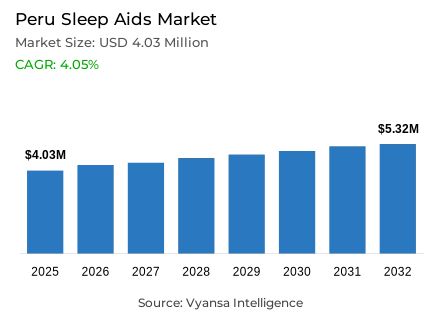
- Sleep aids market size in Peru was estimated at USD 4.03 million in 2025
- The market size is expected to grow to USD 5.32 million by 2032.
- Market to register a CAGR of around 4.05% during 2026-32.
- Product Shares
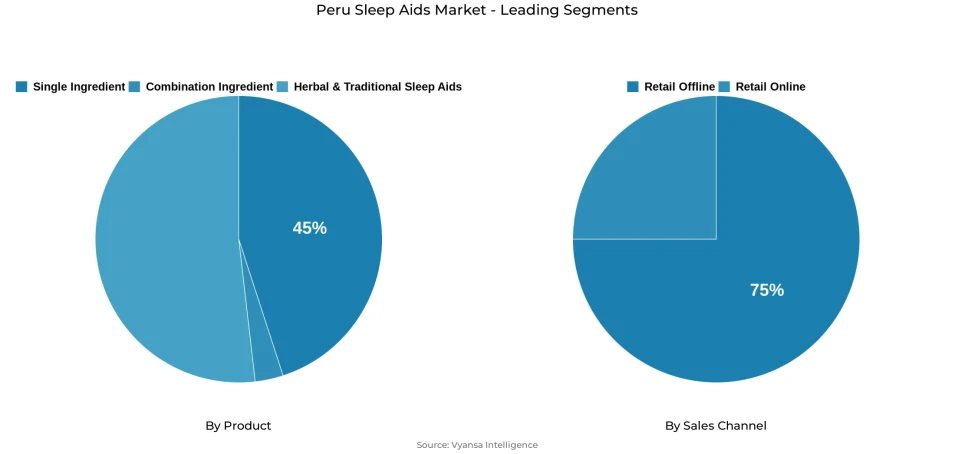
- Single ingredient grabbed market share of 45%.
- Competition
- More than 5 companies are actively engaged in producing sleep aids in Peru.
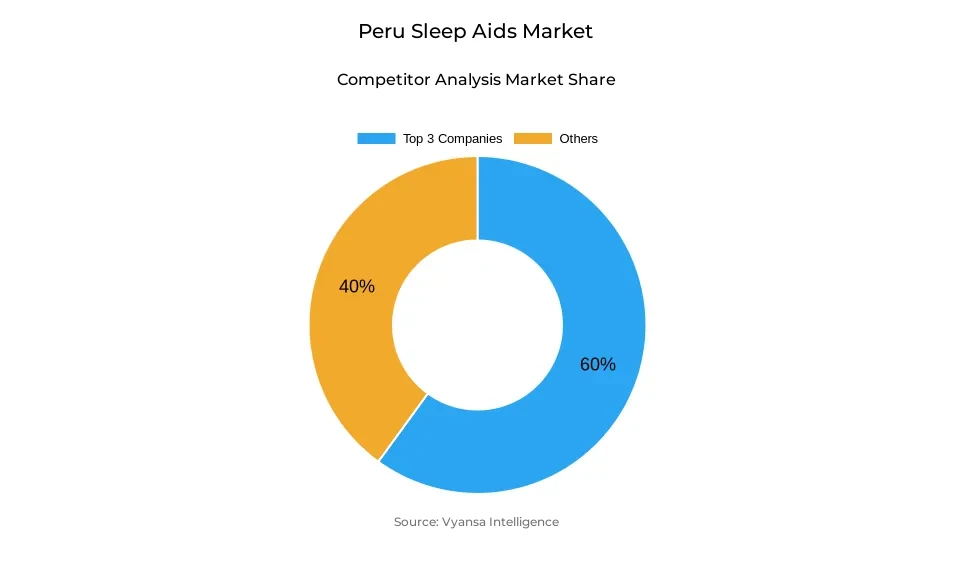
- Top 3 companies acquired around 60% of the market share.
- Corporación Arion SA, Inretail Pharma SA, CBC Peruana SAC etc., are few of the top companies.
- Sales channel
- Retail offline grabbed 75% of the market.
Peru Sleep Aids Market Outlook
The Peru sleep aids market is undergoing a dynamic change because mental health and general wellbeing are becoming the priorities of local consumers. The market is estimated to grow to USD 4.03 million in 2025 and USD 5.32 million in 2032 with a CAGR of about 4.05%. This has been driven by the increased awareness of sleep hygiene and the influence of the environment like the high temperatures brought about by the Coastal Niño phenomenon that has made many Peruvians to take the initiative of finding new methods of getting restorative sleep.
Product format innovation, especially the emergence of gummies, has been effective in capturing the interest of younger adults seeking quick and easy solutions. The purchase of the most popular brand More+ by CBC Peruana SAC, a subsidiary of PepsiCo, is a major invasion of the wellness arena by the giants of mass-consumption. This will likely expand the range of products in the retail outlets, combining the traditional supplementation with consumer-friendly options like the recently introduced magnesium and tryptophan blends.
Although melatonin is still a market leader, magnesium has become a strong competitor due to its natural perception and low side effects. Magnesium citrate is becoming a popular stress and anxiety reliever among many consumers as it is considered a safer long-term alternative to synthetic compounds. This change is also facilitated by the active marketing of social media by nutritionists and influencers, who emphasize the advantages of natural minerals and herbal components like valerian and chamomile compared to traditional pharmaceuticals.
The market is projected to shift more towards herbal and traditional remedies looking at 2032. The increasing alarm over melatonin addiction is fueling the desire to find less invasive options, such as relaxation teas and scented pillow drops. With the population still grappling with social and economic stressors, the need to have easy and natural sleep remedies, which are easily accessible in the vast pharmacy networks in Peru, will be the main pillar of the consistent upward trend in the market.
Peru Sleep Aids Market Growth DriverElevated Nighttime Temperatures and Limited Cooling Infrastructure Drive Demand for Over-the-Counter Sleep Relief
Persistently high nighttime temperatures, particularly in coastal urban areas, are structurally reinforcing demand for over-the-counter sleep support in Peru. Limited penetration of residential cooling systems means many households manage thermal discomfort symptomatically rather than eliminating its root cause, sustaining pharmacy-level demand for convenient relief solutions. Heat-related sleep disruption has become a recurring wellness concern, especially during intensified Coastal Nino and El Nino climatic phases.
According to Senamhi (National Meteorology and Hydrology Service), the national annual mean temperature in 2024 reached 20.29°C, representing a deviation of 1.18°C above the historical average of 19.11°C. This elevated thermal baseline contributes to reduced perceived sleep quality across wide population groups, encouraging experimentation with accessible sleep aids and relaxation supplements as part of routine evening practices.
Peru Sleep Aids Market ChallengeUnregulated Retail Online Supply Channels Introduce Safety and Reputational Risk
Parallel and informal retail online distribution channels present compliance and reputational risks in the Peruvian sleep aids landscape. Higher-dose melatonin and other imported formulations are increasingly available outside regulated pharmacy networks, exposing end users to counterfeit, expired, or unregistered products purchased without medical supervision.
Enforcement data illustrate the magnitude of this issue. In 2025, Digemid (Directorate General of Medicines, Supplies and Drugs) reported the destruction of approximately 14 tonnes of expired and illegally obtained medicines, including tablets, capsules, and drops (Ministry of Health News Release, 23 October 2025). Such enforcement actions highlight vulnerabilities in the supply chain and increase compliance burdens for legitimate manufacturers operating within regulated channels.
Unlock Market Intelligence
Explore the market potential with our data-driven report
Peru Sleep Aids Market TrendSocial Media Platforms Normalise Sleep Hygiene Practices and Accelerate Ingredient Discovery
Digital platforms are playing a growing role in shaping sleep-health behavior and product discovery in Peru. Influencers and wellness content creators actively promote sleep hygiene routines while highlighting specific active ingredients, driving product trial and switching across both established and emerging brands.
This influence is underpinned by expanding digital connectivity. The National Institute of Statistics and Informatics (INEI) reported that 79.0% of individuals aged six years and above used the internet in Q1 2025, while 58.9% of households had internet access. This digital penetration supports rapid dissemination of ingredient narratives and strengthens demand for formats that communicate benefits clearly in short-form content environments.
Peru Sleep Aids Market OpportunityInnovative Product Formats Extend Category Reach Through Expanding Retail Online Infrastructure
Innovative formats such as gummies, hybrid nutraceutical blends, and scent-based pillow drops provide a pathway to broaden category participation beyond traditional tablet users. These formats align with lifestyle-oriented wellness practices and offer differentiation through convenience, palatability, or non-ingestible relaxation positioning.
expanding digital payments ecosystem supports scalable retail online distribution. The Central Reserve Bank of Peru reported 591 digital payments per adult in the first half of 2025—equivalent to 1.6 transactions per adult per day. Additionally, non-presential debit card purchases increased by 58.3% in transaction volume compared to the same period in 2024. This strong digital transaction growth enhances online discovery, subscription-based replenishment, and repeat purchasing of alternative sleep-support formats.
Unlock Market Intelligence
Explore the market potential with our data-driven report
Peru Sleep Aids Market Segmentation Analysis
By Product
- Single Ingredient
- Combination Ingredient
- Herbal & Traditional Sleep Aids
The product category that has the largest market share is the Single Ingredient products, which occupies about 45 percent of the total market. The popularity of concentrated melatonin and valerian preparations is the major contributor to this substantial share. These targeted products are favored by many consumers due to their ability to provide a clear and powerful solution to certain sleep disruptions, such as those related to environmental heat or high-stress periods.
Nevertheless, the scenery is slowly changing with brands coming up with new blends. Although single-ingredient products continue to be the most popular among consumers who want high-dose efficacy, newer products are adding magnesium and vitamins to attract more wellness trends. In spite of this diversification, the simplicity and the reputation of the single-ingredient aids still speak loudly to most Peruvian shoppers, which guarantees their dominance in the product category up to 2032.
By Sales Channel
- Retail Online
- Retail Offline
The largest market share segment under the sales channel is Retail Offline, which comprises about 75% of the total market. Pharmacies are the main place where sleep aids are sold, as they enjoy a larger shelf space and the advice of in-store pharmacists. The convenience of neighbourhood markets and independent stores also contributes to this offline dominance, as they are necessary to reach consumers in both coastal and inland areas.
Even though e-commerce is becoming a channel of social-media-based brands and imported goods, the brick-and-mortar shopping experience is still unsubstitutable to the majority of Peruvians. The possibility of getting instant advice of health specialists and the high accessibility of pharmacy chains make sure that offline channels are on the top of the distribution. With the mass-consumption companies such as CBC steadily increasing their wellness distribution channels, offline retail will solidly establish the overall value of the market by 2032.
List of Companies Covered in Peru Sleep Aids Market
The companies listed below are highly influential in the Peru sleep aids market, with a significant market share and a strong impact on industry developments.
- Corporación Arion SA
- Inretail Pharma SA
- CBC Peruana SAC
Competitive Landscape
Peru sleep aids market is experiencing double-digit value growth, led by More+ Sleep Gummies, which has gained scale through aggressive multichannel expansion and a high-dosage 5mg melatonin positioning, now strengthened by CBC Peruana’s acquisition and entry into wellness. Sunvit retains relevance, while smaller brands expand via pharmacy and e-commerce visibility. However, magnesium supplements, particularly magnesium citrate, represent strong indirect competition, benefiting from broader brand availability, flexible pricing, and endorsement by nutritionists as a natural, low-risk relaxant. Informal imports of higher-dose melatonin and aromatherapy sleep drops further fragment demand. Differentiation opportunities lie in hybrid magnesium-melatonin blends, herbal formulations featuring valerian and chamomile, innovative gummy and liquid formats, and education-led positioning around sleep hygiene and mental wellbeing.
Frequently Asked Questions
Related Report
- Market Segmentation
- Research Scope
- Research Methodology
- Definitions and Assumptions
- Executive Summary
- Peru Sleep Aids Market Policies, Regulations, and Standards
- Peru Sleep Aids Market Dynamics
- Growth Factors
- Challenges
- Trends
- Opportunities
- Peru Sleep Aids Market Statistics, 2022-2032F
- Market Size & Growth Outlook
- By Revenues in USD Million
- Market Segmentation & Growth Outlook
- By Product
- Single Ingredient- Market Insights and Forecast 2022-2032, USD Million
- Doxylamine Succinate- Market Insights and Forecast 2022-2032, USD Million
- Diphenhydramine- Market Insights and Forecast 2022-2032, USD Million
- Melatonin- Market Insights and Forecast 2022-2032, USD Million
- Combination Ingredient- Market Insights and Forecast 2022-2032, USD Million
- Diphenhydramine + Acetaminophen- Market Insights and Forecast 2022-2032, USD Million
- Other Antihistamine-Based Combinations- Market Insights and Forecast 2022-2032, USD Million
- Herbal & Traditional Sleep Aids- Market Insights and Forecast 2022-2032, USD Million
- Valerian root- Market Insights and Forecast 2022-2032, USD Million
- Passionflower- Market Insights and Forecast 2022-2032, USD Million
- Chamomile- Market Insights and Forecast 2022-2032, USD Million
- Kava- Market Insights and Forecast 2022-2032, USD Million
- Multi-Herbal Sleep Blends- Market Insights and Forecast 2022-2032, USD Million
- Single Ingredient- Market Insights and Forecast 2022-2032, USD Million
- By Sleep Disorder
- Insomnia- Market Insights and Forecast 2022-2032, USD Million
- Sleep Apnea- Market Insights and Forecast 2022-2032, USD Million
- Restless Legs Syndrome- Market Insights and Forecast 2022-2032, USD Million
- Narcolepsy- Market Insights and Forecast 2022-2032, USD Million
- Sleep Walking- Market Insights and Forecast 2022-2032, USD Million
- Others- Market Insights and Forecast 2022-2032, USD Million
- By Age Group
- Young to Mid Adults (25-44 Years)- Market Insights and Forecast 2022-2032, USD Million
- Middle-Aged Adults (45-64 Years)- Market Insights and Forecast 2022-2032, USD Million
- Geriatric Population (65+ Years)- Market Insights and Forecast 2022-2032, USD Million
- By Sales Channel
- Retail Online- Market Insights and Forecast 2022-2032, USD Million
- Retail Offline- Market Insights and Forecast 2022-2032, USD Million
- By End User
- Homecare/Individual Consumers- Market Insights and Forecast 2022-2032, USD Million
- Hospitals- Market Insights and Forecast 2022-2032, USD Million
- Sleep Centers & Clinics- Market Insights and Forecast 2022-2032, USD Million
- By Formulation
- Tablets- Market Insights and Forecast 2022-2032, USD Million
- Gummies- Market Insights and Forecast 2022-2032, USD Million
- Capsules- Market Insights and Forecast 2022-2032, USD Million
- Liquid- Market Insights and Forecast 2022-2032, USD Million
- Sublingual- Market Insights and Forecast 2022-2032, USD Million
- By Competitors
- Competition Characteristics
- Market Share & Analysis
- By Product
- Market Size & Growth Outlook
- Peru Single Ingredient Sleep Aids Market Statistics, 2022-2032
- Market Size & Growth Outlook
- By Revenues in USD Million
- Market Segmentation & Growth Outlook
- By Sleep Disorder- Market Insights and Forecast 2022-2032, USD Million
- By Age Group- Market Insights and Forecast 2022-2032, USD Million
- By Sales Channel- Market Insights and Forecast 2022-2032, USD Million
- By End User- Market Insights and Forecast 2022-2032, USD Million
- By Formulation- Market Insights and Forecast 2022-2032, USD Million
- Market Size & Growth Outlook
- Peru Combination Ingredient Sleep Aids Market Statistics, 2022-2032
- Market Size & Growth Outlook
- By Revenues in USD Million
- Market Segmentation & Growth Outlook
- By Sleep Disorder- Market Insights and Forecast 2022-2032, USD Million
- By Age Group- Market Insights and Forecast 2022-2032, USD Million
- By Sales Channel- Market Insights and Forecast 2022-2032, USD Million
- By End User- Market Insights and Forecast 2022-2032, USD Million
- By Formulation- Market Insights and Forecast 2022-2032, USD Million
- Market Size & Growth Outlook
- Peru Herbal & Traditional Sleep Aids Market Statistics, 2022-2032
- Market Size & Growth Outlook
- By Revenues in USD Million
- Market Segmentation & Growth Outlook
- By Sleep Disorder- Market Insights and Forecast 2022-2032, USD Million
- By Age Group- Market Insights and Forecast 2022-2032, USD Million
- By Sales Channel- Market Insights and Forecast 2022-2032, USD Million
- By End User- Market Insights and Forecast 2022-2032, USD Million
- By Formulation- Market Insights and Forecast 2022-2032, USD Million
- Market Size & Growth Outlook
- Competitive Outlook
- Company Profiles
- Inretail Pharma SA
- Business Description
- Product Portfolio
- Collaborations & Alliances
- Recent Developments
- Financial Details
- Others
- CBC Peruana SAC
- Business Description
- Product Portfolio
- Collaborations & Alliances
- Recent Developments
- Financial Details
- Others
- Corporación Arion SA
- Business Description
- Product Portfolio
- Collaborations & Alliances
- Recent Developments
- Financial Details
- Others
- Nuna Terra SAC
- Business Description
- Product Portfolio
- Collaborations & Alliances
- Recent Developments
- Financial Details
- Others
- Inkanatural
- Business Description
- Product Portfolio
- Collaborations & Alliances
- Recent Developments
- Financial Details
- Others
- Alegia Corp SAC
- Business Description
- Product Portfolio
- Collaborations & Alliances
- Recent Developments
- Financial Details
- Others
- Others
- Business Description
- Product Portfolio
- Collaborations & Alliances
- Recent Developments
- Financial Details
- Others
- Inretail Pharma SA
- Company Profiles
- Disclaimer
| Segment | Sub-Segment |
|---|---|
| By Product |
|
| By Sleep Disorder |
|
| By Age Group |
|
| By Sales Channel |
|
| By End User |
|
| By Formulation |
|
Research Methodology
This study followed a structured approach comprising four key phases to assess the size and scope of the electro-oxidation market. The process began with thorough secondary research to collect data on the target market, related markets, and broader industry context. These findings, along with preliminary assumptions and estimates, were then validated through extensive primary research involving industry experts from across the value chain. To calculate the overall market size, both top-down and bottom-up methodologies were employed. Finally, market segmentation and data triangulation techniques were applied to refine and validate segment-level estimations.
Secondary Research
The secondary research phase involved gathering data from a wide range of credible and published sources. This step helped in identifying industry trends, defining market segmentation, and understanding the market landscape and value chain.
Sources consulted during this phase included:
- Company annual reports, investor presentations, and press releases
- Industry white papers and certified publications
- Trade directories and market-recognized databases
- Articles from authoritative authors and reputable journals
- Gold and silver standard websites
Secondary research was critical in mapping out the industry's value chain and monetary flow, identifying key market segments, understanding regional variations, and tracking significant industry developments.
Other key sources:
- Financial disclosures
- Industry associations and trade bodies
- News outlets and business magazines
- Academic journals and research studies
- Paid industry databases
Primary Research
To validate secondary data and gain deeper market insights, primary research was conducted with key stakeholders across both the supply and demand sides of the market.
On the demand side, participants included decision-makers and influencers from end-user industries—such as CIOs, CTOs, and CSOs—who provided first-hand perspectives on market needs, product usage, and future expectations.
On the supply side, interviews were conducted with manufacturers, industry associations, and institutional participants to gather insights into current offerings, product pipelines, and market challenges.
Primary interviews provided critical inputs such as:
- Market size and revenue data
- Product and service breakdowns
- Market forecasts
- Regional and application-specific trends
Stakeholders consulted included:
- Leading OEM and solution providers
- Channel and distribution partners
- End users across various applications
- Independent consultants and industry specialists
Market Size Estimation and Data Triangulation
- Identifying Key Market Participants (Secondary Research)
- Goal: To identify the major players or companies in the target market. This typically involves using publicly available data sources such as industry reports, market research publications, and financial statements of companies.
- Tools: Reports from firms like Gartner, Forrester, Euromonitor, Statista, IBISWorld, and others. Public financial statements, news articles, and press releases from top market players.
- Extracting Earnings of Key Market Participants
- Goal: To estimate the earnings generated from the product or service being analyzed. This step helps in understanding the revenue potential of each market player in a specific geography.
- Methods: Earnings data can be gathered from:
- Publicly available financial reports (for listed companies).
- Interviews and primary data sources from professionals, such as Directors, VPs, SVPs, etc. This is especially useful for understanding more nuanced, internal data that isn't publicly disclosed.
- Annual reports and investor presentations of key players.
- Data Collation and Development of a Relevant Data Model
- Goal: To collate inputs from both primary and secondary sources into a structured, data-driven model for market estimation. This model will incorporate key market KPIs and any independent variables relevant to the market.
- Key KPIs: These could include:
- Market size, growth rate, and demand drivers.
- Industry-specific metrics like market share, average revenue per customer (ARPC), or average deal size.
- External variables, such as economic growth rates, inflation rates, or commodity prices, that could affect the market.
- Data Modeling: Based on this data, the market forecasts are developed for the next 5 years. A combination of trend analysis, scenario modeling, and statistical regression might be used to generate projections.
- Scenario Analysis
- Goal: To test different assumptions and validate how sensitive the market is to changes in key variables (e.g., market demand, regulatory changes, technological disruptions).
- Types of Scenarios:
- Base Case: Based on current assumptions and historical data.
- Best-Case Scenario: Assuming favorable market conditions, regulatory environments, and technological advancements.
- Worst-Case Scenario: Accounting for adverse factors, such as economic downturns, stricter regulations, or unexpected disruptions.












