Norway Room Air Conditioners Market Report: Trends, Growth and Forecast (2026-2032)
By Product Type (Split Air Conditioners (Up to 9,000 BTU/h, 9,001-12,000 BTU/h, 12,001-18,000 BTU/h, 18,001-24,000 BTU/h, Above 24,000 BTU/h), Window Air Conditioners (Up to 9,000 BTU/h, 9,001-12,000 BTU/h, 12,001-18,000 BTU/h, 18,001-24,000 BTU/h, Above 24,000 BTU/h), Others), By Technology (Inverter, Non-Inverter), By Price (Up to USD 300, USD 301 to USD 600, USD 601 to USD 1,000, Above USD 1,000), By End User (Residential (Individual Households, Apartments/Condominiums, Vacation/Secondary Homes), Commercial (Offices, Retail Stores/Showrooms, Hospitality, Healthcare Facilities, Educational Institutions, Small Commercial Establishments, Others)), By Sales Channel (Retail Online (Brand-Owned Websites/D2C, E-Commerce Marketplaces), Retail Offline (Exclusive Brand Stores, Multi-Brand Electronics & Appliance Stores, Specialty Stores, Hypermarkets/Supermarkets, Home Improvement Stores, Dealer/Distributor Network, Direct Sales/Institutional Sales, Local Independent Retailers)), By Refrigerant Type (R-32, R-410A, R-290, R-454B, Others), By Connectivity (Smart/Connected, Conventional/Non-Smart), By Energy Efficiency (1 Star, 2 Star, 3 Star, 4 Star, 5 Star) ... Read more
|
Major Players
|
Norway Room Air Conditioners Market Statistics and Insights, 2026
- Market Size Statistics
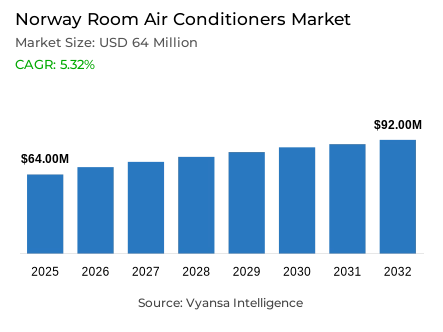
- Room air conditioners market size in Norway was valued at USD 64 million in 2025 and is estimated at USD 69 million in 2026.
- The market size is expected to grow to USD 92 million by 2032.
- Market to register a CAGR of around 5.32% during 2026-32.
- Product Type Shares
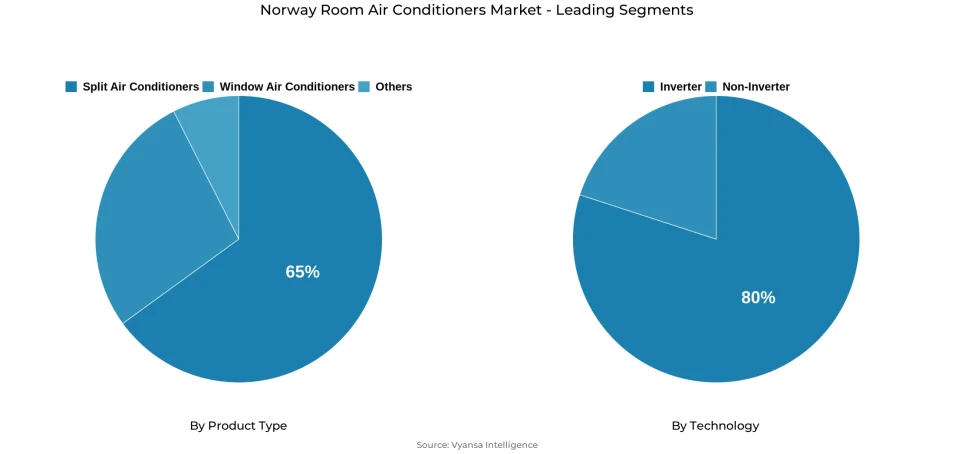
- Split air conditioners grabbed market share of 65%.
- Competition
- More than 10 companies are actively engaged in producing room air conditioners in Norway.
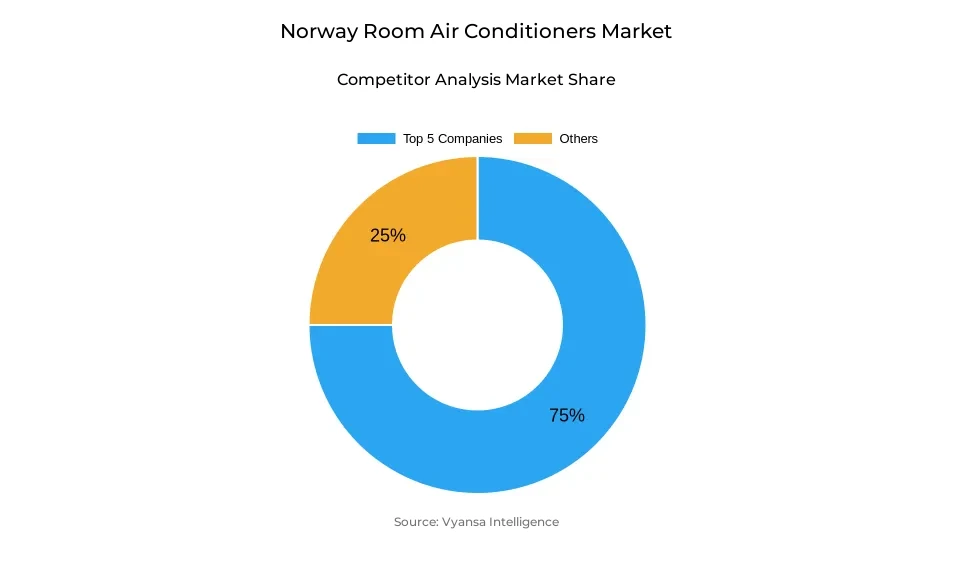
- Top 5 companies acquired around 75% of the market share.
- WC Wood Co Ltd, Gree Electric Appliances Inc of Zhuhai, Eeese Air Care ApS, Mitsubishi Electric Corp, Panasonic Corp etc., are few of the top companies.
- Technology
- Inverter grabbed 80% of the market.
Norway Room Air Conditioners Market Outlook
Norway room air conditioners market size was valued at USD 64 million in 2025 and is projected to grow from USD 69 million in 2026 to USD 92 million by 2032, exhibiting a CAGR of 5.32% during the forecast period. The outlook remains positive, supported by milder weather conditions, a growing residential base, and continued preference for efficient room cooling solutions across the country.
A key factor supporting demand is the changing temperature pattern in Norway. 2024 is described as “extremely warm” in most of Northern Norway and “very warm” or “warm” in Southern Norway. 2024 becomes the warmest year ever recorded in all three counties of Northern Norway. This keeps room air conditioners more relevant for households looking for direct and practical room level comfort during warmer periods.
The outlook also benefits from the country’s expanding housing base and housing support activity. Norway records 2,762,504 dwellings in 2026, up from 2,743,743 in 2025, showing a steady increase in the residential base. In addition, Husbanken’s lending framework rises to NOK 33 billion in 2025, while NOK 21 million is allocated for housing measures in rural districts. In this setting, room air conditioners remain linked to new home setup and practical household comfort upgrades.
Buyer preference remains centered on stable and efficient cooling systems. Split air conditioners hold 65% share, showing their strong role in regular household use, while inverter technology accounts for 80% share, reflecting the appeal of steadier cooling and better electricity control. At the same time, household electricity prices remain an important factor, with the total electricity price reaching 152.8 øre/kWh in the 4th quarter of 2025, keeping room air conditioners tied to both comfort needs and running cost awareness.
Norway Room Air Conditioners Market Growth Driver
Milder Climate Lifts Everyday Cooling Relevance
Warmer conditions are a key driver for room air conditioners in Norway. The Norwegian Meteorological Institute states that 2024 was “extremely warm” in most of Northern Norway and “very warm” or “warm” in Southern Norway. It also notes that, in the temperature series going back to 1901, 2020 remains the warmest year at 1.4°C above normal, while 2024 becomes the warmest year ever recorded in all three counties of Northern Norway. This shows that higher temperatures are becoming more visible in daily life.
These conditions make indoor cooling more relevant for households that need direct room level comfort during warmer periods. As milder weather becomes more frequent, room air conditioners gain stronger relevance in homes looking for quick and practical cooling support instead of relying only on natural ventilation.
Norway Room Air Conditioners Market Challenge
High Power Costs Keep Buyers Cautious
A major challenge for room air conditioners in Norway is the cost of household electricity. Statistics Norway reports that in the 4th quarter of 2025, the total electricity price for households, including grid rent and taxes, is 152.8 øre/kWh, while the electricity price alone is 77.0 øre/kWh. Even after deducting government electricity support, the household total remains 123.6 øre/kWh. These are the latest available official figures and they show that electricity remains an important cost factor for households.
This matters because room air conditioners are judged not only by purchase price, but also by expected running costs. When household electricity stays relatively expensive, buyers can become more careful about using cooling products regularly, especially where cooling is viewed as a comfort upgrade rather than an essential fixed utility.
Unlock Market Intelligence
Explore the market potential with our data-driven report
Norway Room Air Conditioners Market Trend
Large Housing Base Supports Residential Cooling Use
An important trend is the strength of Norway’s housing base. Statistics Norway reports that the country has 2,762,504 dwellings in 2026, up from 2,743,743 in 2025, which means the dwelling stock increases by 18,761 units in one year. This shows a broad and growing residential base where room level cooling products can fit naturally into everyday household use.
This housing structure keeps room air conditioners closely linked to residential comfort needs. As the number of dwellings continues to rise, compact cooling products become more relevant in daily living, particularly in homes looking for practical cooling solutions for selected rooms rather than whole building systems.
Norway Room Air Conditioners Market Opportunity
Construction Support Opens Fresh Installation Scope
A strong opportunity comes from Norway’s housing and construction support pipeline. The government states that it proposes increasing Husbanken’s lending framework by NOK 1 billion to NOK 33 billion in 2025 to help finance more housing projects with high housing quality. In addition, Husbanken says it allocates NOK 21 million in grants for housing measures in rural districts in 2025 to test new housing concepts and increase housing supply.
For room air conditioners, this creates wider scope for first installation demand tied to new and upgraded housing projects. As more homes move forward through financing and local housing measures, brands gain more opportunities to reach households at the stage when practical comfort equipment is being selected.
Unlock Market Intelligence
Explore the market potential with our data-driven report
Norway Room Air Conditioners Market Segmentation Analysis
By Product Type
- Split Air Conditioners
- Up to 9,000 BTU/h
- 9,001-12,000 BTU/h
- 12,001-18,000 BTU/h
- 18,001-24,000 BTU/h
- Above 24,000 BTU/h
- Window Air Conditioners
- Up to 9,000 BTU/h
- 9,001-12,000 BTU/h
- 12,001-18,000 BTU/h
- 18,001-24,000 BTU/h
- Above 24,000 BTU/h
- Others
The segment with the highest share around product type is split air conditioners, with a market share of 65%. This leading position shows that buyers in Norway continue to prefer fixed room cooling systems that offer steadier daily performance than less permanent alternatives. Their fit with regular household use and targeted room cooling keeps them at the center of product demand.
This leadership also reflects how cooling is used in practical home settings. Split systems suit households that want direct comfort in selected rooms and a more stable setup for everyday indoor use. As a result, this product type remains the most established choice for daily room cooling needs across residential settings.
By Technology
- Inverter
- Non-Inverter
The segment with the highest share around technology is inverter, with a market share of 80%. This shows that buyers in Norway increasingly prefer room air conditioner technology that supports steadier cooling performance and better control over electricity use. Because of this, inverter systems continue to hold the strongest position in the technology landscape.
This dominance also reflects a clear shift toward smarter and more efficient operation in household cooling decisions. Buyers increasingly value systems that maintain comfort more smoothly and avoid unnecessary power fluctuations during daily use. That keeps inverter technology at the center of product selection in the country.
List of Companies Covered in Norway Room Air Conditioners Market
The companies listed below are highly influential in the Norway room air conditioners market, with a significant market share and a strong impact on industry developments.
- WC Wood Co Ltd
- Gree Electric Appliances Inc of Zhuhai
- Eeese Air Care ApS
- Mitsubishi Electric Corp
- Panasonic Corp
- Samsung Corp
- Electrolux AB
- Wilfa AS
- De'Longhi SpA
Market News & Updates
- Electrolux AB, 2026:
In 2026, Electrolux continues to actively commercialize a broad portable air-conditioner lineup in Norway through its official Norwegian website, where it lists multiple ChillFlex Pro, ChillFlex Gold, Well P7, Comfort 600, and Comfort 700 room AC models for apartments, houses, cabins, and offices; within that range, the Norway-listed Comfort 600 portable AC highlights app control, a 9,000 BTU capacity, R290 refrigerant, and claims of up to 24% energy savings and up to 54% faster cooling when used with Electrolux’s premium window kit. For the Norway air conditioners market, this is a significant verified development because it shows Electrolux is maintaining a wide, localized portable AC portfolio with connected features and efficiency-focused messaging, which strengthens competition in the mass residential segment and can help expand portable AC adoption during warmer summer periods.
- Panasonic Corp, 2026:
In March 2026, Panasonic Heating & Cooling Solutions introduced new HVAC products for Europe at MCE 2026, including the AQUA-G EVO R290 heat pump chiller and the next-generation Aquarea N Series using R-454C refrigerant, with the company emphasizing higher energy efficiency and lower environmental impact. This is relevant to the Norway air conditioners market because Panasonic already maintains an active Norway-facing product and distributor presence for residential cooling-capable systems, so the launch strengthens its ability to offer newer low-GWP and premium cooling solutions to Norwegian households and small commercial users, while also increasing competitive pressure on other brands as demand gradually shifts toward more efficient and environmentally compliant air-conditioning products.
Frequently Asked Questions
Related Report
- Market Segmentation
- Research Scope
- Research Methodology
- Definitions and Assumptions
- Executive Summary
- Norway Room Air Conditioners Market Policies, Regulations, and Standards
- Norway Room Air Conditioners Market Dynamics
- Growth Factors
- Challenges
- Trends
- Opportunities
- Norway Room Air Conditioners Market Statistics, 2022-2032F
- Market Size & Growth Outlook
- By Revenues in USD Million
- By Units Sold in Thousand Units
- Market Segmentation & Growth Outlook
- By Product Type
- Split Air Conditioners- Market Insights and Forecast 2022-2032, USD Million
- Up to 9,000 BTU/h- Market Insights and Forecast 2022-2032, USD Million
- 9,001-12,000 BTU/h- Market Insights and Forecast 2022-2032, USD Million
- 12,001-18,000 BTU/h- Market Insights and Forecast 2022-2032, USD Million
- 18,001-24,000 BTU/h- Market Insights and Forecast 2022-2032, USD Million
- Above 24,000 BTU/h- Market Insights and Forecast 2022-2032, USD Million
- Window Air Conditioners- Market Insights and Forecast 2022-2032, USD Million
- Up to 9,000 BTU/h- Market Insights and Forecast 2022-2032, USD Million
- 9,001-12,000 BTU/h- Market Insights and Forecast 2022-2032, USD Million
- 12,001-18,000 BTU/h- Market Insights and Forecast 2022-2032, USD Million
- 18,001-24,000 BTU/h- Market Insights and Forecast 2022-2032, USD Million
- Above 24,000 BTU/h- Market Insights and Forecast 2022-2032, USD Million
- Others- Market Insights and Forecast 2022-2032, USD Million
- Split Air Conditioners- Market Insights and Forecast 2022-2032, USD Million
- By Technology
- Inverter- Market Insights and Forecast 2022-2032, USD Million
- Non-Inverter- Market Insights and Forecast 2022-2032, USD Million
- By Price
- Up to USD 300- Market Insights and Forecast 2022-2032, USD Million
- USD 301 to USD 600- Market Insights and Forecast 2022-2032, USD Million
- USD 601 to USD 1,000- Market Insights and Forecast 2022-2032, USD Million
- Above USD 1,000- Market Insights and Forecast 2022-2032, USD Million
- By End User
- Residential- Market Insights and Forecast 2022-2032, USD Million
- Individual Households- Market Insights and Forecast 2022-2032, USD Million
- Apartments/Condominiums- Market Insights and Forecast 2022-2032, USD Million
- Vacation/Secondary Homes- Market Insights and Forecast 2022-2032, USD Million
- Commercial- Market Insights and Forecast 2022-2032, USD Million
- Offices- Market Insights and Forecast 2022-2032, USD Million
- Retail Stores/Showrooms- Market Insights and Forecast 2022-2032, USD Million
- Hospitality- Market Insights and Forecast 2022-2032, USD Million
- Healthcare Facilities- Market Insights and Forecast 2022-2032, USD Million
- Educational Institutions- Market Insights and Forecast 2022-2032, USD Million
- Small Commercial Establishments- Market Insights and Forecast 2022-2032, USD Million
- Others- Market Insights and Forecast 2022-2032, USD Million
- Residential- Market Insights and Forecast 2022-2032, USD Million
- By Sales Channel
- Retail Online- Market Insights and Forecast 2022-2032, USD Million
- Brand-Owned Websites/D2C- Market Insights and Forecast 2022-2032, USD Million
- E-Commerce Marketplaces- Market Insights and Forecast 2022-2032, USD Million
- Retail Offline- Market Insights and Forecast 2022-2032, USD Million
- Exclusive Brand Stores- Market Insights and Forecast 2022-2032, USD Million
- Multi-Brand Electronics & Appliance Stores- Market Insights and Forecast 2022-2032, USD Million
- Specialty Stores- Market Insights and Forecast 2022-2032, USD Million
- Hypermarkets/Supermarkets- Market Insights and Forecast 2022-2032, USD Million
- Home Improvement Stores- Market Insights and Forecast 2022-2032, USD Million
- Dealer/Distributor Network- Market Insights and Forecast 2022-2032, USD Million
- Direct Sales/Institutional Sales- Market Insights and Forecast 2022-2032, USD Million
- Local Independent Retailers- Market Insights and Forecast 2022-2032, USD Million
- Retail Online- Market Insights and Forecast 2022-2032, USD Million
- By Refrigerant Type
- R-32- Market Insights and Forecast 2022-2032, USD Million
- R-410A- Market Insights and Forecast 2022-2032, USD Million
- R-290- Market Insights and Forecast 2022-2032, USD Million
- R-454B- Market Insights and Forecast 2022-2032, USD Million
- Others- Market Insights and Forecast 2022-2032, USD Million
- By Connectivity
- Smart/Connected- Market Insights and Forecast 2022-2032, USD Million
- Conventional/Non-Smart- Market Insights and Forecast 2022-2032, USD Million
- By Energy Efficiency
- 1 Star- Market Insights and Forecast 2022-2032, USD Million
- 2 Star- Market Insights and Forecast 2022-2032, USD Million
- 3 Star- Market Insights and Forecast 2022-2032, USD Million
- 4 Star- Market Insights and Forecast 2022-2032, USD Million
- 5 Star- Market Insights and Forecast 2022-2032, USD Million
- By Competitors
- Competition Characteristics
- Market Share & Analysis
- By Product Type
- Market Size & Growth Outlook
- Norway Split Air Conditioners Market Statistics, 2022-2032
- Market Size & Growth Outlook
- By Revenues in USD Million
- By Units Sold in Thousand Units
- Market Segmentation & Growth Outlook
- By Technology- Market Insights and Forecast 2022-2032, USD Million
- By Price- Market Insights and Forecast 2022-2032, USD Million
- By End User- Market Insights and Forecast 2022-2032, USD Million
- By Sales Channel- Market Insights and Forecast 2022-2032, USD Million
- By Refrigerant Type- Market Insights and Forecast 2022-2032, USD Million
- By Connectivity- Market Insights and Forecast 2022-2032, USD Million
- By Energy Efficiency- Market Insights and Forecast 2022-2032, USD Million
- Market Size & Growth Outlook
- Norway Window Air Conditioners Market Statistics, 2022-2032
- Market Size & Growth Outlook
- By Revenues in USD Million
- By Units Sold in Thousand Units
- Market Segmentation & Growth Outlook
- By Technology- Market Insights and Forecast 2022-2032, USD Million
- By Price- Market Insights and Forecast 2022-2032, USD Million
- By End User- Market Insights and Forecast 2022-2032, USD Million
- By Sales Channel- Market Insights and Forecast 2022-2032, USD Million
- By Refrigerant Type- Market Insights and Forecast 2022-2032, USD Million
- By Connectivity- Market Insights and Forecast 2022-2032, USD Million
- By Energy Efficiency- Market Insights and Forecast 2022-2032, USD Million
- Market Size & Growth Outlook
- Competitive Outlook
- Company Profiles
- Mitsubishi Electric Corp
- Business Description
- Product Portfolio
- Collaborations & Alliances
- Recent Developments
- Financial Details
- Others
- Panasonic Corp
- Business Description
- Product Portfolio
- Collaborations & Alliances
- Recent Developments
- Financial Details
- Others
- Samsung Corp
- Business Description
- Product Portfolio
- Collaborations & Alliances
- Recent Developments
- Financial Details
- Others
- Electrolux AB
- Business Description
- Product Portfolio
- Collaborations & Alliances
- Recent Developments
- Financial Details
- Others
- Wilfa AS
- Business Description
- Product Portfolio
- Collaborations & Alliances
- Recent Developments
- Financial Details
- Others
- WC Wood Co Ltd
- Business Description
- Product Portfolio
- Collaborations & Alliances
- Recent Developments
- Financial Details
- Others
- Gree Electric Appliances Inc of Zhuhai
- Business Description
- Product Portfolio
- Collaborations & Alliances
- Recent Developments
- Financial Details
- Others
- Eeese Air Care ApS
- Business Description
- Product Portfolio
- Collaborations & Alliances
- Recent Developments
- Financial Details
- Others
- De'Longhi SpA
- Business Description
- Product Portfolio
- Collaborations & Alliances
- Recent Developments
- Financial Details
- Others
- Whirlpool Corp
- Business Description
- Product Portfolio
- Collaborations & Alliances
- Recent Developments
- Financial Details
- Others
- Mitsubishi Electric Corp
- Company Profiles
- Disclaimer
| Segment | Sub-Segment |
|---|---|
| By Product Type |
|
| By Technology |
|
| By Price |
|
| By End User |
|
| By Sales Channel |
|
| By Refrigerant Type |
|
| By Connectivity |
|
| By Energy Efficiency |
|
Research Methodology
This study followed a structured approach comprising four key phases to assess the size and scope of the electro-oxidation market. The process began with thorough secondary research to collect data on the target market, related markets, and broader industry context. These findings, along with preliminary assumptions and estimates, were then validated through extensive primary research involving industry experts from across the value chain. To calculate the overall market size, both top-down and bottom-up methodologies were employed. Finally, market segmentation and data triangulation techniques were applied to refine and validate segment-level estimations.
Secondary Research
The secondary research phase involved gathering data from a wide range of credible and published sources. This step helped in identifying industry trends, defining market segmentation, and understanding the market landscape and value chain.
Sources consulted during this phase included:
- Company annual reports, investor presentations, and press releases
- Industry white papers and certified publications
- Trade directories and market-recognized databases
- Articles from authoritative authors and reputable journals
- Gold and silver standard websites
Secondary research was critical in mapping out the industry's value chain and monetary flow, identifying key market segments, understanding regional variations, and tracking significant industry developments.
Other key sources:
- Financial disclosures
- Industry associations and trade bodies
- News outlets and business magazines
- Academic journals and research studies
- Paid industry databases
Primary Research
To validate secondary data and gain deeper market insights, primary research was conducted with key stakeholders across both the supply and demand sides of the market.
On the demand side, participants included decision-makers and influencers from end-user industries—such as CIOs, CTOs, and CSOs—who provided first-hand perspectives on market needs, product usage, and future expectations.
On the supply side, interviews were conducted with manufacturers, industry associations, and institutional participants to gather insights into current offerings, product pipelines, and market challenges.
Primary interviews provided critical inputs such as:
- Market size and revenue data
- Product and service breakdowns
- Market forecasts
- Regional and application-specific trends
Stakeholders consulted included:
- Leading OEM and solution providers
- Channel and distribution partners
- End users across various applications
- Independent consultants and industry specialists
Market Size Estimation and Data Triangulation
- Identifying Key Market Participants (Secondary Research)
- Goal: To identify the major players or companies in the target market. This typically involves using publicly available data sources such as industry reports, market research publications, and financial statements of companies.
- Tools: Reports from firms like Gartner, Forrester, Euromonitor, Statista, IBISWorld, and others. Public financial statements, news articles, and press releases from top market players.
- Extracting Earnings of Key Market Participants
- Goal: To estimate the earnings generated from the product or service being analyzed. This step helps in understanding the revenue potential of each market player in a specific geography.
- Methods: Earnings data can be gathered from:
- Publicly available financial reports (for listed companies).
- Interviews and primary data sources from professionals, such as Directors, VPs, SVPs, etc. This is especially useful for understanding more nuanced, internal data that isn't publicly disclosed.
- Annual reports and investor presentations of key players.
- Data Collation and Development of a Relevant Data Model
- Goal: To collate inputs from both primary and secondary sources into a structured, data-driven model for market estimation. This model will incorporate key market KPIs and any independent variables relevant to the market.
- Key KPIs: These could include:
- Market size, growth rate, and demand drivers.
- Industry-specific metrics like market share, average revenue per customer (ARPC), or average deal size.
- External variables, such as economic growth rates, inflation rates, or commodity prices, that could affect the market.
- Data Modeling: Based on this data, the market forecasts are developed for the next 5 years. A combination of trend analysis, scenario modeling, and statistical regression might be used to generate projections.
- Scenario Analysis
- Goal: To test different assumptions and validate how sensitive the market is to changes in key variables (e.g., market demand, regulatory changes, technological disruptions).
- Types of Scenarios:
- Base Case: Based on current assumptions and historical data.
- Best-Case Scenario: Assuming favorable market conditions, regulatory environments, and technological advancements.
- Worst-Case Scenario: Accounting for adverse factors, such as economic downturns, stricter regulations, or unexpected disruptions.












