Netherlands Wireless Headphones Market Report: Trends, Growth and Forecast (2026-2032)
By Product Type (Over-Ear Headphones, On-Ear Headphones), By Price Range (Mass, Premium), By Technology (Bluetooth, RF (Radio Frequency), Infrared, NFC-enabled, Wi-Fi Wireless), By Features (Active Noise Cancellation (ANC), Passive Noise Isolation, Voice Assistant Integration, Water/Sweat Resistance, Touch Controls, Spatial/3D Audio, Multipoint Connectivity, Fast Charging, Foldable Design, Detachable Microphone), By Application/Use Case (Music & Entertainment, Gaming, Fitness & Sports, Communication/Work, Travel, Professional/Studio Use, Education/E-learning), By Sales Channel (Retail Offline (Electronics Stores, Hypermarkets/Supermarkets, Specialty Audio Stores, Brand Stores, Other Retail Stores), Retail Online (E-commerce Marketplaces, Brand Websites/D2C, Online Electronics Retailers)), By End User (Personal, Commercial/Enterprise, Gaming/Esports Users, Professional Audio Users) ... Read more
|
Major Players
|
Netherlands Wireless Headphones Market Statistics and Insights, 2026
- Market Size Statistics
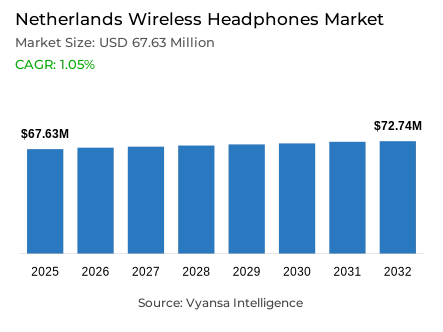
- Wireless headphones market size in Netherlands was valued at USD 67.63 million in 2025 and is estimated at USD 68 million in 2026.
- The market size is expected to grow to USD 72.74 million by 2032.
- Market to register a CAGR of around 1.05% during 2026-32.
- Product Type Shares
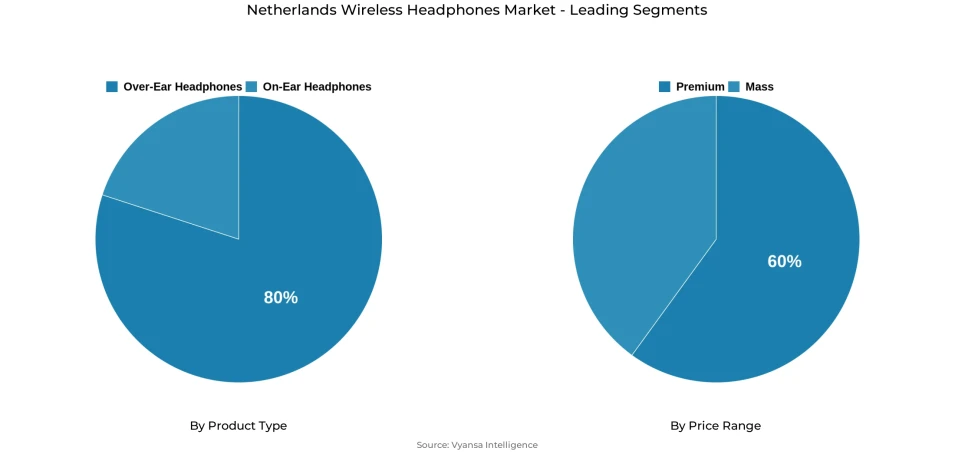
- Over-ear headphones grabbed market share of 80%.
- Competition
- More than 10 companies are actively engaged in producing wireless headphones in Netherlands.
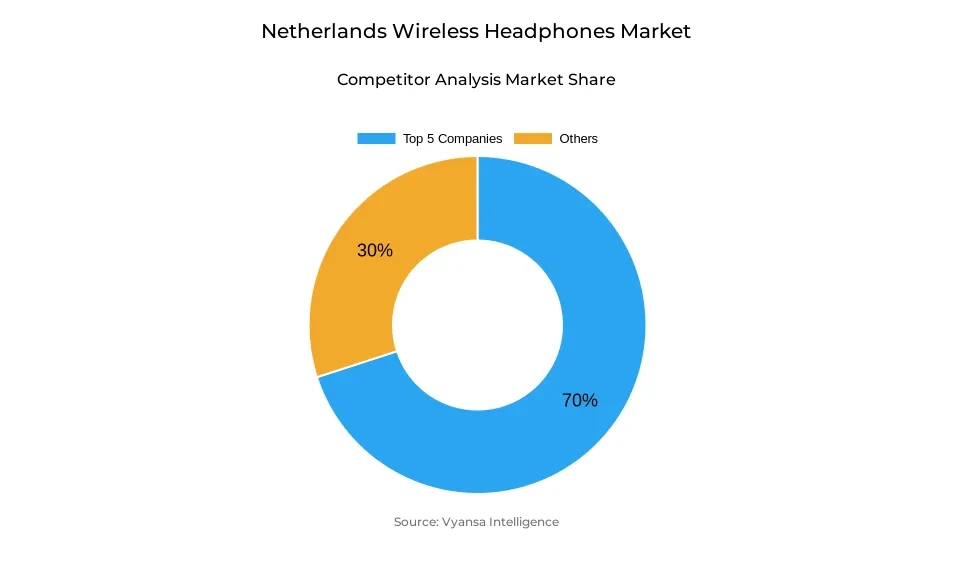
- Top 5 companies acquired around 70% of the market share.
- Koninklijke Philips Electronics NV, GN Audio A/S, Sitecom Europe BV, Apple Computer Benelux BV, Samsung Electronics Nederland BV etc., are few of the top companies.
- Price Range
- Premium grabbed 60% of the market.
Netherlands Wireless Headphones Market Outlook
The Netherlands wireless headphones market was valued at USD 67.63 million in 2025, establishing a commercially stable and digitally well-integrated foundation within one of Europe's most connected consumer electronics ecosystems. Projected to advance from USD 68 million in 2026 to USD 72.74 million by 2032, the sector registers a CAGR of 1.05% across the forecast horizon. This measured and stability-oriented expansion trajectory reflects a market whose demand base is defined by exceptionally high digital connectivity, smartphone-centric consumer behavior, and a quality-conscious buyer population whose willingness to invest in premium personal audio solutions sustains consistent category participation across work, travel, entertainment, and leisure use contexts. Growth is anchored in the structural integration of wireless audio into digitally native consumer routines rather than technology adoption cycles, giving this market a commercial resilience that sustains consistent headphone investment across diverse demographic and usage occasion contexts.
The product architecture defining this market's commercial structure is anchored firmly in over-ear configurations. Over-ear headphones command approximately 80% of total product type market share, reflecting the consistent and deeply embedded consumer preference for headphone formats whose acoustic performance, wearing comfort, and immersive listening experience deliver superior value across extended listening sessions and diversified daily use occasions. This product concentration confirms that Dutch consumers consistently prioritize comprehensive audio performance and comfort engineering over portability considerations, sustaining disproportionate market share within a product category whose design maturity and performance credentials create natural and durable demand advantages over lighter, more compact alternative formats across the country's quality-conscious buyer population.
The pricing architecture reinforces the structural dominance of premium price positioning within wireless headphones. Premium segment accounts for approximately 60% of total price range market share, reflecting the consistent willingness of Dutch consumers to invest substantially in wireless headphones that deliver superior sound quality, refined material construction, advanced feature integration, and credible brand positioning. This premium concentration signals that the Netherlands wireless headphone market is fundamentally driven by quality-led consumption and performance-oriented purchase decision-making rather than price-based value optimization, where buyers consistently demonstrate preference for enhanced listening experience and product durability over entry-level cost accessibility.
The future outlook is defined by four converging structural forces whose combined commercial impact creates a wireless headphones market of sustained and carefully balanced growth momentum. The Central Bureau of Statistics' documentation of 98.3% internet access penetration at home among those aged 12 and over, combined with 97.7% internet usage and 95.6% daily internet engagement rates, establishes a digital connectivity foundation of such exceptional breadth that wireless audio remains structurally essential to consumer participation in streaming, communication, work, and entertainment activities. The CBS data showing 95.5% of Dutch internet users access connectivity through mobile phones and smartphones confirms that portable audio consumption is central to the digital lifestyle patterns that define contemporary Dutch consumer behavior. The CBS documentation of consumer confidence declining to -30 in March 2026 from -24 in February, combined with purchase intention decline and durables-buying sentiment deterioration, creates a consumer spending environment where discretionary electronics purchases face increased scrutiny and value justification requirements. The CBS reporting of 17% of Dutch companies with two or more employees using artificial intelligence in 2025, up from 13% in 2024 and 8% in 2023, confirms an expanding institutional AI adoption trajectory whose consumer-facing applications are progressively reshaping expectations for wireless headphone feature integration, voice interaction capability, and digital ecosystem compatibility over the forecast period.
Netherlands Wireless Headphones Market Growth Driver
High Internet Use Supports Daily Audio Consumption
The exceptionally high rate of internet penetration and smartphone-centric digital engagement across the Netherlands represents the primary structural driver of wireless headphone demand, functioning as a persistent and foundational prerequisite that converts latent personal audio interest into active, daily-use wireless headphone adoption across the country's entire digitally engaged consumer population. As reliable digital connectivity and mobile broadband access have become nearly universal household infrastructure throughout the Netherlands, the functional necessity for cable-free, smartphone-integrated audio has become central to consumer participation in streaming, communication, work collaboration, and entertainment activities whose daily frequency and personal relevance create continuous and high-engagement wireless headphone usage occasions.
The quantitative evidence validating this connectivity driven demand dynamic is documented with precision by the Central Bureau of Statistics. Internet access at home reaches 98.3% penetration among those aged 12 and over in 2025, confirming that digital connectivity has become a near universal household infrastructure element throughout the Dutch population. CBS further documents that 97.7% of the Dutch population uses the internet, 95.6% engage daily, and 95.5% access connectivity through mobile phones and smartphones, establishing that wireless device based digital engagement is the dominant participation mode across the entire connected consumer base. These connectivity metrics validate a demand foundation of exceptional breadth whose sustainability is structurally anchored in the irreplaceable role wireless audio plays in enabling portable digital engagement across work, travel, entertainment, and leisure contexts over the forecast period.
Netherlands Wireless Headphones Market Challenge
Weaker Buying Sentiment Keeps Purchases Selective
The progressively deteriorating consumer confidence environment in the Netherlands represents the most consequential structural challenge confronting the wireless headphones market, creating systematic purchasing hesitation, extended product consideration cycles, and elevated price sensitivity that moderate demand expansion and constrain category growth across a market segment defined by discretionary, non essential electronics purchases. In a consumer spending environment where purchase confidence is declining and buyers are increasingly deferring non critical upgrades, wireless headphones face intensified value justification requirements and stronger competitive pressure to demonstrate credible performance advantages and durability credentials sufficient to justify premium pricing against budget conscious alternatives.
The structural depth and deteriorating trajectory of this consumer confidence challenge are quantified with precision by the Central Bureau of Statistics. Consumer confidence stands at -30 in March 2026, down sharply from -24 in February 2026, marking the sharpest quarterly decline in nearly four years. CBS further documents that willingness to buy declines to -15 from -11, while the balance for whether it is a good time to purchase consumer durables deteriorates to -32 from -28. This constellation of declining confidence indicators confirms that discretionary electronics purchases are facing headwinds from weakened consumer sentiment whose duration and intensity remain uncertain but whose current severity is materially constraining category growth momentum. For wireless headphone providers, navigating this confidence challenge demands strategic emphasis on value communication, performance differentiation, and brand trust reinforcement that justifies premium pricing in an environment of heightened consumer scrutiny over the forecast period.
Unlock Market Intelligence
Explore the market potential with our data-driven report
Netherlands Wireless Headphones Market Trend
AI-Enabled Features Gain More Relevance
The accelerating adoption of artificial intelligence across Dutch business and consumer technology environments represents the defining structural trend reshaping wireless headphone feature expectations, product development priorities, and competitive differentiation parameters across the Netherlands market. This artificial intelligence integration trend is progressively transforming consumer expectations regarding personal audio products from basic listening devices into intelligent digital assistants whose voice interaction capability, real-time translation functionality, device control sophistication, and ecosystem integration depth define baseline feature expectations rather than premium differentiators.
The institutional momentum and consumer adoption pace of this artificial intelligence trend are documented with authority by the Central Bureau of Statistics. CBS reports that 17% of Dutch companies with two or more employees use artificial intelligence in 2025, up from 13% in 2024 and 8% in 2023, confirming that corporate artificial intelligence adoption is advancing at an accelerating pace that progressively embeds AI-driven tools and capabilities into everyday workplace and consumer digital environments. CBS further documents that 12% of companies employ text mining and 6% utilize speech recognition technology, confirming that AI-driven language processing capabilities are becoming more prominent within Dutch business technology infrastructure. As artificial intelligence feature visibility increases across the Dutch digital economy and consumer familiarity with AI-augmented devices deepens, wireless headphone buyer expectations are progressively shifting toward products that integrate voice interaction, translation capability, and intelligent device control alongside acoustic performance. Brands capable of delivering credible and user-friendly artificial intelligence feature integration will capture disproportionate share of Dutch wireless headphone purchasing as consumers increasingly value smart functionality alongside sound quality over the forecast period.
Netherlands Wireless Headphones Market Opportunity
Tourism Flow Expands On-the-Go Usage Potential
The continuous expansion of domestic and international travel activity across the Netherlands creates a structurally significant and commercially compelling opportunity for wireless headphone providers whose products combine portability, durability, battery performance, and premium acoustic experience in configurations optimized for travel and on-the-go listening contexts. This travel-driven opportunity is distinguished from home-based listening demand by its geographic distribution across accommodations, transportation terminals, and commercial spaces, and its intersection with tourism retail and convenience-oriented purchasing behavior that creates multiple promotional and distribution access points beyond traditional consumer electronics retail.
The quantitative scale and growth trajectory of this travel opportunity are documented with precision by the Central Bureau of Statistics. CBS documents that 52.2 million guests stayed at Dutch hotels, campsites, and holiday parks in 2025, representing nearly 2% growth compared with 2024. CBS further documents that 22.3 million international guests visited Dutch accommodations in 2025, marking a 5% year-on-year increase and confirming that both domestic and international travel activity is sustaining robust expansion momentum. This exceptional accommodation occupancy volume creates a compelling procurement opportunity for wireless headphones across travel retail, airport shops, hotel retail environments, and online channels serving mobile consumers. For wireless headphone brands that develop targeted travel product configurations and distribution partnerships optimized for tourism and commuter markets, this travel activity expansion represents a durable and commercially attractive growth opportunity whose expansion will track directly with travel participation and tourism intensity over the forecast period.
Unlock Market Intelligence
Explore the market potential with our data-driven report
Netherlands Wireless Headphones Market Segmentation Analysis
By Product Type
- Over-Ear Headphones
- On-Ear Headphones
The segment with highest market share under the product type is over-ear headphones, accounting for approximately 80% of the total market. This commanding position reflects the deep structural alignment between over-ear headphone design characteristics and the specific audio quality, wearing comfort, and immersive listening experience requirements that define the purchasing priorities of the Dutch consumer market, where sustained listening sessions across work, entertainment, travel, and leisure contexts place premium value on acoustic performance and ergonomic design excellence. With four-fifths of total market value concentrated within a single product format, over-ear headphones define the commercial priorities, product development investment frameworks, and competitive positioning strategies of the Netherlands wireless headphones market.
The structural leadership of over-ear headphones is sustained by the consumer preference hierarchy and quality standards that have established this format as the reference product category across Dutch personal audio consumption. As artificial intelligence integration becomes more visible across the Dutch digital economy and consumer expectations for intelligent feature interaction strengthen, over-ear platforms are progressively evolving to support voice assistant integration, real-time translation capability, and more sophisticated device switching and multi-platform control. This feature evolution positions established over-ear headphone manufacturers to capture both sustained replacement demand and expanding application breadth procurement across the Netherlands' quality-conscious and digitally engaged consumer base. The segment's structural dominance as the market's primary product type revenue contributor is expected to remain intact over the forecast period.
By Price Range
- Mass
- Premium
The segment with highest market share under the price range is premium, accounting for approximately 60% of the total market. This dominant position reflects the fundamental and structurally significant shift in Dutch consumer behavior toward quality-led purchasing and experience-optimization wherein the market's largest and most commercially influential buyer cohort has moved decisively beyond price minimization toward performance maximization, prioritizing superior sound fidelity, refined material quality, advanced feature integration, and credible brand positioning as the primary purchase evaluation criteria. With three-fifths of total market value anchored within the premium tier, this price segment defines the commercial performance drivers, product feature expectations, and competitive innovation priorities that shape wireless headphone development and market positioning across the Netherlands.
The structural dominance of the Premium segment reflects a maturation of consumer expectations that has permanently recalibrated competitive baselines within Dutch personal audio retail environments. Sound quality, comfort engineering, brand credibility, and holistic user experience excellence have transitioned from competitive differentiators into baseline category requirements for premium-positioned wireless headphones, raising the minimum viable product standard and concentrating competitive advantage among manufacturers with deep product development capability and experiential differentiation strength. This elevated competitive baseline creates a demand environment that systematically rewards providers whose acoustic engineering excellence, material quality refinement, and feature innovation depth deliver demonstrable superiority relative to competitor offerings. The premium segment's structural authority as the market's dominant price positioning anchor and primary revenue contributor is expected to strengthen over the forecast period.
List of Companies Covered in Netherlands Wireless Headphones Market
The companies listed below are highly influential in the Netherlands wireless headphones market, with a significant market share and a strong impact on industry developments.
- Koninklijke Philips Electronics NV
- GN Audio A/S
- Sitecom Europe BV
- Apple Computer Benelux BV
- Samsung Electronics Nederland BV
- Harman International Industries Inc
- Anker Innovations Technology Co Ltd
- Sony Nederland BV
- Bose BV
- Sennheiser Nederland BV
Market News & Updates
- Apple Computer Benelux BV, 2026:
In March 2026, Apple introduced AirPods Max 2 on its official Netherlands newsroom and retail site, positioning the new over-ear wireless headphones with the H2 chip, up to 1.5x better Active Noise Cancellation than the previous generation, improved sound quality, and continued direct availability through Apple Netherlands. For the wireless headphones market in the Netherlands, this is one of the most significant verified developments because it refreshes Apple’s premium over-ear category with a clear performance upgrade on an established flagship line, which is likely to support replacement purchases among Apple users, reinforce premium segment demand, and intensify competition with other high-end wireless headphone brands selling through Dutch retail and direct online channels.
- Sony Nederland BV, 2025:
In May 2025, Sony officially introduced the WH-1000XM6 in the Netherlands as its most advanced noise-cancelling wireless headphone to date, and Sony’s Netherlands product and store pages continue to market the model locally with features including the new HD Noise Cancelling Processor QN3, intelligent algorithms, clearer calling, and premium over-ear positioning. For the wireless headphones market in the Netherlands, this is a major fully verified update because it strengthens Sony’s presence in the premium wireless over-ear segment with a new flagship model, helping raise consumer expectations around noise cancellation, call performance, and sound quality while increasing competitive pressure on brands such as Apple, Bose, and Sennheiser in the Dutch market.
Frequently Asked Questions
Related Report
- Market Segmentation
- Research Scope
- Research Methodology
- Definitions and Assumptions
- Executive Summary
- Netherlands Wireless Headphones Market Policies, Regulations, and Standards
- Netherlands Wireless Headphones Market Dynamics
- Growth Factors
- Challenges
- Trends
- Opportunities
- Netherlands Wireless Headphones Market Statistics, 2022-2032F
- Market Size & Growth Outlook
- By Revenues in USD Million
- Market Segmentation & Growth Outlook
- By Product Type
- Over-Ear Headphones- Market Insights and Forecast 2022-2032, USD Million
- On-Ear Headphones- Market Insights and Forecast 2022-2032, USD Million
- By Price Range
- Mass- Market Insights and Forecast 2022-2032, USD Million
- Premium- Market Insights and Forecast 2022-2032, USD Million
- By Technology
- Bluetooth- Market Insights and Forecast 2022-2032, USD Million
- RF (Radio Frequency)- Market Insights and Forecast 2022-2032, USD Million
- Infrared- Market Insights and Forecast 2022-2032, USD Million
- NFC-enabled- Market Insights and Forecast 2022-2032, USD Million
- Wi-Fi Wireless- Market Insights and Forecast 2022-2032, USD Million
- By Features
- Active Noise Cancellation (ANC)- Market Insights and Forecast 2022-2032, USD Million
- Passive Noise Isolation- Market Insights and Forecast 2022-2032, USD Million
- Voice Assistant Integration- Market Insights and Forecast 2022-2032, USD Million
- Water/Sweat Resistance- Market Insights and Forecast 2022-2032, USD Million
- Touch Controls- Market Insights and Forecast 2022-2032, USD Million
- Spatial/3D Audio- Market Insights and Forecast 2022-2032, USD Million
- Multipoint Connectivity- Market Insights and Forecast 2022-2032, USD Million
- Fast Charging- Market Insights and Forecast 2022-2032, USD Million
- Foldable Design- Market Insights and Forecast 2022-2032, USD Million
- Detachable Microphone- Market Insights and Forecast 2022-2032, USD Million
- By Application/Use Case
- Music & Entertainment- Market Insights and Forecast 2022-2032, USD Million
- Gaming- Market Insights and Forecast 2022-2032, USD Million
- Fitness & Sports- Market Insights and Forecast 2022-2032, USD Million
- Communication/Work- Market Insights and Forecast 2022-2032, USD Million
- Travel- Market Insights and Forecast 2022-2032, USD Million
- Professional/Studio Use- Market Insights and Forecast 2022-2032, USD Million
- Education/E-learning- Market Insights and Forecast 2022-2032, USD Million
- By Sales Channel
- Retail Offline- Market Insights and Forecast 2022-2032, USD Million
- Electronics Stores- Market Insights and Forecast 2022-2032, USD Million
- Hypermarkets/Supermarkets- Market Insights and Forecast 2022-2032, USD Million
- Specialty Audio Stores- Market Insights and Forecast 2022-2032, USD Million
- Brand Stores- Market Insights and Forecast 2022-2032, USD Million
- Other Retail Stores- Market Insights and Forecast 2022-2032, USD Million
- Retail Online- Market Insights and Forecast 2022-2032, USD Million
- E-commerce Marketplaces- Market Insights and Forecast 2022-2032, USD Million
- Brand Websites/D2C- Market Insights and Forecast 2022-2032, USD Million
- Online Electronics Retailers- Market Insights and Forecast 2022-2032, USD Million
- Retail Offline- Market Insights and Forecast 2022-2032, USD Million
- By End User
- Personal- Market Insights and Forecast 2022-2032, USD Million
- Commercial/Enterprise- Market Insights and Forecast 2022-2032, USD Million
- Gaming/Esports Users- Market Insights and Forecast 2022-2032, USD Million
- Professional Audio Users- Market Insights and Forecast 2022-2032, USD Million
- By Competitors
- Competition Characteristics
- Market Share & Analysis
- By Product Type
- Market Size & Growth Outlook
- Netherlands Over-Ear Headphones Market Statistics, 2022-2032
- Market Size & Growth Outlook
- By Revenues in USD Million
- Market Segmentation & Growth Outlook
- By Price Range- Market Insights and Forecast 2022-2032, USD Million
- By Technology- Market Insights and Forecast 2022-2032, USD Million
- By Features- Market Insights and Forecast 2022-2032, USD Million
- By Application/Use Case- Market Insights and Forecast 2022-2032, USD Million
- By Sales Channel- Market Insights and Forecast 2022-2032, USD Million
- By End User- Market Insights and Forecast 2022-2032, USD Million
- Market Size & Growth Outlook
- Netherlands On-Ear Headphones Market Statistics, 2022-2032
- Market Size & Growth Outlook
- By Revenues in USD Million
- Market Segmentation & Growth Outlook
- By Price Range- Market Insights and Forecast 2022-2032, USD Million
- By Technology- Market Insights and Forecast 2022-2032, USD Million
- By Features- Market Insights and Forecast 2022-2032, USD Million
- By Application/Use Case- Market Insights and Forecast 2022-2032, USD Million
- By Sales Channel- Market Insights and Forecast 2022-2032, USD Million
- By End User- Market Insights and Forecast 2022-2032, USD Million
- Market Size & Growth Outlook
- Competitive Outlook
- Company Profiles
- Apple Computer Benelux BV
- Business Description
- Product Portfolio
- Collaborations & Alliances
- Recent Developments
- Financial Details
- Others
- Samsung Electronics Nederland BV
- Business Description
- Product Portfolio
- Collaborations & Alliances
- Recent Developments
- Financial Details
- Others
- Harman International Industries Inc
- Business Description
- Product Portfolio
- Collaborations & Alliances
- Recent Developments
- Financial Details
- Others
- Anker Innovations Technology Co Ltd
- Business Description
- Product Portfolio
- Collaborations & Alliances
- Recent Developments
- Financial Details
- Others
- Sony Nederland BV
- Business Description
- Product Portfolio
- Collaborations & Alliances
- Recent Developments
- Financial Details
- Others
- Koninklijke Philips Electronics NV
- Business Description
- Product Portfolio
- Collaborations & Alliances
- Recent Developments
- Financial Details
- Others
- GN Audio A/S
- Business Description
- Product Portfolio
- Collaborations & Alliances
- Recent Developments
- Financial Details
- Others
- Sitecom Europe BV
- Business Description
- Product Portfolio
- Collaborations & Alliances
- Recent Developments
- Financial Details
- Others
- Bose BV
- Business Description
- Product Portfolio
- Collaborations & Alliances
- Recent Developments
- Financial Details
- Others
- Sennheiser Nederland BV
- Business Description
- Product Portfolio
- Collaborations & Alliances
- Recent Developments
- Financial Details
- Others
- Apple Computer Benelux BV
- Company Profiles
- Disclaimer
| Segment | Sub-Segment |
|---|---|
| By Product Type |
|
| By Price Range |
|
| By Technology |
|
| By Features |
|
| By Application/Use Case |
|
| By Sales Channel |
|
| By End User |
|
Research Methodology
This study followed a structured approach comprising four key phases to assess the size and scope of the electro-oxidation market. The process began with thorough secondary research to collect data on the target market, related markets, and broader industry context. These findings, along with preliminary assumptions and estimates, were then validated through extensive primary research involving industry experts from across the value chain. To calculate the overall market size, both top-down and bottom-up methodologies were employed. Finally, market segmentation and data triangulation techniques were applied to refine and validate segment-level estimations.
Secondary Research
The secondary research phase involved gathering data from a wide range of credible and published sources. This step helped in identifying industry trends, defining market segmentation, and understanding the market landscape and value chain.
Sources consulted during this phase included:
- Company annual reports, investor presentations, and press releases
- Industry white papers and certified publications
- Trade directories and market-recognized databases
- Articles from authoritative authors and reputable journals
- Gold and silver standard websites
Secondary research was critical in mapping out the industry's value chain and monetary flow, identifying key market segments, understanding regional variations, and tracking significant industry developments.
Other key sources:
- Financial disclosures
- Industry associations and trade bodies
- News outlets and business magazines
- Academic journals and research studies
- Paid industry databases
Primary Research
To validate secondary data and gain deeper market insights, primary research was conducted with key stakeholders across both the supply and demand sides of the market.
On the demand side, participants included decision-makers and influencers from end-user industries—such as CIOs, CTOs, and CSOs—who provided first-hand perspectives on market needs, product usage, and future expectations.
On the supply side, interviews were conducted with manufacturers, industry associations, and institutional participants to gather insights into current offerings, product pipelines, and market challenges.
Primary interviews provided critical inputs such as:
- Market size and revenue data
- Product and service breakdowns
- Market forecasts
- Regional and application-specific trends
Stakeholders consulted included:
- Leading OEM and solution providers
- Channel and distribution partners
- End users across various applications
- Independent consultants and industry specialists
Market Size Estimation and Data Triangulation
- Identifying Key Market Participants (Secondary Research)
- Goal: To identify the major players or companies in the target market. This typically involves using publicly available data sources such as industry reports, market research publications, and financial statements of companies.
- Tools: Reports from firms like Gartner, Forrester, Euromonitor, Statista, IBISWorld, and others. Public financial statements, news articles, and press releases from top market players.
- Extracting Earnings of Key Market Participants
- Goal: To estimate the earnings generated from the product or service being analyzed. This step helps in understanding the revenue potential of each market player in a specific geography.
- Methods: Earnings data can be gathered from:
- Publicly available financial reports (for listed companies).
- Interviews and primary data sources from professionals, such as Directors, VPs, SVPs, etc. This is especially useful for understanding more nuanced, internal data that isn't publicly disclosed.
- Annual reports and investor presentations of key players.
- Data Collation and Development of a Relevant Data Model
- Goal: To collate inputs from both primary and secondary sources into a structured, data-driven model for market estimation. This model will incorporate key market KPIs and any independent variables relevant to the market.
- Key KPIs: These could include:
- Market size, growth rate, and demand drivers.
- Industry-specific metrics like market share, average revenue per customer (ARPC), or average deal size.
- External variables, such as economic growth rates, inflation rates, or commodity prices, that could affect the market.
- Data Modeling: Based on this data, the market forecasts are developed for the next 5 years. A combination of trend analysis, scenario modeling, and statistical regression might be used to generate projections.
- Scenario Analysis
- Goal: To test different assumptions and validate how sensitive the market is to changes in key variables (e.g., market demand, regulatory changes, technological disruptions).
- Types of Scenarios:
- Base Case: Based on current assumptions and historical data.
- Best-Case Scenario: Assuming favorable market conditions, regulatory environments, and technological advancements.
- Worst-Case Scenario: Accounting for adverse factors, such as economic downturns, stricter regulations, or unexpected disruptions.












