Netherlands Sleep Aids Market Report: Trends, Growth and Forecast (2026-2032)
By Product (Single Ingredient (Doxylamine Succinate, Diphenhydramine, Melatonin), Combination Ingredient (Diphenhydramine + Acetaminophen, Other Antihistamine-Based Combinations), Herbal & Traditional Sleep Aids (Valerian root, Passionflower, Chamomile, Kava, Multi-Herbal Sleep Blends)), By Sleep Disorder (Insomnia, Sleep Apnea, Restless Legs Syndrome, Narcolepsy, Sleep Walking, Others), By Age Group (Young to Mid Adults (25-44 Years), Middle-Aged Adults (45-64 Years), Geriatric Population (65+ Years)), By Sales Channel (Retail Online, Retail Offline), By End User (Homecare/Individual Consumers, Hospitals, Sleep Centers & Clinics), By Formulation (Tablets, Gummies, Capsules, Liquid, Sublingual) ... Read more
|
Major Players
|
Netherlands Sleep Aids Market Statistics and Insights, 2026
- Market Size Statistics
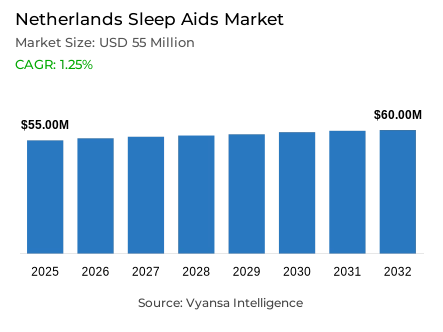
- Sleep aids market size in Netherlands was estimated at USD 55 million in 2025.
- The market size is expected to grow to USD 60 million by 2032.
- Market to register a CAGR of around 1.25% during 2026-32.
- Product Shares
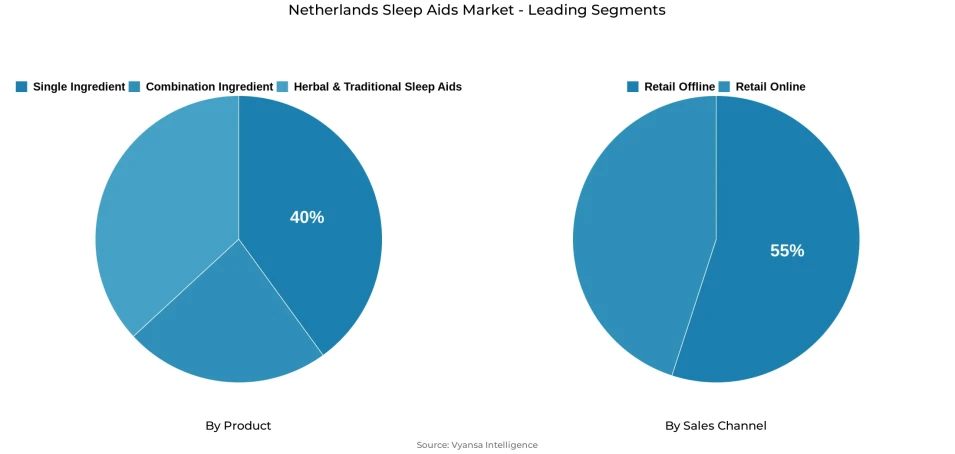
- Melatonin grabbed market share of 40%.
- Competition
- More than 5 companies are actively engaged in producing sleep aids in Netherlands.
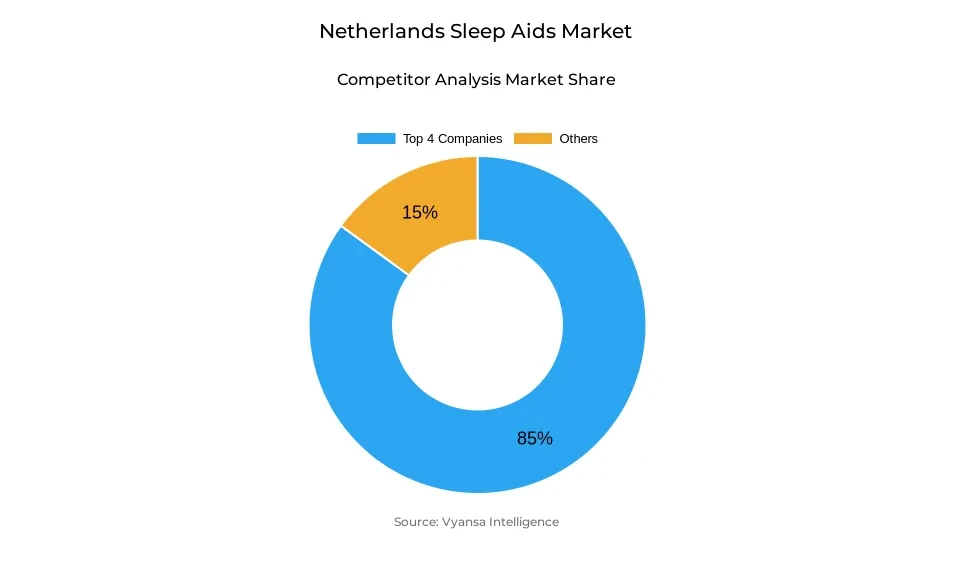
- Top 4 companies acquired around 85% of the market share.
- PK Benelux BV, Biohorma BV, Vemedia BV, Omega Pharma Nederland BV etc., are few of the top companies.
- Sales channel
- Retail offline grabbed 55% of the market.
Netherlands Sleep Aids Market Outlook
The Netherlands sleep aids market was valued at USD 55 million in 2025 and is projected to grow from USD 56.37 million in 2026 to USD 60 million by 2032, registering a CAGR of 1.25% over the forecast period. This steady upward trajectory is supported by a high prevalence of sleep-related issues, with studies indicating that over 40% of Dutch adults experience insomnia or disrupted sleep. As residents navigate increasingly stressful lifestyles, demand for effective solutions continues to rise, pushing manufacturers to innovate with stronger formulas and personalised support services including sleep coaching.
Consumer preferences in the market space are currently driven by melatonin, which holds a significant market share of 40%. Herbal products such as valerian, chamomile, and lavender have been a major hit among consumers, but it is noticeable that consumers are increasingly seeking higher-dose products that deliver quicker results, thereby affecting their purchasing decisions. In addition, consumers are becoming increasingly aware of new products in the market space, such as magnesium supplements and sleep aids available online, but traditional sleep aids remain a major factor in helping consumers manage their nightly rest and mental well-being.
The market space is undergoing a significant shift, with consumers becoming more price-sensitive due to the rise in inflation rates. Physical stores currently account for 55% of total sales, but the market space is expected to shift towards e-commerce, driven by competitive discounts and a smoother online shopping experience. Large brands in the market space are increasing their in-store promotions to remain competitive, given the rise of private-label sleep aids that offer consumers more affordable choices.
Looking into the market space in 2032, it is expected to shift towards more natural and plant-based products that resonate with the Dutch, who prefer a simple, safe, and transparent product profile that meets their needs. It is expected that manufacturers in the market space will look to increase their product portfolio with a balanced mix of traditional products and innovative mineral-based products, thereby continuing to focus on holistic health and better sleep hygiene in the market space in the Netherlands.
Netherlands Sleep Aids Market Growth DriverRising Sleep Problems Expand Routine OTC Relief Demand
Consumers in the Netherlands live more hectic and stressful lives, and more of them are complaining about not being able to fall asleep, stay asleep, or wake up too early. This tendency makes the rapid and self-administered relief methods more popular and consumer inquiries about the information on sleep aids more frequent as insomnia becomes a more typical characteristic of daily life among demographic categories.
According to RIVM's VZinfo, based on the CBS Gezondheidsenquête, 31% of women and 21% of men aged 12 years and older reported significant sleep problems in 2024. Melatonin and magnesium supplements, along with herbal remedies like chamomile, lavender, and valerian, can fulfill this requirement since they are common substances that can be easily integrated into a nighttime routine. New sleep-promotional formulas also increase consumer choice and category interest.
Netherlands Sleep Aids Market ChallengeInflation and Higher-Dose Premiums Reduce Willingness to Pay
Increasing unit prices of sleep aids, due to inflation and the growing popularity of more expensive formulas sold as more effective, pose a significant obstacle to households already strained by the cost of everyday living. The buying behaviour of consumers within the category is thus becoming more premeditated and more promotion-based than impulsive, which is essentially changing the dynamics of consumer buying behaviour in the category.
According to Statistics Netherlands, consumer price inflation stood at 2.8% in December 2025. Consumers in this environment are price-sensitive and will wait until promotional windows occur and switch brands and formats when price differences increase. This decreases the pricing power of manufacturers and heightens the risk that premium sleep-aid lines will fail to perform unless they can show tangible and immediate value, and at the same time, it increases the competition of cheaper substitutes in various retail outlets.
Unlock Market Intelligence
Explore the market potential with our data-driven report
Netherlands Sleep Aids Market TrendDeal-Seeking Drives Faster E-Commerce Adoption
Customers are moving towards online shopping to get a better price on mainstream sleep-aid brands, and discount-based buying is becoming more prevalent. Before making commitments to purchases, consumers compare the offers on different platforms like Bol.com and De Online Drogist, and digital price transparency is one of the distinguishing characteristics of the modern competitive environment.
According to Eurostat, 94% of individuals aged 16 to 74 in the Netherlands ordered or purchased goods or services online in 2025 among the highest rates recorded across the European Union. This high e-commerce behavior facilitates quick deal finding and high-frequency promotional events, rewarding retailers who invest in digital experience enhancements, such as improved search, quicker checkout, and responsive customer support. The online presence and discount policy is thus becoming more decisive in influencing brand choice within the category.
Netherlands Sleep Aids Market OpportunityPrivate Label Value Lines Capture Price-Sensitive Shoppers
The sensitivity to price is causing an increasing number of shoppers to perceive major sleep-aid brands as being too costly, especially as unit prices keep climbing. This provides a commercially viable and obvious gap to retailers to increase their private-label products as reliable sleep support, anchored on well-known and trusted ingredients like melatonin, magnesium, and common botanicals at more affordable prices.
According to RIVM's VZinfo, based on the Gezondheidsmonitor Volwassenen en Ouderen 2024, 13.3% of adults reported difficulty making ends meet in the past 12 months. This budget pressure can be directly met by the use of similar formats at lower prices, and still satisfying consumer expectations regarding safety, easy dosing, and clear communication of ingredients, which will help retailers keep shoppers who would otherwise delay purchase or switch to less effective options until 2032.
Unlock Market Intelligence
Explore the market potential with our data-driven report
Netherlands Sleep Aids Market Segmentation Analysis
By Product
- Single Ingredient
- Doxylamine Succinate
- Diphenhydramine
- Melatonin
- Combination Ingredient
- Diphenhydramine + Acetaminophen
- Other Antihistamine-Based Combinations
- Herbal & Traditional Sleep Aids
- Valerian root
- Passionflower
- Chamomile
- Kava
- Multi-Herbal Sleep Blends
The segment with the highest market share under the product type is melatonin, holding approximately 40% of the total market. This is in line with the general consumer trend of self-educating on sleep-support actives and a strong inclination towards familiar and highly trusted ingredients that can be embraced without physician-directed instruction. The high consumer awareness of Melatonin has ensured that it remains the anchor ingredient that determines shelf assortment and new product launches throughout the Dutch market.
The breadth of dosing and delivery formats also favors Melatonin, as it allows brands to address various occasions of use and personal sensitivities. Melatonin combined with calming botanicals like valerian or chamomile, or with supportive nutrients like magnesium, further support the soft but effective message that appeals to safety-conscious Dutch consumers, keeping melatonin at the top of the category through 2032.
By Sales Channel
- Retail Online
- Retail Offline
The segment with the highest market share under the sales channel is retail offline, accounting for approximately 55% of the total market. This is indicative of a segment in which customers still appreciate the convenience of having products on hand and face-to-face confirmation, especially when trying more potent formulas or having to make a decision between herbal and supplement-based solutions, which demand some degree of informed decision-making at the point of sale.
As of 1 January 2025, according to RIVM VZinfo, sourced through Stichting Farmaceutische Kengetallen, the Netherlands had 1,928 public pharmacies, which supports extensive and uniform offline coverage throughout the country. Physical drugstores and pharmacies also conduct regular in-store promotions, which allow consumers to deal with increased unit prices without making offline purchasing inconvenient and inaccessible, despite the fact that e-commerce will keep gaining prominence as the channel of choice in deal-hunting and brand comparison up to 2032.
List of Companies Covered in Netherlands Sleep Aids Market
The companies listed below are highly influential in the Netherlands sleep aids market, with a significant market share and a strong impact on industry developments.
- PK Benelux BV
- Biohorma BV
- Vemedia BV
- Omega Pharma Nederland BV
Competitive Landscape
The Netherlands sleep aids market is led by Vemedia’s Valdispert, which leverages strong brand equity, higher-dose valerian formulations, and integrated campaigns such as the “8 Hours Sleep Challenge” to justify premium pricing. Melatonin and magnesium supplements dominate overall demand, though magnesium’s influencer-driven popularity poses indirect competition by positioning itself as a natural stress and sleep solution. Herbal brands featuring valerian, chamomile, and lavender benefit from safety perceptions, while unapproved imports like Droomsap signal unmet demand for stronger solutions. E-commerce players such as De Online Drogist and Bol.com intensify price transparency and promotional activity, accelerating private label expansion. Differentiation opportunities lie in clinically substantiated natural blends, competitive pricing tiers, enhanced digital advisory services, and brand trust reinforcement amid rising consumer scepticism.
Frequently Asked Questions
Related Report
- Market Segmentation
- Research Scope
- Research Methodology
- Definitions and Assumptions
- Executive Summary
- Netherlands Sleep Aids Market Policies, Regulations, and Standards
- Netherlands Sleep Aids Market Dynamics
- Growth Factors
- Challenges
- Trends
- Opportunities
- Netherlands Sleep Aids Market Statistics, 2022-2032F
- Market Size & Growth Outlook
- By Revenues in USD Million
- Market Segmentation & Growth Outlook
- By Product
- Single Ingredient- Market Insights and Forecast 2022-2032, USD Million
- Doxylamine Succinate- Market Insights and Forecast 2022-2032, USD Million
- Diphenhydramine- Market Insights and Forecast 2022-2032, USD Million
- Melatonin- Market Insights and Forecast 2022-2032, USD Million
- Combination Ingredient- Market Insights and Forecast 2022-2032, USD Million
- Diphenhydramine + Acetaminophen- Market Insights and Forecast 2022-2032, USD Million
- Other Antihistamine-Based Combinations- Market Insights and Forecast 2022-2032, USD Million
- Herbal & Traditional Sleep Aids- Market Insights and Forecast 2022-2032, USD Million
- Valerian root- Market Insights and Forecast 2022-2032, USD Million
- Passionflower- Market Insights and Forecast 2022-2032, USD Million
- Chamomile- Market Insights and Forecast 2022-2032, USD Million
- Kava- Market Insights and Forecast 2022-2032, USD Million
- Multi-Herbal Sleep Blends- Market Insights and Forecast 2022-2032, USD Million
- Single Ingredient- Market Insights and Forecast 2022-2032, USD Million
- By Sleep Disorder
- Insomnia- Market Insights and Forecast 2022-2032, USD Million
- Sleep Apnea- Market Insights and Forecast 2022-2032, USD Million
- Restless Legs Syndrome- Market Insights and Forecast 2022-2032, USD Million
- Narcolepsy- Market Insights and Forecast 2022-2032, USD Million
- Sleep Walking- Market Insights and Forecast 2022-2032, USD Million
- Others- Market Insights and Forecast 2022-2032, USD Million
- By Age Group
- Young to Mid Adults (25-44 Years)- Market Insights and Forecast 2022-2032, USD Million
- Middle-Aged Adults (45-64 Years)- Market Insights and Forecast 2022-2032, USD Million
- Geriatric Population (65+ Years)- Market Insights and Forecast 2022-2032, USD Million
- By Sales Channel
- Retail Online- Market Insights and Forecast 2022-2032, USD Million
- Retail Offline- Market Insights and Forecast 2022-2032, USD Million
- By End User
- Homecare/Individual Consumers- Market Insights and Forecast 2022-2032, USD Million
- Hospitals- Market Insights and Forecast 2022-2032, USD Million
- Sleep Centers & Clinics- Market Insights and Forecast 2022-2032, USD Million
- By Formulation
- Tablets- Market Insights and Forecast 2022-2032, USD Million
- Gummies- Market Insights and Forecast 2022-2032, USD Million
- Capsules- Market Insights and Forecast 2022-2032, USD Million
- Liquid- Market Insights and Forecast 2022-2032, USD Million
- Sublingual- Market Insights and Forecast 2022-2032, USD Million
- By Competitors
- Competition Characteristics
- Market Share & Analysis
- By Product
- Market Size & Growth Outlook
- Netherlands Single Ingredient Sleep Aids Market Statistics, 2022-2032
- Market Size & Growth Outlook
- By Revenues in USD Million
- Market Segmentation & Growth Outlook
- By Sleep Disorder- Market Insights and Forecast 2022-2032, USD Million
- By Age Group- Market Insights and Forecast 2022-2032, USD Million
- By Sales Channel- Market Insights and Forecast 2022-2032, USD Million
- By End User- Market Insights and Forecast 2022-2032, USD Million
- By Formulation- Market Insights and Forecast 2022-2032, USD Million
- Market Size & Growth Outlook
- Netherlands Combination Ingredient Sleep Aids Market Statistics, 2022-2032
- Market Size & Growth Outlook
- By Revenues in USD Million
- Market Segmentation & Growth Outlook
- By Sleep Disorder- Market Insights and Forecast 2022-2032, USD Million
- By Age Group- Market Insights and Forecast 2022-2032, USD Million
- By Sales Channel- Market Insights and Forecast 2022-2032, USD Million
- By End User- Market Insights and Forecast 2022-2032, USD Million
- By Formulation- Market Insights and Forecast 2022-2032, USD Million
- Market Size & Growth Outlook
- Netherlands Herbal & Traditional Sleep Aids Market Statistics, 2022-2032
- Market Size & Growth Outlook
- By Revenues in USD Million
- Market Segmentation & Growth Outlook
- By Sleep Disorder- Market Insights and Forecast 2022-2032, USD Million
- By Age Group- Market Insights and Forecast 2022-2032, USD Million
- By Sales Channel- Market Insights and Forecast 2022-2032, USD Million
- By End User- Market Insights and Forecast 2022-2032, USD Million
- By Formulation- Market Insights and Forecast 2022-2032, USD Million
- Market Size & Growth Outlook
- Competitive Outlook
- Company Profiles
- Vemedia BV
- Business Description
- Product Portfolio
- Collaborations & Alliances
- Recent Developments
- Financial Details
- Others
- Omega Pharma Nederland BV
- Business Description
- Product Portfolio
- Collaborations & Alliances
- Recent Developments
- Financial Details
- Others
- PK Benelux BV
- Business Description
- Product Portfolio
- Collaborations & Alliances
- Recent Developments
- Financial Details
- Others
- Biohorma BV
- Business Description
- Product Portfolio
- Collaborations & Alliances
- Recent Developments
- Financial Details
- Others
- Others
- Business Description
- Product Portfolio
- Collaborations & Alliances
- Recent Developments
- Financial Details
- Others
- Vemedia BV
- Company Profiles
- Disclaimer
| Segment | Sub-Segment |
|---|---|
| By Product |
|
| By Sleep Disorder |
|
| By Age Group |
|
| By Sales Channel |
|
| By End User |
|
| By Formulation |
|
Research Methodology
This study followed a structured approach comprising four key phases to assess the size and scope of the electro-oxidation market. The process began with thorough secondary research to collect data on the target market, related markets, and broader industry context. These findings, along with preliminary assumptions and estimates, were then validated through extensive primary research involving industry experts from across the value chain. To calculate the overall market size, both top-down and bottom-up methodologies were employed. Finally, market segmentation and data triangulation techniques were applied to refine and validate segment-level estimations.
Secondary Research
The secondary research phase involved gathering data from a wide range of credible and published sources. This step helped in identifying industry trends, defining market segmentation, and understanding the market landscape and value chain.
Sources consulted during this phase included:
- Company annual reports, investor presentations, and press releases
- Industry white papers and certified publications
- Trade directories and market-recognized databases
- Articles from authoritative authors and reputable journals
- Gold and silver standard websites
Secondary research was critical in mapping out the industry's value chain and monetary flow, identifying key market segments, understanding regional variations, and tracking significant industry developments.
Other key sources:
- Financial disclosures
- Industry associations and trade bodies
- News outlets and business magazines
- Academic journals and research studies
- Paid industry databases
Primary Research
To validate secondary data and gain deeper market insights, primary research was conducted with key stakeholders across both the supply and demand sides of the market.
On the demand side, participants included decision-makers and influencers from end-user industries—such as CIOs, CTOs, and CSOs—who provided first-hand perspectives on market needs, product usage, and future expectations.
On the supply side, interviews were conducted with manufacturers, industry associations, and institutional participants to gather insights into current offerings, product pipelines, and market challenges.
Primary interviews provided critical inputs such as:
- Market size and revenue data
- Product and service breakdowns
- Market forecasts
- Regional and application-specific trends
Stakeholders consulted included:
- Leading OEM and solution providers
- Channel and distribution partners
- End users across various applications
- Independent consultants and industry specialists
Market Size Estimation and Data Triangulation
- Identifying Key Market Participants (Secondary Research)
- Goal: To identify the major players or companies in the target market. This typically involves using publicly available data sources such as industry reports, market research publications, and financial statements of companies.
- Tools: Reports from firms like Gartner, Forrester, Euromonitor, Statista, IBISWorld, and others. Public financial statements, news articles, and press releases from top market players.
- Extracting Earnings of Key Market Participants
- Goal: To estimate the earnings generated from the product or service being analyzed. This step helps in understanding the revenue potential of each market player in a specific geography.
- Methods: Earnings data can be gathered from:
- Publicly available financial reports (for listed companies).
- Interviews and primary data sources from professionals, such as Directors, VPs, SVPs, etc. This is especially useful for understanding more nuanced, internal data that isn't publicly disclosed.
- Annual reports and investor presentations of key players.
- Data Collation and Development of a Relevant Data Model
- Goal: To collate inputs from both primary and secondary sources into a structured, data-driven model for market estimation. This model will incorporate key market KPIs and any independent variables relevant to the market.
- Key KPIs: These could include:
- Market size, growth rate, and demand drivers.
- Industry-specific metrics like market share, average revenue per customer (ARPC), or average deal size.
- External variables, such as economic growth rates, inflation rates, or commodity prices, that could affect the market.
- Data Modeling: Based on this data, the market forecasts are developed for the next 5 years. A combination of trend analysis, scenario modeling, and statistical regression might be used to generate projections.
- Scenario Analysis
- Goal: To test different assumptions and validate how sensitive the market is to changes in key variables (e.g., market demand, regulatory changes, technological disruptions).
- Types of Scenarios:
- Base Case: Based on current assumptions and historical data.
- Best-Case Scenario: Assuming favorable market conditions, regulatory environments, and technological advancements.
- Worst-Case Scenario: Accounting for adverse factors, such as economic downturns, stricter regulations, or unexpected disruptions.












