Mexico Sleep Aids Market Report: Trends, Growth and Forecast (2026-2032)
By Product (Single Ingredient (Doxylamine Succinate, Diphenhydramine, Melatonin), Combination Ingredient (Diphenhydramine + Acetaminophen, Other Antihistamine-Based Combinations), Herbal & Traditional Sleep Aids (Valerian root, Passionflower, Chamomile, Kava, Multi-Herbal Sleep Blends)), By Sleep Disorder (Insomnia, Sleep Apnea, Restless Legs Syndrome, Narcolepsy, Sleep Walking, Others), By Age Group (Young to Mid Adults (25-44 Years), Middle-Aged Adults (45-64 Years), Geriatric Population (65+ Years)), By Sales Channel (Retail Online, Retail Offline), By End User (Homecare/Individual Consumers, Hospitals, Sleep Centers & Clinics), By Formulation (Tablets, Gummies, Capsules, Liquid, Sublingual) ... Read more
|
Major Players
|
Mexico Sleep Aids Market Statistics and Insights, 2026
- Market Size Statistics
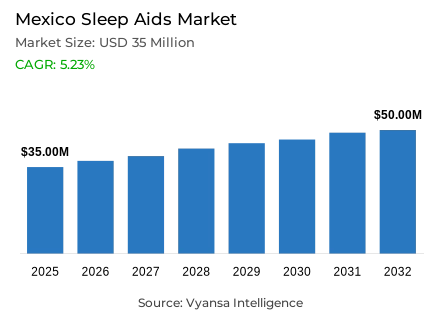
- Sleep aids market size in Mexico was estimated at USD 35 million in 2025.
- The market size is expected to grow to USD 50 million by 2032.
- Market to register a CAGR of around 5.23% during 2026-32.
- Product Shares
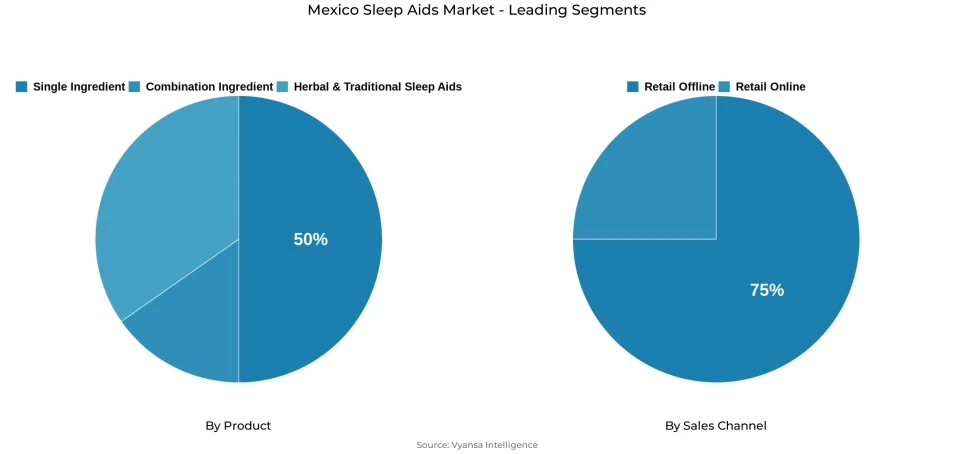
- Single ingredient grabbed market share of 50%.
- Competition
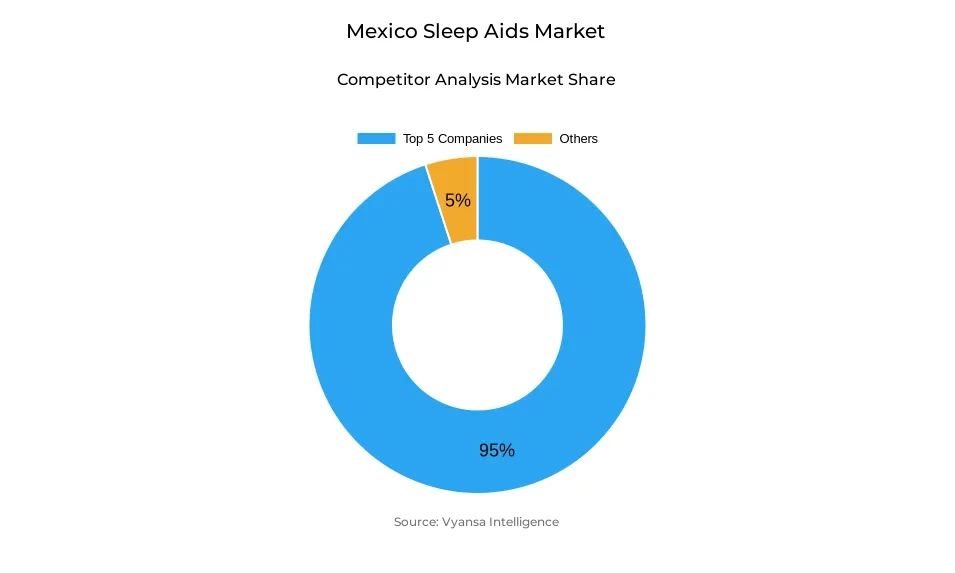
- More than 5 companies are actively engaged in producing sleep aids in Mexico.
- Top 5 companies acquired around 95% of the market share.
- Aspen Labs SA de CV, Bomuca SA de CV, Nartex Laboratorios Homeopáticos SA de CV, Genomma Lab Internacional SAB de CV, Procter & Gamble de México SA de CV etc., are few of the top companies.
- Sales channel
- Retail offline grabbed 75% of the market.
Mexico Sleep Aids Market Outlook
The Mexico sleep aids market is transitioning toward structural stability following the post-pandemic surge in demand. The market is valued at USD 35 million in 2025 and is projected to reach USD 50 million by 2032, reflecting a CAGR of 5.23%. Although economic pressures and increased price comparison have moderated growth momentum, demand remains resilient. Sleep quality is increasingly associated with productivity, emotional balance, and daily safety, reinforcing steady category engagement.
A defining characteristic of the market is end user reluctance toward pharmaceutical sedatives due to dependency concerns. This has accelerated preference for natural, non-habit-forming solutions such as melatonin and herbal formulations. Companies such as Genomma Lab have capitalized on this shift with plant-based brands including Dalay and Passiflorine. Concurrently, digital wellness tools—such as sleep-tracking applications and smart accessories—are complementing OTC solutions by encouraging personalized sleep management.
Pharmacies remain the central distribution pillar. Large chains including Farmacias Guadalajara and Farmacias Similares leverage nationwide presence, affordability positioning, and loyalty programs to maintain reach. While retail online is expanding rapidly, physical pharmacy networks continue to anchor category trust and accessibility.
Looking ahead, holistic wellness integration will increasingly shape demand by 2032. Urban stress patterns in major metropolitan areas are reinforcing interest in botanicals such as chamomile, valerian root, and passionflower. Emphasis on safety, gentle formulations, and transparent communication will sustain long-term market engagement.
Mexico Sleep Aids Market Growth DriverWidespread Sleep Difficulties Sustain Demand for Natural Over-the-Counter Solutions
Sleep disorders remain structurally prevalent in Mexico, sustaining relevance for over-the-counter sleep support solutions. The Institute of Security and Social Services of State Workers (ISSSTE) reports that chronic insomnia affects between 10% and 30% of the population, while up to 80% of individuals experience transient insomnia at some point in their lives (Public Health Information Note on Sleep Disorders). This broad incidence base supports steady category demand across diverse demographic groups.
In response, end users gravitate toward accessible, non-prescription solutions aligned with self-care behaviors. Herbal teas, botanical preparations, and melatonin-based supplements fit a low-entry-barrier model, particularly for individuals associating better sleep with stress control, emotional balance, and productivity. This natural positioning reinforces recurring OTC engagement without the perceived burden of formal clinical pathways.
Mexico Sleep Aids Market ChallengeConstrained Household Budgets Introduce Friction Into Discretionary Health Spending
Macroeconomic caution is tempering category expansion, as households prioritize essential expenditures over discretionary wellness products. The National Institute of Statistics and Geography (INEGI) reported annual inflation of 3.69% in December 2025, while the Global Indicator of Economic Activity declined 0.2% monthly in November 2025. These indicators point to moderated economic momentum and sustained price sensitivity among end users.
Within this environment, sleep aids compete with everyday household spending. Purchases are often delayed, downgraded, or driven by promotions, especially given that many end users perceive sleep aids as occasional rather than routine products. Brands must therefore articulate clear value propositions and reinforce affordability to sustain repeat purchasing behavior in a cost-conscious climate.
Unlock Market Intelligence
Explore the market potential with our data-driven report
Mexico Sleep Aids Market TrendSleep Technology Establishes Itself as a Mainstream Alternative to Product-Based Solutions
Digital connectivity is reshaping how sleep quality is monitored and managed in Mexico. The Federal Telecommunications Institute (IFT) recorded 130.5 million active mobile internet connections as of March 2025, reflecting broad access to mobile-based applications and connected devices. This penetration supports widespread adoption of sleep-tracking apps, light-therapy devices, and digital wellness alerts.
As monitoring tools become embedded in daily routines, some end users prioritize behavioral adjustments and personalized insights over immediate product consumption. This shift toward data-informed lifestyle management raises competitive pressure on traditional OTC solutions, requiring brands to strengthen differentiation through natural positioning, clear benefit communication, and educational engagement.
Mexico Sleep Aids Market OpportunityPharmacy-Led Omnichannel Models Expand Accessibility for Over-the-Counter Sleep Support
The integration of trusted pharmacy networks with expanding online fulfillment systems presents a scalable growth opportunity. Established chains benefit from loyalty programs and wide OTC assortments, while online channels increase convenience for repeat purchasing. Supporting this model, the Federal Telecommunications Institute reported 28,233,420 fixed internet connections in Mexico as of March 2025, enabling broader household access to retail online health purchases.
This infrastructure facilitates subscription-based replenishment, click-and-collect services, and targeted wellness bundles such as jet lag or shift-work support kits. Brands emphasizing natural, non-habit-forming positioning can leverage omnichannel distribution to enhance accessibility, reinforce correct usage guidance, and build sustained trust within a digitally connected end user base.
Unlock Market Intelligence
Explore the market potential with our data-driven report
Mexico Sleep Aids Market Segmentation Analysis
By Product
- Single Ingredient
- Combination Ingredient
- Herbal & Traditional Sleep Aids
Single-Ingredient products represent approximately 50% of total market value, making them the dominant segment. Simplicity, clarity of labeling, and targeted efficacy—particularly in melatonin and specific herbal extracts—support strong end user confidence. These formulations are widely perceived as safer and non-habit-forming, appealing especially to users managing temporary disturbances such as jet lag or shift-related fatigue.
The transparency and focused nature of mono-ingredient products enable brands to build sustained trust through consistent outcomes. Although multi-herb blends are present, single-ingredient solutions remain preferred among first-time users and end users cautious about complex pharmaceutical combinations. This simplicity-driven preference is expected to anchor the product landscape through 2032.
By Sales Channel
- Retail Online
- Retail Offline
Retail Offline accounts for approximately 75% of total market share, retaining clear leadership within the distribution structure. Nationwide pharmacy chains such as Farmacias Similares and Farmacias Guadalajara underpin this dominance through extensive branch networks and established end user trust. Immediate access, pharmacist consultation, and strong value positioning reinforce offline purchasing behavior.
Despite rapid growth in digital channels, in-store purchasing remains prevalent due to established habits and loyalty incentives. Physical pharmacies provide reassurance and instant product availability—critical factors during acute sleep disturbances. Supported by accessibility across both urban and rural regions, Retail Offline is expected to remain the primary sales channel in Mexico through 2032.
List of Companies Covered in Mexico Sleep Aids Market
The companies listed below are highly influential in the Mexico sleep aids market, with a significant market share and a strong impact on industry developments.
- Aspen Labs SA de CV
- Bomuca SA de CV
- Nartex Laboratorios Homeopáticos SA de CV
- Genomma Lab Internacional SAB de CV
- Procter & Gamble de México SA de CV
- UP Pharma SA de CV
Competitive Landscape
Mexico sleep aids market is led decisively by Genomma Lab, whose flagship brands Dalay and Passiflorine anchor the category through strong pharmacy distribution, herbal positioning, and sustained marketing investment. Sanofi-Aventis competes with Valeriana, while private label melatonin lines in chains such as Farmacias Benavides add price-based pressure. Standard antihistamine-based products containing diphenhydramine serve consumers with more persistent insomnia, but face perception challenges around dependency. Indirect competition is intensifying from sleep-tracking apps, light therapy devices, and smart pillows, which appeal to consumers seeking non-pharmaceutical solutions. Growth is moderating post-pandemic amid economic constraints, creating differentiation opportunities in affordable natural blends, stress-linked urban positioning, omnichannel pharmacy and e-commerce integration, and education-led branding that reinforces safety and non-habit-forming credentials.
Frequently Asked Questions
Related Report
- Market Segmentation
- Research Scope
- Research Methodology
- Definitions and Assumptions
- Executive Summary
- Mexico Sleep Aids Market Policies, Regulations, and Standards
- Mexico Sleep Aids Market Dynamics
- Growth Factors
- Challenges
- Trends
- Opportunities
- Mexico Sleep Aids Market Statistics, 2022-2032F
- Market Size & Growth Outlook
- By Revenues in USD Million
- Market Segmentation & Growth Outlook
- By Product
- Single Ingredient- Market Insights and Forecast 2022-2032, USD Million
- Doxylamine Succinate- Market Insights and Forecast 2022-2032, USD Million
- Diphenhydramine- Market Insights and Forecast 2022-2032, USD Million
- Melatonin- Market Insights and Forecast 2022-2032, USD Million
- Combination Ingredient- Market Insights and Forecast 2022-2032, USD Million
- Diphenhydramine + Acetaminophen- Market Insights and Forecast 2022-2032, USD Million
- Other Antihistamine-Based Combinations- Market Insights and Forecast 2022-2032, USD Million
- Herbal & Traditional Sleep Aids- Market Insights and Forecast 2022-2032, USD Million
- Valerian root- Market Insights and Forecast 2022-2032, USD Million
- Passionflower- Market Insights and Forecast 2022-2032, USD Million
- Chamomile- Market Insights and Forecast 2022-2032, USD Million
- Kava- Market Insights and Forecast 2022-2032, USD Million
- Multi-Herbal Sleep Blends- Market Insights and Forecast 2022-2032, USD Million
- Single Ingredient- Market Insights and Forecast 2022-2032, USD Million
- By Sleep Disorder
- Insomnia- Market Insights and Forecast 2022-2032, USD Million
- Sleep Apnea- Market Insights and Forecast 2022-2032, USD Million
- Restless Legs Syndrome- Market Insights and Forecast 2022-2032, USD Million
- Narcolepsy- Market Insights and Forecast 2022-2032, USD Million
- Sleep Walking- Market Insights and Forecast 2022-2032, USD Million
- Others- Market Insights and Forecast 2022-2032, USD Million
- By Age Group
- Young to Mid Adults (25-44 Years)- Market Insights and Forecast 2022-2032, USD Million
- Middle-Aged Adults (45-64 Years)- Market Insights and Forecast 2022-2032, USD Million
- Geriatric Population (65+ Years)- Market Insights and Forecast 2022-2032, USD Million
- By Sales Channel
- Retail Online- Market Insights and Forecast 2022-2032, USD Million
- Retail Offline- Market Insights and Forecast 2022-2032, USD Million
- By End User
- Homecare/Individual Consumers- Market Insights and Forecast 2022-2032, USD Million
- Hospitals- Market Insights and Forecast 2022-2032, USD Million
- Sleep Centers & Clinics- Market Insights and Forecast 2022-2032, USD Million
- By Formulation
- Tablets- Market Insights and Forecast 2022-2032, USD Million
- Gummies- Market Insights and Forecast 2022-2032, USD Million
- Capsules- Market Insights and Forecast 2022-2032, USD Million
- Liquid- Market Insights and Forecast 2022-2032, USD Million
- Sublingual- Market Insights and Forecast 2022-2032, USD Million
- By Competitors
- Competition Characteristics
- Market Share & Analysis
- By Product
- Market Size & Growth Outlook
- Mexico Single Ingredient Sleep Aids Market Statistics, 2022-2032
- Market Size & Growth Outlook
- By Revenues in USD Million
- Market Segmentation & Growth Outlook
- By Sleep Disorder- Market Insights and Forecast 2022-2032, USD Million
- By Age Group- Market Insights and Forecast 2022-2032, USD Million
- By Sales Channel- Market Insights and Forecast 2022-2032, USD Million
- By End User- Market Insights and Forecast 2022-2032, USD Million
- By Formulation- Market Insights and Forecast 2022-2032, USD Million
- Market Size & Growth Outlook
- Mexico Combination Ingredient Sleep Aids Market Statistics, 2022-2032
- Market Size & Growth Outlook
- By Revenues in USD Million
- Market Segmentation & Growth Outlook
- By Sleep Disorder- Market Insights and Forecast 2022-2032, USD Million
- By Age Group- Market Insights and Forecast 2022-2032, USD Million
- By Sales Channel- Market Insights and Forecast 2022-2032, USD Million
- By End User- Market Insights and Forecast 2022-2032, USD Million
- By Formulation- Market Insights and Forecast 2022-2032, USD Million
- Market Size & Growth Outlook
- Mexico Herbal & Traditional Sleep Aids Market Statistics, 2022-2032
- Market Size & Growth Outlook
- By Revenues in USD Million
- Market Segmentation & Growth Outlook
- By Sleep Disorder- Market Insights and Forecast 2022-2032, USD Million
- By Age Group- Market Insights and Forecast 2022-2032, USD Million
- By Sales Channel- Market Insights and Forecast 2022-2032, USD Million
- By End User- Market Insights and Forecast 2022-2032, USD Million
- By Formulation- Market Insights and Forecast 2022-2032, USD Million
- Market Size & Growth Outlook
- Competitive Outlook
- Company Profiles
- Genomma Lab Internacional SAB de CV
- Business Description
- Product Portfolio
- Collaborations & Alliances
- Recent Developments
- Financial Details
- Others
- Procter & Gamble de México SA de CV
- Business Description
- Product Portfolio
- Collaborations & Alliances
- Recent Developments
- Financial Details
- Others
- UP Pharma SA de CV
- Business Description
- Product Portfolio
- Collaborations & Alliances
- Recent Developments
- Financial Details
- Others
- Aspen Labs SA de CV
- Business Description
- Product Portfolio
- Collaborations & Alliances
- Recent Developments
- Financial Details
- Others
- Bomuca SA de CV
- Business Description
- Product Portfolio
- Collaborations & Alliances
- Recent Developments
- Financial Details
- Others
- Nartex Laboratorios Homeopáticos SA de CV
- Business Description
- Product Portfolio
- Collaborations & Alliances
- Recent Developments
- Financial Details
- Others
- Laboratorios Farmasa SA de CV
- Business Description
- Product Portfolio
- Collaborations & Alliances
- Recent Developments
- Financial Details
- Others
- Others
- Business Description
- Product Portfolio
- Collaborations & Alliances
- Recent Developments
- Financial Details
- Others
- Genomma Lab Internacional SAB de CV
- Company Profiles
- Disclaimer
| Segment | Sub-Segment |
|---|---|
| By Product |
|
| By Sleep Disorder |
|
| By Age Group |
|
| By Sales Channel |
|
| By End User |
|
| By Formulation |
|
Research Methodology
This study followed a structured approach comprising four key phases to assess the size and scope of the electro-oxidation market. The process began with thorough secondary research to collect data on the target market, related markets, and broader industry context. These findings, along with preliminary assumptions and estimates, were then validated through extensive primary research involving industry experts from across the value chain. To calculate the overall market size, both top-down and bottom-up methodologies were employed. Finally, market segmentation and data triangulation techniques were applied to refine and validate segment-level estimations.
Secondary Research
The secondary research phase involved gathering data from a wide range of credible and published sources. This step helped in identifying industry trends, defining market segmentation, and understanding the market landscape and value chain.
Sources consulted during this phase included:
- Company annual reports, investor presentations, and press releases
- Industry white papers and certified publications
- Trade directories and market-recognized databases
- Articles from authoritative authors and reputable journals
- Gold and silver standard websites
Secondary research was critical in mapping out the industry's value chain and monetary flow, identifying key market segments, understanding regional variations, and tracking significant industry developments.
Other key sources:
- Financial disclosures
- Industry associations and trade bodies
- News outlets and business magazines
- Academic journals and research studies
- Paid industry databases
Primary Research
To validate secondary data and gain deeper market insights, primary research was conducted with key stakeholders across both the supply and demand sides of the market.
On the demand side, participants included decision-makers and influencers from end-user industries—such as CIOs, CTOs, and CSOs—who provided first-hand perspectives on market needs, product usage, and future expectations.
On the supply side, interviews were conducted with manufacturers, industry associations, and institutional participants to gather insights into current offerings, product pipelines, and market challenges.
Primary interviews provided critical inputs such as:
- Market size and revenue data
- Product and service breakdowns
- Market forecasts
- Regional and application-specific trends
Stakeholders consulted included:
- Leading OEM and solution providers
- Channel and distribution partners
- End users across various applications
- Independent consultants and industry specialists
Market Size Estimation and Data Triangulation
- Identifying Key Market Participants (Secondary Research)
- Goal: To identify the major players or companies in the target market. This typically involves using publicly available data sources such as industry reports, market research publications, and financial statements of companies.
- Tools: Reports from firms like Gartner, Forrester, Euromonitor, Statista, IBISWorld, and others. Public financial statements, news articles, and press releases from top market players.
- Extracting Earnings of Key Market Participants
- Goal: To estimate the earnings generated from the product or service being analyzed. This step helps in understanding the revenue potential of each market player in a specific geography.
- Methods: Earnings data can be gathered from:
- Publicly available financial reports (for listed companies).
- Interviews and primary data sources from professionals, such as Directors, VPs, SVPs, etc. This is especially useful for understanding more nuanced, internal data that isn't publicly disclosed.
- Annual reports and investor presentations of key players.
- Data Collation and Development of a Relevant Data Model
- Goal: To collate inputs from both primary and secondary sources into a structured, data-driven model for market estimation. This model will incorporate key market KPIs and any independent variables relevant to the market.
- Key KPIs: These could include:
- Market size, growth rate, and demand drivers.
- Industry-specific metrics like market share, average revenue per customer (ARPC), or average deal size.
- External variables, such as economic growth rates, inflation rates, or commodity prices, that could affect the market.
- Data Modeling: Based on this data, the market forecasts are developed for the next 5 years. A combination of trend analysis, scenario modeling, and statistical regression might be used to generate projections.
- Scenario Analysis
- Goal: To test different assumptions and validate how sensitive the market is to changes in key variables (e.g., market demand, regulatory changes, technological disruptions).
- Types of Scenarios:
- Base Case: Based on current assumptions and historical data.
- Best-Case Scenario: Assuming favorable market conditions, regulatory environments, and technological advancements.
- Worst-Case Scenario: Accounting for adverse factors, such as economic downturns, stricter regulations, or unexpected disruptions.












