Malaysia Room Air Conditioners Market Report: Trends, Growth and Forecast (2026-2032)
By Product Type (Split Air Conditioners (Up to 9,000 BTU/h, 9,001-12,000 BTU/h, 12,001-18,000 BTU/h, 18,001-24,000 BTU/h, Above 24,000 BTU/h), Window Air Conditioners (Up to 9,000 BTU/h, 9,001-12,000 BTU/h, 12,001-18,000 BTU/h, 18,001-24,000 BTU/h, Above 24,000 BTU/h), Others), By Technology (Inverter, Non-Inverter), By Price (Up to USD 300, USD 301 to USD 600, USD 601 to USD 1,000, Above USD 1,000), By End User (Residential (Individual Households, Apartments/Condominiums, Vacation/Secondary Homes), Commercial (Offices, Retail Stores/Showrooms, Hospitality, Healthcare Facilities, Educational Institutions, Small Commercial Establishments, Others)), By Sales Channel (Retail Online (Brand-Owned Websites/D2C, E-Commerce Marketplaces), Retail Offline (Exclusive Brand Stores, Multi-Brand Electronics & Appliance Stores, Specialty Stores, Hypermarkets/Supermarkets, Home Improvement Stores, Dealer/Distributor Network, Direct Sales/Institutional Sales, Local Independent Retailers)), By Refrigerant Type (R-32, R-410A, R-290, R-454B, Others), By Connectivity (Smart/Connected, Conventional/Non-Smart), By Energy Efficiency (1 Star, 2 Star, 3 Star, 4 Star, 5 Star) ... Read more
|
Major Players
|
Malaysia Room Air Conditioners Market Statistics and Insights, 2026
- Market Size Statistics
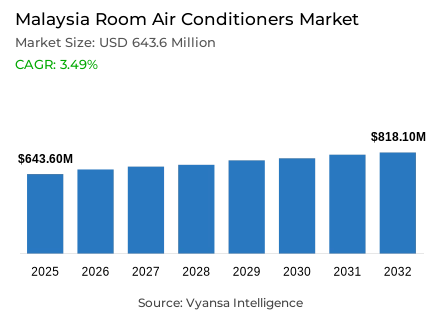
- Room air conditioners market size in Malaysia was valued at USD 643.6 million in 2025 and is estimated at USD 650.3 million in 2026.
- The market size is expected to grow to USD 818.1 million by 2032.
- Market to register a CAGR of around 3.49% during 2026-32.
- Product Type Shares
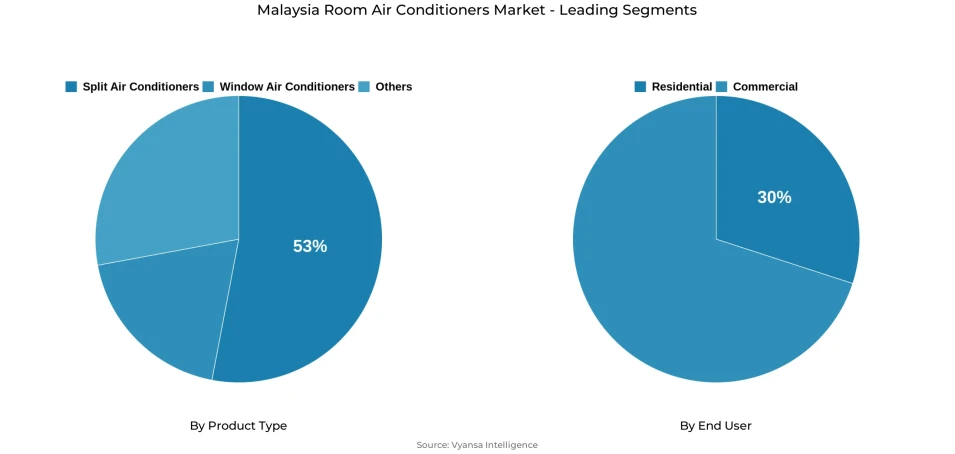
- Split air conditioners grabbed market share of 53%.
- Competition
- More than 10 companies are actively engaged in producing room air conditioners in Malaysia.
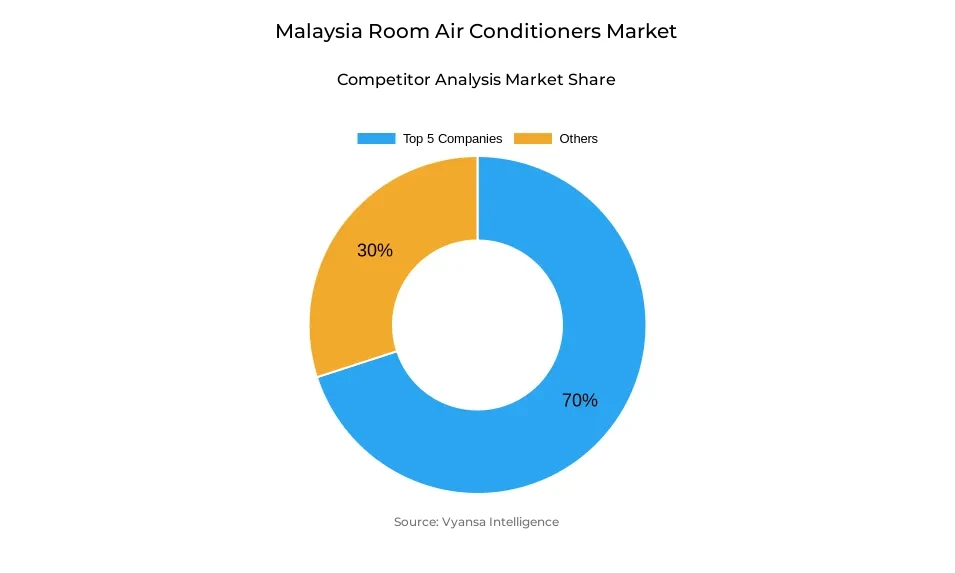
- Top 5 companies acquired around 70% of the market share.
- Hon Hai Precision Industry Co Ltd, Gree Electric Appliances Inc of Zhuhai, Haier Group, Daikin Industries Ltd, Panasonic Corp etc., are few of the top companies.
- End User
- Residential grabbed 30% of the market.
Malaysia Room Air Conditioners Market Outlook
The Malaysia room air conditioners market was valued at USD 643.6 million in 2025 and is projected to rise from USD 650.3 million in 2026 to USD 818.1 million by 2032, corresponding to a compound annual growth rate of 3.49% over the forecast period. This trend indicates a steady and balanced growth environment, where growth is driven by a steady demand as opposed to a fast-tracked market growth. The relentless growth highlights the necessity of cooling devices in the domestic and commercial settings.
By product type, Split Air Conditioners constitute 53% of the total market, thereby establishing them as the leading category. This leadership is an indication of a high level of consumer preference towards practical, efficient and widely compatible cooling solutions. Product development, pricing strategies, and competitive positioning are therefore highly focused on split systems making them the main determinant of the overall market structure.
By end user, the residential segment represents 30% of total demand, highlighting the substantial influence of household consumption on market performance. This percentage shows that room air conditioners are still strongly associated with daily indoor comfort and climate control. The reliance on residential demand supports the role of affordability, usability, and accessibility in determining purchasing behaviour.
In general, the development of USD 650.3 million in 2026 to USD 818.1 million in 2032 indicates a steady increase in value. With a CAGR of 3.49%, the market exhibits resilience supported by a robust split‑unit base and stable residential demand. This puts the industry in a position of sustained steady growth up to 2032.
Malaysia Room Air Conditioners Market Growth DriverRising Heat Sustains Cooling Needs
Rising temperature exposure and heat-related health concerns remain the primary growth driver in Malaysia’s room air conditioners market. As of 25 March 2024, 28 cases of heat-related illnesses were documented, 19 of which were heat exhaustion and 9 heatstroke. This highlights the significance of indoor cooling as a preventive health intervention, which maintains the consistent household demand of air conditioners.
Cumulative data also supports the intensity of this driver. By 13 April 2024, there were 45 cases of heat-related illnesses, and one region was under a Heat Wave Alert Level of 2, which is 37°C to 40°C over three days. These factors support the idea of air conditioners as a necessity, thus continuing the demand of reliable cooling systems up to 2032.
Malaysia Room Air Conditioners Market ChallengeRegulatory Compliance Raises the Entry Burden
Regulatory compliance remains a major challange that defines the business environment in the Malaysian room air conditioner market. The Energy Efficiency and Conservation Act 2024 came into effect on 1 January 2025, and it applies to energy-using products. This rise in regulatory load impacts manufacturers and importers making compliance a condition to enter the market and distribute products.
The certification system also supports this difficulty. Suppliers are required to acquire a Certificate of Energy Efficiency, which costs RM 250, including RM 30 application fee and RM 220 issue fee, and lasts one year. This brings about repetitive administrative and cost liabilities. As a result, compliance demands increase operational complexity and cost frameworks, especially to smaller participants, which affects competitive dynamics up to 2032.
Unlock Market Intelligence
Explore the market potential with our data-driven report
Malaysia Room Air Conditioners Market TrendEnergy Efficiency Moves to the Purchase Core
Energy efficiency is becoming a key trend that determines the choice of products and competition in the market. A new star-rating system of air conditioners will be in place between 1 January 2026 and 31 December 2029, which will make energy performance more visible at the point of sale. This increases efficiency as a major differentiator in consumer decision-making.
This trend is also accelerated by policy support. The NUR programme is expanded to cover rebates on industrial, commercial, and MSME segments in addition to households, but 4-star and 5-star appliances remain eligible. This expands the scope of energy-efficient solutions and reinforces their use. This results in a long-term trend of high-efficiency air conditioners as policy and consumer preference converge by 2032.
Malaysia Room Air Conditioners Market OpportunityIncentive-Led Upgrades Unlock New Demand
Government-backed rebate programmes present a strong opportunity for replacement-driven demand. Under NUR:DOMESTIK, households that buy 4-star or 5-star energy-efficient air conditioners in 2025 will be entitled to an e-rebate of RM 200, with a limit of RM 400 per unit. This is a direct monetary incentive to upgrade to more efficient models.
The programme format also supports quick conversion of purchases. Every registered domestic electricity account is entitled to one rebate per type of appliance on a first-come, first-served basis. This promotes prompt buying behavior and maintains a high sales momentum. As a result, upgrades that are based on rebates can greatly speed up the implementation of efficient cooling systems and contribute to the growth of the market until 2032.
Unlock Market Intelligence
Explore the market potential with our data-driven report
Malaysia Room Air Conditioners Market Segmentation Analysis
By Product Type
- Split Air Conditioners
- Up to 9,000 BTU/h
- 9,001-12,000 BTU/h
- 12,001-18,000 BTU/h
- 18,001-24,000 BTU/h
- Above 24,000 BTU/h
- Window Air Conditioners
- Up to 9,000 BTU/h
- 9,001-12,000 BTU/h
- 12,001-18,000 BTU/h
- 18,001-24,000 BTU/h
- Above 24,000 BTU/h
- Others
The segment with the highest market share under the product‑type classification is Split Air Conditioners, accounting for approximately 53% of the total market. This leadership shows that they are highly suitable in residential applications, with efficient cooling, easy installation, and suitability with different housing types. Their popularity as a product category in the market is strengthened by their wide usage.
The dominance of the segment also shows that the demand is still concentrated in a well-established format. In this regard, the split air conditioner segment is the most influential in product innovation, pricing and competitive positioning. This makes it the focal point of market performance and growth up to 2032.
By End User
- Residential
- Individual Households
- Apartments/Condominiums
- Vacation/Secondary Homes
- Commercial
- Offices
- Retail Stores/Showrooms
- Hospitality
- Healthcare Facilities
- Educational Institutions
- Small Commercial Establishments
- Others
The segment with the highest market share under the end‑user classification is Residential, accounting for approximately 30% of the total market. This underscores the key role of domestic demand in the overall performance of the market. Air conditioners are directly associated with the comfort of the indoors and everyday use, which makes residential customers a steady demand.
The share of the segment also indicates the significance of regular household consumption patterns. Residential demand is sustaining product flow as families focus on indoor climate control and comfort. This makes the segment a major indicator of consumer behaviour and market direction up to 2032.
List of Companies Covered in Malaysia Room Air Conditioners Market
The companies listed below are highly influential in the Malaysia room air conditioners market, with a significant market share and a strong impact on industry developments.
- Hon Hai Precision Industry Co Ltd
- Gree Electric Appliances Inc of Zhuhai
- Haier Group
- Daikin Industries Ltd
- Panasonic Corp
- Midea Group Co Ltd
- Acson Malaysia Sales & Services Sdn Bhd
- Robert Bosch GmbH
- LG Corp
- Samsung Corp
Market News & Updates
- Panasonic Corp, 2025:
Panasonic Malaysia launched its X-Premium Inverter Series in July 2025, describing it as a next-generation 2-in-1 smart air conditioning solution that combines cooling with air purification and smart sensing through nanoe™ X-based clean-air technologies. This is a strong Malaysia room air conditioners market update because it pushes inverter RAC competition toward health-focused and premium smart-cooling features that are highly relevant in a hot, humid market with recurring haze concerns.
- Samsung Corp, 2025:
Samsung’s Malaysia newsroom said in February 2025 that the company had launched the WindFree Combo, adding upgraded dehumidification to its WindFree air-conditioner platform. This matters for the Malaysia room air conditioners market because humidity control is a core consumer need in tropical conditions, and Samsung’s update strengthens the smart, comfort-oriented premium RAC category beyond standard inverter cooling alone.
Frequently Asked Questions
Related Report
- Market Segmentation
- Research Scope
- Research Methodology
- Definitions and Assumptions
- Executive Summary
- Malaysia Room Air Conditioners Market Policies, Regulations, and Standards
- Malaysia Room Air Conditioners Market Dynamics
- Growth Factors
- Challenges
- Trends
- Opportunities
- Malaysia Room Air Conditioners Market Statistics, 2022-2032F
- Market Size & Growth Outlook
- By Revenues in USD Million
- By Units Sold in Thousand Units
- Market Segmentation & Growth Outlook
- By Product Type
- Split Air Conditioners- Market Insights and Forecast 2022-2032, USD Million
- Up to 9,000 BTU/h- Market Insights and Forecast 2022-2032, USD Million
- 9,001-12,000 BTU/h- Market Insights and Forecast 2022-2032, USD Million
- 12,001-18,000 BTU/h- Market Insights and Forecast 2022-2032, USD Million
- 18,001-24,000 BTU/h- Market Insights and Forecast 2022-2032, USD Million
- Above 24,000 BTU/h- Market Insights and Forecast 2022-2032, USD Million
- Window Air Conditioners- Market Insights and Forecast 2022-2032, USD Million
- Up to 9,000 BTU/h- Market Insights and Forecast 2022-2032, USD Million
- 9,001-12,000 BTU/h- Market Insights and Forecast 2022-2032, USD Million
- 12,001-18,000 BTU/h- Market Insights and Forecast 2022-2032, USD Million
- 18,001-24,000 BTU/h- Market Insights and Forecast 2022-2032, USD Million
- Above 24,000 BTU/h- Market Insights and Forecast 2022-2032, USD Million
- Others- Market Insights and Forecast 2022-2032, USD Million
- Split Air Conditioners- Market Insights and Forecast 2022-2032, USD Million
- By Technology
- Inverter- Market Insights and Forecast 2022-2032, USD Million
- Non-Inverter- Market Insights and Forecast 2022-2032, USD Million
- By Price
- Up to USD 300- Market Insights and Forecast 2022-2032, USD Million
- USD 301 to USD 600- Market Insights and Forecast 2022-2032, USD Million
- USD 601 to USD 1,000- Market Insights and Forecast 2022-2032, USD Million
- Above USD 1,000- Market Insights and Forecast 2022-2032, USD Million
- By End User
- Residential- Market Insights and Forecast 2022-2032, USD Million
- Individual Households- Market Insights and Forecast 2022-2032, USD Million
- Apartments/Condominiums- Market Insights and Forecast 2022-2032, USD Million
- Vacation/Secondary Homes- Market Insights and Forecast 2022-2032, USD Million
- Commercial- Market Insights and Forecast 2022-2032, USD Million
- Offices- Market Insights and Forecast 2022-2032, USD Million
- Retail Stores/Showrooms- Market Insights and Forecast 2022-2032, USD Million
- Hospitality- Market Insights and Forecast 2022-2032, USD Million
- Healthcare Facilities- Market Insights and Forecast 2022-2032, USD Million
- Educational Institutions- Market Insights and Forecast 2022-2032, USD Million
- Small Commercial Establishments- Market Insights and Forecast 2022-2032, USD Million
- Others- Market Insights and Forecast 2022-2032, USD Million
- Residential- Market Insights and Forecast 2022-2032, USD Million
- By Sales Channel
- Retail Online- Market Insights and Forecast 2022-2032, USD Million
- Brand-Owned Websites/D2C- Market Insights and Forecast 2022-2032, USD Million
- E-Commerce Marketplaces- Market Insights and Forecast 2022-2032, USD Million
- Retail Offline- Market Insights and Forecast 2022-2032, USD Million
- Exclusive Brand Stores- Market Insights and Forecast 2022-2032, USD Million
- Multi-Brand Electronics & Appliance Stores- Market Insights and Forecast 2022-2032, USD Million
- Specialty Stores- Market Insights and Forecast 2022-2032, USD Million
- Hypermarkets/Supermarkets- Market Insights and Forecast 2022-2032, USD Million
- Home Improvement Stores- Market Insights and Forecast 2022-2032, USD Million
- Dealer/Distributor Network- Market Insights and Forecast 2022-2032, USD Million
- Direct Sales/Institutional Sales- Market Insights and Forecast 2022-2032, USD Million
- Local Independent Retailers- Market Insights and Forecast 2022-2032, USD Million
- Retail Online- Market Insights and Forecast 2022-2032, USD Million
- By Refrigerant Type
- R-32- Market Insights and Forecast 2022-2032, USD Million
- R-410A- Market Insights and Forecast 2022-2032, USD Million
- R-290- Market Insights and Forecast 2022-2032, USD Million
- R-454B- Market Insights and Forecast 2022-2032, USD Million
- Others- Market Insights and Forecast 2022-2032, USD Million
- By Connectivity
- Smart/Connected- Market Insights and Forecast 2022-2032, USD Million
- Conventional/Non-Smart- Market Insights and Forecast 2022-2032, USD Million
- By Energy Efficiency
- 1 Star- Market Insights and Forecast 2022-2032, USD Million
- 2 Star- Market Insights and Forecast 2022-2032, USD Million
- 3 Star- Market Insights and Forecast 2022-2032, USD Million
- 4 Star- Market Insights and Forecast 2022-2032, USD Million
- 5 Star- Market Insights and Forecast 2022-2032, USD Million
- By Competitors
- Competition Characteristics
- Market Share & Analysis
- By Product Type
- Market Size & Growth Outlook
- Malaysia Split Air Conditioners Market Statistics, 2022-2032
- Market Size & Growth Outlook
- By Revenues in USD Million
- By Units Sold in Thousand Units
- Market Segmentation & Growth Outlook
- By Technology- Market Insights and Forecast 2022-2032, USD Million
- By Price- Market Insights and Forecast 2022-2032, USD Million
- By End User- Market Insights and Forecast 2022-2032, USD Million
- By Sales Channel- Market Insights and Forecast 2022-2032, USD Million
- By Refrigerant Type- Market Insights and Forecast 2022-2032, USD Million
- By Connectivity- Market Insights and Forecast 2022-2032, USD Million
- By Energy Efficiency- Market Insights and Forecast 2022-2032, USD Million
- Market Size & Growth Outlook
- Malaysia Window Air Conditioners Market Statistics, 2022-2032
- Market Size & Growth Outlook
- By Revenues in USD Million
- By Units Sold in Thousand Units
- Market Segmentation & Growth Outlook
- By Technology- Market Insights and Forecast 2022-2032, USD Million
- By Price- Market Insights and Forecast 2022-2032, USD Million
- By End User- Market Insights and Forecast 2022-2032, USD Million
- By Sales Channel- Market Insights and Forecast 2022-2032, USD Million
- By Refrigerant Type- Market Insights and Forecast 2022-2032, USD Million
- By Connectivity- Market Insights and Forecast 2022-2032, USD Million
- By Energy Efficiency- Market Insights and Forecast 2022-2032, USD Million
- Market Size & Growth Outlook
- Competitive Outlook
- Company Profiles
- Daikin Industries Ltd
- Business Description
- Product Portfolio
- Collaborations & Alliances
- Recent Developments
- Financial Details
- Others
- Panasonic Corp
- Business Description
- Product Portfolio
- Collaborations & Alliances
- Recent Developments
- Financial Details
- Others
- Midea Group Co Ltd
- Business Description
- Product Portfolio
- Collaborations & Alliances
- Recent Developments
- Financial Details
- Others
- Acson Malaysia Sales & Services Sdn Bhd
- Business Description
- Product Portfolio
- Collaborations & Alliances
- Recent Developments
- Financial Details
- Others
- Robert Bosch GmbH
- Business Description
- Product Portfolio
- Collaborations & Alliances
- Recent Developments
- Financial Details
- Others
- Hon Hai Precision Industry Co Ltd
- Business Description
- Product Portfolio
- Collaborations & Alliances
- Recent Developments
- Financial Details
- Others
- Gree Electric Appliances Inc of Zhuhai
- Business Description
- Product Portfolio
- Collaborations & Alliances
- Recent Developments
- Financial Details
- Others
- Haier Group
- Business Description
- Product Portfolio
- Collaborations & Alliances
- Recent Developments
- Financial Details
- Others
- LG Corp
- Business Description
- Product Portfolio
- Collaborations & Alliances
- Recent Developments
- Financial Details
- Others
- Samsung Corp
- Business Description
- Product Portfolio
- Collaborations & Alliances
- Recent Developments
- Financial Details
- Others
- Daikin Industries Ltd
- Company Profiles
- Disclaimer
| Segment | Sub-Segment |
|---|---|
| By Product Type |
|
| By Technology |
|
| By Price |
|
| By End User |
|
| By Sales Channel |
|
| By Refrigerant Type |
|
| By Connectivity |
|
| By Energy Efficiency |
|
Research Methodology
This study followed a structured approach comprising four key phases to assess the size and scope of the electro-oxidation market. The process began with thorough secondary research to collect data on the target market, related markets, and broader industry context. These findings, along with preliminary assumptions and estimates, were then validated through extensive primary research involving industry experts from across the value chain. To calculate the overall market size, both top-down and bottom-up methodologies were employed. Finally, market segmentation and data triangulation techniques were applied to refine and validate segment-level estimations.
Secondary Research
The secondary research phase involved gathering data from a wide range of credible and published sources. This step helped in identifying industry trends, defining market segmentation, and understanding the market landscape and value chain.
Sources consulted during this phase included:
- Company annual reports, investor presentations, and press releases
- Industry white papers and certified publications
- Trade directories and market-recognized databases
- Articles from authoritative authors and reputable journals
- Gold and silver standard websites
Secondary research was critical in mapping out the industry's value chain and monetary flow, identifying key market segments, understanding regional variations, and tracking significant industry developments.
Other key sources:
- Financial disclosures
- Industry associations and trade bodies
- News outlets and business magazines
- Academic journals and research studies
- Paid industry databases
Primary Research
To validate secondary data and gain deeper market insights, primary research was conducted with key stakeholders across both the supply and demand sides of the market.
On the demand side, participants included decision-makers and influencers from end-user industries—such as CIOs, CTOs, and CSOs—who provided first-hand perspectives on market needs, product usage, and future expectations.
On the supply side, interviews were conducted with manufacturers, industry associations, and institutional participants to gather insights into current offerings, product pipelines, and market challenges.
Primary interviews provided critical inputs such as:
- Market size and revenue data
- Product and service breakdowns
- Market forecasts
- Regional and application-specific trends
Stakeholders consulted included:
- Leading OEM and solution providers
- Channel and distribution partners
- End users across various applications
- Independent consultants and industry specialists
Market Size Estimation and Data Triangulation
- Identifying Key Market Participants (Secondary Research)
- Goal: To identify the major players or companies in the target market. This typically involves using publicly available data sources such as industry reports, market research publications, and financial statements of companies.
- Tools: Reports from firms like Gartner, Forrester, Euromonitor, Statista, IBISWorld, and others. Public financial statements, news articles, and press releases from top market players.
- Extracting Earnings of Key Market Participants
- Goal: To estimate the earnings generated from the product or service being analyzed. This step helps in understanding the revenue potential of each market player in a specific geography.
- Methods: Earnings data can be gathered from:
- Publicly available financial reports (for listed companies).
- Interviews and primary data sources from professionals, such as Directors, VPs, SVPs, etc. This is especially useful for understanding more nuanced, internal data that isn't publicly disclosed.
- Annual reports and investor presentations of key players.
- Data Collation and Development of a Relevant Data Model
- Goal: To collate inputs from both primary and secondary sources into a structured, data-driven model for market estimation. This model will incorporate key market KPIs and any independent variables relevant to the market.
- Key KPIs: These could include:
- Market size, growth rate, and demand drivers.
- Industry-specific metrics like market share, average revenue per customer (ARPC), or average deal size.
- External variables, such as economic growth rates, inflation rates, or commodity prices, that could affect the market.
- Data Modeling: Based on this data, the market forecasts are developed for the next 5 years. A combination of trend analysis, scenario modeling, and statistical regression might be used to generate projections.
- Scenario Analysis
- Goal: To test different assumptions and validate how sensitive the market is to changes in key variables (e.g., market demand, regulatory changes, technological disruptions).
- Types of Scenarios:
- Base Case: Based on current assumptions and historical data.
- Best-Case Scenario: Assuming favorable market conditions, regulatory environments, and technological advancements.
- Worst-Case Scenario: Accounting for adverse factors, such as economic downturns, stricter regulations, or unexpected disruptions.












