Malaysia Paediatric Consumer Health Market Report: Trends, Growth and Forecast (2026-2032)
By Product Type (Paediatric Analgesics (Paediatric Acetaminophen, Paediatric Aspirin, Paediatric Combination Products Analgesics, Paediatric Dipyrone, Paediatric Ibuprofen, Paediatric Naproxen), Paediatric Cough, Cold and Allergy Remedies (Paediatric Allergy Remedies, Paediatric Cough/Cold Remedies), Paediatric Digestive Remedies (Paediatric Diarrhoeal Remedies, Paediatric Indigestion and Heartburn Remedies, Paediatric Laxatives, Paediatric Motion Sickness Remedies), Paediatric Dermatologicals, Nappy (Diaper) Rash Treatments, Paediatric Vitamins and Dietary Supplements), By Dosage Form (Liquid Syrups, Chewable Tablets, Drops, Powders/Sachets, Gummies, Topical Creams & Ointments), By Age Group (Infants & Toddlers (0-3 Years), Children (4-12 Years), Adolescents (13-18 Years)), By Treatment Type (Acute Treatment, Chronic Condition Management, Genetic & Rare Disease Management), By Sales Channel (Retail Online (Online Pharmacies, E-commerce Platforms, Brand Websites), Retail Offline (Hospital Pharmacies, Retail Pharmacies / Drugstores, Supermarkets & Hypermarkets, Specialty Baby Stores)) ... Read more

|
Major Players
|
Malaysia Paediatric Consumer Health Market Statistics and Insights, 2026
- Market Size Statistics
- Paediatric consumer health market size in Malaysia was valued at USD 65 million in 2025 and is estimated at USD 72.38 Million in 2026.
- The market size is expected to grow to USD 85 million by 2032.
- Market to register a CAGR of around 3.91% during 2026-32.
- Product Type Shares
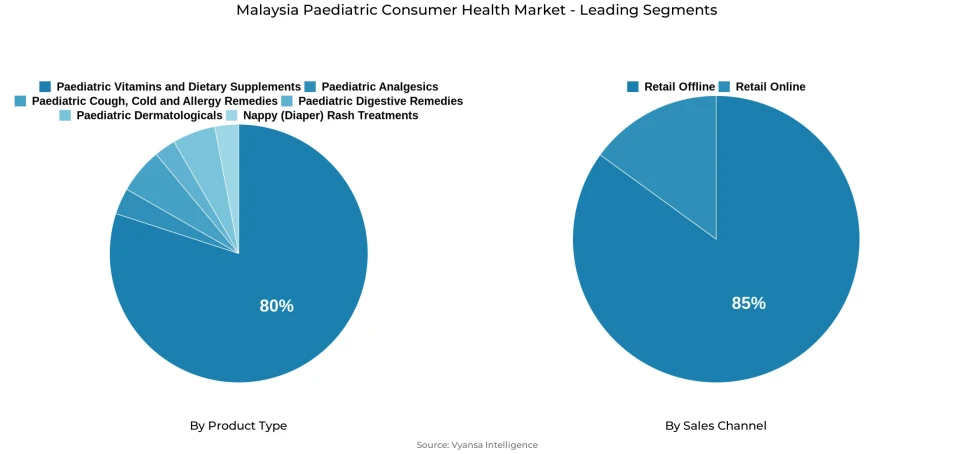
- Paediatric vitamins and dietary supplements grabbed market share of 80%.
- Competition
- More than 20 companies are actively engaged in producing paediatric consumer health in Malaysia.
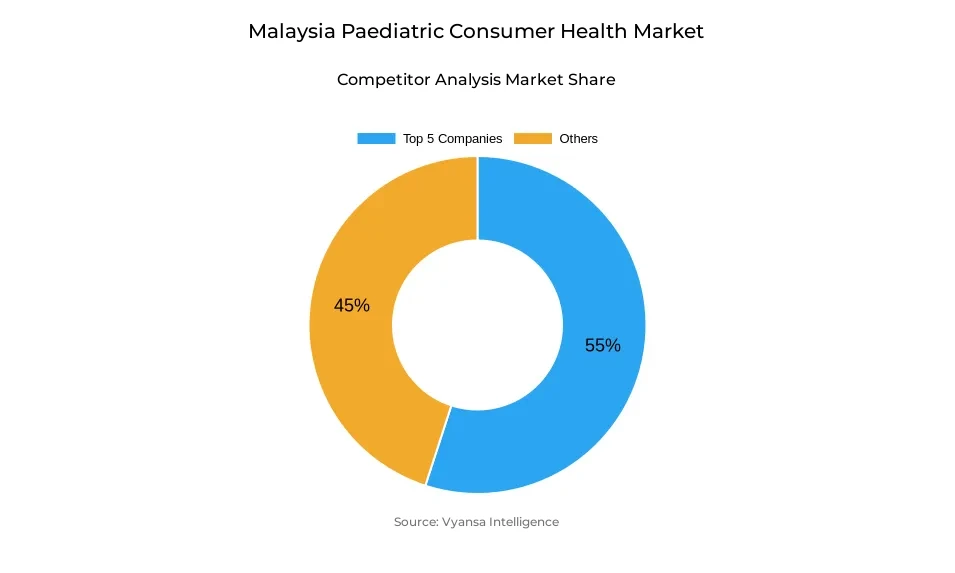
- Top 5 companies acquired around 55% of the market share.
- Megalive Biosciences Sdn Bhd, USANA Health Sciences Sdn Bhd, Bayer (M) Sdn Bhd, GlaxoSmithKline Consumer Healthcare Sdn Bhd, Kotra Industries Bhd etc., are few of the top companies.
- Sales Channel
- Retail offline grabbed 85% of the market.
Malaysia Paediatric Consumer Health Market Outlook
The Malaysia Paediatric consumer Health Market was valued at USD 65 million in 2025 and is projected to expand from USD 72.38 million in 2026 to USD 85 million by 2032, reflecting a compound annual growth rate of 3.91% over the forecast period. This sustained upward growth momentum is driven by a strong and deepening parental focus on preventive health management and a growing willingness among households to invest in specialised wellness solutions tailored specifically for children. As health consciousness continues to rise across the Malaysian end user base, both domestic and international manufacturers are introducing innovative product offerings designed to address increasing parental concern around childhood immunity and respiratory health outcomes.
Preventive care has firmly established itself as a central pillar of the market's commercial structure, with paediatric vitamins and dietary supplements accounting for 80% of total market share. End users are increasingly seeking formulations incorporating functionally positioned ingredients including tiger milk mushroom, black elderberry, and probiotics as proactive measures to protect children against common illnesses. Sustained demand for Paediatric consumer Health products is simultaneously expanding into emerging niche categories, most notably cognitive development and eye health support, driven by growing parental concern regarding the effects of prolonged digital device exposure and the demands of competitive academic environments on children's developmental health.
Product accessibility remains a primary consideration for end users across the market, with retail offline accounting for 85% of total market share. The high degree of trust that end users place in health and beauty specialist retailers, particularly established pharmacy chains, ensures that physical store environments remain the primary destination for the purchase of safe and quality assured paediatric health products. While store based purchasing continues to represent the dominant channel behaviour, the role of Paediatric consumer Health products within digital retail environments is expanding progressively, as retail online platforms offer a broader range of product options and competitively priced promotions to a growing base of digitally engaged and tech oriented parents.
Looking ahead, the market is positioned to diversify further through the introduction of a broader range of chewable delivery formats and botanical beverage products designed to appeal to younger end users. Manufacturers are expected to leverage key functional ingredients including docosahexaenoic acid and Omega 3 fatty acids to support childhood brain health, progressively embedding these supplements into established daily wellness routines. This evolution in the Paediatric consumer Health landscape reflects a broader and structural shift toward proactive lifestyle health management among Malaysian families, providing a foundation for consistent category growth through both traditional pharmacy based distribution networks and the continued expansion of retail online channels serving an increasingly health conscious and digitally connected end user population.
Malaysia Paediatric Consumer Health Market Growth DriverPreventive Health Orientation Sustains Consistent Category Demand
Preventive health management represents the strongest and most structurally supported driver of the Malaysian Paediatric consumer Health market. Parents consistently prioritise products that support childhood immunity and respiratory wellness, maintaining paediatric vitamins and dietary supplements as highly relevant components of everyday child healthcare routines. This orientation equally supports a sustained pace of new product introductions built around child specific formulations, particularly those positioned for routine wellness maintenance rather than exclusively for the treatment of acute symptoms.
The broader infectious disease environment reinforces this parental behaviour pattern. Malaysia's Ministry of Health has reported that influenza positivity rates rose from 15.6% in epidemiological week 38 of 2025 to 20.4% in week 39 of the same year, while the number of recorded influenza clusters increased from 3 to 15 over the same period, predominantly within school and kindergarten settings. This elevated and visible infection exposure keeps parental concern regarding childhood illness at a heightened level and provides durable support for continued demand for preventive paediatric health products across the market.
Malaysia Paediatric Consumer Health Market ChallengeSafety Sensitivity Among End Users Constrains the Pace of Child Friendly Format Expansion
A meaningful structural challenge within the Malaysian Paediatric consumer Health market is the degree to which child friendly supplement delivery formats, while effective in improving product acceptance and ease of administration, simultaneously generate safety related concerns among parents and manufacturers alike. Attractive and highly palatable formats such as gummies and chewable supplements improve consumption compliance among children however, their confectionery like appearance introduces heightened caution regarding the risk of accidental overconsumption. This dynamic places practical limits on the pace and scale at which manufacturers can expand highly appealing product formats, even in market conditions where end user interest and demand remain strong.
This concern is substantiated by official poisoning incidence data. Malaysia's National Poison Centre has reported that 93% of poisoning cases occur within the home environment, that nearly 46% of cases involve children aged 1 to 9 years, and that 66% of unintentional poisoning cases are attributable to household chemical products and medicines. Within this safety sensitive context, end user perception of product risk constitutes a genuine and measurable constraint on the speed of paediatric format innovation, particularly for products specifically designed to be more visually and sensorially appealing to young children.
Unlock Market Intelligence
Explore the market potential with our data-driven report
Malaysia Paediatric Consumer Health Market TrendOmnichannel Purchasing Behaviour Gains Increasing Commercial Visibility
A clearly observable trend within the Malaysian Paediatric consumer Health market is the progressive rise of omnichannel purchasing behaviour among end users. Physical retail outlets retain a central position within the distribution landscape, as parents continue to rely on pharmacies and health focused specialty stores as trusted environments for the selection of safe and appropriate health products for children. Concurrently, retail online shopping is achieving greater visibility and commercial relevance as end users seek broader product choice, more efficient price comparison, and access to frequent promotional pricing on paediatric vitamins and dietary supplements.
Official data reflects this dual channel market structure with clarity. Malaysia's Ministry of Health records 4,320 private community pharmacies in operation as of 31 December 2024, providing the category with a substantial and geographically distributed offline distribution base. In parallel, the Department of Statistics Malaysia reports that national retail online income reached RM 310.6 billion in the first quarter of 2025, representing year on year growth of 3.4%. These indicators collectively confirm that trusted physical retail retains structural strength while digital access channels continue to gain incremental commercial importance within the overall purchasing landscape.
Malaysia Paediatric Consumer Health Market OpportunityCognitive and Eye Health Positioning Creates Differentiated White Space Opportunity
Products addressing cognitive development and visual health represent a meaningful and commercially attractive growth opportunity beyond the established immunity focused core of the Malaysian Paediatric consumer Health market. Parents are demonstrating growing interest in formulations that claim to support concentration, brain development, and visual acuity, particularly as academic performance pressure and the extent of screen based activity among children become more prominent concerns within everyday family life. This shift in end user interest creates clear space for brands to diversify their paediatric wellness propositions into more targeted and functionally specific product territories.
The addressable end user base for such innovations is substantial and digitally well connected. The Department of Statistics Malaysia reports that the country's population of children under 18 years of age stood at 9.03 million in 2025, including 2.31 million children under the age of five. The same agency reports that 96.8% of households had internet access in 2024, providing brands with a large, reachable, and digitally engaged family audience through which education led marketing and awareness campaigns for cognitive, developmental, and eye health paediatric products can be efficiently and cost effectively deployed.
Unlock Market Intelligence
Explore the market potential with our data-driven report
Malaysia Paediatric Consumer Health Market Segmentation Analysis
By Product Type
- Paediatric Analgesics
- Paediatric Acetaminophen
- Paediatric Aspirin
- Paediatric Combination Products Analgesics
- Paediatric Dipyrone
- Paediatric Ibuprofen
- Paediatric Naproxen
- Paediatric Cough, Cold and Allergy Remedies
- Paediatric Allergy Remedies
- Paediatric Cough/Cold Remedies
- Paediatric Digestive Remedies
- Paediatric Diarrhoeal Remedies
- Paediatric Indigestion and Heartburn Remedies
- Paediatric Laxatives
- Paediatric Motion Sickness Remedies
- Paediatric Dermatologicals
- Nappy (Diaper) Rash Treatments
- Paediatric Vitamins and Dietary Supplements
The segment with highest market share under product type is paediatric vitamins and dietary supplements represent the leading segment by a substantial margin, accounting for approximately 80% of total market share. This commanding position of dominance clearly establishes this category as the defining product segment within Malaysia's Paediatric consumer Health market. Its sustained leadership reflects the strong and deeply embedded parental inclination toward preventive care, particularly products associated with immunity reinforcement, respiratory wellness support, and everyday nutritional supplementation for children across multiple age groups.
The segment further benefits from continuous product innovation and the availability of easy to consume delivery formats that meaningfully improve product acceptance among young end users. Chewable formulations, flavoured supplement presentations, and function specific product lines strengthen everyday usage habits and maintain close alignment between the category and routine health maintenance behaviours. Given that demand within this segment is driven primarily by preventive intent rather than acute treatment need, paediatric vitamins and dietary supplements continue to shape and define the overall product mix dynamics of the broader Malaysian Paediatric consumer Health market.
By Sales Channel
- Retail Online
- Online Pharmacies
- E-commerce Platforms
- Brand Websites
- Retail Offline
- Hospital Pharmacies
- Retail Pharmacies / Drugstores
- Supermarkets & Hypermarkets
- Specialty Baby Stores
Within the sales channel segmentation, Retail Offline accounts for approximately 85% of total market share, confirming physical retail as the overwhelmingly dominant purchase channel within Malaysia's Paediatric consumer Health market. End users continue to demonstrate a clear preference for store based purchasing environments, which offer greater perceived trust, direct and immediate product access, and a more reassuring and familiar context for making health related selections on behalf of children.
This channel retains its dominant position through the established prominence of pharmacies and health and beauty specialist outlets, which collectively provide strong product visibility, purchasing convenience, and a well recognised retail setting that supports confident and efficient purchase decision making, particularly for items associated with routine child wellness management. While retail online channels continue to grow in commercial relevance and end user familiarity, retail offline remains the foundational and primary commercial route through which Paediatric consumer Health products reach end users across the Malaysian market.
List of Companies Covered in Malaysia Paediatric Consumer Health Market
The companies listed below are highly influential in the Malaysia paediatric consumer health market, with a significant market share and a strong impact on industry developments.
- Megalive Biosciences Sdn Bhd
- USANA Health Sciences Sdn Bhd
- Bayer (M) Sdn Bhd
- GlaxoSmithKline Consumer Healthcare Sdn Bhd
- Kotra Industries Bhd
- Duopharma Biotech Bhd
- PharmaCare Laboratories (Asia) Sdn Bhd
- Amway (M) Sdn Bhd
- SSL International Plc
- Boehringer Ingelheim (M) Sdn Bhd
Competitive Landscape
Malaysia paediatric consumer health market shows a competitive landscape shaped by supplement innovation and active participation from domestic healthcare brands. Companies such as MegaLive Biosciences Sdn Bhd and Duoleaf Healthcare Sdn Bhd are strengthening their presence through diversified paediatric vitamin portfolios designed in child-friendly formats like chewable tablets and probiotic yoghurt supplements. Product development is largely centred on immune and respiratory support, with new launches such as Tigerus Tiggy Cocoa and Defensa Kids Junior Blackcurrant reflecting rising parental demand for preventive healthcare solutions. At the same time, established supplement players like VitaHealth Malaysia are expanding specialised offerings such as Sambukid to strengthen positioning in immune-support products. Increasing competition among local innovators and specialised paediatric supplement brands is gradually intensifying market dynamics across Malaysia’s children’s health category.
Frequently Asked Questions
Related Report
- Market Segmentation
- Research Scope
- Research Methodology
- Definitions and Assumptions
- Executive Summary
- Malaysia Paediatric Consumer Health Market Policies, Regulations, and Standards
- Malaysia Paediatric Consumer Health Market Dynamics
- Growth Factors
- Challenges
- Trends
- Opportunities
- Malaysia Paediatric Consumer Health Market Statistics, 2022-2032F
- Market Size & Growth Outlook
- By Revenues in USD Million
- Market Segmentation & Growth Outlook
- By Product Type
- Paediatric Analgesics- Market Insights and Forecast 2022-2032, USD Million
- Paediatric Acetaminophen- Market Insights and Forecast 2022-2032, USD Million
- Paediatric Aspirin- Market Insights and Forecast 2022-2032, USD Million
- Paediatric Combination Products Analgesics- Market Insights and Forecast 2022-2032, USD Million
- Paediatric Dipyrone- Market Insights and Forecast 2022-2032, USD Million
- Paediatric Ibuprofen- Market Insights and Forecast 2022-2032, USD Million
- Paediatric Naproxen- Market Insights and Forecast 2022-2032, USD Million
- Paediatric Cough, Cold and Allergy Remedies- Market Insights and Forecast 2022-2032, USD Million
- Paediatric Allergy Remedies- Market Insights and Forecast 2022-2032, USD Million
- Paediatric Cough/Cold Remedies- Market Insights and Forecast 2022-2032, USD Million
- Paediatric Digestive Remedies- Market Insights and Forecast 2022-2032, USD Million
- Paediatric Diarrhoeal Remedies- Market Insights and Forecast 2022-2032, USD Million
- Paediatric Indigestion and Heartburn Remedies- Market Insights and Forecast 2022-2032, USD Million
- Paediatric Laxatives- Market Insights and Forecast 2022-2032, USD Million
- Paediatric Motion Sickness Remedies- Market Insights and Forecast 2022-2032, USD Million
- Paediatric Dermatologicals- Market Insights and Forecast 2022-2032, USD Million
- Nappy (Diaper) Rash Treatments- Market Insights and Forecast 2022-2032, USD Million
- Paediatric Vitamins and Dietary Supplements- Market Insights and Forecast 2022-2032, USD Million
- Paediatric Analgesics- Market Insights and Forecast 2022-2032, USD Million
- By Dosage Form
- Liquid Syrups- Market Insights and Forecast 2022-2032, USD Million
- Chewable Tablets- Market Insights and Forecast 2022-2032, USD Million
- Drops- Market Insights and Forecast 2022-2032, USD Million
- Powders/Sachets- Market Insights and Forecast 2022-2032, USD Million
- Gummies- Market Insights and Forecast 2022-2032, USD Million
- Topical Creams & Ointments- Market Insights and Forecast 2022-2032, USD Million
- By Age Group
- Infants & Toddlers (0-3 Years)- Market Insights and Forecast 2022-2032, USD Million
- Children (4-12 Years)- Market Insights and Forecast 2022-2032, USD Million
- Adolescents (13-18 Years)- Market Insights and Forecast 2022-2032, USD Million
- By Treatment Type
- Acute Treatment- Market Insights and Forecast 2022-2032, USD Million
- Chronic Condition Management- Market Insights and Forecast 2022-2032, USD Million
- Genetic & Rare Disease Management- Market Insights and Forecast 2022-2032, USD Million
- By Sales Channel
- Retail Online- Market Insights and Forecast 2022-2032, USD Million
- Online Pharmacies- Market Insights and Forecast 2022-2032, USD Million
- E-commerce Platforms- Market Insights and Forecast 2022-2032, USD Million
- Brand Websites- Market Insights and Forecast 2022-2032, USD Million
- Retail Offline- Market Insights and Forecast 2022-2032, USD Million
- Hospital Pharmacies- Market Insights and Forecast 2022-2032, USD Million
- Retail Pharmacies / Drugstores- Market Insights and Forecast 2022-2032, USD Million
- Supermarkets & Hypermarkets- Market Insights and Forecast 2022-2032, USD Million
- Specialty Baby Stores
- Retail Online- Market Insights and Forecast 2022-2032, USD Million
- By Competitors
- Competition Characteristics
- Market Share & Analysis
- By Product Type
- Market Size & Growth Outlook
- Malaysia Paediatric Analgesics Market Statistics, 2022-2032
- Market Size & Growth Outlook
- By Revenues in USD Million
- Market Segmentation & Growth Outlook
- By Dosage Form- Market Insights and Forecast 2022-2032, USD Million
- By Age Group- Market Insights and Forecast 2022-2032, USD Million
- By Treatment Type- Market Insights and Forecast 2022-2032, USD Million
- By Sales Channel- Market Insights and Forecast 2022-2032, USD Million
- Market Size & Growth Outlook
- Malaysia Paediatric Cough, Cold and Allergy Remedies Market Statistics, 2022-2032
- Market Size & Growth Outlook
- By Revenues in USD Million
- Market Segmentation & Growth Outlook
- By Dosage Form- Market Insights and Forecast 2022-2032, USD Million
- By Age Group- Market Insights and Forecast 2022-2032, USD Million
- By Treatment Type- Market Insights and Forecast 2022-2032, USD Million
- By Sales Channel- Market Insights and Forecast 2022-2032, USD Million
- Market Size & Growth Outlook
- Malaysia Paediatric Digestive Remedies Market Statistics, 2022-2032
- Market Size & Growth Outlook
- By Revenues in USD Million
- Market Segmentation & Growth Outlook
- By Dosage Form- Market Insights and Forecast 2022-2032, USD Million
- By Age Group- Market Insights and Forecast 2022-2032, USD Million
- By Treatment Type- Market Insights and Forecast 2022-2032, USD Million
- By Sales Channel- Market Insights and Forecast 2022-2032, USD Million
- Market Size & Growth Outlook
- Malaysia Paediatric Dermatologicals Market Statistics, 2022-2032
- Market Size & Growth Outlook
- By Revenues in USD Million
- Market Segmentation & Growth Outlook
- By Dosage Form- Market Insights and Forecast 2022-2032, USD Million
- By Age Group- Market Insights and Forecast 2022-2032, USD Million
- By Treatment Type- Market Insights and Forecast 2022-2032, USD Million
- By Sales Channel- Market Insights and Forecast 2022-2032, USD Million
- Market Size & Growth Outlook
- Malaysia Nappy (Diaper) Rash Treatments Market Statistics, 2022-2032
- Market Size & Growth Outlook
- By Revenues in USD Million
- Market Segmentation & Growth Outlook
- By Dosage Form- Market Insights and Forecast 2022-2032, USD Million
- By Age Group- Market Insights and Forecast 2022-2032, USD Million
- By Treatment Type- Market Insights and Forecast 2022-2032, USD Million
- By Sales Channel- Market Insights and Forecast 2022-2032, USD Million
- Market Size & Growth Outlook
- Malaysia Paediatric Vitamins and Dietary Supplements Market Statistics, 2022-2032
- Market Size & Growth Outlook
- By Revenues in USD Million
- Market Segmentation & Growth Outlook
- By Dosage Form- Market Insights and Forecast 2022-2032, USD Million
- By Age Group- Market Insights and Forecast 2022-2032, USD Million
- By Treatment Type- Market Insights and Forecast 2022-2032, USD Million
- By Sales Channel- Market Insights and Forecast 2022-2032, USD Million
- Market Size & Growth Outlook
- Competitive Outlook
- Company Profiles
- GlaxoSmithKline Consumer Healthcare Sdn Bhd
- Business Description
- Product Portfolio
- Collaborations & Alliances
- Recent Developments
- Financial Details
- Others
- Kotra Industries Bhd
- Business Description
- Product Portfolio
- Collaborations & Alliances
- Recent Developments
- Financial Details
- Others
- Duopharma Biotech Bhd
- Business Description
- Product Portfolio
- Collaborations & Alliances
- Recent Developments
- Financial Details
- Others
- PharmaCare Laboratories (Asia) Sdn Bhd
- Business Description
- Product Portfolio
- Collaborations & Alliances
- Recent Developments
- Financial Details
- Others
- Amway (M) Sdn Bhd
- Business Description
- Product Portfolio
- Collaborations & Alliances
- Recent Developments
- Financial Details
- Others
- Megalive Biosciences Sdn Bhd
- Business Description
- Product Portfolio
- Collaborations & Alliances
- Recent Developments
- Financial Details
- Others
- USANA Health Sciences Sdn Bhd
- Business Description
- Product Portfolio
- Collaborations & Alliances
- Recent Developments
- Financial Details
- Others
- Bayer (M) Sdn Bhd
- Business Description
- Product Portfolio
- Collaborations & Alliances
- Recent Developments
- Financial Details
- Others
- SSL International Plc
- Business Description
- Product Portfolio
- Collaborations & Alliances
- Recent Developments
- Financial Details
- Others
- Boehringer Ingelheim (M) Sdn Bhd
- Business Description
- Product Portfolio
- Collaborations & Alliances
- Recent Developments
- Financial Details
- Others
- GlaxoSmithKline Consumer Healthcare Sdn Bhd
- Company Profiles
- Disclaimer
| Segment | Sub-Segment |
|---|---|
| By Product Type |
|
| By Dosage Form |
|
| By Age Group |
|
| By Treatment Type |
|
| By Sales Channel |
|
Research Methodology
This study followed a structured approach comprising four key phases to assess the size and scope of the electro-oxidation market. The process began with thorough secondary research to collect data on the target market, related markets, and broader industry context. These findings, along with preliminary assumptions and estimates, were then validated through extensive primary research involving industry experts from across the value chain. To calculate the overall market size, both top-down and bottom-up methodologies were employed. Finally, market segmentation and data triangulation techniques were applied to refine and validate segment-level estimations.
Secondary Research
The secondary research phase involved gathering data from a wide range of credible and published sources. This step helped in identifying industry trends, defining market segmentation, and understanding the market landscape and value chain.
Sources consulted during this phase included:
- Company annual reports, investor presentations, and press releases
- Industry white papers and certified publications
- Trade directories and market-recognized databases
- Articles from authoritative authors and reputable journals
- Gold and silver standard websites
Secondary research was critical in mapping out the industry's value chain and monetary flow, identifying key market segments, understanding regional variations, and tracking significant industry developments.
Other key sources:
- Financial disclosures
- Industry associations and trade bodies
- News outlets and business magazines
- Academic journals and research studies
- Paid industry databases
Primary Research
To validate secondary data and gain deeper market insights, primary research was conducted with key stakeholders across both the supply and demand sides of the market.
On the demand side, participants included decision-makers and influencers from end-user industries—such as CIOs, CTOs, and CSOs—who provided first-hand perspectives on market needs, product usage, and future expectations.
On the supply side, interviews were conducted with manufacturers, industry associations, and institutional participants to gather insights into current offerings, product pipelines, and market challenges.
Primary interviews provided critical inputs such as:
- Market size and revenue data
- Product and service breakdowns
- Market forecasts
- Regional and application-specific trends
Stakeholders consulted included:
- Leading OEM and solution providers
- Channel and distribution partners
- End users across various applications
- Independent consultants and industry specialists
Market Size Estimation and Data Triangulation
- Identifying Key Market Participants (Secondary Research)
- Goal: To identify the major players or companies in the target market. This typically involves using publicly available data sources such as industry reports, market research publications, and financial statements of companies.
- Tools: Reports from firms like Gartner, Forrester, Euromonitor, Statista, IBISWorld, and others. Public financial statements, news articles, and press releases from top market players.
- Extracting Earnings of Key Market Participants
- Goal: To estimate the earnings generated from the product or service being analyzed. This step helps in understanding the revenue potential of each market player in a specific geography.
- Methods: Earnings data can be gathered from:
- Publicly available financial reports (for listed companies).
- Interviews and primary data sources from professionals, such as Directors, VPs, SVPs, etc. This is especially useful for understanding more nuanced, internal data that isn't publicly disclosed.
- Annual reports and investor presentations of key players.
- Data Collation and Development of a Relevant Data Model
- Goal: To collate inputs from both primary and secondary sources into a structured, data-driven model for market estimation. This model will incorporate key market KPIs and any independent variables relevant to the market.
- Key KPIs: These could include:
- Market size, growth rate, and demand drivers.
- Industry-specific metrics like market share, average revenue per customer (ARPC), or average deal size.
- External variables, such as economic growth rates, inflation rates, or commodity prices, that could affect the market.
- Data Modeling: Based on this data, the market forecasts are developed for the next 5 years. A combination of trend analysis, scenario modeling, and statistical regression might be used to generate projections.
- Scenario Analysis
- Goal: To test different assumptions and validate how sensitive the market is to changes in key variables (e.g., market demand, regulatory changes, technological disruptions).
- Types of Scenarios:
- Base Case: Based on current assumptions and historical data.
- Best-Case Scenario: Assuming favorable market conditions, regulatory environments, and technological advancements.
- Worst-Case Scenario: Accounting for adverse factors, such as economic downturns, stricter regulations, or unexpected disruptions.












