Kazakhstan Weight Management and Wellbeing Market Report: Trends, Growth and Forecast (2026-2032)
By Category (Meal Replacement Products (Shakes, Bars, Ready-to-Drink (RTD) Beverages, Powder Mixes), OTC Obesity Products (Fat Absorption Inhibitors, Appetite Suppressants, Metabolism Boosters), Supplement Nutrition Drinks, Slimming Teas, Weight Loss Supplements), By Application (Obesity Management, Diabetes-Associated Weight Control, Cardiovascular Risk Reduction, Post-Bariatric Surgery Weight Maintenance, General Fitness & Lifestyle Weight Control), By End User (Hospitals, Specialty & Bariatric Clinics, Weight Loss Centers, Homecare/Individual Consumers), By Sales Channel (Retail Offline (Pharmacies & Drug Stores, Supermarkets/Hypermarkets, Specialty Nutrition Stores), Retail Online (E-commerce Platforms, Brand-Owned Websites)) ... Read more
|
Major Players
|
Kazakhstan Weight Management and Wellbeing Market Statistics and Insights, 2026
- Market Size Statistics
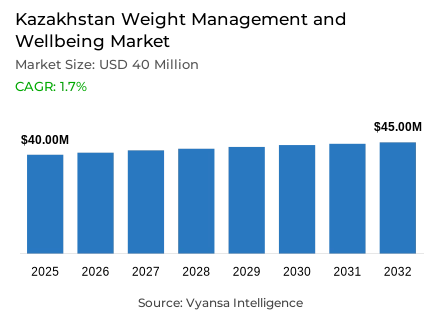
- Weight management and wellbeing market size in Kazakhstan was estimated at USD 40 million in 2025.
- The market size is expected to grow to USD 45 million by 2032.
- Market to register a CAGR of around 1.7% during 2026-32.
- Category Shares
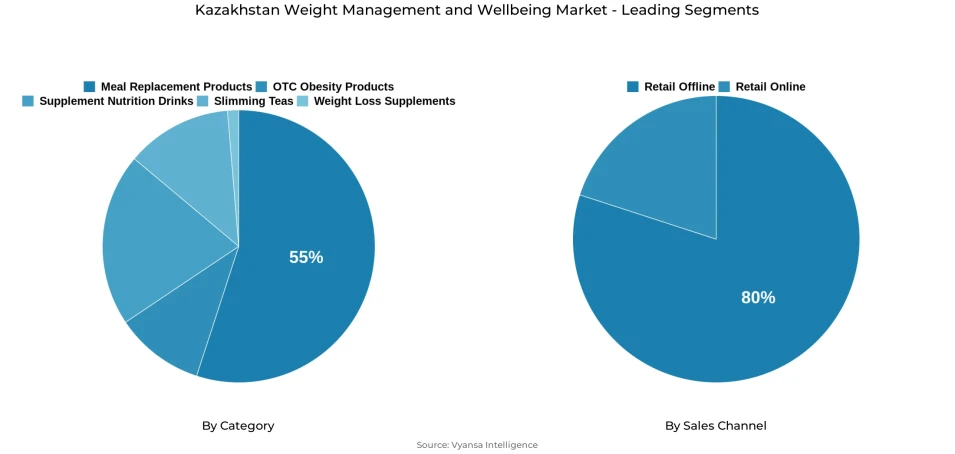
- Meal replacement products grabbed market share of 55%.
- Competition
- More than 10 companies are actively engaged in producing weight management and wellbeing in Kazakhstan.
- Top 5 companies acquired around 65% of the market share.
- Evalar ZAO, Pharmamed ZAO, Tes TOO, Herbalife Kazakhstan TOO, Amway Kazakhstan TOO etc., are few of the top companies.
- Sales Channel
- Retail offline grabbed 80% of the market.
Kazakhstan Weight Management and Wellbeing Market Outlook
The Kazakhstan weight management and wellbeing market size was valued at USD 40 million in 2025 and is projected to grow from USD 42 million in 2026 to USD 45 million by 2032, exhibiting a CAGR of 1.7% during the forecast period. The growth is being maintained as end users are increasingly relating weight control to long-term health, energy levels and mobility and less to short-term appearance objectives.
The weight control appears to be deeply entrenched in a preventive health attitude in 2026. WHO/Europe confirms that Kazakhstan achieved the 2025 Global Monitoring Framework target of reducing premature non-communicable disease mortality by 25%, keeping prevention and risk-factor management highly visible in public discussion. This shift supports consistent interest in weight management and wellbeing solutions that fit daily routines and promote healthy ageing. Budgets in households are pressured. National statistics show year-on-year inflation at 12.2% in January 2026, with food prices rising 12.9%, while the real income index stood at 90.8% for January–November 2025 versus a year earlier. These conditions make end users more cautious, raising expectations for clear efficacy and safety before purchasing weight management and wellbeing products.
Decisions are still made under the influence of the digital world. By 2024, internet penetration reached 96.2% and digital literacy 91.2%, according to National Bureau of Statistics data cited in recent research. Potential customers compare ingredients, reviews and side-effect discussions prior to trial on the internet.
Government reporting shows domestic pharmaceutical production reached 124 billion tenge in 2024, up 18% year on year, creating room for locally produced weight management and wellbeing offerings with compliant labelling and sharper pricing.Meal replacement products lead with a 55% share, reflecting demand for structured, portion-controlled formats. Retail offline accounts for 80% of sales, as physical outlets remain the main trust anchor for ingestible wellbeing purchases.

Kazakhstan Weight Management and Wellbeing Market Growth DriverHealth-first mindset keeps weight control on the agenda
In Kazakhstan in 2026, the idea of weight control is progressively placed within a broader concept of preventive health: people are more aware that being overweight is a long-term health risk, and they are more concerned about how their lifestyles, eating habits, and routines are structured. WHO/Europe reports Kazakhstan reaches the 2025 Global Monitoring Framework target of reducing premature NCD mortality by 25%, keeping prevention and risk‑factor management highly visible in public discourse.
This continued attention creates a sense of relevance of weight management products in daily activities even during financial constraints. The said framing legitimizes weight management as self-care. Weight control is no longer viewed by end users as a cosmetic question that is short term in nature; they relate it to energy, mobility and healthy ageing and this explains why they continue to be interested in solutions that can be used despite hectic schedules and with little behaviour change.
Kazakhstan Weight Management and Wellbeing Market ChallengePrice pressure makes the category easy to postpone
The discretionary spend remains a close watch of many households even in 2026. Kazakhstan’s year‑on‑year inflation is 12.2% in January 2026, and food prices rise 12.9% over the year, both numbers matter because daily essentials crowd out “optional” wellness purchases. End users become pinched and as a result postpone making repeat purchases or switch to less expensive products.
The purchasing power signal is also visible in income dynamics: the Bureau of National Statistics shows a real income index of 90.8% (Jan–Nov 2025 versus the same period a year earlier). That strain constrains the extent to which brands push high prices and it increases the standard of the value assertion, purchasers expect explicit outcomes and high performance safety indicators before they part with additional cash.
Unlock Market Intelligence
Explore the market potential with our data-driven report
Kazakhstan Weight Management and Wellbeing Market TrendDigital health discovery becomes the default journey
Buyers are progressively making weight-control judgements online. By 2024, Kazakhstan’s internet penetration reached 96.2% of the population and digital literacy rises to 91.2%, based on National Bureau of Statistics monitoring data cited in recent academic research. This exposure causes health content, peer reviews, and before/after stories to become very visible and reflects the impression of what works and what is safe.
This digital first behaviour transforms the way of how brands will be trusted. Individuals assess ingredient lists, seek discussions of side effects, and follow wellness creators to stay motivated on a daily basis. This also reduces the time between awareness and trial as well since end users can learn, compare and make decisions at a single place in a short time. Clarity and trust are more relevant than visibility in the competition of the brands in 2026 and transparent claims are a real benefit.
Kazakhstan Weight Management and Wellbeing Market OpportunityDomestic manufacturing push opens room for localisation
The push on policy in Kazakhstan to move to more domestic production provides an actual space of penetration of weight-management solutions produced locally, particularly in areas that depend on imports to maintain prices. Government reporting notes domestic pharmaceutical production reaches 124 billion tenge in 2024, up 18% year on year—a clear signal of rising capacity and stronger local supply capabilities.
In the case of brands, the chance lies in localisation: change formats and pack sizes to the local preferences but retain documentation and conforming labelling high. Local production also serves sharper entry points and replenishment as quickly as possible with the inflation remaining high. Businesses integrating conforming formulations, clear labelling, and consistent supply earn credibility and ease the obstacle to trial by price-sensitive end users.
Unlock Market Intelligence
Explore the market potential with our data-driven report
Kazakhstan Weight Management and Wellbeing Market Segmentation Analysis
By Category
- Meal Replacement Products
- Shakes
- Bars
- Ready-to-Drink (RTD) Beverages
- Powder Mixes
- OTC Obesity Products
- Fat Absorption Inhibitors
- Appetite Suppressants
- Metabolism Boosters
- Supplement Nutrition Drinks
- Slimming Teas
- Weight Loss Supplements
The segment with the highest share is meal replacement products, holding around 55% of the category mix. This top spot suggests a high level of demand of the simple and portion-controlled products that are easy to fit within a working-day schedule, more so when the end users require an organized approach to food preparation without the intricacy involved in making complex meals.
Other product categories, which include weight-loss products, functional foods, and herbal alternatives, are also not yet forgotten, although they frequently take a secondary role to a larger routine. Meal replacements, in their turn, develop a more repeatable habit with more distinct usage pattern (one or two servings a day), which makes maintaining the purchases more continuous and allows it to be more adhered to over time.
By Sales Channel
- Retail Offline
- Pharmacies & Drug Stores
- Supermarkets/Hypermarkets
- Specialty Nutrition Stores
- Retail Online
- E-commerce Platforms
- Brand-Owned Websites
The segment with the highest share under the sales channel split is retail offline, accounting for about 80% of purchases. This superiority shows how end users favor purchasing ingestible wellness products in physical shops where they can look at the packaging, read what is offered in a short time, and be sure of the authenticity.
In the offline, they include pharmacies and large-format stores that assist with routine replenishment and sales consultants and smaller specialty stores that assist with product education and regimen selection. Online alternatives are exposed through social media and delivery promos, yet offline remains the primary trust anchor when it comes to first time purchase, as well as a repeat purchase, when immediate availability is required.
List of Companies Covered in Kazakhstan Weight Management and Wellbeing Market
The companies listed below are highly influential in the Kazakhstan weight management and wellbeing market, with a significant market share and a strong impact on industry developments.
- Evalar ZAO
- Pharmamed ZAO
- Tes TOO
- Herbalife Kazakhstan TOO
- Amway Kazakhstan TOO
- Oriflame Kazakhstan TOO
- Leovit Nutrio OOO
- Tiens Kazakhstan TOO
- Olas Pharm TOO
- Altayskaya Chaynaya Kompaniya OOO
Competitive Landscape
In 2025, the competitive landscape of weight management and wellbeing in Kazakhstan is highly concentrated, with Herbalife Kazakhstan TOO leading at 38.9% value share, followed by Amway Kazakhstan TOO at 18.7%. Herbalife strengthened its dominance through intensive marketing and a well-developed direct selling network, which remains the primary distribution channel in the country. Amway also maintains a strong position, while Oriflame ranks third at a considerable distance. Weight loss supplements are the best-performing category, largely dominated by international brands due to limited local production capacity. Slimming teas continue to grow, supported by affordability and a perception of being a natural, low-risk option, with brands such as Zerde gaining traction in a fragmented segment. Competitive intensity is expected to rise as new direct selling companies enter the market and social media marketing becomes increasingly influential in driving product visibility and consumer engagement.
Frequently Asked Questions
Related Report
- Market Segmentation
- Research Scope
- Research Methodology
- Definitions and Assumptions
- Executive Summary
- Kazakhstan Weight Management and Wellbeing Market Policies, Regulations, and Standards
- Kazakhstan Weight Management and Wellbeing Market Dynamics
- Growth Factors
- Challenges
- Trends
- Opportunities
- Kazakhstan Weight Management and Wellbeing Market Statistics, 2022-2032F
- Market Size & Growth Outlook
- By Revenues in USD Million
- Market Segmentation & Growth Outlook
- By Category
- Meal Replacement Products- Market Insights and Forecast 2022-2032, USD Million
- Shakes- Market Insights and Forecast 2022-2032, USD Million
- Bars- Market Insights and Forecast 2022-2032, USD Million
- Ready-to-Drink (RTD) Beverages- Market Insights and Forecast 2022-2032, USD Million
- Powder Mixes- Market Insights and Forecast 2022-2032, USD Million
- OTC Obesity Products- Market Insights and Forecast 2022-2032, USD Million
- Fat Absorption Inhibitors- Market Insights and Forecast 2022-2032, USD Million
- Appetite Suppressants- Market Insights and Forecast 2022-2032, USD Million
- Metabolism Boosters- Market Insights and Forecast 2022-2032, USD Million
- Supplement Nutrition Drinks- Market Insights and Forecast 2022-2032, USD Million
- Slimming Teas- Market Insights and Forecast 2022-2032, USD Million
- Weight Loss Supplements- Market Insights and Forecast 2022-2032, USD Million
- Meal Replacement Products- Market Insights and Forecast 2022-2032, USD Million
- By Application
- Obesity Management- Market Insights and Forecast 2022-2032, USD Million
- Diabetes-Associated Weight Control- Market Insights and Forecast 2022-2032, USD Million
- Cardiovascular Risk Reduction- Market Insights and Forecast 2022-2032, USD Million
- Post-Bariatric Surgery Weight Maintenance- Market Insights and Forecast 2022-2032, USD Million
- General Fitness & Lifestyle Weight Control- Market Insights and Forecast 2022-2032, USD Million
- By End User
- Hospitals- Market Insights and Forecast 2022-2032, USD Million
- Specialty & Bariatric Clinics- Market Insights and Forecast 2022-2032, USD Million
- Weight Loss Centers- Market Insights and Forecast 2022-2032, USD Million
- Homecare/Individual Consumers- Market Insights and Forecast 2022-2032, USD Million
- By Sales Channel
- Retail Offline- Market Insights and Forecast 2022-2032, USD Million
- Pharmacies & Drug Stores- Market Insights and Forecast 2022-2032, USD Million
- Supermarkets/Hypermarkets- Market Insights and Forecast 2022-2032, USD Million
- Specialty Nutrition Stores- Market Insights and Forecast 2022-2032, USD Million
- Retail Online- Market Insights and Forecast 2022-2032, USD Million
- E-commerce Platforms- Market Insights and Forecast 2022-2032, USD Million
- Brand-Owned Websites- Market Insights and Forecast 2022-2032, USD Million
- Retail Offline- Market Insights and Forecast 2022-2032, USD Million
- By Competitors
- Competition Characteristics
- Market Share & Analysis
- By Category
- Market Size & Growth Outlook
- Kazakhstan Meal Replacement Products Market Statistics, 2022-2032
- Market Size & Growth Outlook
- By Revenues in USD Million
- Market Segmentation & Growth Outlook
- By Application- Market Insights and Forecast 2022-2032, USD Million
- By End User- Market Insights and Forecast 2022-2032, USD Million
- By Sales Channel- Market Insights and Forecast 2022-2032, USD Million
- Market Size & Growth Outlook
- Kazakhstan OTC Obesity Products Market Statistics, 2022-2032
- Market Size & Growth Outlook
- By Revenues in USD Million
- Market Segmentation & Growth Outlook
- By Application- Market Insights and Forecast 2022-2032, USD Million
- By End User- Market Insights and Forecast 2022-2032, USD Million
- By Sales Channel- Market Insights and Forecast 2022-2032, USD Million
- Market Size & Growth Outlook
- Kazakhstan Supplement Nutrition Drinks Market Statistics, 2022-2032
- Market Size & Growth Outlook
- By Revenues in USD Million
- Market Segmentation & Growth Outlook
- By Application- Market Insights and Forecast 2022-2032, USD Million
- By End User- Market Insights and Forecast 2022-2032, USD Million
- By Sales Channel- Market Insights and Forecast 2022-2032, USD Million
- Market Size & Growth Outlook
- Kazakhstan Slimming Teas Market Statistics, 2022-2032
- Market Size & Growth Outlook
- By Revenues in USD Million
- Market Segmentation & Growth Outlook
- By Application- Market Insights and Forecast 2022-2032, USD Million
- By End User- Market Insights and Forecast 2022-2032, USD Million
- By Sales Channel- Market Insights and Forecast 2022-2032, USD Million
- Market Size & Growth Outlook
- Kazakhstan Weight Loss Supplements Market Statistics, 2022-2032
- Market Size & Growth Outlook
- By Revenues in USD Million
- Market Segmentation & Growth Outlook
- By Application- Market Insights and Forecast 2022-2032, USD Million
- By End User- Market Insights and Forecast 2022-2032, USD Million
- By Sales Channel- Market Insights and Forecast 2022-2032, USD Million
- Market Size & Growth Outlook
- Competitive Outlook
- Company Profiles
- Herbalife Kazakhstan TOO
- Business Description
- Product Portfolio
- Collaborations & Alliances
- Recent Developments
- Financial Details
- Others
- Amway Kazakhstan TOO
- Business Description
- Product Portfolio
- Collaborations & Alliances
- Recent Developments
- Financial Details
- Others
- Oriflame Kazakhstan TOO
- Business Description
- Product Portfolio
- Collaborations & Alliances
- Recent Developments
- Financial Details
- Others
- Leovit Nutrio OOO
- Business Description
- Product Portfolio
- Collaborations & Alliances
- Recent Developments
- Financial Details
- Others
- Tiens Kazakhstan TOO
- Business Description
- Product Portfolio
- Collaborations & Alliances
- Recent Developments
- Financial Details
- Others
- Evalar ZAO
- Business Description
- Product Portfolio
- Collaborations & Alliances
- Recent Developments
- Financial Details
- Others
- Pharmamed ZAO
- Business Description
- Product Portfolio
- Collaborations & Alliances
- Recent Developments
- Financial Details
- Others
- Tes TOO
- Business Description
- Product Portfolio
- Collaborations & Alliances
- Recent Developments
- Financial Details
- Others
- Olas Pharm TOO
- Business Description
- Product Portfolio
- Collaborations & Alliances
- Recent Developments
- Financial Details
- Others
- Altayskaya Chaynaya Kompaniya OOO
- Business Description
- Product Portfolio
- Collaborations & Alliances
- Recent Developments
- Financial Details
- Others
- Herbalife Kazakhstan TOO
- Company Profiles
- Disclaimer
| Segment | Sub-Segment |
|---|---|
| By Category |
|
| By Application |
|
| By End User |
|
| By Sales Channel |
|
Research Methodology
This study followed a structured approach comprising four key phases to assess the size and scope of the electro-oxidation market. The process began with thorough secondary research to collect data on the target market, related markets, and broader industry context. These findings, along with preliminary assumptions and estimates, were then validated through extensive primary research involving industry experts from across the value chain. To calculate the overall market size, both top-down and bottom-up methodologies were employed. Finally, market segmentation and data triangulation techniques were applied to refine and validate segment-level estimations.
Secondary Research
The secondary research phase involved gathering data from a wide range of credible and published sources. This step helped in identifying industry trends, defining market segmentation, and understanding the market landscape and value chain.
Sources consulted during this phase included:
- Company annual reports, investor presentations, and press releases
- Industry white papers and certified publications
- Trade directories and market-recognized databases
- Articles from authoritative authors and reputable journals
- Gold and silver standard websites
Secondary research was critical in mapping out the industry's value chain and monetary flow, identifying key market segments, understanding regional variations, and tracking significant industry developments.
Other key sources:
- Financial disclosures
- Industry associations and trade bodies
- News outlets and business magazines
- Academic journals and research studies
- Paid industry databases
Primary Research
To validate secondary data and gain deeper market insights, primary research was conducted with key stakeholders across both the supply and demand sides of the market.
On the demand side, participants included decision-makers and influencers from end-user industries—such as CIOs, CTOs, and CSOs—who provided first-hand perspectives on market needs, product usage, and future expectations.
On the supply side, interviews were conducted with manufacturers, industry associations, and institutional participants to gather insights into current offerings, product pipelines, and market challenges.
Primary interviews provided critical inputs such as:
- Market size and revenue data
- Product and service breakdowns
- Market forecasts
- Regional and application-specific trends
Stakeholders consulted included:
- Leading OEM and solution providers
- Channel and distribution partners
- End users across various applications
- Independent consultants and industry specialists
Market Size Estimation and Data Triangulation
- Identifying Key Market Participants (Secondary Research)
- Goal: To identify the major players or companies in the target market. This typically involves using publicly available data sources such as industry reports, market research publications, and financial statements of companies.
- Tools: Reports from firms like Gartner, Forrester, Euromonitor, Statista, IBISWorld, and others. Public financial statements, news articles, and press releases from top market players.
- Extracting Earnings of Key Market Participants
- Goal: To estimate the earnings generated from the product or service being analyzed. This step helps in understanding the revenue potential of each market player in a specific geography.
- Methods: Earnings data can be gathered from:
- Publicly available financial reports (for listed companies).
- Interviews and primary data sources from professionals, such as Directors, VPs, SVPs, etc. This is especially useful for understanding more nuanced, internal data that isn't publicly disclosed.
- Annual reports and investor presentations of key players.
- Data Collation and Development of a Relevant Data Model
- Goal: To collate inputs from both primary and secondary sources into a structured, data-driven model for market estimation. This model will incorporate key market KPIs and any independent variables relevant to the market.
- Key KPIs: These could include:
- Market size, growth rate, and demand drivers.
- Industry-specific metrics like market share, average revenue per customer (ARPC), or average deal size.
- External variables, such as economic growth rates, inflation rates, or commodity prices, that could affect the market.
- Data Modeling: Based on this data, the market forecasts are developed for the next 5 years. A combination of trend analysis, scenario modeling, and statistical regression might be used to generate projections.
- Scenario Analysis
- Goal: To test different assumptions and validate how sensitive the market is to changes in key variables (e.g., market demand, regulatory changes, technological disruptions).
- Types of Scenarios:
- Base Case: Based on current assumptions and historical data.
- Best-Case Scenario: Assuming favorable market conditions, regulatory environments, and technological advancements.
- Worst-Case Scenario: Accounting for adverse factors, such as economic downturns, stricter regulations, or unexpected disruptions.












