Japan Digestive Remedies Market Report: Trends, Growth and Forecast (2026-2032)
By Product Type (Paediatric Digestive Remedies (Paediatric Diarrhoeal Remedies, Paediatric Indigestion & Heartburn Remedies, Paediatric Laxatives, Paediatric Motion Sickness Remedies), Diarrhoeal Remedies, IBS Treatments, Indigestion & Heartburn Remedies (Antacids, Antiflatulents, Digestive Enzymes, H2 Blockers, Proton Pump Inhibitors), Laxatives, Motion Sickness Remedies), By Age Group (Children & Adolescents (01-17 years), Adults (18-65 years), Geriatric (65+ years)), By Sales Channel (Retail Online, Retail Offline (Hospitals, Clinics, Pharmacies)) ... Read more
|
Major Players
|
Japan Digestive Remedies Market Statistics and Insights, 2026
- Market Size Statistics
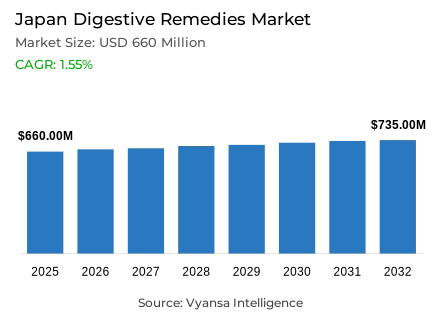
- Digestive remedies market size in Japan was valued at USD 660 million in 2025 and is estimated at USD 670 Million in 2026.
- The market size is expected to grow to USD 735 million by 2032.
- Market to register a CAGR of around 1.55% during 2026-32.
- Product Type Shares
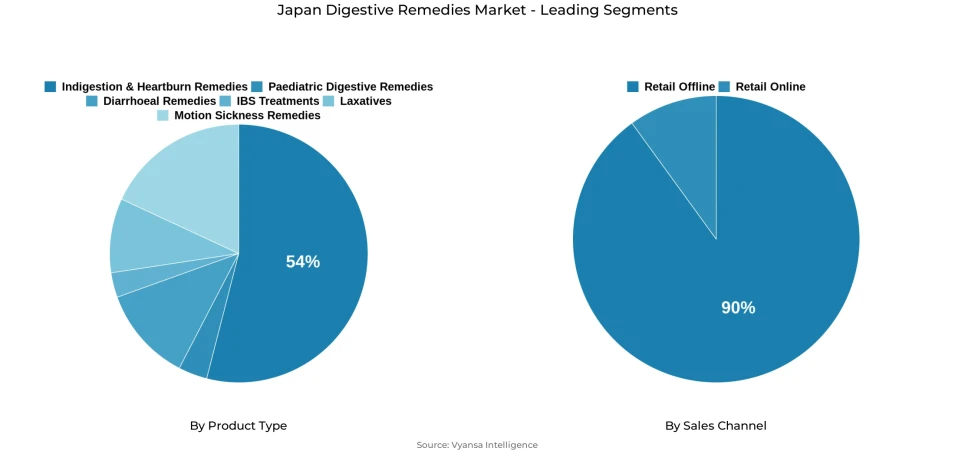
- Indigestion & heartburn remedies grabbed market share of 54%.
- Competition
- More than 15 companies are actively engaged in producing digestive remedies in Japan.
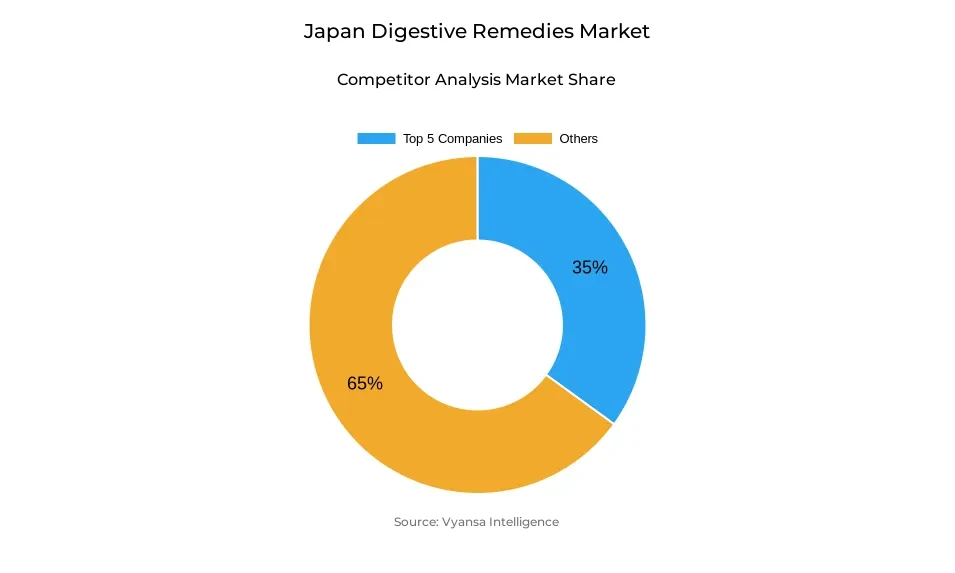
- Top 5 companies acquired around 35% of the market share.
- Ohta's Isan Co Ltd, Lion Corp, Alinamin Pharmaceutical Co Ltd, Taisho Pharmaceutical Co Ltd, Daiichi Sankyo Healthcare Co Ltd etc., are few of the top companies.
- Sales Channel
- Retail offline grabbed 90% of the market.
Japan Digestive Remedies Market Outlook
The Japan digestive remedies market size was valued at USD 660 million in 2025 and is projected to grow from USD 670 million in 2026 to USD 735 million by 2032, exhibiting a CAGR of around 1.55% during the forecast period. Growth is supported by strong travel activity, dining out, and everyday lifestyle patterns that continue to create demand for fast digestive relief. At the same time, policy support for self-medication and OTC access is gradually strengthening the role of over-the-counter healthcare in managing common digestive discomfort.
Travel and active lifestyles continue to support everyday use of digestive remedies. Japan National Tourism Organization (JNTO) reports that Japan receives 42,683,600 inbound visitors in 2025, up 15.8% year on year, while the Japan Tourism Agency records 119.64 million domestic trips in January-March 2025, with domestic travel spending reaching JPY 5.65 trillion, up 15.5% year on year. These patterns increase irregular meals, social dining, and travel-related stomach discomfort. As a result, indigestion and heartburn remedies hold about 54% of product share, reflecting the frequent need for quick OTC relief during travel, social events, and busy daily routines.
At the same time, long-term trends in population structure and demographics will impact the long term future of digestive remedies. According to Japan’s Statistics Bureau, the total population for Japan was 122.86 million in February 2026, which represents a decline of 580,000 from the previous year and a continued trend of decline for children under 15 that decreased 360,000 to 13.497 million from the previous year. For brands operating in mature markets where the customer base continues to shrink, premiumization, product differentiation, and enhanced value proposition will become more important than increased unit sales to achieve growth.
Distribution remains heavily centred on traditional retail. Retail offline accounts for about 90% of sales, as pharmacies and drugstores remain the preferred channel for quick access and pharmacist advice when symptoms such as nausea, diarrhoea, or heartburn appear suddenly. The Ministry of Health, Labour and Welfare notes that the revised medicine sales system takes effect on 1 May 2026, allowing broader online access for some OTC categories while maintaining pharmacist oversight. Even with these changes, digestive remedies continue to rely strongly on pharmacy-led retail for trusted purchase decisions and immediate symptom relief.
Japan Digestive Remedies Market Growth DriverTravel-Led Daily Routines Keep Relief Demand Active
A key driver for digestive remedies in Japan is the continued normalisation of travel and out-of-home activity. JNTO reports that Japan received 42,683,600 inbound visitors in 2025, up 15.8% year on year, while visitor arrivals in December 2025 alone reaches 3,617,700. At the same time, the Japan Tourism Agency states that Japanese residents made 119.64 million domestic trips in January-March 2025, with domestic travel spending rising to JPY 5.65 trillion, up 115.5% year on year.
This rise in travel, dining out, and festive movement keeps demand strong for motion sickness remedies, anti-diarrhoeals, and fast digestive relief products.In Japan, digestive remedies are closely associated with active lifestyles since travelling, irregular food consumption, and increased food intake often result in stomach discomfort.
Japan Digestive Remedies Market ChallengePopulation Decline Limits Broader Volume Expansion
A major challenge for digestive remedies in Japan is the country’s shrinking population base. Japan’s Statistics Bureau reports that in February 2026 the total population was 122.86 million ,580,000 less from previous year. The same release shows the population aged under 15 at 13.497 million, also down 360,000 year on year. This means the consumer base is gradually narrowing even as specific digestive issues remain common.
For digestive remedies, this creates a structural challenge for wider volume growth in a mature OTC market. Even when need remains stable in some age groups, fewer residents and fewer younger households reduce the pace of category expansion. That makes it harder for brands to rely only on volume and pushes them to depend more on premiumisation and value-added positioning.
Unlock Market Intelligence
Explore the market potential with our data-driven report
Japan Digestive Remedies Market TrendSelf-Care Access Becomes More Flexible and Digital
A clear trend in Japan is the steady expansion of self-medication access. The Ministry of Health, Labour and Welfare states that the revised medicine sales system takes effect on 1 May 2026. Under this framework, Japan continues to classify general OTC medicines into three classes, all of which can be sold online, while some guidance medicines can also move online after pharmacist judgement and proper counselling.
This matters for digestive remedies because the category depends heavily on convenience, trust, and quick purchase decisions. Easier access to pharmacist-supported OTC buying, including online pathways for eligible products, strengthens the role of self-care in stomach, reflux, and bowel-related problems. The market trend is therefore moving beyond simple symptom relief toward more accessible, guidance-backed OTC purchasing.
Japan Digestive Remedies Market OpportunityOTC Switch Reform Creates Room for Higher-Value Products
A strong opportunity in Japan comes from the government’s push to expand switch OTC medicines. A 2025 Ministry of Health, Labour and Welfare (MHLW) policy paper states that the review of insurance coverage for OTC-like prescription drugs is set to be carried out during FY 2026. The same document also says the government aims to switch about 60 active ingredients to OTC status by the end of 2026, focusing on ingredients already switched in at least two overseas markets.
For digestive remedies, this opens room for more advanced self-medication products, especially in areas such as reflux and gastric acid management. It gives manufacturers a stronger path to build premium OTC portfolios with clearer functional value. In a mature market, this policy shift supports innovation and can help established digestive brands move into higher-value treatment spaces.
Unlock Market Intelligence
Explore the market potential with our data-driven report
Japan Digestive Remedies Market Segmentation Analysis
By Product Type
- Paediatric Digestive Remedies
- Paediatric Diarrhoeal Remedies
- Paediatric Indigestion & Heartburn Remedies
- Paediatric Laxatives
- Paediatric Motion Sickness Remedies
- Diarrhoeal Remedies
- IBS Treatments
- Indigestion & Heartburn Remedies
- Antacids
- Antiflatulents
- Digestive Enzymes
- H2 Blockers
- Proton Pump Inhibitors
- Laxatives
- Motion Sickness Remedies
The segment has the highest share around product type under indigestion & heartburn remedies, with about 54% of the market. This segment leads because acidity, reflux, and indigestion are common issues linked with eating out, social drinking, travel, and irregular meals. In Japan, these products are used for quick symptom control, which keeps them highly relevant in daily OTC purchase behaviour.
The category’s position is also supported by stronger movement and food-related occasions. JNTO reports 42.68 million inbound visitors in 2025, while the Japan Tourism Agency records 119.64 million domestic trips in January-March 2025 alone. More travel and out-of-home consumption support demand for fast digestive support, helping indigestion & heartburn remedies remain the leading product type.
By Sales Channel
- Retail Online
- Retail Offline
- Hospitals
- Clinics
- Pharmacies
The segment has the highest share around sales channel under retail offline, with about 90% of the market. This leadership remains logical because digestive remedies are often bought for immediate relief, and Japanese consumers still rely heavily on pharmacies and drugstores for quick access, product comparison, and pharmacist guidance when symptoms such as diarrhoea, heartburn, or nausea appear suddenly.
This is also supported by Japan’s medicine sales framework. MHLW explains that OTC medicines are primarily bought through pharmacies and drugstores, and even after the 1 May 2026 reform, some products still require pharmacist involvement and proper information provision. That keeps physical retail highly important for trust-led and urgent digestive remedy purchases.
List of Companies Covered in Japan Digestive Remedies Market
The companies listed below are highly influential in the Japan digestive remedies market, with a significant market share and a strong impact on industry developments.
- Ohta's Isan Co Ltd
- Lion Corp
- Alinamin Pharmaceutical Co Ltd
- Taisho Pharmaceutical Co Ltd
- Daiichi Sankyo Healthcare Co Ltd
- Taiko Pharmaceutical Co Ltd
- SSP Co Ltd
- Kowa Co Ltd
- Rohto Pharmaceutical Co Ltd
- Eisai Co Ltd
Competitive Landscape
In 2025, the competitive landscape of digestive remedies in Japan was relatively fragmented, with Taisho Pharmaceutical Co Ltd leading the market with a 12.2% retail value share, followed by Daiichi Sankyo Healthcare Co Ltd at 7.3%. Taisho Pharmaceutical benefits from the strong performance of its well-known Seirogan brand, which continues to maintain strong consumer trust and has expanded its portfolio with convenient formats such as Seirogan Sugar-Coated A Portable designed for on-the-go use. Daiichi Sankyo Healthcare also maintains a notable position through its portfolio of gastrointestinal treatments and established presence in pharmacies, which remain the dominant distribution channel. Demand for digestive remedies is supported by the recovery of social activities, including dining out, travel and social drinking, which contribute to digestive discomfort and sustain demand for treatments such as diarrhoeal remedies and motion sickness products. However, the category faces increasing competition from functional foods, beverages and probiotic supplements that promote gut health as part of a preventative approach. In addition, regulatory developments encouraging self-medication and the expansion of OTC switch medicines are expected to reshape the competitive environment, while rising price competition from private label products in drugstores is also influencing market dynamics.
Frequently Asked Questions
Related Report
- Market Segmentation
- Research Scope
- Research Methodology
- Definitions and Assumptions
- Executive Summary
- Japan Digestive Remedies Market Policies, Regulations, and Standards
- Japan Digestive Remedies Market Dynamics
- Growth Factors
- Challenges
- Trends
- Opportunities
- Japan Digestive Remedies Market Statistics, 2022-2032F
- Market Size & Growth Outlook
- By Revenues in USD Million
- Market Segmentation & Growth Outlook
- By Product Type
- Paediatric Digestive Remedies- Market Insights and Forecast 2022-2032, USD Million
- Paediatric Diarrhoeal Remedies- Market Insights and Forecast 2022-2032, USD Million
- Paediatric Indigestion & Heartburn Remedies- Market Insights and Forecast 2022-2032, USD Million
- Paediatric Laxatives- Market Insights and Forecast 2022-2032, USD Million
- Paediatric Motion Sickness Remedies- Market Insights and Forecast 2022-2032, USD Million
- Diarrhoeal Remedies- Market Insights and Forecast 2022-2032, USD Million
- IBS Treatments- Market Insights and Forecast 2022-2032, USD Million
- Indigestion & Heartburn Remedies- Market Insights and Forecast 2022-2032, USD Million
- Antacids- Market Insights and Forecast 2022-2032, USD Million
- Antiflatulents- Market Insights and Forecast 2022-2032, USD Million
- Digestive Enzymes- Market Insights and Forecast 2022-2032, USD Million
- H2 Blockers- Market Insights and Forecast 2022-2032, USD Million
- Proton Pump Inhibitors- Market Insights and Forecast 2022-2032, USD Million
- Laxatives- Market Insights and Forecast 2022-2032, USD Million
- Motion Sickness Remedies- Market Insights and Forecast 2022-2032, USD Million
- Paediatric Digestive Remedies- Market Insights and Forecast 2022-2032, USD Million
- By Age Group
- Children & Adolescents (01-17 years)- Market Insights and Forecast 2022-2032, USD Million
- Adults (18-65 years)- Market Insights and Forecast 2022-2032, USD Million
- Geriatric (65+ years)- Market Insights and Forecast 2022-2032, USD Million
- By Sales Channel
- Retail Online- Market Insights and Forecast 2022-2032, USD Million
- Retail Offline- Market Insights and Forecast 2022-2032, USD Million
- Hospitals- Market Insights and Forecast 2022-2032, USD Million
- Clinics- Market Insights and Forecast 2022-2032, USD Million
- Pharmacies- Market Insights and Forecast 2022-2032, USD Million
- By Competitors
- Competition Characteristics
- Market Share & Analysis
- By Product Type
- Market Size & Growth Outlook
- Japan Paediatric Digestive Remedies Market Statistics, 2022-2032
- Market Size & Growth Outlook
- By Revenues in USD Million
- Market Segmentation & Growth Outlook
- By Age Group- Market Insights and Forecast 2022-2032, USD Million
- By Sales Channel- Market Insights and Forecast 2022-2032, USD Million
- Market Size & Growth Outlook
- Japan Diarrhoeal Remedies Market Statistics, 2022-2032
- Market Size & Growth Outlook
- By Revenues in USD Million
- Market Segmentation & Growth Outlook
- By Age Group- Market Insights and Forecast 2022-2032, USD Million
- By Sales Channel- Market Insights and Forecast 2022-2032, USD Million
- Market Size & Growth Outlook
- Japan IBS Treatments Market Statistics, 2022-2032
- Market Size & Growth Outlook
- By Revenues in USD Million
- Market Segmentation & Growth Outlook
- By Age Group- Market Insights and Forecast 2022-2032, USD Million
- By Sales Channel- Market Insights and Forecast 2022-2032, USD Million
- Market Size & Growth Outlook
- Japan Indigestion & Heartburn Remedies Market Statistics, 2022-2032
- Market Size & Growth Outlook
- By Revenues in USD Million
- Market Segmentation & Growth Outlook
- By Age Group- Market Insights and Forecast 2022-2032, USD Million
- By Sales Channel- Market Insights and Forecast 2022-2032, USD Million
- Market Size & Growth Outlook
- Japan Laxatives Market Statistics, 2022-2032
- Market Size & Growth Outlook
- By Revenues in USD Million
- Market Segmentation & Growth Outlook
- By Age Group- Market Insights and Forecast 2022-2032, USD Million
- By Sales Channel- Market Insights and Forecast 2022-2032, USD Million
- Market Size & Growth Outlook
- Japan Motion Sickness Remedies Market Statistics, 2022-2032
- Market Size & Growth Outlook
- By Revenues in USD Million
- Market Segmentation & Growth Outlook
- By Age Group- Market Insights and Forecast 2022-2032, USD Million
- By Sales Channel- Market Insights and Forecast 2022-2032, USD Million
- Market Size & Growth Outlook
- Competitive Outlook
- Company Profiles
- Taisho Pharmaceutical Co Ltd
- Business Description
- Product Portfolio
- Collaborations & Alliances
- Recent Developments
- Financial Details
- Others
- Daiichi Sankyo Healthcare Co Ltd
- Business Description
- Product Portfolio
- Collaborations & Alliances
- Recent Developments
- Financial Details
- Others
- Taiko Pharmaceutical Co Ltd
- Business Description
- Product Portfolio
- Collaborations & Alliances
- Recent Developments
- Financial Details
- Others
- SSP Co Ltd
- Business Description
- Product Portfolio
- Collaborations & Alliances
- Recent Developments
- Financial Details
- Others
- Kowa Co Ltd
- Business Description
- Product Portfolio
- Collaborations & Alliances
- Recent Developments
- Financial Details
- Others
- Ohta's Isan Co Ltd
- Business Description
- Product Portfolio
- Collaborations & Alliances
- Recent Developments
- Financial Details
- Others
- Lion Corp
- Business Description
- Product Portfolio
- Collaborations & Alliances
- Recent Developments
- Financial Details
- Others
- Alinamin Pharmaceutical Co Ltd
- Business Description
- Product Portfolio
- Collaborations & Alliances
- Recent Developments
- Financial Details
- Others
- Rohto Pharmaceutical Co Ltd
- Business Description
- Product Portfolio
- Collaborations & Alliances
- Recent Developments
- Financial Details
- Others
- Eisai Co Ltd
- Business Description
- Product Portfolio
- Collaborations & Alliances
- Recent Developments
- Financial Details
- Others
- Taisho Pharmaceutical Co Ltd
- Company Profiles
- Disclaimer
| Segment | Sub-Segment |
|---|---|
| By Product Type |
|
| By Age Group |
|
| By Sales Channel |
|
Research Methodology
This study followed a structured approach comprising four key phases to assess the size and scope of the electro-oxidation market. The process began with thorough secondary research to collect data on the target market, related markets, and broader industry context. These findings, along with preliminary assumptions and estimates, were then validated through extensive primary research involving industry experts from across the value chain. To calculate the overall market size, both top-down and bottom-up methodologies were employed. Finally, market segmentation and data triangulation techniques were applied to refine and validate segment-level estimations.
Secondary Research
The secondary research phase involved gathering data from a wide range of credible and published sources. This step helped in identifying industry trends, defining market segmentation, and understanding the market landscape and value chain.
Sources consulted during this phase included:
- Company annual reports, investor presentations, and press releases
- Industry white papers and certified publications
- Trade directories and market-recognized databases
- Articles from authoritative authors and reputable journals
- Gold and silver standard websites
Secondary research was critical in mapping out the industry's value chain and monetary flow, identifying key market segments, understanding regional variations, and tracking significant industry developments.
Other key sources:
- Financial disclosures
- Industry associations and trade bodies
- News outlets and business magazines
- Academic journals and research studies
- Paid industry databases
Primary Research
To validate secondary data and gain deeper market insights, primary research was conducted with key stakeholders across both the supply and demand sides of the market.
On the demand side, participants included decision-makers and influencers from end-user industries—such as CIOs, CTOs, and CSOs—who provided first-hand perspectives on market needs, product usage, and future expectations.
On the supply side, interviews were conducted with manufacturers, industry associations, and institutional participants to gather insights into current offerings, product pipelines, and market challenges.
Primary interviews provided critical inputs such as:
- Market size and revenue data
- Product and service breakdowns
- Market forecasts
- Regional and application-specific trends
Stakeholders consulted included:
- Leading OEM and solution providers
- Channel and distribution partners
- End users across various applications
- Independent consultants and industry specialists
Market Size Estimation and Data Triangulation
- Identifying Key Market Participants (Secondary Research)
- Goal: To identify the major players or companies in the target market. This typically involves using publicly available data sources such as industry reports, market research publications, and financial statements of companies.
- Tools: Reports from firms like Gartner, Forrester, Euromonitor, Statista, IBISWorld, and others. Public financial statements, news articles, and press releases from top market players.
- Extracting Earnings of Key Market Participants
- Goal: To estimate the earnings generated from the product or service being analyzed. This step helps in understanding the revenue potential of each market player in a specific geography.
- Methods: Earnings data can be gathered from:
- Publicly available financial reports (for listed companies).
- Interviews and primary data sources from professionals, such as Directors, VPs, SVPs, etc. This is especially useful for understanding more nuanced, internal data that isn't publicly disclosed.
- Annual reports and investor presentations of key players.
- Data Collation and Development of a Relevant Data Model
- Goal: To collate inputs from both primary and secondary sources into a structured, data-driven model for market estimation. This model will incorporate key market KPIs and any independent variables relevant to the market.
- Key KPIs: These could include:
- Market size, growth rate, and demand drivers.
- Industry-specific metrics like market share, average revenue per customer (ARPC), or average deal size.
- External variables, such as economic growth rates, inflation rates, or commodity prices, that could affect the market.
- Data Modeling: Based on this data, the market forecasts are developed for the next 5 years. A combination of trend analysis, scenario modeling, and statistical regression might be used to generate projections.
- Scenario Analysis
- Goal: To test different assumptions and validate how sensitive the market is to changes in key variables (e.g., market demand, regulatory changes, technological disruptions).
- Types of Scenarios:
- Base Case: Based on current assumptions and historical data.
- Best-Case Scenario: Assuming favorable market conditions, regulatory environments, and technological advancements.
- Worst-Case Scenario: Accounting for adverse factors, such as economic downturns, stricter regulations, or unexpected disruptions.












