Indonesia Digestive Remedies Market Report: Trends, Growth and Forecast (2026-2032)
By Product Type (Paediatric Digestive Remedies (Paediatric Diarrhoeal Remedies, Paediatric Indigestion & Heartburn Remedies, Paediatric Laxatives, Paediatric Motion Sickness Remedies), Diarrhoeal Remedies, IBS Treatments, Indigestion & Heartburn Remedies (Antacids, Antiflatulents, Digestive Enzymes, H2 Blockers, Proton Pump Inhibitors), Laxatives, Motion Sickness Remedies), By Age Group (Children & Adolescents (01-17 years), Adults (18-65 years), Geriatric (65+ years)), By Sales Channel (Retail Online, Retail Offline (Hospitals, Clinics, Pharmacies)), By Region (Sumatra, Java, Kalimantan, Sulawesi, Others) ... Read more
|
Major Players
|
Indonesia Digestive Remedies Market Statistics and Insights, 2026
- Market Size Statistics
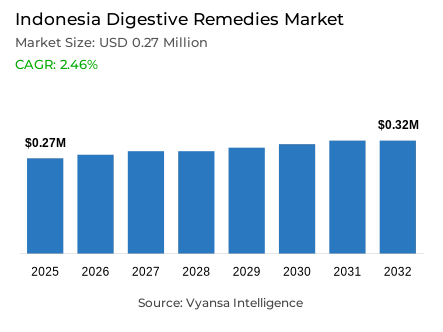
- Digestive remedies market size in Indonesia was valued at USD 0.27 million in 2025 and is estimated at USD 0.28 Million in 2026.
- The market size is expected to grow to USD 0.32 million by 2032.
- Market to register a CAGR of around 2.46% during 2026-32.
- Product Type Shares
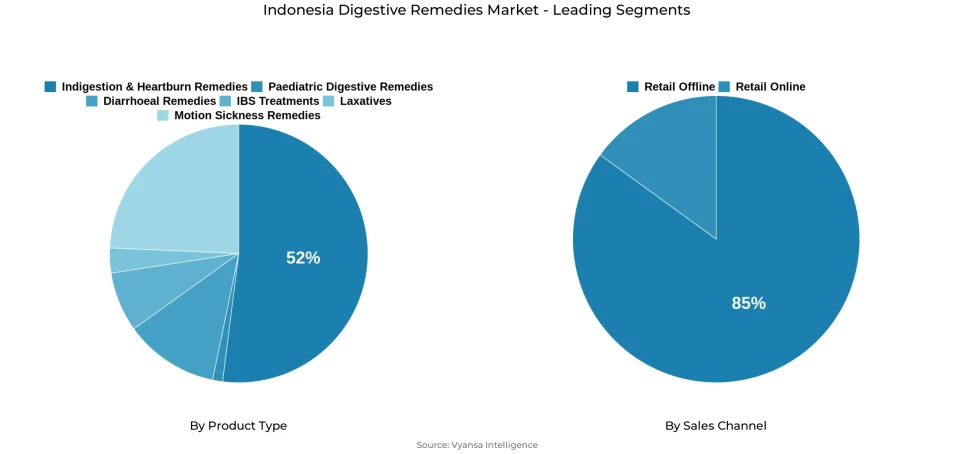
- Indigestion & heartburn remedies grabbed market share of 52%.
- Competition
- More than 10 companies are actively engaged in producing digestive remedies in Indonesia.
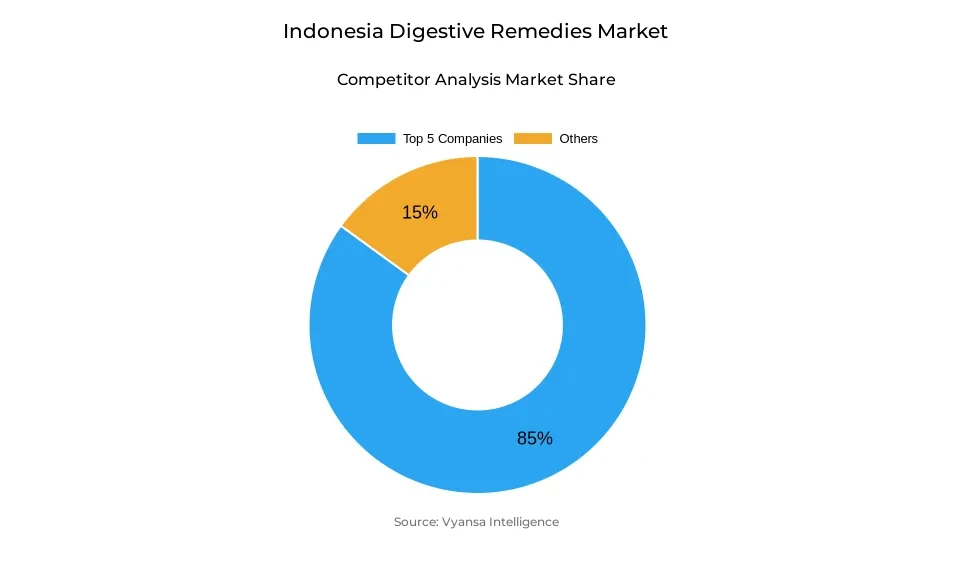
- Top 5 companies acquired around 85% of the market share.
- Medifarma Laboratories Inc PT, PT Aventis Pharma, Bintang Kupu-Kupu PT, Kalbe Farma Tbk PT, Soho Industri Pharmasi PT etc., are few of the top companies.
- Sales Channel
- Retail offline grabbed 85% of the market.
Indonesia Digestive Remedies Market Outlook
The Indonesia digestive remedies market size was valued at USD 0.27 million in 2025 and is projected to grow from USD 0.28 million in 2026 to USD 0.32 million by 2032, exhibiting a CAGR of around 2.46% during the forecast period. Growth is supported by rising mobility and travel activity, which increases exposure to irregular eating habits and stomach discomfort. Statistics Indonesia (BPS) reports that international visitor arrivals reach 1.39 million in September 2025, up 9.04% year on year, while domestic tourism trips reach 94.36 million, rising 13.19%, highlighting strong travel activity that can lead to digestive discomfort.
Travel, festive gatherings, and out-of-home eating continue to sustain everyday demand for digestive remedies. Consumers often look for quick relief from symptoms such as acidity, bloating, or stomach upset during journeys or social occasions. Within product categories, indigestion and heartburn remedies hold around 52% share, reflecting the frequent occurrence of these conditions and the need for fast, familiar OTC solutions. These products remain widely used because they provide simple and accessible treatment for common digestive discomfort.
However, purchasing behaviour remains largely reactive rather than preventive. BPS reports that 78.43% of Indonesians practice self-treatment during the last month in 2025, showing that many consumers buy remedies only when symptoms appear. Inflation also influences spending decisions, with year-on-year inflation recorded at 2.72% in November 2025, encouraging households to remain cautious about routine OTC purchases. This behaviour keeps demand closely tied to immediate need rather than regular stockpiling of digestive remedies.
Distribution remains dominated by traditional retail channels. Retail offline accounts for about 85% of sales, as consumers prefer nearby pharmacies and stores when they need immediate relief from digestive discomfort. At the same time, digital connectivity is expanding product awareness and discovery. BPS reports that 72.78% of Indonesians access the internet and 68.65% own a mobile phone in 2024, supporting broader digital engagement and improving visibility for digestive remedies through online information and product promotion.
Indonesia Digestive Remedies Market Growth DriverTravel-Led Consumption Keeps Digestive Relief Relevant
One of the major motivators of digestive remedies in Indonesia is the long-term revival of travel and activities that are not performed at home. Official BPS data indicate that international visitor arrivals reached 1.39 million in September 2025, an increase of 9.04% year on year, while domestic tourism trips amounted to 94.36 million, up 13.19%. This increase in mobility supports the increased use of motion-sickness products, antacids, and indigestion products because consumers travel, eat out, and face changes in their routine.
This trend keeps a strong association between digestive cures and daily locomotion and holiday travel. Travel in Indonesia is generally associated with irregular eating, more luxurious food, and longer travel, which increases the demand of quick over-the-counter (OTC) medication. Digestive remedies are therefore a viable and recurrent category especially to consumers who want quick assistance when they are out on an excursion and during celebratory events.
Indonesia Digestive Remedies Market ChallengeNeed-Based Buying Limits Regular Product Uptake
One of the biggest problems facing digestive remedies in Indonesia is that buying is very sensitive. BPS reports that 78.43% of Indonesians engage in self‑treatment during the preceding month in 2025. This shows that a significant number of consumers only treat minor health issues when they appear, but not by keeping a consistent supply of OTC products at home. This may limit the consistent volume flow in digestive remedies, particularly in classes used only on occasion.
Price alert also adds to this difficulty. BPS records Indonesia’s year‑on‑year inflation at 2.72% in November 2025. Although the inflation is moderate, it still encourages cautious household spending and makes consumers more discriminating about regular OTC purchases. This maintains demand as a response to urgent need and slows down the more generalized habitual consumption of digestive remedies.
Unlock Market Intelligence
Explore the market potential with our data-driven report
Indonesia Digestive Remedies Market TrendPortable Formats Gain Ground with Mobile-First Consumers
One of the trends in Indonesia is the rise of convenient, easy to carry digestive remedies. BPS states that 72.78% of the population accessed the internet in 2024, while 68.65% owned a mobile cellular phone. This represents a more connected, fast-moving, and comfortable consumer base that prefers to learn about products online. The environment thus promotes digestive remedies that are easy to carry, fast to consume and easy to comprehend.
Consequently, liquid sachets, ready-to-drink products, and other on-the-go products are gaining prominence in the category. These formats fit the mobile lifestyles of Indonesia, as they provide quick relief without planning and can be easily integrated into traveling, working, and celebrating schedules. Convenience is no longer a peripheral aspect in the context of digestive care; it has become a core product trend.
Indonesia Digestive Remedies Market OpportunityDigital Reach Expands Access to Everyday OTC Relief
One of the opportunities in Indonesia is the potential to use digital access to expand access to digestive remedies. BPS data show that 72.78% of Indonesians accessed the internet in 2024, and 68.65% owned a mobile phone. This offers OTC brands a broader platform to inform consumers, increase visibility, and facilitate repeat purchases beyond in-store promotion.
This is a major opportunity in the case of digestive remedies since most of the purchases are urgent and symptom-based. Brands that integrate trusted relief with strong digital presence, easy-to-use instructions, and convenient package sizes can target more consumers at the point of need. In a market where convenience and awareness are the key factors, a more robust digital presence opens room to broader brand coverage and greater category penetration.
Unlock Market Intelligence
Explore the market potential with our data-driven report
Indonesia Digestive Remedies Market Segmentation Analysis
By Product Type
- Paediatric Digestive Remedies
- Paediatric Diarrhoeal Remedies
- Paediatric Indigestion & Heartburn Remedies
- Paediatric Laxatives
- Paediatric Motion Sickness Remedies
- Diarrhoeal Remedies
- IBS Treatments
- Indigestion & Heartburn Remedies
- Antacids
- Antiflatulents
- Digestive Enzymes
- H2 Blockers
- Proton Pump Inhibitors
- Laxatives
- Motion Sickness Remedies
The segment has the highest market share in the product type under indigestion & heartburn remedies, of approximately 52% of the market. This segment is the leader since acidity, bloating, and stomach discomfort are typical short-term problems that consumers want to resolve quickly. The category also enjoys good OTC familiarity and easy use which makes the products easy to carry along in day to day activities and during festive meals.
It is also supported by the fact that Indonesia has a high travel activity. BPS records 94.36 domestic tourism arrivals and 1.39 million international visitor arrivals in September 2025, both rising annually. Increased commuting and eating out of the house increases the demand to quickly relieve indigestion and heartburn, which continues to keep this segment dominant in the market.
By Sales Channel
- Retail Online
- Retail Offline
- Hospitals
- Clinics
- Pharmacies
The segment has the highest share around sales channel under retail offline, with about 85% of the market. Offline remains dominant because digestive remedies are often bought for immediate relief, and consumers prefer nearby pharmacies, drugstores, and general retail outlets when acidity, diarrhoea, nausea, or bloating starts suddenly. Fast availability and direct product access continue to give physical stores a strong advantage.
This pattern also matches Indonesia’s reactive self-care behavior. BPS reports that 78.43% of the population self-treats during the last month in 2025. That suggests many purchases happen only when symptoms appear, which naturally supports quick offline buying instead of delayed fulfilment. As a result, retail offline remains the main channel for digestive remedies across the country.
List of Companies Covered in Indonesia Digestive Remedies Market
The companies listed below are highly influential in the Indonesia digestive remedies market, with a significant market share and a strong impact on industry developments.
- Medifarma Laboratories Inc PT
- PT Aventis Pharma
- Bintang Kupu-Kupu PT
- Kalbe Farma Tbk PT
- Soho Industri Pharmasi PT
- Johnson & Johnson Indonesia PT
- Phapros (Persero) Tbk PT
- Pharos Indonesia PT
- Sari Enesis Indah PT
- Galenium Pharmasia Laboratories PT
Competitive Landscape
In 2025, the competitive landscape of digestive remedies in Indonesia was led by Kalbe Farma Tbk PT with a 42.3% retail value share, followed by Soho Industri Pharmasi PT at 20.7%. Kalbe Farma maintains its strong leadership primarily through its Promag brand, which benefits from a well-established reputation, extensive nationwide distribution and multiple packaging formats that cater to different consumer needs. The introduction of convenient liquid sachet variants has further strengthened the brand’s popularity among consumers seeking quick and portable digestive relief. Meanwhile, Soho Industri Pharmasi also holds a significant position in the market with a strong portfolio of digestive health products. Demand for digestive remedies continues to be supported by the high prevalence of diarrhoeal diseases linked to poor water quality and sanitation in some regions, as well as seasonal consumption patterns during periods such as Ramadan and Eid when dietary habits change. Additionally, the recovery of travel and tourism activities is expected to drive further demand for motion sickness remedies and other digestive treatments, although increasing awareness of hygiene and preventive health practices may moderate long-term growth as consumers focus more on preventing digestive problems rather than treating them after symptoms appear.
Frequently Asked Questions
Related Report
- Market Segmentation
- Research Scope
- Research Methodology
- Definitions and Assumptions
- Executive Summary
- Indonesia Digestive Remedies Market Policies, Regulations, and Standards
- Indonesia Digestive Remedies Market Dynamics
- Growth Factors
- Challenges
- Trends
- Opportunities
- Indonesia Digestive Remedies Market Statistics, 2022-2032F
- Market Size & Growth Outlook
- By Revenues in USD Million
- Market Segmentation & Growth Outlook
- By Product Type
- Paediatric Digestive Remedies- Market Insights and Forecast 2022-2032, USD Million
- Paediatric Diarrhoeal Remedies- Market Insights and Forecast 2022-2032, USD Million
- Paediatric Indigestion & Heartburn Remedies- Market Insights and Forecast 2022-2032, USD Million
- Paediatric Laxatives- Market Insights and Forecast 2022-2032, USD Million
- Paediatric Motion Sickness Remedies- Market Insights and Forecast 2022-2032, USD Million
- Diarrhoeal Remedies- Market Insights and Forecast 2022-2032, USD Million
- IBS Treatments- Market Insights and Forecast 2022-2032, USD Million
- Indigestion & Heartburn Remedies- Market Insights and Forecast 2022-2032, USD Million
- Antacids- Market Insights and Forecast 2022-2032, USD Million
- Antiflatulents- Market Insights and Forecast 2022-2032, USD Million
- Digestive Enzymes- Market Insights and Forecast 2022-2032, USD Million
- H2 Blockers- Market Insights and Forecast 2022-2032, USD Million
- Proton Pump Inhibitors- Market Insights and Forecast 2022-2032, USD Million
- Laxatives- Market Insights and Forecast 2022-2032, USD Million
- Motion Sickness Remedies- Market Insights and Forecast 2022-2032, USD Million
- Paediatric Digestive Remedies- Market Insights and Forecast 2022-2032, USD Million
- By Age Group
- Children & Adolescents (01-17 years)- Market Insights and Forecast 2022-2032, USD Million
- Adults (18-65 years)- Market Insights and Forecast 2022-2032, USD Million
- Geriatric (65+ years)- Market Insights and Forecast 2022-2032, USD Million
- By Sales Channel
- Retail Online- Market Insights and Forecast 2022-2032, USD Million
- Retail Offline- Market Insights and Forecast 2022-2032, USD Million
- Hospitals- Market Insights and Forecast 2022-2032, USD Million
- Clinics- Market Insights and Forecast 2022-2032, USD Million
- Pharmacies- Market Insights and Forecast 2022-2032, USD Million
- By Region
- Sumatra
- Java
- Kalimantan
- Sulawesi
- Others
- By Competitors
- Competition Characteristics
- Market Share & Analysis
- By Product Type
- Market Size & Growth Outlook
- Indonesia Paediatric Digestive Remedies Market Statistics, 2022-2032
- Market Size & Growth Outlook
- By Revenues in USD Million
- Market Segmentation & Growth Outlook
- By Age Group- Market Insights and Forecast 2022-2032, USD Million
- By Sales Channel- Market Insights and Forecast 2022-2032, USD Million
- By Region- Market Insights and Forecast 2022-2032, USD Million
- Market Size & Growth Outlook
- Indonesia Diarrhoeal Remedies Market Statistics, 2022-2032
- Market Size & Growth Outlook
- By Revenues in USD Million
- Market Segmentation & Growth Outlook
- By Age Group- Market Insights and Forecast 2022-2032, USD Million
- By Sales Channel- Market Insights and Forecast 2022-2032, USD Million
- By Region- Market Insights and Forecast 2022-2032, USD Million
- Market Size & Growth Outlook
- Indonesia IBS Treatments Market Statistics, 2022-2032
- Market Size & Growth Outlook
- By Revenues in USD Million
- Market Segmentation & Growth Outlook
- By Age Group- Market Insights and Forecast 2022-2032, USD Million
- By Sales Channel- Market Insights and Forecast 2022-2032, USD Million
- By Region- Market Insights and Forecast 2022-2032, USD Million
- Market Size & Growth Outlook
- Indonesia Indigestion & Heartburn Remedies Market Statistics, 2022-2032
- Market Size & Growth Outlook
- By Revenues in USD Million
- Market Segmentation & Growth Outlook
- By Age Group- Market Insights and Forecast 2022-2032, USD Million
- By Sales Channel- Market Insights and Forecast 2022-2032, USD Million
- By Region- Market Insights and Forecast 2022-2032, USD Million
- Market Size & Growth Outlook
- Indonesia Laxatives Market Statistics, 2022-2032
- Market Size & Growth Outlook
- By Revenues in USD Million
- Market Segmentation & Growth Outlook
- By Age Group- Market Insights and Forecast 2022-2032, USD Million
- By Sales Channel- Market Insights and Forecast 2022-2032, USD Million
- By Region- Market Insights and Forecast 2022-2032, USD Million
- Market Size & Growth Outlook
- Indonesia Motion Sickness Remedies Market Statistics, 2022-2032
- Market Size & Growth Outlook
- By Revenues in USD Million
- Market Segmentation & Growth Outlook
- By Age Group- Market Insights and Forecast 2022-2032, USD Million
- By Sales Channel- Market Insights and Forecast 2022-2032, USD Million
- By Region- Market Insights and Forecast 2022-2032, USD Million
- Market Size & Growth Outlook
- Competitive Outlook
- Company Profiles
- Kalbe Farma Tbk PT
- Business Description
- Product Portfolio
- Collaborations & Alliances
- Recent Developments
- Financial Details
- Others
- Soho Industri Pharmasi PT
- Business Description
- Product Portfolio
- Collaborations & Alliances
- Recent Developments
- Financial Details
- Others
- Johnson & Johnson Indonesia PT
- Business Description
- Product Portfolio
- Collaborations & Alliances
- Recent Developments
- Financial Details
- Others
- Phapros (Persero) Tbk PT
- Business Description
- Product Portfolio
- Collaborations & Alliances
- Recent Developments
- Financial Details
- Others
- Pharos Indonesia PT
- Business Description
- Product Portfolio
- Collaborations & Alliances
- Recent Developments
- Financial Details
- Others
- Medifarma Laboratories Inc PT
- Business Description
- Product Portfolio
- Collaborations & Alliances
- Recent Developments
- Financial Details
- Others
- PT Aventis Pharma
- Business Description
- Product Portfolio
- Collaborations & Alliances
- Recent Developments
- Financial Details
- Others
- Bintang Kupu-Kupu PT
- Business Description
- Product Portfolio
- Collaborations & Alliances
- Recent Developments
- Financial Details
- Others
- Sari Enesis Indah PT
- Business Description
- Product Portfolio
- Collaborations & Alliances
- Recent Developments
- Financial Details
- Others
- Galenium Pharmasia Laboratories PT
- Business Description
- Product Portfolio
- Collaborations & Alliances
- Recent Developments
- Financial Details
- Others
- Kalbe Farma Tbk PT
- Company Profiles
- Disclaimer
| Segment | Sub-Segment |
|---|---|
| By Product Type |
|
| By Age Group |
|
| By Sales Channel |
|
| By Region |
|
Research Methodology
This study followed a structured approach comprising four key phases to assess the size and scope of the electro-oxidation market. The process began with thorough secondary research to collect data on the target market, related markets, and broader industry context. These findings, along with preliminary assumptions and estimates, were then validated through extensive primary research involving industry experts from across the value chain. To calculate the overall market size, both top-down and bottom-up methodologies were employed. Finally, market segmentation and data triangulation techniques were applied to refine and validate segment-level estimations.
Secondary Research
The secondary research phase involved gathering data from a wide range of credible and published sources. This step helped in identifying industry trends, defining market segmentation, and understanding the market landscape and value chain.
Sources consulted during this phase included:
- Company annual reports, investor presentations, and press releases
- Industry white papers and certified publications
- Trade directories and market-recognized databases
- Articles from authoritative authors and reputable journals
- Gold and silver standard websites
Secondary research was critical in mapping out the industry's value chain and monetary flow, identifying key market segments, understanding regional variations, and tracking significant industry developments.
Other key sources:
- Financial disclosures
- Industry associations and trade bodies
- News outlets and business magazines
- Academic journals and research studies
- Paid industry databases
Primary Research
To validate secondary data and gain deeper market insights, primary research was conducted with key stakeholders across both the supply and demand sides of the market.
On the demand side, participants included decision-makers and influencers from end-user industries—such as CIOs, CTOs, and CSOs—who provided first-hand perspectives on market needs, product usage, and future expectations.
On the supply side, interviews were conducted with manufacturers, industry associations, and institutional participants to gather insights into current offerings, product pipelines, and market challenges.
Primary interviews provided critical inputs such as:
- Market size and revenue data
- Product and service breakdowns
- Market forecasts
- Regional and application-specific trends
Stakeholders consulted included:
- Leading OEM and solution providers
- Channel and distribution partners
- End users across various applications
- Independent consultants and industry specialists
Market Size Estimation and Data Triangulation
- Identifying Key Market Participants (Secondary Research)
- Goal: To identify the major players or companies in the target market. This typically involves using publicly available data sources such as industry reports, market research publications, and financial statements of companies.
- Tools: Reports from firms like Gartner, Forrester, Euromonitor, Statista, IBISWorld, and others. Public financial statements, news articles, and press releases from top market players.
- Extracting Earnings of Key Market Participants
- Goal: To estimate the earnings generated from the product or service being analyzed. This step helps in understanding the revenue potential of each market player in a specific geography.
- Methods: Earnings data can be gathered from:
- Publicly available financial reports (for listed companies).
- Interviews and primary data sources from professionals, such as Directors, VPs, SVPs, etc. This is especially useful for understanding more nuanced, internal data that isn't publicly disclosed.
- Annual reports and investor presentations of key players.
- Data Collation and Development of a Relevant Data Model
- Goal: To collate inputs from both primary and secondary sources into a structured, data-driven model for market estimation. This model will incorporate key market KPIs and any independent variables relevant to the market.
- Key KPIs: These could include:
- Market size, growth rate, and demand drivers.
- Industry-specific metrics like market share, average revenue per customer (ARPC), or average deal size.
- External variables, such as economic growth rates, inflation rates, or commodity prices, that could affect the market.
- Data Modeling: Based on this data, the market forecasts are developed for the next 5 years. A combination of trend analysis, scenario modeling, and statistical regression might be used to generate projections.
- Scenario Analysis
- Goal: To test different assumptions and validate how sensitive the market is to changes in key variables (e.g., market demand, regulatory changes, technological disruptions).
- Types of Scenarios:
- Base Case: Based on current assumptions and historical data.
- Best-Case Scenario: Assuming favorable market conditions, regulatory environments, and technological advancements.
- Worst-Case Scenario: Accounting for adverse factors, such as economic downturns, stricter regulations, or unexpected disruptions.












