India Weight Management and Wellbeing Market Report: Trends, Growth and Forecast (2026-2032)
By Category (Meal Replacement Products (Shakes, Bars, Ready-to-Drink (RTD) Beverages, Powder Mixes), OTC Obesity Products (Fat Absorption Inhibitors, Appetite Suppressants, Metabolism Boosters), Supplement Nutrition Drinks, Slimming Teas, Weight Loss Supplements), By Application (Obesity Management, Diabetes-Associated Weight Control, Cardiovascular Risk Reduction, Post-Bariatric Surgery Weight Maintenance, General Fitness & Lifestyle Weight Control), By End User (Hospitals, Specialty & Bariatric Clinics, Weight Loss Centers, Homecare/Individual Consumers), By Sales Channel (Retail Offline (Pharmacies & Drug Stores, Supermarkets/Hypermarkets, Specialty Nutrition Stores), Retail Online (E-commerce Platforms, Brand-Owned Websites)), By Region (North, East, West, South) ... Read more
|
Major Players
|
India Weight Management and Wellbeing Market Statistics and Insights, 2026
- Market Size Statistics
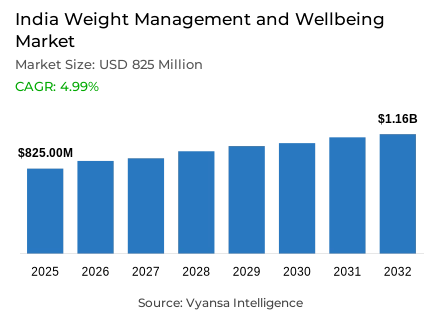
- Weight management and wellbeing market size in India was estimated at USD 825 million in 2025.
- The market size is expected to grow to USD 1.16 billion by 2032.
- Market to register a CAGR of around 4.99% during 2026-32.
- Category Shares
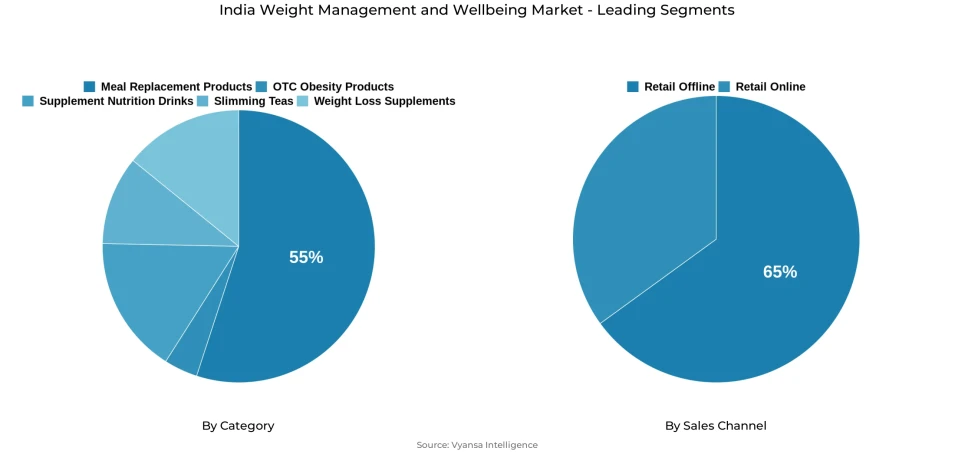
- Meal replacement products grabbed market share of 55%.
- Competition
- More than 10 companies are actively engaged in producing weight management and wellbeing in India.
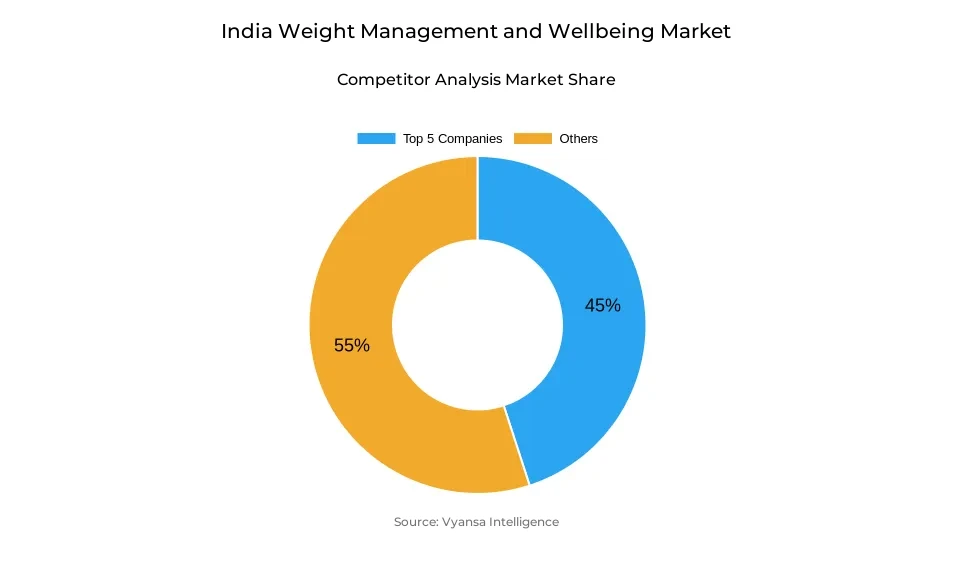
- Top 5 companies acquired around 45% of the market share.
- Oriflame India Pvt Ltd, Goodcare Pharma Pvt Ltd, Sanat Products Ltd, Herbalife International India Pvt Ltd, Zydus Wellness Ltd etc., are few of the top companies.
- Sales Channel
- Retail offline grabbed 65% of the market.
India Weight Management and Wellbeing Market Outlook
The India weight management and wellbeing market size was valued at USD 825 million in 2025 and is projected to grow from USD 890 in 2026 to USD 1.16 billion by 2032, exhibiting a CAGR of 4.99% during the forecast period. Growth is supported by rising awareness about diet related health risks and the increasing need for convenient solutions that help End users manage calorie intake alongside busy lifestyles.
Estimates from Indian Council of Medical Research (ICMR)- National Institute of Nutrition(NIN) indicate that 56.4% of the country’s total disease burden is linked to unhealthy diets, reinforcing the importance of preventive health practices. As a result, weight management and wellbeing products such as nutrition shakes, fibre blends, and portion-controlled options are gaining attention as practical tools that complement lifestyle changes. WHO further highlights that healthy diets and physical activity can prevent up to 80% of type 2 diabetes, encouraging demand for solutions that simplify daily adherence.
At the same time, regulatory scrutiny is intensifying. During FY 2024-25, the Central Consumer Protection Authority issued 79 notices across sectors, including 8 under food/health and wellness for misleading advertisements. This environment pushes brands to strengthen substantiation and transparency. Meanwhile, meal replacement products lead the category with a 55% share due to their ready-to-consume format and ease of portion control.
Distribution remains largely store-driven, with retail offline accounting for 65% share. End users prefer pharmacies and supermarkets for trusted access and immediate purchase. Continued policy support in 2026-27, including enhanced health allocations and research funding, further strengthens the foundation for evidence-led weight management and wellbeing solutions across India.
India Weight Management and Wellbeing Market Growth DriverDiet-Linked Disease Burden Drives Preventive Choices
In India, the ICMR-National Institute of Nutrition notes that estimates show 56.4% of the country’s total disease burden is due to unhealthy diets. This keeps calorie control and “better-for-you” eating top of mind for many end users, especially when long work hours and on the go meals make consistent diet planning difficult.
With diet and inactivity tied to chronic conditions, end users look for practical tools alongside lifestyle change. Weight management and wellbeing offerings such as nutrition shakes, fibre blends, and portion controlled options fit this “control without complexity” need without requiring drastic routines. WHO states that healthy diets and physical activity can prevent up to 80% of type 2 diabetes, so shoppers increasingly favour products that make daily adherence easier.
India Weight Management and Wellbeing Market ChallengeTighter Scrutiny on Claims and Promotions
Regulators actively police exaggerated “instant” results and unverified health promises in wellness advertising. During FY 2024-25, the Central Consumer Protection Authority (CCPA) issued 79 notices across sectors, and under “Food/Health and Wellness” it issued 8 notices for misleading advertisements including food & beverages or medical product consultation.
The same report highlights that orders can require discontinuing or modifying misleading ads, delisting products, or imposing penalties. This enforcement raises compliance risk for brands selling weight management and wellbeing products through digital-first campaigns and influencer marketing. Claims need stronger substantiation, clearer qualifiers, and tighter alignment between label, ad copy, and what the product can realistically deliver, slowing go to market and increasing cost to serve.
Unlock Market Intelligence
Explore the market potential with our data-driven report
India Weight Management and Wellbeing Market TrendRegulatory Push for a Standardised Nutraceutical Playbook
Product development increasingly aligns with formal nutraceutical rules, especially for gut health positioning. In a direction dated 30 August 2024, FSSAI re-operationalises provisions of the draft Food Safety and Standards act (FSS) regulations covering health supplements, nutraceuticals, foods for special dietary use or medical purpose, and prebiotic and probiotic foods, with effect from 01.07.2024 while final rules are pending.
The attached June 2024 direction also allows use of additives and the GMP table as per Codex until the final notification. This clarity nudges brands to build multi-benefit formulations, weight control plus digestion or metabolism, within a recognised compliance pathway. Weight management and wellbeing players therefore emphasise cleaner labels, dosage justification, and stronger claim substantiation to fit the evolving rulebook.
India Weight Management and Wellbeing Market OpportunityR&D Tailwinds Create Space for Evidence-Led Offerings
Public policy in 2026 visibly backs more science-backed health products and services. Under Union Budget 2026-27, the Ministry of Health & Family Welfare receives INR 1,06,530.42 crore, and the government announces “Bio Pharma Shakti” with a INR 10,000 crore outlay to boost biologics/biosimilars and promote pharma research. The same release notes that the ICMR allocation is enhanced to INR 4,000 crore in budget estimates 2026-27.
It also emphasises strengthening the drug regulation framework through augmentation of CDSCO’s scientific capacity. This creates a clearer runway for collaborations between consumer brands, clinicians, and pharma/biotech to validate ingredients, run studies, and build trusted offerings around medically supervised weight loss. For weight management and wellbeing, the opportunity lies in earning end user confidence through evidence, not hype.
Unlock Market Intelligence
Explore the market potential with our data-driven report
India Weight Management and Wellbeing Market Segmentation Analysis
By Category
- Meal Replacement Products
- OTC Obesity Products
- Supplement Nutrition Drinks
- Slimming Teas
- Weight Loss Supplements
The segment has the highest share around product type under the category as meal replacement products, holding about 55% share. This lead comes from their clear use-case: a ready-to-consume option that supports portion control when end users want quick, measurable routine changes.
Meal replacements also fit modern consumption habits because they are easy to standardise in one scoop, one sachet, one bottle. This makes daily tracking simpler than calorie counting full meals. For first time users, this simplicity lowers the “start barrier” compared to planning every meal from scratch. Other offerings such as slimming teas, fat burners, and fibre/probiotic blends typically play a supporting role.
By Sales Channel
- Retail Offline
- Retail Online
The segment has the highest share around segment under the sales channel as offline retail, holding about 65% share. Many first time users prefer buying weight management and wellbeing products from pharmacies, supermarkets, and nutrition stores because it feels more trustworthy and they can ask basic questions on usage, safety, and expected results before paying.
This channel also fits the “need it now” behaviour seen in the category, where busy urban end users rely on convenient aids when regular exercise and meal planning are hard to sustain. Strong brand visibility through athlete-led promotions and broad in-store availability keeps these products easy to pick up alongside routine shopping, supporting repeat purchase.
List of Companies Covered in India Weight Management and Wellbeing Market
The companies listed below are highly influential in the India weight management and wellbeing market, with a significant market share and a strong impact on industry developments.
- Oriflame India Pvt Ltd
- Goodcare Pharma Pvt Ltd
- Sanat Products Ltd
- Herbalife International India Pvt Ltd
- Zydus Wellness Ltd
- Himalaya Drug Co
- Abbott India Ltd
- Camillotek India Pvt Ltd
- Amway India Enterprises Pvt Ltd
Competitive Landscape
In 2025, the competitive landscape of weight management and wellbeing in India remains highly concentrated, with Herbalife International India Pvt Ltd maintaining clear leadership, supported by strong brand visibility and strategic sports partnerships. Its long-standing association with high-profile athletes and its role as Official Nutrition Partner for Team India reinforce brand credibility and consumer trust, strengthening its dominance in retail value terms. Zydus Wellness Ltd holds a significantly smaller share, indicating a sharp gap between the category leader and other players. Meanwhile, emerging brands such as Carbamide Forte and Plix are gaining traction by offering multifunctional supplements that combine weight loss benefits with gut health, immunity and metabolic support. Competitive intensity is expected to rise further as pharmaceutical entrants, including Novo Nordisk with Wegovy, prepare to compete with traditional meal replacement and weight loss supplements, potentially reshaping positioning strategies across the category.
Frequently Asked Questions
Related Report
- Market Segmentation
- Research Scope
- Research Methodology
- Definitions and Assumptions
- Executive Summary
- India Weight Management and Wellbeing Market Policies, Regulations, and Standards
- India Weight Management and Wellbeing Market Dynamics
- Growth Factors
- Challenges
- Trends
- Opportunities
- India Weight Management and Wellbeing Market Statistics, 2022-2032F
- Market Size & Growth Outlook
- By Revenues in USD Million
- Market Segmentation & Growth Outlook
- By Category
- Meal Replacement Products- Market Insights and Forecast 2022-2032, USD Million
- Shakes- Market Insights and Forecast 2022-2032, USD Million
- Bars- Market Insights and Forecast 2022-2032, USD Million
- Ready-to-Drink (RTD) Beverages- Market Insights and Forecast 2022-2032, USD Million
- Powder Mixes- Market Insights and Forecast 2022-2032, USD Million
- OTC Obesity Products- Market Insights and Forecast 2022-2032, USD Million
- Fat Absorption Inhibitors- Market Insights and Forecast 2022-2032, USD Million
- Appetite Suppressants- Market Insights and Forecast 2022-2032, USD Million
- Metabolism Boosters- Market Insights and Forecast 2022-2032, USD Million
- Supplement Nutrition Drinks- Market Insights and Forecast 2022-2032, USD Million
- Slimming Teas- Market Insights and Forecast 2022-2032, USD Million
- Weight Loss Supplements- Market Insights and Forecast 2022-2032, USD Million
- Meal Replacement Products- Market Insights and Forecast 2022-2032, USD Million
- By Application
- Obesity Management- Market Insights and Forecast 2022-2032, USD Million
- Diabetes-Associated Weight Control- Market Insights and Forecast 2022-2032, USD Million
- Cardiovascular Risk Reduction- Market Insights and Forecast 2022-2032, USD Million
- Post-Bariatric Surgery Weight Maintenance- Market Insights and Forecast 2022-2032, USD Million
- General Fitness & Lifestyle Weight Control- Market Insights and Forecast 2022-2032, USD Million
- By End User
- Hospitals- Market Insights and Forecast 2022-2032, USD Million
- Specialty & Bariatric Clinics- Market Insights and Forecast 2022-2032, USD Million
- Weight Loss Centers- Market Insights and Forecast 2022-2032, USD Million
- Homecare/Individual Consumers- Market Insights and Forecast 2022-2032, USD Million
- By Sales Channel
- Retail Offline- Market Insights and Forecast 2022-2032, USD Million
- Pharmacies & Drug Stores- Market Insights and Forecast 2022-2032, USD Million
- Supermarkets/Hypermarkets- Market Insights and Forecast 2022-2032, USD Million
- Specialty Nutrition Stores- Market Insights and Forecast 2022-2032, USD Million
- Retail Online- Market Insights and Forecast 2022-2032, USD Million
- E-commerce Platforms- Market Insights and Forecast 2022-2032, USD Million
- Brand-Owned Websites- Market Insights and Forecast 2022-2032, USD Million
- Retail Offline- Market Insights and Forecast 2022-2032, USD Million
- By Region
- North
- East
- West
- South
- By Competitors
- Competition Characteristics
- Market Share & Analysis
- By Category
- Market Size & Growth Outlook
- India Meal Replacement Products Market Statistics, 2022-2032
- Market Size & Growth Outlook
- By Revenues in USD Million
- Market Segmentation & Growth Outlook
- By Application- Market Insights and Forecast 2022-2032, USD Million
- By End User- Market Insights and Forecast 2022-2032, USD Million
- By Sales Channel- Market Insights and Forecast 2022-2032, USD Million
- By Region- Market Insights and Forecast 2022-2032, USD Million
- Market Size & Growth Outlook
- India OTC Obesity Products Market Statistics, 2022-2032
- Market Size & Growth Outlook
- By Revenues in USD Million
- Market Segmentation & Growth Outlook
- By Application- Market Insights and Forecast 2022-2032, USD Million
- By End User- Market Insights and Forecast 2022-2032, USD Million
- By Sales Channel- Market Insights and Forecast 2022-2032, USD Million
- By Region- Market Insights and Forecast 2022-2032, USD Million
- Market Size & Growth Outlook
- India Supplement Nutrition Drinks Market Statistics, 2022-2032
- Market Size & Growth Outlook
- By Revenues in USD Million
- Market Segmentation & Growth Outlook
- By Application- Market Insights and Forecast 2022-2032, USD Million
- By End User- Market Insights and Forecast 2022-2032, USD Million
- By Sales Channel- Market Insights and Forecast 2022-2032, USD Million
- By Region- Market Insights and Forecast 2022-2032, USD Million
- Market Size & Growth Outlook
- India Slimming Teas Market Statistics, 2022-2032
- Market Size & Growth Outlook
- By Revenues in USD Million
- Market Segmentation & Growth Outlook
- By Application- Market Insights and Forecast 2022-2032, USD Million
- By End User- Market Insights and Forecast 2022-2032, USD Million
- By Sales Channel- Market Insights and Forecast 2022-2032, USD Million
- By Region- Market Insights and Forecast 2022-2032, USD Million
- Market Size & Growth Outlook
- India Weight Loss Supplements Market Statistics, 2022-2032
- Market Size & Growth Outlook
- By Revenues in USD Million
- Market Segmentation & Growth Outlook
- By Application- Market Insights and Forecast 2022-2032, USD Million
- By End User- Market Insights and Forecast 2022-2032, USD Million
- By Sales Channel- Market Insights and Forecast 2022-2032, USD Million
- By Region- Market Insights and Forecast 2022-2032, USD Million
- Market Size & Growth Outlook
- Competitive Outlook
- Company Profiles
- Herbalife International India Pvt Ltd
- Business Description
- Product Portfolio
- Collaborations & Alliances
- Recent Developments
- Financial Details
- Others
- Zydus Wellness Ltd
- Business Description
- Product Portfolio
- Collaborations & Alliances
- Recent Developments
- Financial Details
- Others
- Himalaya Drug Co The
- Business Description
- Product Portfolio
- Collaborations & Alliances
- Recent Developments
- Financial Details
- Others
- Abbott India Ltd
- Business Description
- Product Portfolio
- Collaborations & Alliances
- Recent Developments
- Financial Details
- Others
- Camillotek India Pvt Ltd
- Business Description
- Product Portfolio
- Collaborations & Alliances
- Recent Developments
- Financial Details
- Others
- Oriflame India Pvt Ltd
- Business Description
- Product Portfolio
- Collaborations & Alliances
- Recent Developments
- Financial Details
- Others
- Goodcare Pharma Pvt Ltd
- Business Description
- Product Portfolio
- Collaborations & Alliances
- Recent Developments
- Financial Details
- Others
- Sanat Products Ltd
- Business Description
- Product Portfolio
- Collaborations & Alliances
- Recent Developments
- Financial Details
- Others
- Amway India Enterprises Pvt Ltd
- Business Description
- Product Portfolio
- Collaborations & Alliances
- Recent Developments
- Financial Details
- Others
- Heinz India Pvt Ltd
- Business Description
- Product Portfolio
- Collaborations & Alliances
- Recent Developments
- Financial Details
- Others
- Herbalife International India Pvt Ltd
- Company Profiles
- Disclaimer
| Segment | Sub-Segment |
|---|---|
| By Category |
|
| By Application |
|
| By End User |
|
| By Sales Channel |
|
| By Region |
|
Research Methodology
This study followed a structured approach comprising four key phases to assess the size and scope of the electro-oxidation market. The process began with thorough secondary research to collect data on the target market, related markets, and broader industry context. These findings, along with preliminary assumptions and estimates, were then validated through extensive primary research involving industry experts from across the value chain. To calculate the overall market size, both top-down and bottom-up methodologies were employed. Finally, market segmentation and data triangulation techniques were applied to refine and validate segment-level estimations.
Secondary Research
The secondary research phase involved gathering data from a wide range of credible and published sources. This step helped in identifying industry trends, defining market segmentation, and understanding the market landscape and value chain.
Sources consulted during this phase included:
- Company annual reports, investor presentations, and press releases
- Industry white papers and certified publications
- Trade directories and market-recognized databases
- Articles from authoritative authors and reputable journals
- Gold and silver standard websites
Secondary research was critical in mapping out the industry's value chain and monetary flow, identifying key market segments, understanding regional variations, and tracking significant industry developments.
Other key sources:
- Financial disclosures
- Industry associations and trade bodies
- News outlets and business magazines
- Academic journals and research studies
- Paid industry databases
Primary Research
To validate secondary data and gain deeper market insights, primary research was conducted with key stakeholders across both the supply and demand sides of the market.
On the demand side, participants included decision-makers and influencers from end-user industries—such as CIOs, CTOs, and CSOs—who provided first-hand perspectives on market needs, product usage, and future expectations.
On the supply side, interviews were conducted with manufacturers, industry associations, and institutional participants to gather insights into current offerings, product pipelines, and market challenges.
Primary interviews provided critical inputs such as:
- Market size and revenue data
- Product and service breakdowns
- Market forecasts
- Regional and application-specific trends
Stakeholders consulted included:
- Leading OEM and solution providers
- Channel and distribution partners
- End users across various applications
- Independent consultants and industry specialists
Market Size Estimation and Data Triangulation
- Identifying Key Market Participants (Secondary Research)
- Goal: To identify the major players or companies in the target market. This typically involves using publicly available data sources such as industry reports, market research publications, and financial statements of companies.
- Tools: Reports from firms like Gartner, Forrester, Euromonitor, Statista, IBISWorld, and others. Public financial statements, news articles, and press releases from top market players.
- Extracting Earnings of Key Market Participants
- Goal: To estimate the earnings generated from the product or service being analyzed. This step helps in understanding the revenue potential of each market player in a specific geography.
- Methods: Earnings data can be gathered from:
- Publicly available financial reports (for listed companies).
- Interviews and primary data sources from professionals, such as Directors, VPs, SVPs, etc. This is especially useful for understanding more nuanced, internal data that isn't publicly disclosed.
- Annual reports and investor presentations of key players.
- Data Collation and Development of a Relevant Data Model
- Goal: To collate inputs from both primary and secondary sources into a structured, data-driven model for market estimation. This model will incorporate key market KPIs and any independent variables relevant to the market.
- Key KPIs: These could include:
- Market size, growth rate, and demand drivers.
- Industry-specific metrics like market share, average revenue per customer (ARPC), or average deal size.
- External variables, such as economic growth rates, inflation rates, or commodity prices, that could affect the market.
- Data Modeling: Based on this data, the market forecasts are developed for the next 5 years. A combination of trend analysis, scenario modeling, and statistical regression might be used to generate projections.
- Scenario Analysis
- Goal: To test different assumptions and validate how sensitive the market is to changes in key variables (e.g., market demand, regulatory changes, technological disruptions).
- Types of Scenarios:
- Base Case: Based on current assumptions and historical data.
- Best-Case Scenario: Assuming favorable market conditions, regulatory environments, and technological advancements.
- Worst-Case Scenario: Accounting for adverse factors, such as economic downturns, stricter regulations, or unexpected disruptions.












