India Waste Sorting Equipment Market Report: Trends, Growth and Forecast (2026-2032)
By Waste Type (Plastic Waste, Paper & Cardboard, Metal Waste, Organic Waste, Glass Waste, Construction & Demolition Waste, E Waste, Others), By Technology (Mechanical Sorting, Sensor-Based Sorting (Optical, NIR, X ray), Magnetic & Eddy Current Separation, Air Classification, Robotic & AI Based Sorting, Others), By Application (Municipal Waste Management, Industrial Waste Management, Commercial Recycling, Construction & Demolition Waste Processing, Waste to Energy Pre Processing, Material Recovery Facilities (MRFs)), By Operation Mode (Manual, Semi Automatic, Fully Automatic), By Region (North, East, Southwest, Northwest, North East, South) ... Read more
|
Major Players
|
India Waste Sorting Equipment Market Statistics and Insights, 2026
- Market Size Statistics
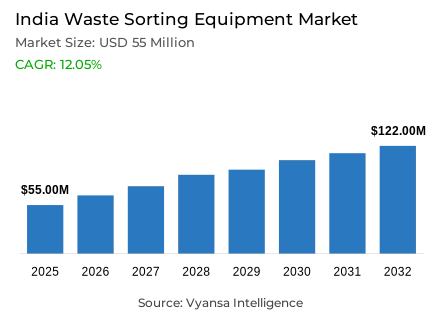
- Waste sorting equipment market size in India was valued at USD 55 million in 2025 and is estimated at USD 62 million in 2026.
- The market size is expected to grow to USD 122 million by 2032.
- Market to register a CAGR of around 12.05% during 2026-32.
- Waste Type Shares
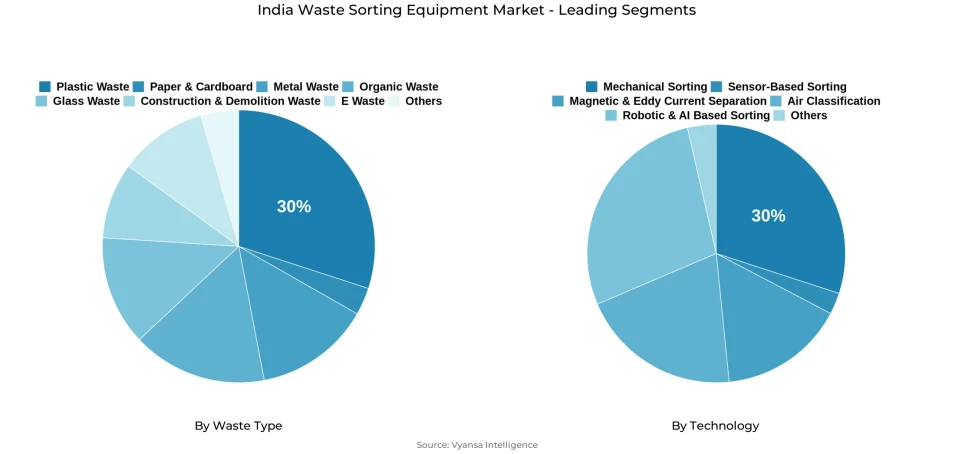
- Plastic waste grabbed market share of 30%.
- Competition
- More than 10 companies are actively engaged in producing waste sorting equipment in India.
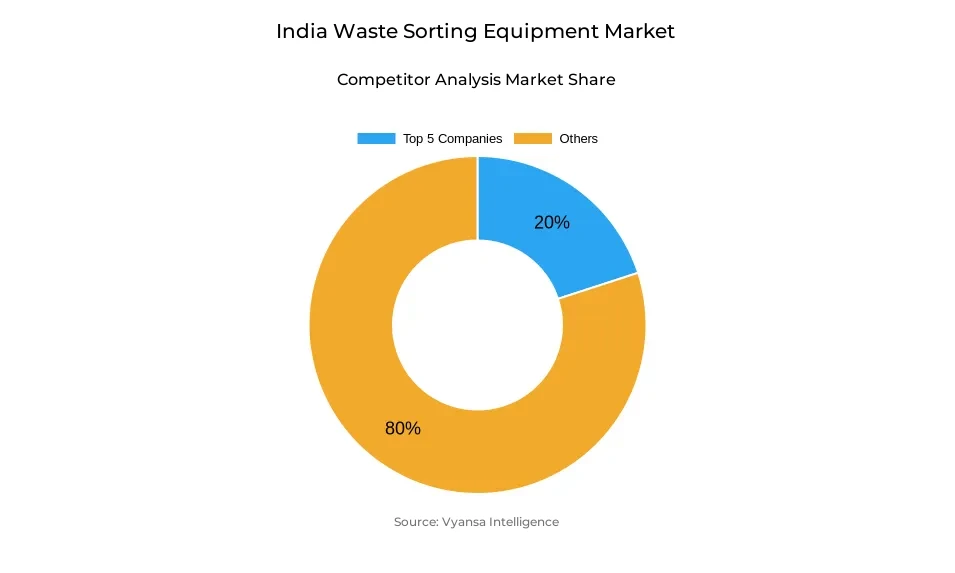
- Top 5 companies acquired around 20% of the market share.
- Saahas Zero Waste, VPS Waste Management, RVM Recycle, Alfa Therm Limited, Amey Shredtech etc., are few of the top companies.
- Technology
- Mechanical sorting grabbed 30% of the market.
India Waste Sorting Equipment Market Outlook
Valued at USD 55 million in 2025, India waste sorting equipment market is advancing from USD 62 million in 2026 toward USD 122 million by 2032, representing 12.05% compound annual growth rate throughout the forecast window. This strong expansion trajectory reflects rising demand for better waste handling, strengthened recovery systems, and more structured processing across urban and industrial waste streams. Market momentum remains underpinned by rapidly expanding waste processing capacity, mandatory four-stream segregation requirements, and emerging startup-driven innovation transforming segregation and decentralized waste operations.
Higher waste volumes and expanded processing capacity establish foundational market driver sustaining consistent demand for waste sorting equipment throughout India's urban and industrial sectors. Evidence from Ministry of Housing and Urban Affairs reveals urban India generates 1,61,157 tonnes of municipal solid waste daily, with 1,29,708 tonnes already being processed, establishing 80.49% processing rate. This substantial waste handling scale directly translates into heightened market relevance for waste sorting equipment supporting faster segregation and recovery systems. Published data from Ministry of Science and Technology indicates waste processing capacity in urban areas increases by 1,05,876 tonnes daily under Swachh Bharat Mission Urban through material recovery facilities, waste-to-energy plants, and recycling units, creating persistent demand for screens, conveyors, separators, and balers improving recovery efficiency.
Mandatory segregation requirements and tech-driven innovation reshape India waste sorting equipment market toward compliance-focused and startup-enabled solutions. Data from Ministry of Environment, Forest and Climate Change indicates Solid Waste Management Rules 2026 make four-stream segregation at source mandatory from April 1, 2026, with dry waste directed to material recovery facilities for sorting. Analysis from Ministry of Housing and Urban Affairs reveals 32 clean-tech startups onboarded under second cohort launched with IIT Kanpur in November 2025, with more than 5,000 waste-management startups registered by DPIIT. This innovation momentum supports market expansion for automated sorting, digital tracking, and decentralized waste operations throughout India waste sorting equipment market.
Market segmentation demonstrates pronounced demand concentration within plastic waste applications and mechanical sorting technologies supporting scalable processing infrastructure. Plastic waste commands 30% market share through alignment with visible recovery value and stronger separation requirements supporting recycling routing, while mechanical sorting accounts for 30% of technology demand reflecting reliable separation and practical deployment capabilities. This India waste sorting equipment market structure indicates facility operators increasingly prioritize proven mechanical systems and plastic-focused applications supporting consistent operational performance and material recovery optimization.
India Waste Sorting Equipment Market Growth Driver
Processing Expansion Keeps Equipment Demand Firm
Expanding waste processing capacity and infrastructure growth establish sustained demand for waste sorting equipment throughout India's urban waste management systems. Statistics from Ministry of Science and Technology confirm waste processing capacity in urban areas increases by 1,05,876 tonnes daily under Swachh Bharat Mission Urban through material recovery facilities, waste-to-energy plants, and recycling units. This infrastructure expansion directly translates into heightened market relevance for waste sorting equipment emphasizing faster segregation and enhanced recovery systems. Growing processing base ensures persistent demand for professional waste sorting infrastructure supporting improved recovery efficiency and reduced landfill dependence.
Large-scale waste generation and municipal processing requirements strengthen commercial foundation for comprehensive waste sorting equipment deployment. Published evidence from Ministry of Housing and Urban Affairs indicates urban India generates 1,61,157 tonnes of municipal solid waste daily with 1,29,708 tonnes already being processed at 80.49% rate, establishing substantial processing volume. This large waste handling scale creates market opportunity for equipment suppliers developing scalable sorting solutions addressing urban processing requirements. Infrastructure expansion momentum ensures sustained equipment demand supporting continued processing capacity growth throughout extended forecast period.
India Waste Sorting Equipment Market Challenge
Four-Stream Compliance Raises Execution Complexity
Waste sorting equipment market faces substantial challenge from tighter segregation and compliance requirements affecting collection discipline and system design complexity. Official records from Ministry of Environment, Forest and Climate Change indicate Solid Waste Management Rules 2026 make four-stream segregation at source mandatory from April 1, 2026, raising need for better collection discipline and cleaner incoming waste streams. This mandatory segregation framework increases system design precision requirements at sorting facilities. Service providers must develop flexible systems addressing stricter compliance, decentralized processing needs, and stronger monitoring requirements simultaneously.
Bulk waste generator obligations and concentrated waste sources intensify operational burden for waste sorting equipment. Evidence from Ministry of Environment, Forest and Climate Change reveals bulk waste generators including entities generating 100 kg or more daily account for nearly 30% of total solid waste generation, establishing significant concentrated waste sources. This bulk generator requirement raises pressure on equipment suppliers delivering flexible systems handling compliance complexity and decentralized processing needs. Equipment manufacturers must develop adaptive sorting solutions addressing diverse generator requirements and compliance monitoring obligations throughout India waste sorting equipment market.
Unlock Market Intelligence
Explore the market potential with our data-driven report
India Waste Sorting Equipment Market Trend
Startup-Led Innovation Moves to the Center
India waste sorting equipment market demonstrates pronounced shift toward tech-driven and startup-led waste sorting solutions emphasizing automation and digital tracking. Market data from Ministry of Housing and Urban Affairs indicates 32 clean-tech startups onboarded under second cohort launched with IIT Kanpur in November 2025, with more than 5,000 waste-management startups registered by DPIIT. This innovation momentum reshapes competitive landscape favoring automated sorting, digital tracking, and decentralized waste operations. Startup-driven solutions support market expansion for advanced waste sorting technologies and integrated tracking systems.
On-ground startup outcomes and scalable waste management demonstrate emerging technology adoption momentum. Published data from Ministry of Housing and Urban Affairs reveals 30 startups from Cohort 1 manage 63,000+ metric tonnes of waste, clear 15,000 metric tonnes of street garbage, and create more than 2,000 jobs while treating 300+ lakh liters of wastewater. This tangible startup impact establishes practical validation for automated sorting, digital tracking, and local waste-tech solutions. Innovation ecosystem development supports broader industry adoption of technology-enabled waste sorting equipment throughout India waste sorting equipment market.
India Waste Sorting Equipment Market Opportunity
Formal Recycling Networks Open Wider Headroom
Strong opportunities emerge in formal expansion of plastic and dry-waste recovery systems supporting organized recycling infrastructure development. Official records from Ministry of Environment, Forest and Climate Change indicate 2,614 plastic waste processors are registered under EPR framework with around 103 lakh tonnes of plastic packaging waste processed through centralized EPR portal by December 2024. This growing formal recovery network creates strengthened demand for sorting, cleaning, separation, and recovery equipment across recycling-linked waste streams. Formal plastic recovery system expansion directly supports equipment demand for specialized plastic processing solutions.
Material recovery facility expansion and traceable recycling infrastructure strengthens commercial foundation for waste sorting equipment deployment. Evidence from Central Pollution Control Board reveals India already has 4,446 solid waste material recovery facilities with capacity of 31,427.2 tonnes daily, establishing substantial processing infrastructure base. As formal recycling chain becomes deeper and more traceable, suppliers gain broader scope in mechanical sorting lines, plastic recovery equipment, and integrated systems improving material quality before downstream processing. Recovery infrastructure expansion enables service providers developing advanced sorting equipment to capture growth opportunities throughout India waste sorting equipment market.
Unlock Market Intelligence
Explore the market potential with our data-driven report
India Waste Sorting Equipment Market Segmentation Analysis
By Waste Type
- Plastic Waste
- Paper & Cardboard
- Metal Waste
- Organic Waste
- Glass Waste
- Construction & Demolition Waste
- E Waste
- Others
Plastic waste commands market leadership at 30% share within India waste sorting equipment market, establishing dominant waste-type positioning through alignment with visible recovery value and organized recycling routing requirements. This market segment maintains leading position due to operator prioritization of waste streams requiring dedicated handling, cleaner separation, and stronger recovery support, generating sustained demand for plastic-focused sorting solutions. Plastic waste sorting equipment delivers accessible positioning supporting routine processing while enabling recovery system optimization, establishing broad appeal across material recovery facilities and recycling-linked operators.
This market leadership position reflects operators' continued selection of plastic waste applications supporting organized downstream recovery. Plastic Waste remains important because sorting quality directly affects recovery value and recyclability, requiring dedicated equipment handling across mixed dry waste streams. The 30% market share indicates this segment continues shaping equipment demand, investment attention, and competitive direction throughout India waste sorting equipment market. Equipment manufacturers maintaining plastic waste sorting leadership develop competitive advantages enabling customer retention and sustained market growth supporting category expansion.
By Technology
- Mechanical Sorting
- Sensor-Based Sorting
- Optical
- NIR
- X ray
- Magnetic & Eddy Current Separation
- Air Classification
- Robotic & AI Based Sorting
- Others
Mechanical sorting commands market leadership at 30% share within India waste sorting equipment market, establishing dominant technology positioning through reliable separation support and practical deployment across diverse waste-processing environments. This market segment maintains leading position due to operator preference for technologies supporting reliable separation, scalable throughput, and practical deployment, generating sustained demand for proven mechanical sorting systems. Mechanical sorting solutions deliver accessible positioning supporting routine waste processing while enabling operational consistency, establishing broad appeal across different facility types and processing scales.
This market leadership position reflects operators' continued selection of mechanical sorting technologies supporting consistent operational performance. Mechanical Sorting remains important because it fits wide range of waste-processing environments while supporting organized downstream recovery and routine separation work. The 30% market share indicates this segment continues influencing technology selection, project planning, and competitive structure throughout India waste sorting equipment market. Equipment manufacturers maintaining mechanical sorting leadership develop competitive advantages enabling customer retention and sustainable market growth supporting category expansion throughout extended forecast period.
List of Companies Covered in India Waste Sorting Equipment Market
The companies listed below are highly influential in the India waste sorting equipment market, with a significant market share and a strong impact on industry developments.
- Saahas Zero Waste
- VPS Waste Management
- RVM Recycle
- Alfa Therm Limited
- Amey Shredtech
- Indus Engineering Projects India
- Greenrich Grow India
- TrashCon
- Fornnax Technology
- Fabtex Engineering Works
Frequently Asked Questions
Related Report
- Market Segmentation
- Research Scope
- Research Methodology
- Definitions and Assumptions
- Executive Summary
- India Waste Sorting Equipment Market Policies, Regulations, and Standards
- India Waste Sorting Equipment Market Dynamics
- Growth Factors
- Challenges
- Trends
- Opportunities
- India Waste Sorting Equipment Market Statistics, 2022-2032F
- Market Size & Growth Outlook
- By Revenues in USD Million
- Market Segmentation & Growth Outlook
- By Waste Type
- Plastic Waste- Market Insights and Forecast 2022-2032, USD Million
- Paper & Cardboard- Market Insights and Forecast 2022-2032, USD Million
- Metal Waste- Market Insights and Forecast 2022-2032, USD Million
- Organic Waste- Market Insights and Forecast 2022-2032, USD Million
- Glass Waste- Market Insights and Forecast 2022-2032, USD Million
- Construction & Demolition Waste- Market Insights and Forecast 2022-2032, USD Million
- E Waste- Market Insights and Forecast 2022-2032, USD Million
- Others- Market Insights and Forecast 2022-2032, USD Million
- By Technology
- Mechanical Sorting- Market Insights and Forecast 2022-2032, USD Million
- Sensor-Based Sorting - Market Insights and Forecast 2022-2032, USD Million
- Optical - Market Insights and Forecast 2022-2032, USD Million
- NIR - Market Insights and Forecast 2022-2032, USD Million
- X ray- Market Insights and Forecast 2022-2032, USD Million
- Magnetic & Eddy Current Separation- Market Insights and Forecast 2022-2032, USD Million
- Air Classification- Market Insights and Forecast 2022-2032, USD Million
- Robotic & AI Based Sorting- Market Insights and Forecast 2022-2032, USD Million
- Others- Market Insights and Forecast 2022-2032, USD Million
- By Application
- Municipal Waste Management- Market Insights and Forecast 2022-2032, USD Million
- Industrial Waste Management- Market Insights and Forecast 2022-2032, USD Million
- Commercial Recycling- Market Insights and Forecast 2022-2032, USD Million
- Construction & Demolition Waste Processing- Market Insights and Forecast 2022-2032, USD Million
- Waste to Energy Pre Processing- Market Insights and Forecast 2022-2032, USD Million
- Material Recovery Facilities (MRFs)- Market Insights and Forecast 2022-2032, USD Million
- By Operation Mode
- Manual- Market Insights and Forecast 2022-2032, USD Million
- Semi Automatic- Market Insights and Forecast 2022-2032, USD Million
- Fully Automatic- Market Insights and Forecast 2022-2032, USD Million
- By Region
- North- Market Insights and Forecast 2022-2032, USD Million
- East- Market Insights and Forecast 2022-2032, USD Million
- Southwest- Market Insights and Forecast 2022-2032, USD Million
- Northwest- Market Insights and Forecast 2022-2032, USD Million
- North East- Market Insights and Forecast 2022-2032, USD Million
- South- Market Insights and Forecast 2022-2032, USD Million
- By Competitors
- Competition Characteristics
- Market Share & Analysis
- By Waste Type
- Market Size & Growth Outlook
- India Plastic Waste Market Statistics, 2022-2032
- Market Size & Growth Outlook
- By Revenues in USD Million
- Market Segmentation & Growth Outlook
- By Technology - Market Insights and Forecast 2022-2032, USD Million
- By Application - Market Insights and Forecast 2022-2032, USD Million
- By Operation Mode - Market Insights and Forecast 2022-2032, USD Million
- By Region - Market Insights and Forecast 2022-2032, USD Million
- Market Size & Growth Outlook
- India Paper & Cardboard Market Statistics, 2022-2032
- Market Size & Growth Outlook
- By Revenues in USD Million
- Market Segmentation & Growth Outlook
- By Technology - Market Insights and Forecast 2022-2032, USD Million
- By Application - Market Insights and Forecast 2022-2032, USD Million
- By Operation Mode - Market Insights and Forecast 2022-2032, USD Million
- By Region - Market Insights and Forecast 2022-2032, USD Million
- Market Size & Growth Outlook
- India Metal Waste Market Statistics, 2022-2032
- Market Size & Growth Outlook
- By Revenues in USD Million
- Market Segmentation & Growth Outlook
- By Technology - Market Insights and Forecast 2022-2032, USD Million
- By Application - Market Insights and Forecast 2022-2032, USD Million
- By Operation Mode - Market Insights and Forecast 2022-2032, USD Million
- By Region - Market Insights and Forecast 2022-2032, USD Million
- Market Size & Growth Outlook
- India Organic Waste Market Statistics, 2022-2032
- Market Size & Growth Outlook
- By Revenues in USD Million
- Market Segmentation & Growth Outlook
- By Technology - Market Insights and Forecast 2022-2032, USD Million
- By Application - Market Insights and Forecast 2022-2032, USD Million
- By Operation Mode - Market Insights and Forecast 2022-2032, USD Million
- By Region - Market Insights and Forecast 2022-2032, USD Million
- Market Size & Growth Outlook
- India Glass Waste Market Statistics, 2022-2032
- Market Size & Growth Outlook
- By Revenues in USD Million
- Market Segmentation & Growth Outlook
- By Technology - Market Insights and Forecast 2022-2032, USD Million
- By Application - Market Insights and Forecast 2022-2032, USD Million
- By Operation Mode - Market Insights and Forecast 2022-2032, USD Million
- By Region - Market Insights and Forecast 2022-2032, USD Million
- Market Size & Growth Outlook
- India Construction & Demolition Waste Market Statistics, 2022-2032
- Market Size & Growth Outlook
- By Revenues in USD Million
- Market Segmentation & Growth Outlook
- By Technology - Market Insights and Forecast 2022-2032, USD Million
- By Application - Market Insights and Forecast 2022-2032, USD Million
- By Operation Mode - Market Insights and Forecast 2022-2032, USD Million
- By Region - Market Insights and Forecast 2022-2032, USD Million
- Market Size & Growth Outlook
- India E Waste Market Statistics, 2022-2032
- Market Size & Growth Outlook
- By Revenues in USD Million
- Market Segmentation & Growth Outlook
- By Technology - Market Insights and Forecast 2022-2032, USD Million
- By Application - Market Insights and Forecast 2022-2032, USD Million
- By Operation Mode - Market Insights and Forecast 2022-2032, USD Million
- By Region - Market Insights and Forecast 2022-2032, USD Million
- Market Size & Growth Outlook
- Competitive Outlook
- Company Profiles
- Alfa Therm Limited
- Business Description
- Product Portfolio
- Collaborations & Alliances
- Recent Developments
- Financial Details
- Others
- Amey Shredtech
- Business Description
- Product Portfolio
- Collaborations & Alliances
- Recent Developments
- Financial Details
- Others
- Indus Engineering Projects India
- Business Description
- Product Portfolio
- Collaborations & Alliances
- Recent Developments
- Financial Details
- Others
- Greenrich Grow India
- Business Description
- Product Portfolio
- Collaborations & Alliances
- Recent Developments
- Financial Details
- Others
- TrashCon
- Business Description
- Product Portfolio
- Collaborations & Alliances
- Recent Developments
- Financial Details
- Others
- Saahas Zero Waste
- Business Description
- Product Portfolio
- Collaborations & Alliances
- Recent Developments
- Financial Details
- Others
- VPS Waste Management
- Business Description
- Product Portfolio
- Collaborations & Alliances
- Recent Developments
- Financial Details
- Others
- RVM Recycle
- Business Description
- Product Portfolio
- Collaborations & Alliances
- Recent Developments
- Financial Details
- Others
- Fornnax Technology
- Business Description
- Product Portfolio
- Collaborations & Alliances
- Recent Developments
- Financial Details
- Others
- Fabtex Engineering Works
- Business Description
- Product Portfolio
- Collaborations & Alliances
- Recent Developments
- Financial Details
- Others
- Alfa Therm Limited
- Company Profiles
- Disclaimer
| Segment | Sub-Segment |
|---|---|
| By Waste Type |
|
| By Technology |
|
| By Application |
|
| By Operation Mode |
|
| By Region |
|
Research Methodology
This study followed a structured approach comprising four key phases to assess the size and scope of the electro-oxidation market. The process began with thorough secondary research to collect data on the target market, related markets, and broader industry context. These findings, along with preliminary assumptions and estimates, were then validated through extensive primary research involving industry experts from across the value chain. To calculate the overall market size, both top-down and bottom-up methodologies were employed. Finally, market segmentation and data triangulation techniques were applied to refine and validate segment-level estimations.
Secondary Research
The secondary research phase involved gathering data from a wide range of credible and published sources. This step helped in identifying industry trends, defining market segmentation, and understanding the market landscape and value chain.
Sources consulted during this phase included:
- Company annual reports, investor presentations, and press releases
- Industry white papers and certified publications
- Trade directories and market-recognized databases
- Articles from authoritative authors and reputable journals
- Gold and silver standard websites
Secondary research was critical in mapping out the industry's value chain and monetary flow, identifying key market segments, understanding regional variations, and tracking significant industry developments.
Other key sources:
- Financial disclosures
- Industry associations and trade bodies
- News outlets and business magazines
- Academic journals and research studies
- Paid industry databases
Primary Research
To validate secondary data and gain deeper market insights, primary research was conducted with key stakeholders across both the supply and demand sides of the market.
On the demand side, participants included decision-makers and influencers from end-user industries—such as CIOs, CTOs, and CSOs—who provided first-hand perspectives on market needs, product usage, and future expectations.
On the supply side, interviews were conducted with manufacturers, industry associations, and institutional participants to gather insights into current offerings, product pipelines, and market challenges.
Primary interviews provided critical inputs such as:
- Market size and revenue data
- Product and service breakdowns
- Market forecasts
- Regional and application-specific trends
Stakeholders consulted included:
- Leading OEM and solution providers
- Channel and distribution partners
- End users across various applications
- Independent consultants and industry specialists
Market Size Estimation and Data Triangulation
- Identifying Key Market Participants (Secondary Research)
- Goal: To identify the major players or companies in the target market. This typically involves using publicly available data sources such as industry reports, market research publications, and financial statements of companies.
- Tools: Reports from firms like Gartner, Forrester, Euromonitor, Statista, IBISWorld, and others. Public financial statements, news articles, and press releases from top market players.
- Extracting Earnings of Key Market Participants
- Goal: To estimate the earnings generated from the product or service being analyzed. This step helps in understanding the revenue potential of each market player in a specific geography.
- Methods: Earnings data can be gathered from:
- Publicly available financial reports (for listed companies).
- Interviews and primary data sources from professionals, such as Directors, VPs, SVPs, etc. This is especially useful for understanding more nuanced, internal data that isn't publicly disclosed.
- Annual reports and investor presentations of key players.
- Data Collation and Development of a Relevant Data Model
- Goal: To collate inputs from both primary and secondary sources into a structured, data-driven model for market estimation. This model will incorporate key market KPIs and any independent variables relevant to the market.
- Key KPIs: These could include:
- Market size, growth rate, and demand drivers.
- Industry-specific metrics like market share, average revenue per customer (ARPC), or average deal size.
- External variables, such as economic growth rates, inflation rates, or commodity prices, that could affect the market.
- Data Modeling: Based on this data, the market forecasts are developed for the next 5 years. A combination of trend analysis, scenario modeling, and statistical regression might be used to generate projections.
- Scenario Analysis
- Goal: To test different assumptions and validate how sensitive the market is to changes in key variables (e.g., market demand, regulatory changes, technological disruptions).
- Types of Scenarios:
- Base Case: Based on current assumptions and historical data.
- Best-Case Scenario: Assuming favorable market conditions, regulatory environments, and technological advancements.
- Worst-Case Scenario: Accounting for adverse factors, such as economic downturns, stricter regulations, or unexpected disruptions.












