India Video Surveillance Storage Market Report: Trends, Growth and Forecast (2026-2032)
By Storage Architecture (Edge Storage, Recorder-Based Storage, DVR-Based Storage, NVR-Based Storage, Centralized On-Premises Storage, Cloud Storage, Hybrid Storage), By End-User Vertical (Commercial Buildings, Retail and Hospitality, Industrial and Warehousing, Transport and Logistics, Government Sector, Critical Infrastructure and Utilities, Healthcare, Education, Residential and Multi-Dwelling), By Retention and Search Complexity (Basic Operational Recording, Standard Investigation-Centric Storage, Analytics-Assisted Searchable Storage, Evidence-Grade and Compliance-Sensitive Archival), By Sales Channel (Direct Sales, System Integrators, Value-Added Resellers, Distributors, Online Sales/E-Procurement, Managed Service Providers/Cloud Partners), By Region (North, East, West, South) ... Read more
|
Major Players
|
India Video Surveillance Storage Market Statistics and Insights, 2026
- Market Size Statistics
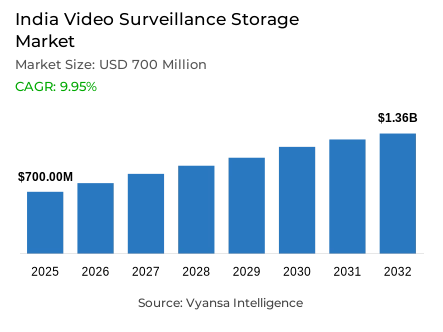
- Video surveillance storage market size in India was valued at USD 700 million in 2025 and is estimated at USD 770 million in 2026.
- The market size is expected to grow to USD 1.36 billion by 2032.
- Market to register a CAGR of around 9.95% during 2026-32.
- Storage Architecture Shares
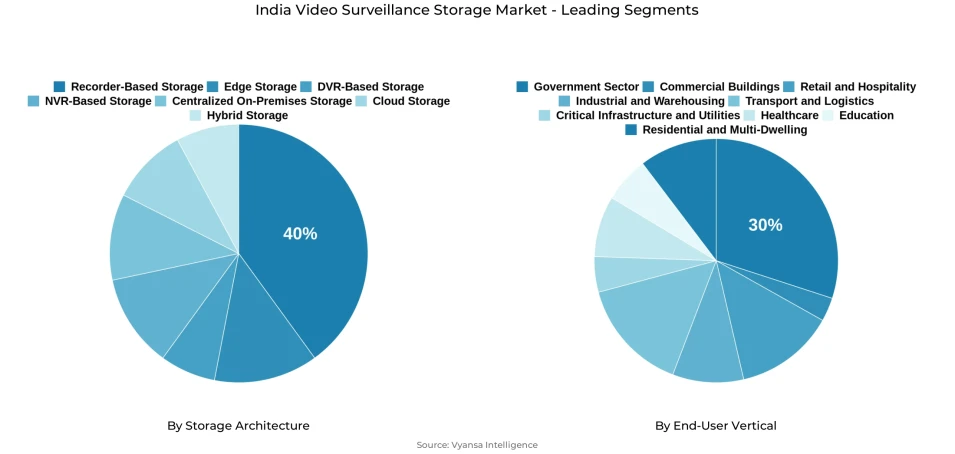
- Recorder-based storage grabbed market share of 40%.
- Competition
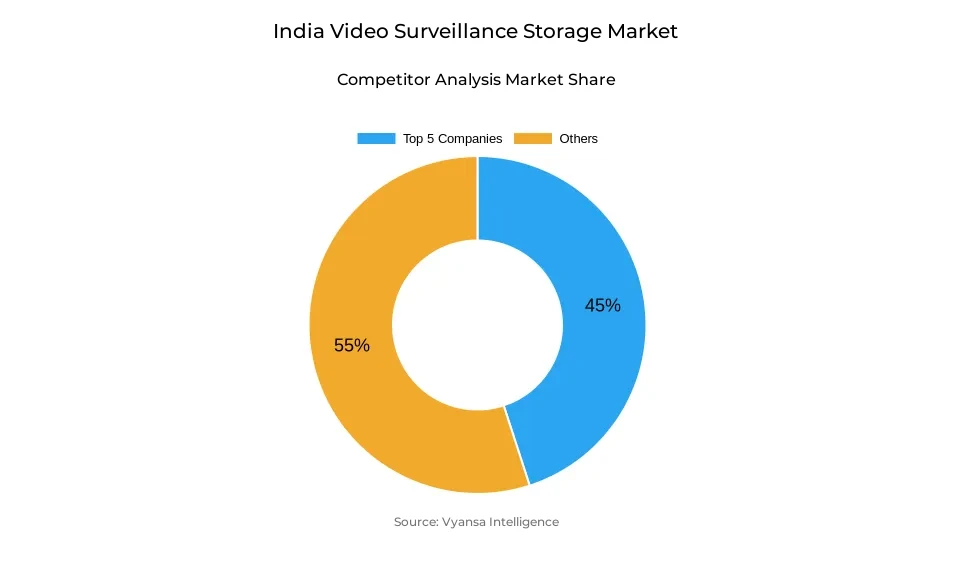
- More than 10 companies are actively engaged in producing video surveillance storage in India.
- Top 5 companies acquired around 45% of the market share.
- Synology, QNAP, Dell Technologies, CP PLUS, Matrix Comsec etc., are few of the top companies.
- End-User Vertical
- Government sector grabbed 30% of the market.
India Video Surveillance Storage Market Outlook
The India video surveillance storage market was valued at USD 700 million in 2025, establishing a commercially purposeful and structurally well-supported foundation within one of Asia's most actively expanding public safety and digital infrastructure ecosystems. Projected to advance from USD 770 million in 2026 to USD 1.36 billion by 2032, the sector registers a CAGR of 9.95% across the forecast horizon. This near-doubling of market value reflects a genuine and compounding institutional need for dependable video data management across public monitoring networks, urban security programs, and private facility surveillance environments. Growth is anchored in operational necessity rather than technology cycle enthusiasm, giving this market a commercial durability that sustains consistent storage investment across diverse user segments and deployment conditions.
The storage architecture defining this market's commercial structure is anchored in recorder-based configurations. Recorder-Based Storage commands approximately 40% of total storage architecture market share, reflecting the consistent and deeply embedded institutional preference for structured, locally managed footage capture and retention systems. Its operational familiarity, retrieval practicality, and system control characteristics align naturally with the security management workflows of India's most commercially significant user segments. This architecture concentration confirms that a large proportion of end users continue to prioritize proven, operationally predictable storage configurations whose management simplicity and reliability credentials sustain disproportionate procurement share across both new installation and system upgrade demand cycles.
The end-user architecture reinforces the structural centrality of the government sector as the category's dominant demand source. The Government Sector accounts for approximately 30% of total end-user vertical market share, reflecting the foundational role of public surveillance infrastructure in civic monitoring, transportation security, administrative facility protection, and public safety program management across national and municipal deployments. The Press Information Bureau's documentation that all 100 Smart Cities now operate Integrated Command and Control Centres confirms the institutional investment depth that sustains government sector video storage procurement at a commercially significant and consistently expanding scale. This public-sector demand concentration creates a procurement environment where storage system reliability, footage retention capacity, and compliance architecture carry disproportionate commercial weight.
The forward outlook is defined by four converging structural forces whose combined commercial impact creates a video surveillance storage market of sustained and well-grounded expansion momentum. The Smart Cities Mission's documented installation of over 84,000 CCTV surveillance cameras across all 100 operational ICCCs creates a growing footage volume base whose retention and retrieval requirements sustain consistent storage capacity procurement. MeitY's October 2024 CCTV regulations, combined with a mandatory compliance deadline of 1 April 2026, are simultaneously elevating security architecture standards and reshaping procurement criteria across the industry. Rural connectivity reaching 97.65% mobile coverage and 96.80% 4G coverage across Indian villages is progressively opening new surveillance deployment geographies whose storage requirements will expand the addressable market well beyond its current urban concentration. RDSO's 2024 station surveillance specification, supporting AI analytics and face recognition across railway environments, confirms that infrastructure-linked storage demand is advancing in both scale and technical complexity over the forecast period.
India Video Surveillance Storage Market Growth Driver
Smart City Infrastructure Scale Sustains Government Storage Procurement
The sustained and institutionally documented expansion of India's Smart Cities Mission surveillance infrastructure represents the primary structural driver of video surveillance storage demand, functioning as a persistent capacity procurement imperative that sustains consistent footage volume growth, retention requirement intensification, and storage system investment across government and public infrastructure operator end user segments nationwide. This public-sector infrastructure-driven demand dynamic transcends cyclical budget fluctuations, reflecting a durable institutional necessity whose procurement volume generation is structurally anchored in the continuous expansion of urban surveillance networks whose footage generation rates, retention obligations, and operational continuity requirements demand reliable and scalable storage systems across every stage of the city monitoring lifecycle.
The quantitative evidence validating this infrastructure-driven demand dynamic is documented with precision by the Press Information Bureau. All 100 Smart Cities have operational Integrated Command and Control Centres, and over 84,000 CCTV surveillance cameras have already been installed across these cities, confirming the scale of the active surveillance infrastructure base whose footage management requirements generate consistent video storage capacity procurement. Smart City deployments further include 1,884 emergency call boxes and over 3,000 public address systems integrated into broader connected public safety networks, confirming that surveillance-linked data generation is expanding across multiple system types whose footage retention and retrieval requirements compound consistently. These Smart City infrastructure metrics validate a government-led demand base of sufficient institutional scale and operational urgency to sustain structural video surveillance storage market growth over the forecast period.
India Video Surveillance Storage Market Challenge
Regulatory Compliance and Cyber Risk Elevation Constrain Deployment Confidence
The rapidly tightening regulatory compliance framework and rising cybersecurity incident environment surrounding video surveillance system operation in India represent the most consequential structural challenge confronting the video surveillance storage market, creating systematic security governance, equipment certification, and operational compliance burdens that elevate deployment complexity and raise the implementation investment threshold for storage-linked surveillance systems across the market's most institutionally significant end user segments. In a procurement environment where storage systems sit at the intersection of sensitive recorded footage, network-connected equipment, and institutional data governance obligations, the security and compliance implications of inadequate architecture alignment and weak access controls are directly material to procurement approval processes and regulatory standing.
The regulatory specificity and cybersecurity scale of this challenge are documented with precision by the Press Information Bureau and MeitY. MeitY's updated CCTV regulations became effective in October 2024 and require strict standards covering physical security, access control, network encryption, and penetration testing, confirming that the compliance investment burden placed on surveillance storage system providers and integrators is advancing toward mandatory standardization across a broad and commercially significant product category. Cybersecurity incidents in India increased from 10.29 lakh in 2022 to 22.68 lakh in 2024, confirming an accelerating threat environment whose implications for networked surveillance system security are direct and operationally significant. MeitY's enforcement deadline of 1 April 2026, after which non-compliant CCTV cameras cannot be sold, confirms that compliance management capability is becoming an increasingly decisive competitive differentiator that shapes market access velocity and procurement eligibility over the forecast period.
Unlock Market Intelligence
Explore the market potential with our data-driven report
India Video Surveillance Storage Market Trend
AI-Enabled Surveillance Integration Reshapes Storage System Requirements
The accelerating integration of artificial intelligence and advanced video analytics capabilities into India's public and institutional surveillance system architectures represents the defining structural trend reshaping video surveillance storage system design priorities, performance specifications, and competitive differentiation parameters across the domestic market. This AI integration trend is progressively transforming the functional role of video surveillance storage from passive footage archive into an active, analytics-ready data infrastructure layer whose performance characteristics must support rapid content search, automated event detection, and real-time analytical processing alongside traditional capacity and retention management requirements. The commercial implications of this functional transformation are significant, as storage system providers unable to demonstrate AI-analytics integration readiness are progressively disadvantaged in procurement evaluations among the market's most technically sophisticated end user segments.
The institutional momentum and technical specificity of this AI-enabled analytics trend are documented with authority by the Press Information Bureau and RDSO. All 100 Smart Cities now operate Integrated Command and Control Centres using AI, IoT, and data analytics in conjunction with over 84,000 installed CCTV surveillance cameras, confirming that AI-integrated public surveillance is already operational at a nationally significant scale whose storage architecture implications are directly reshaping platform design expectations. RDSO's 2024 station surveillance specification, designed to support video management, video recording, AI-enabled video analytics, and face recognition software across railway infrastructure, confirms that AI-ready storage architecture is advancing from a competitive differentiator into a baseline infrastructure requirement across India's most actively developing surveillance deployment environments. As AI-enabled surveillance capabilities advance toward mainstream institutional adoption, storage system AI-readiness will transition from an optional performance feature to a standard procurement requirement over the forecast period.
India Video Surveillance Storage Market Opportunity
Rural Connectivity Expansion Creates a Structurally Significant New Deployment Frontier
The rapid and institutionally documented spread of digital connectivity into India's rural and distributed public geographies creates a structurally significant and commercially compelling opportunity for video surveillance storage providers whose systems combine deployment simplicity, remote management capability, and the operational durability required across the connectivity environments of India's most recently digitized communities and public institutions. This rural expansion opportunity is distinguished from urban replacement demand by its geographic breadth, its first-installation character, and the progressive institutional demand it is creating across district administrations, rural schools, local healthcare facilities, and Gram Panchayat offices whose public safety and administrative oversight requirements are generating new surveillance deployment motivation across previously underserved geographies.
The quantitative scale and infrastructure specificity of this rural connectivity opportunity are documented with precision by the Press Information Bureau. A total of 97.65% of India's villages had mobile connectivity by May 2025, while 96.80% already had 4G coverage, confirming the wireless connectivity foundation that makes rural surveillance system deployment practically viable at a national geographic scale. BharatNet had made 2,14,325 Gram Panchayats service-ready by June 2025, with 13,01,193 FTTH connections already provided, while PM-WANI had installed 3,33,300 Wi-Fi hotspots by 30 June 2025, confirming that fixed and public internet infrastructure is progressively building the broadband connectivity base that supports networked surveillance system deployment across rural institutional environments. Storage system providers that combine compact platform design, remote management capability, and accessible deployment economics suited to rural public sector procurement will capture disproportionate value from this structurally significant and geographically expansive market opportunity over the forecast period.
Unlock Market Intelligence
Explore the market potential with our data-driven report
India Video Surveillance Storage Market Segmentation Analysis
By Storage Architecture
- Edge Storage
- Recorder-Based Storage
- DVR-Based Storage
- NVR-Based Storage
- Centralized On-Premises Storage
- Cloud Storage
- Hybrid Storage
The segment with highest market share under the Storage Architecture is Recorder-Based Storage, accounting for approximately 40% of the total market. This leading position reflects the deep structural alignment between recorder-based system characteristics and the specific footage management requirements of the market's most institutionally significant end user segments. Operational familiarity, direct recording capability, structured retention management, and practical footage retrieval workflows make recorder-based configurations the reference storage architecture across security operations, transportation monitoring environments, and facility-level surveillance deployments across India. With two-fifths of total market value concentrated within a single architecture category, Recorder-Based Storage defines the commercial priorities, system integration frameworks, and procurement evaluation criteria of the India video surveillance storage market.
The structural leadership of Recorder-Based Storage is sustained by the operational familiarity and deployment simplicity that have established this architecture as the default storage specification across the market's most volume-significant end user segments. As AI-enabled video analytics capabilities become more deeply integrated into surveillance system architectures, recorder-based platforms are progressively evolving to support searchable footage, faster analytical access, and performance levels suited to AI-augmented monitoring workflows. RDSO's 2024 station surveillance specification, designed to support video management, video recording, AI-enabled analytics, and face recognition software, confirms that the technical integration between recording infrastructure and analytical capability is advancing at an institutional level that is progressively reshaping the functional requirements placed on recorder-based storage platforms. The segment's structural market leadership is expected to remain intact over the forecast period.
By End-User Vertical
- Commercial Buildings
- Retail and Hospitality
- Industrial and Warehousing
- Transport and Logistics
- Government Sector
- Critical Infrastructure and Utilities
- Healthcare
- Education
- Residential and Multi-Dwelling
The segment with highest market share under the End-User Vertical is the Government Sector, accounting for approximately 30% of the total market. This dominant position reflects the foundational role of public surveillance infrastructure in civic monitoring, administrative security, transportation management, and public safety program delivery across national, regional, and municipal government deployments in India. Reliable footage retention, controlled access management, and consistent recording availability are non-negotiable operational requirements whose procurement scale generates disproportionate storage capacity investment relative to private sector end user segments of comparable organizational size. With nearly one-third of total market value anchored in government sector demand, this end-user vertical defines the compliance requirements, retention policy frameworks, and system reliability standards of the India video surveillance storage market.
The structural leadership of the Government Sector is being actively sustained by the accelerating institutional investment in smart city infrastructure and public safety digitization across India's urban centers. The Press Information Bureau's documentation that all 100 Smart Cities operate Integrated Command and Control Centres using AI, IoT, and data analytics, with over 84,000 CCTV surveillance cameras already installed, confirms the expanding scope of government surveillance system deployment whose footage generation rates and retention requirements create consistent and compounding video storage capacity demand. The further integration of 1,884 emergency call boxes and over 3,000 public address systems into connected public safety networks confirms that government surveillance infrastructure is broadening in both coverage and operational complexity. The Government Sector's position as the market's dominant commercial demand anchor is expected to deepen over the forecast period.
List of Companies Covered in India Video Surveillance Storage Market
The companies listed below are highly influential in the India video surveillance storage market, with a significant market share and a strong impact on industry developments.
- Synology
- QNAP
- Dell Technologies
- CP PLUS
- Matrix Comsec
- Sparsh CCTV
- Seagate
- Western Digital
- Hewlett Packard Enterprise (HPE)
- NetApp
Market News & Updates
- Matrix Comsec, 2026:
Matrix’s official materials show that SATATYA NVRX V9R2.1 was released on February 23, 2026, and the company’s current SATATYA NVR platform supports features such as up to 8 SATA III bays with 18TB per port, RAID 0/1/5/10 on larger models, adaptive recording to save storage space, and scheduled backup over USB, NAS, and FTP. For the India video surveillance storage market, this is a meaningful development because it underlines the continued strengthening of locally available enterprise NVR infrastructure around retention efficiency, redundancy, and backup resilience—three factors that matter increasingly in smart-city, industrial, and government surveillance deployments
Frequently Asked Questions
Related Report
- Market Segmentation
- Research Scope
- Research Methodology
- Definitions and Assumptions
- Executive Summary
- India Video Surveillance Storage Market Policies, Regulations, and Standards
- India Video Surveillance Storage Market Case Study
- India Video Surveillance Storage Market Dynamics
- Growth Factors
- Challenges
- Trends
- Opportunities
- India Video Surveillance Storage Market Statistics, 2022-2032F
- Market Size & Growth Outlook
- By Revenues in USD Million
- Market Segmentation & Growth Outlook
- By Storage Architecture
- Edge Storage- Market Insights and Forecast 2022-2032, USD Million
- Recorder-Based Storage- Market Insights and Forecast 2022-2032, USD Million
- DVR-Based Storage- Market Insights and Forecast 2022-2032, USD Million
- NVR-Based Storage- Market Insights and Forecast 2022-2032, USD Million
- Centralized On-Premises Storage- Market Insights and Forecast 2022-2032, USD Million
- Cloud Storage- Market Insights and Forecast 2022-2032, USD Million
- Hybrid Storage- Market Insights and Forecast 2022-2032, USD Million
- By End-User Vertical
- Commercial Buildings- Market Insights and Forecast 2022-2032, USD Million
- Retail and Hospitality- Market Insights and Forecast 2022-2032, USD Million
- Industrial and Warehousing- Market Insights and Forecast 2022-2032, USD Million
- Transport and Logistics- Market Insights and Forecast 2022-2032, USD Million
- Government Sector- Market Insights and Forecast 2022-2032, USD Million
- Critical Infrastructure and Utilities- Market Insights and Forecast 2022-2032, USD Million
- Healthcare- Market Insights and Forecast 2022-2032, USD Million
- Education- Market Insights and Forecast 2022-2032, USD Million
- Residential and Multi-Dwelling- Market Insights and Forecast 2022-2032, USD Million
- By Retention and Search Complexity
- Basic Operational Recording- Market Insights and Forecast 2022-2032, USD Million
- Standard Investigation-Centric Storage- Market Insights and Forecast 2022-2032, USD Million
- Analytics-Assisted Searchable Storage- Market Insights and Forecast 2022-2032, USD Million
- Evidence-Grade and Compliance-Sensitive Archival- Market Insights and Forecast 2022-2032, USD Million
- By Sales Channel
- Direct Sales- Market Insights and Forecast 2022-2032, USD Million
- System Integrators- Market Insights and Forecast 2022-2032, USD Million
- Value-Added Resellers- Market Insights and Forecast 2022-2032, USD Million
- Distributors- Market Insights and Forecast 2022-2032, USD Million
- Online Sales/E-Procurement- Market Insights and Forecast 2022-2032, USD Million
- Managed Service Providers/Cloud Partners- Market Insights and Forecast 2022-2032, USD Million
- By Region
- North
- East
- West
- South
- By Competitors
- Competition Characteristics
- Market Share & Analysis
- By Storage Architecture
- Market Size & Growth Outlook
- India Edge Storage Market Statistics, 2022-2032
- Market Size & Growth Outlook
- By Revenues in USD Million
- Market Segmentation & Growth Outlook
- By End-User Vertical- Market Insights and Forecast 2022-2032, USD Million
- By Retention and Search Complexity- Market Insights and Forecast 2022-2032, USD Million
- By Sales Channel- Market Insights and Forecast 2022-2032, USD Million
- By Region- Market Insights and Forecast 2022-2032, USD Million
- Market Size & Growth Outlook
- India Recorder-Based Storage Market Statistics, 2022-2032
- Market Size & Growth Outlook
- By Revenues in USD Million
- Market Segmentation & Growth Outlook
- By End-User Vertical- Market Insights and Forecast 2022-2032, USD Million
- By Retention and Search Complexity- Market Insights and Forecast 2022-2032, USD Million
- By Sales Channel- Market Insights and Forecast 2022-2032, USD Million
- By Region- Market Insights and Forecast 2022-2032, USD Million
- Market Size & Growth Outlook
- India DVR-Based Storage Market Statistics, 2022-2032
- Market Size & Growth Outlook
- By Revenues in USD Million
- Market Segmentation & Growth Outlook
- By End-User Vertical- Market Insights and Forecast 2022-2032, USD Million
- By Retention and Search Complexity- Market Insights and Forecast 2022-2032, USD Million
- By Sales Channel- Market Insights and Forecast 2022-2032, USD Million
- By Region- Market Insights and Forecast 2022-2032, USD Million
- Market Size & Growth Outlook
- India NVR-Based Storage Market Statistics, 2022-2032
- Market Size & Growth Outlook
- By Revenues in USD Million
- Market Segmentation & Growth Outlook
- By End-User Vertical- Market Insights and Forecast 2022-2032, USD Million
- By Retention and Search Complexity- Market Insights and Forecast 2022-2032, USD Million
- By Sales Channel- Market Insights and Forecast 2022-2032, USD Million
- By Region- Market Insights and Forecast 2022-2032, USD Million
- Market Size & Growth Outlook
- India Centralized On-Premises Storage Market Statistics, 2022-2032
- Market Size & Growth Outlook
- By Revenues in USD Million
- Market Segmentation & Growth Outlook
- By End-User Vertical- Market Insights and Forecast 2022-2032, USD Million
- By Retention and Search Complexity- Market Insights and Forecast 2022-2032, USD Million
- By Sales Channel- Market Insights and Forecast 2022-2032, USD Million
- By Region- Market Insights and Forecast 2022-2032, USD Million
- Market Size & Growth Outlook
- India Cloud Storage Market Statistics, 2022-2032
- Market Size & Growth Outlook
- By Revenues in USD Million
- Market Segmentation & Growth Outlook
- By End-User Vertical- Market Insights and Forecast 2022-2032, USD Million
- By Retention and Search Complexity- Market Insights and Forecast 2022-2032, USD Million
- By Sales Channel- Market Insights and Forecast 2022-2032, USD Million
- By Region- Market Insights and Forecast 2022-2032, USD Million
- Market Size & Growth Outlook
- India Hybrid Storage Market Statistics, 2022-2032
- Market Size & Growth Outlook
- By Revenues in USD Million
- Market Segmentation & Growth Outlook
- By End-User Vertical- Market Insights and Forecast 2022-2032, USD Million
- By Retention and Search Complexity- Market Insights and Forecast 2022-2032, USD Million
- By Sales Channel- Market Insights and Forecast 2022-2032, USD Million
- By Region- Market Insights and Forecast 2022-2032, USD Million
- Market Size & Growth Outlook
- Competitive Outlook
- Company Profiles
- CP PLUS
- Business Description
- Product Portfolio
- Collaborations & Alliances
- Recent Developments
- Financial Details
- Others
- Matrix Comsec
- Business Description
- Product Portfolio
- Collaborations & Alliances
- Recent Developments
- Financial Details
- Others
- Sparsh CCTV
- Business Description
- Product Portfolio
- Collaborations & Alliances
- Recent Developments
- Financial Details
- Others
- Seagate
- Business Description
- Product Portfolio
- Collaborations & Alliances
- Recent Developments
- Financial Details
- Others
- Western Digital
- Business Description
- Product Portfolio
- Collaborations & Alliances
- Recent Developments
- Financial Details
- Others
- Synology
- Business Description
- Product Portfolio
- Collaborations & Alliances
- Recent Developments
- Financial Details
- Others
- QNAP
- Business Description
- Product Portfolio
- Collaborations & Alliances
- Recent Developments
- Financial Details
- Others
- Dell Technologies
- Business Description
- Product Portfolio
- Collaborations & Alliances
- Recent Developments
- Financial Details
- Others
- Hewlett Packard Enterprise (HPE)
- Business Description
- Product Portfolio
- Collaborations & Alliances
- Recent Developments
- Financial Details
- Others
- NetApp
- Business Description
- Product Portfolio
- Collaborations & Alliances
- Recent Developments
- Financial Details
- Others
- CP PLUS
- Company Profiles
- Disclaimer
| Segment | Sub-Segment |
|---|---|
| By Storage Architecture |
|
| By End-User Vertical |
|
| By Retention and Search Complexity |
|
| By Sales Channel |
|
| By Region |
|
Research Methodology
This study followed a structured approach comprising four key phases to assess the size and scope of the electro-oxidation market. The process began with thorough secondary research to collect data on the target market, related markets, and broader industry context. These findings, along with preliminary assumptions and estimates, were then validated through extensive primary research involving industry experts from across the value chain. To calculate the overall market size, both top-down and bottom-up methodologies were employed. Finally, market segmentation and data triangulation techniques were applied to refine and validate segment-level estimations.
Secondary Research
The secondary research phase involved gathering data from a wide range of credible and published sources. This step helped in identifying industry trends, defining market segmentation, and understanding the market landscape and value chain.
Sources consulted during this phase included:
- Company annual reports, investor presentations, and press releases
- Industry white papers and certified publications
- Trade directories and market-recognized databases
- Articles from authoritative authors and reputable journals
- Gold and silver standard websites
Secondary research was critical in mapping out the industry's value chain and monetary flow, identifying key market segments, understanding regional variations, and tracking significant industry developments.
Other key sources:
- Financial disclosures
- Industry associations and trade bodies
- News outlets and business magazines
- Academic journals and research studies
- Paid industry databases
Primary Research
To validate secondary data and gain deeper market insights, primary research was conducted with key stakeholders across both the supply and demand sides of the market.
On the demand side, participants included decision-makers and influencers from end-user industries—such as CIOs, CTOs, and CSOs—who provided first-hand perspectives on market needs, product usage, and future expectations.
On the supply side, interviews were conducted with manufacturers, industry associations, and institutional participants to gather insights into current offerings, product pipelines, and market challenges.
Primary interviews provided critical inputs such as:
- Market size and revenue data
- Product and service breakdowns
- Market forecasts
- Regional and application-specific trends
Stakeholders consulted included:
- Leading OEM and solution providers
- Channel and distribution partners
- End users across various applications
- Independent consultants and industry specialists
Market Size Estimation and Data Triangulation
- Identifying Key Market Participants (Secondary Research)
- Goal: To identify the major players or companies in the target market. This typically involves using publicly available data sources such as industry reports, market research publications, and financial statements of companies.
- Tools: Reports from firms like Gartner, Forrester, Euromonitor, Statista, IBISWorld, and others. Public financial statements, news articles, and press releases from top market players.
- Extracting Earnings of Key Market Participants
- Goal: To estimate the earnings generated from the product or service being analyzed. This step helps in understanding the revenue potential of each market player in a specific geography.
- Methods: Earnings data can be gathered from:
- Publicly available financial reports (for listed companies).
- Interviews and primary data sources from professionals, such as Directors, VPs, SVPs, etc. This is especially useful for understanding more nuanced, internal data that isn't publicly disclosed.
- Annual reports and investor presentations of key players.
- Data Collation and Development of a Relevant Data Model
- Goal: To collate inputs from both primary and secondary sources into a structured, data-driven model for market estimation. This model will incorporate key market KPIs and any independent variables relevant to the market.
- Key KPIs: These could include:
- Market size, growth rate, and demand drivers.
- Industry-specific metrics like market share, average revenue per customer (ARPC), or average deal size.
- External variables, such as economic growth rates, inflation rates, or commodity prices, that could affect the market.
- Data Modeling: Based on this data, the market forecasts are developed for the next 5 years. A combination of trend analysis, scenario modeling, and statistical regression might be used to generate projections.
- Scenario Analysis
- Goal: To test different assumptions and validate how sensitive the market is to changes in key variables (e.g., market demand, regulatory changes, technological disruptions).
- Types of Scenarios:
- Base Case: Based on current assumptions and historical data.
- Best-Case Scenario: Assuming favorable market conditions, regulatory environments, and technological advancements.
- Worst-Case Scenario: Accounting for adverse factors, such as economic downturns, stricter regulations, or unexpected disruptions.












