India Facial Cleanser Market Report: Trends, Growth and Forecast (2026-2032)
By Product Type (Gel Cleanser, Foam Cleanser, Cream Cleanser, Liquid Cleanser, Oil Cleanser, Balm Cleanser, Micellar Cleanser, Powder/Bar Cleanser), By Skin Type (Oily & Acne-Prone Skin, Dry Skin, Sensitive Skin, Combination Skin, Normal Skin), By Ingredient (Conventional, Natural/Organic, Sulfate-Free, Fragrance-Free, Medicated/Active-Based), By Consumer Group (Women, Men, Unisex, Teen), By Distribution Channel (Retail Offline (Supermarkets/Hypermarkets, Pharmacies/Drug Stores, Specialty Beauty Stores, Department Stores), Retail Online (E-commerce Platforms, Brand-Owned Websites (D2C), Online Beauty Retailers)), By Price Point (Mass, Premium, Luxury), By Region (North, East, West, South) ... Read more
|
Major Players
|
India Facial Cleanser Market Statistics and Insights, 2026
- Market Size Statistics
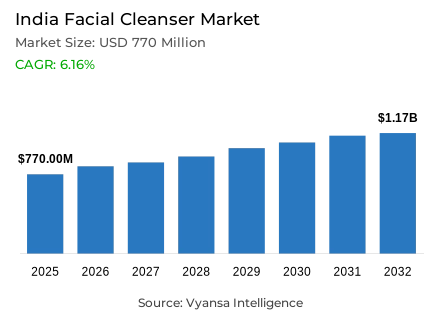
- Facial cleanser market size in India was valued at USD 770 million in 2025 and is estimated at USD 817 million in 2026.
- The market size is expected to grow to USD 1.17 billion by 2032.
- Market to register a CAGR of around 6.16% during 2026-32.
- Skin Type Shares
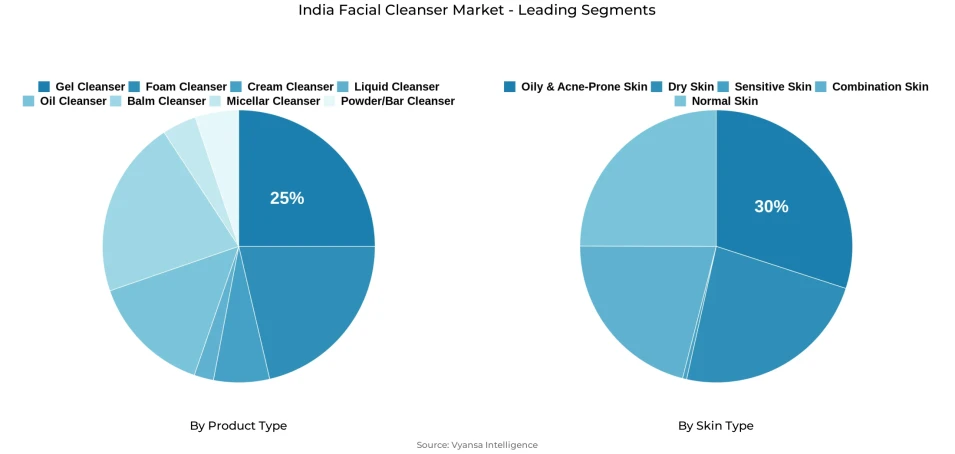
- Oily & acne-prone skin grabbed market share of 25%.
- Competition
- More than 10 companies are actively engaged in producing facial cleanser in India.
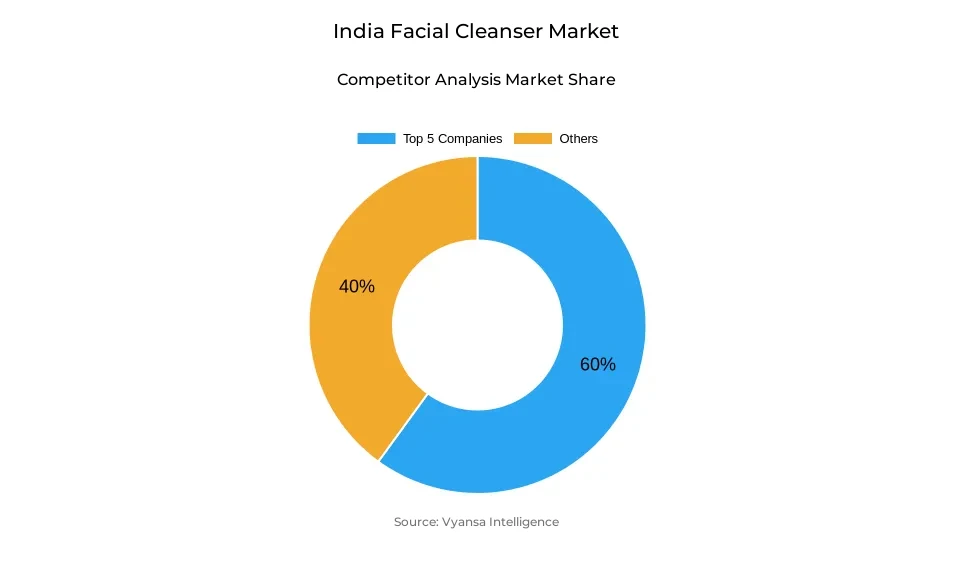
- Top 5 companies acquired around 60% of the market share.
- Procter & Gamble , Lotus Herbals , VLCC , Hindustan Unilever , Himalaya Wellness etc., are few of the top companies.
- Skin Type
- Oily & acne-prone skin grabbed 30% of the market.
India Facial Cleanser Market Outlook
The India Facial Cleanser Market Size was valued at USD 770 million in 2025 and is projected to grow from USD 817 million in 2026 to USD 1.17 billion by 2032, exhibiting a CAGR of 6.16% during the forecast period. The category shows steady expansion as daily skincare routines become more established across consumer groups. Rising attention to hygiene, appearance, and regular skin maintenance continues to support category demand. In addition, facial cleansers benefit from repeat purchase behavior because they are used frequently and fit easily into everyday personal care routines. This keeps the category relevant across both basic and concern-based skincare needs.
Demand conditions remain favorable because consumers continue to face dust, sweat, humidity, and pollution during daily movement, especially in urban areas. These conditions make cleansing a necessary step for removing surface buildup and maintaining skin comfort. At the same time, regulatory developments related to quality standards, packaging declarations, and certification are improving the overall structure of the category. Stronger regulatory oversight is helping organized brands build trust through better compliance, clearer labels, and more consistent product quality. As a result, facial cleanser offerings are becoming more reliable and better aligned with changing consumer expectations in India.
Consumer preferences are also evolving in ways that support category expansion. Interest in herbal and Ayurveda-linked products remains visible, while formal institutional developments around traditional medicine are improving the credibility of such positioning. This gives brands stronger scope to present natural and botanical formulations within a more credible and structured framework. Additionally, digital adoption is widening access to skincare products across a broader consumer base. Online platforms allow users to compare ingredients, check skin-type suitability, and repurchase products more conveniently. Because facial cleanser products are used frequently and are easy to reorder, the category aligns well with this growing digital buying pattern.
From a segmentation perspective, products designed for oily and acne-prone skin continue to hold the leading position, accounting for 30% share. Their dominance reflects strong demand for oil-control, deep-cleansing, and blemish-focused solutions among consumers seeking visible functional results. This preference is further reinforced by climatic conditions and everyday exposure to sweat and impurities. Moreover, improving internet penetration and digital payment access are helping facial cleanser brands reach more consumers across urban and semi-urban areas. Together, these factors support sustained expansion through a mix of necessity-driven usage, stronger product credibility, wider accessibility, and growing preference for targeted skincare solutions.
India Facial Cleanser Market Growth Driver
Urban Exposure to Dust and Air Pollution Supports Daily Cleansing Use
India’s facial cleanser demand remains closely linked to everyday environmental exposure. In major cities, consumers encounter dust, traffic emissions, sweat, and suspended particles during regular commuting and outdoor movement. This makes facial cleansing relevant not only for cosmetic care but also for daily skin hygiene and comfort. Products that help remove surface buildup, excess oil, and visible grime align naturally with this need. Moreover, the driver remains broad-based because pollution and urban congestion affect large consumer groups across metros as well as many fast-growing cities. This keeps facial cleansers positioned as a practical, repeat-use skincare category within broader India facial cleanser market trends rather than an occasional discretionary purchase.
Official data reinforces that relevance. According to the Ministry of Environment, Forest and Climate Change, the National Clean Air Programme (NCAP) covers 130 cities. In addition, a 2025 Press Information Bureau (PIB) release on Swachh Vayu Survekshan states that 11 best-performing cities are recognized out of those 130 NCAP cities. The same ministry also states that USD 1.57 billion (INR 13,036.52 crore) has been released in total for air-quality measures, with USD 0.22 billion (INR 1,825.39 crore) released during April-July 2025. These figures indicate that air-quality management remains a significant urban policy issue, which continues to keep pollution-linked cleansing needs visible across daily facial cleansing solutions in India’s skincare routines.
India Facial Cleanser Market Challenge
Stricter Standards and Packaging Rules Raise Compliance Complexity
Regulatory tightening remains a meaningful challenge for facial cleanser brands in India. The category depends on frequent launches, multiple variants, and clear on-pack communication around ingredients, usage, and safety. When standards become stricter, brands must invest more in testing, documentation, packaging revisions, and declaration accuracy before products reach the market. This increases execution complexity for both domestic producers and importers. Additionally, the challenge extends beyond large brands, because smaller suppliers may face greater pressure in aligning packaging, compliance timelines, and quality systems with evolving rules. As a result, regulatory readiness directly influences launch speed, distribution continuity, and operational efficiency in the facial cleansing products market.
Recent official actions illustrate this clearly. The Bureau of Indian Standards states that 187 quality control orders covering 769 products have been notified for compulsory certification, while about 23,000 Indian Standards are currently in force. Separately, the Department of Consumer Affairs notified the Legal Metrology (Packaged Commodities) Amendment Rules, 2025 on 29 October 2025, with an explicit focus on clearer declarations and stronger consumer confidence. These measures raise the compliance threshold across product labelling and certification environments. For facial cleanser suppliers, this means more disciplined packaging control, better regulatory tracking, and stronger internal quality systems before products can scale smoothly across India’s retail and e-commerce channels, reinforcing the importance of facial cleanser industry analysis.
Unlock Market Intelligence
Explore the market potential with our data-driven report
India Facial Cleanser Market Trend
Ayurveda-Linked Skincare Gains More Structured Scientific Visibility
Ayurveda-linked positioning is becoming a clearer trend in India’s facial cleanser market because consumers increasingly look for products that combine familiar traditional ingredients with stronger credibility and more structured presentation. In facial cleansing, this is relevant because herbal and botanical claims can influence purchase decisions only when buyers also trust quality, authenticity, and suitability for daily skin use. Moreover, the trend is moving beyond simple natural branding. It is increasingly supported by formal policy attention, international recognition, and knowledge-protection efforts, which give traditional skincare positioning a more credible and organized foundation in the market and strengthen the broader facial cleanser industry outlook.
Official developments in 2025 reinforce this direction. The Ministry of Ayush states that India signed an agreement with the World Health Organization on 24 May 2025 to begin work on a dedicated Traditional Medicine module under the International Classification of Health Interventions, backed by a USD 3 million Indian contribution. Separately, official releases describe the Traditional Knowledge Digital Library as a major prior-art resource for protecting Indian traditional knowledge, while global forums recognize India’s digitisation efforts as a model for preserving indigenous medical heritage. Together, these developments strengthen the institutional standing of Ayurveda-linked systems and improve the credibility of herbal facial cleanser positioning in India, in line with evolving facial cleanser market trends.
India Facial Cleanser Market Opportunity
Expanding Digital Access Opens Wider Reach for Facial Cleansers
Digital expansion creates a clear opportunity because facial cleansers are easy to compare, reorder, and target by skin concern through online channels. Consumers can assess ingredients, skin-type suitability, pack sizes, and price points without relying entirely on in-store consultation. This is significant in India because skincare demand is widening beyond premium counters and large metros into digitally connected households across urban and semi-urban areas. Moreover, facial cleansers benefit from repeat purchase behavior, which fits well with app-based shopping, search-led discovery, and platform-driven recommendations. As a result, digital commerce is becoming an increasingly practical route for both mass and niche facial cleanser brands to improve visibility and access through the e-commerce facial cleanser market.
Official indicators confirm the scale of this opportunity. The National Statistics Office reports that 86.3% of households in India have internet access within household premises in the January-March 2025 Comprehensive Modular Survey: Telecom. Separately, a 2025 PIB release states that Open Network for Digital Commerce (ONDC) has processed 326 million+ cumulative orders as of October 2025, including 18.2 million orders in October alone, with average daily transactions of about 590,000. These figures show that digital reach and open commerce infrastructure are becoming stronger and more practical. For facial cleanser brands, that environment improves product discovery, supports repeat buying, and widens market access across a broader consumer base, while also creating stronger scope for AI-driven skincare personalization.
Unlock Market Intelligence
Explore the market potential with our data-driven report
India Facial Cleanser Market Segmentation Analysis
By Product Type
- Gel Cleanser
- Foam Cleanser
- Cream Cleanser
- Liquid Cleanser
- Oil Cleanser
- Balm Cleanser
- Micellar Cleanser
- Powder/Bar Cleanser
The segment with the highest share under the product type category is Gel Cleanser, holding 25% of the market. This segment leads because gel cleansers match everyday consumer needs around easy rinsing, a light skin feel, and quick daily use. Their broad appeal makes them suitable for morning and evening skincare routines, especially among buyers looking for practical products that remove oil, dirt, and surface buildup without adding heaviness. In India, this functional fit helps gel cleansers maintain stronger repeat demand than many other formats.
Recent official figures reinforce the scale of this advantage. The National Statistics Office reports that 86.3% of households in India have internet access within household premises in the January-March 2025 Comprehensive Modular Survey: Telecom. In addition, a 2025 Press Information Bureau (PIB) release states that Press Information Bureau (ONDC) has processed 326 million+ cumulative orders as of October 2025, including 18.2 million orders in October alone, with average daily transactions of about 590,000. This expanding digital reach improves product discovery, supports repeat buying, and creates stronger visibility for gel-based facial cleanser products, while also widening the scope for AI-driven skincare personalization.
By Skin Type
- Oily & Acne-Prone Skin
- Dry Skin
- Sensitive Skin
- Combination Skin
- Normal Skin
Under the skin type segment, oily and acne-prone skin remains the highest-share segment, accounting for 30% of the market. This leadership remains commercially credible because consumers often purchase facial cleansers for a visible functional outcome, especially lower oiliness, cleaner pores, and reduced surface buildup. Compared with broader skincare needs, these concerns are easier to identify and more likely to drive routine product use. Additionally, facial cleanser purchases in this segment benefit from clearer performance messaging, which makes products easier to assess both online and at the point of sale and supports the strong position of oily and acne-prone skin formulations within category demand.
Recent official consumer and digital indicators reinforce that environment. The National Statistics Office reports that 91.6% of urban households and 83.3% of rural households have internet access within household premises in the 2025 telecom survey. Reserve Bank of India (RBI) also states that UPI accounts for 84% of total retail payment volume in 2024-25, while UPI QR codes rise 91.5% to 65.8 crore by 31 March 2025. Together, these figures show that concern-based skincare products can reach and convert a very broad digital consumer base. That accessibility helps oily and acne-prone skin cleansers retain the top position in this alternate segmentation split.
List of Companies Covered in India Facial Cleanser Market
The companies listed below are highly influential in the India facial cleanser market, with a significant market share and a strong impact on industry developments.
- Procter & Gamble
- Lotus Herbals
- VLCC
- Hindustan Unilever
- Himalaya Wellness
- L’Oreal
- Honasa Consumer
- Kenvue
- Beiersdorf
- WOW Skin Science
Market News & Updates
- Hindustan Unilever, 2025:
In 2025, Hindustan Unilever highlighted product innovation in India through Pond’s, stating that the brand launched the Hydra Miracle range and specifically noting the Pond’s Hydra Gentle Gel Face Wash, which the company says cleanses without stripping and contains 10 million prebiotic molecules to help maintain hydration and balance; HUL also positioned this launch as part of its science-led response to Indian consumers seeking lighter textures, hydration, and clinically backed daily skincare solutions. For the facial cleanser market in India, this is a significant product-specific development because it strengthens HUL’s offering in gentle, hydration-focused cleansing, aligns with rising demand for skin-barrier-friendly formulations, and increases competition in the premium-mass segment where efficacy and everyday comfort increasingly influence purchase decisions.
- Beiersdorf, 2025:
In 2025, Beiersdorf confirmed the launch of Eucerin in India through its official results communication, and Eucerin India’s official product pages now show the DermoPurifyer Triple Effect Cleansing Gel as part of the local lineup, with the company positioning the cleanser for oily, acne-prone, and blemish-prone skin and highlighting ingredients such as salicylic acid, AHAs, and BHAs. For the facial cleanser market in India, this is a major product-specific update because it brings a dermatologist-led cleansing proposition into a fast-growing skincare market, supports premiumization in acne and problem-solution face cleansing, and raises competitive pressure on existing brands by expanding the availability of clinically positioned cleanser formats in India.
Frequently Asked Questions
Related Report
- Market Segmentation
- Research Scope
- Research Methodology
- Definitions and Assumptions
- Executive Summary
- India Facial Cleanser Market Policies, Regulations, and Standards
- India Facial Cleanser Market Dynamics
- Growth Factors
- Challenges
- Trends
- Opportunities
- India Facial Cleanser Market Statistics, 2022-2032F
- Market Size & Growth Outlook
- By Revenues in USD Million
- Market Segmentation & Growth Outlook
- By Product Type
- Gel Cleanser- Market Insights and Forecast 2022-2032, USD Million
- Foam Cleanser- Market Insights and Forecast 2022-2032, USD Million
- Cream Cleanser- Market Insights and Forecast 2022-2032, USD Million
- Liquid Cleanser- Market Insights and Forecast 2022-2032, USD Million
- Oil Cleanser- Market Insights and Forecast 2022-2032, USD Million
- Balm Cleanser- Market Insights and Forecast 2022-2032, USD Million
- Micellar Cleanser- Market Insights and Forecast 2022-2032, USD Million
- Powder/Bar Cleanser- Market Insights and Forecast 2022-2032, USD Million
- By Skin Type
- Oily & Acne-Prone Skin- Market Insights and Forecast 2022-2032, USD Million
- Dry Skin- Market Insights and Forecast 2022-2032, USD Million
- Sensitive Skin- Market Insights and Forecast 2022-2032, USD Million
- Combination Skin- Market Insights and Forecast 2022-2032, USD Million
- Normal Skin- Market Insights and Forecast 2022-2032, USD Million
- By Ingredient
- Conventional- Market Insights and Forecast 2022-2032, USD Million
- Natural/Organic- Market Insights and Forecast 2022-2032, USD Million
- Sulfate-Free- Market Insights and Forecast 2022-2032, USD Million
- Fragrance-Free- Market Insights and Forecast 2022-2032, USD Million
- Medicated/Active-Based- Market Insights and Forecast 2022-2032, USD Million
- By Consumer Group
- Women- Market Insights and Forecast 2022-2032, USD Million
- Men- Market Insights and Forecast 2022-2032, USD Million
- Unisex- Market Insights and Forecast 2022-2032, USD Million
- Teen- Market Insights and Forecast 2022-2032, USD Million
- By Distribution Channel
- Retail Offline- Market Insights and Forecast 2022-2032, USD Million
- Supermarkets/Hypermarkets- Market Insights and Forecast 2022-2032, USD Million
- Pharmacies/Drug Stores- Market Insights and Forecast 2022-2032, USD Million
- Specialty Beauty Stores- Market Insights and Forecast 2022-2032, USD Million
- Department Stores- Market Insights and Forecast 2022-2032, USD Million
- Retail Online- Market Insights and Forecast 2022-2032, USD Million
- E-commerce Platforms- Market Insights and Forecast 2022-2032, USD Million
- Brand-Owned Websites (D2C)- Market Insights and Forecast 2022-2032, USD Million
- Online Beauty Retailers- Market Insights and Forecast 2022-2032, USD Million
- Retail Offline- Market Insights and Forecast 2022-2032, USD Million
- By Price Point
- Mass- Market Insights and Forecast 2022-2032, USD Million
- Premium- Market Insights and Forecast 2022-2032, USD Million
- Luxury- Market Insights and Forecast 2022-2032, USD Million
- By Region
- North- Market Insights and Forecast 2022-2032, USD Million
- East- Market Insights and Forecast 2022-2032, USD Million
- West- Market Insights and Forecast 2022-2032, USD Million
- South- Market Insights and Forecast 2022-2032, USD Million
- By Competitors
- Competition Characteristics
- Market Share & Analysis
- By Product Type
- Market Size & Growth Outlook
- India Gel Cleanser Market Statistics, 2022-2032
- Market Size & Growth Outlook
- By Revenues in USD Million
- Market Segmentation & Growth Outlook
- By Skin Type- Market Insights and Forecast 2022-2032, USD Million
- By Ingredient- Market Insights and Forecast 2022-2032, USD Million
- By Consumer Group- Market Insights and Forecast 2022-2032, USD Million
- By Distribution Channel- Market Insights and Forecast 2022-2032, USD Million
- By Price Point- Market Insights and Forecast 2022-2032, USD Million
- By Region- Market Insights and Forecast 2022-2032, USD Million
- Market Size & Growth Outlook
- India Foam Cleanser Market Statistics, 2022-2032
- Market Size & Growth Outlook
- By Revenues in USD Million
- Market Segmentation & Growth Outlook
- By Skin Type- Market Insights and Forecast 2022-2032, USD Million
- By Ingredient- Market Insights and Forecast 2022-2032, USD Million
- By Consumer Group- Market Insights and Forecast 2022-2032, USD Million
- By Distribution Channel- Market Insights and Forecast 2022-2032, USD Million
- By Price Point- Market Insights and Forecast 2022-2032, USD Million
- By Region- Market Insights and Forecast 2022-2032, USD Million
- Market Size & Growth Outlook
- India Cream Cleanser Market Statistics, 2022-2032
- Market Size & Growth Outlook
- By Revenues in USD Million
- Market Segmentation & Growth Outlook
- By Skin Type- Market Insights and Forecast 2022-2032, USD Million
- By Ingredient- Market Insights and Forecast 2022-2032, USD Million
- By Consumer Group- Market Insights and Forecast 2022-2032, USD Million
- By Distribution Channel- Market Insights and Forecast 2022-2032, USD Million
- By Price Point- Market Insights and Forecast 2022-2032, USD Million
- By Region- Market Insights and Forecast 2022-2032, USD Million
- Market Size & Growth Outlook
- India Liquid Cleanser Market Statistics, 2022-2032
- Market Size & Growth Outlook
- By Revenues in USD Million
- Market Segmentation & Growth Outlook
- By Skin Type- Market Insights and Forecast 2022-2032, USD Million
- By Ingredient- Market Insights and Forecast 2022-2032, USD Million
- By Consumer Group- Market Insights and Forecast 2022-2032, USD Million
- By Distribution Channel- Market Insights and Forecast 2022-2032, USD Million
- By Price Point- Market Insights and Forecast 2022-2032, USD Million
- By Region- Market Insights and Forecast 2022-2032, USD Million
- Market Size & Growth Outlook
- India Oil Cleanser Market Statistics, 2022-2032
- Market Size & Growth Outlook
- By Revenues in USD Million
- Market Segmentation & Growth Outlook
- By Skin Type- Market Insights and Forecast 2022-2032, USD Million
- By Ingredient- Market Insights and Forecast 2022-2032, USD Million
- By Consumer Group- Market Insights and Forecast 2022-2032, USD Million
- By Distribution Channel- Market Insights and Forecast 2022-2032, USD Million
- By Price Point- Market Insights and Forecast 2022-2032, USD Million
- By Region- Market Insights and Forecast 2022-2032, USD Million
- Market Size & Growth Outlook
- India Balm Cleanser Market Statistics, 2022-2032
- Market Size & Growth Outlook
- By Revenues in USD Million
- Market Segmentation & Growth Outlook
- By Skin Type- Market Insights and Forecast 2022-2032, USD Million
- By Ingredient- Market Insights and Forecast 2022-2032, USD Million
- By Consumer Group- Market Insights and Forecast 2022-2032, USD Million
- By Distribution Channel- Market Insights and Forecast 2022-2032, USD Million
- By Price Point- Market Insights and Forecast 2022-2032, USD Million
- By Region- Market Insights and Forecast 2022-2032, USD Million
- Market Size & Growth Outlook
- India Micellar Cleanser Market Statistics, 2022-2032
- Market Size & Growth Outlook
- By Revenues in USD Million
- Market Segmentation & Growth Outlook
- By Skin Type- Market Insights and Forecast 2022-2032, USD Million
- By Ingredient- Market Insights and Forecast 2022-2032, USD Million
- By Consumer Group- Market Insights and Forecast 2022-2032, USD Million
- By Distribution Channel- Market Insights and Forecast 2022-2032, USD Million
- By Price Point- Market Insights and Forecast 2022-2032, USD Million
- By Region- Market Insights and Forecast 2022-2032, USD Million
- Market Size & Growth Outlook
- India Powder/Bar Cleanser Market Statistics, 2022-2032
- Market Size & Growth Outlook
- By Revenues in USD Million
- Market Segmentation & Growth Outlook
- By Skin Type- Market Insights and Forecast 2022-2032, USD Million
- By Ingredient- Market Insights and Forecast 2022-2032, USD Million
- By Consumer Group- Market Insights and Forecast 2022-2032, USD Million
- By Distribution Channel- Market Insights and Forecast 2022-2032, USD Million
- By Price Point- Market Insights and Forecast 2022-2032, USD Million
- By Region- Market Insights and Forecast 2022-2032, USD Million
- Market Size & Growth Outlook
- Competitive Outlook
- Company Profiles
- Powder/Bar Cleanser
- Business Description
- Product Portfolio
- Collaborations & Alliances
- Recent Developments
- Financial Details
- Others
- Hindustan Unilever
- Business Description
- Product Portfolio
- Collaborations & Alliances
- Recent Developments
- Financial Details
- Others
- Himalaya Wellness
- Business Description
- Product Portfolio
- Collaborations & Alliances
- Recent Developments
- Financial Details
- Others
- L’Oréal
- Business Description
- Product Portfolio
- Collaborations & Alliances
- Recent Developments
- Financial Details
- Others
- Honasa Consumer
- Business Description
- Product Portfolio
- Collaborations & Alliances
- Recent Developments
- Financial Details
- Others
- Kenvue
- Business Description
- Product Portfolio
- Collaborations & Alliances
- Recent Developments
- Financial Details
- Others
- Procter & Gamble
- Business Description
- Product Portfolio
- Collaborations & Alliances
- Recent Developments
- Financial Details
- Others
- Lotus Herbals
- Business Description
- Product Portfolio
- Collaborations & Alliances
- Recent Developments
- Financial Details
- Others
- VLCC
- Business Description
- Product Portfolio
- Collaborations & Alliances
- Recent Developments
- Financial Details
- Others
- Beiersdorf
- Business Description
- Product Portfolio
- Collaborations & Alliances
- Recent Developments
- Financial Details
- Others
- Powder/Bar Cleanser
- Company Profiles
- Disclaimer
| Segment | Sub-Segment |
|---|---|
| By Product Type |
|
| By Skin Type |
|
| By Ingredient |
|
| By Consumer Group |
|
| By Distribution Channel |
|
| By Price Point |
|
| By Region |
|
Research Methodology
This study followed a structured approach comprising four key phases to assess the size and scope of the electro-oxidation market. The process began with thorough secondary research to collect data on the target market, related markets, and broader industry context. These findings, along with preliminary assumptions and estimates, were then validated through extensive primary research involving industry experts from across the value chain. To calculate the overall market size, both top-down and bottom-up methodologies were employed. Finally, market segmentation and data triangulation techniques were applied to refine and validate segment-level estimations.
Secondary Research
The secondary research phase involved gathering data from a wide range of credible and published sources. This step helped in identifying industry trends, defining market segmentation, and understanding the market landscape and value chain.
Sources consulted during this phase included:
- Company annual reports, investor presentations, and press releases
- Industry white papers and certified publications
- Trade directories and market-recognized databases
- Articles from authoritative authors and reputable journals
- Gold and silver standard websites
Secondary research was critical in mapping out the industry's value chain and monetary flow, identifying key market segments, understanding regional variations, and tracking significant industry developments.
Other key sources:
- Financial disclosures
- Industry associations and trade bodies
- News outlets and business magazines
- Academic journals and research studies
- Paid industry databases
Primary Research
To validate secondary data and gain deeper market insights, primary research was conducted with key stakeholders across both the supply and demand sides of the market.
On the demand side, participants included decision-makers and influencers from end-user industries—such as CIOs, CTOs, and CSOs—who provided first-hand perspectives on market needs, product usage, and future expectations.
On the supply side, interviews were conducted with manufacturers, industry associations, and institutional participants to gather insights into current offerings, product pipelines, and market challenges.
Primary interviews provided critical inputs such as:
- Market size and revenue data
- Product and service breakdowns
- Market forecasts
- Regional and application-specific trends
Stakeholders consulted included:
- Leading OEM and solution providers
- Channel and distribution partners
- End users across various applications
- Independent consultants and industry specialists
Market Size Estimation and Data Triangulation
- Identifying Key Market Participants (Secondary Research)
- Goal: To identify the major players or companies in the target market. This typically involves using publicly available data sources such as industry reports, market research publications, and financial statements of companies.
- Tools: Reports from firms like Gartner, Forrester, Euromonitor, Statista, IBISWorld, and others. Public financial statements, news articles, and press releases from top market players.
- Extracting Earnings of Key Market Participants
- Goal: To estimate the earnings generated from the product or service being analyzed. This step helps in understanding the revenue potential of each market player in a specific geography.
- Methods: Earnings data can be gathered from:
- Publicly available financial reports (for listed companies).
- Interviews and primary data sources from professionals, such as Directors, VPs, SVPs, etc. This is especially useful for understanding more nuanced, internal data that isn't publicly disclosed.
- Annual reports and investor presentations of key players.
- Data Collation and Development of a Relevant Data Model
- Goal: To collate inputs from both primary and secondary sources into a structured, data-driven model for market estimation. This model will incorporate key market KPIs and any independent variables relevant to the market.
- Key KPIs: These could include:
- Market size, growth rate, and demand drivers.
- Industry-specific metrics like market share, average revenue per customer (ARPC), or average deal size.
- External variables, such as economic growth rates, inflation rates, or commodity prices, that could affect the market.
- Data Modeling: Based on this data, the market forecasts are developed for the next 5 years. A combination of trend analysis, scenario modeling, and statistical regression might be used to generate projections.
- Scenario Analysis
- Goal: To test different assumptions and validate how sensitive the market is to changes in key variables (e.g., market demand, regulatory changes, technological disruptions).
- Types of Scenarios:
- Base Case: Based on current assumptions and historical data.
- Best-Case Scenario: Assuming favorable market conditions, regulatory environments, and technological advancements.
- Worst-Case Scenario: Accounting for adverse factors, such as economic downturns, stricter regulations, or unexpected disruptions.












