India Elevators & Escalators Market Report: Trends, Growth and Forecast (2026-2032)
By Product Type (Elevator (By Type (Traction, Hydraulic, Machine Room Less), By Speed (Upto 1 m/s, 1.1 to 2 m/s, 2.1 to 3 m/s, 3.6 to 5 m/s, Above 5 m/s)), Escalator (By Type (Moving Walkway, Moving Stairs))), By Service (New Installation, After Sales Service, Modernization, Maintenance), By Application (Residential, Commercial, Industrial), By Region (North, East, West, South) ... Read more
|
Major Players
|
India Elevators & Escalators Market Statistics and Insights, 2026
- Market Size Statistics
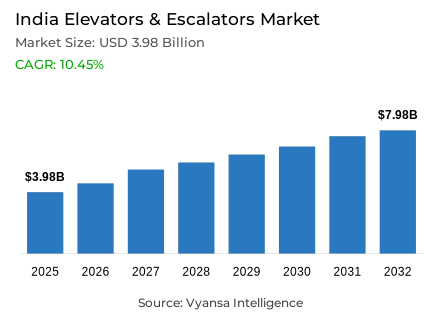
- Elevators & escalators market size in India was estimated at USD 3.98 billion in 2025.
- The market size is expected to grow to USD 7.98 billion by 2032.
- Market to register a CAGR of around 10.45% during 2026-32.
- Product Type Shares
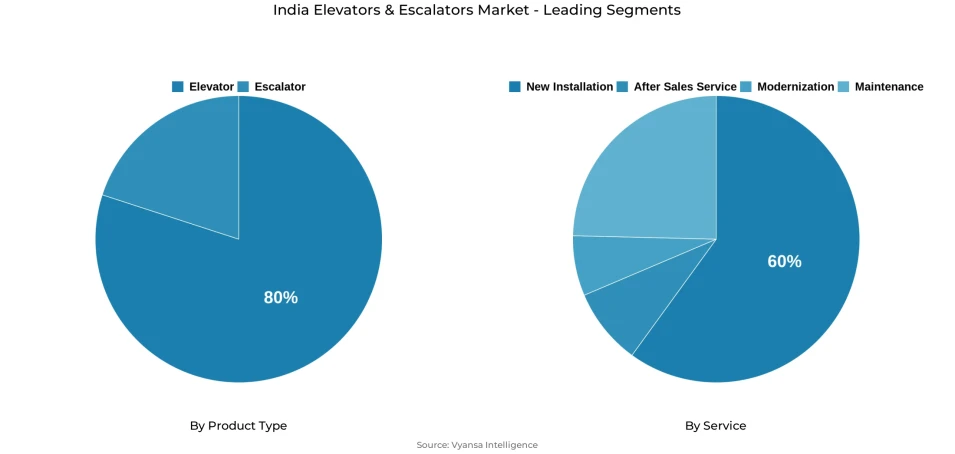
- Elevator grabbed market share of 80%.
- Competition
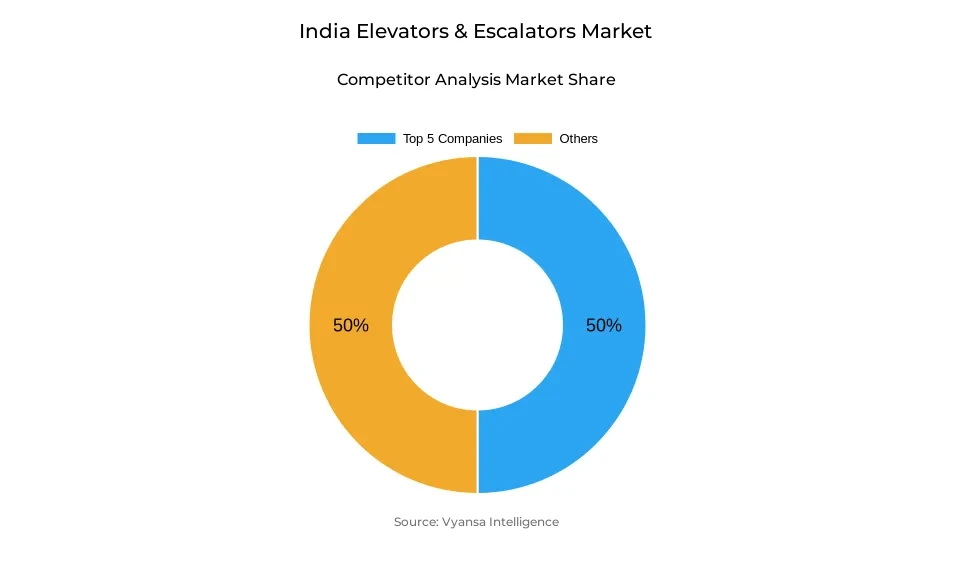
- Elevators & escalators in India is currently being catered to by more than 10 companies.
- Top 5 companies acquired around 50% of the market share.
- Hitachi Lift India Private Limited, Fujitec India Private Limited, Omega Elevators Private Limited, Otis Elevator Company (India) Limited, KONE Elevator India Private Limited etc., are few of the top companies.
- Service
- New installation grabbed 60% of the market.
India Elevators & Escalators Market Outlook
The India elevators & escalators market size was valued at USD 3.98 billion in 2025 and is projected to grow from USD 4.23 billion in 2026 to USD 7.98 billion by 2032, exhibiting a CAGR of 10.45% during the forecast period. Growth during 2026-32 will be supported by sustained construction expansion, infrastructure commissioning, and increasing modernization of existing buildings.
Construction activity grew by 9.4% in FY 2024-25, reflecting strong execution across residential, commercial, healthcare, and public infrastructure projects. This momentum directly translates into early-stage procurement of elevators & escalators, as these systems are embedded into architectural planning, fire compliance, and accessibility design in multi-storey developments. Rising building heights and occupancy densities are increasing the number of lift cores per project. Elevators account for 80% of total product demand, underscoring their essential role in residential towers, offices, hospitals, and institutional facilities where daily vertical mobility is critical.
Reliability in operations continues to be an important focus area, given that the maximum peak electricity demand of 241 GW was achieved in June 2025, emphasizing the pressures of load intensity. Given that the product is sensitive to power, facility managers are increasingly focusing on developing backup power supply systems, voltage stabilizers, and protective electronics. However, the increasing number of machine-to-machine connections is facilitating predictive diagnostics and remote monitoring.
The service business continues to be project-based, with New Installation accounting for 60% of the total business. The development of metro rail networks, with approximately 1,036 km operational in 24 cities as of 2026, continues to create new demand for elevators & escalators in metro stations and related developments. Accessibility enhancements, with over 13.45 million UDID cards distributed as of February 2026, are also fueling retrofit and upgrade business in both public and private infrastructure.
India Elevators & Escalators Market Growth DriverRobust Construction Expansion Strengthening Core Demand
The market continues to remain on an increasing structural trajectory due to the steady growth of construction activities in the residential, commercial, healthcare, and public sectors. According to the Ministry of Statistics and Programme Implementation (MoSPI), the construction sector grew by 9.4% in FY 2024-25 (Press Note, 30 May 2025), indicating robust project implementation across the country. In effect, this level of construction activity is directly translated into the early procurement stage of vertical mobility solutions, as the planning of lift and escalator solutions is inherently incorporated into architectural design, fire safety, and accessibility planning from the early stages of multi-story construction projects.
Increasing building heights and population density further accelerates the demand for equipment at the project level. Builders are increasingly adopting multiple lift core solutions to reduce waiting times and optimize people and material flow. For the end-user community, this means enhanced traffic management and business continuity, whereas for equipment manufacturers and system integrators, increased construction activity throughput immediately increases the equipment sales pipeline for advanced control solutions and turnkey installation contracts.
India Elevators & Escalators Market ChallengeGrid Reliability Pressures Elevating Lifecycle Cost Burden
Reliability of operation remains a structural issue in the India elevators & escalators market, especially in high-density urban areas. According to government statistics, India achieved a peak electricity demand of 241 GW in June 2025, indicating the severity of loading conditions during peak demand periods. From an operational perspective, elevators and escalators are extremely sensitive to power quality; voltage instability and temporary power outages have a direct impact on ride quality, control systems, and passenger safety.
Consequently, there is a growing investment in backup power solutions, voltage stabilizers, and protective electronics to mitigate the risks. This increases the scope of initial electrical infrastructure investments and subsequent maintenance. In busy buildings like hospitals and transport hubs, where unavailability is not an option, the cost of ownership increases with regular preventive maintenance and replacement of equipment due to power quality fluctuations. The net effect is a higher total cost of ownership and more stringent risk management of operations for owners.
Unlock Market Intelligence
Explore the market potential with our data-driven report
India Elevators & Escalators Market TrendRapid Shift Toward Data-Driven Remote Maintenance Models
The India elevators & escalators market is undergoing a paradigm shift from reactive maintenance to predictive and connectivity-driven maintenance. According to TRAI, M2M cellular mobile subscriptions rose from 89.70 million as on end-August 2025 to 94.57 million as on end-September 2025 (Press Release No. 120/2025). This indicates a rapid expansion of connectivity infrastructure for machines. This rapid expansion significantly enhances the enabling environment for SIM-based sensors and gateways integrated into the control system of elevators.
With the increased availability of connectivity, manufacturers are now using remote diagnostic analysis, usage analytics, and alert-driven dispatch systems to reduce down-time and improve passenger safety. For building owners, this allows for condition-based maintenance rather than time-based maintenance, improving predictability of uptime. In busy environments, digital monitoring improves performance visibility and enables faster response cycles, making connected maintenance the new normal rather than a premium feature.
India Elevators & Escalators Market OpportunityExpanding Accessibility Mandate Creating Retrofit Headroom
The emerging accessibility policy in India is unlocking the long-term retrofitting opportunities in the India elevators & escalators market. The UDID portal shows that 13,455,735 Disability Certificates/UDID Cards have been produced as of 22 February 2026, which emphasizes the magnitude of documented people who are dependent on step-free infrastructure. This further emphasizes the need for barrier-free vertical transportation in existing infrastructure.
In essence, this creates a tangible opportunity for modernization and new installations in government offices, hospitals, educational institutions, and transit-related properties where existing infrastructure does not have accessibility features. Building modernization projects are now incorporating audio-visual displays, Braille-marked panels, improved acceleration control, and improved safety systems. Accessibility requirements are now being integrated into renovation projects, which further fuels the demand for sophisticated elevator packages designed for seniors and people with disabilities.
Unlock Market Intelligence
Explore the market potential with our data-driven report
India Elevators & Escalators Market Segmentation Analysis
By Product Type
- Elevator
- Escalator
In the India elevators & escalators market, the Elevators segment holds around 80% market share, making it the leading product type segment. This is because of the structural shift in the market towards high-rise residential buildings, mixed-use buildings, and institutional buildings where vertical transportation is an operational necessity. According to the World Bank, the urban population of India was 35.38% of the total population in 2024, which has further solidified the trend towards dense urban living patterns that are inherently dependent on multiple lift installations per building.
In terms of application, the primary use of elevators is for passenger and material transport in residential, commercial, healthcare, and infrastructure sectors. While escalators continue to find application in high-traffic commercial and transportation hubs, the elevator continues to be the primary system in most other sectors. The 80% market share is a testament to their critical application in ensuring efficient mobility, accessibility, and optimized people flow management for various end-use sectors.
By Service
- New Installation
- After Sales Service
- Modernization
- Maintenance
In terms of service segmentation, New Installation is the leading segment with approximately 60% share of the total demand in the India elevators & escalators market, which indicates a project-based revenue model. The continued development of new infrastructure, including metro rail and transport hubs, sustains high volumes of new installations. According to parliamentary statistics, approximately 1,036 km of metro rail network (including RRTS) is operational in 24 cities as of 2026, which reiterates the continued need for new elevator and escalator installations in stations and adjacent developments.
This service mix, which is predominantly installation-driven, clearly indicates that new asset development currently contributes more to revenue streams compared to maintenance and modernization services. Every new development of residential, institutional, and transport infrastructure creates an immediate need for comprehensive vertical mobility solutions. As long as new infrastructure development remains robust, new installations will continue to drive the service market, influencing procurement cycles and capacity development among original equipment manufacturers and engineering contractors.
List of Companies Covered in India Elevators & Escalators Market
The companies listed below are highly influential in the India elevators & escalators market, with a significant market share and a strong impact on industry developments.
- Hitachi Lift India Private Limited
- Fujitec India Private Limited
- Omega Elevators Private Limited
- Otis Elevator Company (India) Limited
- KONE Elevator India Private Limited
- Schindler India Private Limited
- Johnson Lifts Private Limited
- Mitsubishi Elevator India Private Limited
- Escon Elevators
- Express Lifts Private Limited
Market News & Updates
- KONE Elevator India Private Limited, 2025:
KONE disclosed it won an order to deliver a suite of People Flow® solutions for the Aga Hall Estate residential redevelopment in Mumbai, positioning the project as a flagship reference in a high-visibility, premium urban-redevelopment corridor where developers increasingly specify integrated elevator/escalator + people-flow systems (not just “units”) to manage peak traffic, security, and resident experience; commercially, this kind of Mumbai marquee win tends to ripple into follow-on specifications across luxury residential and mixed-use pipelines, tightening competitive pressure on global OEMs and raising the bar on digital/connected features and lifecycle service attach rates in India’s mid-/high-rise segment.
- Otis Elevator Company (India) Limited, 2025:
Otis highlighted its involvement in India’s first high-speed rail line, signaling a strategic push deeper into rail infrastructure (stations/depots and associated mobility nodes) where uptime, passenger-throughput design, and long-term maintenance performance are decisive; for the India elevators & escalators market, this matters because “infrastructure-grade” reference projects typically accelerate adoption of higher-spec escalators/moving walks, expand the installed base that feeds multi-decade service revenues, and strengthen Otis’ qualification position for subsequent metro/rail tenders as India scales transit-led development.
Frequently Asked Questions
Related Report
- Market Segmentation
- Research Scope
- Research Methodology
- Definitions and Assumptions
- Executive Summary
- India Elevator & Escalator Market Policies, Regulations, and Standards
- India Elevator & Escalator Market Dynamics
- Growth Factors
- Challenges
- Trends
- Opportunities
- India Elevator & Escalator Market Statistics, 2022-2032F
- Market Size & Growth Outlook
- By Revenues in USD Million
- Market Segmentation & Growth Outlook
- By Product Type
- Elevator- Market Insights and Forecast 2022-2032, USD Million
- By Type- Market Insights and Forecast 2022-2032, USD Million
- Traction- Market Insights and Forecast 2022-2032, USD Million
- Hydraulic- Market Insights and Forecast 2022-2032, USD Million
- Machine Room Less- Market Insights and Forecast 2022-2032, USD Million
- By Speed- Market Insights and Forecast 2022-2032, USD Million
- Upto 1 m/s- Market Insights and Forecast 2022-2032, USD Million
- 1.1 to 2 m/s- Market Insights and Forecast 2022-2032, USD Million
- 2.1 to 3 m/s- Market Insights and Forecast 2022-2032, USD Million
- 3.6 to 5 m/s- Market Insights and Forecast 2022-2032, USD Million
- Above 5 m/s- Market Insights and Forecast 2022-2032, USD Million
- By Type- Market Insights and Forecast 2022-2032, USD Million
- Escalator- Market Insights and Forecast 2022-2032, USD Million
- By Type- Market Insights and Forecast 2022-2032, USD Million
- Moving Walkway- Market Insights and Forecast 2022-2032, USD Million
- Moving Stairs- Market Insights and Forecast 2022-2032, USD Million
- By Type- Market Insights and Forecast 2022-2032, USD Million
- Elevator- Market Insights and Forecast 2022-2032, USD Million
- By Service
- New Installation- Market Insights and Forecast 2022-2032, USD Million
- After Sales Service- Market Insights and Forecast 2022-2032, USD Million
- Modernization- Market Insights and Forecast 2022-2032, USD Million
- Maintenance- Market Insights and Forecast 2022-2032, USD Million
- By Application
- Residential- Market Insights and Forecast 2022-2032, USD Million
- Commercial- Market Insights and Forecast 2022-2032, USD Million
- Industrial- Market Insights and Forecast 2022-2032, USD Million
- By Region
- North
- East
- West
- South
- By Competitors
- Competition Characteristics
- Market Share & Analysis
- By Product Type
- Market Size & Growth Outlook
- India Elevator Market Statistics, 2022-2032
- Market Size & Growth Outlook
- By Revenues in USD Million
- Market Segmentation & Growth Outlook
- By Service- Market Insights and Forecast 2022-2032, USD Million
- By Application- Market Insights and Forecast 2022-2032, USD Million
- By Region- Market Insights and Forecast 2022-2032, USD Million
- Market Size & Growth Outlook
- India Escalator Market Statistics, 2022-2032
- Market Size & Growth Outlook
- By Revenues in USD Million
- Market Segmentation & Growth Outlook
- By Service- Market Insights and Forecast 2022-2032, USD Million
- By Application- Market Insights and Forecast 2022-2032, USD Million
- By Region- Market Insights and Forecast 2022-2032, USD Million
- Market Size & Growth Outlook
- Competitive Outlook
- Company Profiles
- Otis Elevator Company (India) Limited
- Business Description
- Product Portfolio
- Collaborations & Alliances
- Recent Developments
- Financial Details
- Others
- KONE Elevator India Private Limited
- Business Description
- Product Portfolio
- Collaborations & Alliances
- Recent Developments
- Financial Details
- Others
- Schindler India Private Limited
- Business Description
- Product Portfolio
- Collaborations & Alliances
- Recent Developments
- Financial Details
- Others
- Johnson Lifts Private Limited
- Business Description
- Product Portfolio
- Collaborations & Alliances
- Recent Developments
- Financial Details
- Others
- Mitsubishi Elevator India Private Limited
- Business Description
- Product Portfolio
- Collaborations & Alliances
- Recent Developments
- Financial Details
- Others
- Hitachi Lift India Private Limited
- Business Description
- Product Portfolio
- Collaborations & Alliances
- Recent Developments
- Financial Details
- Others
- Fujitec India Private Limited
- Business Description
- Product Portfolio
- Collaborations & Alliances
- Recent Developments
- Financial Details
- Others
- Omega Elevators Private Limited
- Business Description
- Product Portfolio
- Collaborations & Alliances
- Recent Developments
- Financial Details
- Others
- Escon Elevators
- Business Description
- Product Portfolio
- Collaborations & Alliances
- Recent Developments
- Financial Details
- Others
- Express Lifts Private Limited
- Business Description
- Product Portfolio
- Collaborations & Alliances
- Recent Developments
- Financial Details
- Others
- Otis Elevator Company (India) Limited
- Company Profiles
- Disclaimer
| Segment | Sub-Segment |
|---|---|
| By Product Type |
|
| By Type |
|
| By Speed |
|
| By Type |
|
| By Service |
|
| By Application |
|
| By Region |
|
Research Methodology
This study followed a structured approach comprising four key phases to assess the size and scope of the electro-oxidation market. The process began with thorough secondary research to collect data on the target market, related markets, and broader industry context. These findings, along with preliminary assumptions and estimates, were then validated through extensive primary research involving industry experts from across the value chain. To calculate the overall market size, both top-down and bottom-up methodologies were employed. Finally, market segmentation and data triangulation techniques were applied to refine and validate segment-level estimations.
Secondary Research
The secondary research phase involved gathering data from a wide range of credible and published sources. This step helped in identifying industry trends, defining market segmentation, and understanding the market landscape and value chain.
Sources consulted during this phase included:
- Company annual reports, investor presentations, and press releases
- Industry white papers and certified publications
- Trade directories and market-recognized databases
- Articles from authoritative authors and reputable journals
- Gold and silver standard websites
Secondary research was critical in mapping out the industry's value chain and monetary flow, identifying key market segments, understanding regional variations, and tracking significant industry developments.
Other key sources:
- Financial disclosures
- Industry associations and trade bodies
- News outlets and business magazines
- Academic journals and research studies
- Paid industry databases
Primary Research
To validate secondary data and gain deeper market insights, primary research was conducted with key stakeholders across both the supply and demand sides of the market.
On the demand side, participants included decision-makers and influencers from end-user industries—such as CIOs, CTOs, and CSOs—who provided first-hand perspectives on market needs, product usage, and future expectations.
On the supply side, interviews were conducted with manufacturers, industry associations, and institutional participants to gather insights into current offerings, product pipelines, and market challenges.
Primary interviews provided critical inputs such as:
- Market size and revenue data
- Product and service breakdowns
- Market forecasts
- Regional and application-specific trends
Stakeholders consulted included:
- Leading OEM and solution providers
- Channel and distribution partners
- End users across various applications
- Independent consultants and industry specialists
Market Size Estimation and Data Triangulation
- Identifying Key Market Participants (Secondary Research)
- Goal: To identify the major players or companies in the target market. This typically involves using publicly available data sources such as industry reports, market research publications, and financial statements of companies.
- Tools: Reports from firms like Gartner, Forrester, Euromonitor, Statista, IBISWorld, and others. Public financial statements, news articles, and press releases from top market players.
- Extracting Earnings of Key Market Participants
- Goal: To estimate the earnings generated from the product or service being analyzed. This step helps in understanding the revenue potential of each market player in a specific geography.
- Methods: Earnings data can be gathered from:
- Publicly available financial reports (for listed companies).
- Interviews and primary data sources from professionals, such as Directors, VPs, SVPs, etc. This is especially useful for understanding more nuanced, internal data that isn't publicly disclosed.
- Annual reports and investor presentations of key players.
- Data Collation and Development of a Relevant Data Model
- Goal: To collate inputs from both primary and secondary sources into a structured, data-driven model for market estimation. This model will incorporate key market KPIs and any independent variables relevant to the market.
- Key KPIs: These could include:
- Market size, growth rate, and demand drivers.
- Industry-specific metrics like market share, average revenue per customer (ARPC), or average deal size.
- External variables, such as economic growth rates, inflation rates, or commodity prices, that could affect the market.
- Data Modeling: Based on this data, the market forecasts are developed for the next 5 years. A combination of trend analysis, scenario modeling, and statistical regression might be used to generate projections.
- Scenario Analysis
- Goal: To test different assumptions and validate how sensitive the market is to changes in key variables (e.g., market demand, regulatory changes, technological disruptions).
- Types of Scenarios:
- Base Case: Based on current assumptions and historical data.
- Best-Case Scenario: Assuming favorable market conditions, regulatory environments, and technological advancements.
- Worst-Case Scenario: Accounting for adverse factors, such as economic downturns, stricter regulations, or unexpected disruptions.












