India Anti-Aging Products Market Report: Trends, Growth and Forecast (2026-2032)
By Product Type (Creams & Moisturizers, Serums, Sunscreens/SPF Day Creams, Exfoliators/Peels, Masks, Targeted Treatments/Spot Correctors), By Claim/Benefit Type (Wrinkle & Fine-Line Reduction, Firming/Lifting Appearance, Hydration/Plumping, Brightening/Age-Spot Correction, Barrier Repair/Sensitive Mature Skin, Sun Protection/Photoaging Prevention), By Sales Channel (Retail Offline (Supermarkets/Hypermarkets, Pharmacy/Drugstores, Specialty Beauty Stores, Department Stores, Brand Exclusive Stores, Clinics/Salons/Spas, Other Offline Retail), Retail Online (Brand-Owned Websites, E-commerce Marketplaces, Online Beauty Retailers, Online Pharmacy Platforms, Social Commerce Platforms, Quick Commerce/On-Demand Delivery Platforms, Other Online Retail)), By Ingredient Platform (Retinoids, Hyaluronic Acid, Niacinamide, Vitamin C, Peptides, AHAs/BHAs, Ceramides, Botanical/Natural Actives, Others), By Consumer Age Group (18-34 Years, 35-54 Years, 55 Years & Above), By End User (Women, Men, Unisex), By Price Tier (Mass, Premium), By Regions (North, East, West, South) ... Read more
|
Major Players
|
India Anti-Aging Products Market Statistics and Insights, 2026
- Market Size Statistics
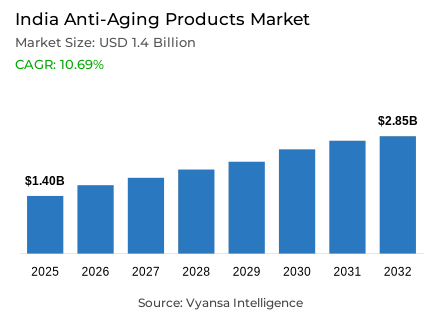
- Anti-aging products market size in India was valued at USD 1.4 billion in 2025 and is estimated at USD 1.55 billion in 2026.
- The market size is expected to grow to USD 2.85 billion by 2032.
- Market to register a CAGR of around 10.69% during 2026-32.
- Product Type Shares
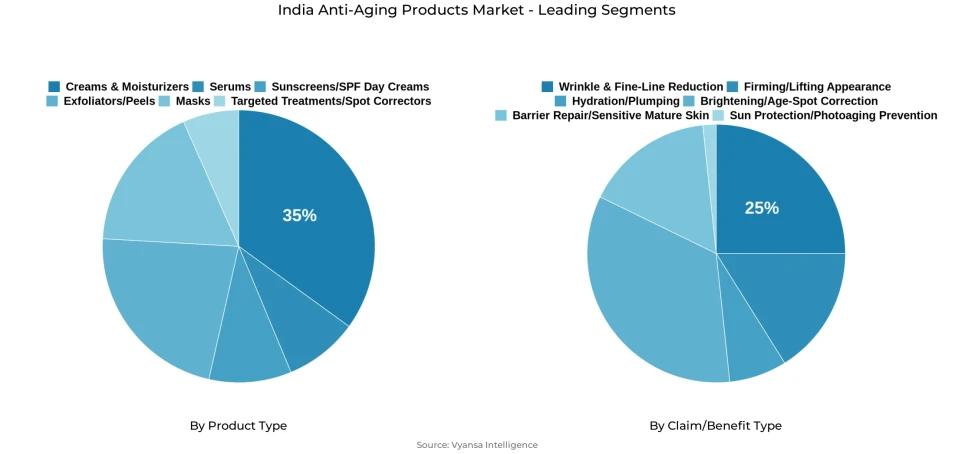
- Creams & moisturizers grabbed market share of 35%.
- Competition
- More than 10 companies are actively engaged in producing anti-aging products in India.
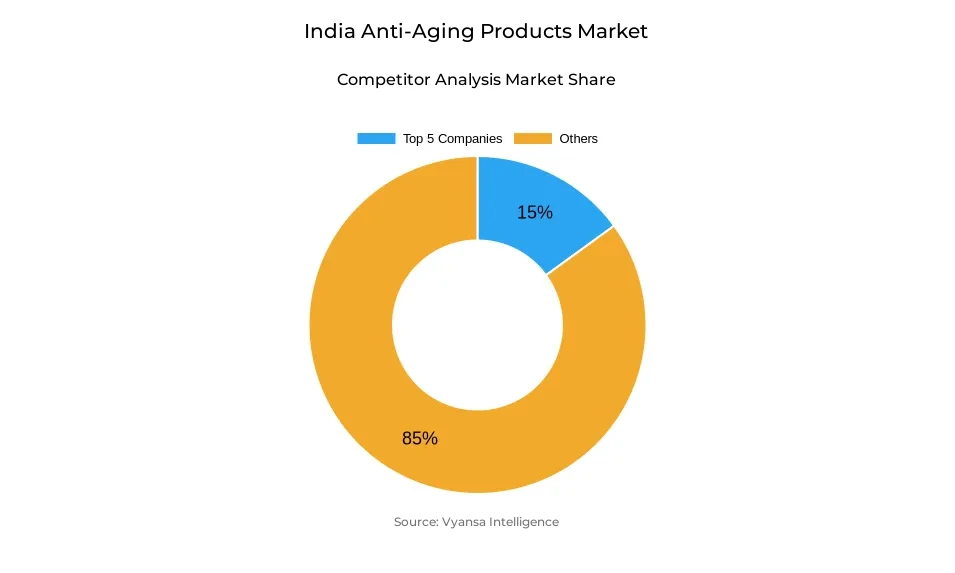
- Top 5 companies acquired around 15% of the market share.
- Laboratoire NUXE, NAOS Group, Sisley Cosmetics USA Inc., The Estee Lauder Companies Inc., Beiersdorf AG etc., are few of the top companies.
- Claim/Benefit Type
- Wrinkle & fine-line reduction grabbed 25% of the market.
India Anti-Aging Products Market Outlook
Valued at USD 1.4 billion in 2025, India's anti-aging products market is positioned to advance from USD 1.55 billion in 2026 to USD 2.85 billion by 2032, demonstrating 10.69% compound annual growth rate throughout the forecast window. This market expansion reflects rising consumer interest in skincare products supporting visible skin maintenance, everyday care routines, and appearance-focused solutions addressing visible wrinkle treatment and age-sign reduction. Growth remains underpinned by rising household consumption, strong economic momentum, and expanded digital accessibility enabling consumer participation across diverse income segments and geographic regions throughout urban and semi-urban India.
Rising household consumption establishes foundational market driver sustaining consumer investment in appearance-focused anti-aging products and visible age-management solutions. Data from Ministry of Statistics and Programme Implementation (MoSPI) reveals that per capita private final consumption expenditure at current prices rises to ₹1,29,967 in 2023-24 from ₹1,19,516 in 2022-23, establishing growth trajectory supporting higher consumer willingness to spend on hydration-focused and repair-oriented anti-aging skincare addressing visible age-management benefits. This consumption expansion creates market opportunity for premium herbal anti-aging creams and Ayurvedic skincare formulations resonating with quality-conscious Indian consumers seeking performance-driven solutions.
Economic expansion and strong consumption momentum keep premium anti-aging products commercially attractive across urban and semi-urban markets. Statistics from Press Information Bureau (PIB)'s Economic Survey 2025-26 indicate India's GDP growth for FY26 estimated at 7.4%, driven by consumption and investment dynamics maintaining favorable conditions for discretionary market category expansion. Published data from PIB demonstrates real private final consumption expenditure records 7.9% growth in Q2 FY2025-26 compared with 6.4% in equivalent previous-year period, establishing accelerated momentum supporting market expansion and consumer adoption of premium anti-aging product portfolios.
Market segmentation demonstrates pronounced consumer preference for practical formats and targeted benefit positioning. Creams and moisturizers command 35% market share through alignment with daily-use routines delivering visible skincare support without complexity, while wrinkle and fine-line reduction claims account for 25% of demand reflecting consumer prioritization of functional value and visible results. This market structure indicates that anti-aging products increasingly tie to functional skincare choices where targeted outcomes help brands build stronger relevance and sharper differentiation supporting category expansion through 2032.
India Anti-Aging Products Market Growth Driver
Stronger Consumer Spending Keeps Premium Skincare Moving
Expanding per capita consumption expenditure strengthens consumer willingness to invest in premium anti-aging market solutions and appearance-focused skincare routines. Evidence from MoSPI confirms per capita private final consumption expenditure growth from ₹1,19,516 in 2022-23 to ₹1,29,967 in 2023-24, establishing consumer capacity expansion for premium market category participation and investment in visible age-management benefits. This consumption growth directly supports demand for anti-aging products emphasizing hydration, repair, and visible skin improvement linked with long-term skincare maintenance and appearance confidence building.
Macroeconomic momentum and strong consumption patterns sustain favorable conditions for anti-aging market expansion and brand portfolio development. Analysis from PIB's Economic Survey 2025-26 indicates GDP growth for FY26 estimated at 7.4%, with real private final consumption expenditure recording 7.9% growth in Q2 FY2025-26 versus 6.4% previous-year equivalent, establishing sustained economic momentum supporting market expansion. This environment keeps anti-aging market categories commercially attractive and supports brand investment in e-commerce beauty market presence and D2C skincare brands enabling direct consumer engagement supporting market growth.
India Anti-Aging Products Market Challenge
Claim Scrutiny Keeps Brand Messaging Under Pressure
Regulatory authority enforcement around misleading advertisements and unsubstantiated efficacy claims creates substantial compliance burden affecting market communication strategies for anti-aging brands. Official records from PIB indicate the Central Consumer Protection Authority has issued 325 notices for violation of consumer rights, misleading advertisements, and unfair trade practices, imposing total penalties of ₹1.19 crore. This enforcement intensity establishes clear regulatory boundaries around visible results claims and efficacy positioning common in anti-aging market communications, requiring brands to carefully substantiate benefit claims around wrinkle reduction and visible improvement.
Digital commerce platform compliance requirements intensify pressure on online beauty retail channels and aggressive promotional messaging. Evidence from PIB reveals CCPA advised e-commerce platforms in June 2025 to conduct self-audits detecting dark patterns and ensuring complaint resolution, while authority statements indicate false, misleading, and exaggerated advertisements in health, wellness, and beauty industry will invite stringent action. This regulatory environment raises compliance costs for e-commerce beauty market participants and constrains aggressive promotional strategies, requiring brands to balance market visibility with heightened diligence and substantiation documentation obligations.
Unlock Market Intelligence
Explore the market potential with our data-driven report
India Anti-Aging Products Market Trend
Digital Beauty Discovery Is Becoming the New Normal
Consumer purchasing behavior demonstrates pronounced shift toward digital-first discovery and transaction journeys supported by ubiquitous payment infrastructure and expanding online accessibility. Market data from PIB indicates UPI processes 18.39 billion transactions worth ₹24 lakh crore in June 2025, powering 85% of India's digital payments and enabling frictionless repeat skincare purchasing and subscription-led replenishment mechanisms. This digital payment adoption eliminates traditional friction from routine anti-aging market buying, supporting convenient online discovery and price comparison for premium products.
Online commerce network expansion dramatically widens anti-aging market accessibility across secondary and tertiary cities where organized beauty retail infrastructure remains underdeveloped. Published data from PIB confirms Open Network for Digital Commerce (ONDC) has more than 7.64 lakh sellers and service providers across 616 plus cities as of January 2025, processing 154.4 million plus cumulative orders through December 2024. This expanding digital reach supports stronger visibility for anti-aging products across smaller cities where consumers increasingly discover skincare solutions through e-commerce beauty market platforms rather than traditional pharmacy skincare channels.
India Anti-Aging Products Market Opportunity
Silver-Economy Demand Opens a Wider Premium Space
Strong opportunities emerge in premium anti-aging products positioned for India's expanding senior-care ecosystem and government-backed healthy aging initiatives supporting commercial viability of mature-skin care solutions. Official records from PIB indicate Ayushman Bharat National Health Protection Scheme (PM-JAY) expansion now covers approximately 6 crore senior citizens aged 70 years and above from 4.5 crore families, with more than 40 lakh senior citizens enrolled by January 15, 2025. This senior demographic concentration creates substantial addressable market for age-specific anti-aging market products emphasizing comfort, visible care, and mature-skin support.
Silver economy policy support and government-backed elderly entrepreneurship initiatives strengthen business case for premium anti-aging market solutions targeting senior consumers. Data from PIB confirms over 2.21 crore citizens benefit from Indira Gandhi National Old Age Pension Scheme as of October 2025, establishing substantial income base supporting anti-aging market participation. Analysis from PIB indicates Seniorcare Aging Growth Engine (SAGE) platform supports elderly-care start-ups with equity support up to ₹1 crore per project, demonstrating government commitment to aging-related commerce enabling brands to develop D2C skincare brands and specialized formulations serving mature skin segments.
Unlock Market Intelligence
Explore the market potential with our data-driven report
India Anti-Aging Products Market Segmentation Analysis
By Product Type
- Creams & Moisturizers
- Serums
- Sunscreens/SPF Day Creams
- Exfoliators/Peels
- Masks
- Targeted Treatments/Spot Correctors
Creams and moisturizers command market leadership at 35% share within India's anti-aging products market, establishing dominant product type positioning through superior alignment with consumer preferences for practical daily-use formats. This market segment maintains leading position due to strong consumer preference for familiar formats combining convenience with visible skincare benefits without adding complexity to usage routines. Cream and moisturizer formulations deliver accessible positioning supporting market participation while maintaining adequate performance for routine daily application across diverse age segments seeking hydration-focused and nourishment-linked skincare solutions.
This market leadership position reflects consumers' continued selection of practical product types supporting daily use integration without specialized techniques. Cream and moisturizer formats support repeated daily application delivering hydration and nourishment benefits alongside visible age-management claims. The 35% market share indicates this segment continues shaping market development priorities, retail strategies, and competitive positioning throughout India's skincare industry. As e-commerce beauty market channels accelerate and consumers emphasize convenient purchasing, manufacturers maintaining cream and moisturizer leadership develop formulation innovation enabling direct consumer engagement through D2C skincare brands supporting market expansion.
By Claim/Benefit Type
- Wrinkle & Fine-Line Reduction
- Firming/Lifting Appearance
- Hydration/Plumping
- Brightening/Age-Spot Correction
- Barrier Repair/Sensitive Mature Skin
- Sun Protection/Photoaging Prevention
Wrinkle and fine-line reduction claims command market leadership at 25% share within India's anti-aging products market benefit segment, establishing categorical dominance reflecting consumer prioritization of visible results over generic beauty positioning. This market segment demonstrates consumers increasingly assign importance to targeted functional benefits and actively seek anti-aging market solutions delivering meaningful wrinkle reduction and visible fine-line improvement. Consumers across age groups expect anti-aging market products demonstrating clear efficacy around fine-line softening and visible skin texture improvement through daily application.
Product development continues being shaped by efficacy-driven requirements as manufacturers introduce formulation sophistication supporting wrinkle and fine-line reduction differentiation within competitive market environments. Brands formulating wrinkle reduction claims emphasize vitamin C serums, anti-aging face oils, and active formulations addressing consumer expectations around visible texture improvement and age-sign reduction. The 25% market share indicates this benefit segment continues influencing market messaging direction, competitive positioning, and product innovation priorities throughout India's skincare industry. As consumer awareness around visible aging signs intensifies and D2C skincare brands establish market presence through digital channels, manufacturers maintaining wrinkle and fine-line reduction claim leadership develop product innovation capturing sustained demand.
List of Companies Covered in India Anti-Aging Products Market
The companies listed below are highly influential in the India anti-aging products market, with a significant market share and a strong impact on industry developments.
- Laboratoire NUXE
- NAOS Group
- Sisley Cosmetics USA Inc.
- The Estee Lauder Companies Inc.
- Beiersdorf AG
- L’Oreal S.A.
- Caudalie
- Pierre Fabre
- Re’equil India Pvt. Ltd.
- Kenvue Brands LLC
Market News & Updates
- Kenvue Brands LLC, 2026:
In 2026, Kenvue launched Neutrogena Visible Repair Range in India. The company said the range addresses early aging signs. It also said the products target Indian women’s skincare needs. Kenvue described the range as science-backed and efficacious. This is a major product-related update for India’s anti-aging category. It brings a targeted, dermatologist-linked anti-aging line to market. It also supports stronger consumer education and earlier category adoption. These factors can widen demand in premium mass anti-aging skincare.
- L’Oréal S.A., 2026:
In 2026, L’Oréal Paris India continues promoting its Revitalift anti-aging range. Its official India site highlights serums, creams, and cleansers. The company says the range uses advanced anti-aging technology. It also links the products to visible wrinkle reduction. This is a relevant product-led development for India. It keeps anti-aging solutions visible across mainstream digital channels. It also supports broader access to multi-step anti-aging routines. These factors can strengthen premium mass competition in India’s category.
Frequently Asked Questions
Related Report
- Market Segmentation
- Research Scope
- Research Methodology
- Definitions and Assumptions
- Executive Summary
- India Anti-Aging Products Market Policies, Regulations, and Standards
- India Anti-Aging Products Market Dynamics
- Growth Factors
- Challenges
- Trends
- Opportunities
- India Anti-Aging Products Market Statistics, 2022-2032F
- Market Size & Growth Outlook
- By Revenues in USD Million
- Market Segmentation & Growth Outlook
- By Product Type
- Creams & Moisturizers- Market Insights and Forecast 2022-2032, USD Million
- Serums- Market Insights and Forecast 2022-2032, USD Million
- Sunscreens/SPF Day Creams- Market Insights and Forecast 2022-2032, USD Million
- Exfoliators/Peels- Market Insights and Forecast 2022-2032, USD Million
- Masks- Market Insights and Forecast 2022-2032, USD Million
- Targeted Treatments/Spot Correctors- Market Insights and Forecast 2022-2032, USD Million
- By Claim/Benefit Type
- Wrinkle & Fine-Line Reduction- Market Insights and Forecast 2022-2032, USD Million
- Firming/Lifting Appearance- Market Insights and Forecast 2022-2032, USD Million
- Hydration/Plumping- Market Insights and Forecast 2022-2032, USD Million
- Brightening/Age-Spot Correction- Market Insights and Forecast 2022-2032, USD Million
- Barrier Repair/Sensitive Mature Skin- Market Insights and Forecast 2022-2032, USD Million
- Sun Protection/Photoaging Prevention- Market Insights and Forecast 2022-2032, USD Million
- By Sales Channel
- Retail Offline- Market Insights and Forecast 2022-2032, USD Million
- Supermarkets/Hypermarkets- Market Insights and Forecast 2022-2032, USD Million
- Pharmacy/Drugstores- Market Insights and Forecast 2022-2032, USD Million
- Specialty Beauty Stores- Market Insights and Forecast 2022-2032, USD Million
- Department Stores- Market Insights and Forecast 2022-2032, USD Million
- Brand Exclusive Stores- Market Insights and Forecast 2022-2032, USD Million
- Clinics/Salons/Spas- Market Insights and Forecast 2022-2032, USD Million
- Other Offline Retail- Market Insights and Forecast 2022-2032, USD Million
- Retail Online- Market Insights and Forecast 2022-2032, USD Million
- Brand-Owned Websites- Market Insights and Forecast 2022-2032, USD Million
- E-commerce Marketplaces- Market Insights and Forecast 2022-2032, USD Million
- Online Beauty Retailers- Market Insights and Forecast 2022-2032, USD Million
- Online Pharmacy Platforms- Market Insights and Forecast 2022-2032, USD Million
- Social Commerce Platforms- Market Insights and Forecast 2022-2032, USD Million
- Quick Commerce/On-Demand Delivery Platforms- Market Insights and Forecast 2022-2032, USD Million
- Other Online Retail- Market Insights and Forecast 2022-2032, USD Million
- Retail Offline- Market Insights and Forecast 2022-2032, USD Million
- By Ingredient Platform
- Retinoids- Market Insights and Forecast 2022-2032, USD Million
- Hyaluronic Acid- Market Insights and Forecast 2022-2032, USD Million
- Niacinamide- Market Insights and Forecast 2022-2032, USD Million
- Vitamin C- Market Insights and Forecast 2022-2032, USD Million
- Peptides- Market Insights and Forecast 2022-2032, USD Million
- AHAs/BHAs- Market Insights and Forecast 2022-2032, USD Million
- Ceramides- Market Insights and Forecast 2022-2032, USD Million
- Botanical/Natural Actives- Market Insights and Forecast 2022-2032, USD Million
- Others- Market Insights and Forecast 2022-2032, USD Million
- By Consumer Age Group
- 18-34 Years- Market Insights and Forecast 2022-2032, USD Million
- 35-54 Years- Market Insights and Forecast 2022-2032, USD Million
- 55 Years & Above- Market Insights and Forecast 2022-2032, USD Million
- By End User
- Women- Market Insights and Forecast 2022-2032, USD Million
- Men- Market Insights and Forecast 2022-2032, USD Million
- Unisex- Market Insights and Forecast 2022-2032, USD Million
- By Price Tier
- Mass- Market Insights and Forecast 2022-2032, USD Million
- Premium- Market Insights and Forecast 2022-2032, USD Million
- By Regions
- North- Market Insights and Forecast 2022-2032, USD Million
- East- Market Insights and Forecast 2022-2032, USD Million
- West- Market Insights and Forecast 2022-2032, USD Million
- South- Market Insights and Forecast 2022-2032, USD Million
- By Competitors
- Competition Characteristics
- Market Share & Analysis
- By Product Type
- Market Size & Growth Outlook
- India Creams & Moisturizers Market Statistics, 2022-2032
- Market Size & Growth Outlook
- By Revenues in USD Million
- Market Segmentation & Growth Outlook
- By Claim/Benefit Type- Market Insights and Forecast 2022-2032, USD Million
- By Sales Channel- Market Insights and Forecast 2022-2032, USD Million
- By Ingredient Platform- Market Insights and Forecast 2022-2032, USD Million
- By Consumer Age Group- Market Insights and Forecast 2022-2032, USD Million
- By End User- Market Insights and Forecast 2022-2032, USD Million
- By Price Tier- Market Insights and Forecast 2022-2032, USD Million
- By Regions- Market Insights and Forecast 2022-2032, USD Million
- Market Size & Growth Outlook
- India Serums Market Statistics, 2022-2032
- Market Size & Growth Outlook
- By Revenues in USD Million
- Market Segmentation & Growth Outlook
- By Claim/Benefit Type- Market Insights and Forecast 2022-2032, USD Million
- By Sales Channel- Market Insights and Forecast 2022-2032, USD Million
- By Ingredient Platform- Market Insights and Forecast 2022-2032, USD Million
- By Consumer Age Group- Market Insights and Forecast 2022-2032, USD Million
- By End User- Market Insights and Forecast 2022-2032, USD Million
- By Price Tier- Market Insights and Forecast 2022-2032, USD Million
- By Regions- Market Insights and Forecast 2022-2032, USD Million
- Market Size & Growth Outlook
- India Sunscreens/SPF Day Creams Market Statistics, 2022-2032
- Market Size & Growth Outlook
- By Revenues in USD Million
- Market Segmentation & Growth Outlook
- By Claim/Benefit Type- Market Insights and Forecast 2022-2032, USD Million
- By Sales Channel- Market Insights and Forecast 2022-2032, USD Million
- By Ingredient Platform- Market Insights and Forecast 2022-2032, USD Million
- By Consumer Age Group- Market Insights and Forecast 2022-2032, USD Million
- By End User- Market Insights and Forecast 2022-2032, USD Million
- By Price Tier- Market Insights and Forecast 2022-2032, USD Million
- By Regions- Market Insights and Forecast 2022-2032, USD Million
- Market Size & Growth Outlook
- India Exfoliators/Peels Market Statistics, 2022-2032
- Market Size & Growth Outlook
- By Revenues in USD Million
- Market Segmentation & Growth Outlook
- By Claim/Benefit Type- Market Insights and Forecast 2022-2032, USD Million
- By Sales Channel- Market Insights and Forecast 2022-2032, USD Million
- By Ingredient Platform- Market Insights and Forecast 2022-2032, USD Million
- By Consumer Age Group- Market Insights and Forecast 2022-2032, USD Million
- By End User- Market Insights and Forecast 2022-2032, USD Million
- By Price Tier- Market Insights and Forecast 2022-2032, USD Million
- By Regions- Market Insights and Forecast 2022-2032, USD Million
- Market Size & Growth Outlook
- India Masks Market Statistics, 2022-2032
- Market Size & Growth Outlook
- By Revenues in USD Million
- Market Segmentation & Growth Outlook
- By Claim/Benefit Type- Market Insights and Forecast 2022-2032, USD Million
- By Sales Channel- Market Insights and Forecast 2022-2032, USD Million
- By Ingredient Platform- Market Insights and Forecast 2022-2032, USD Million
- By Consumer Age Group- Market Insights and Forecast 2022-2032, USD Million
- By End User- Market Insights and Forecast 2022-2032, USD Million
- By Price Tier- Market Insights and Forecast 2022-2032, USD Million
- By Regions- Market Insights and Forecast 2022-2032, USD Million
- Market Size & Growth Outlook
- India Targeted Treatments/Spot Correctors Market Statistics, 2022-2032
- Market Size & Growth Outlook
- By Revenues in USD Million
- Market Segmentation & Growth Outlook
- By Claim/Benefit Type- Market Insights and Forecast 2022-2032, USD Million
- By Sales Channel- Market Insights and Forecast 2022-2032, USD Million
- By Ingredient Platform- Market Insights and Forecast 2022-2032, USD Million
- By Consumer Age Group- Market Insights and Forecast 2022-2032, USD Million
- By End User- Market Insights and Forecast 2022-2032, USD Million
- By Price Tier- Market Insights and Forecast 2022-2032, USD Million
- By Regions- Market Insights and Forecast 2022-2032, USD Million
- Market Size & Growth Outlook
- Competitive Outlook
- Company Profiles
- The Estee Lauder Companies Inc.
- Business Description
- Product Portfolio
- Collaborations & Alliances
- Recent Developments
- Financial Details
- Others
- Beiersdorf AG
- Business Description
- Product Portfolio
- Collaborations & Alliances
- Recent Developments
- Financial Details
- Others
- L’Oreal S.A.
- Business Description
- Product Portfolio
- Collaborations & Alliances
- Recent Developments
- Financial Details
- Others
- Caudalie
- Business Description
- Product Portfolio
- Collaborations & Alliances
- Recent Developments
- Financial Details
- Others
- Pierre Fabre
- Business Description
- Product Portfolio
- Collaborations & Alliances
- Recent Developments
- Financial Details
- Others
- Laboratoire NUXE
- Business Description
- Product Portfolio
- Collaborations & Alliances
- Recent Developments
- Financial Details
- Others
- NAOS Group
- Business Description
- Product Portfolio
- Collaborations & Alliances
- Recent Developments
- Financial Details
- Others
- Sisley Cosmetics USA Inc.
- Business Description
- Product Portfolio
- Collaborations & Alliances
- Recent Developments
- Financial Details
- Others
- Re’equil India Pvt. Ltd.
- Business Description
- Product Portfolio
- Collaborations & Alliances
- Recent Developments
- Financial Details
- Others
- Kenvue Brands LLC
- Business Description
- Product Portfolio
- Collaborations & Alliances
- Recent Developments
- Financial Details
- Others
- The Estee Lauder Companies Inc.
- Company Profiles
- Disclaimer
| Segment | Sub-Segment |
|---|---|
| By Product Type |
|
| By Claim/Benefit Type |
|
| By Sales Channel |
|
| By Ingredient Platform |
|
| By Consumer Age Group |
|
| By End User |
|
| By Price Tier |
|
| By Regions |
|
Research Methodology
This study followed a structured approach comprising four key phases to assess the size and scope of the electro-oxidation market. The process began with thorough secondary research to collect data on the target market, related markets, and broader industry context. These findings, along with preliminary assumptions and estimates, were then validated through extensive primary research involving industry experts from across the value chain. To calculate the overall market size, both top-down and bottom-up methodologies were employed. Finally, market segmentation and data triangulation techniques were applied to refine and validate segment-level estimations.
Secondary Research
The secondary research phase involved gathering data from a wide range of credible and published sources. This step helped in identifying industry trends, defining market segmentation, and understanding the market landscape and value chain.
Sources consulted during this phase included:
- Company annual reports, investor presentations, and press releases
- Industry white papers and certified publications
- Trade directories and market-recognized databases
- Articles from authoritative authors and reputable journals
- Gold and silver standard websites
Secondary research was critical in mapping out the industry's value chain and monetary flow, identifying key market segments, understanding regional variations, and tracking significant industry developments.
Other key sources:
- Financial disclosures
- Industry associations and trade bodies
- News outlets and business magazines
- Academic journals and research studies
- Paid industry databases
Primary Research
To validate secondary data and gain deeper market insights, primary research was conducted with key stakeholders across both the supply and demand sides of the market.
On the demand side, participants included decision-makers and influencers from end-user industries—such as CIOs, CTOs, and CSOs—who provided first-hand perspectives on market needs, product usage, and future expectations.
On the supply side, interviews were conducted with manufacturers, industry associations, and institutional participants to gather insights into current offerings, product pipelines, and market challenges.
Primary interviews provided critical inputs such as:
- Market size and revenue data
- Product and service breakdowns
- Market forecasts
- Regional and application-specific trends
Stakeholders consulted included:
- Leading OEM and solution providers
- Channel and distribution partners
- End users across various applications
- Independent consultants and industry specialists
Market Size Estimation and Data Triangulation
- Identifying Key Market Participants (Secondary Research)
- Goal: To identify the major players or companies in the target market. This typically involves using publicly available data sources such as industry reports, market research publications, and financial statements of companies.
- Tools: Reports from firms like Gartner, Forrester, Euromonitor, Statista, IBISWorld, and others. Public financial statements, news articles, and press releases from top market players.
- Extracting Earnings of Key Market Participants
- Goal: To estimate the earnings generated from the product or service being analyzed. This step helps in understanding the revenue potential of each market player in a specific geography.
- Methods: Earnings data can be gathered from:
- Publicly available financial reports (for listed companies).
- Interviews and primary data sources from professionals, such as Directors, VPs, SVPs, etc. This is especially useful for understanding more nuanced, internal data that isn't publicly disclosed.
- Annual reports and investor presentations of key players.
- Data Collation and Development of a Relevant Data Model
- Goal: To collate inputs from both primary and secondary sources into a structured, data-driven model for market estimation. This model will incorporate key market KPIs and any independent variables relevant to the market.
- Key KPIs: These could include:
- Market size, growth rate, and demand drivers.
- Industry-specific metrics like market share, average revenue per customer (ARPC), or average deal size.
- External variables, such as economic growth rates, inflation rates, or commodity prices, that could affect the market.
- Data Modeling: Based on this data, the market forecasts are developed for the next 5 years. A combination of trend analysis, scenario modeling, and statistical regression might be used to generate projections.
- Scenario Analysis
- Goal: To test different assumptions and validate how sensitive the market is to changes in key variables (e.g., market demand, regulatory changes, technological disruptions).
- Types of Scenarios:
- Base Case: Based on current assumptions and historical data.
- Best-Case Scenario: Assuming favorable market conditions, regulatory environments, and technological advancements.
- Worst-Case Scenario: Accounting for adverse factors, such as economic downturns, stricter regulations, or unexpected disruptions.












