Greece Digestive Remedies Market Report: Trends, Growth and Forecast (2026-2032)
By Product Type (Paediatric Digestive Remedies (Paediatric Diarrhoeal Remedies, Paediatric Indigestion & Heartburn Remedies, Paediatric Laxatives, Paediatric Motion Sickness Remedies), Diarrhoeal Remedies, IBS Treatments, Indigestion & Heartburn Remedies (Antacids, Antiflatulents, Digestive Enzymes, H2 Blockers, Proton Pump Inhibitors), Laxatives, Motion Sickness Remedies), By Age Group (Children & Adolescents (01-17 years), Adults (18-65 years), Geriatric (65+ years)), By Sales Channel (Retail Online, Retail Offline (Hospitals, Clinics, Pharmacies)) ... Read more
|
Major Players
|
Greece Digestive Remedies Market Statistics and Insights, 2026
- Market Size Statistics
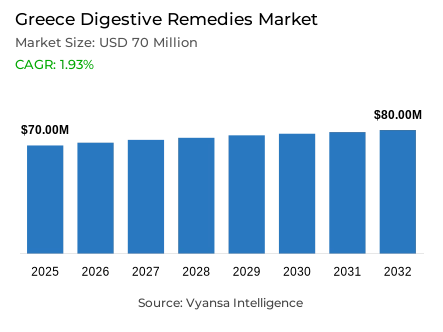
- Digestive remedies market size in Greece was valued at USD 70 million in 2025 and is estimated at USD 70.7 Million in 2026.
- The market size is expected to grow to USD 80 million by 2032.
- Market to register a CAGR of around 1.93% during 2026-32.
- Product Type Shares
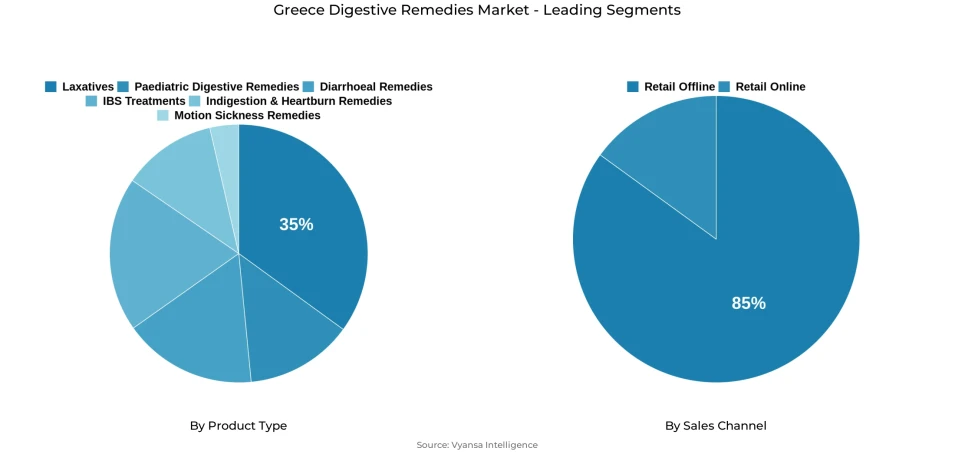
- Laxatives grabbed market share of 35%.
- Competition
- More than 20 companies are actively engaged in producing digestive remedies in Greece.
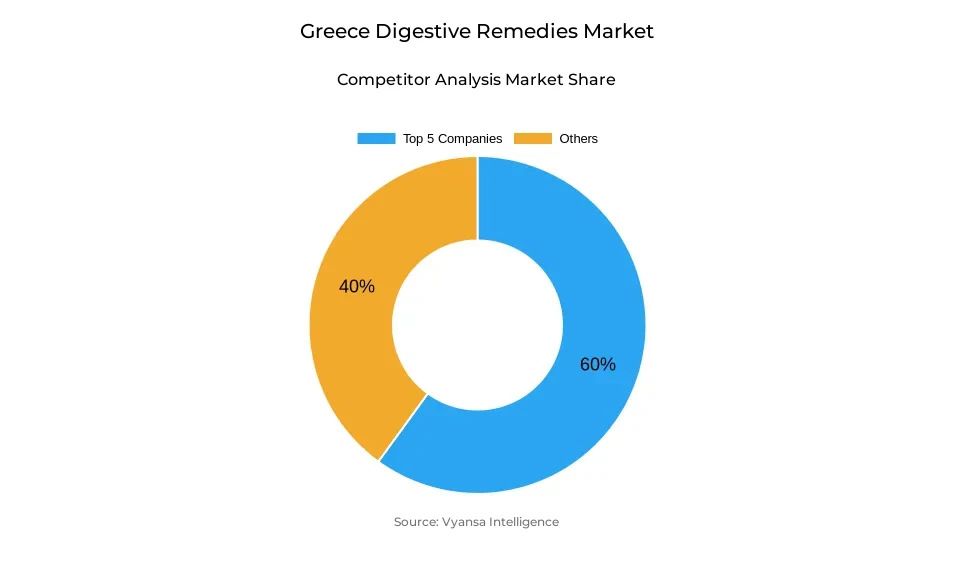
- Top 5 companies acquired around 60% of the market share.
- Epsilon Health SA, Takeda Hellas Pharmaceuticals SA, Olvos Science SA, Sanofi-Aventis SA, BGP Products Ltd etc., are few of the top companies.
- Sales Channel
- Retail offline grabbed 85% of the market.
Greece Digestive Remedies Market Outlook
The Greece digestive remedies market size was valued at USD 70 million in 2025 and is projected to grow from USD 70.7 million in 2026 to USD 80 million by 2032, exhibiting a CAGR of around 1.93% during the forecast period. Growth remains steady as travel activity, social mobility, and out-of-home routines continue to support everyday digestive health needs. Bank of Greece reports that inbound traveller flows reach 40.7 million in 2024, up 12.8%, while overnight stays reach 240.8 million, highlighting strong movement across tourism and domestic activity.
Active lifestyles and travel patterns continue to support regular demand for digestive remedies. Motion sickness, irregular eating habits, and stomach discomfort remain common when consumers spend more time travelling, working, or dining outside the home. Within product categories, laxatives account for about 35% of the market, reflecting their strong role in managing constipation and other recurring digestive issues. These products remain widely used because they address repeat digestive discomfort and are available in multiple convenient dosage formats.
Consumer spending behaviour, however, remains cautious due to inflation and price awareness. Eurostat reports that Greece’s annual inflation rate reaches 3.7% in July 2025 before easing to 1.8% in September 2025, highlighting continued pressure on household budgets. At the same time, digital purchasing is becoming more common, as 69.2% of internet users aged 16–74 buy goods or services online in the first quarter of 2025, increasing transparency across brands and price points for digestive remedies.
Distribution continues to rely heavily on traditional retail. Retail offline holds about 85% of sales, reflecting consumer preference for immediate access and pharmacist interaction when purchasing treatments for reflux, diarrhoea, constipation, and bloating. At the same time, digital behaviour is expanding, as 95.0% of internet users access the internet through mobile phones and 89.2% of people aged 16–74 go online, supporting wider awareness and easier product discovery for digestive remedies.
Greece Digestive Remedies Market Growth DriverTourism and Daily Mobility Keep Relief Demand Active
A key driver for digestive remedies in Greece is the return of strong travel and out-of-home activity. According to the Bank of Greece, inbound visitor flows increased by 12.8% in 2024 to 40.7 million visitors; travel receipts increased by 4.8% to EUR 21.6 billion; and overnight visitors were 240.8 million. Cruise activity continued its positive momentum with cruise receipt growth projected at 22.4% in 2024.
More visitors travelling will increase incidences of motion sickness, out-of-routine eating, and stomach discomfort, increasing the need for quick OTC relief for motion sickness, anti-diarrhoeals and antacids as consumers are looking for quick ways to alleviate symptoms from these activities. In Greece, digestive health continues to be considered an essential part of an individual's overall health and wellness and continues to be connected to eating outside the home, maintaining an active lifestyle, and instantaneous symptom relief versus delayed symptom relief through medication.
Greece Digestive Remedies Market ChallengePrice Pressure Keeps Value-for-Money at the Center
A major challenge for digestive remedies in Greece is continued consumer sensitivity to OTC price increases. Eurostat shows that Greece’s annual inflation rate reaches 3.7% in July 2025 before easing to 1.8% in September 2025, which still reflects a market where household budgets remain under pressure. In this setting, shoppers examine routine healthcare purchases more carefully and become less willing to pay extra unless product value is very clear.
Price comparison also becomes easier. Hellenic Statistical Authority (ELSTAT) reports that 69.2% of people aged 16-74 who have used the internet buy goods or services online in the first quarter of 2025, up from 62.8% in 2024. This wider digital buying habit increases transparency across brands and price points, which limits pricing headroom for antacids, laxatives, and diarrhoeal remedies.
Unlock Market Intelligence
Explore the market potential with our data-driven report
Greece Digestive Remedies Market TrendConvenience and Mobile Discovery Reshape Product Formats
The emergence of convenient, fast on-the-go digestion remedies is an ongoing trend in Greece. According to ELSTAT, in the first three months of 2025, 95.0% of people ages 16 to 74 utilized their mobile phones to get online, while 69.2% bought something online. With mobile-first behaviours, quick access to information about digestive aids has a direct connection to fast purchase decisions as well.
As a consequence, brands are now putting more emphasis on the portability of their products, the simplicity of their dosing, and packaging formats that can be used while traveling, working or socially. This change will not only contribute to new product additions; it will also provide consumers with easier means to transport, comprehend and apply digestive health solutions when and where they need them. That is why convenience-led formats now stand out as a visible market trend.
Greece Digestive Remedies Market OpportunityNatural OTC Extensions Open New Space for Brands
A strong opportunity in Greece lies in natural and supplement-style digestive support products that sit close to OTC care. According to data from ELSTAT published in the first quarter of 2025, 89.2% of people aged 16 to 74 support their constitutional right by using the internet; 95.0% of that group expresses that support via the use of mobile devices; and 72.0% of this same group utilizes e-government services. The numerous statistics convey a broad digital infrastructure that can effectively support product education (through internet connectivity, access to education), create awareness (through social media traffic), and facilitate self-care based on digital communication platforms.
With such a strong digital foundation exist opportunities for brands that offer natural relief for reflux, IBS related discomfort and other digestive health products as they do not rely on prescription drug use. These opportunities are best suited for products that have clear product benefits, are positioned as "gentle" and can be utilized daily as the consumer continues to gravitate towards purchasing support for their digestive health in the most practical manner possible while avoiding the "medicine" option.
Unlock Market Intelligence
Explore the market potential with our data-driven report
Greece Digestive Remedies Market Segmentation Analysis
By Product Type
- Paediatric Digestive Remedies
- Paediatric Diarrhoeal Remedies
- Paediatric Indigestion & Heartburn Remedies
- Paediatric Laxatives
- Paediatric Motion Sickness Remedies
- Diarrhoeal Remedies
- IBS Treatments
- Indigestion & Heartburn Remedies
- Antacids
- Antiflatulents
- Digestive Enzymes
- H2 Blockers
- Proton Pump Inhibitors
- Laxatives
- Motion Sickness Remedies
The segment has the highest share around product type under laxatives, with about 35% of the market. This lead reflects the segment’s strong connection with repeat-use digestive discomfort, especially constipation management. Laxatives also benefit from strong OTC familiarity, broad brand visibility, and multiple dosage formats, which help them remain a first-choice option for everyday digestive relief.
The segment also matches the market’s push toward practical and value-led solutions. Family-oriented packs, child-focused variants, and format expansion make laxatives easier to fit different household needs and usage occasions. Because constipation is often managed over time rather than as a one-time issue, laxatives maintain a wider and steadier consumer base than many other digestive remedy product types.
By Sales Channel
- Retail Online
- Retail Offline
- Hospitals
- Clinics
- Pharmacies
The segment has the highest share around sales channel under retail offline, with about 85% of the market. This dominance remains strong because digestive remedies are often bought for immediate relief, and physical pharmacies and stores offer instant access, pharmacist interaction, and stronger confidence for symptom-led purchases such as reflux, diarrhoea, constipation, and bloating.
At the same time, digital buying is clearly growing. ELSTAT reports that 69.2% of internet users aged 16-74 buy goods or services online in the first quarter of 2025, up from 62.8% in 2024. Even with that rise, offline stays ahead in digestive remedies because speed, trust, and in-person guidance still matter more than delayed delivery for many consumers in this category.
List of Companies Covered in Greece Digestive Remedies Market
The companies listed below are highly influential in the Greece digestive remedies market, with a significant market share and a strong impact on industry developments.
- Epsilon Health SA
- Takeda Hellas Pharmaceuticals SA
- Olvos Science SA
- Sanofi-Aventis SA
- BGP Products Ltd
- Johnson & Johnson Hellas SA
- Reckitt Benckiser Hellas SA
- Elpen SA
- Zarbis & Co EI - Johnz
- Uni-Pharma SA
Competitive Landscape
In 2025, the competitive landscape of digestive remedies in Greece experienced notable shifts following the discontinuation of Haleon’s Simeco, a key antacid brand. This change allowed leading players to strengthen their positions, with Sanofi-Aventis SA leading the market with a 22.3% retail value share, followed by BGP Products Ltd with 13.1%. Sanofi-Aventis benefited from strong demand for brands such as Maalox Plus, supported by the launch of the new Maalox Sugar Free variant and extensive promotional activities, while the exit of Simeco also boosted the performance of competing brands like Gaviscon-L. BGP Products maintains a strong presence through brands such as Duphalac, which has benefited from rising retail prices and sustained consumer demand. The category has also seen increasing product innovation and new entrants, including offerings from Menarini Hellas and domestic players such as Bionat and Elpen, particularly with products targeting conditions such as reflux and irritable bowel syndrome. Despite this growth, rising consumer awareness of gut health and the increasing use of probiotics as part of preventative health approaches are expected to moderate demand for traditional digestive remedies over time, although trends such as busy lifestyles, rising stress levels and growing digestive health concerns continue to support baseline demand in the market.
Frequently Asked Questions
Related Report
- Market Segmentation
- Research Scope
- Research Methodology
- Definitions and Assumptions
- Executive Summary
- Greece Digestive Remedies Market Policies, Regulations, and Standards
- Greece Digestive Remedies Market Dynamics
- Growth Factors
- Challenges
- Trends
- Opportunities
- Greece Digestive Remedies Market Statistics, 2022-2032F
- Market Size & Growth Outlook
- By Revenues in USD Million
- Market Segmentation & Growth Outlook
- By Product Type
- Paediatric Digestive Remedies- Market Insights and Forecast 2022-2032, USD Million
- Paediatric Diarrhoeal Remedies- Market Insights and Forecast 2022-2032, USD Million
- Paediatric Indigestion & Heartburn Remedies- Market Insights and Forecast 2022-2032, USD Million
- Paediatric Laxatives- Market Insights and Forecast 2022-2032, USD Million
- Paediatric Motion Sickness Remedies- Market Insights and Forecast 2022-2032, USD Million
- Diarrhoeal Remedies- Market Insights and Forecast 2022-2032, USD Million
- IBS Treatments- Market Insights and Forecast 2022-2032, USD Million
- Indigestion & Heartburn Remedies- Market Insights and Forecast 2022-2032, USD Million
- Antacids- Market Insights and Forecast 2022-2032, USD Million
- Antiflatulents- Market Insights and Forecast 2022-2032, USD Million
- Digestive Enzymes- Market Insights and Forecast 2022-2032, USD Million
- H2 Blockers- Market Insights and Forecast 2022-2032, USD Million
- Proton Pump Inhibitors- Market Insights and Forecast 2022-2032, USD Million
- Laxatives- Market Insights and Forecast 2022-2032, USD Million
- Motion Sickness Remedies- Market Insights and Forecast 2022-2032, USD Million
- Paediatric Digestive Remedies- Market Insights and Forecast 2022-2032, USD Million
- By Age Group
- Children & Adolescents (01-17 years)- Market Insights and Forecast 2022-2032, USD Million
- Adults (18-65 years)- Market Insights and Forecast 2022-2032, USD Million
- Geriatric (65+ years)- Market Insights and Forecast 2022-2032, USD Million
- By Sales Channel
- Retail Online- Market Insights and Forecast 2022-2032, USD Million
- Retail Offline- Market Insights and Forecast 2022-2032, USD Million
- Hospitals- Market Insights and Forecast 2022-2032, USD Million
- Clinics- Market Insights and Forecast 2022-2032, USD Million
- Pharmacies- Market Insights and Forecast 2022-2032, USD Million
- By Competitors
- Competition Characteristics
- Market Share & Analysis
- By Product Type
- Market Size & Growth Outlook
- Greece Paediatric Digestive Remedies Market Statistics, 2022-2032
- Market Size & Growth Outlook
- By Revenues in USD Million
- Market Segmentation & Growth Outlook
- By Age Group- Market Insights and Forecast 2022-2032, USD Million
- By Sales Channel- Market Insights and Forecast 2022-2032, USD Million
- Market Size & Growth Outlook
- Greece Diarrhoeal Remedies Market Statistics, 2022-2032
- Market Size & Growth Outlook
- By Revenues in USD Million
- Market Segmentation & Growth Outlook
- By Age Group- Market Insights and Forecast 2022-2032, USD Million
- By Sales Channel- Market Insights and Forecast 2022-2032, USD Million
- Market Size & Growth Outlook
- Greece IBS Treatments Market Statistics, 2022-2032
- Market Size & Growth Outlook
- By Revenues in USD Million
- Market Segmentation & Growth Outlook
- By Age Group- Market Insights and Forecast 2022-2032, USD Million
- By Sales Channel- Market Insights and Forecast 2022-2032, USD Million
- Market Size & Growth Outlook
- Greece Indigestion & Heartburn Remedies Market Statistics, 2022-2032
- Market Size & Growth Outlook
- By Revenues in USD Million
- Market Segmentation & Growth Outlook
- By Age Group- Market Insights and Forecast 2022-2032, USD Million
- By Sales Channel- Market Insights and Forecast 2022-2032, USD Million
- Market Size & Growth Outlook
- Greece Laxatives Market Statistics, 2022-2032
- Market Size & Growth Outlook
- By Revenues in USD Million
- Market Segmentation & Growth Outlook
- By Age Group- Market Insights and Forecast 2022-2032, USD Million
- By Sales Channel- Market Insights and Forecast 2022-2032, USD Million
- Market Size & Growth Outlook
- Greece Motion Sickness Remedies Market Statistics, 2022-2032
- Market Size & Growth Outlook
- By Revenues in USD Million
- Market Segmentation & Growth Outlook
- By Age Group- Market Insights and Forecast 2022-2032, USD Million
- By Sales Channel- Market Insights and Forecast 2022-2032, USD Million
- Market Size & Growth Outlook
- Competitive Outlook
- Company Profiles
- Sanofi-Aventis SA
- Business Description
- Product Portfolio
- Collaborations & Alliances
- Recent Developments
- Financial Details
- Others
- BGP Products Ltd
- Business Description
- Product Portfolio
- Collaborations & Alliances
- Recent Developments
- Financial Details
- Others
- Johnson & Johnson Hellas SA
- Business Description
- Product Portfolio
- Collaborations & Alliances
- Recent Developments
- Financial Details
- Others
- Reckitt Benckiser Hellas SA
- Business Description
- Product Portfolio
- Collaborations & Alliances
- Recent Developments
- Financial Details
- Others
- Elpen SA
- Business Description
- Product Portfolio
- Collaborations & Alliances
- Recent Developments
- Financial Details
- Others
- Epsilon Health SA
- Business Description
- Product Portfolio
- Collaborations & Alliances
- Recent Developments
- Financial Details
- Others
- Takeda Hellas Pharmaceuticals SA
- Business Description
- Product Portfolio
- Collaborations & Alliances
- Recent Developments
- Financial Details
- Others
- Olvos Science SA
- Business Description
- Product Portfolio
- Collaborations & Alliances
- Recent Developments
- Financial Details
- Others
- Zarbis & Co EI - Johnz
- Business Description
- Product Portfolio
- Collaborations & Alliances
- Recent Developments
- Financial Details
- Others
- Uni-Pharma SA
- Business Description
- Product Portfolio
- Collaborations & Alliances
- Recent Developments
- Financial Details
- Others
- Sanofi-Aventis SA
- Company Profiles
- Disclaimer
| Segment | Sub-Segment |
|---|---|
| By Product Type |
|
| By Age Group |
|
| By Sales Channel |
|
Research Methodology
This study followed a structured approach comprising four key phases to assess the size and scope of the electro-oxidation market. The process began with thorough secondary research to collect data on the target market, related markets, and broader industry context. These findings, along with preliminary assumptions and estimates, were then validated through extensive primary research involving industry experts from across the value chain. To calculate the overall market size, both top-down and bottom-up methodologies were employed. Finally, market segmentation and data triangulation techniques were applied to refine and validate segment-level estimations.
Secondary Research
The secondary research phase involved gathering data from a wide range of credible and published sources. This step helped in identifying industry trends, defining market segmentation, and understanding the market landscape and value chain.
Sources consulted during this phase included:
- Company annual reports, investor presentations, and press releases
- Industry white papers and certified publications
- Trade directories and market-recognized databases
- Articles from authoritative authors and reputable journals
- Gold and silver standard websites
Secondary research was critical in mapping out the industry's value chain and monetary flow, identifying key market segments, understanding regional variations, and tracking significant industry developments.
Other key sources:
- Financial disclosures
- Industry associations and trade bodies
- News outlets and business magazines
- Academic journals and research studies
- Paid industry databases
Primary Research
To validate secondary data and gain deeper market insights, primary research was conducted with key stakeholders across both the supply and demand sides of the market.
On the demand side, participants included decision-makers and influencers from end-user industries—such as CIOs, CTOs, and CSOs—who provided first-hand perspectives on market needs, product usage, and future expectations.
On the supply side, interviews were conducted with manufacturers, industry associations, and institutional participants to gather insights into current offerings, product pipelines, and market challenges.
Primary interviews provided critical inputs such as:
- Market size and revenue data
- Product and service breakdowns
- Market forecasts
- Regional and application-specific trends
Stakeholders consulted included:
- Leading OEM and solution providers
- Channel and distribution partners
- End users across various applications
- Independent consultants and industry specialists
Market Size Estimation and Data Triangulation
- Identifying Key Market Participants (Secondary Research)
- Goal: To identify the major players or companies in the target market. This typically involves using publicly available data sources such as industry reports, market research publications, and financial statements of companies.
- Tools: Reports from firms like Gartner, Forrester, Euromonitor, Statista, IBISWorld, and others. Public financial statements, news articles, and press releases from top market players.
- Extracting Earnings of Key Market Participants
- Goal: To estimate the earnings generated from the product or service being analyzed. This step helps in understanding the revenue potential of each market player in a specific geography.
- Methods: Earnings data can be gathered from:
- Publicly available financial reports (for listed companies).
- Interviews and primary data sources from professionals, such as Directors, VPs, SVPs, etc. This is especially useful for understanding more nuanced, internal data that isn't publicly disclosed.
- Annual reports and investor presentations of key players.
- Data Collation and Development of a Relevant Data Model
- Goal: To collate inputs from both primary and secondary sources into a structured, data-driven model for market estimation. This model will incorporate key market KPIs and any independent variables relevant to the market.
- Key KPIs: These could include:
- Market size, growth rate, and demand drivers.
- Industry-specific metrics like market share, average revenue per customer (ARPC), or average deal size.
- External variables, such as economic growth rates, inflation rates, or commodity prices, that could affect the market.
- Data Modeling: Based on this data, the market forecasts are developed for the next 5 years. A combination of trend analysis, scenario modeling, and statistical regression might be used to generate projections.
- Scenario Analysis
- Goal: To test different assumptions and validate how sensitive the market is to changes in key variables (e.g., market demand, regulatory changes, technological disruptions).
- Types of Scenarios:
- Base Case: Based on current assumptions and historical data.
- Best-Case Scenario: Assuming favorable market conditions, regulatory environments, and technological advancements.
- Worst-Case Scenario: Accounting for adverse factors, such as economic downturns, stricter regulations, or unexpected disruptions.












