Germany Sleep Aids Market Report: Trends, Growth and Forecast (2026-2032)
By Product (Single Ingredient (Doxylamine Succinate, Diphenhydramine, Melatonin), Combination Ingredient (Diphenhydramine + Acetaminophen, Other Antihistamine-Based Combinations), Herbal & Traditional Sleep Aids (Valerian root, Passionflower, Chamomile, Kava, Multi-Herbal Sleep Blends)), By Sleep Disorder (Insomnia, Sleep Apnea, Restless Legs Syndrome, Narcolepsy, Sleep Walking, Others), By Age Group (Young to Mid Adults (25-44 Years), Middle-Aged Adults (45-64 Years), Geriatric Population (65+ Years)), By Sales Channel (Retail Online, Retail Offline), By End User (Homecare/Individual Consumers, Hospitals, Sleep Centers & Clinics), By Formulation (Tablets, Gummies, Capsules, Liquid, Sublingual) ... Read more
|
Major Players
|
Germany Sleep Aids Market Statistics and Insights, 2026
- Market Size Statistics
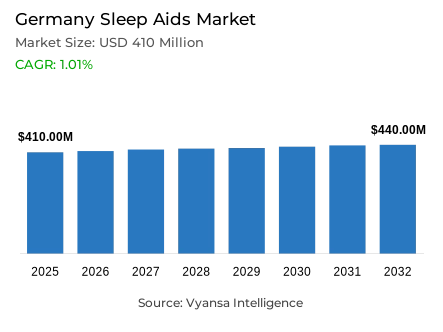
- Sleep aids market size in Germany was estimated at USD 410 million in 2025.
- The market size is expected to grow to USD 440 million by 2032.
- Market to register a CAGR of around 1.01% during 2026-32.
- Product Shares
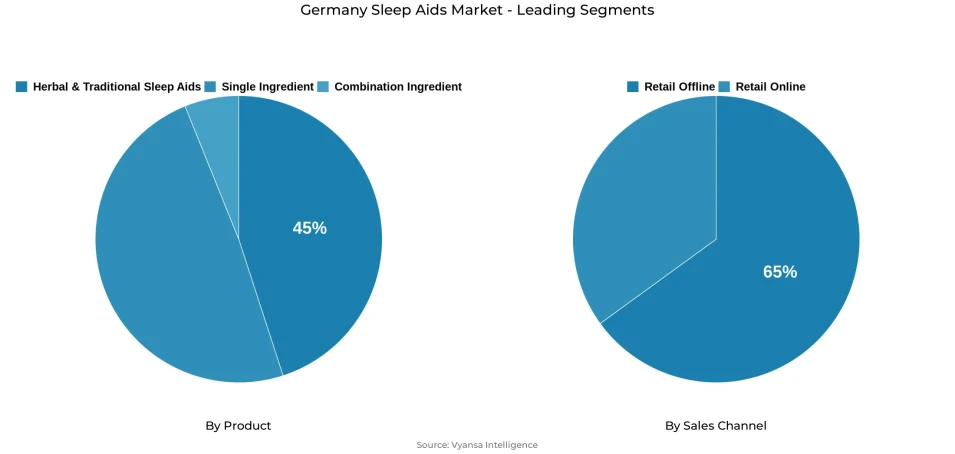
- Herbal & traditional sleep aids grabbed market share of 45%.
- Competition
- More than 15 companies are actively engaged in producing sleep aids in Germany.
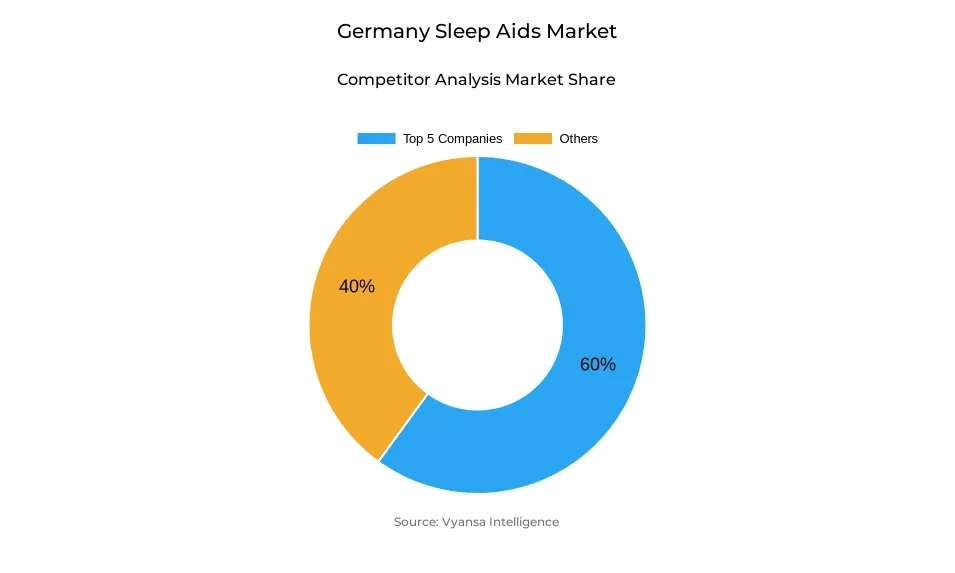
- Top 5 companies acquired around 60% of the market share.
- Dirk Rossmann GmbH, Aristo Pharma GmbH, Perrigo Deutschland GmbH, STADA Consumer Health Deutschland GmbH, Cheplapharm Arzneimittel GmbH etc., are few of the top companies.
- Sales channel
- Retail offline grabbed 65% of the market.
Germany Sleep Aids Market Outlook
Germany sleep aids market is estimated to grow steadily, at a moderate rate up to 2032, as sleep health becomes a component of holistic wellness. The market is projected to grow to USD 410 million in 2025 and USD 440 million in 2032 with a CAGR of 1.01%. This trend is driven by the fact that the prevalence of sleep problems in young adults and stressed people is high, and they are becoming more and more inclined to use non-prescription solutions to enhance their quality of life.
The category is still dominated by herbal and traditional sleep aids, which have a market share of 45%. This supremacy is an indication of a cultural belief in the power of natural substances such as valerian, passion flower, and lemon balm. Also, the market is experiencing a boom in melatonin-based products, with producers launching new delivery systems like fast-dissolving oral strips and sublingual sprays to meet the needs of consumers who want to fall asleep faster.
Retail Offline channels still dominate distribution with 65% of the market. Pharmacies are the most reliable place to consult and health and beauty experts such as Rossmann and dm enjoy high foot traffic. Despite the importance of e-commerce as a convenient platform, its development has been challenged in the recent past by legal obstacles, including the limitation of the widespread distribution of pharmacy-only medicines through large marketplaces, which strengthens the role of physical stores and online pharmacies.
Over the forecast period, the market will be influenced by the trends of beauty-within and preventive self-care. Consumers are also demanding high-quality, vegan, and sustainably packaged goods that are in line with clean-label ideals. Although the market maturity can cause a minor decrease in the growth rates up to 2032, the prospects are in multifunctional formulations and tech-integrated packaging that will provide digital sleep-tracking assistance to health-conscious adults.
Germany Sleep Aids Market Growth DriverWellness-Led Self-Medication Sustains Herbal/Melatonin Demand
In Germany, end users still address sleep-related issues with non-prescription products, which is a well-established cultural tendency to use herbal products and products containing melatonin. This shopping trend maintains a steady buying behaviour in pharmacies and health-and-beauty specialty stores. The main competitive strategy of brands in this space is natural positioning, which relies on well-known botanical ingredients, including valerian, lemon balm, hops, and passionflower, which are consistent with existing daily wellness practices.
The salience of sleep support products in the healthcare self-medication environment is reinforced by broader societal wellbeing pressures. Statistics released by the latest panel release by the Robert Koch Institute show that 21.9% of adults had depressive symptoms in the 2024 survey year, which highlights the established correlation between stress, mood, and sleep quality as perceived by end users.
Germany Sleep Aids Market ChallengePharmacy Network Contraction and Data-Privacy Rules Constrain Scale
Sleep aid products rely heavily on controlled, trust-based distribution channels, but the pharmacy network in Germany is undergoing a significant structural shrinkage. As of the end of 2025, the number of pharmacies in operation is reduced to 16,601, which is 440 fewer than the number of pharmacies at the end of 2024, or 2.6%. This shrinkage reduces local availability and increases the intensity of competition to in-store presence, especially to newer product formats and high-end stock-keeping units.
Legal and regulatory limitations also limit the rate at which retail online distribution can be scaled in the case of pharmacy-classified medicines. The decision of the German Federal Court of Justice confirms that the sale of medicines via large-scale platforms, where the order data containing health-related information is handled without express consent of the end-user, is a breach of the relevant data protection laws. This decision places increased compliance burdens on marketplace-based sales models and restricts their scope of operation in the pharmaceutical sector.
Unlock Market Intelligence
Explore the market potential with our data-driven report
Germany Sleep Aids Market TrendExpanded Natural Portfolios via New Delivery Formats
Manufacturers are increasingly expanding their range of herbal and natural hormone products with differentiated delivery systems, such as dissolvable strips, oral sprays, gummies, and combination formulations. This diversification approach allows brands to attain significant differentiation in a competitive and mature product environment. The trend is consistent with the increasing end-user demand of clean-label credentials and sustainability promises, which enable the extension of the product line continuously instead of depending on a flagship product.
The maturity of the natural medicine ecosystem in Germany is demonstrated by the richness of its regulatory framework. According to the Federal Institute for Drugs and Medical Devices, 6615 herbal, traditional, homoeopathic, and anthroposophic medicinal products are licensed or registered to be sold in the German market as of the May 2025 update, with 829 herbal medicinal products in both licensed and post-marketing approval categories combined.
Germany Sleep Aids Market OpportunityCompliant Online Pharmacies Unlock Digital Reorder Growth
There is a strong commercial case in utilizing compliant retail online platforms to reach end users, with the help of specific pharmacy models and strong digital service layers including re-ordering features, subscriptions-based buying, and educational guidance content. According to the Federal Statistical Office of Germany, 86% of people aged 16 to 74 years purchased online in 2025, and 85 and 87% of this group were women and men, respectively. This extensive online buying pattern shows a high potential of expansion into the over-the-counter health products where the regulatory systems allow.
Although marketplace limitations may apply to pharmacy-classified products, specialty retail online pharmacies and omnichannel operators can build competitive advantage through the integration of convenient access with credibility cues, such as pharmacist support, explicit dosing instructions, and systematic product education. This is especially applicable to next-generation melatonin formats that are poised to be fast-acting and part of daily wellness routines.
Unlock Market Intelligence
Explore the market potential with our data-driven report
Germany Sleep Aids Market Segmentation Analysis
By Product
- Single Ingredient
- Combination Ingredient
- Herbal & Traditional Sleep Aids
In the product type segmentation, the most dominant segment is herbal and traditional sleep aids, which occupies about 45% of the market share. This leadership stance aligns with the long-standing German preference of plant-based self-care and the established positioning of the segment around easy, routine-friendly usage. This profile is effective in reducing end-user reluctance with traditional pharmaceutical sleep aids in wellness-oriented populations.
The strength of this segment is also backed by the variety of regulated traditional products in the market. The Federal Institute for Drugs and Medical Devices May 2025 update lists 269 registered traditional herbal medicinal products that have gone through the registration process, including both single and fixed-combination registration. This variety allows retailers to have a wide variety of assortments in terms of dose forms, botanical profiles and combination formulas, and manufacturers the chance to be innovative in terms of quicker and more convenient delivery systems.
By Sales Channel
- Retail Online
- Retail Offline
Under the sales channel segmentation, the Retail Offline is the dominant distribution segment with a market share of about 65%. The prevalence of offline channels is indicative of the trust-based nature of sleep aid purchasing behaviour. Pharmacist consultation, immediate product availability, and direct assurance of proper use of over-the-counter products are highly valued by end users, especially when it comes to hormone-based products like melatonin and multi-ingredient formulations.
Despite this structural advantage, offline channels are experiencing significant headwinds due to the increasing operating expenses in the pharmacy ecosystem at large. According to industry statistics, the operating costs of pharmacies have increased by 65% since 2013, which has put pharmacy operators under a long-term financial strain that has had an impact on the density of stores, staffing levels, and shelf space allocation. These are the direct influences on the visibility of sleep aid brands and the possibility to facilitate the new product introduction in the offline retail setting.
List of Companies Covered in Germany Sleep Aids Market
The companies listed below are highly influential in the Germany sleep aids market, with a significant market share and a strong impact on industry developments.
- Dirk Rossmann GmbH
- Aristo Pharma GmbH
- Perrigo Deutschland GmbH
- STADA Consumer Health Deutschland GmbH
- Cheplapharm Arzneimittel GmbH
- Procter & Gamble Health Germany GmbH
- PharmaSGP GmbH
- Dr Gerhard Mann Chem-Pharm Fabrik GmbH
- Dr Willmar Schwabe GmbH & Co KG
- Biologische Heilmittel Heel GmbH
Competitive Landscape
Germany sleep aids market is led by STADA Consumer Health with Hoggar Night, leveraging strong pharmacy distribution and brand recognition in a mature category. Herbal specialists such as PharmaSGP’s Baldriparan and Procter & Gamble’s ZzzQuil Gute Nacht compete through plant-based positioning and incremental innovation, including nasal strips and melatonin extensions. MCM Klosterfrau is restructuring to enhance competitiveness, while newer entrants like HBI Health & Beauty International differentiate via fast-dissolving melatonin strips. The market remains pharmacy dominated following legal restrictions on Amazon’s sale of pharmacy-only medicines, though online pharmacies retain relevance. Competitive differentiation increasingly centres on natural botanicals, rapid-onset delivery formats, multifunctional formulations, smart packaging integration, and sustainable, clean-label positioning aligned with preventive wellness trends.
Frequently Asked Questions
Related Report
- Market Segmentation
- Research Scope
- Research Methodology
- Definitions and Assumptions
- Executive Summary
- Germany Sleep Aids Market Policies, Regulations, and Standards
- Germany Sleep Aids Market Dynamics
- Growth Factors
- Challenges
- Trends
- Opportunities
- Germany Sleep Aids Market Statistics, 2022-2032F
- Market Size & Growth Outlook
- By Revenues in USD Million
- Market Segmentation & Growth Outlook
- By Product
- Single Ingredient- Market Insights and Forecast 2022-2032, USD Million
- Doxylamine Succinate- Market Insights and Forecast 2022-2032, USD Million
- Diphenhydramine- Market Insights and Forecast 2022-2032, USD Million
- Melatonin- Market Insights and Forecast 2022-2032, USD Million
- Combination Ingredient- Market Insights and Forecast 2022-2032, USD Million
- Diphenhydramine + Acetaminophen- Market Insights and Forecast 2022-2032, USD Million
- Other Antihistamine-Based Combinations- Market Insights and Forecast 2022-2032, USD Million
- Herbal & Traditional Sleep Aids- Market Insights and Forecast 2022-2032, USD Million
- Valerian root- Market Insights and Forecast 2022-2032, USD Million
- Passionflower- Market Insights and Forecast 2022-2032, USD Million
- Chamomile- Market Insights and Forecast 2022-2032, USD Million
- Kava- Market Insights and Forecast 2022-2032, USD Million
- Multi-Herbal Sleep Blends- Market Insights and Forecast 2022-2032, USD Million
- Single Ingredient- Market Insights and Forecast 2022-2032, USD Million
- By Sleep Disorder
- Insomnia- Market Insights and Forecast 2022-2032, USD Million
- Sleep Apnea- Market Insights and Forecast 2022-2032, USD Million
- Restless Legs Syndrome- Market Insights and Forecast 2022-2032, USD Million
- Narcolepsy- Market Insights and Forecast 2022-2032, USD Million
- Sleep Walking- Market Insights and Forecast 2022-2032, USD Million
- Others- Market Insights and Forecast 2022-2032, USD Million
- By Age Group
- Young to Mid Adults (25-44 Years)- Market Insights and Forecast 2022-2032, USD Million
- Middle-Aged Adults (45-64 Years)- Market Insights and Forecast 2022-2032, USD Million
- Geriatric Population (65+ Years)- Market Insights and Forecast 2022-2032, USD Million
- By Sales Channel
- Retail Online- Market Insights and Forecast 2022-2032, USD Million
- Retail Offline- Market Insights and Forecast 2022-2032, USD Million
- By End User
- Homecare/Individual Consumers- Market Insights and Forecast 2022-2032, USD Million
- Hospitals- Market Insights and Forecast 2022-2032, USD Million
- Sleep Centers & Clinics- Market Insights and Forecast 2022-2032, USD Million
- By Formulation
- Tablets- Market Insights and Forecast 2022-2032, USD Million
- Gummies- Market Insights and Forecast 2022-2032, USD Million
- Capsules- Market Insights and Forecast 2022-2032, USD Million
- Liquid- Market Insights and Forecast 2022-2032, USD Million
- Sublingual- Market Insights and Forecast 2022-2032, USD Million
- By Competitors
- Competition Characteristics
- Market Share & Analysis
- By Product
- Market Size & Growth Outlook
- Germany Single Ingredient Sleep Aids Market Statistics, 2022-2032
- Market Size & Growth Outlook
- By Revenues in USD Million
- Market Segmentation & Growth Outlook
- By Sleep Disorder- Market Insights and Forecast 2022-2032, USD Million
- By Age Group- Market Insights and Forecast 2022-2032, USD Million
- By Sales Channel- Market Insights and Forecast 2022-2032, USD Million
- By End User- Market Insights and Forecast 2022-2032, USD Million
- By Formulation- Market Insights and Forecast 2022-2032, USD Million
- Market Size & Growth Outlook
- Germany Combination Ingredient Sleep Aids Market Statistics, 2022-2032
- Market Size & Growth Outlook
- By Revenues in USD Million
- Market Segmentation & Growth Outlook
- By Sleep Disorder- Market Insights and Forecast 2022-2032, USD Million
- By Age Group- Market Insights and Forecast 2022-2032, USD Million
- By Sales Channel- Market Insights and Forecast 2022-2032, USD Million
- By End User- Market Insights and Forecast 2022-2032, USD Million
- By Formulation- Market Insights and Forecast 2022-2032, USD Million
- Market Size & Growth Outlook
- Germany Herbal & Traditional Sleep Aids Market Statistics, 2022-2032
- Market Size & Growth Outlook
- By Revenues in USD Million
- Market Segmentation & Growth Outlook
- By Sleep Disorder- Market Insights and Forecast 2022-2032, USD Million
- By Age Group- Market Insights and Forecast 2022-2032, USD Million
- By Sales Channel- Market Insights and Forecast 2022-2032, USD Million
- By End User- Market Insights and Forecast 2022-2032, USD Million
- By Formulation- Market Insights and Forecast 2022-2032, USD Million
- Market Size & Growth Outlook
- Competitive Outlook
- Company Profiles
- STADA Consumer Health Deutschland GmbH
- Business Description
- Product Portfolio
- Collaborations & Alliances
- Recent Developments
- Financial Details
- Others
- Cheplapharm Arzneimittel GmbH
- Business Description
- Product Portfolio
- Collaborations & Alliances
- Recent Developments
- Financial Details
- Others
- Procter & Gamble Health Germany GmbH
- Business Description
- Product Portfolio
- Collaborations & Alliances
- Recent Developments
- Financial Details
- Others
- PharmaSGP GmbH
- Business Description
- Product Portfolio
- Collaborations & Alliances
- Recent Developments
- Financial Details
- Others
- Dr Gerhard Mann Chem-Pharm Fabrik GmbH
- Business Description
- Product Portfolio
- Collaborations & Alliances
- Recent Developments
- Financial Details
- Others
- Dirk Rossmann GmbH
- Business Description
- Product Portfolio
- Collaborations & Alliances
- Recent Developments
- Financial Details
- Others
- Aristo Pharma GmbH
- Business Description
- Product Portfolio
- Collaborations & Alliances
- Recent Developments
- Financial Details
- Others
- Perrigo Deutschland GmbH
- Business Description
- Product Portfolio
- Collaborations & Alliances
- Recent Developments
- Financial Details
- Others
- Dr Willmar Schwabe GmbH & Co KG
- Business Description
- Product Portfolio
- Collaborations & Alliances
- Recent Developments
- Financial Details
- Others
- Biologische Heilmittel Heel GmbH
- Business Description
- Product Portfolio
- Collaborations & Alliances
- Recent Developments
- Financial Details
- Others
- STADA Consumer Health Deutschland GmbH
- Company Profiles
- Disclaimer
| Segment | Sub-Segment |
|---|---|
| By Product |
|
| By Sleep Disorder |
|
| By Age Group |
|
| By Sales Channel |
|
| By End User |
|
| By Formulation |
|
Research Methodology
This study followed a structured approach comprising four key phases to assess the size and scope of the electro-oxidation market. The process began with thorough secondary research to collect data on the target market, related markets, and broader industry context. These findings, along with preliminary assumptions and estimates, were then validated through extensive primary research involving industry experts from across the value chain. To calculate the overall market size, both top-down and bottom-up methodologies were employed. Finally, market segmentation and data triangulation techniques were applied to refine and validate segment-level estimations.
Secondary Research
The secondary research phase involved gathering data from a wide range of credible and published sources. This step helped in identifying industry trends, defining market segmentation, and understanding the market landscape and value chain.
Sources consulted during this phase included:
- Company annual reports, investor presentations, and press releases
- Industry white papers and certified publications
- Trade directories and market-recognized databases
- Articles from authoritative authors and reputable journals
- Gold and silver standard websites
Secondary research was critical in mapping out the industry's value chain and monetary flow, identifying key market segments, understanding regional variations, and tracking significant industry developments.
Other key sources:
- Financial disclosures
- Industry associations and trade bodies
- News outlets and business magazines
- Academic journals and research studies
- Paid industry databases
Primary Research
To validate secondary data and gain deeper market insights, primary research was conducted with key stakeholders across both the supply and demand sides of the market.
On the demand side, participants included decision-makers and influencers from end-user industries—such as CIOs, CTOs, and CSOs—who provided first-hand perspectives on market needs, product usage, and future expectations.
On the supply side, interviews were conducted with manufacturers, industry associations, and institutional participants to gather insights into current offerings, product pipelines, and market challenges.
Primary interviews provided critical inputs such as:
- Market size and revenue data
- Product and service breakdowns
- Market forecasts
- Regional and application-specific trends
Stakeholders consulted included:
- Leading OEM and solution providers
- Channel and distribution partners
- End users across various applications
- Independent consultants and industry specialists
Market Size Estimation and Data Triangulation
- Identifying Key Market Participants (Secondary Research)
- Goal: To identify the major players or companies in the target market. This typically involves using publicly available data sources such as industry reports, market research publications, and financial statements of companies.
- Tools: Reports from firms like Gartner, Forrester, Euromonitor, Statista, IBISWorld, and others. Public financial statements, news articles, and press releases from top market players.
- Extracting Earnings of Key Market Participants
- Goal: To estimate the earnings generated from the product or service being analyzed. This step helps in understanding the revenue potential of each market player in a specific geography.
- Methods: Earnings data can be gathered from:
- Publicly available financial reports (for listed companies).
- Interviews and primary data sources from professionals, such as Directors, VPs, SVPs, etc. This is especially useful for understanding more nuanced, internal data that isn't publicly disclosed.
- Annual reports and investor presentations of key players.
- Data Collation and Development of a Relevant Data Model
- Goal: To collate inputs from both primary and secondary sources into a structured, data-driven model for market estimation. This model will incorporate key market KPIs and any independent variables relevant to the market.
- Key KPIs: These could include:
- Market size, growth rate, and demand drivers.
- Industry-specific metrics like market share, average revenue per customer (ARPC), or average deal size.
- External variables, such as economic growth rates, inflation rates, or commodity prices, that could affect the market.
- Data Modeling: Based on this data, the market forecasts are developed for the next 5 years. A combination of trend analysis, scenario modeling, and statistical regression might be used to generate projections.
- Scenario Analysis
- Goal: To test different assumptions and validate how sensitive the market is to changes in key variables (e.g., market demand, regulatory changes, technological disruptions).
- Types of Scenarios:
- Base Case: Based on current assumptions and historical data.
- Best-Case Scenario: Assuming favorable market conditions, regulatory environments, and technological advancements.
- Worst-Case Scenario: Accounting for adverse factors, such as economic downturns, stricter regulations, or unexpected disruptions.












