Germany Medium-Range Surface-to-Air Missile Systems Market Report: Trends, Growth and Forecast (2026-2032)
By Range (Tactical Medium-Range (approx 15-40 km), Strategic Medium-Range (approx 40-100 km)), By Platform (Land-Based, Mobile Mounted, Fixed Sites, Naval/Sea-Based, Air-Based), By Guidance System (Semi-Active Radar Homing (SARH), Active Radar Homing (ARH), Infrared or Dual-Mode seekers, Command-guided systems with datalink), By Application (Ballistic Missile Defense, Cruise Missile Defense, Aircraft interception, UAV Defense), By Speed (Subsonic (Below Mach 1), Supersonic (Mach 1-Mach 5), Hypersonic (Above Mach 5)), By Procurement Type (Domestic Procurement, Foreign Military Sales (FMS), Direct Commercial Sales (DCS), Joint Development Programs) ... Read more
|
Major Players
|
Germany Medium-Range Surface-to-Air Missile Systems Market Statistics and Insights, 2026
- Market Size Statistics
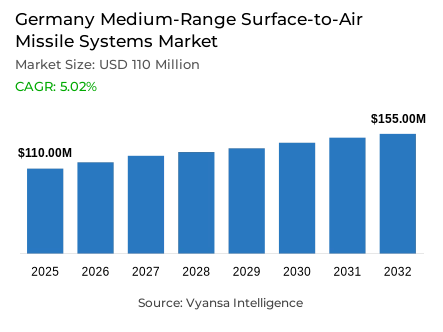
- Medium-range surface-to-air missile systems market size in Germany was estimated at USD 110 million in 2025.
- The market size is expected to grow to USD 155 million by 2032.
- Market to register a CAGR of around 5.02% during 2026-32.
- Range Shares
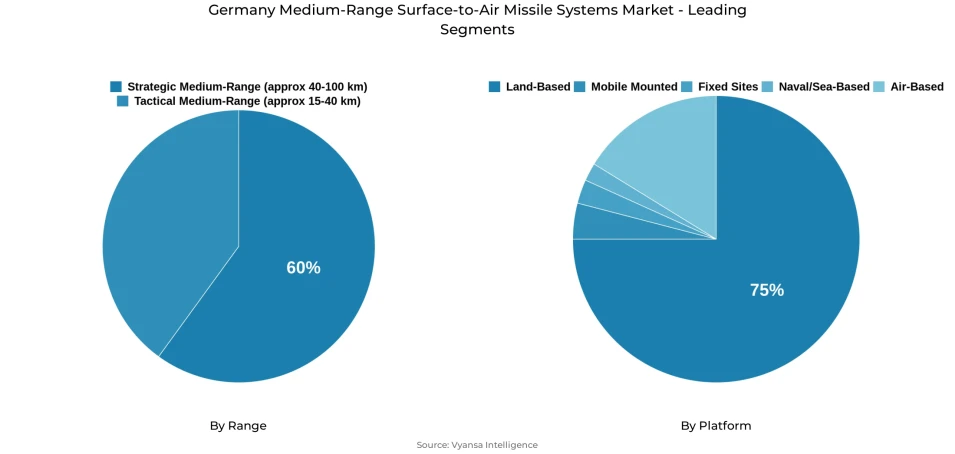
- Strategic medium-range (approx. 40-100 km) grabbed market share of 60%.
- Competition
- Medium-range surface-to-air missile systems in Germany is currently being catered to by more than 5 companies.
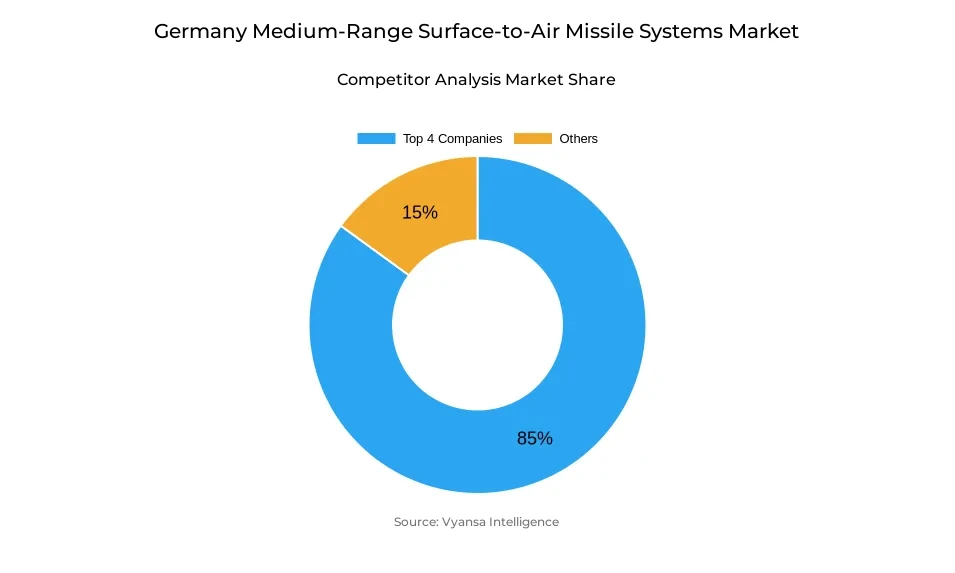
- Top 4 companies acquired around 85% of the market share.
- Raytheon (RTX), Lockheed Martin, Diehl Defence, MBDA etc., are few of the top companies.
- Platform
- Land-based grabbed 75% of the market.
Germany Medium-Range Surface-to-Air Missile Systems Market Outlook
The Germany medium-range surface-to-air missile systems market was valued at around $110 million in 2025 and is expected to reach $155 million by 2032, growing at a CAGR of approximately 5.02% from 2026 to 2032. This steady growth is underpinned by a dramatic increase in military procurement budgets, rising from €21.64 billion in 2025 to €38.53 billion in 2026, with total core defence spending reaching €82.69 billion. This increased fiscal outlay is directly fueling investment in the launchers and missiles, radar, and long-lead spare purchases.
Compliance with collaborative efforts such as the European Sky Shield Initiative, which brings together 23 countries, and the NATO Integrated Air and Missile Defence mission, is a key driving force behind the growth. These efforts are propelling medium-range surface-to-air missile systems towards being interoperable by design, with the ability to operate within multinational command and control structures. The reconstitution of formations such as the Air Force's 61st Air Defense Missile Group, organized around five IRIS-T SLM fire units and some 500 troops, further extends the procurement chain across radars, simulators, secure data links, and long-term maintenance cycles.
In terms of range, the Strategic Medium-Range segment (roughly 40-100 km) leads the way with a market share of around 60%. This range category effectively engages cruise missiles, fixed-wing aircraft, helicopters, and unmanned aerial vehicles while maintaining platform mobility, making it the bedrock of Germany's air defence system and a high priority area for steady procurement activity.
Regarding the platform component, ground-based systems currently account for the 75% share. Truck-mounted launchers and radars provide operational flexibility without the need for runway access, directly integrating into national command structures with rapid reaction times. However, a structural problem remains—a top-heavy personnel structure, with officer personnel increasing from 15% to 21% between 2010 and 2024, may slow the rate of capability growth throughout the forecast period.
Germany Medium-Range Surface-to-Air Missile Systems Market Growth Driver
Escalating Defence Procurement Budgets Accelerating System Acquisitions
The federal defence budget of Germany for 2026 reflects a strong commitment to speeding up the modernization of air defence, with military procurement budgets increasing significantly from 2025’s €21.64 billion to 2026’s €38.53 billion—an increase of around €16.89 billion. This increased budgetary flexibility will go a long way in facilitating the procurement of new launchers and missiles, radar systems, and the purchase of long-lead spares without affecting operational preparedness.
To add to this, the investments budget increases to €2.51 billion in 2026 from €1.66 billion in 2025, while the total core defence budget touches €82.69 billion. The continued budgetary boost ensures that the modernization of air defence remains firmly on the radar of Germany’s procurement strategy, thus facilitating faster contracting cycles for systems intended to fill critical gaps in the Germany medium-range surface-to-air missile systems market.
Germany Medium-Range Surface-to-Air Missile Systems Market Challenge
Structural Workforce Imbalances Constraining Operational Readiness
Medium-range air defence systems require not only sophisticated equipment but also trained personnel and simplified command structures. The Federal Court of Auditors of Germany points out that there is a structural imbalance in the military’s personnel distribution. The proportion of officers and senior officers in military personnel has increased from 15% in 2010 to 21% in 2024, even as the total number of military personnel has reduced by around 60,000 or 24% over the same period.
This top-heaviness of the military structure reduces the number of personnel in deployable units. As of February 2025, some 5,000 troops are deployed in the administration offices of the Bundeswehr, while another 1,000 are stationed in the defence ministry itself. Such a distribution of personnel is bound to create friction in the formation and maintenance of operationally ready air defence units, thus becoming a structural bottleneck in the expansion of capabilities in the Germany medium-range surface-to-air missile systems market.
Unlock Market Intelligence
Explore the market potential with our data-driven report
Germany Medium-Range Surface-to-Air Missile Systems Market Trend
Integration into Multinational Air-Defence Frameworks Reshaping Procurement Approaches
One of the defining trends influencing the Germany medium-range surface-to-air missile systems market is the strategic integration of national procurement efforts within broader European and NATO-strategic frameworks. The European Sky Shield Initiative (ESSI) presently brings together 23 European countries with the common goal of improving air defence and expediting the implementation of specific, interoperable actions among member states.
At the same time, the NATO Integrated Air and Missile Defence (IAMD) mission is always active with a 360-degree threat coverage strategy, including 24/7 air policing and ballistic missile defence. These initiatives are increasingly requiring that medium-range SAM systems be interoperable from the outset, seamlessly integrating with allied command and control systems and operating in multinational, network-centric sensor environments, fundamentally transforming how end-users assess and procure systems.
Germany Medium-Range Surface-to-Air Missile Systems Market Opportunity
Unit-Level Expansion Creating Sustained Demand Across the System Lifecycle
The gradual reconstitution of specialized ground-based air defence forces in Germany represents a complex set of opportunities for the Germany medium-range surface-to-air missile systems market. The Air Force's 61st Air Defense Missile Group, organized around five IRIS-T SLM fire units and staffed by some 500 troops, illustrates the scope at which end-users are seeking to operationalize new capabilities.
As new fire units become operational, procurement requirements will stretch far beyond launchers and interceptors to include radars, secure data links, simulators, test equipment, and maintenance pipelines. Each new fire unit also drives ongoing demand for missile inventories, spare components, and depot-level repair support—opening up long-term market opportunities for training system suppliers, platform integrators, and full-spectrum through-life support providers.
Unlock Market Intelligence
Explore the market potential with our data-driven report
Germany Medium-Range Surface-to-Air Missile Systems Market Segmentation Analysis
By Range
- Tactical Medium-Range (approx 15-40 km)
- Strategic Medium-Range (approx 40-100 km)
Under the range segment, the Strategic Medium-Range segment (ranging 40-100 km) leads the market for medium-range surface-to-air missile systems in Germany, with a share of around 60% of the overall market. This engagement range is preferred as it not only covers the major threat set of operation—cruise missiles, fixed-wing aircraft, helicopters, and a general category of unmanned aerial vehicles—but also maintains the mobility of the platform to reposition and safeguard various high-value assets.
In Germany's air-defence network, this range category plays a pivotal role as an intermediate layer between very short-range terminal defence systems and higher-tier long-range systems that target ballistic and high-altitude threats. This categorization makes the 40-100 km range segment the backbone of the air-defence network, which generates consistent and high-priority demand for corresponding missiles, launchers, and network-capable sensor systems among end-users in Germany.
By Platform
- Land-Based
- Mobile Mounted
- Fixed Sites
- Naval/Sea-Based
- Air-Based
Under the platform segment, the land-based platform leads the Germany medium-range surface-to-air missile systems market, with a share of around 75% of the total market. The land-based medium-range SAM systems are the most operationally feasible solution for securing fixed strategic assets such as air bases, seaports, and energy infrastructure, while maintaining the mobility to reposition with ground forces as the threat environment dictates.
This market dominance is further supported by the existing air-defence deployment and maintenance strategy in Germany. Truck-mobile launchers and radars can disperse, hide, and redeploy without relying on runway access or air-tasking coordination. The land-based platforms also have better integration with the national air-defence command structure, which enables the development of layered air-defence architectures with short reaction times and stable maintenance and training cycles that end-users in Germany depend on for consistent operational performance.
List of Companies Covered in Germany Medium-Range Surface-to-Air Missile Systems Market
The companies listed below are highly influential in the Germany medium-range surface-to-air missile systems market, with a significant market share and a strong impact on industry developments.
- Raytheon (RTX)
- Lockheed Martin
- Diehl Defence
- MBDA
Market News & Updates
- Diehl Defence, 2026:
Diehl Defence reported on 5 February 2026 that, “at the turn of the year,” it and Germany’s procurement authority BAAINBw signed several contracts for procurement/follow-on procurement of IRIS-T family missiles, explicitly covering ground-based air defence IRIS-T SLS and IRIS-T SLM; Diehl characterizes IRIS-T SLM as covering the MRAD layer with an effective range up to 60 km and altitude 20 km, and states a company-wide investment program of ~€1.5 billion to expand capacity. Market impact in Germany’s medium-range SAM segment is direct and immediate: it underwrites interceptor availability for the IRIS-T SLM fleet (reducing a key readiness bottleneck), strengthens domestic industrial throughput at a time of European missile scarcity, and materially improves Germany’s ability to scale layered GBAD coverage as demand rises for MRAD protection of critical infrastructure and maneuver forces.
- Lockheed Martin, 2025:
Lockheed Martin announced on 14 October 2025 that it signed a Memorandum of Understanding with Diehl Defence to explore collaboration opportunities in Integrated Air and Missile Defense, including expanding the supply chain for PAC-3 MSE (Patriot interceptor) alongside R&D and other activities; the release notes Germany as one of the PAC-3 partner nations and frames the partnership as increasing allied supply-chain resilience. For Germany’s medium-range air defense market—where Patriot remains a central capability—this is a strategic industrial lever: it supports faster replenishment and modernization by widening/derisking European production pathways, improves delivery confidence amid surging European demand, and strengthens Germany’s role in the transatlantic Patriot ecosystem (potentially improving sustainment, spares availability, and future upgrade options for Bundeswehr Patriot units).
Frequently Asked Questions
Related Report
1. Market Segmentation
1.1. Research Scope
1.2. Research Methodology
1.3. Definitions and Assumptions
2. Executive Summary
3. Germany Medium-Range Surface-to-Air Missile Systems Market Policies, Regulations, and Standards
4. Germany Medium-Range Surface-to-Air Missile Systems Market Dynamics
4.1. Growth Factors
4.2. Challenges
4.3. Trends
4.4. Opportunities
5. Germany Medium-Range Surface-to-Air Missile Systems Market Statistics, 2022-2032F
5.1. Market Size & Growth Outlook
5.1.1.By Revenues in USD Million
5.2. Market Segmentation & Growth Outlook
5.2.1.By Range
5.2.1.1. Tactical Medium-Range (approx 15-40 km)- Market Insights and Forecast 2022-2032, USD Million
5.2.1.2. Strategic Medium-Range (approx 40-100 km)- Market Insights and Forecast 2022-2032, USD Million
5.2.2.By Platform
5.2.2.1. Land-Based - Market Insights and Forecast 2022-2032, USD Million
5.2.2.2. Mobile Mounted- Market Insights and Forecast 2022-2032, USD Million
5.2.2.3. Fixed Sites- Market Insights and Forecast 2022-2032, USD Million
5.2.2.4. Naval/Sea-Based- Market Insights and Forecast 2022-2032, USD Million
5.2.2.5. Air-Based- Market Insights and Forecast 2022-2032, USD Million
5.2.3.By Guidance System
5.2.3.1. Semi-Active Radar Homing (SARH)- Market Insights and Forecast 2022-2032, USD Million
5.2.3.2. Active Radar Homing (ARH)- Market Insights and Forecast 2022-2032, USD Million
5.2.3.3. Infrared or Dual-Mode seekers- Market Insights and Forecast 2022-2032, USD Million
5.2.3.4. Command-guided systems with datalink- Market Insights and Forecast 2022-2032, USD Million
5.2.4.By Application
5.2.4.1. Ballistic Missile Defense- Market Insights and Forecast 2022-2032, USD Million
5.2.4.2. Cruise Missile Defense- Market Insights and Forecast 2022-2032, USD Million
5.2.4.3. Aircraft interception- Market Insights and Forecast 2022-2032, USD Million
5.2.4.4. UAV Defense- Market Insights and Forecast 2022-2032, USD Million
5.2.5.By Speed
5.2.5.1. Subsonic (Below Mach 1)- Market Insights and Forecast 2022-2032, USD Million
5.2.5.2. Supersonic (Mach 1-Mach 5)- Market Insights and Forecast 2022-2032, USD Million
5.2.5.3. Hypersonic (Above Mach 5)- Market Insights and Forecast 2022-2032, USD Million
5.2.6.By Procurement Type
5.2.6.1. Domestic Procurement- Market Insights and Forecast 2022-2032, USD Million
5.2.6.2. Foreign Military Sales (FMS)- Market Insights and Forecast 2022-2032, USD Million
5.2.6.3. Direct Commercial Sales (DCS)- Market Insights and Forecast 2022-2032, USD Million
5.2.6.4. Joint Development Programs- Market Insights and Forecast 2022-2032, USD Million
5.2.7.By Competitors
5.2.7.1. Competition Characteristics
5.2.7.2. Market Share & Analysis
6. Germany Tactical Medium-Range (approx. 15-40 km) Missile Systems Market Statistics, 2022-2032
6.1. Market Size & Growth Outlook
6.1.1.By Revenues in USD Million
6.2. Market Segmentation & Growth Outlook
6.2.1.By Platform- Market Insights and Forecast 2022-2032, USD Million
6.2.2.By Guidance System- Market Insights and Forecast 2022-2032, USD Million
6.2.3.By Application - Market Insights and Forecast 2022-2032, USD Million
6.2.4.By Speed - Market Insights and Forecast 2022-2032, USD Million
6.2.5.By Procurement Type- Market Insights and Forecast 2022-2032, USD Million
7. Germany Strategic Medium-Range (approx. 40-100 km) Missile Systems Market Statistics, 2022-2032
7.1. Market Size & Growth Outlook
7.1.1.By Revenues in USD Million
7.2. Market Segmentation & Growth Outlook
7.2.1.By Platform- Market Insights and Forecast 2022-2032, USD Million
7.2.2.By Guidance System- Market Insights and Forecast 2022-2032, USD Million
7.2.3.By Application - Market Insights and Forecast 2022-2032, USD Million
7.2.4.By Speed - Market Insights and Forecast 2022-2032, USD Million
7.2.5.By Procurement Type- Market Insights and Forecast 2022-2032, USD Million
8. Competitive Outlook
8.1. Company Profiles
8.1.1.Diehl Defence
8.1.1.1. Business Description
8.1.1.2. Product Portfolio
8.1.1.3. Collaborations & Alliances
8.1.1.4. Recent Developments
8.1.1.5. Financial Details
8.1.1.6. Others
8.1.2.MBDA
8.1.2.1. Business Description
8.1.2.2. Product Portfolio
8.1.2.3. Collaborations & Alliances
8.1.2.4. Recent Developments
8.1.2.5. Financial Details
8.1.2.6. Others
8.1.3.Raytheon (RTX)
8.1.3.1. Business Description
8.1.3.2. Product Portfolio
8.1.3.3. Collaborations & Alliances
8.1.3.4. Recent Developments
8.1.3.5. Financial Details
8.1.3.6. Others
8.1.4.Lockheed Martin
8.1.4.1. Business Description
8.1.4.2. Product Portfolio
8.1.4.3. Collaborations & Alliances
8.1.4.4. Recent Developments
8.1.4.5. Financial Details
8.1.4.6. Others
8.1.5.Others
8.1.5.1. Business Description
8.1.5.2. Product Portfolio
8.1.5.3. Collaborations & Alliances
8.1.5.4. Recent Developments
8.1.5.5. Financial Details
8.1.5.6. Others
9. Disclaimer
| Segment | Sub-Segment |
|---|---|
| By Range |
|
| By Platform |
|
| By Guidance System |
|
| By Application |
|
| By Speed |
|
| By Procurement Type |
|
Research Methodology
This study followed a structured approach comprising four key phases to assess the size and scope of the electro-oxidation market. The process began with thorough secondary research to collect data on the target market, related markets, and broader industry context. These findings, along with preliminary assumptions and estimates, were then validated through extensive primary research involving industry experts from across the value chain. To calculate the overall market size, both top-down and bottom-up methodologies were employed. Finally, market segmentation and data triangulation techniques were applied to refine and validate segment-level estimations.
Secondary Research
The secondary research phase involved gathering data from a wide range of credible and published sources. This step helped in identifying industry trends, defining market segmentation, and understanding the market landscape and value chain.
Sources consulted during this phase included:
- Company annual reports, investor presentations, and press releases
- Industry white papers and certified publications
- Trade directories and market-recognized databases
- Articles from authoritative authors and reputable journals
- Gold and silver standard websites
Secondary research was critical in mapping out the industry's value chain and monetary flow, identifying key market segments, understanding regional variations, and tracking significant industry developments.
Other key sources:
- Financial disclosures
- Industry associations and trade bodies
- News outlets and business magazines
- Academic journals and research studies
- Paid industry databases
Primary Research
To validate secondary data and gain deeper market insights, primary research was conducted with key stakeholders across both the supply and demand sides of the market.
On the demand side, participants included decision-makers and influencers from end-user industries—such as CIOs, CTOs, and CSOs—who provided first-hand perspectives on market needs, product usage, and future expectations.
On the supply side, interviews were conducted with manufacturers, industry associations, and institutional participants to gather insights into current offerings, product pipelines, and market challenges.
Primary interviews provided critical inputs such as:
- Market size and revenue data
- Product and service breakdowns
- Market forecasts
- Regional and application-specific trends
Stakeholders consulted included:
- Leading OEM and solution providers
- Channel and distribution partners
- End users across various applications
- Independent consultants and industry specialists
Market Size Estimation and Data Triangulation
- Identifying Key Market Participants (Secondary Research)
- Goal: To identify the major players or companies in the target market. This typically involves using publicly available data sources such as industry reports, market research publications, and financial statements of companies.
- Tools: Reports from firms like Gartner, Forrester, Euromonitor, Statista, IBISWorld, and others. Public financial statements, news articles, and press releases from top market players.
- Extracting Earnings of Key Market Participants
- Goal: To estimate the earnings generated from the product or service being analyzed. This step helps in understanding the revenue potential of each market player in a specific geography.
- Methods: Earnings data can be gathered from:
- Publicly available financial reports (for listed companies).
- Interviews and primary data sources from professionals, such as Directors, VPs, SVPs, etc. This is especially useful for understanding more nuanced, internal data that isn't publicly disclosed.
- Annual reports and investor presentations of key players.
- Data Collation and Development of a Relevant Data Model
- Goal: To collate inputs from both primary and secondary sources into a structured, data-driven model for market estimation. This model will incorporate key market KPIs and any independent variables relevant to the market.
- Key KPIs: These could include:
- Market size, growth rate, and demand drivers.
- Industry-specific metrics like market share, average revenue per customer (ARPC), or average deal size.
- External variables, such as economic growth rates, inflation rates, or commodity prices, that could affect the market.
- Data Modeling: Based on this data, the market forecasts are developed for the next 5 years. A combination of trend analysis, scenario modeling, and statistical regression might be used to generate projections.
- Scenario Analysis
- Goal: To test different assumptions and validate how sensitive the market is to changes in key variables (e.g., market demand, regulatory changes, technological disruptions).
- Types of Scenarios:
- Base Case: Based on current assumptions and historical data.
- Best-Case Scenario: Assuming favorable market conditions, regulatory environments, and technological advancements.
- Worst-Case Scenario: Accounting for adverse factors, such as economic downturns, stricter regulations, or unexpected disruptions.












