GCC Hydroponics Market Report: Trends, Growth and Forecast (2026-2032)
By Type (Aggregate Systems (Ebb & Flow, Drip Systems, Wick Systems), Liquid Systems (Deep Water Culture, NFT (Nutrient Film Technique), Aeroponics)), By Equipment (HVAC, LED Grow Light, Control Systems, Irrigation Systems, Others), By Crop Type (Fruits & Vegetable, Flowers & Turfs), By Farm Type (Indoor farming, Outdoor farming), By End Users (Restaurants, Commercial Farms), By Country (Saudi Arabia, United Arab Emirates, Qatar, Kuwait, Oman, Bahrain) ... Read more
|
Major Players
|
GCC Hydroponics Market Statistics and Insights, 2026
- Market Size Statistics
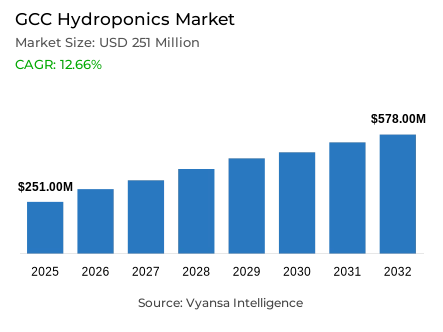
- Hydroponics market size in GCC was valued at USD 251 million in 2025 and is estimated at USD 293 million in 2026.
- The market size is expected to grow to USD 578 million by 2032.
- Market to register a CAGR of around 12.66% during 2026-32.
- Type Shares
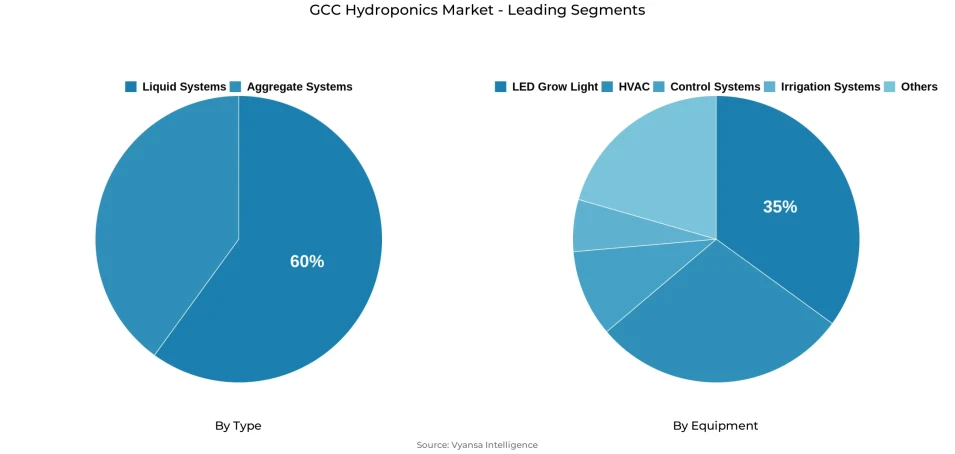
- Liquid systems grabbed market share of 60%.
- Competition
- More than 10 companies are actively engaged in producing hydroponics in GCC.
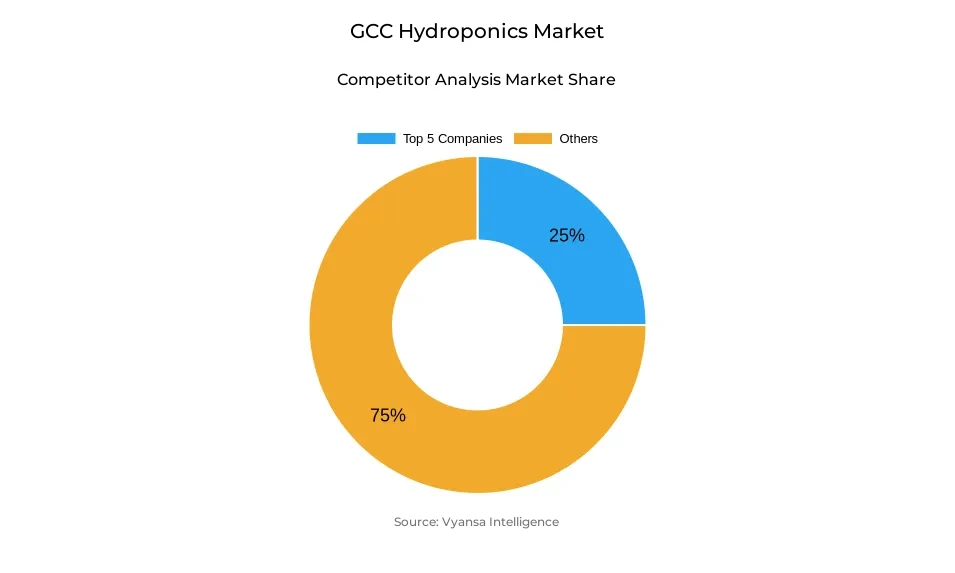
- Top 5 companies acquired around 25% of the market share.
- Red Sea Farms, Mowreq Specialized Agriculture Co., Smart Acres, Pure Harvest Smart Farms, Bustanica etc., are few of the top companies.
- Equipment
- LED Grow Light grabbed 35% of the market.
- Country
- United Arab Emirates leads with a 45% share of the GCC market.
GCC Hydroponics Market Outlook
The GCC hydroponics market was valued at USD 251 million in 2025 and is projected to grow from USD 293 million in 2026 to USD 578 million by 2032, exhibiting a CAGR of 12.66% during the forecast period. This expansion reflects Gulf countries adopting controlled-environment agriculture improving local food production substantially. Water scarcity and limited arable land strengthen hydroponic adoption across arid economies significantly. Strong import dependence and food security imperatives reshape production strategy toward sustainable agricultural systems substantially.
Rising water scarcity and food security initiatives establish foundational drivers sustaining consistent market demand. Evidence from Saudi Arabia's Agricultural Development Fund reveals hydroponics can save approximately 90% of water consumption. This water efficiency directly supports increased demand for nutrient film technique and deep water culture systems. Growing water stress across Gulf region ensures persistent GCC hydroponics demand for efficient production solutions. Food security momentum ensures persistent demand for professional controlled-environment agriculture substantially.
Climate control innovation and LED-based systems reshape the GCC hydroponics market toward precision production. Data from U.S. Department of Energy indicates LED technology enables indoor horticultural applications effectively. Published evidence from industry analysis reveals LED grow lights allow photoperiod and spectrum management optimization. This technology momentum supports substantial expansion for smart irrigation and greenhouse automation infrastructure. Precision agriculture advancement strengthens adoption of sensor-based crop monitoring and nutrient dosing automation substantially.
Segment analysis demonstrates pronounced demand concentration within liquid systems and LED grow light equipment. Liquid Systems commands 60% type share through precise nutrient-water delivery and recirculation capabilities substantially. LED Grow Light dominates 35% equipment share reflecting photosynthesis optimization and year-round production requirements. United Arab Emirates establishes dominant regional position with 40% share reflecting food-security investment substantially. This GCC hydroponics market structure indicates growers increasingly prioritize controlled-environment and resource-efficient production systems.
GCC Hydroponics Market Growth Driver
Water Scarcity and Food Security Policy Support
Rising water scarcity and food security imperatives establish sustained demand for hydroponic farming systems. Statistics from Saudi Arabia's Agricultural Development Fund confirm hydroponics saves approximately 90% of water consumption. This water efficiency directly supports increased demand for soilless farming systems and smart agriculture technologies. Growing water stress ensures persistent GCC hydroponics demand for efficient production solutions supporting sustainability. Food security momentum ensures persistent demand for professional controlled-environment agriculture substantially.
Government investment and agricultural expansion strengthen commercial foundation for hydroponics deployment substantially. Published evidence from Saudi Arabia's Public Investment Fund indicates four greenhouse projects producing approximately 324,600 tonnes. This government commitment creates substantial opportunity for hydroponic suppliers developing local production infrastructure substantially. Growing national food-security programs drive hydroponic system adoption across UAE, Saudi Arabia, Qatar, and other Gulf nations. Rising agricultural technology investment ensures sustained GCC hydroponics demand supporting local food production.
GCC Hydroponics Market Challenge
High Energy and Operating Cost Pressures
GCC hydroponics market faces substantial challenge from high operating expenses affecting farm profitability significantly. Official records from U.S. Department of Energy indicate LED technology enables controlled-environment agriculture while reducing consumption. This energy complexity creates operational constraints affecting commercial viability of local hydroponic production systems. Service providers must develop efficient LED and climate-control solutions managing electricity and cooling costs. HVAC, pumps, nutrient dosing, cooling, and labor systems all influence GCC hydroponics operating expense substantially.
Cooling requirements and maintenance complexity intensify challenges for controlled environment agriculture deployment substantially. Evidence establishes cooling and lighting requirements increasing local production costs in desert climates significantly. This cost barrier creates difficult operating landscape affecting competitiveness against imported vegetables in Gulf region. Manufacturers must develop efficient hydroponic systems supporting sustainable operations while managing energy expenses. Capital investment elevation and operating cost pressures continue affecting commercial adoption across GCC substantially.
Unlock Market Intelligence
Explore the market potential with our data-driven report
GCC Hydroponics Market Trend
LED Grow Lights and Vertical Farming System Integration
GCC hydroponics market demonstrates pronounced shift toward LED-based and vertical farming production systems. Market data from U.S. Department of Energy indicates LED technology enables vertical farms and greenhouse applications. This technology momentum directly supports substantial expansion for indoor hydroponic and stacked cultivation systems. Published evidence from USDA establishes vertical farming as indoor production using hydroponics and aquaponics collectively. LED-supported hydroponics strengthens adoption of precision agriculture and controlled lighting systems substantially.
Smart greenhouse automation and renewable energy adoption strengthen sector-wide adoption of advanced farming solutions. Published data from industry analysis indicates increasing climate-controlled greenhouse automation and sensor integration substantially. This technology focus supports substantial expansion for IoT-enabled monitoring and automated nutrient delivery systems. Service providers developing AI-driven hydroponic systems and smart irrigation controllers capture growth opportunities substantially. Automation in controlled environment agriculture and precision crop management continue supporting innovation substantially.
GCC Hydroponics Market Opportunity
Commercial Greenhouse and Premium Produce Expansion
Strong opportunities emerge in commercial greenhouse projects supporting advanced hydroponic adoption substantially. Official records from Saudi Arabia's Public Investment Fund reveal four projects producing approximately 324,600 tonnes. This government initiative creates commercial opportunity for hydroponic suppliers developing large-scale production infrastructure substantially. Projects covering approximately 1,369 hectares growing tomatoes, lettuce, strawberries, and peppers strengthen market opportunity substantially. Commercial greenhouse expansion directly enables accelerated GCC hydroponics adoption across Gulf agricultural regions.
High-value produce demand and urban retail strengthening commercial foundation for hydroponics deployment substantially. Evidence from industry trends indicates strong demand for fresh vegetables, herbs, and premium leafy greens. This retail expansion creates opportunity for hydroponic providers serving food-security and premium produce channels substantially. Growing hospitality, aviation catering, and restaurant demand ensure sustained GCC hydroponics demand substantially. Rising local consumption preference and food-security goals ensure sustained long-term opportunity substantially.
GCC Hydroponics Market Country Analysis
By Country
- Saudi Arabia
- United Arab Emirates
- Qatar
- Kuwait
- Oman
- Bahrain
United Arab Emirates emerges as leading regional market with 45% share within the GCC hydroponics market. This region combines food-security policy, agri-tech investment, and hydroponic adoption supporting production substantially. Official records from UAE government guidance indicate country prioritizing hydroponic technology use among farmers substantially. This policy commitment and infrastructure investment directly support heightened hydroponics relevance throughout region substantially. UAE's food-security approach ensures continued regional market leadership long-term substantially.
Premium produce demand and technology investment strengthen commercial foundation for UAE dominance substantially. Published evidence establishes UAE combining vertical farming, controlled-environment agriculture, and advanced farming technologies substantially. This agricultural modernization combined with food-security policy creates sustained opportunity for hydroponic suppliers substantially. Service providers developing UAE focused hydroponic systems addressing premium retail and sustainability capture regional leadership. Sustained government investment and supermarket-farm connections reinforce UAE's dominant GCC hydroponics position substantially.
Unlock Market Intelligence
Explore the market potential with our data-driven report
GCC Hydroponics Market Segmentation Analysis
By Type
- Aggregate Systems
- Ebb & Flow
- Drip Systems
- Wick Systems
- Liquid Systems
- Deep Water Culture
- NFT (Nutrient Film Technique)
- Aeroponics
Liquid Systems commands market leadership at 60% share within the GCC hydroponics market substantially. This segment establishes dominant type positioning through precise nutrient-water delivery and recirculation capabilities substantially. Liquid Systems provide strong capability for nutrient film technique and deep-water culture applications effectively. This segment maintains leading position due to suitability for leafy greens and vegetable cultivation. Liquid systems delivery supports routine hydroponic applications enabling controlled nutrient management substantially.
This market leadership position reflects growers' continued selection of liquid hydroponic systems for production substantially. Liquid Systems remains important because nutrient control and root-zone management combined with recirculation sustains leadership. The 60% share indicates this segment continues shaping type demand and manufacturer development strategies substantially. Manufacturers maintaining liquid systems focus develop competitive advantages enabling broader market penetration substantially. Rising controlled-environment agriculture adoption continues reinforcing liquid systems demand substantially.
By Equipment
- HVAC
- LED Grow Light
- Control Systems
- Irrigation Systems
- Others
LED Grow Light commands market leadership at 35% share within the GCC hydroponics market substantially. This segment establishes dominant equipment positioning through photosynthesis optimization and spectrum management capabilities substantially. LED Grow Light provides strong capability for year-round indoor and vertical farming production substantially. This segment maintains leading position due to light affecting crop speed, uniformity, and quality substantially. LED grow light delivery supports routine production applications enabling quality control and yield optimization substantially.
This market leadership position reflects growers' continued selection of LED grow light systems substantially. LED Grow Light remains important because photosynthesis optimization and spectrum control combined with efficiency sustains leadership. The 35% share indicates this segment continues shaping equipment demand and manufacturer development strategies substantially. Manufacturers maintaining LED grow light focus develop competitive advantages enabling customer retention and sustained growth. Rising vertical farming adoption continues reinforcing LED grow light demand substantially.
Various Market Players in GCC Hydroponics Market
The companies mentioned below are highly active in the GCC hydroponics market, occupying a considerable portion of the market and shaping industry progress.
- Red Sea Farms
- Mowreq Specialized Agriculture Co.
- Smart Acres
- Pure Harvest Smart Farms
- Bustanica
- Madar Farms
- Badia Farms
- Emirates Hydroponics Farms
- Armela Farms
- iFarm Corp.
- Aljoaib Holdings (Desert Agriculture)
- AeroFarms Inc.
Market News & Updates
- Pure Harvest Smart Farms, 2025:
Pure Harvest Smart Farms officially opened its redeveloped Al Ain controlled-environment agriculture facility in the UAE in February 2025. The upgraded operation integrates AI-powered smart farming technologies developed with PlanTFarm and introduces commercial-scale hydroponic and controlled-environment production systems for fresh produce and resource-efficient fodder cultivation. The development expands high-tech hydroponic growing capacity within the GCC’s controlled-environment agriculture sector.
- Bustanica, 2025:
Bustanica, operated by Emirates Flight Catering, continued expanding its hydroponic leafy greens portfolio and production operations during 2025 through its large-scale vertical farming facility in Dubai. The company maintained year-round commercial production using AI-enabled environmental controls, hydroponic cultivation systems, and water-recycling technologies designed for arid-climate agriculture. The operational expansion supports increased regional supply of locally grown pesticide-free leafy vegetables across GCC retail and foodservice channels.
Frequently Asked Questions
Related Report
- Market Segmentation
- Research Scope
- Research Methodology
- Definitions and Assumptions
- Executive Summary
- GCC Hydroponics Market Policies, Regulations, and Standards
- GCC Hydroponics Production Trend 2022-2032
- GCC Hydroponics Production Trend By Product Type
- Aggregate Systems
- Liquid Systems
- Company Wise Production Plants and Statistics
- Installed Production Capacity
- Actual Production
- Planned Production Target
- GCC Hydroponics Production Trend By Product Type
- GCC Hydroponics Pricing Analysis 2022-2032
- GCC Hydroponics Pricing Trend (USD) 2022-2032
- GCC Hydroponics Pricing Trend (USD) By Country 2022-2032
- Saudi Arabia
- United Arab Emirates
- Qatar
- Kuwait
- Oman
- Bahrain
- GCC Hydroponics Pricing Trend (USD) By Product Type 2022-2032
- Aggregate Systems
- Liquid Systems
- GCC Hydroponics Market Dynamics
- Growth Factors
- Challenges
- Trends
- Opportunities
- GCC Hydroponics Market Statistics, 2022-2032F
- Market Size & Growth Outlook
- By Revenues in USD Million
- Market Segmentation & Growth Outlook
- By Type
- Aggregate Systems- Market Insights and Forecast 2022-2032, USD Million
- Ebb & Flow- Market Insights and Forecast 2022-2032, USD Million
- Drip Systems- Market Insights and Forecast 2022-2032, USD Million
- Wick Systems- Market Insights and Forecast 2022-2032, USD Million
- Liquid Systems- Market Insights and Forecast 2022-2032, USD Million
- Deep Water Culture- Market Insights and Forecast 2022-2032, USD Million
- NFT (Nutrient Film Technique)- Market Insights and Forecast 2022-2032, USD Million
- Aeroponics- Market Insights and Forecast 2022-2032, USD Million
- Aggregate Systems- Market Insights and Forecast 2022-2032, USD Million
- By Equipment
- HVAC- Market Insights and Forecast 2022-2032, USD Million
- LED Grow Light- Market Insights and Forecast 2022-2032, USD Million
- Control Systems- Market Insights and Forecast 2022-2032, USD Million
- Irrigation Systems- Market Insights and Forecast 2022-2032, USD Million
- Others- Market Insights and Forecast 2022-2032, USD Million
- By Crop Type
- Fruits & Vegetable - Market Insights and Forecast 2022-2032, USD Million
- Flowers & Turfs- Market Insights and Forecast 2022-2032, USD Million
- By Farm Type
- Indoor farming- Market Insights and Forecast 2022-2032, USD Million
- Outdoor farming- Market Insights and Forecast 2022-2032, USD Million
- By End Users
- Restaurants- Market Insights and Forecast 2022-2032, USD Million
- Commercial Farms- Market Insights and Forecast 2022-2032, USD Million
- By Country
- Saudi Arabia
- United Arab Emirates
- Qatar
- Kuwait
- Oman
- Bahrain
- By Competitors
- Competition Characteristics
- Market Share & Analysis
- By Type
- Market Size & Growth Outlook
- Saudi Arabia Hydroponics Market Statistics, 2022-2032F
- Market Size & Growth Outlook
- By Revenues in USD Million
- Market Segmentation & Growth Outlook
- By Type- Market Insights and Forecast 2022-2032, USD Million
- By Equipment- Market Insights and Forecast 2022-2032, USD Million
- By Crop Type- Market Insights and Forecast 2022-2032, USD Million
- By Farm Type- Market Insights and Forecast 2022-2032, USD Million
- By End Users- Market Insights and Forecast 2022-2032, USD Million
- Market Size & Growth Outlook
- United Arab Emirates Hydroponics Market Statistics, 2022-2032F
- Market Size & Growth Outlook
- By Revenues in USD Million
- Market Segmentation & Growth Outlook
- By Type- Market Insights and Forecast 2022-2032, USD Million
- By Equipment- Market Insights and Forecast 2022-2032, USD Million
- By Crop Type- Market Insights and Forecast 2022-2032, USD Million
- By Farm Type- Market Insights and Forecast 2022-2032, USD Million
- By End Users- Market Insights and Forecast 2022-2032, USD Million
- Market Size & Growth Outlook
- Qatar Hydroponics Market Statistics, 2022-2032F
- Market Size & Growth Outlook
- By Revenues in USD Million
- Market Segmentation & Growth Outlook
- By Type- Market Insights and Forecast 2022-2032, USD Million
- By Equipment- Market Insights and Forecast 2022-2032, USD Million
- By Crop Type- Market Insights and Forecast 2022-2032, USD Million
- By Farm Type- Market Insights and Forecast 2022-2032, USD Million
- By End Users- Market Insights and Forecast 2022-2032, USD Million
- Market Size & Growth Outlook
- Kuwait Hydroponics Market Statistics, 2022-2032F
- Market Size & Growth Outlook
- By Revenues in USD Million
- Market Segmentation & Growth Outlook
- By Type- Market Insights and Forecast 2022-2032, USD Million
- By Equipment- Market Insights and Forecast 2022-2032, USD Million
- By Crop Type- Market Insights and Forecast 2022-2032, USD Million
- By Farm Type- Market Insights and Forecast 2022-2032, USD Million
- By End Users- Market Insights and Forecast 2022-2032, USD Million
- Market Size & Growth Outlook
- Oman Hydroponics Market Statistics, 2022-2032F
- Market Size & Growth Outlook
- By Revenues in USD Million
- Market Segmentation & Growth Outlook
- By Type- Market Insights and Forecast 2022-2032, USD Million
- By Equipment- Market Insights and Forecast 2022-2032, USD Million
- By Crop Type- Market Insights and Forecast 2022-2032, USD Million
- By Farm Type- Market Insights and Forecast 2022-2032, USD Million
- By End Users- Market Insights and Forecast 2022-2032, USD Million
- Market Size & Growth Outlook
- Competitive Outlook
- Company Profiles
- Pure Harvest Smart Farms
- Business Description
- Product Portfolio
- Collaborations & Alliances
- Recent Developments
- Financial Details
- Others
- Bustanica
- Business Description
- Product Portfolio
- Collaborations & Alliances
- Recent Developments
- Financial Details
- Others
- Madar Farms
- Business Description
- Product Portfolio
- Collaborations & Alliances
- Recent Developments
- Financial Details
- Others
- Badia Farms
- Business Description
- Product Portfolio
- Collaborations & Alliances
- Recent Developments
- Financial Details
- Others
- Emirates Hydroponics Farms
- Business Description
- Product Portfolio
- Collaborations & Alliances
- Recent Developments
- Financial Details
- Others
- Red Sea Farms
- Business Description
- Product Portfolio
- Collaborations & Alliances
- Recent Developments
- Financial Details
- Others
- Mowreq Specialized Agriculture Co.
- Business Description
- Product Portfolio
- Collaborations & Alliances
- Recent Developments
- Financial Details
- Others
- Smart Acres
- Business Description
- Product Portfolio
- Collaborations & Alliances
- Recent Developments
- Financial Details
- Others
- Armela Farms
- Business Description
- Product Portfolio
- Collaborations & Alliances
- Recent Developments
- Financial Details
- Others
- iFarm Corp.
- Business Description
- Product Portfolio
- Collaborations & Alliances
- Recent Developments
- Financial Details
- Others
- Aljoaib Holdings (Desert Agriculture)
- Business Description
- Product Portfolio
- Collaborations & Alliances
- Recent Developments
- Financial Details
- Others
- AeroFarms Inc.
- Business Description
- Product Portfolio
- Collaborations & Alliances
- Recent Developments
- Financial Details
- Others
- Pure Harvest Smart Farms
- Company Profiles
- Disclaimer
| Segment | Sub-Segment |
|---|---|
| By Type |
|
| By Equipment |
|
| By Crop Type |
|
| By Farm Type |
|
| By End Users |
|
| By Country |
|
Research Methodology
This study followed a structured approach comprising four key phases to assess the size and scope of the electro-oxidation market. The process began with thorough secondary research to collect data on the target market, related markets, and broader industry context. These findings, along with preliminary assumptions and estimates, were then validated through extensive primary research involving industry experts from across the value chain. To calculate the overall market size, both top-down and bottom-up methodologies were employed. Finally, market segmentation and data triangulation techniques were applied to refine and validate segment-level estimations.
Secondary Research
The secondary research phase involved gathering data from a wide range of credible and published sources. This step helped in identifying industry trends, defining market segmentation, and understanding the market landscape and value chain.
Sources consulted during this phase included:
- Company annual reports, investor presentations, and press releases
- Industry white papers and certified publications
- Trade directories and market-recognized databases
- Articles from authoritative authors and reputable journals
- Gold and silver standard websites
Secondary research was critical in mapping out the industry's value chain and monetary flow, identifying key market segments, understanding regional variations, and tracking significant industry developments.
Other key sources:
- Financial disclosures
- Industry associations and trade bodies
- News outlets and business magazines
- Academic journals and research studies
- Paid industry databases
Primary Research
To validate secondary data and gain deeper market insights, primary research was conducted with key stakeholders across both the supply and demand sides of the market.
On the demand side, participants included decision-makers and influencers from end-user industries—such as CIOs, CTOs, and CSOs—who provided first-hand perspectives on market needs, product usage, and future expectations.
On the supply side, interviews were conducted with manufacturers, industry associations, and institutional participants to gather insights into current offerings, product pipelines, and market challenges.
Primary interviews provided critical inputs such as:
- Market size and revenue data
- Product and service breakdowns
- Market forecasts
- Regional and application-specific trends
Stakeholders consulted included:
- Leading OEM and solution providers
- Channel and distribution partners
- End users across various applications
- Independent consultants and industry specialists
Market Size Estimation and Data Triangulation
- Identifying Key Market Participants (Secondary Research)
- Goal: To identify the major players or companies in the target market. This typically involves using publicly available data sources such as industry reports, market research publications, and financial statements of companies.
- Tools: Reports from firms like Gartner, Forrester, Euromonitor, Statista, IBISWorld, and others. Public financial statements, news articles, and press releases from top market players.
- Extracting Earnings of Key Market Participants
- Goal: To estimate the earnings generated from the product or service being analyzed. This step helps in understanding the revenue potential of each market player in a specific geography.
- Methods: Earnings data can be gathered from:
- Publicly available financial reports (for listed companies).
- Interviews and primary data sources from professionals, such as Directors, VPs, SVPs, etc. This is especially useful for understanding more nuanced, internal data that isn't publicly disclosed.
- Annual reports and investor presentations of key players.
- Data Collation and Development of a Relevant Data Model
- Goal: To collate inputs from both primary and secondary sources into a structured, data-driven model for market estimation. This model will incorporate key market KPIs and any independent variables relevant to the market.
- Key KPIs: These could include:
- Market size, growth rate, and demand drivers.
- Industry-specific metrics like market share, average revenue per customer (ARPC), or average deal size.
- External variables, such as economic growth rates, inflation rates, or commodity prices, that could affect the market.
- Data Modeling: Based on this data, the market forecasts are developed for the next 5 years. A combination of trend analysis, scenario modeling, and statistical regression might be used to generate projections.
- Scenario Analysis
- Goal: To test different assumptions and validate how sensitive the market is to changes in key variables (e.g., market demand, regulatory changes, technological disruptions).
- Types of Scenarios:
- Base Case: Based on current assumptions and historical data.
- Best-Case Scenario: Assuming favorable market conditions, regulatory environments, and technological advancements.
- Worst-Case Scenario: Accounting for adverse factors, such as economic downturns, stricter regulations, or unexpected disruptions.












