GCC Clinical Laboratory Services Market Report: Trends, Growth and Forecast (2026-2032)
By Test Type (Clinical Chemistry (Routine Chemistry Testing, Therapeutic Drug Monitoring Testing, Endocrinology Chemistry Testing, Specialized Chemistry Testing, Other Clinical Chemistry Testing), Hematology Testing, Medical Microbiology (Infectious Disease Testing, Transplant Diagnostic Testing, Other Microbiology Testing), Immunology & Serology Testing, Molecular Diagnostics, Genetic Testing, Pathology (Cytopathology, Histopathology), Blood Banking & Transfusion Services, Toxicology & Drug Abuse Testing, Other Specialty/Esoteric Tests), By Service Provider (Hospital-based Laboratories, Independent/Standalone Clinical Laboratories, Clinic/Physician Office Laboratories, Public Health Laboratories, Specialty Laboratories), By Application (Routine Diagnostic Testing, Chronic Disease Testing, Infectious Disease Testing, Oncology Testing, Preventive/Screening Testing, Specialized/Genetic Testing), By Country (UAE, Saudi Arabia, Qatar, Kuwait, Bahrain, Oman) ... Read more
|
Major Players
|
GCC Clinical Laboratory Services Market Statistics and Insights, 2026
- Market Size Statistics
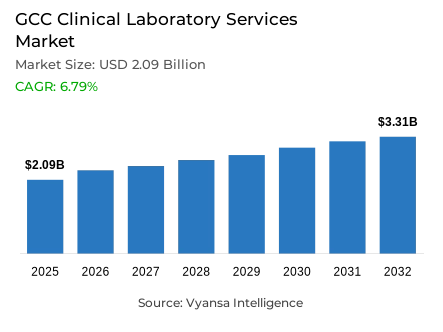
- Clinical laboratory services market size in GCC was valued at USD 2.09 billion in 2025 and is estimated at USD 2.23 billion in 2026.
- The market size is expected to grow to USD 3.31 billion by 2032.
- Market to register a CAGR of around 6.79% during 2026-32.
- Test Type Shares
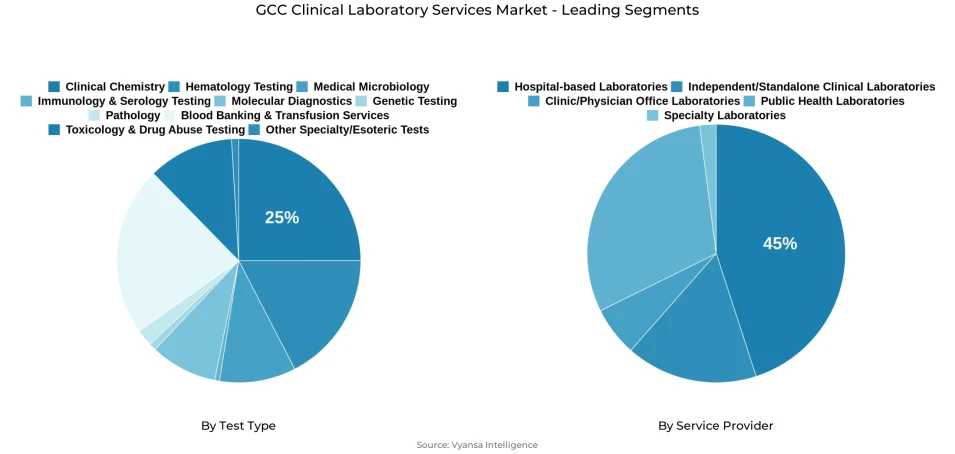
- Clinical chemistry grabbed market share of 25%.
- Competition
- More than 10 companies are actively engaged in producing clinical laboratory services in GCC.
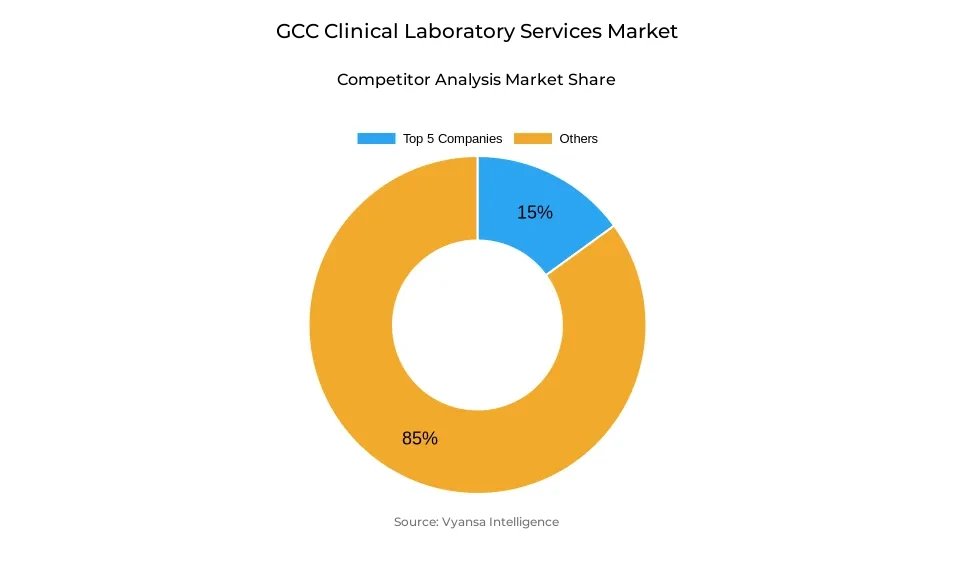
- Top 5 companies acquired around 15% of the market share.
- MedLabs, Aster Medinova Diagnostic Centre, Unilabs Middle East, Al Borg Diagnostics, PureLab etc., are few of the top companies.
- Service Provider
- Hospital-based Laboratories grabbed 45% of the market.
- Country
- Saudi Arabia leads with a 40% share of the GCC market.
GCC Clinical Laboratory Services Market Outlook
The GCC clinical laboratory services market was valued at USD 2.09 billion in 2025, establishing a commercially steady and institutionally well-supported foundation within the Gulf region's most actively expanding healthcare diagnostics ecosystem. Projected to advance from USD 2.23 billion in 2026 to USD 3.31 billion by 2032, the sector registers a CAGR of 6.79% across the forecast horizon. This steady and structurally supported expansion trajectory reflects the sustained clinical demand for diagnostic testing support across a region confronting an exceptionally high chronic disease burden, expanding hospital-based care networks, and progressive national commitments to preventive health screening whose combined institutional force sustains consistent laboratory service utilization across public and private healthcare delivery settings throughout the GCC member states.
The test type architecture defining this market's commercial structure is anchored in clinical chemistry testing. Clinical Chemistry commands approximately 25% of total test type market share, reflecting the consistent and broad clinical preference for routine biochemical testing whose high-volume applicability, repeat evaluation frequency, and broad relevance across organ function assessment, metabolic monitoring, and chronic disease management make it the reference test category across the region's most commercially significant laboratory service environments. WHO EMRO's documentation that the Eastern Mediterranean Region has the highest diabetes prevalence globally at 17.6% among adults aged 20 to 79, with almost 85 million adults living with diabetes and nearly one third still undiagnosed, confirms the chronic disease monitoring burden that sustains consistent clinical chemistry testing demand across hospital-based, clinic, and specialist laboratory settings throughout the GCC.
The service provider architecture reinforces the structural centrality of hospital-based laboratories as the category's dominant service delivery platform. Hospital-Based Laboratories command approximately 45% of total service provider market share, reflecting the foundational operational advantages of institutional care integration in coordinating diagnostic workflows, physician-laboratory communication, and timely testing access across the region's most clinically active inpatient, emergency care, and specialist treatment environments. Saudi Arabia's General Authority for Statistics documentation of 516 total hospitals and 5,779 primary healthcare centers and medical complexes in the Kingdom in 2024 confirms the institutional care infrastructure scale that sustains hospital-based laboratory service utilization as the region's dominant diagnostic testing channel across both acute and routine care settings.
The future outlook is defined by four converging structural forces whose combined commercial impact creates a clinical laboratory services market of sustained and well-grounded expansion momentum. WHO EMRO's documentation that cardiovascular diseases, diabetes, cancers, and chronic respiratory illnesses account for approximately 72% of all deaths in Qatar, combined with similar chronic disease prevalence profiles across other GCC member states, confirms the disease monitoring demand that sustains consistent clinical testing volume. The UAE MOHAP's introduction of mandatory genetic testing within the premarital screening program for all Emiratis from January 2025, covering 570 genes and more than 840 genetic disorders, confirms the expanding preventive screening mandate that is progressively broadening laboratory service demand beyond reactive diagnostics. WHO EMRO's regional digital health action plan targeting national digital health policy implementation across all Eastern Mediterranean countries by 2025 creates the connected infrastructure framework that will progressively enhance laboratory service integration and referral pathway coordination. Saudi Arabia's healthcare scale, anchored by a national population exceeding 35 million and a hospital network of 516 facilities, positions it as the commercial center around which regional competitive strategy and laboratory service investment are organized over the forecast period.
GCC Clinical Laboratory Services Market Growth Driver
Chronic Disease Burden Sustains High-Volume Diagnostic Testing Demand
The exceptionally high and institutionally documented chronic disease burden across GCC member states represents the primary structural driver of clinical laboratory services demand, functioning as a persistent diagnostic testing imperative that sustains consistent high-volume service utilization across patient monitoring, treatment response assessment, disease detection, and population health screening programs throughout the region's public and private healthcare delivery networks. This chronic disease burden-driven demand dynamic reflects a genuine clinical management necessity whose testing volume generation is structurally anchored in the irreducible requirement for regular biochemical monitoring, specialist follow-up, and preventive surveillance across the GCC's disproportionately high-risk adult population.
The quantitative evidence validating this chronic disease-driven demand dynamic is documented with precision by WHO EMRO. The Eastern Mediterranean Region has the highest diabetes prevalence globally at 17.6% among adults aged 20 to 79, with almost 85 million adults living with diabetes and nearly one third still undiagnosed, confirming the monitoring and detection demand scale that sustains consistent clinical chemistry testing utilization across the GCC's laboratory service network. WHO EMRO's country-level documentation that cardiovascular diseases, diabetes, cancers, and chronic respiratory illnesses account for approximately 72% of all deaths in Qatar, with over 70% of adults overweight or obese and hypertension affecting over 600,000 adults aged 30 to 79, confirms the multi-condition chronic disease burden that generates consistent and compounding diagnostic testing demand across GCC clinical laboratory service environments. These disease burden metrics validate a demand expansion dynamic of sufficient scale and chronicity to sustain structural laboratory services market growth over the forecast period.
GCC Clinical Laboratory Services Market Challenge
Biosafety Compliance Gaps and Regulatory Fragmentation Raise Operating Complexity
The persistent structural gaps in laboratory biosafety and biosecurity framework implementation across the Eastern Mediterranean Region, combined with the fragmented and uneven regulatory landscape that characterizes GCC member state laboratory governance, represent the most consequential operational challenge confronting clinical laboratory service providers, creating systematic compliance planning, quality system development, and regulatory navigation burdens that elevate operational investment requirements and constrain service expansion velocity across markets where institutional compliance expectations are advancing ahead of actual laboratory system readiness. In a laboratory operating environment where biosafety standards, accreditation requirements, and national regulatory frameworks are advancing at different rates across GCC member states, the compliance management complexity for multi-market laboratory service providers is compounding consistently.
The structural depth and operational specificity of this biosafety and regulatory challenge are documented with authority by WHO EMRO and the UAE MOHAP. WHO EMRO confirms that countries in the Eastern Mediterranean Region face persistent and systemic challenges in implementing laboratory biosafety and biosecurity frameworks, with the regulatory landscape remaining fragmented and uneven across countries. Only 38% of responding countries in the Region had an up-to-date biosafety manual available in all laboratories in the 2022 assessment, while only 29% had designated biosafety officers across public and private laboratories, confirming the institutional biosafety readiness gap that creates both compliance risk and competitive differentiation opportunity for providers with established biosafety management infrastructure. The UAE MOHAP's regulatory framework requiring compliance with local and federal laws in addition to international accreditation standards confirms that the most commercially significant GCC market is simultaneously advancing its regulatory sophistication, creating compliance investment obligations that systematically advantage well-resourced laboratory providers over less-organized competitors over the forecast period.
Unlock Market Intelligence
Explore the market potential with our data-driven report
GCC Clinical Laboratory Services Market Trend
Preventive and Genetic Screening Programs Expand the Laboratory Services Mandate
The progressive expansion of mandatory and structured preventive health screening programs across GCC member states represents the defining structural trend reshaping laboratory service demand profiles, test menu investment priorities, and specialized diagnostic capability requirements across the regional market. This preventive screening trend is moving the clinical laboratory services demand conversation beyond traditional reactive diagnostic testing into the domain of proactive population health management, genetic risk identification, newborn health surveillance, and family health planning support, dimensions that collectively expand the role and commercial importance of laboratory services within GCC healthcare systems well beyond their conventional acute care and chronic disease monitoring functions.
The regulatory specificity and population-level reach of this preventive and genetic screening trend are documented with authority by the UAE MOHAP and the Oman Ministry of Health. The UAE MOHAP confirms that mandatory genetic testing became part of the premarital screening program for all Emiratis planning to marry from early January 2025, covering 570 genes and more than 840 genetic disorders, confirming that genetic screening has transitioned from an elective clinical service into a national public health mandate whose laboratory testing volume implications are immediate and institutionally guaranteed. The Oman Ministry of Health's National Newborn Screening Program, requiring testing within 24 to 48 hours after birth, confirms that preventive laboratory testing mandates are advancing across multiple life-stage contexts simultaneously, creating consistent and recurring laboratory service demand across newborn care, premarital health, and family planning program touchpoints. As these preventive screening mandates expand and deepen across GCC member states, laboratory providers with genetic testing capability, specialized assay infrastructure, and regulatory compliance alignment will capture disproportionate demand share over the forecast period.
GCC Clinical Laboratory Services Market Opportunity
Digital Health Integration Creates Connected Laboratory Service Expansion Pathways
The accelerating institutional momentum behind digital health infrastructure development across GCC member states and the broader Eastern Mediterranean Region creates a structurally significant and commercially durable opportunity for clinical laboratory service providers whose digital connectivity infrastructure, interoperable reporting systems, and electronic result delivery capability position them favorably within the connected healthcare ecosystems that GCC governments are systematically building through national digital health transformation programs. This digital integration opportunity is distinguished from conventional laboratory service market growth by its policy-backed investment certainty, its transformative implications for laboratory service referral pathway efficiency, and its capacity to expand laboratory service reach and utilization frequency across previously disconnected care settings through connected diagnostic workflow integration.
The institutional scale and implementation specificity of this digital health integration opportunity are documented with authority by Saudi Vision 2030 and WHO EMRO. Saudi Vision 2030's Health Sector Transformation Program explicitly focuses on expanding e-health services and digital solutions while improving access, quality, and adherence to international standards, confirming the Kingdom's institutional commitment to the connected healthcare infrastructure within which digital-ready laboratory services will capture disproportionate referral volume and integration depth. WHO EMRO's regional digital health action plan targets national digital health policy implementation across all Eastern Mediterranean countries by 2025, alongside an increase in the share of healthcare workers with basic digital health technology understanding from 20% to 80% by 2025, confirming the workforce digital readiness development that creates progressively more receptive clinical environments for digital laboratory service integration. Laboratory service providers that invest in interoperable result reporting infrastructure, physician connectivity platforms, and digital workflow integration capability aligned with GCC national digital health program standards will capture disproportionate value from this structurally significant and policy-supported market development opportunity over the forecast period.
GCC Clinical Laboratory Services Market Country Analysis
By Country
- UAE
- Saudi Arabia
- Qatar
- Kuwait
- Bahrain
- Oman
Saudi Arabia emerges as the leading market within the GCC with 40% of market, based on its healthcare scale, population base, and institutional capacity. The country carries the region’s largest demand pool and wide hospital infrastructure, giving it a strong foundation for higher laboratory service volumes across preventive, routine, and hospital-based testing. According to GCC-Stat, the GCC population reached 61.5 million in 2024. According to Saudi Arabia’s General Authority for Statistics, the Kingdom’s population exceeded 35 million in 2024.
The country’s healthcare footprint strengthens its lead in clinical testing demand. According to Saudi Arabia’s General Authority for Statistics, the total number of hospitals in the Kingdom reached 516 in 2024, while primary healthcare centers and medical complexes reached 5,779. According to Saudi Arabia’s General Authority for Statistics, 39.3% of adults aged 15 years and above underwent periodic medical check-ups in 2025. This combination keeps Saudi Arabia at the center of GCC clinical laboratory demand and service activity.
Unlock Market Intelligence
Explore the market potential with our data-driven report
GCC Clinical Laboratory Services Market Segmentation Analysis
By Test Type
- Clinical Chemistry
- Routine Chemistry Testing
- Therapeutic Drug Monitoring Testing
- Endocrinology Chemistry Testing
- Specialized Chemistry Testing
- Other Clinical Chemistry Testing
- Hematology Testing
- Medical Microbiology
- Infectious Disease Testing
- Transplant Diagnostic Testing
- Other Microbiology Testing
- Immunology & Serology Testing
- Molecular Diagnostics
- Genetic Testing
- Pathology
- Cytopathology
- Histopathology
- Blood Banking & Transfusion Services
- Toxicology & Drug Abuse Testing
- Other Specialty/Esoteric Tests
The segment with highest market share under the Test Type is Clinical Chemistry, accounting for approximately 25% of the total market. This leading position reflects the deep structural alignment between clinical chemistry testing capabilities and the specific diagnostic workflow requirements of the GCC's most institutionally significant laboratory service environments, where the high-volume applicability, repeat testing frequency, and broad clinical relevance of biochemical analysis across metabolic assessment, organ function monitoring, chronic disease management, and routine health screening make clinical chemistry the reference test category across hospital-based, outpatient clinic, and specialist laboratory settings throughout the region. With one-quarter of total market value concentrated within a single test type category, Clinical Chemistry defines the equipment investment priorities, reagent procurement frameworks, and operational capacity planning benchmarks of the GCC clinical laboratory services market.
The structural leadership of Clinical Chemistry is being actively sustained by the exceptionally high chronic disease burden that characterizes the GCC's population health profile, where diabetes, hypertension, cardiovascular disease, and obesity-related metabolic conditions generate consistent and high-frequency biochemical testing requirements across patient monitoring, treatment response assessment, and population screening programs. WHO EMRO's documentation of 17.6% adult diabetes prevalence in the Eastern Mediterranean Region, the highest globally, confirms the chronic disease monitoring demand that sustains disproportionate clinical chemistry testing utilization relative to regional population size. As preventive screening programs expand and chronic disease management protocols intensify across GCC healthcare systems, the high-volume and broad-applicability characteristics of clinical chemistry testing will sustain its structural commercial leadership over the forecast period.
By Service Provider
- Hospital-based Laboratories
- Independent/Standalone Clinical Laboratories
- Clinic/Physician Office Laboratories
- Public Health Laboratories
- Specialty Laboratories
The segment with highest market share under the Service Provider is Hospital-Based Laboratories, accounting for approximately 45% of the total market. This dominant position reflects the foundational operational reality of GCC clinical diagnostics, where the integration of laboratory testing within hospital care workflows, the physician-directed testing referral patterns of institutional care settings, and the round-the-clock diagnostic access requirements of inpatient and emergency care environments collectively generate the highest concentration and most clinically urgent laboratory service demand across the regional market. With nearly half of total market value anchored in hospital-based laboratory service delivery, this provider segment defines the testing volume benchmarks, quality standard expectations, and equipment investment priorities of the GCC clinical laboratory services market.
The structural leadership of Hospital-Based Laboratories is being actively sustained by the progressive expansion of hospital care infrastructure across GCC member states, where government and private sector hospital capacity investment is generating consistent expansion in the institutional care settings whose laboratory service requirements create the most commercially significant diagnostic testing demand concentrations in the regional market. Saudi Arabia's documentation of 516 hospitals and 5,779 primary healthcare centers and medical complexes confirms the institutional care infrastructure depth that sustains hospital-based laboratory service demand across both routine and specialized diagnostic testing categories. The UAE MOHAP's regulatory framework requiring clinical laboratory compliance with local, federal, and international accreditation standards confirms that the quality and compliance environment within which hospital-based laboratories operate is advancing toward international best-practice alignment. The segment's structural commercial dominance is expected to deepen over the forecast period.
Various Market Players in GCC Clinical Laboratory Services Market
The companies mentioned below are highly active in the GCC clinical laboratory services market, occupying a considerable portion of the market and shaping industry progress.
- MedLabs
- Aster Medinova Diagnostic Centre
- Unilabs Middle East
- Al Borg Diagnostics
- PureLab
- National Reference Laboratory (NRL)
- SEHA
- AVMLabs
- Dallah Hospital Laboratory
- Saudi German Health
- BioDynamics Lab (BDL)
- Alpha Laboratories Qatar
Market News & Updates
- National Reference Laboratory (NRL), 2025:
NRL launched the MENA region’s first Center for Advanced Neuro Biochemical Diagnostics in Abu Dhabi with Neurocode International, introducing non-invasive blood-based testing aimed at earlier detection of Alzheimer’s disease and related conditions. For the GCC clinical laboratory services market, this is a major service innovation because it expands access to specialized neurodiagnostic testing in the region and raises the sophistication of reference-lab offerings beyond conventional routine diagnostics.
- Unilabs Middle East, 2025:
Unilabs Middle East launched the region’s first AI-powered digital cytology technology in the UAE, using Hologic’s Genius Digital Diagnostics system to shift the workflow from glass slides to digital review supported by deep-learning AI and remote access. This is a significant laboratory upgrade for the GCC market because it improves screening workflow efficiency, standardization, and diagnostic support in cytology, especially in high-volume women’s health testing environments
Frequently Asked Questions
Related Report
- Market Segmentation
- Research Scope
- Research Methodology
- Definitions and Assumptions
- Executive Summary
- GCC Clinical Laboratory Services Market Policies, Regulations, and Standards
- GCC Clinical Laboratory Services Market Dynamics
- Growth Factors
- Challenges
- Trends
- Opportunities
- GCC Clinical Laboratory Services Market Statistics, 2022-2032F
- Market Size & Growth Outlook
- By Revenues in USD Million
- Market Segmentation & Growth Outlook
- By Test Type
- Clinical Chemistry- Market Insights and Forecast 2022-2032, USD Million
- Routine Chemistry Testing- Market Insights and Forecast 2022-2032, USD Million
- Therapeutic Drug Monitoring Testing- Market Insights and Forecast 2022-2032, USD Million
- Endocrinology Chemistry Testing- Market Insights and Forecast 2022-2032, USD Million
- Specialized Chemistry Testing- Market Insights and Forecast 2022-2032, USD Million
- Other Clinical Chemistry Testing- Market Insights and Forecast 2022-2032, USD Million
- Hematology Testing- Market Insights and Forecast 2022-2032, USD Million
- Medical Microbiology- Market Insights and Forecast 2022-2032, USD Million
- Infectious Disease Testing- Market Insights and Forecast 2022-2032, USD Million
- Transplant Diagnostic Testing- Market Insights and Forecast 2022-2032, USD Million
- Other Microbiology Testing- Market Insights and Forecast 2022-2032, USD Million
- Immunology & Serology Testing- Market Insights and Forecast 2022-2032, USD Million
- Molecular Diagnostics- Market Insights and Forecast 2022-2032, USD Million
- Genetic Testing- Market Insights and Forecast 2022-2032, USD Million
- Pathology- Market Insights and Forecast 2022-2032, USD Million
- Cytopathology- Market Insights and Forecast 2022-2032, USD Million
- Histopathology- Market Insights and Forecast 2022-2032, USD Million
- Blood Banking & Transfusion Services- Market Insights and Forecast 2022-2032, USD Million
- Toxicology & Drug Abuse Testing- Market Insights and Forecast 2022-2032, USD Million
- Other Specialty/Esoteric Tests- Market Insights and Forecast 2022-2032, USD Million
- Clinical Chemistry- Market Insights and Forecast 2022-2032, USD Million
- By Service Provider
- Hospital-based Laboratories- Market Insights and Forecast 2022-2032, USD Million
- Independent/Standalone Clinical Laboratories- Market Insights and Forecast 2022-2032, USD Million
- Clinic/Physician Office Laboratories- Market Insights and Forecast 2022-2032, USD Million
- Public Health Laboratories- Market Insights and Forecast 2022-2032, USD Million
- Specialty Laboratories- Market Insights and Forecast 2022-2032, USD Million
- By Application
- Routine Diagnostic Testing- Market Insights and Forecast 2022-2032, USD Million
- Chronic Disease Testing- Market Insights and Forecast 2022-2032, USD Million
- Infectious Disease Testing- Market Insights and Forecast 2022-2032, USD Million
- Oncology Testing- Market Insights and Forecast 2022-2032, USD Million
- Preventive/Screening Testing- Market Insights and Forecast 2022-2032, USD Million
- Specialized/Genetic Testing- Market Insights and Forecast 2022-2032, USD Million
- By Country
- UAE
- Saudi Arabia
- Qatar
- Kuwait
- Bahrain
- Oman
- By Competitors
- Competition Characteristics
- Market Share & Analysis
- By Test Type
- Market Size & Growth Outlook
- UAE Clinical Laboratory Services Market Statistics, 2022-2032F
- Market Size & Growth Outlook
- By Revenues in USD Million
- Market Segmentation & Growth Outlook
- By Test Type- Market Insights and Forecast 2022-2032, USD Million
- By Service Provider- Market Insights and Forecast 2022-2032, USD Million
- By Application- Market Insights and Forecast 2022-2032, USD Million
- Market Size & Growth Outlook
- Saudi Arabia Clinical Laboratory Services Market Statistics, 2022-2032F
- Market Size & Growth Outlook
- By Revenues in USD Million
- Market Segmentation & Growth Outlook
- By Test Type- Market Insights and Forecast 2022-2032, USD Million
- By Service Provider- Market Insights and Forecast 2022-2032, USD Million
- By Application- Market Insights and Forecast 2022-2032, USD Million
- Market Size & Growth Outlook
- Qatar Clinical Laboratory Services Market Statistics, 2022-2032F
- Market Size & Growth Outlook
- By Revenues in USD Million
- Market Segmentation & Growth Outlook
- By Test Type- Market Insights and Forecast 2022-2032, USD Million
- By Service Provider- Market Insights and Forecast 2022-2032, USD Million
- By Application- Market Insights and Forecast 2022-2032, USD Million
- Market Size & Growth Outlook
- Kuwait Clinical Laboratory Services Market Statistics, 2022-2032F
- Market Size & Growth Outlook
- By Revenues in USD Million
- Market Segmentation & Growth Outlook
- By Test Type- Market Insights and Forecast 2022-2032, USD Million
- By Service Provider- Market Insights and Forecast 2022-2032, USD Million
- By Application- Market Insights and Forecast 2022-2032, USD Million
- Market Size & Growth Outlook
- Bahrain Clinical Laboratory Services Market Statistics, 2022-2032F
- Market Size & Growth Outlook
- By Revenues in USD Million
- Market Segmentation & Growth Outlook
- By Test Type- Market Insights and Forecast 2022-2032, USD Million
- By Service Provider- Market Insights and Forecast 2022-2032, USD Million
- By Application- Market Insights and Forecast 2022-2032, USD Million
- Market Size & Growth Outlook
- Oman Clinical Laboratory Services Market Statistics, 2022-2032F
- Market Size & Growth Outlook
- By Revenues in USD Million
- Market Segmentation & Growth Outlook
- By Test Type- Market Insights and Forecast 2022-2032, USD Million
- By Service Provider- Market Insights and Forecast 2022-2032, USD Million
- By Application- Market Insights and Forecast 2022-2032, USD Million
- Market Size & Growth Outlook
- Competitive Outlook
- Company Profiles
- Al Borg Diagnostics
- Business Description
- Product Portfolio
- Collaborations & Alliances
- Recent Developments
- Financial Details
- Others
- PureLab
- Business Description
- Product Portfolio
- Collaborations & Alliances
- Recent Developments
- Financial Details
- Others
- National Reference Laboratory (NRL)
- Business Description
- Product Portfolio
- Collaborations & Alliances
- Recent Developments
- Financial Details
- Others
- SEHA
- Business Description
- Product Portfolio
- Collaborations & Alliances
- Recent Developments
- Financial Details
- Others
- AVMLabs
- Business Description
- Product Portfolio
- Collaborations & Alliances
- Recent Developments
- Financial Details
- Others
- MedLabs
- Business Description
- Product Portfolio
- Collaborations & Alliances
- Recent Developments
- Financial Details
- Others
- Aster Medinova Diagnostic Centre
- Business Description
- Product Portfolio
- Collaborations & Alliances
- Recent Developments
- Financial Details
- Others
- Unilabs Middle East
- Business Description
- Product Portfolio
- Collaborations & Alliances
- Recent Developments
- Financial Details
- Others
- Dallah Hospital Laboratory
- Business Description
- Product Portfolio
- Collaborations & Alliances
- Recent Developments
- Financial Details
- Others
- Saudi German Health
- Business Description
- Product Portfolio
- Collaborations & Alliances
- Recent Developments
- Financial Details
- Others
- BioDynamics Lab (BDL)
- Business Description
- Product Portfolio
- Collaborations & Alliances
- Recent Developments
- Financial Details
- Others
- Alpha Laboratories Qatar
- Business Description
- Product Portfolio
- Collaborations & Alliances
- Recent Developments
- Financial Details
- Others
- Al Borg Diagnostics
- Company Profiles
- Disclaimer
| Segment | Sub-Segment |
|---|---|
| By Test Type |
|
| By Service Provider |
|
| By Application |
|
| By Country |
|
Research Methodology
This study followed a structured approach comprising four key phases to assess the size and scope of the electro-oxidation market. The process began with thorough secondary research to collect data on the target market, related markets, and broader industry context. These findings, along with preliminary assumptions and estimates, were then validated through extensive primary research involving industry experts from across the value chain. To calculate the overall market size, both top-down and bottom-up methodologies were employed. Finally, market segmentation and data triangulation techniques were applied to refine and validate segment-level estimations.
Secondary Research
The secondary research phase involved gathering data from a wide range of credible and published sources. This step helped in identifying industry trends, defining market segmentation, and understanding the market landscape and value chain.
Sources consulted during this phase included:
- Company annual reports, investor presentations, and press releases
- Industry white papers and certified publications
- Trade directories and market-recognized databases
- Articles from authoritative authors and reputable journals
- Gold and silver standard websites
Secondary research was critical in mapping out the industry's value chain and monetary flow, identifying key market segments, understanding regional variations, and tracking significant industry developments.
Other key sources:
- Financial disclosures
- Industry associations and trade bodies
- News outlets and business magazines
- Academic journals and research studies
- Paid industry databases
Primary Research
To validate secondary data and gain deeper market insights, primary research was conducted with key stakeholders across both the supply and demand sides of the market.
On the demand side, participants included decision-makers and influencers from end-user industries—such as CIOs, CTOs, and CSOs—who provided first-hand perspectives on market needs, product usage, and future expectations.
On the supply side, interviews were conducted with manufacturers, industry associations, and institutional participants to gather insights into current offerings, product pipelines, and market challenges.
Primary interviews provided critical inputs such as:
- Market size and revenue data
- Product and service breakdowns
- Market forecasts
- Regional and application-specific trends
Stakeholders consulted included:
- Leading OEM and solution providers
- Channel and distribution partners
- End users across various applications
- Independent consultants and industry specialists
Market Size Estimation and Data Triangulation
- Identifying Key Market Participants (Secondary Research)
- Goal: To identify the major players or companies in the target market. This typically involves using publicly available data sources such as industry reports, market research publications, and financial statements of companies.
- Tools: Reports from firms like Gartner, Forrester, Euromonitor, Statista, IBISWorld, and others. Public financial statements, news articles, and press releases from top market players.
- Extracting Earnings of Key Market Participants
- Goal: To estimate the earnings generated from the product or service being analyzed. This step helps in understanding the revenue potential of each market player in a specific geography.
- Methods: Earnings data can be gathered from:
- Publicly available financial reports (for listed companies).
- Interviews and primary data sources from professionals, such as Directors, VPs, SVPs, etc. This is especially useful for understanding more nuanced, internal data that isn't publicly disclosed.
- Annual reports and investor presentations of key players.
- Data Collation and Development of a Relevant Data Model
- Goal: To collate inputs from both primary and secondary sources into a structured, data-driven model for market estimation. This model will incorporate key market KPIs and any independent variables relevant to the market.
- Key KPIs: These could include:
- Market size, growth rate, and demand drivers.
- Industry-specific metrics like market share, average revenue per customer (ARPC), or average deal size.
- External variables, such as economic growth rates, inflation rates, or commodity prices, that could affect the market.
- Data Modeling: Based on this data, the market forecasts are developed for the next 5 years. A combination of trend analysis, scenario modeling, and statistical regression might be used to generate projections.
- Scenario Analysis
- Goal: To test different assumptions and validate how sensitive the market is to changes in key variables (e.g., market demand, regulatory changes, technological disruptions).
- Types of Scenarios:
- Base Case: Based on current assumptions and historical data.
- Best-Case Scenario: Assuming favorable market conditions, regulatory environments, and technological advancements.
- Worst-Case Scenario: Accounting for adverse factors, such as economic downturns, stricter regulations, or unexpected disruptions.












