France Digestive Remedies Market Report: Trends, Growth and Forecast (2026-2032)
By Product Type (Paediatric Digestive Remedies (Paediatric Diarrhoeal Remedies, Paediatric Indigestion & Heartburn Remedies, Paediatric Laxatives, Paediatric Motion Sickness Remedies), Diarrhoeal Remedies, IBS Treatments, Indigestion & Heartburn Remedies (Antacids, Antiflatulents, Digestive Enzymes, H2 Blockers, Proton Pump Inhibitors), Laxatives, Motion Sickness Remedies), By Age Group (Children & Adolescents (01-17 years), Adults (18-65 years), Geriatric (65+ years)), By Sales Channel (Retail Online, Retail Offline (Hospitals, Clinics, Pharmacies)) ... Read more
|
Major Players
|
France Digestive Remedies Market Statistics and Insights, 2026
- Market Size Statistics
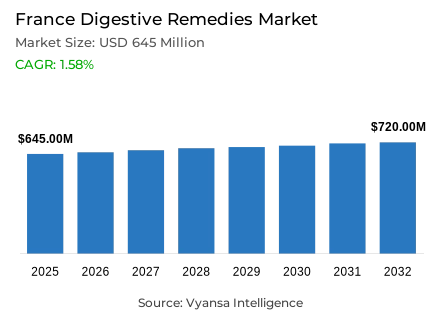
- Digestive remedies market size in France was valued at USD 645 million in 2025 and is estimated at USD 670.98 million in 2026.
- The market size is expected to grow to USD 720 million by 2032.
- Market to register a CAGR of around 1.58% during 2026-32.
- Product Type Shares
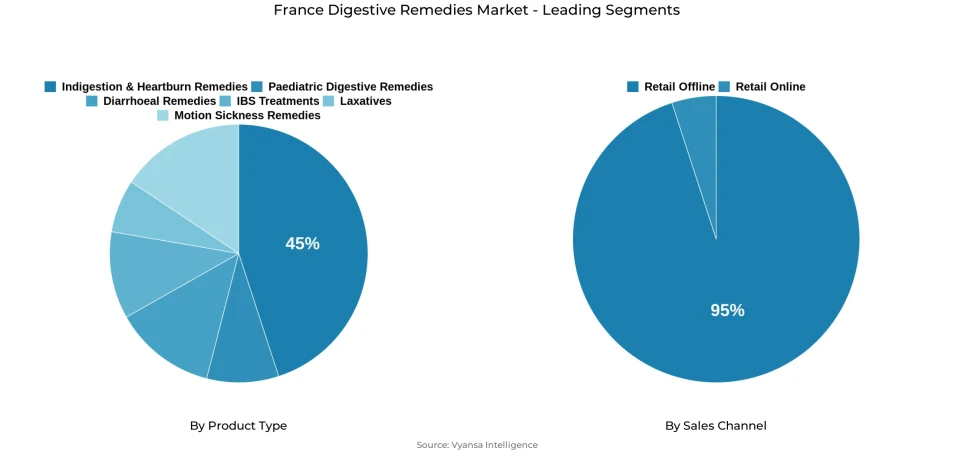
- Indigestion & heartburn remedies grabbed market share of 45%.
- Competition
- More than 20 companies are actively engaged in producing digestive remedies in France.
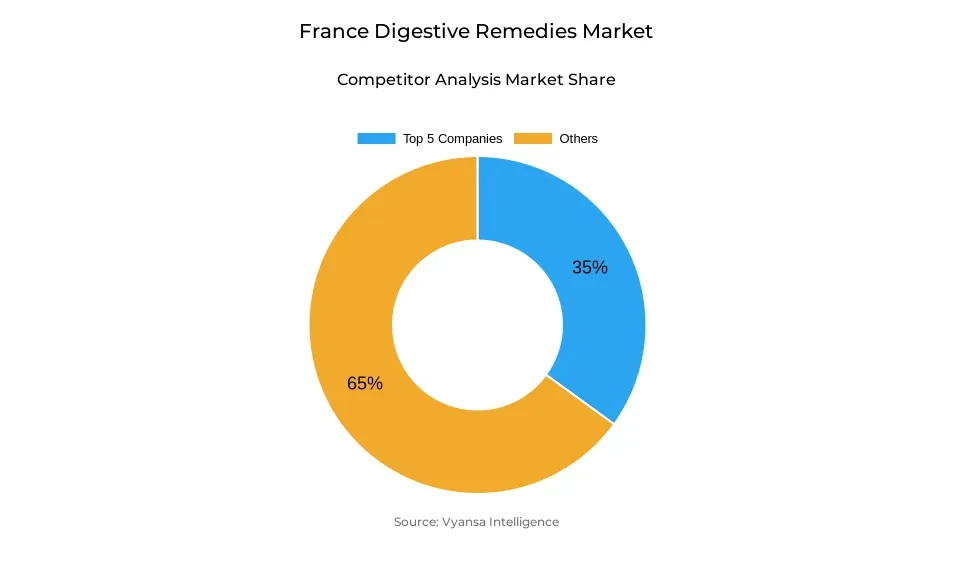
- Top 5 companies acquired around 35% of the market share.
- Ipsen SA, Abbott France SA, Haleon France SAS, Johnson & Johnson Sante Beaute France SA, Reckitt Benckiser France SA etc., are few of the top companies.
- Sales Channel
- Retail offline grabbed 95% of the market.
France Digestive Remedies Market Outlook
The France digestive remedies market size was valued at USD 645 million in 2025 and is projected to grow from USD 670.98 million in 2026 to USD 720 million by 2032, exhibiting a CAGR of around 1.58% during the forecast period. Growth remains steady as consumers continue to seek fast relief from reflux, abdominal discomfort, and IBS-related symptoms. Stress related to economic pressure and busier routines contributes to recurring digestive complaints. Limited access to doctors in some areas also encourages consumers to rely on pharmacist guidance and over-the-counter treatments for quick symptom management.
Demand for digestive remedies remains strong as many consumers prefer convenient OTC solutions for everyday digestive discomfort. The French Ministry of Health identifies 151 priority zones under its anti–medical desert plan in 2025, highlighting continued pressure on healthcare access. Within product categories, indigestion and heartburn remedies hold the largest share at about 45%, reflecting the common occurrence of reflux and upper digestive discomfort and the popularity of familiar treatments such as antacids for rapid relief.
However, the category faces some pressure from increasing caution around long-term use of certain medicines. Healthcare authorities are highlighting concerns about the overuse of proton pump inhibitors. Assurance Maladie states that its PPI deprescribing incentive scheme began on 1 January 2025 for three years, encouraging more appropriate use. Guidance also indicates that initial reflux treatment generally lasts four weeks and continuation is rarely justified. This stronger focus on controlled use may moderate growth in some digestive remedies segments.
Distribution remains heavily centred on pharmacies because consumers value trusted advice and quick access to treatments. As a result, retail offline accounts for around 95% of sales, reflecting the strong role of physical pharmacy networks. At the same time, demographic and travel patterns continue to support product demand. INSEE reports that 22% of the population is aged 65 or over in 2026, while tourist accommodation overnight stays increase 5.4% year on year in Q2 2025, factors that help maintain regular use occasions for digestive remedies.
France Digestive Remedies Market Growth DriverStress-Led Self-Care Keeps Demand Active
France's demand for digestive remedies will continue to grow largely because people will want quick relief from reflux, abdominal discomfort, and IBS-related symptoms. Economic pressure, uncertainty in the world, and the hurried pace of life with work returning to a more normal schedule all contribute to making digestive complaints part of people's daily lives. A large number of people will use products from pharmacies instead of going to visit a physician because of difficulty seeing a doctor quickly; this is particularly true for people who are using antacids (stomach acid reducers) and those with IBS (irritable bowel syndrome) seeking help to relieve their symptoms. Official data from 2025 supports these trends.
The French Ministry of Health identifies 151 priority zones under its anti–medical desert plan in 2025, showing continued pressure on access to care. Santé publique France also reports that in August 2025, adult visits for anxiety, anguish, mood disorders, suicidal ideation, and suicide attempts are above previous years, mainly among people aged 18–64. This environment keeps pharmacist-led digestive self-care highly relevant.
France Digestive Remedies Market ChallengeMisuse Concerns Weigh on Long-Term Category Confidence
One of the main hurdles faced by the market for gastrointestinal products in France has to do with an increased amount of caution regarding the over-prescribing of many types of OTC medications. Particularly proton pumps inhibitors (PPIs). Although PPIs are still effective medications and they are prescribed frequently, health care providers are becoming more cautious about prescribing long-term use of PPIs or when PPIs should not be used at all. As a result, both health care providers and patients will be slower to adopt new products, particularly when advertised alternatives are safer or more natural.
Official guidance in 2025 reinforces this concern. Assurance Maladie states that its PPI deprescribing incentive scheme entered into force on 1 January 2025 for three years, with the aim of reducing inappropriate consumption. It also notes that for reflux, the initial treatment duration is four weeks, and continuation is rarely justified, especially in older polymedicated patients. This stronger focus on deprescribing places pressure on long-term PPI demand.
Unlock Market Intelligence
Explore the market potential with our data-driven report
France Digestive Remedies Market TrendTravel Recovery Keeps Motion Remedies in Focus
A clear trend in France’s digestive remedies market is the renewed strength of motion sickness remedies alongside travel recovery. Travel-related digestive and motion discomfort remains important as domestic and international mobility stays active. This keeps motion sickness products visible, especially around holiday periods and major travel events, and supports their role within digestive self-care despite broader category changes.
Official tourism data confirms that travel activity stays high.National Institute of Statistics and Economic Studies (INSEE) states that in Q2 2025, tourist accommodation overnight stays in France rise 5.4% year on year, with hotel attendance up 5.2% and short-stay accommodation up 6.1%. INSEE also notes that the Paris 2024 Olympic and Paralympic Games increase tourism attractiveness and that tourist spending per night during the Games is 22% higher than in 2023 for visitors attending the event.
France Digestive Remedies Market OpportunityAgeing Creates More Room for Digestive Support
A key opportunity for France’s digestive remedies market comes from population ageing. Older consumers are more likely to experience gas, bloating, constipation, diarrhoea, and broader digestive discomfort as digestive function slows with age. This gives digestive remedies a clear opportunity to stay relevant through products that target recurring age-related needs, especially in antacids, IBS treatments, diarrhoeal remedies, and laxatives, where symptom frequency tends to rise among older adults.
INSEE’s latest demographic release supports this opening. On 1 January 2026, 22% of the French population was aged 65 or over, almost the same share as people under 20. INSEE also reports that France’s population reaches 69.1 million in 2026, with ageing continuing to reshape the healthcare landscape. This older demographic increases the relevance of digestive support products in everyday consumer health.
Unlock Market Intelligence
Explore the market potential with our data-driven report
France Digestive Remedies Market Segmentation Analysis
By Product Type
- Paediatric Digestive Remedies
- Paediatric Diarrhoeal Remedies
- Paediatric Indigestion & Heartburn Remedies
- Paediatric Laxatives
- Paediatric Motion Sickness Remedies
- Diarrhoeal Remedies
- IBS Treatments
- Indigestion & Heartburn Remedies
- Antacids
- Antiflatulents
- Digestive Enzymes
- H2 Blockers
- Proton Pump Inhibitors
- Laxatives
- Motion Sickness Remedies
Within the dietary supplement industry, the product type segment has the highest overall market share, with indigestion and heartburn remedies representing 45% of total market share. The continued availability of these types of remedies aligns with the motive for purchasing products within this category; the most frequent reasons for self-medicating in France revolve around indigestion/reflux/upper digestive discomfort. Consumers prefer to purchase products that can provide quick relief and are familiar and practical, which has allowed this segment to remain at the forefront or centre of dietary supplement purchases related to upper digestive disorders.
Another reason for the success of this segment within the overall category mix is that complaints related to indigestion and heartburn are common in individuals because they are caused by stress, busy lifestyles, and discomfort after meals. As such, these types of remedies will continue to be purchased routinely, compared to less widely used digestive products, because they are regularly used as part of a consumer's normal self-care practices.
By Sales Channel
- Retail Online
- Retail Offline
- Hospitals
- Clinics
- Pharmacies
The segment has the highest share under the sales channel, with retail offline grabbed 95% of the market. This dominance reflects the central role of pharmacies in France, where consumers still rely heavily on physical outlets for digestive remedies. Pharmacists remain important because they offer guidance, reassurance, and immediate access to products, especially in a market where many consumers seek support for recurring digestive discomfort without first visiting a doctor.
Offline leadership also reflects habit and trust. Even though digital tools and online information are increasingly visible, physical pharmacy purchases remain the main route because digestive remedies are often bought for quick relief and because pharmacist advice continues to influence choice. This keeps retail offline firmly dominant in the category.
List of Companies Covered in France Digestive Remedies Market
The companies listed below are highly influential in the France digestive remedies market, with a significant market share and a strong impact on industry developments.
- Ipsen SA
- Abbott France SA
- Haleon France SAS
- Johnson & Johnson Sante Beaute France SA
- Reckitt Benckiser France SA
- Bayer Sante Familiale SAS
- Teva Sante SAS
- Sanofi
- Omega Pharma France
- Pharma Developpement SA
Competitive Landscape
In 2025, the competitive landscape of digestive remedies in France was led by Johnson & Johnson Santé Beauté France SA with a 9.7% retail value share, followed closely by Reckitt Benckiser France SA with 9.1%. Johnson & Johnson maintains its leadership largely through strong brands such as Imodium in diarrhoeal remedies and Microlax and Lansoÿl in laxatives, which benefit from high consumer recognition and consistent demand. Reckitt Benckiser also holds a strong position in the market with its established digestive remedy portfolio and extensive retail presence. Market growth continues to be supported by rising stress levels, increasing prevalence of irritable bowel syndrome and strong pharmacist influence in OTC recommendations, although growing consumer interest in probiotics, natural remedies and preventive gut health solutions is gradually intensifying competition for traditional digestive remedies.
Frequently Asked Questions
Related Report
- Market Segmentation
- Research Scope
- Research Methodology
- Definitions and Assumptions
- Executive Summary
- France Digestive Remedies Market Policies, Regulations, and Standards
- France Digestive Remedies Market Dynamics
- Growth Factors
- Challenges
- Trends
- Opportunities
- France Digestive Remedies Market Statistics, 2022-2032F
- Market Size & Growth Outlook
- By Revenues in USD Million
- Market Segmentation & Growth Outlook
- By Product Type
- Paediatric Digestive Remedies- Market Insights and Forecast 2022-2032, USD Million
- Paediatric Diarrhoeal Remedies- Market Insights and Forecast 2022-2032, USD Million
- Paediatric Indigestion & Heartburn Remedies- Market Insights and Forecast 2022-2032, USD Million
- Paediatric Laxatives- Market Insights and Forecast 2022-2032, USD Million
- Paediatric Motion Sickness Remedies- Market Insights and Forecast 2022-2032, USD Million
- Diarrhoeal Remedies- Market Insights and Forecast 2022-2032, USD Million
- IBS Treatments- Market Insights and Forecast 2022-2032, USD Million
- Indigestion & Heartburn Remedies- Market Insights and Forecast 2022-2032, USD Million
- Antacids- Market Insights and Forecast 2022-2032, USD Million
- Antiflatulents- Market Insights and Forecast 2022-2032, USD Million
- Digestive Enzymes- Market Insights and Forecast 2022-2032, USD Million
- H2 Blockers- Market Insights and Forecast 2022-2032, USD Million
- Proton Pump Inhibitors- Market Insights and Forecast 2022-2032, USD Million
- Laxatives- Market Insights and Forecast 2022-2032, USD Million
- Motion Sickness Remedies- Market Insights and Forecast 2022-2032, USD Million
- Paediatric Digestive Remedies- Market Insights and Forecast 2022-2032, USD Million
- By Age Group
- Children & Adolescents (01-17 years)- Market Insights and Forecast 2022-2032, USD Million
- Adults (18-65 years)- Market Insights and Forecast 2022-2032, USD Million
- Geriatric (65+ years)- Market Insights and Forecast 2022-2032, USD Million
- By Sales Channel
- Retail Online- Market Insights and Forecast 2022-2032, USD Million
- Retail Offline- Market Insights and Forecast 2022-2032, USD Million
- Hospitals- Market Insights and Forecast 2022-2032, USD Million
- Clinics- Market Insights and Forecast 2022-2032, USD Million
- Pharmacies- Market Insights and Forecast 2022-2032, USD Million
- By Competitors
- Competition Characteristics
- Market Share & Analysis
- By Product Type
- Market Size & Growth Outlook
- France Paediatric Digestive Remedies Market Statistics, 2022-2032
- Market Size & Growth Outlook
- By Revenues in USD Million
- Market Segmentation & Growth Outlook
- By Age Group- Market Insights and Forecast 2022-2032, USD Million
- By Sales Channel- Market Insights and Forecast 2022-2032, USD Million
- Market Size & Growth Outlook
- France Diarrhoeal Remedies Market Statistics, 2022-2032
- Market Size & Growth Outlook
- By Revenues in USD Million
- Market Segmentation & Growth Outlook
- By Age Group- Market Insights and Forecast 2022-2032, USD Million
- By Sales Channel- Market Insights and Forecast 2022-2032, USD Million
- Market Size & Growth Outlook
- France IBS Treatments Market Statistics, 2022-2032
- Market Size & Growth Outlook
- By Revenues in USD Million
- Market Segmentation & Growth Outlook
- By Age Group- Market Insights and Forecast 2022-2032, USD Million
- By Sales Channel- Market Insights and Forecast 2022-2032, USD Million
- Market Size & Growth Outlook
- France Indigestion & Heartburn Remedies Market Statistics, 2022-2032
- Market Size & Growth Outlook
- By Revenues in USD Million
- Market Segmentation & Growth Outlook
- By Age Group- Market Insights and Forecast 2022-2032, USD Million
- By Sales Channel- Market Insights and Forecast 2022-2032, USD Million
- Market Size & Growth Outlook
- France Laxatives Market Statistics, 2022-2032
- Market Size & Growth Outlook
- By Revenues in USD Million
- Market Segmentation & Growth Outlook
- By Age Group- Market Insights and Forecast 2022-2032, USD Million
- By Sales Channel- Market Insights and Forecast 2022-2032, USD Million
- Market Size & Growth Outlook
- France Motion Sickness Remedies Market Statistics, 2022-2032
- Market Size & Growth Outlook
- By Revenues in USD Million
- Market Segmentation & Growth Outlook
- By Age Group- Market Insights and Forecast 2022-2032, USD Million
- By Sales Channel- Market Insights and Forecast 2022-2032, USD Million
- Market Size & Growth Outlook
- Competitive Outlook
- Company Profiles
- Johnson & Johnson Sante Beaute France SA
- Business Description
- Product Portfolio
- Collaborations & Alliances
- Recent Developments
- Financial Details
- Others
- Reckitt Benckiser France SA
- Business Description
- Product Portfolio
- Collaborations & Alliances
- Recent Developments
- Financial Details
- Others
- Bayer Sante Familiale SAS
- Business Description
- Product Portfolio
- Collaborations & Alliances
- Recent Developments
- Financial Details
- Others
- Teva Sante SAS
- Business Description
- Product Portfolio
- Collaborations & Alliances
- Recent Developments
- Financial Details
- Others
- Sanofi
- Business Description
- Product Portfolio
- Collaborations & Alliances
- Recent Developments
- Financial Details
- Others
- Ipsen SA
- Business Description
- Product Portfolio
- Collaborations & Alliances
- Recent Developments
- Financial Details
- Others
- Abbott France SA
- Business Description
- Product Portfolio
- Collaborations & Alliances
- Recent Developments
- Financial Details
- Others
- Haleon France SAS
- Business Description
- Product Portfolio
- Collaborations & Alliances
- Recent Developments
- Financial Details
- Others
- Omega Pharma France
- Business Description
- Product Portfolio
- Collaborations & Alliances
- Recent Developments
- Financial Details
- Others
- Pharma Developpement SA
- Business Description
- Product Portfolio
- Collaborations & Alliances
- Recent Developments
- Financial Details
- Others
- Johnson & Johnson Sante Beaute France SA
- Company Profiles
- Disclaimer
| Segment | Sub-Segment |
|---|---|
| By Product Type |
|
| By Age Group |
|
| By Sales Channel |
|
Research Methodology
This study followed a structured approach comprising four key phases to assess the size and scope of the electro-oxidation market. The process began with thorough secondary research to collect data on the target market, related markets, and broader industry context. These findings, along with preliminary assumptions and estimates, were then validated through extensive primary research involving industry experts from across the value chain. To calculate the overall market size, both top-down and bottom-up methodologies were employed. Finally, market segmentation and data triangulation techniques were applied to refine and validate segment-level estimations.
Secondary Research
The secondary research phase involved gathering data from a wide range of credible and published sources. This step helped in identifying industry trends, defining market segmentation, and understanding the market landscape and value chain.
Sources consulted during this phase included:
- Company annual reports, investor presentations, and press releases
- Industry white papers and certified publications
- Trade directories and market-recognized databases
- Articles from authoritative authors and reputable journals
- Gold and silver standard websites
Secondary research was critical in mapping out the industry's value chain and monetary flow, identifying key market segments, understanding regional variations, and tracking significant industry developments.
Other key sources:
- Financial disclosures
- Industry associations and trade bodies
- News outlets and business magazines
- Academic journals and research studies
- Paid industry databases
Primary Research
To validate secondary data and gain deeper market insights, primary research was conducted with key stakeholders across both the supply and demand sides of the market.
On the demand side, participants included decision-makers and influencers from end-user industries—such as CIOs, CTOs, and CSOs—who provided first-hand perspectives on market needs, product usage, and future expectations.
On the supply side, interviews were conducted with manufacturers, industry associations, and institutional participants to gather insights into current offerings, product pipelines, and market challenges.
Primary interviews provided critical inputs such as:
- Market size and revenue data
- Product and service breakdowns
- Market forecasts
- Regional and application-specific trends
Stakeholders consulted included:
- Leading OEM and solution providers
- Channel and distribution partners
- End users across various applications
- Independent consultants and industry specialists
Market Size Estimation and Data Triangulation
- Identifying Key Market Participants (Secondary Research)
- Goal: To identify the major players or companies in the target market. This typically involves using publicly available data sources such as industry reports, market research publications, and financial statements of companies.
- Tools: Reports from firms like Gartner, Forrester, Euromonitor, Statista, IBISWorld, and others. Public financial statements, news articles, and press releases from top market players.
- Extracting Earnings of Key Market Participants
- Goal: To estimate the earnings generated from the product or service being analyzed. This step helps in understanding the revenue potential of each market player in a specific geography.
- Methods: Earnings data can be gathered from:
- Publicly available financial reports (for listed companies).
- Interviews and primary data sources from professionals, such as Directors, VPs, SVPs, etc. This is especially useful for understanding more nuanced, internal data that isn't publicly disclosed.
- Annual reports and investor presentations of key players.
- Data Collation and Development of a Relevant Data Model
- Goal: To collate inputs from both primary and secondary sources into a structured, data-driven model for market estimation. This model will incorporate key market KPIs and any independent variables relevant to the market.
- Key KPIs: These could include:
- Market size, growth rate, and demand drivers.
- Industry-specific metrics like market share, average revenue per customer (ARPC), or average deal size.
- External variables, such as economic growth rates, inflation rates, or commodity prices, that could affect the market.
- Data Modeling: Based on this data, the market forecasts are developed for the next 5 years. A combination of trend analysis, scenario modeling, and statistical regression might be used to generate projections.
- Scenario Analysis
- Goal: To test different assumptions and validate how sensitive the market is to changes in key variables (e.g., market demand, regulatory changes, technological disruptions).
- Types of Scenarios:
- Base Case: Based on current assumptions and historical data.
- Best-Case Scenario: Assuming favorable market conditions, regulatory environments, and technological advancements.
- Worst-Case Scenario: Accounting for adverse factors, such as economic downturns, stricter regulations, or unexpected disruptions.












