Denmark Room Air Conditioners Market Report: Trends, Growth and Forecast (2026-2032)
By Product Type (Split Air Conditioners (Up to 9,000 BTU/h, 9,001-12,000 BTU/h, 12,001-18,000 BTU/h, 18,001-24,000 BTU/h, Above 24,000 BTU/h), Window Air Conditioners (Up to 9,000 BTU/h, 9,001-12,000 BTU/h, 12,001-18,000 BTU/h, 18,001-24,000 BTU/h, Above 24,000 BTU/h), Others), By Technology (Inverter, Non-Inverter), By Price (Up to USD 300, USD 301 to USD 600, USD 601 to USD 1,000, Above USD 1,000), By End User (Residential (Individual Households, Apartments/Condominiums, Vacation/Secondary Homes), Commercial (Offices, Retail Stores/Showrooms, Hospitality, Healthcare Facilities, Educational Institutions, Small Commercial Establishments, Others)), By Sales Channel (Retail Online (Brand-Owned Websites/D2C, E-Commerce Marketplaces), Retail Offline (Exclusive Brand Stores, Multi-Brand Electronics & Appliance Stores, Specialty Stores, Hypermarkets/Supermarkets, Home Improvement Stores, Dealer/Distributor Network, Direct Sales/Institutional Sales, Local Independent Retailers)), By Refrigerant Type (R-32, R-410A, R-290, R-454B, Others), By Connectivity (Smart/Connected, Conventional/Non-Smart), By Energy Efficiency (1 Star, 2 Star, 3 Star, 4 Star, 5 Star) ... Read more
|
Major Players
|
Denmark Room Air Conditioners Market Statistics and Insights, 2026
- Market Size Statistics
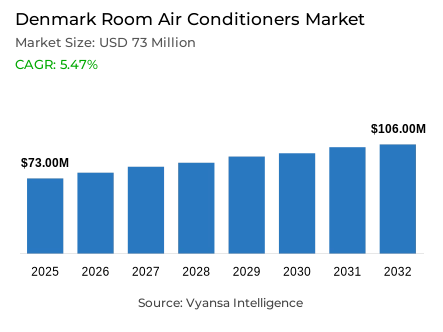
- Room air conditioners market size in Denmark was valued at USD 73 million in 2025 and is estimated at USD 77 million in 2026.
- The market size is expected to grow to USD 106 million by 2032.
- Market to register a CAGR of around 5.47% during 2026-32.
- Product Type Shares
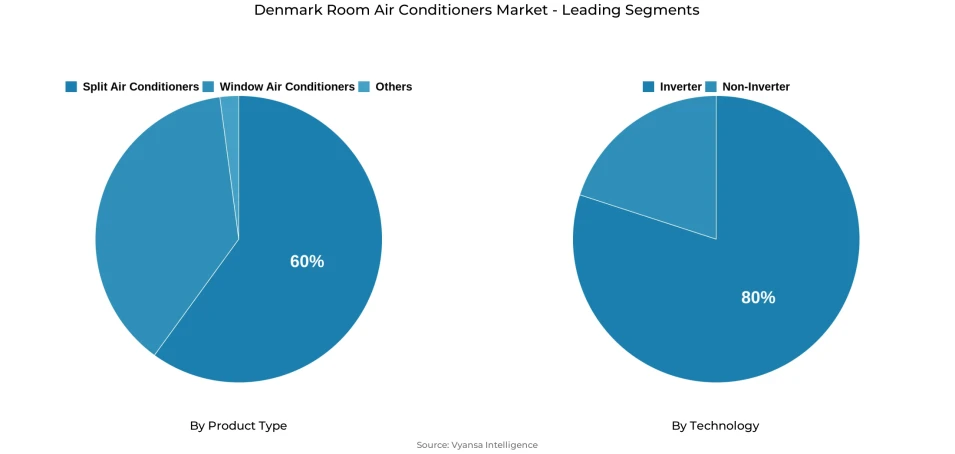
- Split air conditioners grabbed market share of 60%.
- Competition
- More than 5 companies are actively engaged in producing room air conditioners in Denmark.
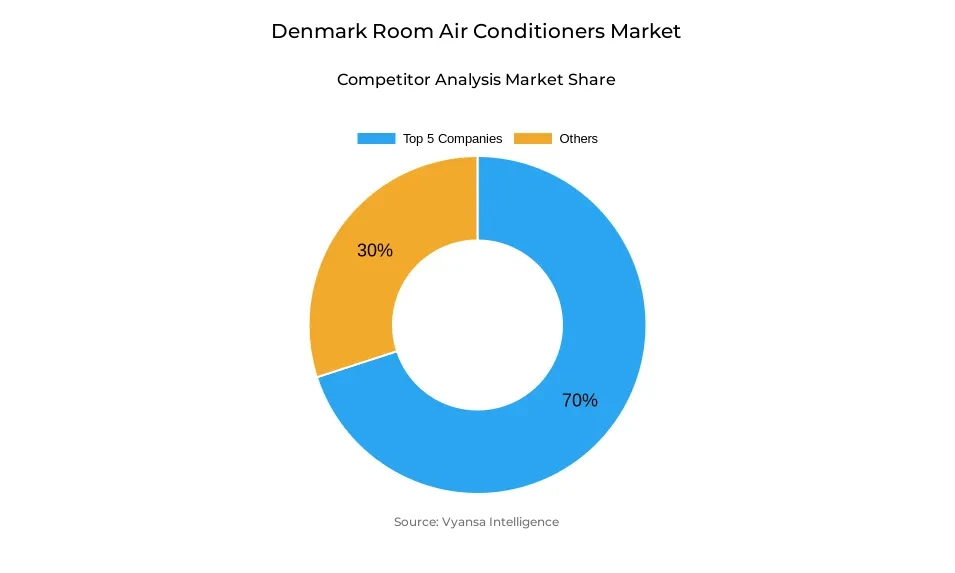
- Top 5 companies acquired around 70% of the market share.
- Electrolux AB, BSH Hausgerate GmbH, Whirlpool Corp, WC Wood Co Ltd, Panasonic Corp etc., are few of the top companies.
- Technology
- Inverter grabbed 80% of the market.
Denmark Room Air Conditioners Market Outlook
Denmark room air conditioners market size was valued at USD 73 million in 2025 and is projected to grow from USD 77 million in 2026 to USD 106 million by 2032, exhibiting a CAGR of 5.47% during the forecast period. The outlook remains positive, supported by warmer weather conditions, a stable residential base, and continued preference for efficient room cooling solutions across the country.
A key factor supporting demand is the shift in Denmark’s temperature pattern. The country’s average temperature reaches 9.8°C in 2024, which is 1.1°C above the 1991-2020 climate normal, while frost days fall to 37.3 from the normal 67.7 days. This keeps room air conditioners more relevant in households seeking flexible and immediate cooling support during warmer periods.
The outlook also benefits from Denmark’s broad household base and ongoing construction activity. The country records 2,878,144 households in 2026 and 2,852,000 occupied dwellings in 2025, while 530,132 m² of floor area and 1,257 dwellings are under construction in December 2025. In this setting, room air conditioners remain closely linked to residential use, new home setup, and practical comfort upgrades.
Buyer preference remains centered on fixed and efficient cooling systems. Split air conditioners hold 60% share, showing strong demand for stable room cooling formats, while inverter technology accounts for 80% share, reflecting the appeal of better electricity control. At the same time, household electricity prices of 2.6 DKK per kWh in the first half of 2025 keep room air conditioners tied not only to comfort needs, but also to running cost awareness and efficiency led buying decisions.
Denmark Room Air Conditioners Market Growth DriverWarmer Conditions Raise Everyday Cooling Need
Warmer weather is a key driver for room air conditioners in Denmark. Danish Meteorological Institute (DMI) reports that Denmark’s average temperature reaches 9.8°C in 2024, which is 1.1°C above the 1991-2020 climate normal. The same report shows that the country records only 37.3 frost days in 2024, far below the normal of 67.7 days. This indicates a milder temperature pattern and a more noticeable shift in household comfort needs.
These conditions keep indoor cooling more relevant, especially during warmer periods when households seek direct room level comfort. As higher than normal temperatures become more visible in everyday life, room air conditioners gain stronger relevance in homes that want flexible and immediate cooling support rather than depending only on natural ventilation.
Denmark Room Air Conditioners Market ChallengeHigh Electricity Costs Limit Faster Adoption
A major challenge for room air conditioners in Denmark is the cost of household electricity. Statistics Denmark reports that the price of electricity for households with normal consumption is 2.6 DKK per kWh in the first half of 2025. At the same time, consumer price pressure remains relevant, as Statistics Denmark’s consumer price index continues to be the country’s main measure of inflation and household purchasing power.
This matters because room air conditioners are judged not only by purchase price, but also by expected running costs. When electricity remains relatively expensive, households can become more careful about buying and using cooling products, especially where cooling is seen as a comfort upgrade rather than an essential fixed utility.
Unlock Market Intelligence
Explore the market potential with our data-driven report
Denmark Room Air Conditioners Market TrendLarge Household Base Supports Residential Cooling Demand
An important trend is the strong household and housing base in Denmark. Statistics Denmark reports 2,878,144 households in 2026 and 2,852,000 occupied dwellings in 2025. These figures show a broad residential base where room level cooling products can fit naturally, especially in homes looking for targeted comfort rather than whole building climate systems.
This housing structure keeps room air conditioners closely linked to everyday residential use. When the number of households and occupied dwellings remains high, compact cooling products become more relevant in daily living, particularly where households want practical cooling solutions for specific rooms and short warmer periods.
Denmark Room Air Conditioners Market OpportunityConstruction Pipeline Opens Fresh Installation Scope
A strong opportunity comes from Denmark’s ongoing construction pipeline. Statistics Denmark reports that the country has 530,132 m² of floor area under construction in December 2025, along with 1,257 dwellings under construction. This creates a visible base of homes where cooling products can be considered during move in, renovation, or early equipment installation.
For room air conditioners, this expands the scope for first installation demand. As more dwellings move through the construction phase, brands gain more opportunities to reach households at the stage when practical comfort appliances are being selected for new or upgraded living spaces.
Unlock Market Intelligence
Explore the market potential with our data-driven report
Denmark Room Air Conditioners Market Segmentation Analysis
By Product Type
- Split Air Conditioners
- Up to 9,000 BTU/h
- 9,001-12,000 BTU/h
- 12,001-18,000 BTU/h
- 18,001-24,000 BTU/h
- Above 24,000 BTU/h
- Window Air Conditioners
- Up to 9,000 BTU/h
- 9,001-12,000 BTU/h
- 12,001-18,000 BTU/h
- 18,001-24,000 BTU/h
- Above 24,000 BTU/h
- Others
The segment with the highest share around product type is split air conditioners, with a market share of 60%. This leading position shows that buyers in Denmark continue to prefer fixed room cooling systems that offer more stable daily performance than less permanent alternatives. Their fit with room specific household use keeps them at the center of product demand.
This preference also aligns with Denmark’s climate pattern. DMI reports that 2024 records an average temperature of 9.8°C, which is 1.1°C above the 1991-2020 normal, while frost days fall to 37.3 from a normal of 67.7. In such a setting, fixed room air conditioner formats remain closely tied to practical indoor comfort needs.
By Technology
- Inverter
- Non-Inverter
The segment with the highest share around technology is inverter, with a market share of 80%. This shows that buyers in Denmark increasingly prefer room air conditioner technology that supports steadier cooling and better control over electricity use in everyday operation. Inverter systems therefore remain the dominant technology choice in the country.
This preference also fits the current cost environment. Statistics Denmark reports that household electricity prices reach 2.6 DKK per kWh in the first half of 2025. In this setting, technologies associated with more stable operation and better energy control become more attractive, as households remain careful about balancing comfort with ongoing electricity spending.
List of Companies Covered in Denmark Room Air Conditioners Market
The companies listed below are highly influential in the Denmark room air conditioners market, with a significant market share and a strong impact on industry developments.
- Electrolux AB
- BSH Hausgerate GmbH
- Whirlpool Corp
- WC Wood Co Ltd
- Panasonic Corp
- Eeese Air Care ApS
- Wilfa AS
Market News & Updates
- Electrolux AB, 2026:
In 2026, Electrolux is actively supporting its Denmark air-conditioners business through a localized portable AC portfolio and Denmark-facing product marketing, with its official Danish site listing ChillFlex Pro, Well P7, 600 Comfort, and 700 Comfort portable air-conditioner models and positioning them for villas, summer houses, apartments, and offices, while also emphasizing Wi-Fi/app connectivity, low noise, and energy-efficient cooling features; this is commercially important for the Denmark air conditioners market because it shows Electrolux is maintaining a broad, premium-leaning portable AC offer tailored to common Danish residential use cases, which should help the brand capture warm-season replacement and first-time demand in flexible room-cooling applications.
- Eeese Air Care ApS, 2026:
In 2026, Denmark-based Eeese Air Care continues to strengthen its domestic room-cooling presence through an active Denmark assortment built around a dedicated air-conditioner category, a “new products” section on its Danish site, and support documentation that lists current AC models including Alba, Kaya, and Nora, all managed from its Roskilde operation; for the Denmark air conditioners market, this matters because it confirms that a local Nordic indoor-climate specialist is sustaining an identifiable portable AC lineup and product-refresh pipeline in Denmark, which can improve retailer confidence, support faster consumer adoption of locally branded cooling appliances, and increase competitive pressure in the mid-market residential segment.
Frequently Asked Questions
Related Report
- Market Segmentation
- Research Scope
- Research Methodology
- Definitions and Assumptions
- Executive Summary
- Denmark Room Air Conditioners Market Policies, Regulations, and Standards
- Denmark Room Air Conditioners Market Dynamics
- Growth Factors
- Challenges
- Trends
- Opportunities
- Denmark Room Air Conditioners Market Statistics, 2022-2032F
- Market Size & Growth Outlook
- By Revenues in USD Million
- By Units Sold in Thousand Units
- Market Segmentation & Growth Outlook
- By Product Type
- Split Air Conditioners- Market Insights and Forecast 2022-2032, USD Million
- Up to 9,000 BTU/h- Market Insights and Forecast 2022-2032, USD Million
- 9,001-12,000 BTU/h- Market Insights and Forecast 2022-2032, USD Million
- 12,001-18,000 BTU/h- Market Insights and Forecast 2022-2032, USD Million
- 18,001-24,000 BTU/h- Market Insights and Forecast 2022-2032, USD Million
- Above 24,000 BTU/h- Market Insights and Forecast 2022-2032, USD Million
- Window Air Conditioners- Market Insights and Forecast 2022-2032, USD Million
- Up to 9,000 BTU/h- Market Insights and Forecast 2022-2032, USD Million
- 9,001-12,000 BTU/h- Market Insights and Forecast 2022-2032, USD Million
- 12,001-18,000 BTU/h- Market Insights and Forecast 2022-2032, USD Million
- 18,001-24,000 BTU/h- Market Insights and Forecast 2022-2032, USD Million
- Above 24,000 BTU/h- Market Insights and Forecast 2022-2032, USD Million
- Others- Market Insights and Forecast 2022-2032, USD Million
- Split Air Conditioners- Market Insights and Forecast 2022-2032, USD Million
- By Technology
- Inverter- Market Insights and Forecast 2022-2032, USD Million
- Non-Inverter- Market Insights and Forecast 2022-2032, USD Million
- By Price
- Up to USD 300- Market Insights and Forecast 2022-2032, USD Million
- USD 301 to USD 600- Market Insights and Forecast 2022-2032, USD Million
- USD 601 to USD 1,000- Market Insights and Forecast 2022-2032, USD Million
- Above USD 1,000- Market Insights and Forecast 2022-2032, USD Million
- By End User
- Residential- Market Insights and Forecast 2022-2032, USD Million
- Individual Households- Market Insights and Forecast 2022-2032, USD Million
- Apartments/Condominiums- Market Insights and Forecast 2022-2032, USD Million
- Vacation/Secondary Homes- Market Insights and Forecast 2022-2032, USD Million
- Commercial- Market Insights and Forecast 2022-2032, USD Million
- Offices- Market Insights and Forecast 2022-2032, USD Million
- Retail Stores/Showrooms- Market Insights and Forecast 2022-2032, USD Million
- Hospitality- Market Insights and Forecast 2022-2032, USD Million
- Healthcare Facilities- Market Insights and Forecast 2022-2032, USD Million
- Educational Institutions- Market Insights and Forecast 2022-2032, USD Million
- Small Commercial Establishments- Market Insights and Forecast 2022-2032, USD Million
- Others- Market Insights and Forecast 2022-2032, USD Million
- Residential- Market Insights and Forecast 2022-2032, USD Million
- By Sales Channel
- Retail Online- Market Insights and Forecast 2022-2032, USD Million
- Brand-Owned Websites/D2C- Market Insights and Forecast 2022-2032, USD Million
- E-Commerce Marketplaces- Market Insights and Forecast 2022-2032, USD Million
- Retail Offline- Market Insights and Forecast 2022-2032, USD Million
- Exclusive Brand Stores- Market Insights and Forecast 2022-2032, USD Million
- Multi-Brand Electronics & Appliance Stores- Market Insights and Forecast 2022-2032, USD Million
- Specialty Stores- Market Insights and Forecast 2022-2032, USD Million
- Hypermarkets/Supermarkets- Market Insights and Forecast 2022-2032, USD Million
- Home Improvement Stores- Market Insights and Forecast 2022-2032, USD Million
- Dealer/Distributor Network- Market Insights and Forecast 2022-2032, USD Million
- Direct Sales/Institutional Sales- Market Insights and Forecast 2022-2032, USD Million
- Local Independent Retailers- Market Insights and Forecast 2022-2032, USD Million
- Retail Online- Market Insights and Forecast 2022-2032, USD Million
- By Refrigerant Type
- R-32- Market Insights and Forecast 2022-2032, USD Million
- R-410A- Market Insights and Forecast 2022-2032, USD Million
- R-290- Market Insights and Forecast 2022-2032, USD Million
- R-454B- Market Insights and Forecast 2022-2032, USD Million
- Others- Market Insights and Forecast 2022-2032, USD Million
- By Connectivity
- Smart/Connected- Market Insights and Forecast 2022-2032, USD Million
- Conventional/Non-Smart- Market Insights and Forecast 2022-2032, USD Million
- By Energy Efficiency
- 1 Star- Market Insights and Forecast 2022-2032, USD Million
- 2 Star- Market Insights and Forecast 2022-2032, USD Million
- 3 Star- Market Insights and Forecast 2022-2032, USD Million
- 4 Star- Market Insights and Forecast 2022-2032, USD Million
- 5 Star- Market Insights and Forecast 2022-2032, USD Million
- By Competitors
- Competition Characteristics
- Market Share & Analysis
- By Product Type
- Market Size & Growth Outlook
- Denmark Split Air Conditioners Market Statistics, 2022-2032
- Market Size & Growth Outlook
- By Revenues in USD Million
- By Units Sold in Thousand Units
- Market Segmentation & Growth Outlook
- By Technology- Market Insights and Forecast 2022-2032, USD Million
- By Price- Market Insights and Forecast 2022-2032, USD Million
- By End User- Market Insights and Forecast 2022-2032, USD Million
- By Sales Channel- Market Insights and Forecast 2022-2032, USD Million
- By Refrigerant Type- Market Insights and Forecast 2022-2032, USD Million
- By Connectivity- Market Insights and Forecast 2022-2032, USD Million
- By Energy Efficiency- Market Insights and Forecast 2022-2032, USD Million
- Market Size & Growth Outlook
- Denmark Window Air Conditioners Market Statistics, 2022-2032
- Market Size & Growth Outlook
- By Revenues in USD Million
- By Units Sold in Thousand Units
- Market Segmentation & Growth Outlook
- By Technology- Market Insights and Forecast 2022-2032, USD Million
- By Price- Market Insights and Forecast 2022-2032, USD Million
- By End User- Market Insights and Forecast 2022-2032, USD Million
- By Sales Channel- Market Insights and Forecast 2022-2032, USD Million
- By Refrigerant Type- Market Insights and Forecast 2022-2032, USD Million
- By Connectivity- Market Insights and Forecast 2022-2032, USD Million
- By Energy Efficiency- Market Insights and Forecast 2022-2032, USD Million
- Market Size & Growth Outlook
- Competitive Outlook
- Company Profiles
- WC Wood Co Ltd
- Business Description
- Product Portfolio
- Collaborations & Alliances
- Recent Developments
- Financial Details
- Others
- Panasonic Corp
- Business Description
- Product Portfolio
- Collaborations & Alliances
- Recent Developments
- Financial Details
- Others
- Electrolux AB
- Business Description
- Product Portfolio
- Collaborations & Alliances
- Recent Developments
- Financial Details
- Others
- BSH Hausgeräte GmbH
- Business Description
- Product Portfolio
- Collaborations & Alliances
- Recent Developments
- Financial Details
- Others
- Whirlpool Corp
- Business Description
- Product Portfolio
- Collaborations & Alliances
- Recent Developments
- Financial Details
- Others
- Eeese Air Care ApS
- Business Description
- Product Portfolio
- Collaborations & Alliances
- Recent Developments
- Financial Details
- Others
- Wilfa AS
- Business Description
- Product Portfolio
- Collaborations & Alliances
- Recent Developments
- Financial Details
- Others
- Thermex Scandinavia A/S
- Business Description
- Product Portfolio
- Collaborations & Alliances
- Recent Developments
- Financial Details
- Others
- Others
- Business Description
- Product Portfolio
- Collaborations & Alliances
- Recent Developments
- Financial Details
- Others
- WC Wood Co Ltd
- Company Profiles
- Disclaimer
| Segment | Sub-Segment |
|---|---|
| By Product Type |
|
| By Technology |
|
| By Price |
|
| By End User |
|
| By Sales Channel |
|
| By Refrigerant Type |
|
| By Connectivity |
|
| By Energy Efficiency |
|
Research Methodology
This study followed a structured approach comprising four key phases to assess the size and scope of the electro-oxidation market. The process began with thorough secondary research to collect data on the target market, related markets, and broader industry context. These findings, along with preliminary assumptions and estimates, were then validated through extensive primary research involving industry experts from across the value chain. To calculate the overall market size, both top-down and bottom-up methodologies were employed. Finally, market segmentation and data triangulation techniques were applied to refine and validate segment-level estimations.
Secondary Research
The secondary research phase involved gathering data from a wide range of credible and published sources. This step helped in identifying industry trends, defining market segmentation, and understanding the market landscape and value chain.
Sources consulted during this phase included:
- Company annual reports, investor presentations, and press releases
- Industry white papers and certified publications
- Trade directories and market-recognized databases
- Articles from authoritative authors and reputable journals
- Gold and silver standard websites
Secondary research was critical in mapping out the industry's value chain and monetary flow, identifying key market segments, understanding regional variations, and tracking significant industry developments.
Other key sources:
- Financial disclosures
- Industry associations and trade bodies
- News outlets and business magazines
- Academic journals and research studies
- Paid industry databases
Primary Research
To validate secondary data and gain deeper market insights, primary research was conducted with key stakeholders across both the supply and demand sides of the market.
On the demand side, participants included decision-makers and influencers from end-user industries—such as CIOs, CTOs, and CSOs—who provided first-hand perspectives on market needs, product usage, and future expectations.
On the supply side, interviews were conducted with manufacturers, industry associations, and institutional participants to gather insights into current offerings, product pipelines, and market challenges.
Primary interviews provided critical inputs such as:
- Market size and revenue data
- Product and service breakdowns
- Market forecasts
- Regional and application-specific trends
Stakeholders consulted included:
- Leading OEM and solution providers
- Channel and distribution partners
- End users across various applications
- Independent consultants and industry specialists
Market Size Estimation and Data Triangulation
- Identifying Key Market Participants (Secondary Research)
- Goal: To identify the major players or companies in the target market. This typically involves using publicly available data sources such as industry reports, market research publications, and financial statements of companies.
- Tools: Reports from firms like Gartner, Forrester, Euromonitor, Statista, IBISWorld, and others. Public financial statements, news articles, and press releases from top market players.
- Extracting Earnings of Key Market Participants
- Goal: To estimate the earnings generated from the product or service being analyzed. This step helps in understanding the revenue potential of each market player in a specific geography.
- Methods: Earnings data can be gathered from:
- Publicly available financial reports (for listed companies).
- Interviews and primary data sources from professionals, such as Directors, VPs, SVPs, etc. This is especially useful for understanding more nuanced, internal data that isn't publicly disclosed.
- Annual reports and investor presentations of key players.
- Data Collation and Development of a Relevant Data Model
- Goal: To collate inputs from both primary and secondary sources into a structured, data-driven model for market estimation. This model will incorporate key market KPIs and any independent variables relevant to the market.
- Key KPIs: These could include:
- Market size, growth rate, and demand drivers.
- Industry-specific metrics like market share, average revenue per customer (ARPC), or average deal size.
- External variables, such as economic growth rates, inflation rates, or commodity prices, that could affect the market.
- Data Modeling: Based on this data, the market forecasts are developed for the next 5 years. A combination of trend analysis, scenario modeling, and statistical regression might be used to generate projections.
- Scenario Analysis
- Goal: To test different assumptions and validate how sensitive the market is to changes in key variables (e.g., market demand, regulatory changes, technological disruptions).
- Types of Scenarios:
- Base Case: Based on current assumptions and historical data.
- Best-Case Scenario: Assuming favorable market conditions, regulatory environments, and technological advancements.
- Worst-Case Scenario: Accounting for adverse factors, such as economic downturns, stricter regulations, or unexpected disruptions.












