Denmark NRT Smoking Cessation Aids Market Report: Trends, Growth and Forecast (2026-2032)
By Category (NRT Gum, NRT Inhalators, NRT Lozenges, NRT Patches, Other NRT Products), By Gender (Male, Female), By Sales Channel (Retail Online (Online Pharmacies, Brand-Owned Websites, E-commerce Marketplaces), Retail Offline (Hospital, Pharmacies, Drug Stores)), By End User (Individual / Consumer Self-Use, Healthcare-Professional-Supervised (Clinics, De-addiction Centers, Smoking Cessation Centers)) ... Read more
|
Major Players
|
Denmark NRT Smoking Cessation Aids Market Statistics and Insights, 2026
- Market Size Statistics
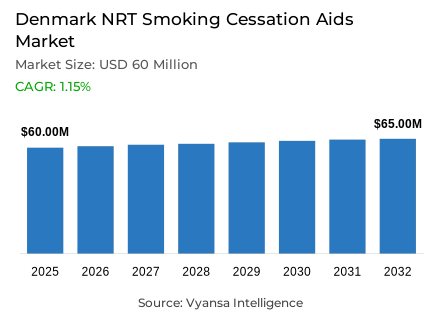
- Nrt smoking cessation aids market size in Denmark was valued at USD 60 million in 2025 and is estimated at USD 62 million in 2026.
- The market size is expected to grow to USD 65 million by 2032.
- Market to register a CAGR of around 1.15% during 2026-32.
- Category Shares
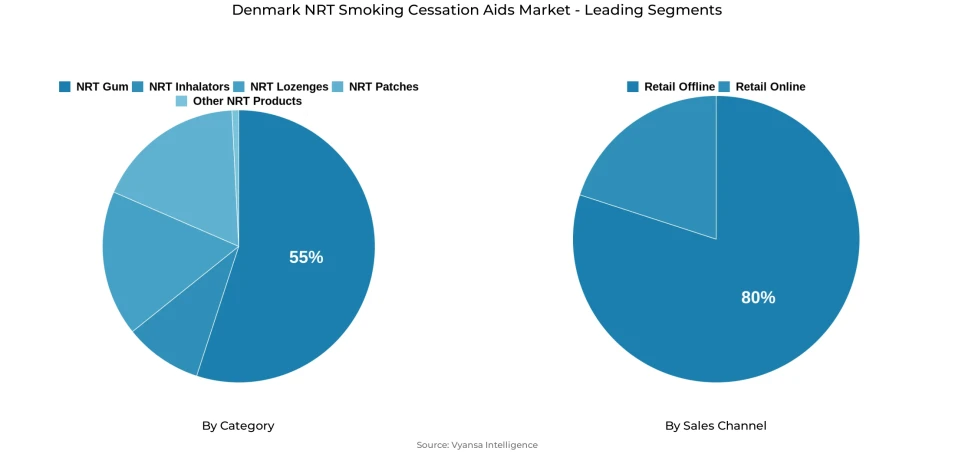
- Nrt gum grabbed market share of 55%.
- Competition
- More than 5 companies are actively engaged in producing nrt smoking cessation aids in Denmark.
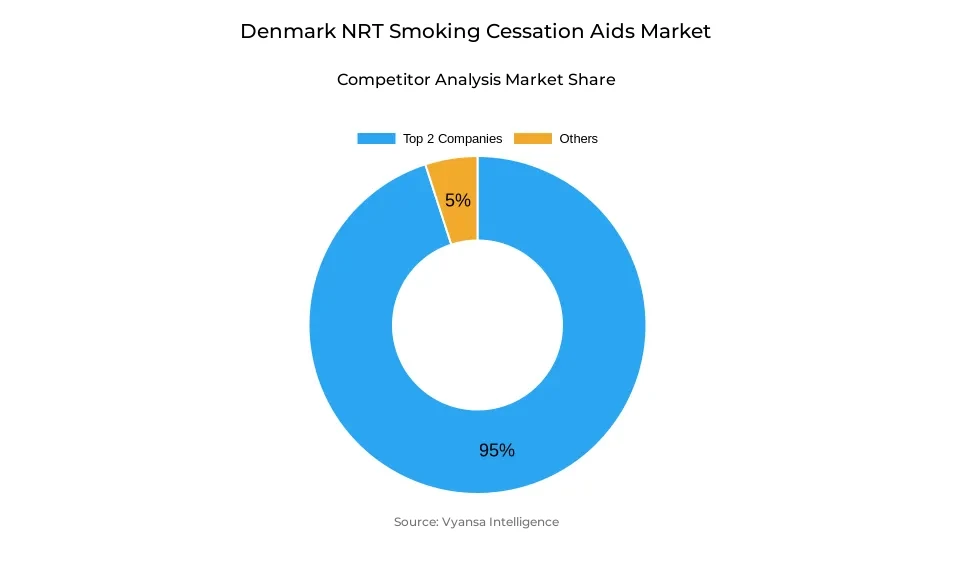
- Top 2 companies acquired around 95% of the market share.
- McNeil Denmark ApS, GSK Consumer Healthcare etc., are few of the top companies.
- Sales Channel
- Retail offline grabbed 80% of the market.
Denmark NRT Smoking Cessation Aids Market Outlook
The Denmark NRT smoking cessation aids market size was valued at USD 60 million in 2025 and is projected to grow from USD 62 million in 2026 to USD 65 million by 2032, exhibiting a CAGR of 1.15% during the forecast period. Growth remains modest as the category is influenced by a shrinking base of traditional smokers, even though many of those who still smoke continue to attempt quitting. Denmark’s National Health Profile 2025 shows that 74.4% of daily smokers want to stop smoking, and 41.8% of those who want to quit also want help or support, indicating that motivation to quit remains strong among the remaining smoking population.
Demand is also supported by repeated quit attempts and reliance on familiar products. Many consumers return to established formats when trying to stop smoking, which helps maintain demand for NRT smoking cessation aids despite limited innovation in the category. Gum remains the most widely used format and accounts for around 55% of category share, as it is well known, easy to carry, and suitable for managing cravings during multiple quit attempts. These characteristics help established formats remain central to cessation routines.
However, structural pressure comes from the steady decline in traditional smoking. Denmark’s National Health Profile 2025 reports that only 10.5% of adults smoke daily, which directly limits the pool of potential users for NRT smoking cessation aids. At the same time, alternative nicotine behaviours are becoming more visible, with 3.5% of adults reporting daily use of e-cigarettes or vaping devices, which slightly shifts nicotine consumption away from conventional cigarettes.
Channel dynamics are also evolving as consumer purchasing habits change. Retail offline channels still dominate and account for around 80% of sales, mainly because pharmacies remain trusted places where consumers can receive advice before choosing cessation products. At the same time, NRT smoking cessation aids are gradually gaining traction through online pharmacies as Denmark’s strong digital shopping culture supports repeat purchases of familiar health products. Statistics Denmark reports that 82% of people aged 16–74 make internet purchases within the last three months in 2025, reinforcing the role of digital channels in routine replenishment.
Denmark NRT Smoking Cessation Aids Market Growth DriverPersistent Quit Intent Keeps Core Demand Intact
A key driver for Denmark’s NRT smoking cessation aids market is the continued willingness of smokers to quit, even as the total smoking population becomes smaller. Consumers still value cessation support, especially when selecting aids such as gum and patches. This keeps a stable layer of demand in the category, because quitting often involves repeated attempts and a need for familiar, trusted formats that can be used more than once during the stop-smoking journey.
Official 2025 data supports this driver. Denmark’s National Health Profile 2025 shows that 74.4% of daily smokers want to stop smoking, and 41.8% of those daily smokers who want to quit also want support or help to do so. This confirms that quit motivation remains strong among the smokers who are still in the market.
Denmark NRT Smoking Cessation Aids Market ChallengeA Shrinking Smoker Base Keeps the Category Under Pressure
A key challenge for Denmark’s NRT smoking cessation aids market is the steady reduction in the number of traditional smokers. Cigarette sales have been declining for years, and that lower smoking prevalence directly reduces the pool of potential NRT users. This creates a structural limit for the category, because fewer smokers means fewer consumers who need gum, patches, or other nicotine replacement options in the first place.
The latest official data shows how narrow that base already is. Denmark’s National Health Profile 2025 reports that only 10.5% of adults smoke daily. In the same 2025 survey, daily use of e-cigarettes/vapes reaches 3.5% of adults, showing that some nicotine use is shifting outside traditional smoking. This combination keeps pressure on NRT demand by reducing the core smoker base and widening the set of substitute behaviours.
Unlock Market Intelligence
Explore the market potential with our data-driven report
Denmark NRT Smoking Cessation Aids Market TrendOnline Buying Becomes a Stronger Part of the Purchase Journey
A clear trend in Denmark’s NRT smoking cessation aids market is the growing importance of e-commerce, especially for repeat purchases. Many consumers buy NRT products through online pharmacies because the process is convenient and well suited to repurchasing familiar items without needing pharmacist guidance each time. This is gradually reshaping the channel mix, even though physical pharmacies still remain the leading outlet.
Denmark’s broader shopping behaviour supports this shift. Statistics Denmark reports that 82% of the population aged 16–74 makes internet purchases within the last three months in 2025. This high level of digital buying helps explain why online pharmacies continue to gain relevance for healthcare and OTC categories, including smoking cessation aids. As more consumers become comfortable buying health-related products online, digital channels become a stronger part of routine replenishment.
Denmark NRT Smoking Cessation Aids Market OpportunityPharmacy-Led Guidance Opens a Support-Based Growth Window
A key opportunity in Denmark’s NRT smoking cessation aids market lies in turning pharmacy advice and professional support into stronger conversion. Consumers still value personal guidance from pharmacies when selecting smoking cessation aids, even as e-commerce grows. This creates room for brands to work more closely with pharmacists and healthcare touchpoints so that motivated smokers are guided toward the right format and encouraged to stay on treatment.
Official 2025 data shows there is a meaningful audience for this approach. Denmark’s National Health Profile 2025 states that 41.8% of daily smokers who want to quit also want support, while among daily smokers who visit their general practice, 51.0% of men and 42.2% of women report receiving advice from health professionals about quitting. That makes support-led positioning a clear opportunity for the category.
Unlock Market Intelligence
Explore the market potential with our data-driven report
Denmark NRT Smoking Cessation Aids Market Segmentation Analysis
By Category
- NRT Gum
- NRT Inhalators
- NRT Lozenges
- NRT Patches
- Other NRT Products
The segment has the highest share around the category under NRT smoking cessation aids, with NRT gum accounting for 55%. This leading position shows that the category remains centred on the most familiar and established formats, with little real movement beyond gum and patches. Gum keeps a strong role because it is already well known to consumers and fits repeated quit attempts, where smokers often test different formats to find the most practical solution.
Its leadership also reflects the category’s limited innovation pattern. There have been no major new disruptive launches, which means established forms continue to dominate consumer choice. In that environment, gum remains a dependable format that benefits from familiarity, accessibility, and routine use.
By Sales Channel
- Retail Online
- Online Pharmacies
- Brand-Owned Websites
- E-commerce Marketplaces
- Retail Offline
- Hospital
- Pharmacies
- Drug Stores
The segment has the highest share around the sales channel, where retail offline accounts for 80% of the market. This states that pharmacies remain the leading retail channel for NRT smoking cessation aids because consumers still value personal advice and guidance when choosing among cessation products. Even though online pharmacies are gaining ground, physical retail remains the main channel for trust, product reassurance, and immediate availability.
At the same time, Denmark’s digital habits explain why channel pressure is increasing. Statistics Denmark reports that 82% of people aged 16–74 make internet purchases within the last three months in 2025, showing how normal online buying has become. Even with that shift, offline channels remain dominant in this category because pharmacy guidance still matters more than pure convenience for many cessation users.
List of Companies Covered in Denmark NRT Smoking Cessation Aids Market
The companies listed below are highly influential in the Denmark nrt smoking cessation aids market, with a significant market share and a strong impact on industry developments.
- McNeil Denmark ApS
- GSK Consumer Healthcare
Competitive Landscape
In 2025, Denmark’s NRT smoking cessation aids market remained highly consolidated, dominated by two key players. McNeil Denmark ApS held the leading position with a 67.7% value share, driven by the strong presence and consumer loyalty associated with the Nicorette brand. GSK Consumer Healthcare followed with a 32.3% share through its Nicotinell brand, maintaining a solid position due to strong brand recognition and established distribution across major retail channels. Together, these two companies accounted for nearly the entire category, creating high barriers to entry and limiting opportunities for new competitors. The market continues to face declining demand as smoking prevalence decreases in Denmark, reducing the consumer base for cessation products. In addition, the growing popularity of alternatives such as vaping devices and snus is increasing competitive pressure within the broader nicotine consumption landscape.
Frequently Asked Questions
Related Report
- Market Segmentation
- Research Scope
- Research Methodology
- Definitions and Assumptions
- Executive Summary
- Denmark NRT Smoking Cessation Aids Market Policies, Regulations, and Standards
- Denmark NRT Smoking Cessation Aids Market Dynamics
- Growth Factors
- Challenges
- Trends
- Opportunities
- Denmark NRT Smoking Cessation Aids Market Statistics, 2022-2032F
- Market Size & Growth Outlook
- By Revenues in USD Million
- Market Segmentation & Growth Outlook
- By Category
- NRT Gum- Market Insights and Forecast 2022-2032, USD Million
- NRT Inhalators- Market Insights and Forecast 2022-2032, USD Million
- NRT Lozenges- Market Insights and Forecast 2022-2032, USD Million
- NRT Patches- Market Insights and Forecast 2022-2032, USD Million
- Other NRT Products- Market Insights and Forecast 2022-2032, USD Million
- By Gender
- Male- Market Insights and Forecast 2022-2032, USD Million
- Female- Market Insights and Forecast 2022-2032, USD Million
- By Sales Channel
- Retail Online- Market Insights and Forecast 2022-2032, USD Million
- Online Pharmacies- Market Insights and Forecast 2022-2032, USD Million
- Brand-Owned Websites- Market Insights and Forecast 2022-2032, USD Million
- E-commerce Marketplaces- Market Insights and Forecast 2022-2032, USD Million
- Retail Offline- Market Insights and Forecast 2022-2032, USD Million
- Hospital- Market Insights and Forecast 2022-2032, USD Million
- Pharmacies- Market Insights and Forecast 2022-2032, USD Million
- Drug Stores- Market Insights and Forecast 2022-2032, USD Million
- Retail Online- Market Insights and Forecast 2022-2032, USD Million
- By End User
- Individual / Consumer Self-Use- Market Insights and Forecast 2022-2032, USD Million
- Healthcare-Professional-Supervised- Market Insights and Forecast 2022-2032, USD Million
- Clinics- Market Insights and Forecast 2022-2032, USD Million
- De-addiction Centers - Market Insights and Forecast 2022-2032, USD Million
- Smoking Cessation Centers- Market Insights and Forecast 2022-2032, USD Million
- By Competitors
- Competition Characteristics
- Market Share & Analysis
- By Category
- Market Size & Growth Outlook
- Denmark NRT Gum Market Statistics, 2022-2032
- Market Size & Growth Outlook
- By Revenues in USD Million
- Market Segmentation & Growth Outlook
- By Gender- Market Insights and Forecast 2022-2032, USD Million
- By Sales Channel- Market Insights and Forecast 2022-2032, USD Million
- By End User- Market Insights and Forecast 2022-2032, USD Million
- Market Size & Growth Outlook
- Denmark NRT Inhalators Market Statistics, 2022-2032
- Market Size & Growth Outlook
- By Revenues in USD Million
- Market Segmentation & Growth Outlook
- By Gender- Market Insights and Forecast 2022-2032, USD Million
- By Sales Channel- Market Insights and Forecast 2022-2032, USD Million
- By End User- Market Insights and Forecast 2022-2032, USD Million
- Market Size & Growth Outlook
- Denmark NRT Lozenges Market Statistics, 2022-2032
- Market Size & Growth Outlook
- By Revenues in USD Million
- Market Segmentation & Growth Outlook
- By Gender- Market Insights and Forecast 2022-2032, USD Million
- By Sales Channel- Market Insights and Forecast 2022-2032, USD Million
- By End User- Market Insights and Forecast 2022-2032, USD Million
- Market Size & Growth Outlook
- Denmark NRT Patches Market Statistics, 2022-2032
- Market Size & Growth Outlook
- By Revenues in USD Million
- Market Segmentation & Growth Outlook
- By Gender- Market Insights and Forecast 2022-2032, USD Million
- By Sales Channel- Market Insights and Forecast 2022-2032, USD Million
- By End User- Market Insights and Forecast 2022-2032, USD Million
- Market Size & Growth Outlook
- Denmark Other NRT Products Market Statistics, 2022-2032
- Market Size & Growth Outlook
- By Revenues in USD Million
- Market Segmentation & Growth Outlook
- By Gender- Market Insights and Forecast 2022-2032, USD Million
- By Sales Channel- Market Insights and Forecast 2022-2032, USD Million
- By End User- Market Insights and Forecast 2022-2032, USD Million
- Market Size & Growth Outlook
- Competitive Outlook
- Company Profiles
- McNeil Denmark ApS
- Business Description
- Product Portfolio
- Collaborations & Alliances
- Recent Developments
- Financial Details
- Others
- GSK Consumer Healthcare
- Business Description
- Product Portfolio
- Collaborations & Alliances
- Recent Developments
- Financial Details
- Others
- Others
- Business Description
- Product Portfolio
- Collaborations & Alliances
- Recent Developments
- Financial Details
- Others
- McNeil Denmark ApS
- Company Profiles
- Disclaimer
| Segment | Sub-Segment |
|---|---|
| By Category |
|
| By Gender |
|
| By Sales Channel |
|
| By End User |
|
Research Methodology
This study followed a structured approach comprising four key phases to assess the size and scope of the electro-oxidation market. The process began with thorough secondary research to collect data on the target market, related markets, and broader industry context. These findings, along with preliminary assumptions and estimates, were then validated through extensive primary research involving industry experts from across the value chain. To calculate the overall market size, both top-down and bottom-up methodologies were employed. Finally, market segmentation and data triangulation techniques were applied to refine and validate segment-level estimations.
Secondary Research
The secondary research phase involved gathering data from a wide range of credible and published sources. This step helped in identifying industry trends, defining market segmentation, and understanding the market landscape and value chain.
Sources consulted during this phase included:
- Company annual reports, investor presentations, and press releases
- Industry white papers and certified publications
- Trade directories and market-recognized databases
- Articles from authoritative authors and reputable journals
- Gold and silver standard websites
Secondary research was critical in mapping out the industry's value chain and monetary flow, identifying key market segments, understanding regional variations, and tracking significant industry developments.
Other key sources:
- Financial disclosures
- Industry associations and trade bodies
- News outlets and business magazines
- Academic journals and research studies
- Paid industry databases
Primary Research
To validate secondary data and gain deeper market insights, primary research was conducted with key stakeholders across both the supply and demand sides of the market.
On the demand side, participants included decision-makers and influencers from end-user industries—such as CIOs, CTOs, and CSOs—who provided first-hand perspectives on market needs, product usage, and future expectations.
On the supply side, interviews were conducted with manufacturers, industry associations, and institutional participants to gather insights into current offerings, product pipelines, and market challenges.
Primary interviews provided critical inputs such as:
- Market size and revenue data
- Product and service breakdowns
- Market forecasts
- Regional and application-specific trends
Stakeholders consulted included:
- Leading OEM and solution providers
- Channel and distribution partners
- End users across various applications
- Independent consultants and industry specialists
Market Size Estimation and Data Triangulation
- Identifying Key Market Participants (Secondary Research)
- Goal: To identify the major players or companies in the target market. This typically involves using publicly available data sources such as industry reports, market research publications, and financial statements of companies.
- Tools: Reports from firms like Gartner, Forrester, Euromonitor, Statista, IBISWorld, and others. Public financial statements, news articles, and press releases from top market players.
- Extracting Earnings of Key Market Participants
- Goal: To estimate the earnings generated from the product or service being analyzed. This step helps in understanding the revenue potential of each market player in a specific geography.
- Methods: Earnings data can be gathered from:
- Publicly available financial reports (for listed companies).
- Interviews and primary data sources from professionals, such as Directors, VPs, SVPs, etc. This is especially useful for understanding more nuanced, internal data that isn't publicly disclosed.
- Annual reports and investor presentations of key players.
- Data Collation and Development of a Relevant Data Model
- Goal: To collate inputs from both primary and secondary sources into a structured, data-driven model for market estimation. This model will incorporate key market KPIs and any independent variables relevant to the market.
- Key KPIs: These could include:
- Market size, growth rate, and demand drivers.
- Industry-specific metrics like market share, average revenue per customer (ARPC), or average deal size.
- External variables, such as economic growth rates, inflation rates, or commodity prices, that could affect the market.
- Data Modeling: Based on this data, the market forecasts are developed for the next 5 years. A combination of trend analysis, scenario modeling, and statistical regression might be used to generate projections.
- Scenario Analysis
- Goal: To test different assumptions and validate how sensitive the market is to changes in key variables (e.g., market demand, regulatory changes, technological disruptions).
- Types of Scenarios:
- Base Case: Based on current assumptions and historical data.
- Best-Case Scenario: Assuming favorable market conditions, regulatory environments, and technological advancements.
- Worst-Case Scenario: Accounting for adverse factors, such as economic downturns, stricter regulations, or unexpected disruptions.












