Brazil Weight Management and Wellbeing Market Report: Trends, Growth and Forecast (2026-2032)
By Category (Meal Replacement Products (Shakes, Bars, Ready-to-Drink (RTD) Beverages, Powder Mixes), OTC Obesity Products (Fat Absorption Inhibitors, Appetite Suppressants, Metabolism Boosters), Supplement Nutrition Drinks, Slimming Teas, Weight Loss Supplements), By Application (Obesity Management, Diabetes-Associated Weight Control, Cardiovascular Risk Reduction, Post-Bariatric Surgery Weight Maintenance, General Fitness & Lifestyle Weight Control), By End User (Hospitals, Specialty & Bariatric Clinics, Weight Loss Centers, Homecare/Individual Consumers), By Sales Channel (Retail Offline (Pharmacies & Drug Stores, Supermarkets/Hypermarkets, Specialty Nutrition Stores), Retail Online (E-commerce Platforms, Brand-Owned Websites)), By Region (North, Center-West, Northeast, Southeast, South) ... Read more
|
Major Players
|
Brazil Weight Management and Wellbeing Market Statistics and Insights, 2026
- Market Size Statistics
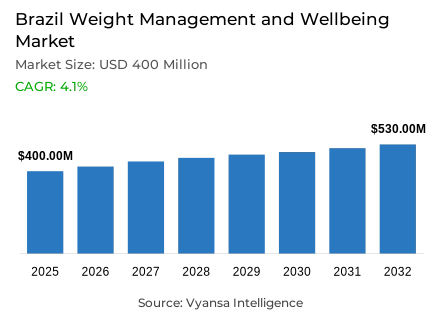
- Weight management and wellbeing market size in Brazil was estimated at USD 400 million in 2025.
- The market size is expected to grow to USD 530 million by 2032.
- Market to register a CAGR of around 4.1% during 2026-32.
- Category Shares
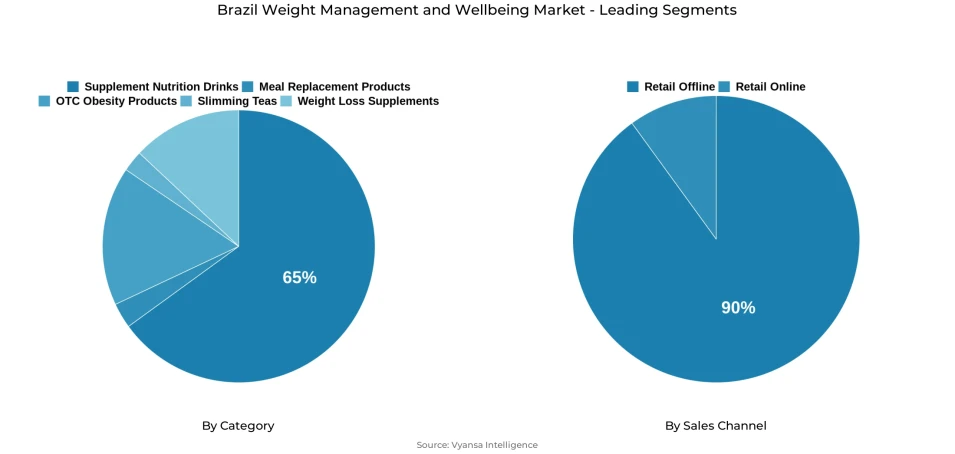
- Supplement nutrition drinks grabbed market share of 65%.
- Competition
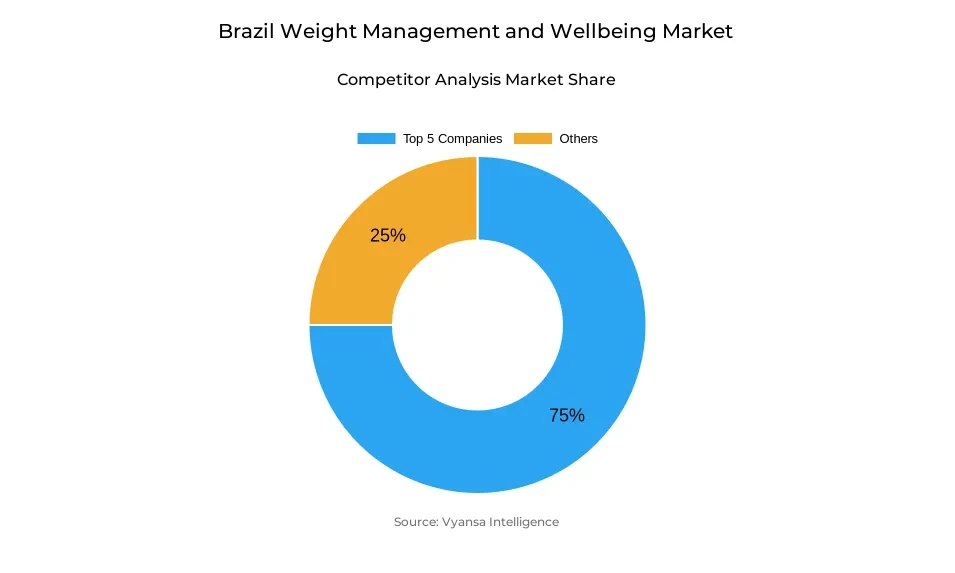
- More than 5 companies are actively engaged in producing weight management and wellbeing in Brazil.
- Top 5 companies acquired around 75% of the market share.
- Herbalife International do Brasil Ltda, Reckitt Benckiser (Brasil) Ltda, Danone Ltda, Abbott Laboratorios do Brasil Ltda, Nestle Brasil Ltda etc., are few of the top companies.
- Sales Channel
- Retail offline grabbed 90% of the market.
Brazil Weight Management and Wellbeing Market Outlook
The Brazil weight management and wellbeing market size was valued at USD 400 million in 2025 and is projected to grow from USD 416 million in 2026 to USD 530 million by 2032, registering a CAGR of around 4.1% during 2026–2032. Growth in 2026 is driven by a sustained metabolic burden. Vigitel reports that 62.6% of adults in state capitals and the Federal District have excess weight and 25.7% live with obesity, alongside 12.9% self-reported diabetes and 29.7% hypertension. These figures keep weight control high on household agendas and sustain routine demand within weight management and wellbeing for practical, daily-use solutions.
A key challenge remains price sensitivity. Brazilian Institute of Geography and Statistics (IBGE) reports the IPCA at 0.33% in January 2026, with 12-month inflation at 4.44%, while IPCA-15 closed 2024 at 4.71% and “refeição” rose 5.72% in 2024. Elevated living costs increase promotion dependency and trading down, putting pressure on premium claims and out-of-pocket purchases.
A major 2026 trend is movement-led weight control. Vigitel shows 42.3% of adults meet leisure-time physical activity thresholds, normalising gym-anchored routines. This shifts product preference toward portable, easy-to-dose formats with credible, science-led claims around satiety and sustained energy.
An important opportunity comes from improving purchasing power. IBGE PNAD Contínua reports real monthly household income per capita at USD 390, with 66.1% of the population earning income. From a segmentation perspective, supplement nutrition drinks hold 65% share, while retail offline accounts for 90%, reflecting preference for complete, food-like formats purchased through trusted physical stores.
Brazil Weight Management and Wellbeing Market Growth Driver
High Burden of Excess Weight Keeps Demand Structural
Latest national surveillance shows excess weight is already the norm. In 2024, 62.6% of adults in state capitals and the Federal District are classified with excess weight, while obesity reaches 25.7%. Vigitel also reports self-reported diabetes at 12.9% and hypertension at 29.7% in 2024, underscoring the wider metabolic burden linked to weight gain.
These realities keep weight control high on household health agendas and on clinical counselling checklists. This makes ongoing solutions feel necessary, not optional. Shoppers look for practical daily aids that fit routine eating and activity patterns, with clear benefits and quick guidance on use. Weight management and wellbeing benefits from this “always-on” need state, where end users seek convenient ways to manage calories, satiety, and nutrition without rigid plans.
Brazil Weight Management and Wellbeing Market Challenge
Cost Pressures Constrain Trial and Repeat
Price sensitivity remains a real brake on discretionary health spending. Consumer inflation stays elevated into 2026: IBGE reports the IPCA at 0.33% in January 2026, with 12-month inflation at 4.44%. When essentials become more expensive, households are quicker to trade down, delay new purchases, or cut “nice-to-have” health items—especially those bought out-of-pocket.
Food-related costs add to the squeeze. In IBGE’s IPCA-15 release for December 2024, the meals consumed away from home ( the subitem “refeição”) ends 2024 up to 5.72%, while the year’s IPCA-15 closes at 4.71%. This backdrop increases promotion dependency and pushes brands toward smaller packs and sharper price points, raising churn risk once introductory discounts end. Weight management and wellbeing premium claims face higher scrutiny, so conversion needs fast, tangible benefits.
Unlock Market Intelligence
Explore the market potential with our data-driven report
Brazil Weight Management and Wellbeing Market Trend
Fitness-First Weight Loss Routines Gain Ground
Behavioural signals increasingly favour movement-led weight control. Vigitel data show 42.3% of adults in state capitals and the Federal District meet the threshold for leisure-time physical activity in 2024 (=150 minutes/week of moderate activity or =75 minutes/week vigorous). This normalises gym-going, structured training, and “active lifestyle” identity as a core path to manage weight.
That shift changes how products are selected and talked about. Weight management and wellbeing increasingly sits alongside routines built around workouts, recovery, and everyday performance so end users prefer formats that are portable, simple to dose, and easy to combine with meals. It also increases demand for credible, science-led claims. Brands that communicate support for energy, satiety, and sustained routines align better with this fitness-anchored mindset and strengthen repeat usage.
Brazil Weight Management and Wellbeing Market Opportunity
Higher Incomes Create Headroom for Premium Wellness Baskets
Household purchasing power is improving from an official data standpoint. IBGE’s PNAD Contínua shows monthly real household income per capita reaches USD 390 in 2024 (a record in the series). In the same year, 66.1% of the resident population have some form of income, widening the base able to pay for non-essential health items.
This creates a clear commercial opening for better, not just cheaper, solutions. Weight management and wellbeing can be positioned as part of a broader self-care budget, especially when brands make benefits measurable (satiety support, nutrient adequacy, and routine adherence). Higher incomes improve willingness to pay for quality and convenience. Ready formats, clear instructions, and credible claims reduce friction in daily use and help sustain repeat behaviour.
Unlock Market Intelligence
Explore the market potential with our data-driven report
Brazil Weight Management and Wellbeing Market Segmentation Analysis
By Category
- Meal Replacement Products
- OTC Obesity Products
- Supplement Nutrition Drinks
- Slimming Teas
- Weight Loss Supplements
The segment has the highest share around supplement nutrition drinks under the product type split, accounting for 65% of category value in 2025. This points to strong preference for “complete” solutions that feel close to food, easy to understand, easy to prepare, and easier to keep using versus pills or strict meal plans.
In practice, this leadership is reinforced by how these drinks fit multiple use occasions. They work as a controlled snack, a light meal bridge, or a nutrition top-up for people managing weight alongside busy schedules. Weight management and wellbeing brands that win here typically focus on taste, convenience, and clear functional benefits like satiety and balanced macros, rather than aggressive “rapid loss” promises.
By Sales Channel
- Retail Offline
- Retail Online
The segment has the highest share around retail offline under the sales channel split, contributing 90% of value in 2025. This reflects how shoppers still prefer buying health and nutrition products through physical stores where they can compare options, get basic guidance, and pick up immediately.
Offline dominance also matches typical replenishment behaviour, many end users buy these products alongside weekly grocery trips or during routine pharmacy visits. That creates an advantage for brands that invest in shelf visibility, point-of-sale education, and in-store promotions that explain usage and expected outcomes. Weight management and wellbeing brands that simplify choice at the shelf like clear benefit ladders and easy-to-read labels, are better positioned to convert first-time buyers and build repeat cycles.
List of Companies Covered in Brazil Weight Management and Wellbeing Market
The companies listed below are highly influential in the Brazil weight management and wellbeing market, with a significant market share and a strong impact on industry developments.
- Herbalife International do Brasil Ltda
- Reckitt Benckiser (Brasil) Ltda
- Danone Ltda
- Abbott Laboratorios do Brasil Ltda
- Nestle Brasil Ltda
- Supley Laboratorio
Competitive Landscape
The competitive landscape in Brazil remains led by Abbott Laboratórios do Brasil Ltda, holding a 23.2% value share, supported by the strong positioning of Ensure and Glucerna within supplement nutrition drinks. Abbott benefits from medical credibility and targeted formulations addressing diabetes management and adult nutrition, reinforcing its leadership in a category where clinical trust influences purchasing decisions. Nestle Brasil Ltda follows with a 15.7% share, overtaking Herbalife to secure second place. Nestle’s Nutren portfolio reflects a life-stage strategy, offering products ranging from infant nutrition to muscle and bone health solutions, enabling broad demographic reach. The company’s emphasis on holistic health positioning strengthens competitiveness amid rising demand for functional nutrition. However, with supplement nutrition drinks averaging BRL176 per kilogram, around 6% of Brazil’s average monthly income (IBGE) the category remains concentrated among higher-income consumers, intensifying rivalry among leading players.
Frequently Asked Questions
Related Report
- Market Segmentation
- Research Scope
- Research Methodology
- Definitions and Assumptions
- Executive Summary
- Brazil Weight Management and Wellbeing Market Policies, Regulations, and Standards
- Brazil Weight Management and Wellbeing Market Dynamics
- Growth Factors
- Challenges
- Trends
- Opportunities
- Brazil Weight Management and Wellbeing Market Statistics, 2022-2032F
- Market Size & Growth Outlook
- By Revenues in USD Million
- Market Segmentation & Growth Outlook
- By Category
- Meal Replacement Products- Market Insights and Forecast 2022-2032, USD Million
- Shakes- Market Insights and Forecast 2022-2032, USD Million
- Bars- Market Insights and Forecast 2022-2032, USD Million
- Ready-to-Drink (RTD) Beverages- Market Insights and Forecast 2022-2032, USD Million
- Powder Mixes- Market Insights and Forecast 2022-2032, USD Million
- OTC Obesity Products- Market Insights and Forecast 2022-2032, USD Million
- Fat Absorption Inhibitors- Market Insights and Forecast 2022-2032, USD Million
- Appetite Suppressants- Market Insights and Forecast 2022-2032, USD Million
- Metabolism Boosters- Market Insights and Forecast 2022-2032, USD Million
- Supplement Nutrition Drinks- Market Insights and Forecast 2022-2032, USD Million
- Slimming Teas- Market Insights and Forecast 2022-2032, USD Million
- Weight Loss Supplements- Market Insights and Forecast 2022-2032, USD Million
- Meal Replacement Products- Market Insights and Forecast 2022-2032, USD Million
- By Application
- Obesity Management- Market Insights and Forecast 2022-2032, USD Million
- Diabetes-Associated Weight Control- Market Insights and Forecast 2022-2032, USD Million
- Cardiovascular Risk Reduction- Market Insights and Forecast 2022-2032, USD Million
- Post-Bariatric Surgery Weight Maintenance- Market Insights and Forecast 2022-2032, USD Million
- General Fitness & Lifestyle Weight Control- Market Insights and Forecast 2022-2032, USD Million
- By End User
- Hospitals- Market Insights and Forecast 2022-2032, USD Million
- Specialty & Bariatric Clinics- Market Insights and Forecast 2022-2032, USD Million
- Weight Loss Centers- Market Insights and Forecast 2022-2032, USD Million
- Homecare/Individual Consumers- Market Insights and Forecast 2022-2032, USD Million
- By Sales Channel
- Retail Offline- Market Insights and Forecast 2022-2032, USD Million
- Pharmacies & Drug Stores- Market Insights and Forecast 2022-2032, USD Million
- Supermarkets/Hypermarkets- Market Insights and Forecast 2022-2032, USD Million
- Specialty Nutrition Stores- Market Insights and Forecast 2022-2032, USD Million
- Retail Online- Market Insights and Forecast 2022-2032, USD Million
- E-commerce Platforms- Market Insights and Forecast 2022-2032, USD Million
- Brand-Owned Websites- Market Insights and Forecast 2022-2032, USD Million
- Retail Offline- Market Insights and Forecast 2022-2032, USD Million
- By Region
- North
- Center-West
- Northeast
- Southeast
- South
- By Competitors
- Competition Characteristics
- Market Share & Analysis
- By Category
- Market Size & Growth Outlook
- Brazil Meal Replacement Products Market Statistics, 2022-2032
- Market Size & Growth Outlook
- By Revenues in USD Million
- Market Segmentation & Growth Outlook
- By Application- Market Insights and Forecast 2022-2032, USD Million
- By End User- Market Insights and Forecast 2022-2032, USD Million
- By Sales Channel- Market Insights and Forecast 2022-2032, USD Million
- By Region- Market Insights and Forecast 2022-2032, USD Million
- Market Size & Growth Outlook
- Brazil OTC Obesity Products Market Statistics, 2022-2032
- Market Size & Growth Outlook
- By Revenues in USD Million
- Market Segmentation & Growth Outlook
- By Application- Market Insights and Forecast 2022-2032, USD Million
- By End User- Market Insights and Forecast 2022-2032, USD Million
- By Sales Channel- Market Insights and Forecast 2022-2032, USD Million
- By Region- Market Insights and Forecast 2022-2032, USD Million
- Market Size & Growth Outlook
- Brazil Supplement Nutrition Drinks Market Statistics, 2022-2032
- Market Size & Growth Outlook
- By Revenues in USD Million
- Market Segmentation & Growth Outlook
- By Application- Market Insights and Forecast 2022-2032, USD Million
- By End User- Market Insights and Forecast 2022-2032, USD Million
- By Sales Channel- Market Insights and Forecast 2022-2032, USD Million
- By Region- Market Insights and Forecast 2022-2032, USD Million
- Market Size & Growth Outlook
- Brazil Slimming Teas Market Statistics, 2022-2032
- Market Size & Growth Outlook
- By Revenues in USD Million
- Market Segmentation & Growth Outlook
- By Application- Market Insights and Forecast 2022-2032, USD Million
- By End User- Market Insights and Forecast 2022-2032, USD Million
- By Sales Channel- Market Insights and Forecast 2022-2032, USD Million
- By Region- Market Insights and Forecast 2022-2032, USD Million
- Market Size & Growth Outlook
- Brazil Weight Loss Supplements Market Statistics, 2022-2032
- Market Size & Growth Outlook
- By Revenues in USD Million
- Market Segmentation & Growth Outlook
- By Application- Market Insights and Forecast 2022-2032, USD Million
- By End User- Market Insights and Forecast 2022-2032, USD Million
- By Sales Channel- Market Insights and Forecast 2022-2032, USD Million
- By Region- Market Insights and Forecast 2022-2032, USD Million
- Market Size & Growth Outlook
- Competitive Outlook
- Company Profiles
- Nestle Brasil Ltda
- Business Description
- Product Portfolio
- Collaborations & Alliances
- Recent Developments
- Financial Details
- Others
- Herbalife International Do Brasil Ltda
- Business Description
- Product Portfolio
- Collaborations & Alliances
- Recent Developments
- Financial Details
- Others
- Reckitt Benckiser (Brasil) Ltda
- Business Description
- Product Portfolio
- Collaborations & Alliances
- Recent Developments
- Financial Details
- Others
- Danone Ltda
- Business Description
- Product Portfolio
- Collaborations & Alliances
- Recent Developments
- Financial Details
- Others
- Supley Laboratorio de Alimentos & Suplementos Nutricionais Ltda
- Business Description
- Product Portfolio
- Collaborations & Alliances
- Recent Developments
- Financial Details
- Others
- Cimed Industria de Medicamentos Ltda
- Business Description
- Product Portfolio
- Collaborations & Alliances
- Recent Developments
- Financial Details
- Others
- ADS Laboratorio Nutricional Ltda
- Business Description
- Product Portfolio
- Collaborations & Alliances
- Recent Developments
- Financial Details
- Others
- Omnilife Brasil Comercio de Produtos Nutricionais Ltda
- Business Description
- Product Portfolio
- Collaborations & Alliances
- Recent Developments
- Financial Details
- Others
- Integralmedica Suplementos Nutricionais Ltda
- Business Description
- Product Portfolio
- Collaborations & Alliances
- Recent Developments
- Financial Details
- Others
- Sanavita Industria e Comercio de Alimentos Funcionais Ltda
- Business Description
- Product Portfolio
- Collaborations & Alliances
- Recent Developments
- Financial Details
- Others
- Nestle Brasil Ltda
- Company Profiles
- Disclaimer
| Segment | Sub-Segment |
|---|---|
| By Category |
|
| By Application |
|
| By End User |
|
| By Sales Channel |
|
| By Region |
|
Research Methodology
This study followed a structured approach comprising four key phases to assess the size and scope of the electro-oxidation market. The process began with thorough secondary research to collect data on the target market, related markets, and broader industry context. These findings, along with preliminary assumptions and estimates, were then validated through extensive primary research involving industry experts from across the value chain. To calculate the overall market size, both top-down and bottom-up methodologies were employed. Finally, market segmentation and data triangulation techniques were applied to refine and validate segment-level estimations.
Secondary Research
The secondary research phase involved gathering data from a wide range of credible and published sources. This step helped in identifying industry trends, defining market segmentation, and understanding the market landscape and value chain.
Sources consulted during this phase included:
- Company annual reports, investor presentations, and press releases
- Industry white papers and certified publications
- Trade directories and market-recognized databases
- Articles from authoritative authors and reputable journals
- Gold and silver standard websites
Secondary research was critical in mapping out the industry's value chain and monetary flow, identifying key market segments, understanding regional variations, and tracking significant industry developments.
Other key sources:
- Financial disclosures
- Industry associations and trade bodies
- News outlets and business magazines
- Academic journals and research studies
- Paid industry databases
Primary Research
To validate secondary data and gain deeper market insights, primary research was conducted with key stakeholders across both the supply and demand sides of the market.
On the demand side, participants included decision-makers and influencers from end-user industries—such as CIOs, CTOs, and CSOs—who provided first-hand perspectives on market needs, product usage, and future expectations.
On the supply side, interviews were conducted with manufacturers, industry associations, and institutional participants to gather insights into current offerings, product pipelines, and market challenges.
Primary interviews provided critical inputs such as:
- Market size and revenue data
- Product and service breakdowns
- Market forecasts
- Regional and application-specific trends
Stakeholders consulted included:
- Leading OEM and solution providers
- Channel and distribution partners
- End users across various applications
- Independent consultants and industry specialists
Market Size Estimation and Data Triangulation
- Identifying Key Market Participants (Secondary Research)
- Goal: To identify the major players or companies in the target market. This typically involves using publicly available data sources such as industry reports, market research publications, and financial statements of companies.
- Tools: Reports from firms like Gartner, Forrester, Euromonitor, Statista, IBISWorld, and others. Public financial statements, news articles, and press releases from top market players.
- Extracting Earnings of Key Market Participants
- Goal: To estimate the earnings generated from the product or service being analyzed. This step helps in understanding the revenue potential of each market player in a specific geography.
- Methods: Earnings data can be gathered from:
- Publicly available financial reports (for listed companies).
- Interviews and primary data sources from professionals, such as Directors, VPs, SVPs, etc. This is especially useful for understanding more nuanced, internal data that isn't publicly disclosed.
- Annual reports and investor presentations of key players.
- Data Collation and Development of a Relevant Data Model
- Goal: To collate inputs from both primary and secondary sources into a structured, data-driven model for market estimation. This model will incorporate key market KPIs and any independent variables relevant to the market.
- Key KPIs: These could include:
- Market size, growth rate, and demand drivers.
- Industry-specific metrics like market share, average revenue per customer (ARPC), or average deal size.
- External variables, such as economic growth rates, inflation rates, or commodity prices, that could affect the market.
- Data Modeling: Based on this data, the market forecasts are developed for the next 5 years. A combination of trend analysis, scenario modeling, and statistical regression might be used to generate projections.
- Scenario Analysis
- Goal: To test different assumptions and validate how sensitive the market is to changes in key variables (e.g., market demand, regulatory changes, technological disruptions).
- Types of Scenarios:
- Base Case: Based on current assumptions and historical data.
- Best-Case Scenario: Assuming favorable market conditions, regulatory environments, and technological advancements.
- Worst-Case Scenario: Accounting for adverse factors, such as economic downturns, stricter regulations, or unexpected disruptions.












