Brazil Sleep Aids Market Report: Trends, Growth and Forecast (2026-2032)
By Product (Single Ingredient (Doxylamine Succinate, Diphenhydramine, Melatonin), Combination Ingredient (Diphenhydramine + Acetaminophen, Other Antihistamine-Based Combinations), Herbal & Traditional Sleep Aids (Valerian root, Passionflower, Chamomile, Kava, Multi-Herbal Sleep Blends)), By Sleep Disorder (Insomnia, Sleep Apnea, Restless Legs Syndrome, Narcolepsy, Sleep Walking, Others), By Age Group (Young to Mid Adults (25-44 Years), Middle-Aged Adults (45-64 Years), Geriatric Population (65+ Years)), By Sales Channel (Retail Online, Retail Offline), By End User (Homecare/Individual Consumers, Hospitals, Sleep Centers & Clinics), By Formulation (Tablets, Gummies, Capsules, Liquid, Sublingual), By Region (North, Center-West, Northeast, Southeast, South) ... Read more
|
Major Players
|
Brazil Sleep Aids Market Statistics and Insights, 2026
- Market Size Statistics
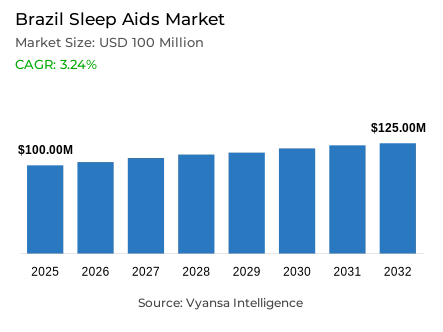
- Sleep aids market size in Brazil was estimated at USD 100 million in 2025.
- The market size is expected to grow to USD 125 million by 2032.
- Market to register a CAGR of around 3.24% during 2026-32.
- Product Shares
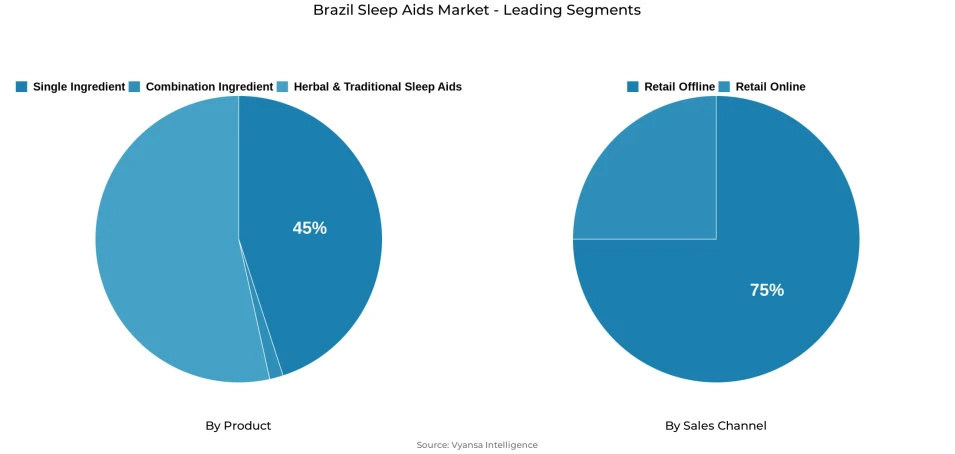
- Single ingredient grabbed market share of 45%.
- Competition
- More than 10 companies are actively engaged in producing sleep aids in Brazil.
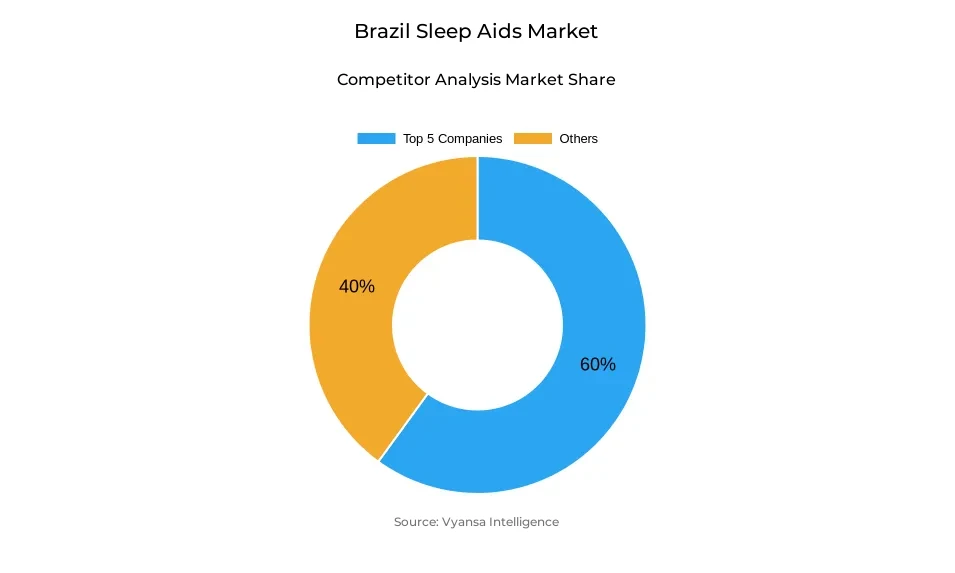
- Top 5 companies acquired around 60% of the market share.
- Aché Laboratórios Farmacêuticos SA, Biolab Sanus Farmacêutica Ltda, Sanofi-Aventis Farmacêutica Ltda, Natulab Laboratório SA, Marjan Indústria e Comércio Ltda etc., are few of the top companies.
- Sales channel
- Retail offline grabbed 75% of the market.
Brazil Sleep Aids Market Outlook
The Brazil sleep-aids market is at a stage of healthy, stable growth as the contemporary lifestyles keep pushing the need to rest. The market is estimated to be worth USD 100 million in 2025, and it is expected to grow to USD 125 million in 2032 with a CAGR of about 3.24% between 2026 and 2032. The main cause of this growth is the so-called vicious cycle of urban life, where long working hours, traffic jams, and constant screen-based stimulation interfere with natural melatonin synthesis and increase stress levels.
One of the trends in the market is the polarization of end user preferences. Most Brazilians are inclined to either strong prescription drugs or natural and herbal products like Weleda. Although the Zolpidem fever has caused more stringent Anvisa regulations, the non-prescription alternatives are still in demand. Melatonin remains a major force as it has been since its approval in 2021, but its expansion might plateau as end users learn more about its inefficacy at low doses and its long-term side effects.
There is also a trend in the industry towards holistic wellbeing and high technology. People are also using wearable gadgets such as smartwatches to track sleep patterns and heart rates, thus taking back their health. Moreover, the market is growing not only in terms of the traditional pills but also in terms of sleep-inducing teas, special mattresses, and new delivery options like sleep patches, which deliver active ingredients continuously to ensure uninterrupted sleep.
The sleep-aids market is strong, despite the competition of the beauty and personal-care industries, where other brands like Natura and O Boticario also have their relaxation lines. With sleep emerging as a more valued health pillar in Brazil, the market will have a more educated end user base that will be seeking a balance between pharmacological effectiveness and natural wellness.
Brazil Sleep Aids Market Growth Driver
Urban Lifestyle Disruption Amplifying Demand for Sleep Restoration Solutions
The hectic schedules and the constant screen time are forcing more and more Brazilians to turn to sleep support, which increases the demand of sleep aids. The scale of this intent is reflected in digital behaviour: a Timelens analysis, based on Google Trends and Google Ads, found more than 17.5 million Google searches of melatonin in 2024, and suggested that the number of searches has increased six-fold since Anvisa approved melatonin as a supplement.
The same study notes that the problem is actively discussed online, and over the last five years, there were over 20.8 million social-media mentions of fatigue or exhaustion and 11.6 million mentions of sleep problems. This consistent stream of search and discussion is an indication that sleep-support products will still be relevant in 2026, as people strive to replenish sleep in their hectic lives.
Brazil Sleep Aids Market Challenge
Stricter Zolpidem Controls Increasing Access Friction and Compliance Burden
The swift transition to prescription solutions creates a barrier to the expansion of categories and requires changes in compliance throughout the sleep ecosystem. In 2024, Anvisa amended the control regulations of zolpidem after a sharp increase in irregular and abusive use, removing the threshold that previously allowed products with up to 10 mg per unit to take a less restrictive route.
Since 1 August 2024, Anvisa has made it mandatory that all medicines containing zolpidem, regardless of dosage, be prescribed using the blue Notificação de Receita⁻, which requires registration of the prescriber with local health-surveillance authorities. This augmented regime raises the friction of access and operational burdens on pharmacies and brands, and at the same time, end user migration to non-prescription and natural sleep options.
Unlock Market Intelligence
Explore the market potential with our data-driven report
Brazil Sleep Aids Market Trend
Digital Search Momentum Accelerating Shift Toward Holistic Sleep Ecosystems
The end user behaviour shows a definite shift towards researching sleep remedies both pharmaceutical and lifestyle. According to a Timelens analysis of Google Trends and Google Ads, searches of remedios para dormir have surpassed 29 million in the last five years, and searches of remedios para dormir que não precisam de receita have increased 1450 percent in the last five years. This search intensity leaks into other related categories, not just over-the-counter products.
Beauty and personal-care brands create pre-sleep relaxation lines with chamomile and lavender, and influencers introduce sleep-related products. As a result, sleep support is a cross-industry space in 2026, where end users consider supplements, prescriptions, teas, mattresses, and relaxation products as a single wellbeing habit.
Brazil Sleep Aids Market Opportunity
Wearable Integration and Novel Delivery Formats Enabling Next-Gen Sleep Support
End users are more and more proactive in managing their sleep quality, which opens the opportunities of tools and products that monitor the patterns and provide long-term benefits. The increased popularity of wearables like rings and smartwatches that track sleep stages, heart rate, and even blood-oxygen levels, which allow making more informed choices about sleep habits. Innovation in products also shifts towards formats that overcome perceived efficacy constraints and convenience.
Anvisa authorizes melatonin as an adult supplement in a dose of 0.21 mg/day, and Brazilian Ministry of Health restates the same limit on supplementary use. Sleep patches therefore become a viable option, delivering actives over the night and being attractive to end users who like non-oral, slow-acting products.
Unlock Market Intelligence
Explore the market potential with our data-driven report
Brazil Sleep Aids Market Segmentation Analysis
By Product
- Single Ingredient
- Doxylamine Succinate
- Diphenhydramine
- Melatonin
- Combination Ingredient
- Diphenhydramine + Acetaminophen
- Other Antihistamine-Based Combinations
- Herbal & Traditional Sleep Aids
- Valerian root
- Passionflower
- Chamomile
- Kava
- Multi-Herbal Sleep Blends
The market is characterized by a strong tendency to simplicity and certain functional advantages, with the single-ingredient segment taking the biggest portion, 45% of the market. This popularity is mostly fueled by the fact that melatonin and magnesium inositol are extremely popular among end users who want to correct certain deficiencies or induce natural sleep mechanisms without the multi-drug complexes.
The strength of this segment is indicative of a larger trend of informed consumption in Brazil. Although multi-benefit supplements are changing, most users are inclined to the clarity of one active ingredient. However, the market is evolving with brands launching new forms like sleep patches and high-quality herbal products. This guarantees that even though single-ingredient products dominate, the range of available natural and pharmacological options remains to serve a highly polarised end user base.
By Sales Channel
- Retail Online
- Retail Offline
The retail offline segment has the largest share in the sales-channel category with 75% of the market. Although retail online is rapidly developing, and digital influencers are starting their own sleep-health brands, the overwhelming majority of Brazilians continue to buy their sleep aids in physical pharmacies and drugstores. This choice is probably explained by the urgent necessity to relieve and the possibility to discuss dosages and prescriptions with pharmacists.
Although retail offlineis still the leading player, the environment is changing with the introduction of digital platforms as a necessity in research. The online marketplace serves as a significant funnel to the retail market with more than 17.5 million search results on melatonin and a booming demand in the non-prescription market. However, the brick-and-mortar pharmacy is the main point of sale, and it offers the convenience and reliability that Brazilian customers value when it comes to taking care of their sleep health.
List of Companies Covered in Brazil Sleep Aids Market
The companies listed below are highly influential in the Brazil sleep aids market, with a significant market share and a strong impact on industry developments.
- Aché Laboratórios Farmacêuticos SA
- Biolab Sanus Farmacêutica Ltda
- Sanofi-Aventis Farmacêutica Ltda
- Natulab Laboratório SA
- Marjan Indústria e Comércio Ltda
- Hypera SA
- Procter & Gamble do Brasil SA
- Kley Hertz SA Indústria e Comércio
- Genomma Laboratories do Brasil Ltda
Competitive Landscape
Brazil’s sleep aids market is led by established OTC brands such as Vicks (PureZzzs) and Seakalm, benefiting from melatonin’s post-2021 approval, while facing polarised competition from prescription zolpidem, whose reclassification by Anvisa reflects surging demand, and from natural players like Weleda positioned around organic, holistic sleep solutions. Beauty brands such as Natura and O Boticário and influencer-led offerings (eg, Relax Soon) act as indirect competitors by capturing mild insomnia cases through pre-sleep relaxation lines. Vitamins and dietary supplements with magnesium or herbal blends further fragment demand. Key growth opportunities lie in differentiated delivery systems (eg, sustained-release sleep patches), clinically substantiated low-dose melatonin alternatives, and tech-integrated sleep ecosystems leveraging wearables, while addressing efficacy concerns and consumer ambivalence toward data privacy.
Frequently Asked Questions
Related Report
1. Market Segmentation
1.1. Research Scope
1.2. Research Methodology
1.3. Definitions and Assumptions
2. Executive Summary
3. Brazil Sleep Aids Market Policies, Regulations, and Standards
4. Brazil Sleep Aids Market Dynamics
4.1. Growth Factors
4.2. Challenges
4.3. Trends
4.4. Opportunities
5. Brazil Sleep Aids Market Statistics, 2022-2032F
5.1. Market Size & Growth Outlook
5.1.1.By Revenues in USD Million
5.2. Market Segmentation & Growth Outlook
5.2.1.By Product
5.2.1.1. Single Ingredient- Market Insights and Forecast 2022-2032, USD Million
5.2.1.1.1. Doxylamine Succinate- Market Insights and Forecast 2022-2032, USD Million
5.2.1.1.2. Diphenhydramine- Market Insights and Forecast 2022-2032, USD Million
5.2.1.1.3. Melatonin- Market Insights and Forecast 2022-2032, USD Million
5.2.1.2. Combination Ingredient- Market Insights and Forecast 2022-2032, USD Million
5.2.1.2.1. Diphenhydramine + Acetaminophen- Market Insights and Forecast 2022-2032, USD Million
5.2.1.2.2. Other Antihistamine-Based Combinations- Market Insights and Forecast 2022-2032, USD Million
5.2.1.3. Herbal & Traditional Sleep Aids- Market Insights and Forecast 2022-2032, USD Million
5.2.1.3.1. Valerian root- Market Insights and Forecast 2022-2032, USD Million
5.2.1.3.2. Passionflower- Market Insights and Forecast 2022-2032, USD Million
5.2.1.3.3. Chamomile- Market Insights and Forecast 2022-2032, USD Million
5.2.1.3.4. Kava- Market Insights and Forecast 2022-2032, USD Million
5.2.1.3.5. Multi-Herbal Sleep Blends- Market Insights and Forecast 2022-2032, USD Million
5.2.2.By Sleep Disorder
5.2.2.1. Insomnia- Market Insights and Forecast 2022-2032, USD Million
5.2.2.2. Sleep Apnea- Market Insights and Forecast 2022-2032, USD Million
5.2.2.3. Restless Legs Syndrome- Market Insights and Forecast 2022-2032, USD Million
5.2.2.4. Narcolepsy- Market Insights and Forecast 2022-2032, USD Million
5.2.2.5. Sleep Walking- Market Insights and Forecast 2022-2032, USD Million
5.2.2.6. Others- Market Insights and Forecast 2022-2032, USD Million
5.2.3.By Age Group
5.2.3.1. Young to Mid Adults (25-44 Years)- Market Insights and Forecast 2022-2032, USD Million
5.2.3.2. Middle-Aged Adults (45-64 Years)- Market Insights and Forecast 2022-2032, USD Million
5.2.3.3. Geriatric Population (65+ Years)- Market Insights and Forecast 2022-2032, USD Million
5.2.4.By Sales Channel
5.2.4.1. Retail Online- Market Insights and Forecast 2022-2032, USD Million
5.2.4.2. Retail Offline- Market Insights and Forecast 2022-2032, USD Million
5.2.5.By End User
5.2.5.1. Homecare/Individual Consumers- Market Insights and Forecast 2022-2032, USD Million
5.2.5.2. Hospitals- Market Insights and Forecast 2022-2032, USD Million
5.2.5.3. Sleep Centers & Clinics- Market Insights and Forecast 2022-2032, USD Million
5.2.6.By Formulation
5.2.6.1. Tablets- Market Insights and Forecast 2022-2032, USD Million
5.2.6.2. Gummies- Market Insights and Forecast 2022-2032, USD Million
5.2.6.3. Capsules- Market Insights and Forecast 2022-2032, USD Million
5.2.6.4. Liquid- Market Insights and Forecast 2022-2032, USD Million
5.2.6.5. Sublingual- Market Insights and Forecast 2022-2032, USD Million
5.2.7.By Region
5.2.7.1. North
5.2.7.2. Center-West
5.2.7.3. Northeast
5.2.7.4. Southeast
5.2.7.5. South
5.2.8.By Competitors
5.2.8.1. Competition Characteristics
5.2.8.2. Market Share & Analysis
6. Brazil Single Ingredient Sleep Aids Market Statistics, 2022-2032
6.1. Market Size & Growth Outlook
6.1.1.By Revenues in USD Million
6.2. Market Segmentation & Growth Outlook
6.2.1.By Sleep Disorder- Market Insights and Forecast 2022-2032, USD Million
6.2.2.By Age Group- Market Insights and Forecast 2022-2032, USD Million
6.2.3.By Sales Channel- Market Insights and Forecast 2022-2032, USD Million
6.2.4.By End User- Market Insights and Forecast 2022-2032, USD Million
6.2.5.By Formulation- Market Insights and Forecast 2022-2032, USD Million
6.2.6.By Region- Market Insights and Forecast 2022-2032, USD Million
7. Brazil Combination Ingredient Sleep Aids Market Statistics, 2022-2032
7.1. Market Size & Growth Outlook
7.1.1.By Revenues in USD Million
7.2. Market Segmentation & Growth Outlook
7.2.1.By Sleep Disorder- Market Insights and Forecast 2022-2032, USD Million
7.2.2.By Age Group- Market Insights and Forecast 2022-2032, USD Million
7.2.3.By Sales Channel- Market Insights and Forecast 2022-2032, USD Million
7.2.4.By End User- Market Insights and Forecast 2022-2032, USD Million
7.2.5.By Formulation- Market Insights and Forecast 2022-2032, USD Million
7.2.6.By Region- Market Insights and Forecast 2022-2032, USD Million
8. Brazil Herbal & Traditional Sleep Aids Market Statistics, 2022-2032
8.1. Market Size & Growth Outlook
8.1.1.By Revenues in USD Million
8.2. Market Segmentation & Growth Outlook
8.2.1.By Sleep Disorder- Market Insights and Forecast 2022-2032, USD Million
8.2.2.By Age Group- Market Insights and Forecast 2022-2032, USD Million
8.2.3.By Sales Channel- Market Insights and Forecast 2022-2032, USD Million
8.2.4.By End User- Market Insights and Forecast 2022-2032, USD Million
8.2.5.By Formulation- Market Insights and Forecast 2022-2032, USD Million
8.2.6.By Region- Market Insights and Forecast 2022-2032, USD Million
9. Competitive Outlook
9.1. Company Profiles
9.1.1.Natulab Laboratório SA
9.1.1.1. Business Description
9.1.1.2. Product Portfolio
9.1.1.3. Collaborations & Alliances
9.1.1.4. Recent Developments
9.1.1.5. Financial Details
9.1.1.6. Others
9.1.2.Marjan Indústria e Comércio Ltda
9.1.2.1. Business Description
9.1.2.2. Product Portfolio
9.1.2.3. Collaborations & Alliances
9.1.2.4. Recent Developments
9.1.2.5. Financial Details
9.1.2.6. Others
9.1.3.Hypera SA
9.1.3.1. Business Description
9.1.3.2. Product Portfolio
9.1.3.3. Collaborations & Alliances
9.1.3.4. Recent Developments
9.1.3.5. Financial Details
9.1.3.6. Others
9.1.4.Procter & Gamble do Brasil SA
9.1.4.1. Business Description
9.1.4.2. Product Portfolio
9.1.4.3. Collaborations & Alliances
9.1.4.4. Recent Developments
9.1.4.5. Financial Details
9.1.4.6. Others
9.1.5.Kley Hertz SA Indústria e Comércio
9.1.5.1. Business Description
9.1.5.2. Product Portfolio
9.1.5.3. Collaborations & Alliances
9.1.5.4. Recent Developments
9.1.5.5. Financial Details
9.1.5.6. Others
9.1.6.Aché Laboratórios Farmacêuticos SA
9.1.6.1. Business Description
9.1.6.2. Product Portfolio
9.1.6.3. Collaborations & Alliances
9.1.6.4. Recent Developments
9.1.6.5. Financial Details
9.1.6.6. Others
9.1.7.Biolab Sanus Farmacêutica Ltda
9.1.7.1. Business Description
9.1.7.2. Product Portfolio
9.1.7.3. Collaborations & Alliances
9.1.7.4. Recent Developments
9.1.7.5. Financial Details
9.1.7.6. Others
9.1.8.Sanofi-Aventis Farmacêutica Ltda
9.1.8.1. Business Description
9.1.8.2. Product Portfolio
9.1.8.3. Collaborations & Alliances
9.1.8.4. Recent Developments
9.1.8.5. Financial Details
9.1.8.6. Others
9.1.9.Genomma Laboratories do Brasil Ltda
9.1.9.1. Business Description
9.1.9.2. Product Portfolio
9.1.9.3. Collaborations & Alliances
9.1.9.4. Recent Developments
9.1.9.5. Financial Details
9.1.9.6. Others
9.1.10. Hypermarcas SA
9.1.10.1. Business Description
9.1.10.2. Product Portfolio
9.1.10.3. Collaborations & Alliances
9.1.10.4. Recent Developments
9.1.10.5. Financial Details
9.1.10.6. Others
10. Disclaimer
| Segment | Sub-Segment |
|---|---|
| By Product |
|
| By Sleep Disorder |
|
| By Age Group |
|
| By Sales Channel |
|
| By End User |
|
| By Formulation |
|
| By Region |
|
Research Methodology
This study followed a structured approach comprising four key phases to assess the size and scope of the electro-oxidation market. The process began with thorough secondary research to collect data on the target market, related markets, and broader industry context. These findings, along with preliminary assumptions and estimates, were then validated through extensive primary research involving industry experts from across the value chain. To calculate the overall market size, both top-down and bottom-up methodologies were employed. Finally, market segmentation and data triangulation techniques were applied to refine and validate segment-level estimations.
Secondary Research
The secondary research phase involved gathering data from a wide range of credible and published sources. This step helped in identifying industry trends, defining market segmentation, and understanding the market landscape and value chain.
Sources consulted during this phase included:
- Company annual reports, investor presentations, and press releases
- Industry white papers and certified publications
- Trade directories and market-recognized databases
- Articles from authoritative authors and reputable journals
- Gold and silver standard websites
Secondary research was critical in mapping out the industry's value chain and monetary flow, identifying key market segments, understanding regional variations, and tracking significant industry developments.
Other key sources:
- Financial disclosures
- Industry associations and trade bodies
- News outlets and business magazines
- Academic journals and research studies
- Paid industry databases
Primary Research
To validate secondary data and gain deeper market insights, primary research was conducted with key stakeholders across both the supply and demand sides of the market.
On the demand side, participants included decision-makers and influencers from end-user industries—such as CIOs, CTOs, and CSOs—who provided first-hand perspectives on market needs, product usage, and future expectations.
On the supply side, interviews were conducted with manufacturers, industry associations, and institutional participants to gather insights into current offerings, product pipelines, and market challenges.
Primary interviews provided critical inputs such as:
- Market size and revenue data
- Product and service breakdowns
- Market forecasts
- Regional and application-specific trends
Stakeholders consulted included:
- Leading OEM and solution providers
- Channel and distribution partners
- End users across various applications
- Independent consultants and industry specialists
Market Size Estimation and Data Triangulation
- Identifying Key Market Participants (Secondary Research)
- Goal: To identify the major players or companies in the target market. This typically involves using publicly available data sources such as industry reports, market research publications, and financial statements of companies.
- Tools: Reports from firms like Gartner, Forrester, Euromonitor, Statista, IBISWorld, and others. Public financial statements, news articles, and press releases from top market players.
- Extracting Earnings of Key Market Participants
- Goal: To estimate the earnings generated from the product or service being analyzed. This step helps in understanding the revenue potential of each market player in a specific geography.
- Methods: Earnings data can be gathered from:
- Publicly available financial reports (for listed companies).
- Interviews and primary data sources from professionals, such as Directors, VPs, SVPs, etc. This is especially useful for understanding more nuanced, internal data that isn't publicly disclosed.
- Annual reports and investor presentations of key players.
- Data Collation and Development of a Relevant Data Model
- Goal: To collate inputs from both primary and secondary sources into a structured, data-driven model for market estimation. This model will incorporate key market KPIs and any independent variables relevant to the market.
- Key KPIs: These could include:
- Market size, growth rate, and demand drivers.
- Industry-specific metrics like market share, average revenue per customer (ARPC), or average deal size.
- External variables, such as economic growth rates, inflation rates, or commodity prices, that could affect the market.
- Data Modeling: Based on this data, the market forecasts are developed for the next 5 years. A combination of trend analysis, scenario modeling, and statistical regression might be used to generate projections.
- Scenario Analysis
- Goal: To test different assumptions and validate how sensitive the market is to changes in key variables (e.g., market demand, regulatory changes, technological disruptions).
- Types of Scenarios:
- Base Case: Based on current assumptions and historical data.
- Best-Case Scenario: Assuming favorable market conditions, regulatory environments, and technological advancements.
- Worst-Case Scenario: Accounting for adverse factors, such as economic downturns, stricter regulations, or unexpected disruptions.












