Brazil Paediatric Consumer Health Market Report: Trends, Growth and Forecast (2026-2032)
By Product Type (Paediatric Analgesics (Paediatric Acetaminophen, Paediatric Aspirin, Paediatric Combination Products Analgesics, Paediatric Dipyrone, Paediatric Ibuprofen, Paediatric Naproxen), Paediatric Cough, Cold and Allergy Remedies (Paediatric Allergy Remedies, Paediatric Cough/Cold Remedies), Paediatric Digestive Remedies (Paediatric Diarrhoeal Remedies, Paediatric Indigestion and Heartburn Remedies, Paediatric Laxatives, Paediatric Motion Sickness Remedies), Paediatric Dermatologicals, Nappy (Diaper) Rash Treatments, Paediatric Vitamins and Dietary Supplements), By Dosage Form (Liquid Syrups, Chewable Tablets, Drops, Powders/Sachets, Gummies, Topical Creams & Ointments), By Age Group (Infants & Toddlers (0-3 Years), Children (4-12 Years), Adolescents (13-18 Years)), By Treatment Type (Acute Treatment, Chronic Condition Management, Genetic & Rare Disease Management), By Sales Channel (Retail Online (Online Pharmacies, E-commerce Platforms, Brand Websites), Retail Offline (Hospital Pharmacies, Retail Pharmacies / Drugstores, Supermarkets & Hypermarkets, Specialty Baby Stores)), By Region (North, Center-West, Northeast, Southeast, South) ... Read more
|
Major Players
|
Brazil Paediatric Consumer Health Market Statistics and Insights, 2026
- Market Size Statistics
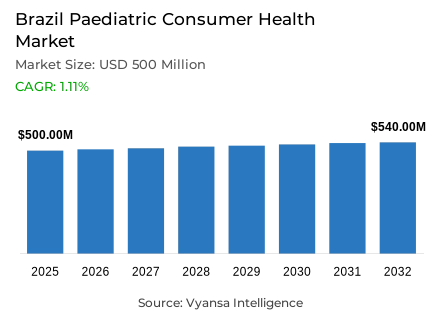
- Paediatric consumer health market size in Brazil was valued at USD 500 million in 2025 and is estimated at USD 510.46 million in 2026.
- The market size is expected to grow to USD 540 million by 2032.
- Market to register a CAGR of around 1.11% during 2026-32.
- Product Type Shares
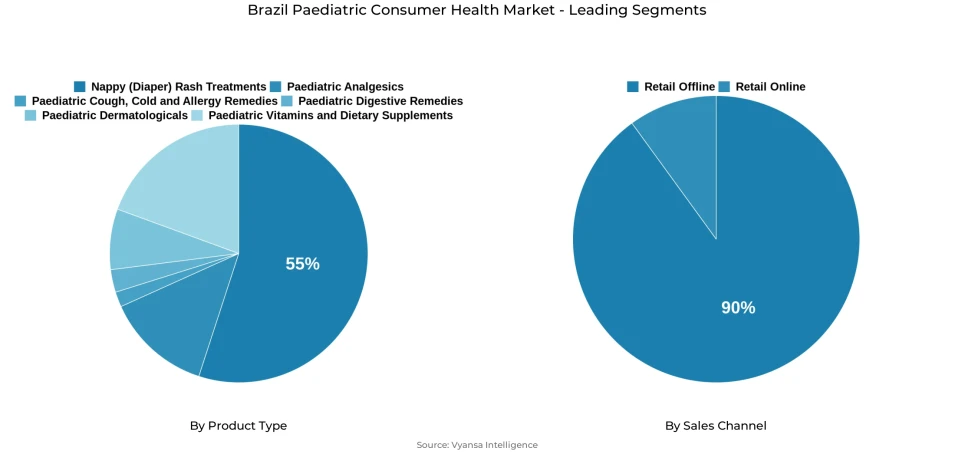
- Nappy rash treatments grabbed market share of 55%.
- Competition
- More than 20 companies are actively engaged in producing paediatric consumer health in Brazil.
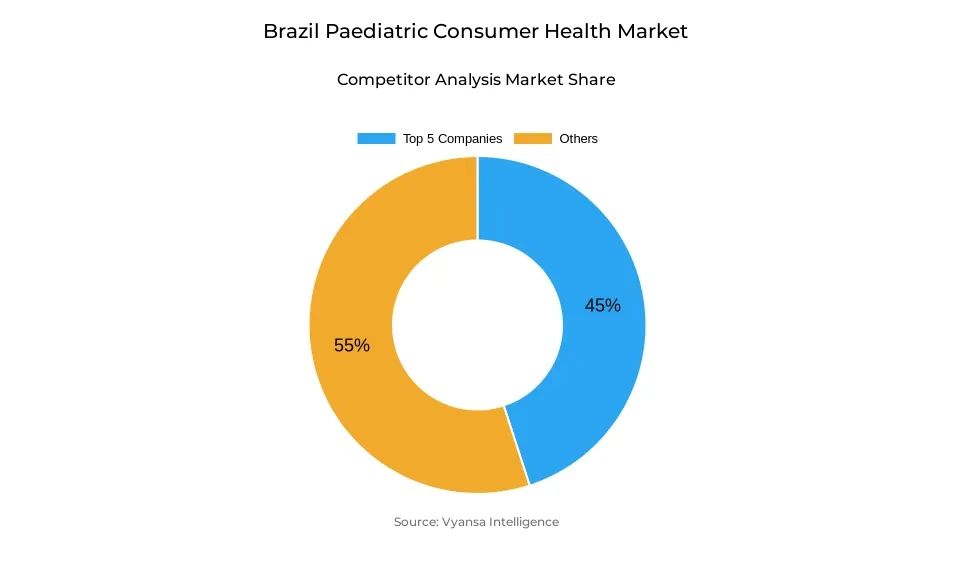
- Top 5 companies acquired around 45% of the market share.
- Janssen-Cilag Farmaceutica Ltda, Reckitt Benckiser (Brasil) Ltda, EMS SA, Johnson & Johnson do Brasil Indústria e Comércio de Produtos para Saúde Ltda, Bayer Brazil SA etc., are few of the top companies.
- Sales Channel
- Retail offline grabbed 90% of the market.
Brazil Paediatric Consumer Health Market Outlook
The Brazil Paediatric Consumer Health Market size was valued at USD 500 million in 2025 and is projected to grow from USD 510.46 million in 2026 to USD 540 million by 2032, exhibiting a CAGR of 1.11 % during the forecast period. This gradual increase is becoming more and more dependent on climate-related health shocks, including heavy rainfall and floods, which have changed end-user demand to digestive solutions to waterborne diseases. Although analgesics like dipyrone continue to play a crucial role in the management of arboviruses such as dengue, the emerging environment is characterized by these changing environmental issues.
The category is being redefined by innovation in natural and preventive solutions, especially in new forms like vitamin sprays and probiotic powders. In this changing landscape, nappy-rash treatments are holding firm, with established brands gaining access to older age groups with mild skin conditions. The increased popularity of paediatric end-user health products is also backed by the emergence of pharmacy own-label, which provides cheaper but quality substitutes to the conventional market leaders.
The distribution is still very much location-based and the retail offline channels have continued to dominate. Brazilian parents are more concerned with safety and brand recognition, and they tend to prefer personal touch and professional advice in physical pharmacies. Although retail online is taking off with loyalty applications and home-delivery convenience, most end-users continue to buy their paediatric end-user health necessities in the traditional retail outlets and direct-selling paradigms.
In the future, the category will have to deal with major demographic changes that will be marked by the reduction of fertility rates and the decrease in the number of children. Nevertheless, the digital-lifestyle changes, including more screen time, create new opportunities, including the need to have products that target eye health and sleep support. Combining educational information with convenient buying plans, the companies are able to retain the good relations with parents who want to find holistic and science-based solutions to their families.
Brazil Paediatric Consumer Health Market Growth DriverHealth Emergencies Caused by Climate Shift Treatment Priority.
Extreme weather events associated with climate are becoming more and more important in determining the paediatric healthcare requirements in Brazil. The AprilMay 2024 floods in Rio Grande do Sul impacted 2,398,255 people in 478 municipalities and caused 183 deaths, with 500mm of rainfall in the Guaiba basin in five days and Lake Guaiba reaching 5.35m. These incidents have a devastating impact on sanitation infrastructure and spread of infectious diseases, which generate immediate public-health issues that require responsive treatment and preventive healthcare responses.
Sanitation disruptions caused by floods pose a great risk of diarrhoea and waterborne diseases, which are usually linked to poor water and hygiene conditions during disasters. This climate increases the need of paediatric digestive and rehydration solutions, especially when there is an outbreak of gastrointestinal infections among children. At the same time, the management of dengue-related fever is also topical, and medical advice should exclude the use of medications like aspirin and ibuprofen because of the risk of bleeding. Health emergencies caused by climate establish a long-term need in emergency treatment categories and at the same time highlight the significance of preventive healthcare products that help children to be resilient in case of environmental health emergencies.
Brazil Paediatric Consumer Health Market ChallengeDemographic Slows down decreases the Natural End Users Base.
The demographic transition in Brazil poses structural issues to the paediatric end-user health demand. In 2024, Brazil recorded 2,376,901 births, representing a 5.8 % decline compared with 2,523,267 births in 2023, marking the sixth consecutive annual decrease. The declining birth cohort will diminish the natural growth of the child end-user base and will put more strain on brands to continue to grow volumes through innovation, premiumisation and category expansion beyond the traditional infant-based products.
The demographic structure is also changing and indicates the changes in family-planning patterns. The share of births to mothers aged 24 or younger fell from 51.7 % in 2004 to 34.6 % in 2024, highlighting evolving family‑formation trends. With a declining number of children born, the volume growth of the paediatric product categories might be lower, and product innovation, brand trust, and premium positioning will become more significant to maintain the demand. The demographic headwinds require strategic response in terms of portfolio diversification, expansion in age groups, and improvement of value propositions to ensure category relevance in the face of falling birth rates and dwindling target end-user populations.
Unlock Market Intelligence
Explore the market potential with our data-driven report
Brazil Paediatric Consumer Health Market TrendDigital Purchasing Behaviors Transform Healthcare Buys.
The end-user behaviour of families is becoming more and more convenient-based, as they buy health and childcare products. In Brazil, 46 % of internet users purchased products or services online in the previous 12 months, representing approximately 73 million people, indicating rapid digital commerce expansion across everyday categories, including healthcare and personal care. The normalisation of digital purchasing poses strategic requirements on pharmacy retailers and healthcare brands to maximize online presence and delivery.
This transition is also supported by digital payment methods. Research shows that 84 % of Brazilian internet users now utilise Pix, making it the most widely used digital payment method in the country. This trend of smooth online shopping is prompting pharmacies and healthcare brands to enhance online presence, optimize product placement, and enhance delivery services to satisfy the increasing tendency of parents to purchase products based on convenience. The digital trend is a radical transformation of the healthcare retail business, necessitating omnichannel approaches that combine physical pharmacy experience with digital convenience, thus enabling brands to attract digitally-focused parents who value speed, convenience, and a smooth transaction experience.
Brazil Paediatric Consumer Health Market OpportunityDigital Lifestyles Open New Wellness Needs in Children.
The high rates of digital interaction among children generate new health concerns and product opportunities. In Brazil, 93 % of individuals aged 9-17 use the internet, representing around 24.5 million children and adolescents, with 95 % accessing the internet daily or almost daily, and mobile phones serving as the primary access device for 98 %. This unprecedented digital penetration generates new health issues that demand specific product development and education interventions to deal with the wellness issues posed by technology.
Increasing screen exposure is becoming associated with issues of sleep quality, eye strain, and wellbeing. Such behavioural shifts create a need to purchase products that promote eye health, sleep habits, and mental health. Regulatory control, nevertheless, is necessary. According to the Ministry of Health of Brazil, melatonin is not a licensed drug and can only be used as a food supplement with a maximum dose of 0.21mg/day, and its safety has only been proven in adults. The digital-lifestyle opportunity allows brands to create science-based wellness products that can solve the contemporary childhood health issues and overcome regulatory systems and parental fears regarding the effects of technology on child development.
Unlock Market Intelligence
Explore the market potential with our data-driven report
Brazil Paediatric Consumer Health Market Segmentation Analysis
By Product Type
- Paediatric Analgesics
- Paediatric Acetaminophen
- Paediatric Aspirin
- Paediatric Combination Products Analgesics
- Paediatric Dipyrone
- Paediatric Ibuprofen
- Paediatric Naproxen
- Paediatric Cough, Cold and Allergy Remedies
- Paediatric Allergy Remedies
- Paediatric Cough/Cold Remedies
- Paediatric Digestive Remedies
- Paediatric Diarrhoeal Remedies
- Paediatric Indigestion and Heartburn Remedies
- Paediatric Laxatives
- Paediatric Motion Sickness Remedies
- Paediatric Dermatologicals
- Nappy (Diaper) Rash Treatments
- Paediatric Vitamins and Dietary Supplements
The segment commanding the highest share within the product‑category division is Nappy (Diaper) Rash Treatments, capturing approximately 55 % of the market. This leadership is indicative of the necessity of these products in the infant skincare practices because diaper irritation is a common issue in the early childhood. Parents generally consider rash creams and protective ointments to be essential items to buy, not occasional ones, and nappy-rash solutions are the basic category elements that underpin the regularity of demand patterns.
The segment also enjoys wider usage other than infant care. These are being used more in mild skin irritation, rashes, and protective skin barriers, and this is assisting in sustaining consistent demand even as birth rates drop. Good brand recognition, safety perception, and recommendation by dermatologists further support end-user trust, enabling rash-treatment products to maintain leading roles in paediatric end-user health categories. The category leadership is supported by a trusted brand heritage, clinical validation, and the broadening of application contexts that can make the product relevant beyond the traditional infant-only positioning.
By Sales Channel
- Retail Online
- Online Pharmacies
- E-commerce Platforms
- Brand Websites
- Retail Offline
- Hospital Pharmacies
- Retail Pharmacies / Drugstores
- Supermarkets & Hypermarkets
- Specialty Baby Stores
The segment commanding the highest share within the sales‑channel division is Retail Offline, accounting for approximately 90 % of total market sales. Physical pharmacies are the main place of purchase because parents tend to choose direct access to paediatric drugs and medical supplies when they have to treat the symptoms that are urgent and need to be treated quickly. The dominance of offline channels indicates underlying end-user desires to experience immediacy, professional advice, and product touch before making a commitment to healthcare spending on children.
The offline stores also offer the confidence of direct contact with pharmacists, the possibility of examining the labels of products, and the possibility of professional advice when choosing the treatment of children. This in-store assurance enhances the trust of the end-users and helps in impulse or bundled buying of related healthcare products. Although digital channels are growing at an impressive pace due to better logistics and the adoption of digital payments, brick-and-mortar pharmacies remain the main distribution channels where parents make final purchasing decisions regarding paediatric healthcare products, with the benefits of professional consultation and instant product access that cannot be entirely emulated by digital channels.
List of Companies Covered in Brazil Paediatric Consumer Health Market
The companies listed below are highly influential in the Brazil paediatric consumer health market, with a significant market share and a strong impact on industry developments.
- Janssen-Cilag Farmaceutica Ltda
- Reckitt Benckiser (Brasil) Ltda
- EMS SA
- Johnson & Johnson do Brasil Indústria e Comércio de Produtos para Saúde Ltda
- Bayer Brazil SA
- Hypera SA
- Aché Laboratórios Farmacêuticos SA
- Cimed Indústria de Medicamentos Ltda
- Sanofi-Aventis Farmacêutica Ltda
- Kimberly-Clark Brasil Indústria e Comércio de Produtos de Higiene Ltda
Competitive Landscape
Brazil paediatric consumer health market shows a moderately concentrated competitive landscape led by multinational healthcare companies, although competition is gradually intensifying with new entrants and private label expansion. Johnson & Johnson do Brasil Indústria e Comércio de Produtos para Saúde Ltda maintains the leading position, largely supported by strong performance in nappy (diaper) rash treatments through brands such as Hipoglós and the growing popularity of Desitin. Bayer Brazil SA also holds a major share with its well-known dermatological and paediatric care portfolio including Bepanthen and Bepantol. Despite their strong presence, the dominance of global players is gradually weakening as pharmacy chains expand private label lines, such as Needs, while companies like Herbarium Laboratório Botânico Ltda and Sanofi introduce new child-friendly formulations, intensifying competition across the market.
Frequently Asked Questions
Related Report
- Market Segmentation
- Research Scope
- Research Methodology
- Definitions and Assumptions
- Executive Summary
- Brazil Paediatric Consumer Health Market Policies, Regulations, and Standards
- Brazil Paediatric Consumer Health Market Dynamics
- Growth Factors
- Challenges
- Trends
- Opportunities
- Brazil Paediatric Consumer Health Market Statistics, 2022-2032F
- Market Size & Growth Outlook
- By Revenues in USD Million
- Market Segmentation & Growth Outlook
- By Product Type
- Paediatric Analgesics- Market Insights and Forecast 2022-2032, USD Million
- Paediatric Acetaminophen- Market Insights and Forecast 2022-2032, USD Million
- Paediatric Aspirin- Market Insights and Forecast 2022-2032, USD Million
- Paediatric Combination Products Analgesics- Market Insights and Forecast 2022-2032, USD Million
- Paediatric Dipyrone- Market Insights and Forecast 2022-2032, USD Million
- Paediatric Ibuprofen- Market Insights and Forecast 2022-2032, USD Million
- Paediatric Naproxen- Market Insights and Forecast 2022-2032, USD Million
- Paediatric Cough, Cold and Allergy Remedies- Market Insights and Forecast 2022-2032, USD Million
- Paediatric Allergy Remedies- Market Insights and Forecast 2022-2032, USD Million
- Paediatric Cough/Cold Remedies- Market Insights and Forecast 2022-2032, USD Million
- Paediatric Digestive Remedies- Market Insights and Forecast 2022-2032, USD Million
- Paediatric Diarrhoeal Remedies- Market Insights and Forecast 2022-2032, USD Million
- Paediatric Indigestion and Heartburn Remedies- Market Insights and Forecast 2022-2032, USD Million
- Paediatric Laxatives- Market Insights and Forecast 2022-2032, USD Million
- Paediatric Motion Sickness Remedies- Market Insights and Forecast 2022-2032, USD Million
- Paediatric Dermatologicals- Market Insights and Forecast 2022-2032, USD Million
- Nappy (Diaper) Rash Treatments- Market Insights and Forecast 2022-2032, USD Million
- Paediatric Vitamins and Dietary Supplements- Market Insights and Forecast 2022-2032, USD Million
- Paediatric Analgesics- Market Insights and Forecast 2022-2032, USD Million
- By Dosage Form
- Liquid Syrups- Market Insights and Forecast 2022-2032, USD Million
- Chewable Tablets- Market Insights and Forecast 2022-2032, USD Million
- Drops- Market Insights and Forecast 2022-2032, USD Million
- Powders/Sachets- Market Insights and Forecast 2022-2032, USD Million
- Gummies- Market Insights and Forecast 2022-2032, USD Million
- Topical Creams & Ointments- Market Insights and Forecast 2022-2032, USD Million
- By Age Group
- Infants & Toddlers (0-3 Years)- Market Insights and Forecast 2022-2032, USD Million
- Children (4-12 Years)- Market Insights and Forecast 2022-2032, USD Million
- Adolescents (13-18 Years)- Market Insights and Forecast 2022-2032, USD Million
- By Treatment Type
- Acute Treatment- Market Insights and Forecast 2022-2032, USD Million
- Chronic Condition Management- Market Insights and Forecast 2022-2032, USD Million
- Genetic & Rare Disease Management- Market Insights and Forecast 2022-2032, USD Million
- By Sales Channel
- Retail Online- Market Insights and Forecast 2022-2032, USD Million
- Online Pharmacies- Market Insights and Forecast 2022-2032, USD Million
- E-commerce Platforms- Market Insights and Forecast 2022-2032, USD Million
- Brand Websites- Market Insights and Forecast 2022-2032, USD Million
- Retail Offline- Market Insights and Forecast 2022-2032, USD Million
- Hospital Pharmacies- Market Insights and Forecast 2022-2032, USD Million
- Retail Pharmacies / Drugstores- Market Insights and Forecast 2022-2032, USD Million
- Supermarkets & Hypermarkets- Market Insights and Forecast 2022-2032, USD Million
- Specialty Baby Stores
- Retail Online- Market Insights and Forecast 2022-2032, USD Million
- By Region
- North
- Center-West
- Northeast
- Southeast
- South
- By Competitors
- Competition Characteristics
- Market Share & Analysis
- By Product Type
- Market Size & Growth Outlook
- Brazil Paediatric Analgesics Market Statistics, 2022-2032
- Market Size & Growth Outlook
- By Revenues in USD Million
- Market Segmentation & Growth Outlook
- By Dosage Form- Market Insights and Forecast 2022-2032, USD Million
- By Age Group- Market Insights and Forecast 2022-2032, USD Million
- By Treatment Type- Market Insights and Forecast 2022-2032, USD Million
- By Sales Channel- Market Insights and Forecast 2022-2032, USD Million
- By Region- Market Insights and Forecast 2022-2032, USD Million
- Market Size & Growth Outlook
- Brazil Paediatric Cough, Cold and Allergy Remedies Market Statistics, 2022-2032
- Market Size & Growth Outlook
- By Revenues in USD Million
- Market Segmentation & Growth Outlook
- By Dosage Form- Market Insights and Forecast 2022-2032, USD Million
- By Age Group- Market Insights and Forecast 2022-2032, USD Million
- By Treatment Type- Market Insights and Forecast 2022-2032, USD Million
- By Sales Channel- Market Insights and Forecast 2022-2032, USD Million
- By Region- Market Insights and Forecast 2022-2032, USD Million
- Market Size & Growth Outlook
- Brazil Paediatric Digestive Remedies Market Statistics, 2022-2032
- Market Size & Growth Outlook
- By Revenues in USD Million
- Market Segmentation & Growth Outlook
- By Dosage Form- Market Insights and Forecast 2022-2032, USD Million
- By Age Group- Market Insights and Forecast 2022-2032, USD Million
- By Treatment Type- Market Insights and Forecast 2022-2032, USD Million
- By Sales Channel- Market Insights and Forecast 2022-2032, USD Million
- By Region- Market Insights and Forecast 2022-2032, USD Million
- Market Size & Growth Outlook
- Brazil Paediatric Dermatologicals Market Statistics, 2022-2032
- Market Size & Growth Outlook
- By Revenues in USD Million
- Market Segmentation & Growth Outlook
- By Dosage Form- Market Insights and Forecast 2022-2032, USD Million
- By Age Group- Market Insights and Forecast 2022-2032, USD Million
- By Treatment Type- Market Insights and Forecast 2022-2032, USD Million
- By Sales Channel- Market Insights and Forecast 2022-2032, USD Million
- By Region- Market Insights and Forecast 2022-2032, USD Million
- Market Size & Growth Outlook
- Brazil Nappy (Diaper) Rash Treatments Market Statistics, 2022-2032
- Market Size & Growth Outlook
- By Revenues in USD Million
- Market Segmentation & Growth Outlook
- By Dosage Form- Market Insights and Forecast 2022-2032, USD Million
- By Age Group- Market Insights and Forecast 2022-2032, USD Million
- By Treatment Type- Market Insights and Forecast 2022-2032, USD Million
- By Sales Channel- Market Insights and Forecast 2022-2032, USD Million
- By Region- Market Insights and Forecast 2022-2032, USD Million
- Market Size & Growth Outlook
- Brazil Paediatric Vitamins and Dietary Supplements Market Statistics, 2022-2032
- Market Size & Growth Outlook
- By Revenues in USD Million
- Market Segmentation & Growth Outlook
- By Dosage Form- Market Insights and Forecast 2022-2032, USD Million
- By Age Group- Market Insights and Forecast 2022-2032, USD Million
- By Treatment Type- Market Insights and Forecast 2022-2032, USD Million
- By Sales Channel- Market Insights and Forecast 2022-2032, USD Million
- By Region- Market Insights and Forecast 2022-2032, USD Million
- Market Size & Growth Outlook
- Competitive Outlook
- Company Profiles
- Johnson & Johnson do Brasil Indústria e Comércio de Produtos para Saúde Ltda
- Business Description
- Product Portfolio
- Collaborations & Alliances
- Recent Developments
- Financial Details
- Others
- Bayer Brazil SA
- Business Description
- Product Portfolio
- Collaborations & Alliances
- Recent Developments
- Financial Details
- Others
- Hypera SA
- Business Description
- Product Portfolio
- Collaborations & Alliances
- Recent Developments
- Financial Details
- Others
- Aché Laboratórios Farmacêuticos SA
- Business Description
- Product Portfolio
- Collaborations & Alliances
- Recent Developments
- Financial Details
- Others
- Cimed Indústria de Medicamentos Ltda
- Business Description
- Product Portfolio
- Collaborations & Alliances
- Recent Developments
- Financial Details
- Others
- Janssen-Cilag Farmaceutica Ltda
- Business Description
- Product Portfolio
- Collaborations & Alliances
- Recent Developments
- Financial Details
- Others
- Reckitt Benckiser (Brasil) Ltda
- Business Description
- Product Portfolio
- Collaborations & Alliances
- Recent Developments
- Financial Details
- Others
- EMS SA
- Business Description
- Product Portfolio
- Collaborations & Alliances
- Recent Developments
- Financial Details
- Others
- Sanofi-Aventis Farmacêutica Ltda
- Business Description
- Product Portfolio
- Collaborations & Alliances
- Recent Developments
- Financial Details
- Others
- Kimberly-Clark Brasil Indústria e Comércio de Produtos de Higiene Ltda
- Business Description
- Product Portfolio
- Collaborations & Alliances
- Recent Developments
- Financial Details
- Others
- Johnson & Johnson do Brasil Indústria e Comércio de Produtos para Saúde Ltda
- Company Profiles
- Disclaimer
| Segment | Sub-Segment |
|---|---|
| By Product Type |
|
| By Dosage Form |
|
| By Age Group |
|
| By Treatment Type |
|
| By Sales Channel |
|
| By Region |
|
Research Methodology
This study followed a structured approach comprising four key phases to assess the size and scope of the electro-oxidation market. The process began with thorough secondary research to collect data on the target market, related markets, and broader industry context. These findings, along with preliminary assumptions and estimates, were then validated through extensive primary research involving industry experts from across the value chain. To calculate the overall market size, both top-down and bottom-up methodologies were employed. Finally, market segmentation and data triangulation techniques were applied to refine and validate segment-level estimations.
Secondary Research
The secondary research phase involved gathering data from a wide range of credible and published sources. This step helped in identifying industry trends, defining market segmentation, and understanding the market landscape and value chain.
Sources consulted during this phase included:
- Company annual reports, investor presentations, and press releases
- Industry white papers and certified publications
- Trade directories and market-recognized databases
- Articles from authoritative authors and reputable journals
- Gold and silver standard websites
Secondary research was critical in mapping out the industry's value chain and monetary flow, identifying key market segments, understanding regional variations, and tracking significant industry developments.
Other key sources:
- Financial disclosures
- Industry associations and trade bodies
- News outlets and business magazines
- Academic journals and research studies
- Paid industry databases
Primary Research
To validate secondary data and gain deeper market insights, primary research was conducted with key stakeholders across both the supply and demand sides of the market.
On the demand side, participants included decision-makers and influencers from end-user industries—such as CIOs, CTOs, and CSOs—who provided first-hand perspectives on market needs, product usage, and future expectations.
On the supply side, interviews were conducted with manufacturers, industry associations, and institutional participants to gather insights into current offerings, product pipelines, and market challenges.
Primary interviews provided critical inputs such as:
- Market size and revenue data
- Product and service breakdowns
- Market forecasts
- Regional and application-specific trends
Stakeholders consulted included:
- Leading OEM and solution providers
- Channel and distribution partners
- End users across various applications
- Independent consultants and industry specialists
Market Size Estimation and Data Triangulation
- Identifying Key Market Participants (Secondary Research)
- Goal: To identify the major players or companies in the target market. This typically involves using publicly available data sources such as industry reports, market research publications, and financial statements of companies.
- Tools: Reports from firms like Gartner, Forrester, Euromonitor, Statista, IBISWorld, and others. Public financial statements, news articles, and press releases from top market players.
- Extracting Earnings of Key Market Participants
- Goal: To estimate the earnings generated from the product or service being analyzed. This step helps in understanding the revenue potential of each market player in a specific geography.
- Methods: Earnings data can be gathered from:
- Publicly available financial reports (for listed companies).
- Interviews and primary data sources from professionals, such as Directors, VPs, SVPs, etc. This is especially useful for understanding more nuanced, internal data that isn't publicly disclosed.
- Annual reports and investor presentations of key players.
- Data Collation and Development of a Relevant Data Model
- Goal: To collate inputs from both primary and secondary sources into a structured, data-driven model for market estimation. This model will incorporate key market KPIs and any independent variables relevant to the market.
- Key KPIs: These could include:
- Market size, growth rate, and demand drivers.
- Industry-specific metrics like market share, average revenue per customer (ARPC), or average deal size.
- External variables, such as economic growth rates, inflation rates, or commodity prices, that could affect the market.
- Data Modeling: Based on this data, the market forecasts are developed for the next 5 years. A combination of trend analysis, scenario modeling, and statistical regression might be used to generate projections.
- Scenario Analysis
- Goal: To test different assumptions and validate how sensitive the market is to changes in key variables (e.g., market demand, regulatory changes, technological disruptions).
- Types of Scenarios:
- Base Case: Based on current assumptions and historical data.
- Best-Case Scenario: Assuming favorable market conditions, regulatory environments, and technological advancements.
- Worst-Case Scenario: Accounting for adverse factors, such as economic downturns, stricter regulations, or unexpected disruptions.












