Brazil Anti-Aging Products Market Report: Trends, Growth and Forecast (2026-2032)
By Product Type (Creams & Moisturizers, Serums, Sunscreens/SPF Day Creams, Exfoliators/Peels, Masks, Targeted Treatments/Spot Correctors), By Claim/Benefit Type (Wrinkle & Fine-Line Reduction, Firming/Lifting Appearance, Hydration/Plumping, Brightening/Age-Spot Correction, Barrier Repair/Sensitive Mature Skin, Sun Protection/Photoaging Prevention), By Sales Channel (Retail Offline (Supermarkets/Hypermarkets, Pharmacy/Drugstores, Specialty Beauty Stores, Department Stores, Brand Exclusive Stores, Clinics/Salons/Spas, Other Offline Retail), Retail Online (Brand-Owned Websites, E-commerce Marketplaces, Online Beauty Retailers, Online Pharmacy Platforms, Social Commerce Platforms, Quick Commerce/On-Demand Delivery Platforms, Other Online Retail)), By Ingredient Platform (Retinoids, Hyaluronic Acid, Niacinamide, Vitamin C, Peptides, AHAs/BHAs, Ceramides, Botanical/Natural Actives, Others), By Age Group (18–34 Years, 35–54 Years, 55 Years & Above), By End User (Women, Men, Unisex), By Price Tier (Mass, Premium), By Region (North, Center-West, Northeast, Southeast, South) ... Read more
|
Major Players
|
Brazil Anti-Aging Products Market Statistics and Insights, 2026
- Market Size Statistics
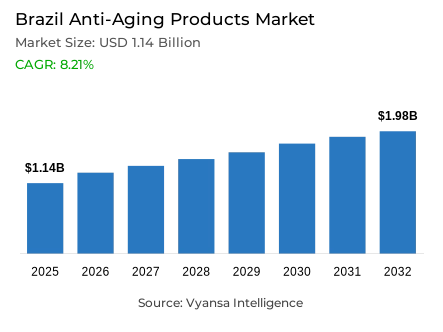
- Anti-aging products market size in Brazil was valued at USD 1.14 billion in 2025 and is estimated at USD 1.23 billion in 2026.
- The market size is expected to grow to USD 1.98 billion by 2032.
- Market to register a CAGR of around 8.21% during 2026-32.
- Product Type Shares
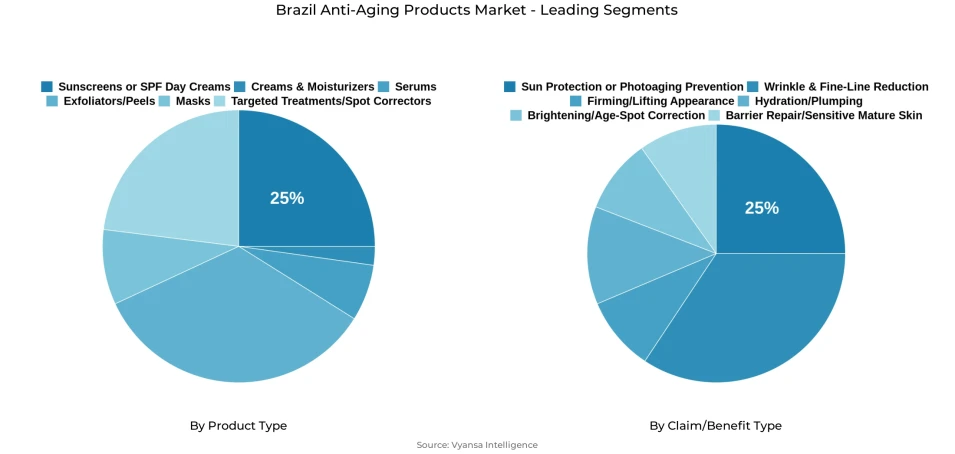
- Sunscreens/spf day creams grabbed market share of 25%.
- Competition
- More than 10 companies are actively engaged in producing anti-aging products in Brazil.
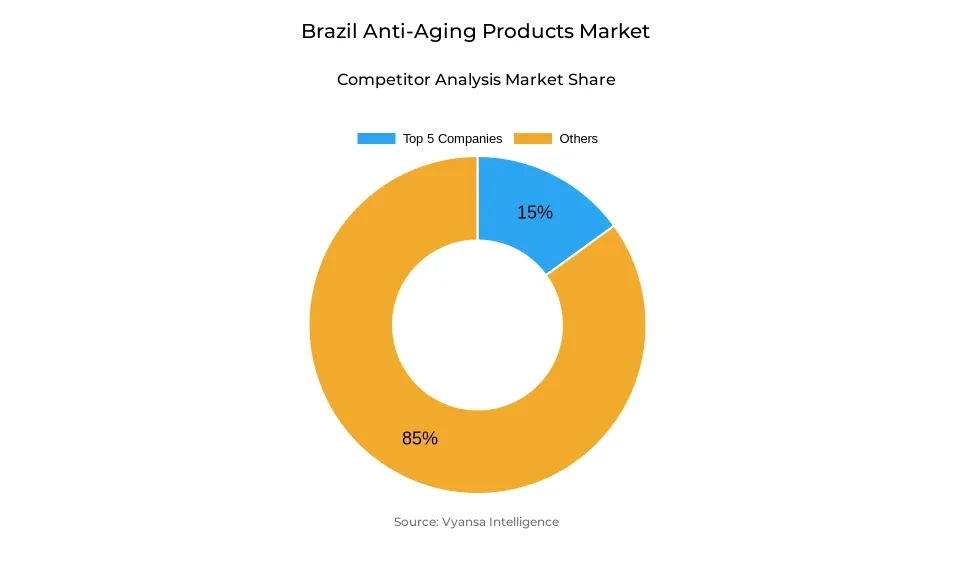
- Top 5 companies acquired around 15% of the market share.
- Shiseido Company Limited , The Estee Lauder Companies Inc. , Natura &Co. , L'Oreal S.A. , JNTL Consumer Health Private Limited etc., are few of the top companies.
- Claim/Benefit Type
- Sun protection/photoaging prevention grabbed 25% of the market.
Brazil Anti-Aging Products Market Outlook
Positioned at USD 1.14 billion valuation during 2025, the Brazil anti-aging products market is advancing from USD 1.23 billion in 2026 toward USD 1.98 billion by 2032, representing 8.21% compound annual growth rate throughout the forecast window. This market expansion reflects steady category growth sustained by rising consumer attention to skincare routines, prevention-led product positioning, and expanded offerings delivering visible daily-use benefits supporting long-term skin maintenance. The anti-aging market continues building momentum through consistent repurchase behavior and strengthened consumer interest in solutions addressing sun protection, collagen support, and age-related skin concerns. Market dynamics are shaped by fundamental demand drivers including pronounced skin cancer prevalence creating prevention awareness, growing digital product discovery enabling informed purchasing, and rising consumer willingness to invest in premium anti-aging skincare addressing visible wrinkle treatment and texture improvement.
Rising consumer awareness around skin cancer prevention establishes foundational market driver sustaining consistent demand for anti-aging skincare products emphasizing protection and early intervention. Statistics from the Ministry of Health indicate that skin cancer represents 30% of all malignant tumors registered in Brazil, creating pronounced public health awareness and consumer concern around prevention behaviors. This disease prevalence maintains consumer focus on protective daily care and products supporting long-term skin maintenance as practical necessities rather than optional indulgences. Evidence from the Ministry of Health reveals that skin cancer cure rate exceeds 90% when discovered early, encouraging preventive skincare adoption and strengthening market relevance for anti-aging market solutions combining age-care positioning with regular protection habits integrated into everyday routines.
Digital connectivity and mobile-first consumer behavior have fundamentally reshaped product discovery and purchasing patterns throughout the anti-aging skincare market. Research from Brazilian Institute of Geography and Statistics (IBGE) demonstrates that internet usage reaches 93.6% of Brazilian households in 2024, encompassing 74.9 million homes, creating comprehensive digital exposure to skincare information and ingredient-led product comparisons. Analysis from IBGE confirms that cellphone possession reaches 97% of households in 2024, establishing near-universal mobile access enabling continuous skincare engagement across product research, review consumption, and online transactions. This digital infrastructure supports faster awareness for new market entries and enables consumers to compare benefits, evaluate claims, and narrow purchasing choices before completing store or e-commerce transactions, democratizing access to product information and supporting performance-driven selection based on substantiated benefits.
Market segmentation demonstrates pronounced consumer preference for practical, multi-benefit anti-aging products addressing visible aging signs while integrating seamlessly into daily skincare routines. Sunscreen and SPF day cream products command 25% market share through superior alignment with consumer preferences for protective formats delivering anti-aging benefits alongside daily UV defense. Products positioned around sun protection and photoaging prevention claim benefits account for 25% of anti-aging market demand, reflecting consumer prioritization of preventive positioning over purely corrective claims. These segmentation patterns indicate that anti-aging market manufacturers must develop offerings balancing protection benefits with visible efficacy claims addressing wrinkle reduction and skin texture improvement to capture share within increasingly sophisticated consumer markets where prevention-focused benefits drive purchasing decisions over single-benefit positioning strategies.
Brazil Anti-Aging Products Market Growth Driver
Sun Protection Awareness Keeps Demand Moving
Skin cancer prevalence and documented prevention efficacy establish powerful market drivers sustaining consumer commitment to protective anti-aging skincare routines and preventive product adoption throughout Brazil. Official records from the Ministry of Health confirm that skin cancer represents 30% of all malignant tumors registered in Brazil, establishing pronounced disease prevalence that creates widespread consumer concern and prevention motivation. This disease burden keeps consumer attention focused on protection, daily defense, and products supporting long-term skin maintenance as medical necessities rather than discretionary beauty purchases. The anti-aging market benefits directly from this health consciousness as consumers increasingly select skincare addressing photoaging prevention and collagen support as integral components of preventive health behavior rather than vanity-driven beauty consumption.
Early intervention success rates amplify consumer motivation for preventive skincare adoption and support market expansion for anti-aging products emphasizing protection and early care habits. Published data from the Ministry of Health reveals that skin cancer cure rates exceed 90% when discovered early, establishing strong incentive for preventive behaviors and encouraging younger demographic adoption of protective anti-aging skincare routines. This documented efficacy of early prevention translates into market demand for anti-aging skincare market products combining age-care positioning with regular sun defense benefits, establishing commercial opportunities for brands positioning wrinkle treatment products and protective creams as preventive health investments. The prevention narrative strengthens market relevance beyond traditional beauty categories by framing anti-aging skincare as health-supporting behavior, enabling premium positioning and sustained consumer engagement throughout extended usage periods.
Brazil Anti-Aging Products Market Challenge
Price Pressure Keeps Trading-Up Limited
Anti-aging market faces demand headwinds from persistent household budget caution that reduces consumer willingness to trade up to premium anti-aging skincare offerings and multi-step skincare regimens. Data from the World Bank indicates that inflation in consumer prices across Brazil stands at 4.4% in 2024, establishing cost pressures that make consumers more selective in discretionary beauty purchases and increase price sensitivity when evaluating premium wrinkle treatment products. This inflationary environment compels consumers to compare prices more carefully before upgrading to higher-value anti-aging market solutions, slowing expansion of premium positioning and constraining brand ability to capture share within price-sensitive consumer segments. The market faces structural pricing pressure where consumers prioritize essential purchases over discretionary anti-aging skincare despite acknowledged benefits of preventive age-care routines and visible efficacy claims.
Labor market conditions and employment uncertainty further constrain consumer confidence in premium anti-aging market spending and limit household capacity for skincare portfolio expansion. Evidence from the World Bank reveals that unemployment in Brazil stands at 6.0% in 2025, establishing economic uncertainty that shapes household spending caution and prioritizes essential categories over premium personal care investments. This employment environment slows repeat purchases of premium creams, serums, and advanced treatment-led anti-aging skincare products, particularly among consumers prioritizing essential household budgets and reducing discretionary spending. For anti-aging market manufacturers, this creates necessity for stronger value communication strategies at shelf and digital channels, requiring clear articulation of visible benefits, efficacy claims, and cost-per-use positioning supporting purchase justification within constrained household budgets facing competing financial demands.
Unlock Market Intelligence
Explore the market potential with our data-driven report
Brazil Anti-Aging Products Market Trend
Digital Discovery Is Reshaping Purchase Behavior
Consumer purchasing behavior demonstrates decisive shift toward digital-first product discovery, comparison, and purchasing decision-making within anti-aging skincare market channels. Market data from IBGE indicates that internet usage reaches 93.6% of Brazilian households in 2024, representing 74.9 million homes and establishing comprehensive digital exposure to skincare research and ingredient-led product information. This broad digital connectivity keeps anti-aging market research highly connected and supports faster consumer movement toward ingredient-focused and claim-led purchasing decisions based on substantiated benefits and transparent product positioning. Consumers increasingly leverage digital channels to compare benefits, examine product details, evaluate customer reviews, and narrow purchasing choices before entering retail environments or completing online transactions, fundamentally restructuring market discovery mechanics away from traditional retail gatekeeping.
Mobile device ubiquity and continuous digital connectivity embed skincare engagement throughout daily consumer routines supporting sustained market awareness and impulse purchasing behavior. Analysis from IBGE reveals that cellphone possession reaches 97% of Brazilian households in 2024, establishing near-universal mobile access enabling continuous engagement across product search, review consumption, social media skincare content, and repeat ordering. This mobile dominance transforms anti-aging skincare market dynamics by supporting faster market awareness for new product launches and enabling brands to present clear visible benefits, simplified claims, and easy-to-understand anti-aging routines through mobile-optimized content and social commerce channels. The mobile-first market environment rewards brands establishing authentic social engagement, transparent ingredient communication, and convenient e-commerce purchase experiences that align with consumer expectations for seamless digital shopping and instant product access.
Brazil Anti-Aging Products Market Opportunity
Premium White Space Opens Through Spending Capacity
Strong opportunities emerge in premium anti-aging skincare market segments combining visible skin benefits with superior textures, protective benefits, and enhanced daily-use positioning targeting affluent and aspirational consumers. Analysis from the World Bank confirms that Brazil GDP per capita reaches USD 10,310.50 in 2024, establishing sufficient household income supporting premium anti-aging market participation and consumer willingness to invest in higher-value skincare addressing visible aging signs. This purchasing power creates commercial opportunity for brands widening premium anti-aging market portfolios, particularly through multi-benefit formulations emphasizing prevention, hydration, and day-use convenience that justify elevated price positioning through demonstrated functional benefits. The market expansion opportunity centers on developing premium offerings delivering perceptible value differentiation and enhanced user experience supporting justification of price premiums relative to mass-market alternatives dominating the anti-aging skincare market.
Household income growth and expanding middle-class consumer base support broader category laddering across masstige and upper-tier anti-aging market segments enabling premiumization strategies. Research from IBGE indicates that per capita household income in Brazil reaches R$ 2,069 in 2024, establishing sufficient income base supporting wider consumer participation in upgraded anti-aging skincare market offerings positioned above entry-level products while remaining accessible to quality-conscious consumers seeking targeted benefits. This income foundation supports anti-aging market brand opportunity to position sophisticated offerings above mass-market alternatives while maintaining appeal to consumers seeking upgraded quality, advanced formulations, and more targeted skincare benefits addressing specific aging concerns. Premiumization opportunities remain among clearest growth pathways for the anti-aging market as consumer segments demonstrate willingness to invest in superior textures, advanced ingredient combinations like collagen beauty products and vitamin-enriched serums, and proven anti-aging skincare solutions delivering visible efficacy outcomes justifying elevated market positioning and premium retail placement.
Unlock Market Intelligence
Explore the market potential with our data-driven report
Brazil Anti-Aging Products Market Segmentation Analysis
By Product Type
- Creams & Moisturizers
- Serums
- Sunscreens/SPF Day Creams
- Exfoliators/Peels
- Masks
- Targeted Treatments/Spot Correctors
Sunscreen and SPF day cream products command market leadership at 25% share within the anti-aging skincare market, establishing clear product type dominance through superior alignment with consumer preferences for protective, multi-benefit formats. This market segment maintains its position as leading anti-aging product type due to strong consumer preference for formats combining visible skin care with daily protective application supporting prevention-focused usage patterns. SPF formulations deliver accessible entry point into premium anti-aging market while maintaining adequate performance for routine daily use, establishing broad appeal across diverse demographic segments and price-conscious consumers seeking combination benefits. Consumer preference for sunscreen anti-aging products reflects both functional necessity of sun protection and commercial appreciation for multi-benefit positioning enabling single product to serve age-care and protective functions within simplified skincare routines.
This market leadership position reflects consumers' continued selection of practical product types supporting daily use integration without requiring specialized application or extended skincare procedures. Sunscreen and SPF day cream formats support repeated daily application, delivering protection benefits alongside anti-aging claims that resonate with health-conscious consumers aware of photoaging prevention importance. The 25% market share indicates that this segment continues shaping anti-aging market development priorities, retail merchandising strategies, and competitive positioning throughout the industry. As e-commerce beauty market channels accelerate and consumers emphasize convenience purchasing, manufacturers maintaining sunscreen anti-aging product leadership and developing formulation innovation within this dominant market category are positioned advantageously to capture growth opportunities through advanced UV protection technology, enhanced moisturization benefits, and premium market positioning supporting category expansion.
By Claim/Benefit Type
- Wrinkle & Fine-Line Reduction
- Firming/Lifting Appearance
- Hydration/Plumping
- Brightening/Age-Spot Correction
- Barrier Repair/Sensitive Mature Skin
- Sun Protection/Photoaging Prevention
Sun protection and photoaging prevention claims command market leadership at 25% share within the anti-aging skincare market claim landscape, establishing clear categorical dominance reflecting consumer prioritization of preventive positioning over purely corrective benefits. This market segment demonstrates that consumers increasingly assign importance to preventive care benefits and actively seek anti-aging products helping reduce visible skin effects linked with daily sun exposure and long-term environmental stress. Consumers across age demographics expect anti-aging market solutions delivering meaningful photoaging prevention benefits, reduced wrinkle appearance, and sustained skin quality through daily protection and early intervention. Research findings indicate that consumers selecting anti-aging market products addressing sun protection demonstrate heightened engagement with functional claims, increased attention to SPF ratings and protective ingredient content, and greater brand loyalty when products consistently deliver visible prevention outcomes throughout extended usage periods.
Product development continues being shaped by benefit-driven requirements as manufacturers introduce claim sophistication supporting prevention-focused differentiation within increasingly competitive anti-aging skincare market environments. Brands formulating prevention-focused anti-aging market offerings emphasize sun protection mechanisms, photoaging prevention substantiation, and collagen support benefits addressing consumer expectations around protective efficacy and visible texture improvement. The 25% market share indicates that this claim segment continues influencing anti-aging market messaging direction, competitive positioning, and product innovation priorities throughout Brazil. As consumer awareness around skin cancer prevention accelerates and younger demographics adopt preventive anti-aging skincare routines, manufacturers maintaining prevention-focused claim leadership and developing product innovation within this expanding market category are positioned to capture sustained demand through clinical substantiation, transparent ingredient communication, and prevention-centered positioning emphasizing health benefits alongside cosmetic improvements supporting category expansion and market growth throughout forecast period.
List of Companies Covered in Brazil Anti-Aging Products Market
The companies listed below are highly influential in the Brazil anti-aging products market, with a significant market share and a strong impact on industry developments.
- Shiseido Company Limited
- The Estee Lauder Companies Inc.
- Natura &Co.
- L'Oreal S.A.
- JNTL Consumer Health Private Limited
- The Procter & Gamble Company
- Beiersdorf AG
- Unilever PLC
- Boticario SA
- DECIEM Beauty Group Inc.
Market News & Updates
- Natura &Co, 2026:
In 2026, Natura continued expanding its anti-aging offer in Brazil. Its official Brazil site promotes the renewed Chronos Derma platform. The range includes age-targeted day and night anti-sign creams. It also includes intensive serums and refill formats. Natura describes Chronos Derma as dermocosmetic innovation for healthier skin. Official product pages highlight actives like bakuchiol, niacinamide, and vitamin C. For Brazil’s anti-aging products market, this matters significantly. It shows Natura is deepening science-led segmentation locally. It also strengthens premium anti-aging positioning through broader routines and claims. These moves can improve consumer retention and category value growth.
- Boticário SA, 2026:
In April 2026, O Boticário highlighted fresh launches on its official site. Its 2026 launches page directs consumers toward skincare nouveautés. The brand’s official Botik pages also emphasize high-performance anti-aging care. These pages feature the new Retinol Puro line prominently. Product pages say the serum reduces deep wrinkles quickly. They also position Botik as dermatologist-approved skincare with Swiss technology. For Brazil’s anti-aging products market, this is highly relevant. It shows Boticário is investing in active-led premium facial care. That can strengthen competition in retinol-based anti-aging treatments across Brazil.
Frequently Asked Questions
Related Report
- Market Segmentation
- Research Scope
- Research Methodology
- Definitions and Assumptions
- Executive Summary
- Brazil Anti-Aging Products Market Policies, Regulations, and Standards
- Brazil Anti-Aging Products Market Dynamics
- Growth Factors
- Challenges
- Trends
- Opportunities
- Brazil Anti-Aging Products Market Statistics, 2022-2032F
- Market Size & Growth Outlook
- By Revenues in USD Million
- Market Segmentation & Growth Outlook
- By Product Type
- Creams & Moisturizers- Market Insights and Forecast 2022-2032, USD Million
- Serums- Market Insights and Forecast 2022-2032, USD Million
- Sunscreens/SPF Day Creams- Market Insights and Forecast 2022-2032, USD Million
- Exfoliators/Peels- Market Insights and Forecast 2022-2032, USD Million
- Masks- Market Insights and Forecast 2022-2032, USD Million
- Targeted Treatments/Spot Correctors- Market Insights and Forecast 2022-2032, USD Million
- By Claim/Benefit Type
- Wrinkle & Fine-Line Reduction- Market Insights and Forecast 2022-2032, USD Million
- Firming/Lifting Appearance- Market Insights and Forecast 2022-2032, USD Million
- Hydration/Plumping- Market Insights and Forecast 2022-2032, USD Million
- Brightening/Age-Spot Correction- Market Insights and Forecast 2022-2032, USD Million
- Barrier Repair/Sensitive Mature Skin- Market Insights and Forecast 2022-2032, USD Million
- Sun Protection/Photoaging Prevention- Market Insights and Forecast 2022-2032, USD Million
- By Sales Channel
- Retail Offline- Market Insights and Forecast 2022-2032, USD Million
- Supermarkets/Hypermarkets- Market Insights and Forecast 2022-2032, USD Million
- Pharmacy/Drugstores- Market Insights and Forecast 2022-2032, USD Million
- Specialty Beauty Stores- Market Insights and Forecast 2022-2032, USD Million
- Department Stores- Market Insights and Forecast 2022-2032, USD Million
- Brand Exclusive Stores- Market Insights and Forecast 2022-2032, USD Million
- Clinics/Salons/Spas- Market Insights and Forecast 2022-2032, USD Million
- Other Offline Retail- Market Insights and Forecast 2022-2032, USD Million
- Retail Online- Market Insights and Forecast 2022-2032, USD Million
- Brand-Owned Websites- Market Insights and Forecast 2022-2032, USD Million
- E-commerce Marketplaces- Market Insights and Forecast 2022-2032, USD Million
- Online Beauty Retailers- Market Insights and Forecast 2022-2032, USD Million
- Online Pharmacy Platforms- Market Insights and Forecast 2022-2032, USD Million
- Social Commerce Platforms- Market Insights and Forecast 2022-2032, USD Million
- Quick Commerce/On-Demand Delivery Platforms- Market Insights and Forecast 2022-2032, USD Million
- Other Online Retail- Market Insights and Forecast 2022-2032, USD Million
- Retail Offline- Market Insights and Forecast 2022-2032, USD Million
- By Ingredient Platform
- Retinoids- Market Insights and Forecast 2022-2032, USD Million
- Hyaluronic Acid- Market Insights and Forecast 2022-2032, USD Million
- Niacinamide- Market Insights and Forecast 2022-2032, USD Million
- Vitamin C- Market Insights and Forecast 2022-2032, USD Million
- Peptides- Market Insights and Forecast 2022-2032, USD Million
- AHAs/BHAs- Market Insights and Forecast 2022-2032, USD Million
- Ceramides- Market Insights and Forecast 2022-2032, USD Million
- Botanical/Natural Actives- Market Insights and Forecast 2022-2032, USD Million
- Others- Market Insights and Forecast 2022-2032, USD Million
- By Age Group
- 18–34 Years- Market Insights and Forecast 2022-2032, USD Million
- 35–54 Years- Market Insights and Forecast 2022-2032, USD Million
- 55 Years & Above- Market Insights and Forecast 2022-2032, USD Million
- By End User
- Women- Market Insights and Forecast 2022-2032, USD Million
- Men- Market Insights and Forecast 2022-2032, USD Million
- Unisex- Market Insights and Forecast 2022-2032, USD Million
- By Price Tier
- Mass- Market Insights and Forecast 2022-2032, USD Million
- Premium- Market Insights and Forecast 2022-2032, USD Million
- By Region
- North- Market Insights and Forecast 2022-2032, USD Million
- Center-West- Market Insights and Forecast 2022-2032, USD Million
- Northeast- Market Insights and Forecast 2022-2032, USD Million
- Southeast- Market Insights and Forecast 2022-2032, USD Million
- South- Market Insights and Forecast 2022-2032, USD Million
- By Competitors
- Competition Characteristics
- Market Share & Analysis
- By Product Type
- Market Size & Growth Outlook
- Brazil Creams & Moisturizers Market Statistics, 2022-2032
- Market Size & Growth Outlook
- By Revenues in USD Million
- Market Segmentation & Growth Outlook
- By Claim/Benefit Type- Market Insights and Forecast 2022-2032, USD Million
- By Sales Channel- Market Insights and Forecast 2022-2032, USD Million
- By Ingredient Platform- Market Insights and Forecast 2022-2032, USD Million
- By Age Group- Market Insights and Forecast 2022-2032, USD Million
- By End User- Market Insights and Forecast 2022-2032, USD Million
- By Price Tier- Market Insights and Forecast 2022-2032, USD Million
- By Region- Market Insights and Forecast 2022-2032, USD Million
- Market Size & Growth Outlook
- Brazil Serums Market Statistics, 2022-2032
- Market Size & Growth Outlook
- By Revenues in USD Million
- Market Segmentation & Growth Outlook
- By Claim/Benefit Type- Market Insights and Forecast 2022-2032, USD Million
- By Sales Channel- Market Insights and Forecast 2022-2032, USD Million
- By Ingredient Platform- Market Insights and Forecast 2022-2032, USD Million
- By Age Group- Market Insights and Forecast 2022-2032, USD Million
- By End User- Market Insights and Forecast 2022-2032, USD Million
- By Price Tier- Market Insights and Forecast 2022-2032, USD Million
- By Region- Market Insights and Forecast 2022-2032, USD Million
- Market Size & Growth Outlook
- Brazil Sunscreens/SPF Day Creams Market Statistics, 2022-2032
- Market Size & Growth Outlook
- By Revenues in USD Million
- Market Segmentation & Growth Outlook
- By Claim/Benefit Type- Market Insights and Forecast 2022-2032, USD Million
- By Sales Channel- Market Insights and Forecast 2022-2032, USD Million
- By Ingredient Platform- Market Insights and Forecast 2022-2032, USD Million
- By Age Group- Market Insights and Forecast 2022-2032, USD Million
- By End User- Market Insights and Forecast 2022-2032, USD Million
- By Price Tier- Market Insights and Forecast 2022-2032, USD Million
- By Region- Market Insights and Forecast 2022-2032, USD Million
- Market Size & Growth Outlook
- Brazil Exfoliators/Peels Market Statistics, 2022-2032
- Market Size & Growth Outlook
- By Revenues in USD Million
- Market Segmentation & Growth Outlook
- By Claim/Benefit Type- Market Insights and Forecast 2022-2032, USD Million
- By Sales Channel- Market Insights and Forecast 2022-2032, USD Million
- By Ingredient Platform- Market Insights and Forecast 2022-2032, USD Million
- By Age Group- Market Insights and Forecast 2022-2032, USD Million
- By End User- Market Insights and Forecast 2022-2032, USD Million
- By Price Tier- Market Insights and Forecast 2022-2032, USD Million
- By Region- Market Insights and Forecast 2022-2032, USD Million
- Market Size & Growth Outlook
- Brazil Masks Market Statistics, 2022-2032
- Market Size & Growth Outlook
- By Revenues in USD Million
- Market Segmentation & Growth Outlook
- By Claim/Benefit Type- Market Insights and Forecast 2022-2032, USD Million
- By Sales Channel- Market Insights and Forecast 2022-2032, USD Million
- By Ingredient Platform- Market Insights and Forecast 2022-2032, USD Million
- By Age Group- Market Insights and Forecast 2022-2032, USD Million
- By End User- Market Insights and Forecast 2022-2032, USD Million
- By Price Tier- Market Insights and Forecast 2022-2032, USD Million
- By Region- Market Insights and Forecast 2022-2032, USD Million
- Market Size & Growth Outlook
- Brazil Targeted Treatments/Spot Correctors Market Statistics, 2022-2032
- Market Size & Growth Outlook
- By Revenues in USD Million
- Market Segmentation & Growth Outlook
- By Claim/Benefit Type- Market Insights and Forecast 2022-2032, USD Million
- By Sales Channel- Market Insights and Forecast 2022-2032, USD Million
- By Ingredient Platform- Market Insights and Forecast 2022-2032, USD Million
- By Age Group- Market Insights and Forecast 2022-2032, USD Million
- By End User- Market Insights and Forecast 2022-2032, USD Million
- By Price Tier- Market Insights and Forecast 2022-2032, USD Million
- By Region- Market Insights and Forecast 2022-2032, USD Million
- Market Size & Growth Outlook
- Competitive Outlook
- Company Profiles
- L'Oreal S.A.
- Business Description
- Product Portfolio
- Collaborations & Alliances
- Recent Developments
- Financial Details
- Others
- JNTL Consumer Health Private Limited
- Business Description
- Product Portfolio
- Collaborations & Alliances
- Recent Developments
- Financial Details
- Others
- The Procter & Gamble Company
- Business Description
- Product Portfolio
- Collaborations & Alliances
- Recent Developments
- Financial Details
- Others
- Beiersdorf AG
- Business Description
- Product Portfolio
- Collaborations & Alliances
- Recent Developments
- Financial Details
- Others
- Unilever PLC
- Business Description
- Product Portfolio
- Collaborations & Alliances
- Recent Developments
- Financial Details
- Others
- Shiseido Company Limited
- Business Description
- Product Portfolio
- Collaborations & Alliances
- Recent Developments
- Financial Details
- Others
- The Estee Lauder Companies Inc.
- Business Description
- Product Portfolio
- Collaborations & Alliances
- Recent Developments
- Financial Details
- Others
- Natura &Co.
- Business Description
- Product Portfolio
- Collaborations & Alliances
- Recent Developments
- Financial Details
- Others
- Boticario SA
- Business Description
- Product Portfolio
- Collaborations & Alliances
- Recent Developments
- Financial Details
- Others
- DECIEM Beauty Group Inc.
- Business Description
- Product Portfolio
- Collaborations & Alliances
- Recent Developments
- Financial Details
- Others
- L'Oreal S.A.
- Company Profiles
- Disclaimer
| Segment | Sub-Segment |
|---|---|
| By Product Type |
|
| By Claim/Benefit Type |
|
| By Sales Channel |
|
| By Ingredient Platform |
|
| By Age Group |
|
| By End User |
|
| By Price Tier |
|
| By Region |
|
Research Methodology
This study followed a structured approach comprising four key phases to assess the size and scope of the electro-oxidation market. The process began with thorough secondary research to collect data on the target market, related markets, and broader industry context. These findings, along with preliminary assumptions and estimates, were then validated through extensive primary research involving industry experts from across the value chain. To calculate the overall market size, both top-down and bottom-up methodologies were employed. Finally, market segmentation and data triangulation techniques were applied to refine and validate segment-level estimations.
Secondary Research
The secondary research phase involved gathering data from a wide range of credible and published sources. This step helped in identifying industry trends, defining market segmentation, and understanding the market landscape and value chain.
Sources consulted during this phase included:
- Company annual reports, investor presentations, and press releases
- Industry white papers and certified publications
- Trade directories and market-recognized databases
- Articles from authoritative authors and reputable journals
- Gold and silver standard websites
Secondary research was critical in mapping out the industry's value chain and monetary flow, identifying key market segments, understanding regional variations, and tracking significant industry developments.
Other key sources:
- Financial disclosures
- Industry associations and trade bodies
- News outlets and business magazines
- Academic journals and research studies
- Paid industry databases
Primary Research
To validate secondary data and gain deeper market insights, primary research was conducted with key stakeholders across both the supply and demand sides of the market.
On the demand side, participants included decision-makers and influencers from end-user industries—such as CIOs, CTOs, and CSOs—who provided first-hand perspectives on market needs, product usage, and future expectations.
On the supply side, interviews were conducted with manufacturers, industry associations, and institutional participants to gather insights into current offerings, product pipelines, and market challenges.
Primary interviews provided critical inputs such as:
- Market size and revenue data
- Product and service breakdowns
- Market forecasts
- Regional and application-specific trends
Stakeholders consulted included:
- Leading OEM and solution providers
- Channel and distribution partners
- End users across various applications
- Independent consultants and industry specialists
Market Size Estimation and Data Triangulation
- Identifying Key Market Participants (Secondary Research)
- Goal: To identify the major players or companies in the target market. This typically involves using publicly available data sources such as industry reports, market research publications, and financial statements of companies.
- Tools: Reports from firms like Gartner, Forrester, Euromonitor, Statista, IBISWorld, and others. Public financial statements, news articles, and press releases from top market players.
- Extracting Earnings of Key Market Participants
- Goal: To estimate the earnings generated from the product or service being analyzed. This step helps in understanding the revenue potential of each market player in a specific geography.
- Methods: Earnings data can be gathered from:
- Publicly available financial reports (for listed companies).
- Interviews and primary data sources from professionals, such as Directors, VPs, SVPs, etc. This is especially useful for understanding more nuanced, internal data that isn't publicly disclosed.
- Annual reports and investor presentations of key players.
- Data Collation and Development of a Relevant Data Model
- Goal: To collate inputs from both primary and secondary sources into a structured, data-driven model for market estimation. This model will incorporate key market KPIs and any independent variables relevant to the market.
- Key KPIs: These could include:
- Market size, growth rate, and demand drivers.
- Industry-specific metrics like market share, average revenue per customer (ARPC), or average deal size.
- External variables, such as economic growth rates, inflation rates, or commodity prices, that could affect the market.
- Data Modeling: Based on this data, the market forecasts are developed for the next 5 years. A combination of trend analysis, scenario modeling, and statistical regression might be used to generate projections.
- Scenario Analysis
- Goal: To test different assumptions and validate how sensitive the market is to changes in key variables (e.g., market demand, regulatory changes, technological disruptions).
- Types of Scenarios:
- Base Case: Based on current assumptions and historical data.
- Best-Case Scenario: Assuming favorable market conditions, regulatory environments, and technological advancements.
- Worst-Case Scenario: Accounting for adverse factors, such as economic downturns, stricter regulations, or unexpected disruptions.












