Bolivia Weight Management and Wellbeing Market Report: Trends, Growth and Forecast (2026-2032)
By Category (Meal Replacement Products (Shakes, Bars, Ready-to-Drink (RTD) Beverages, Powder Mixes), OTC Obesity Products (Fat Absorption Inhibitors, Appetite Suppressants, Metabolism Boosters), Supplement Nutrition Drinks, Slimming Teas, Weight Loss Supplements), By Application (Obesity Management, Diabetes-Associated Weight Control, Cardiovascular Risk Reduction, Post-Bariatric Surgery Weight Maintenance, General Fitness & Lifestyle Weight Control), By End User (Hospitals, Specialty & Bariatric Clinics, Weight Loss Centers, Homecare/Individual Consumers), By Sales Channel (Retail Offline (Pharmacies & Drug Stores, Supermarkets/Hypermarkets, Specialty Nutrition Stores), Retail Online (E-commerce Platforms, Brand-Owned Websites)) ... Read more
|
Major Players
|
Bolivia Weight Management and Wellbeing Market Statistics and Insights, 2026
- Market Size Statistics
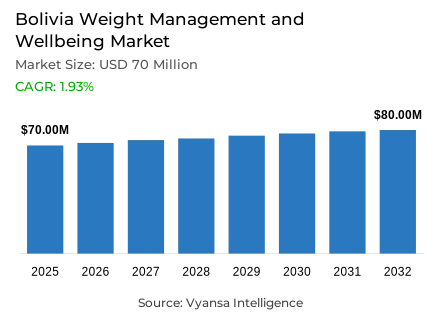
- Weight management and wellbeing market size in Bolivia was estimated at USD 70 million in 2025.
- The market size is expected to grow to USD 80 million by 2032.
- Market to register a CAGR of around 1.93% during 2026-32.
- Category Shares
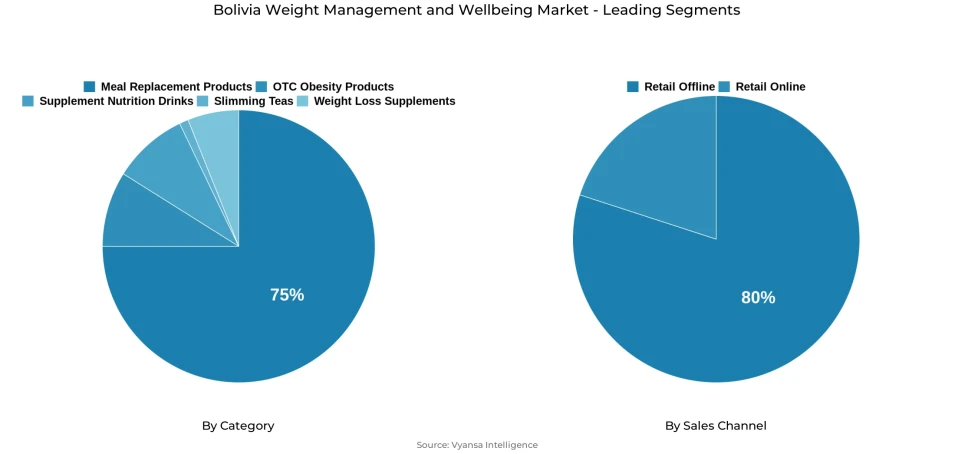
- Meal replacement products grabbed market share of 75%.
- Competition
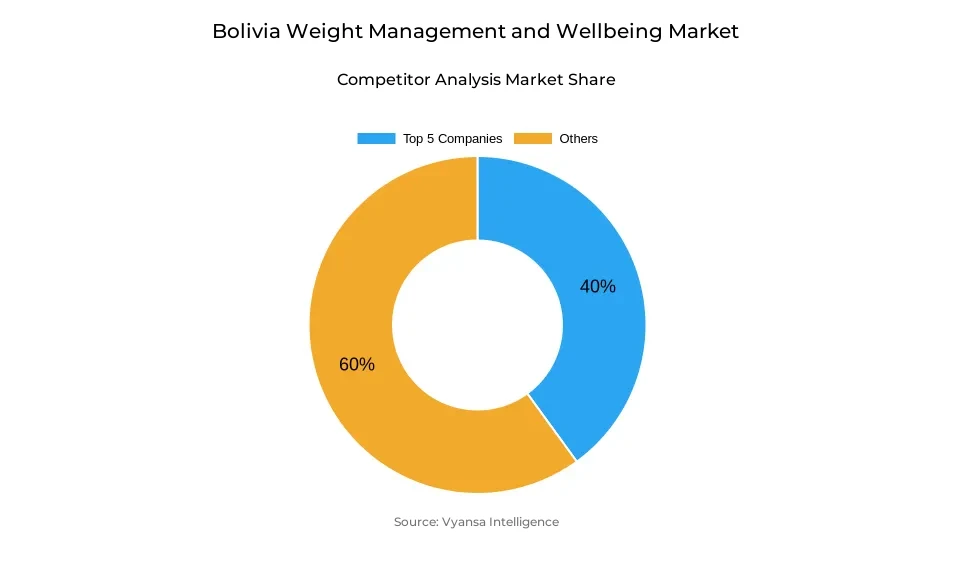
- More than 5 companies are actively engaged in producing weight management and wellbeing in Bolivia.
- Top 5 companies acquired around 40% of the market share.
- Promedical SA, Omnilife de Bolivia SA, Prolife Bolivia, Herbalife Bolivia Ltda, Pharmatech Boliviana SA etc., are few of the top companies.
- Sales Channel
- Retail offline grabbed 80% of the market.
Bolivia Weight Management and Wellbeing Market Outlook
The Bolivia weight management and wellbeing market size was valued at USD 70 million in 2025 and is projected to grow from USD 71.4 million in 2026 to USD 80 million by 2032, registering a CAGR of around 1.93% during 2026–2032. In 2026, an ageing profile supports steady demand for products positioned around recovery, restricted diets, and everyday nourishment; people aged 65+ account for 5.64% of the total population, widening the pool that typically prefers functional nutrition over aesthetic “rapid slimming” claims. This demographic shift sustains spending within weight management and wellbeing categories focused on balanced intake and practical daily use.
A key challenge in 2026 is affordability pressure under elevated inflation. Bolivia closes December 2025 with 20.40% accumulated inflation, and January 2026 ended at 19.64% year-on-year, keeping consumers highly price sensitive and accelerating trade-down to smaller packs and lower-priced alternatives. In this environment, discretionary slimming products face tighter baskets and more substitution toward essential healthcare spending.
A clear trend is that digitalisation increasingly shapes discovery and price checking as payments become easier, especially through QR-led routines. As QR transactions expand rapidly through 2024–2025, digital touchpoints influence product comparison and repeat purchases even when fulfilment remains mixed between online and offline.
A practical opportunity lies in repositioning products around “functional everyday health” and offering value-led pack sizes suited to constrained budgets. From a segmentation perspective, meal replacement products hold the highest share at 75%, reflecting demand for structured, routine-friendly nutrition. By sales channel, retail offline leads with 80%, anchored by trust-based purchasing through pharmacies and supermarkets despite rising digital engagement.
Bolivia Weight Management and Wellbeing Market Growth DriverHealth-Focused Nutrition Needs Strengthen Core Demand
Bolivia’s ageing profile keeps demand steady for products positioned around recovery, restricted diets, and day-to-day nourishment. In 2024, people aged 65+ account for 5.64% of the total population, expanding the pool of consumers who typically seek convenient, functional nutrition rather than aesthetic weight-loss claims.
This supports weight management and wellness purchases that emphasise balanced intake and practical use cases like post-surgery recovery, low-appetite routines, or diet limitations. Across pharmacy-led assortments, positioning centered on “complete nutrition” demonstrates stronger resonance among older consumer cohorts compared to “rapid slimming” claims; consequently, brands emphasizing clinically relevant and function-driven benefits exhibit greater resilience in 2026.
Bolivia Weight Management and Wellbeing Market ChallengeInflation-Driven Affordability Squeeze on Imported Products
The rising inflation is pressing prices from all sides, particularly on imported products or those related to costs that increase transactions and logistics. By the end of 2025, Bolivia recorded an annual inflation rate of 20.40%, and as January 2026 began, the year-over-year inflation rate was 19.64%. This sudden rise has made consumers extremely sensitive to all prices.
Under such circumstances, consumers are giving utmost priority to necessary healthcare spending and are postponing unnecessary purchases. This tendency affects weight loss supplements and slimming teas the most. Even if consumers are looking to make “health upgrades,” the bottom line is that consumers are buying less, with smaller packs and more switching to local, lower-priced alternatives, making it increasingly difficult to maintain import-intensive product lines in 2026.
Unlock Market Intelligence
Explore the market potential with our data-driven report
Bolivia Weight Management and Wellbeing Market TrendQR-Led Digital Payments Expand How People Buy
Digitalisation is becoming more practical because payments are getting easier, not just because consumers “like” online shopping. Bolivia’s QR payment value multiplies by 48 between 2021 and 2024, reaching USD 22.64 billion in 2024; in January 2025, QR payments reach USD 2.88 billion, equal to 27% of electronic fund transfer orders by value.
This payment shift supports more online discovery, price comparison, and home delivery for health products—especially through pharmacy platforms and distributor-led social commerce. On the ground, easier QR checkout reduces friction for partially banked buyers, so digital touchpoints increasingly influence product choice even when fulfilment stays mixed across channels.
Bolivia Weight Management and Wellbeing Market OpportunityValue-Tier, Functional Positioning Can Win Back Buyers
A clear opportunity sits in repositioning products around “functional everyday health” and designing value packs that fit today’s budgets. Inflation remains elevated into 2026, so brands that simplify claims, keep formats practical, and compete on affordability are better aligned with current buying behaviour.
At the same time, fast-growing QR payments make it easier to distribute these value-led, function-first items through pharmacy e-commerce, marketplaces, and social selling with transparent pricing. When brands combine clear nutritional purpose (energy, digestion, recovery) with accessible pack sizes and broad availability, they can regain relevance among consumers who are deprioritising purely aesthetic weight-loss routines.
Unlock Market Intelligence
Explore the market potential with our data-driven report
Bolivia Weight Management and Wellbeing Market Segmentation Analysis
By Category
- Meal Replacement Products
- OTC Obesity Products
- Supplement Nutrition Drinks
- Slimming Teas
- Weight Loss Supplements
The segment that has the highest share under the category is meal replacement products, and this highest market share is 75%. This reflects how consumers concentrate spending on products that feel more “complete” and routine-friendly, especially when they want convenience and clearer use instructions.
Other categories like slimming teas and weight-loss supplements remain present, but they tend to be more sensitive to price jumps and shifting priorities. In practice, meal replacements benefit from structured usage (daily shakes, defined portions) and clearer functional cues, which helps maintain repeat purchase even when consumers trade down on pack size.
By Sales Channel
- Retail Offline
- Retail Online
The segment that has the highest share under the sales channel is retail offline, and this highest market share is 80%. Offline strength is tied to trust-led buying—pharmacies, supermarkets, and traditional outlets provide visibility and reassurance on authenticity and usage.
Retail online grows as a convenience layer, particularly for repeat buys and promo-led purchasing, but offline remains the anchor because many consumers still prefer in-person advice and immediate availability. As a result, the channel mix stays weighted to offline retail, with digital touchpoints increasingly supporting discovery and price checking.
List of Companies Covered in Bolivia Weight Management and Wellbeing Market
The companies listed below are highly influential in the Bolivia weight management and wellbeing market, with a significant market share and a strong impact on industry developments.
- Promedical SA
- Omnilife de Bolivia SA
- Prolife Bolivia
- Herbalife Bolivia Ltda
- Pharmatech Boliviana SA
- Naturaleza SA
- Laboratorio y Herboristeria Santa Margarita SA
Competitive Landscape
The competitive landscape in Bolivia remains highly concentrated, led by Herbalife Bolivia Ltda, which holds a dominant 31.9% value share in 2025. Herbalife sustains its leadership through a strong direct selling model supported by an extensive distributor network that provides personalized guidance and post-purchase engagement—an important factor in maintaining repeat consumption in a trust-driven category. The company also reinforces its position through ongoing product innovation, including new flavour extensions within its nutritional shake and protein portfolio. In comparison, Pharmatech Boliviana SA holds a significantly smaller 4% share, positioning it as a secondary player. While Pharmatech maintains visibility in the supplement space, it operates in a market environment marked by price sensitivity and import constraints, limiting rapid scale expansion relative to the dominant direct selling leader.
Frequently Asked Questions
Related Report
- Market Segmentation
- Research Scope
- Research Methodology
- Definitions and Assumptions
- Executive Summary
- Bolivia Weight Management and Wellbeing Market Policies, Regulations, and Standards
- Bolivia Weight Management and Wellbeing Market Dynamics
- Growth Factors
- Challenges
- Trends
- Opportunities
- Bolivia Weight Management and Wellbeing Market Statistics, 2022-2032F
- Market Size & Growth Outlook
- By Revenues in USD Million
- Market Segmentation & Growth Outlook
- By Category
- Meal Replacement Products- Market Insights and Forecast 2022-2032, USD Million
- Shakes- Market Insights and Forecast 2022-2032, USD Million
- Bars- Market Insights and Forecast 2022-2032, USD Million
- Ready-to-Drink (RTD) Beverages- Market Insights and Forecast 2022-2032, USD Million
- Powder Mixes- Market Insights and Forecast 2022-2032, USD Million
- OTC Obesity Products- Market Insights and Forecast 2022-2032, USD Million
- Fat Absorption Inhibitors- Market Insights and Forecast 2022-2032, USD Million
- Appetite Suppressants- Market Insights and Forecast 2022-2032, USD Million
- Metabolism Boosters- Market Insights and Forecast 2022-2032, USD Million
- Supplement Nutrition Drinks- Market Insights and Forecast 2022-2032, USD Million
- Slimming Teas- Market Insights and Forecast 2022-2032, USD Million
- Weight Loss Supplements- Market Insights and Forecast 2022-2032, USD Million
- Meal Replacement Products- Market Insights and Forecast 2022-2032, USD Million
- By Application
- Obesity Management- Market Insights and Forecast 2022-2032, USD Million
- Diabetes-Associated Weight Control- Market Insights and Forecast 2022-2032, USD Million
- Cardiovascular Risk Reduction- Market Insights and Forecast 2022-2032, USD Million
- Post-Bariatric Surgery Weight Maintenance- Market Insights and Forecast 2022-2032, USD Million
- General Fitness & Lifestyle Weight Control- Market Insights and Forecast 2022-2032, USD Million
- By End User
- Hospitals- Market Insights and Forecast 2022-2032, USD Million
- Specialty & Bariatric Clinics- Market Insights and Forecast 2022-2032, USD Million
- Weight Loss Centers- Market Insights and Forecast 2022-2032, USD Million
- Homecare/Individual Consumers- Market Insights and Forecast 2022-2032, USD Million
- By Sales Channel
- Retail Offline- Market Insights and Forecast 2022-2032, USD Million
- Pharmacies & Drug Stores- Market Insights and Forecast 2022-2032, USD Million
- Supermarkets/Hypermarkets- Market Insights and Forecast 2022-2032, USD Million
- Specialty Nutrition Stores- Market Insights and Forecast 2022-2032, USD Million
- Retail Online- Market Insights and Forecast 2022-2032, USD Million
- E-commerce Platforms- Market Insights and Forecast 2022-2032, USD Million
- Brand-Owned Websites- Market Insights and Forecast 2022-2032, USD Million
- Retail Offline- Market Insights and Forecast 2022-2032, USD Million
- By Competitors
- Competition Characteristics
- Market Share & Analysis
- By Category
- Market Size & Growth Outlook
- Bolivia Meal Replacement Products Market Statistics, 2022-2032
- Market Size & Growth Outlook
- By Revenues in USD Million
- Market Segmentation & Growth Outlook
- By Application- Market Insights and Forecast 2022-2032, USD Million
- By End User- Market Insights and Forecast 2022-2032, USD Million
- By Sales Channel- Market Insights and Forecast 2022-2032, USD Million
- Market Size & Growth Outlook
- Bolivia OTC Obesity Products Market Statistics, 2022-2032
- Market Size & Growth Outlook
- By Revenues in USD Million
- Market Segmentation & Growth Outlook
- By Application- Market Insights and Forecast 2022-2032, USD Million
- By End User- Market Insights and Forecast 2022-2032, USD Million
- By Sales Channel- Market Insights and Forecast 2022-2032, USD Million
- Market Size & Growth Outlook
- Bolivia Supplement Nutrition Drinks Market Statistics, 2022-2032
- Market Size & Growth Outlook
- By Revenues in USD Million
- Market Segmentation & Growth Outlook
- By Application- Market Insights and Forecast 2022-2032, USD Million
- By End User- Market Insights and Forecast 2022-2032, USD Million
- By Sales Channel- Market Insights and Forecast 2022-2032, USD Million
- Market Size & Growth Outlook
- Bolivia Slimming Teas Market Statistics, 2022-2032
- Market Size & Growth Outlook
- By Revenues in USD Million
- Market Segmentation & Growth Outlook
- By Application- Market Insights and Forecast 2022-2032, USD Million
- By End User- Market Insights and Forecast 2022-2032, USD Million
- By Sales Channel- Market Insights and Forecast 2022-2032, USD Million
- Market Size & Growth Outlook
- Bolivia Weight Loss Supplements Market Statistics, 2022-2032
- Market Size & Growth Outlook
- By Revenues in USD Million
- Market Segmentation & Growth Outlook
- By Application- Market Insights and Forecast 2022-2032, USD Million
- By End User- Market Insights and Forecast 2022-2032, USD Million
- By Sales Channel- Market Insights and Forecast 2022-2032, USD Million
- Market Size & Growth Outlook
- Competitive Outlook
- Company Profiles
- Herbalife Bolivia Ltda
- Business Description
- Product Portfolio
- Collaborations & Alliances
- Recent Developments
- Financial Details
- Others
- Pharmatech Boliviana SA
- Business Description
- Product Portfolio
- Collaborations & Alliances
- Recent Developments
- Financial Details
- Others
- Promedical SA
- Business Description
- Product Portfolio
- Collaborations & Alliances
- Recent Developments
- Financial Details
- Others
- Omnilife de Bolivia SA
- Business Description
- Product Portfolio
- Collaborations & Alliances
- Recent Developments
- Financial Details
- Others
- Prolife Bolivia
- Business Description
- Product Portfolio
- Collaborations & Alliances
- Recent Developments
- Financial Details
- Others
- Naturaleza SA
- Business Description
- Product Portfolio
- Collaborations & Alliances
- Recent Developments
- Financial Details
- Others
- Laboratorio Y
- Business Description
- Product Portfolio
- Collaborations & Alliances
- Recent Developments
- Financial Details
- Others
- Others
- Business Description
- Product Portfolio
- Collaborations & Alliances
- Recent Developments
- Financial Details
- Others
- Herbalife Bolivia Ltda
- Company Profiles
- Disclaimer
| Segment | Sub-Segment |
|---|---|
| By Category |
|
| By Application |
|
| By End User |
|
| By Sales Channel |
|
Research Methodology
This study followed a structured approach comprising four key phases to assess the size and scope of the electro-oxidation market. The process began with thorough secondary research to collect data on the target market, related markets, and broader industry context. These findings, along with preliminary assumptions and estimates, were then validated through extensive primary research involving industry experts from across the value chain. To calculate the overall market size, both top-down and bottom-up methodologies were employed. Finally, market segmentation and data triangulation techniques were applied to refine and validate segment-level estimations.
Secondary Research
The secondary research phase involved gathering data from a wide range of credible and published sources. This step helped in identifying industry trends, defining market segmentation, and understanding the market landscape and value chain.
Sources consulted during this phase included:
- Company annual reports, investor presentations, and press releases
- Industry white papers and certified publications
- Trade directories and market-recognized databases
- Articles from authoritative authors and reputable journals
- Gold and silver standard websites
Secondary research was critical in mapping out the industry's value chain and monetary flow, identifying key market segments, understanding regional variations, and tracking significant industry developments.
Other key sources:
- Financial disclosures
- Industry associations and trade bodies
- News outlets and business magazines
- Academic journals and research studies
- Paid industry databases
Primary Research
To validate secondary data and gain deeper market insights, primary research was conducted with key stakeholders across both the supply and demand sides of the market.
On the demand side, participants included decision-makers and influencers from end-user industries—such as CIOs, CTOs, and CSOs—who provided first-hand perspectives on market needs, product usage, and future expectations.
On the supply side, interviews were conducted with manufacturers, industry associations, and institutional participants to gather insights into current offerings, product pipelines, and market challenges.
Primary interviews provided critical inputs such as:
- Market size and revenue data
- Product and service breakdowns
- Market forecasts
- Regional and application-specific trends
Stakeholders consulted included:
- Leading OEM and solution providers
- Channel and distribution partners
- End users across various applications
- Independent consultants and industry specialists
Market Size Estimation and Data Triangulation
- Identifying Key Market Participants (Secondary Research)
- Goal: To identify the major players or companies in the target market. This typically involves using publicly available data sources such as industry reports, market research publications, and financial statements of companies.
- Tools: Reports from firms like Gartner, Forrester, Euromonitor, Statista, IBISWorld, and others. Public financial statements, news articles, and press releases from top market players.
- Extracting Earnings of Key Market Participants
- Goal: To estimate the earnings generated from the product or service being analyzed. This step helps in understanding the revenue potential of each market player in a specific geography.
- Methods: Earnings data can be gathered from:
- Publicly available financial reports (for listed companies).
- Interviews and primary data sources from professionals, such as Directors, VPs, SVPs, etc. This is especially useful for understanding more nuanced, internal data that isn't publicly disclosed.
- Annual reports and investor presentations of key players.
- Data Collation and Development of a Relevant Data Model
- Goal: To collate inputs from both primary and secondary sources into a structured, data-driven model for market estimation. This model will incorporate key market KPIs and any independent variables relevant to the market.
- Key KPIs: These could include:
- Market size, growth rate, and demand drivers.
- Industry-specific metrics like market share, average revenue per customer (ARPC), or average deal size.
- External variables, such as economic growth rates, inflation rates, or commodity prices, that could affect the market.
- Data Modeling: Based on this data, the market forecasts are developed for the next 5 years. A combination of trend analysis, scenario modeling, and statistical regression might be used to generate projections.
- Scenario Analysis
- Goal: To test different assumptions and validate how sensitive the market is to changes in key variables (e.g., market demand, regulatory changes, technological disruptions).
- Types of Scenarios:
- Base Case: Based on current assumptions and historical data.
- Best-Case Scenario: Assuming favorable market conditions, regulatory environments, and technological advancements.
- Worst-Case Scenario: Accounting for adverse factors, such as economic downturns, stricter regulations, or unexpected disruptions.












